Omega: Jurnal Fisika dan Pendidikan Fisika3(2), 40 - 46 (2017) (Journal of Physics and Physics Education)
Resonance Contributions to
η
Photoproduction on the Nucleon in the
Isobaric Model
Feli Cianda Adrin Burhendi
Physics Education Study Programme, Universitas Muhammadiyah Prof. DR. HAMKA Jl. Tanah Merdeka, Jakarta 13830, Indonesia
(Received 11 July 2017; published 29 November 2017)
Abstract
The contributions of the resonancesS11(1535),S11(1650), and P11(1710) to gamma nucleon→eta nucleon are found. In order to estimate model dependence of the obtained resonance characteristics, an isobaric models used for analysis. For the resonances considered, our analysis yields mass values compatible with those advocated by the Particle Data Group. We emphasise, however, that cross-section data alone are unable to pin down the resonance parameters and it is shown that the beam and or target asymmetries impose more stringent constraints on these parameter values. The amplitude transitions of Feynman diagrams at the center of mass frame used to find amplitude squares involving the s-channel, u-channel, and t-channel on Born term and resonance. The value of the differential cross section on the energy system used by 1.685 MeV up to 2.795 MeV.
c
2017 The Author. Published by Pendidikan Fisika UHAMKA
Keywords: photoproduction, resonances, amplitude transitions
Corresponding author. E-mail address: [email protected]
Introduction
Understanding the structure of the proton and its excited states is one of the key questions in hadronic physics. Known as the missing-baryon problem, quark models based on three constituent quark degrees of freedom predict many more states than have been observed experimentally. Baryon resonances are broad and widely overlap, especially at higher energies, imposing challenges on the in-terpretation of experimental data in terms of res-onance contributions. Without precise data from many decay channels, it will be difficult or even im-possible to accurately determine the properties of well-established resonances, or to confirm or rule out the existence of weakly established resonances or new, so far unobserved states [1].
Although theoretical research in the field of par-ticle physics has reached the standard model, the
current model is believed to be a theory that ex-plains the interaction between the constituent par-ticles of matter, quarks and leptons, with the inter-mediate particles of the interinter-mediate bosons (gauge boson), but there are still many phenomena in the field of particle physics that can not be fully ex-plained.
The meson particles η were discovered in 1961 by Pevsner [3]. The meson particles η represent isospin with condition 0, so only resonance with isospin 1
2 contributes to the s-channel and u. Since
the η particle has a neutral charge, it causes the seagull term that has an important role in meson production does not contribute anything. Thus, there is an interesting interest in the meson phe-notypeη, both theoretically and experimentally.
In general, Mainz group data provides informa-tion about the more systematic nature of the pro-duction ofη at the threshold area, which has better angular resolution allowing us to study the more
S11(1535) resonance structure good. Thus, the η
particle is interesting to note that the amplitude amplitudeAP1
2 extracted from Mainz data [4] gives
closer results to the quark model [5,6]. From theo-retical side, the theotheo-retical study on theη fotopro-duction almost corresponds to the Breit-Wigner pa-rameterisation framework [7] or isobar model with the coupled channel [8].
Methods
Eta belongs to the meson group because it is a combination of a quark and antiquark. Where, eta is a composite of one quark strange and one antiquark up or down, or one antiquark strange and one quark up or down. Eta has a mass of 1070 times the mass of an electron, with a silent mass 547.862±0.018 MeV/c2
, and average life time (5.02±0.19)×10−19s, and is a zero-loaded
elemen-tary particle type. The quantities required in the calculations are shown in Table1.
Table 1: The particle properties were reviewed in the study. magnetic moment, spin, total spin, parity, and isospin, respectively.
The isobar model is often used to analyse the process of eta photoproduction produced from neu-trons. The reason, this model is easier to use for the production of nuclei. This method is based on a Feynman Diagram appropriate for the s-, u-, t-, and resonances channels with an unknown param-eter to match the model generated by the experi-mental data. In this case, the calculation process in the η meson photoproduction reaction uses rel-ativistic kinematics. The general reaction equation corresponding to this study is
γ(k) +N(p1)→η(q) +N(p2) (1)
for next of the above equation we will consistently use k1, k2, p1, andp2 respectively as the four
mo-mentum of the incoming real photons,η generated, the initial state nucleons and nucleons in the final state.
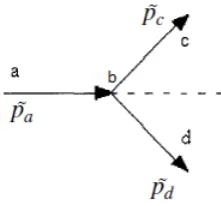
In explaining the mechanisms for the particle interaction process we use two terms of reference. The first frame of reference is the central mass frame where both particles are moving at the same speed but in opposite directions so that the total momen-tum in this reference frame is equal to zero (see Figure 1).
Figure 1: Scattering of two particles in the framework of the center of mass where the direction of the vector is opposite.
The second frame of reference is the laboratory frame in which the particles are subjected to colli-sions or are in a state of silence (see Figure 2). In order to facilitate the calculation of all quantities referring to the laboratory frame it will be marked
tilde (for example, the four photon momentum in
the laboratory frame and the mass center is denoted by ˜k1 dank1, respectively).
Figure 2: Scattering of two particles in the laboratory frame where one of them becomes the target.
s= (pA+pB)2= (pC+pD)2
t= (pC−pA)2= (pD−pB)2
u= (pC−pB)2= (pD−pA)2
(2)
where s, t, and ualso known as Mandelstam vari-ables, which also satisfies the identity
s+t+u=m2A+m2B+m2C+m2D. (3)
In the photoproduction reactionη, if we use the calculation in terms of the center of mass, Figure1, then the four momentum of each particle:
pγ = (Eγ, pγ)
Equation (2) becomes
s= (pγ+pN)2= (Eγ+EN)2=W2
Since the transition amplitudes will be calcu-lated in the framework of C.M., we need to find the values of photon and meson-eta momentum in the frame. Photon momentum in C.M. is obtained from the conservation law of momentum four where the total invariant mass of the system is as follows
W2= (pγ+pN)2= (pγ+p1)
= (pη+pN′)2= (pη+p2).
(6)
This quantity is the invariance of the Lorentz trans-form, then we can recalculate it within the lab. Where on the nucleos lab framework is targeted or in silence,pN =p1={mN,0}, and photons as
pro-as a function of particle momentum at the initial state, that is a photon. After we recalculate the first line of Equation (6) the C.M. frame, it will generate for the momentum of photon particles in the frame-work of C.M. The same treatment for the second row in Equation (6) so as to generate the particle momentum η in the framework of C.M.
|pη|= The energy of the photon threshold in the labora-tory frame is While the photon threshold energy in the C.M. framework is toproduction reaction we use threshold energy the photon is ˜Eth
γ = 707.577 MeV.
To calculate the cross section according to this study we used the equation according to [8] can be written as follows
Cross section = Wf i
flux first(number in the last condition) (12) with the transition rateWf i,
Wf i= |
Tf i| 2
τ (13)
where τ is an interval of time of the interaction, while the amplitude of the transition Tf i, i.e.
Tf i=−iNANBNCND(2π)4δ4(PC+PD−PA−PB)M
(14) and then Equation (13) becomes
Wf i= (2π)
with the valueS= (EA+EB)2=W2 and|M|2is
the transition amplitudes total of all channel. The amplitude of the transition is one of the important variables in the calculation of the cross section. Calculation of the amplitude of the tran-sition is usually calculated based on Feynman dia-grams. Some interactions in the Feynman diagram are depicted in s-channel, t-channel, u-channel, and resonance. The contribution of these channels and resonance is used to match the model to the exper-imental data.
Results and Discussion
For the first step, we use a single resonance in doing fitting experimental data. Some reso-nance we investigate areS11(1535),S11(1650), and
P11(1710). The resulting graph fitting for resonance
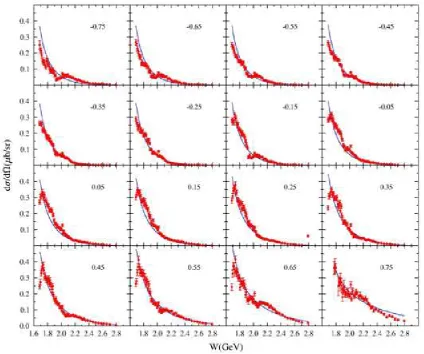
S11(1535) can be seen in Figure 3. The results
show that for large angles (backward angles) be-tween graphs and experiment data coincide well, it is just a little different for small angles (forward
an-gles) that gives quite a wide difference, but overall graph of the results fitting is consistent with ex-perimental data. This is understandable because of the small χ2 value, which is about 17.36320, it
can be concluded that theS11(1535) resonance has
an important contribution to the photoproduction reaction process η.
Table 2: Parameters fittingS11(1535).
Parameters Value
ΛN (MeV) 1466.4402
gηN N -0.0567
ΛN∗ (MeV) 1814.5824
gηN N∗ 1.8523
Λρ (MeV) 1140.2047
gρηγ 0.0623
While for the parameter values fitting obtained can be seen in Table 2. From Table 2 it is known that the value of the coupling constant gηN N∗ and
mass cut off dominant resonance nucleons.
For contributions of resonant S11(1650) can be
seen in Figure4. For the large angle, visible exper-imental data can be well explained starting from the value of cosθ =−0.35, less then the resultant graph fitting is still widening from the experimental data. But the overall results of the fitting in accor-dance with experimental data. From the graph in Figure 4 it generally gives the same result as the
S11(1535) resonance. As for the parameter values
fitting obtained can be seen in Table 3. From the table it is known that the value of the coupling con-stantsgηN N∗ and mass cut off dominant resonance
nucleons.
This is because the value of the cross section of the resonantS11(1650) has a value which is almost
equal toS11(1535) for all values of the scattering
an-gle variation. Thus the results of fitting using reso-nantS11(1650) will give a value ofχ2sizable unlike
the resonanceS11(1535), which is about 29.25026.
The parameter value fitting we obtain in this case can be seen in Table 3, and note that the value of the coupling constant gη and mass N N cut off the
more dominant resonance nucleons. Based on the graph of the result fitting by using aS11(1650)
res-onant, this indicates that the S11(1650) resonance
also has an important contribution in the η photo-production reaction process.
Table 3: Parameters fittingS11(1650).
Parameters Value
ΛN (MeV) 1345.7216
gηN N -0.1023
ΛN∗ (MeV) 1860.5997
gηN N∗ 0.8607
Λρ (MeV) 1149.1165
gρηγ 0.0775
Figure 4: The resulting graph fitting differential cross section with resonanceS11(1650) for different variations of the scattering angle.
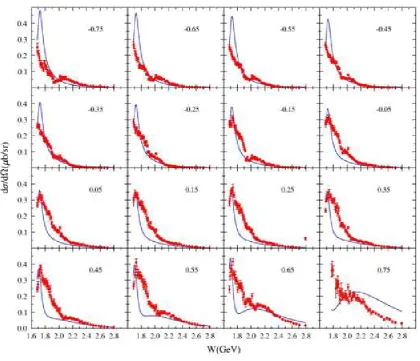
The resulting graph fitting for resonant
P11(1710) can be seen in Figure 5. These results
show that between graphs and experimental data do not occur crushes. This is understandable be-cause of the largeχ2
value, which is about 68.86677
whereas for the parameter values fitting obtained can be seen in Table 4. From the table it is known that the coupling constant value gηN N∗ and mass
Figure 5: The resulting graph fitting differential cross section with resonanceP11(1710) for different variations of the scattering angle.
Table 4: Parameters fittingP11(1710).
Parameters Value
ΛN (MeV) 225.7498
gη′N N -20.0000
ΛN∗ (MeV) 1372.3486
gηN N∗ 4.3235
Λρ(MeV) 741.6699
gρηγ -0.2906
Conclusion
From the results obtained in the study, on the graph for low energy then the amount of η scat-tered on the proton is always more, is inversely pro-portional to the higher energy where the numberη
scattered on the protons is always less. With a large contribution of u-channel thenη is more scattered when in the u-channel.
The graph also shows thatη scattered on theo-retical results is also slightly higher than theηsums scattered on the protons in the experiment. The
in-troduction of the hadronic form factor into the re-action calculationγ p→ηp also gives results that are more in line with the experimental data than the result without using the hadronic form factor.
The use of resonant S11(1,535) and S11(1650)
generate considerable contribution both to gener-ate numerical data trends for the fitting process in order to compare it with the experimental results. The more resonance used then the better the model we have. The cut off mass of the nucleon and reso-nant nucleon also affects the results obtained.
In this research is not too much difference theo-retical study between photoproduction mesonη on the neutron with model isobar and photoproduc-tion meson η on a proton with model isobar that distinguishes the difference in charge and the mass of protons and neutrons.
References
[1] V. Crede et al. (CBELSA/TAPS Collaboration), Photoproduction of η and η′ mesons off protons,
[2] V. Cred´eet al.(CB-ELSA Collaboration), Photo-production ofηmesons off protons for 0.75 GeV< Eγ <3 GeV,Phys. Rev. Lett.94, 012004 (2005).
[3] A. Pevsner, R. Kraemer, M. Nussbaum, C. Richardson, P. Schlein, R. Strand, T. Toohig, M. Block, A. Engler, R. Gessaroli, and C. Meltzer, Ev-idence for a three-pion resonance near 550 MeV,
Phys. Rev. Lett.7, 421 (1961).
[4] B. Krusche, J. Ahrens, G. Anton, R. Beck, M. Fuchs, A. R. Gabler, F. H¨arter, S. Hall, P. Harty, S. Hlavac, D. MacGregor, C. McGeorge, V. Metag, R. Owens, J. Peise, M. R¨obig-Landau, A. Schubert, R. S. Simon, H. Str¨oher, and V. Tries, Near threshold photoproduction ofηmesons off the proton,Phys. Rev. Lett.74, 3736 (1995).
[5] F. E. Close and Z. Li, Photo- and electroproduc-tion ofN∗in a quark model,Phys. Rev. D42, 2194
(1990).
[6] R. Koniuk and N. Isgur, Baryon decays in a quark model with chromodynamics, Phys. Rev. D 21,
1868 (1980).
[7] H. R. Hicks, S. R. Deans, D. T. Jacobs, P. W. Lyons, and D. L. Montgomery, Isobar analysis of γp→ηp,Phys. Rev. D7, 2614 (1973).
[8] C. Bennhold and H. Tanabe, Low-energyη photo-production from nucleons and nuclei, Phys. Lett. B243(1-2), 13-17 (1990).