CONTEMPORARY AGRICULTURE / SAVREMENA POLJOPRIVREDA
UDC: 63(497.1)(051)-”540.2” ISSN 0350-1205
59 (3-4) 393-399, 2010.
UDC: 543.562.1:582.998.16:582.736.3
ANTIOXIDANTS IN SOYBEAN AND SUNFLOWER GRAIN*
VESNA DRAGIČEVIĆ, VESNA PERIĆ,
ANIKA NIŠAVIĆ, MIRJANA SREBRIĆ
1SUMMARY: The objective of this study was to examine differences in
anti-oxidants content: phytate, phenolics, free thiolics (PSH) and glutathione (GSH)
in seeds of 7 soybean varieties and 10 sunflower lines with aim to signify their
nutritive quality, valuable for further breeding process. The variations between
soybean varieties in phytate content were minor, while el/7 was sunflower line with
lowest phytate content, which could be used for program breeding of low phytate
grain. The relative high phytate and phenolics content was present in Laura seeds,
as well as lowest PSH and GSH content. Generally, the higher content of
pheno-lics were in sunflower seeds, what could be considered as negative atribut from
nutritive point of view. The highest PSH content was observed in soybean seeds of
Nena and Olga. Lower PSH and GSH content was noted in sunflower seeds (down
to 4 and 7 times, respectively), compared to soybean. The soybean seeds have
po-tentially better antioxidative potential, compared to sunflower, owing to multiple
higher PSH and GSH content and lower level of phenolics. Soybean variety Olga
is accenuated as high in PSH and GSH, as well as sunflower line l4/ru, which had
higher PSH and particulary GSH level, with lower phytate and phenolics content,
as possible antinutrients.
Key words:
phytate, phenolics, thiolics, glutathione, soybean, sunflower.
INTRODUCTION
Antioxidative substances are very important nutritive factor, responsible for seed
longevity (Ramarathnam et al., 1986). One of the most important components for
phos-phorus storage is phytate (Lott et al., 2000), which, from one side represents
antinutri-tive factor, due to its indigestibility for monogastric organisms, and from other side, has
positive role as an antioxidant and anticancerogenic agent. Malenčić et al. (2007)
un-Original scientific paper / Originalni naučni rad
1Vesna Dragičević, PhD, Scientific collaborator, Department of Maize Production; Anika Nišavić, dipl. Ing., Department of Seed Production; Vesna Perić, MSc, Department for Selection and Breeding; Mirjana Srebrić, MSc, Department for Selection and Breeding.
Corresponding author: Vesna Dragičević, Maize Research Institute “Zemun Polje”, Slobodana Bajića 1, 11185 Zemun Polje, Serbia, Phone: +381 11 37 56 704, Fax: +381 11 37 56 707, E-mail: [email protected]
*This research was supported by the Ministry of Science and Technology, Republic of Serbia, through Project TR 20114.
derlined phenolics as bearers of antioxidative activity in soybean seeds, since the seeds
with low phenolic’s content have poor antioxidative activity, too. Meanwhile, phenolics
react with proteins in sunflower seeds, threatening its quality (Gandhi et al., 2008).
One of the most important antioxidative and nutritive factors are protein
antioxi-dants, i.e. free thiolic groups, which participate in stress prevention in seeds, either in
green parts of plants (Chernikova et al., 2000; Santos and Rey, 2006). From this point
of view, special attention is given to glutathione, as the one of the crucial “free radical”
trappers. Free thiolics have important role in soybean and sunflower grain, since they
prevent protein components from degradation (De Paula et al., 1996; Awazuhara et al.,
2002).
Therefore, the content of phytate, phenolics, free thiolics and glutathione in grain
of 7 ZP soybean varieties and 10 sunflower lines were examined in aim to signify their
nutritive quality and importance in future breeding program.
MATERIAL AND METHODS
The content of antioxidative substances was analysed in grain of 7 ZP soybean
varieties ZPS 015, Lidija, Laura, Lana, Olga, Nena and Bosa) and 10 sunflower lines
(koz/11, all/19, bk/25, az/20, alv/12, alt/9, el/7, l4/ru and alb/1). The seeds originated
from 2009 and was produced in the experimental field of Maize Research Institute in
Zemun Polje. The pericarp was previously removed from sunflower seeds. The soybean
and sunflower grain was ground on Tecator Knifetec 1095, then the oil was removed
by extraction with petrol-ether (40 – 60 °C) during 12 hours. From grain prepared in
such manner, the extraction of antioxidative substances was performed with bidistilled
water. The content of particularized antioxidans was analysed: total soluble phenolics,
by method of Simić et al. (2004), total soluble thiolics (PSH), by method of deKok et
al., (1981), total phytate by modified method of Jočić (1996), while the total gluathione
(GSH) was determined after extraction with 5% trichloracetic acid, by method of Sari
Gorla et al. (1993). Over against, the content of analysed antioxidants, the was similarity
between genotypes was determined b, PATH analysis (Wright, 1923).
RESULTS AND DISCUSSION
The phytate presents important antioxidant in plants, irrespective to its
antinu-tritive character (Lott et al., 2000). Phytate content differed among soybean varieties
in lower degree, to 32% (Graph 2). The highest phytate level was observed in grain
of Laura, variety lacking in Kunitz trypsin inhibitor (Perić et al., 2009). On the other
hand, a variation of phytate content among sunflower lines was up to 45%. Thereby, it
was necessary to emphasize el/7 as line with lowest phytate level. This genotype could
be used as valuable source in further breeding programs for low-phytate sunflower
hy-brids, first of all from the reason of negative aspect of high phytate level in sunflower
grain (De Paula et al., 1996; Hídvégi and Lásztity, 2002). Unlike soybean, where
posi-tive correlation between seed size and phytate content was observed (R = 0.80), the
cor-relation was negative at sunflower and it was insignificant (R = -0.34).
Graph 1. The seed weight of different soybean varieties (ZPS015, BISA, LANA, OLGA, LIDIJA, NENA, LAURA) and sunflower lines (koz/11, pp/34, all/19, alb/19, el/7, l4/ru, az/20,
alt/9, alv/12, bk/25); average value ± SD
Grafik 1. Masa semena različitih sorti soje (ZPS015, BISA, LANA, OLGA, LIDIJA, NENA, LAURA) i linija suncokreta (koz/11, pp/34, all/19, alb/19, el/7, l4/ru, az/20, alt/9, alv/12, bk/25);
prosečna vrednost ± SD
Graph 2. The content of phytate and phenolics in grain of the different soybean varieties (ZPS015, BISA, LANA, OLGA, LIDIJA, NENA, LAURA) and sunfl ower lines (koz/11, pp/34,
all/19, alb/19, el/7, l4/ru, az/20, alt/9, alv/12, bk/25); ± SD
Grafi k 2. Sadržaj fi tina i ukupnih fenola u zrnu različitih sorti soje (ZPS015, BISA, LANA, OLGA, LIDIJA, NENA, LAURA) i linija suncokreta (koz/11, pp/34, all/19, alb/19, el/7, l4/ru,
az/20, alt/9, alv/12, bk/25); ± SD
As well, the content of total soluble phenolics varied among soybean varieties to
35%. The group of 4 varieties with higher content of phenolics in grain was seceding:
Lana, Lidija, Nena and Laura, which had 758 – 805 mg kg
-1(Graph 2). Considering
Laura, as variety with largest seed and highest level of phenolics is aparted from other
varieties, the theory of Lee et al. (2008), about negative correlation between grain size
(Graph 1) and phenolics content in soybean grain could be confirmed. Beside the high
level of phenolycs and phytate in Laura grain (Graph 2), it was important to underline
that lowest level of PSH i GSH was present, too (Graph 3) indicating different
anti-oxidative profile of this variety, i.e. relatively low antianti-oxidative potential of its protein
component in grain. Generally, the higher content of phenolics was present in sunflower
grain, while the varying among lines was up to 42%. From the nutritive point of view,
higher phenolics level, as it was in grain of koz/11, all/19, el/7 alt/9 and bk/25 is
nega-tive characteristics, since it has been responsible for changes in protein quality during
the procession of sunflower meal (Gandhi et al., 2008). Ramarathnam et al. (1986) are
underlining positive impact of phenolics on rice seed longevity.
Graph 3. The content of thiolics (PSH) and glutathione (GSH) in grain of the different soy-bean varieties (ZPS015, BISA, LANA, OLGA, LIDIJA, NENA, LAURA) and sunflower lines
(koz/11, pp/34, all/19, alb/19, el/7, l4/ru, az/20, alt/9, alv/12, bk/25); average value ± SD Grafik 3. Sadržaj tiolnih grupa (PSH) i glutationa (GSH) u zrnu različitih sorti soje (ZPS015, BISA, LANA, OLGA, LIDIJA, NENA, LAURA) i linija suncokreta (koz/11, pp/34, all/19, alb/19,
el/7, l4/ru, az/20, alt/9, alv/12, bk/25); prosečna vrednost ± SD
The free thiolic groups (-SH) are of importance as anti stress factor (Chernikova
et al., 2000; Awazuhara et al., 2002). The highest PSH content was observed in grain
of Nena and Olga (Graph 3). Additionally, the highest GSH value was noticed in Olga’s
grain, which could provide the high anti oxidative potential of this variety, based on
thioredoxines (Santos and Rey, 2006). Then again, low PSH i GSH content in Lidija
grain could point to low thioredoxine’s activity in trapping of free radicals. Other than
soybean, 4 times lower PSH and 7 times lower GSH content was noted in sunflower
grain. Torres et al. (1996) are emphasizing that GSH is the most important antioxidant
in sunflower grain. In regard to that fact alb/1, el/7 i l4/ru were identified as the lines
with twice higher PSH level, compared to other lines. It is important to underline line
l4/ru, which had the highest GSH level, too.
Graph 4. Cluster analysis dendrogram for content of analysed antioxidants in soybean grain (ZPS015, BISA, LANA, OLGA, LIDIJA, NENA, LAURA)
Grafik 4. Dendrogram klaster analize za sadržaj analiziranih antioksidanata u zrnu soje (ZPS015, BISA, LANA, OLGA, LIDIJA, NENA, LAURA)
Graph 5. Cluster analysis dendrogram for content of analysed antioxidants in sunflower grain (koz/11, pp/34, all/19, alb/19, el/7, l4/ru, az/20, alt/9, alv/12, bk/25)
Grafikon 5. Dendrogram klaster analize za sadržaj analiziranih antioksidanata u zrnu sun-cokreta (koz/11, pp/34, all/19, alb/19, el/7, l4/ru, az/20, alt/9, alv/12, bk/25)
Considering the total content of analysed antioxidants, a cluster analysis classified
7 soybean genotypes into two groups: first subcluster composed of cultivars ZPS015,
Lidija and Laura and second group comprised of cultivars Bosa, Lana, Nena and Olga
(Graph 4), which were characterised by high level of protein antioxidants (Graph 3).
Sunflower lines (Graph 5) were clustered into several smaller groups, while two lines
were outliers: koz/11 with the lowest level of protein antioxidants (Graph 3) and relative
high content of phenolics (Graph 2), and alb/1, with the highest content of phenolics and
PSH.
CONCLUSION
Based on obtained results, it could be concluded that soybean grain has potentially
better antioxidative potential, in relation to sunflower, owing to multiple higher content
of PSH and GSH, as well as lower level of phenolics. Special accent is given to soybean
variety Olga, which has high PSH and GSH content and sunflower line l4/ru, which
had higher GSH and PSH content, too, with lower level of phytate and phenolics, as
potential antinutrients.
REFERENCES
AWAZUHARA, M., KIM, H., HAYASHI, H., CHINO, M., KIM, S. G., FUJIWARA,
T.: Composition of seed storage proteins changed by glutathione treatment of soybeans.
Biosci. Biotechnol. Biochem., 66:1751-1754, 2002.
CHERNIKOVA, T., ROBINSON, J. M., LEE, E. H., MULCHI, C. L.: Ozone tolerance
and antioxidant enzyme activity in soybean cultivars. Photosynth. Res,. 64:15-26,
2000.
CHUNG, I. M.: Analysis of isoflavones and phenolic compounds in Korean soybean
(Glycine max (L.) Merrill) seeds of different seed weights. J. Agric. Food Chem.,
56:2751-2758, 2008.
DE KOK, L. J., DE KAN, P. J. L., TANCZOS, G., KUPIER, J. C.: Sulphate induced
accumulation of glutathione and frost-tolerance of spinach leaf tissue. Physiol. Plant.,
53:435-438, 1981.
DE PAULA, M., PEREZ-OTAOLA, M., DARDER, M., TORRES, M., FRUTOS, G.,
MARTINEZ-HONDUVILLA, C. J: Function of the ascorbate-glutathione cycle in aged
sunflower seeds. Physiol. Plant., 96:543-550, 1996.
GANDHI, A. P, JHA, K., GUPTA, V.: Studies on the production of defatted sunflower
meal with low polyphenol and phytate contents and its nutritional profile, ASEAN Food
J., 15:91-100, 2008.
HÍDVÉGI, M., LÁSZTITY, R.: Phytic acid content of cereals and legumes and
interaction with proteins. Periodica Polytechnica Ser. Chem. Eng., 46:59–64, 2002.
JOČIĆ, N.: Ispitivanje sadržaja rastvorljivog fitina u semenu hibrida kukuruza F1
generacije u fazi mirovanja. Specijalistički rad, Hemijski fakultet, Beograd, 1996.
LEE, S. J., KIM, J. J., MOON, H. I., AHN, J. K., CHUN, S. C., JUNG, W. S., LEE, O. K.,
LOTT, J. N. A., OCKENDEN, I., RABOY, V., BATTEN, G. D.: Phytic acid and
phosphorus in crop seeds and fruits: a global estimate. Seed Sci. Res., 10:11-33, 2000.
MALENČIĆ, D, POPOVIĆ, M., MILADINOVIĆ, J.: Phenolic content and antioxidant
properties of soybean (Glycine max (L.) Merr.) seeds. Molecules, 12:576-581, 2007.
PERIĆ, V., SREBRIĆ, M., JANKULOSKI, LJ., JANKULOSKA, M., ŽILIĆ, S.,
KANDIĆ, V,. DRINIĆ-MLADENOVIĆ, S.: The effects of nitrogen on protein and
trypsin inhibitor content of soybean. Genetika 41:137-143, 2009.
RAMARATHNAM, N., OSAWA, T., NAMIKI, M., TASHIRO, T.: Studies on the
relationship between antioxidative activity of rice hull and germination ability of rice
seeds. J. Sci. Food Agric., 37:719-726, 1986.
SANTOS, C. V. D., REY, P.: Plant thioredoxins are key actors in the oxidative stress
response. Trends Plant Sci., 11: 329-334, 2006.
SARI-GORLA, M., FERRARIO, S., ROSSINI, L., FROVA, C., VILLA, M.:
Developmental expression of glutathione-S-transferase in maize and its possible
connection with herbicide tolerance, Euphytica, 67: 221-230, 1993.
WRIGHT, S.: Theory of path coefficients. Genetics, 8:239-255, 1923.
ANTIOKSIDANTI U SEMENU SOJE I SUNCOKRETA
VESNA DRAGIČEVIĆ, ANIKA NIŠAVIĆ,
VESNA PERIĆ, MIRJANA SREBRIĆ
Izvod
Cilj ogleda je bio da se ispitaju razlike u sadržaju antioksidanata: fitina, fenola,
slobodnih tiola i glutationa u semenu 7 ZP sorti soje i 10 linija suncokreta i time ukaže
na njihov nutritivni kvalitet i značaj za dalji proces selekcije. Kod soje nije bilo znatnijih
variranja u pogledu sadržaja fitina, dok se kod suncokreta izdvaja el/7, kao linija sa
najnižim učešćem fitina, koja bi mogla poslužiti u postupku oplemenjvanja
niskofitin-skih hibrida suncokreta. Kod Laure je pored relativno visokog sadržaj fenola i fitina bio
prisutan i najniži sadržaj PSH i GSH. Kod suncokreta je generalno bio prisutan znatno
veći sadržaj fenola u zrnu, što je sa nutritivne tačke gledišta negativno. Kod ispitivanih
sorti soje, najveći sadržaj PSH je bio kod Nene i Olge. U semenu suncokreta je prosečno
bilo 4 i 7 puta manje PSH i GSH. Seme soje poseduje potencijalno bolji antioksidativni
potencijal u odnosu na suncokret, zahvaljujući višestruko većem sadržaju PSH i GSH i
nižem udelu fenola. Posebno se ističe sorta soje Olga sa visokom sadržajem PSH i GSH,
kao i linija suncokreta l4/ru, koja je imala veći sadržaj PSH, a posebno GSH i niži udeo
fitina i fenola, kao potencijalnih antinutritiva.
Ključne reči:
fitin, fenoli, tioli, glutation, soja, suncokret.
Received /
Primljen
: 02.11.2010.
CONTEMPORARY AGRICULTURE / SAVREMENA POLJOPRIVREDA
UDC: 63(497.1)(051)-”540.2” ISSN 0350-1205
59 (3-4) 400-416, 2010.
UDC: 582.542.11:547:338.3(043.3)
ORGANIC CEREAL PRODUCTION
-OPPORTUNITY FOR AGRICULTURE IN SERBIA*
MIROSLAV MALEŠEVIĆ, JANOŠ BERENJI, FRANC BAVEC, GORAN
JAĆIMOVIĆ, DRAGANA LATKOVIĆ, VLADIMIR AĆIN
1SUMMARY: Areas under certified organic production in the world are
con-stantly increasing. The most present plant species in organic production in the
world are cereals and forage crops, and from permanent crops - olives, fruits and
grape vines. Trend of constant increasing in human population imposes a constant
need to increase the production of small grain, while the specific nutrition
require-ments suggest use of alternative grain in addition to conventional. These usually
involve species that are produced in relatively small areas, whose production is
in most cases labor intensive, but from the unit area provides greater profit
com-pared to the production of conventional crops. Organic production in Serbia is
re-cent date compared with EU countries, and it is based mainly on the production of
vegetable and fruit. Since the cereals are most represented in organic production
in the world, our goal is to present the basic recommendations and the
possibili-ties of their growing in these systems in our country. Special accent was placed on
the specificity of next alternative plant species: durum wheat, spelt, millets, grain
sorghum and buckwheat.
Key words:
organic production, small grains, alternative crops
INTRODUCTION
According to the
International Federation of Organic Agriculture Movements
(IFOAM)
,
«Organic agriculture is a production system that sustains the health of soils,
ecosystems and people. It relies on ecological processes, biodiversity and cycles adapted
to local conditions, rather than the use of inputs with adverse effects».
Organic
produc-Review scientific paper / Pregledni naučni rad
1Dr Miroslav Malešević, Full prof., Dr Janoš Berenji, Full prof., B.Sc. Vladimir Aćin, Assistant; Institute of Field and Vegetable Crops, Maksima Gorkog 30., 21000 Novi Sad, Serbia. Dr Franc Bavec, Full prof., Faculty of Agriculture, University of Maribor, Vrbanska 30., 2000 Maribor, Slovenia. M.Sc. Goran Jaćimović, Teaching assistant, Dr Dragana Latković, Teaching assistant; Faculty of Agriculture, University of Novi Sad, Trg Dositeja Obradovića 8., 21000 Novi Sad, Serbia.
Corresponding author: Miroslav Malešević, Institute of Field and Vegetable Crops, Maksima Gorkog 30., 21000 Novi Sad, Serbia. Tel.: +381 21 4898 210, e-mail: [email protected] *The paper is a part of the research work on the project (TR 20138), financed by the Ministry of Science and Technological Development of the Republic of Serbia (2008 to 2011).
tion is based on basic agroecological principles, by including household management of
resources with respect for all elements of environmental protection. In recent decades,
there is intensively developed awareness that the quality of food and raw materials is
necessary to monitor, improve and regularly control, more than ever
(Malešević et al.,
2008).
Besides that, accent is put on the control of use of various agrochemicals, whose
improper application negatively affects agro- and natural ecosystems, and directly or
indirectly influences people’s health (
Malešević et al., 2009)
. According to
Bavec and
Bavec (2007),
in human- and environment-friendly crop production and food processing
systems, use of chemicals (fertilizers, pesticides, pharmaceuticals, growth regulators,
and unhealthy additives), gene modified organisms (GMOs), and non-resistant cultivars
to diseases are maximally reduced.
Thus, the notion of organic agriculture usually refers to the way of growing plants
without using mineral fertilizers and pesticides
(Kovačević and Oljača, 2005).
Long
term maintenance of soil fertility is of crucial importance, and it is obtained mostly by
applying integral and preventive measures. Organic production is based on the principles
of agroecology
(Oljača, 2001; Molnar et al., 2005; Milošev and Šeremešić, 2007),
and it
is integral part of sustainable agricultural development which uses scientific knowledge
regarding the natural laws and establishment of environment protection principles, for
production of healthy and safe food (
Lotter, 2003; Lazić and Malešević, 2006)
.
Due to a number of advantages in comparison to other systems of growing plants,
the areas under certified organic production are increasing every year. Organic
produc-tion methods have been applied in over 150 countries in the world, on over 35 million
ha, from which 8,2 (about 23%) million ha are in Europe. The most common plants in
organic arable land (total 4,6 million ha) are cereals (~2 mill. ha, or 44%; the countries
with the largest areas in 2008 are Italy, USA and Germany) and field fodder crops
(32%), and among perennial plants - olives, fruit and grape vines
(Source: FiBL &
IFOAM Survey 2010; most data collected are from 2008).
As cereals are the most common species in organic production in the world, our
goal is to point out basic principles of their cultivation, with a special review of
alterna-tive grain species which are becoming more and more popular in organic production.
According to
Bavec and Bavec (2007)
, the introduction of alternative crops into rotation
will contribute to more natural production systems. Alternative crops (old, ancient,
ne-glected, disregarded, or new) can also help to reduce natural over-sensitivity by sowing
more resistant genotypes to plant diseases, increasing the population of natural
preda-tors, changing weed population, and helping us to produce healthy food without
syn-thetic pesticides.
The basic principles of organic production in field crops management
Successful farming, as well as
organic production of field crops
, is based on
soils
rich in organic matter, with a good structure, water-air properties and ample in living
microorganisms, wich represents a basis for production of healthy plants. This type of
soil is good for providing plants with water and elements of mineral nutrition which
oc-curs due to the activity of soil microorganisms, and can be assured by the proper
manip-ulation of harvest residues
(Malešević et al., 2009b; Latković et al., 2009)
. Fixation of
atmospheric nitrogen can be successfully done on such soil as well as normal circulation
of matter, including organic matter from farm and fertilizers permitted in this kind of
production
(Malešević et al., 2009a)
. Organic farming is founded on the idea that soils
with sufficient organic matter content, good structure, ample and variegated in living
microorganisms can provide a base for healthy crops.
Đurić et al. (2008)
refers that
ap-plication of manure as a result had an increase of microbial C-biomass by 100% in soil
profile from 0-60 cm. During the organic maize production, input of manure induced
the increase of number of investigated group of microorganisms in soil.
Crop rotation
has the crucial role in achieving goals of organic production
(Milošev and Šeremešić, 2004)
because it systematically harmonizes and optimizes all
agrotechincal measures. The impact of
previous crops (precrops)
is manifested through
consumption of water and nutrients, quantity of harvest residues, time of leaving the
field etc. Pre-crops also dictate the method and intensity of soil cultivation, as well as
dynamics of fertilizing. Thus, crop rotations have a great importance and potential in
the development of integral systems of plant production, especially in the systems of
organic farming.
In order to preserve soil fertility potential, it is important to carefully choose which
annual and perennial plant species will be grown, therefore, crop rotation is most
impor-tant agrotechical measure in organic production
(Lazić and Malešević, 2004; Šeremešić
and Milošev, 2006)
. Organic production has greater capacity for improvement of soil
quality in comparison to the conventional production systems
(Karlen et al., 1997)
be-cause it uses different crop rotations, organic fertilizers and smaller intensity of soil
cultivation
(Liebig and Doran, 1999).
In the organic production system,
forage and
le-guminous crops
should be more present in the structure of crop rotation. Crop rotations
should include growing of
stubble and cover crops, intercrops, companion- and catch
crops,
as well as other various modifications. By sowing inter- and cover crops, organic
production can be remarkably improved. The main goal of growing intercrops is not
the yield, but primarily protection of agroecosystems, decreasing or avoiding mineral
fertilizers, pesticides and increase in biodiversity
(Ćupina et al., 2004)
.
Release of
nutrients
into easily accessible forms to plants is directly affected by
the activity of microorganisms, and their activity is conditioned with temperature and
presence of water and air. Nutrient management in organic systems is based on
fertility-building leys that fix atmospheric nitrogen, combined with the recycling of nutrients via
bulky organic materials such as farmyard manure and crop residues, and with only
lim-ited inputs of permitted fertilizers
(Gosling and Shepherd, 2005)
.
Soil fertility control,
which includes measuring of content of easily available nutrients in the soil, must be
included in this segment of organic production
(Malešević, 2008b)
. Amount of nutrients
in the soil and their availability depend to a great extent on fertilizing system before
conversion to the organic production as well as during the conversion period
(Čuvardić
et al., 2006).
Organic fertilizers
are irreplaceable when it comes to soil revitalization, i.e. to the
improvement of its physical, chemical and biological characteristics. They are
impor-tant in all concepts of sustainable and organic agriculture as those concepts almost
com-pletely exclude application of mineral fertilizers
(Čuvardić, 2006)
. Also, a significant
amount of fresh organic matter is introduced by plowing down
green manure
, and
le-guminous crops
which can enrich soil by nitrogen. Green manuring improve soil
physi-cal and water characteristics, and above all, enhance structure and increase biologiphysi-cal
activity, as significant factor of soil fertility. Tasks of organic management system are
to maximize the contributions of on-farm resources such as animal manures, composts,
and green manures to soil fertility. However, purchased off-farm nutrients - including
mineral fertilizers, fortified composts, and plant and animal meals - may be necessary
to ensure adequate nutrient availability during transition to an organic program
(AT-TRA, 2003)
.
Special attention in organic crop production should be devoted to
nitrogen
, as
ma-jor yield bearer
(Malešević, 1987)
. Animal manures and legumes are two major sources
of nitrogen in organic systems. Legume cover crops, plowed down to provide
green-ma-nure nitrogen, also contribute to soil tilth and increase of organic matter content. During
decomposition, legumes can provide 50 to 170 kg N ha
-1. Small grains can also receive
supplemental nitrogen from crop rotation patterns that include perennial legumes like
alfalfa and clover
(Sullivan, 2003)
. Plant demands for nitrogen can be compensated
be-sides symbiotic, with the unsymbiotic nitrogen fixing bacterias. Possibilities for use of
useful microorganisms in organic agriculture are great, especially as bio-fertilizers and
biofertilizators
(Đorđević, 2005).
Nowadays, for such intentions there are numerous
microbiological preparations in Serbia
(“Nitragin”, “Azotofiksin”, “Azotobakterin”)
.
Leguminous plants that fix and accumulate nitrogen in soil should be grown in rotation
with plant species that consumes greater amounts of this nutrient.
Native
phosphorus and potassium
fertility may be enhanced using animal
ma-nures and conserved through good management of cover crops and crop residues. Rock
phosphate can serve as an alternative or supplementary phosphorus source when
neces-sary
(Sullivan, 2003)
.
The right selection of adaptable cultivars and hybrids of agricultural plants for
specific ecological conditions, as well as quality and health conditions of seed material,
represents one of the most important pre-conditions for successful crop production.
Moreover, the choice of the variety and hybrids must be founded on precise evaluation
of consumptive habits in the specific market as well as on the expected financial results.
Modern breeding technologies offer great choice of varieties and hybrids of field crops
species suitable for organic growing. According to
Berenji (2009),
creation of
varie-ties with an outstanding resistance towards the most important diseases and pests, and
adapted to the conditions of low-input, rational investments as well as on abiotic stresses
- represent a special challenge in breeding.
Crop density
should be adjusted to the characteristics of variety (height, tillering,
branching, yield structure etc.) and to the chosen methods of plant protection against
weeds and diseases. Crops with lower density have a better developed root system and
they are more immune to stresses. Moreover, in such lower density crops, the possibility
of mechanical control of weeds is much simpler. Crop density should be also formed on
the basis of available water quantities.
In a dynamic and highly sensitive agroecosystems in which an organic production
is carried out without the use of synthetic preparates, for suppression of diseases, pests
and weeds it is necessary to develop and promote natural mechanisms as self-regulatory
function of their populations. In the ecological croping systems, the occurrence of
dif-ferent weed species was significantly higher and similarly in this system the weight of
weed dry matter was much higher than in the integrated one
(Týr and Lacko-Bartošová,
2007)
. Weed control in organic agriculture should be based on long-term strategy that
includes prevention of their growth, exhaustion and destruction.
Preventive measures
in suppressing weeds are very important factor in efficient
protection in all systems of plant production. They include all measures whose goal
is protection of field from weeding, which refer to all those measures that stop
occur-rences of weed seeds and their vegetative organs in the field
(Kovačević i Momirović,
2008)
. From all direct agrotechnical measures used in weed control; the most important
are all methods and systems of field cultivation, fertilization, sowing, care measures,
and especially plant production systems where crop rotation is playing a important role.
Also, growing resistant varieties and hybrids, utilisation of alelopathy, passive barriers
and monitoring of weather forecast, have significant place in efficient plant protection
in organic production.
Harvest and crop reaping
are defined and determined by plant growing systems.
The moment of harvest is also determined by dynamics of plant maturation, forming of
the quality of products, methods of drying and storing.
Organic small grains production
Growing of small grains organically means using sustainable methods that
ex-clude the use of standard artificial fertilizers and other synthetic matter like pesticides,
preservatives, and growth regulators. The group of small grains suitable for organic
production includes wheat, barley, oats, rye and triticale (
Triticosecale
). From
Triticum
genus, because of their high nutritive values, more and more interesting are
Durum
(hard) wheat
,
Spelt wheat
,
Einkorn
,
Emmer, Kamut (Khorasan wheat)
and many
oth-ers
.
By knowing requirements of these species to environmental conditions is extremely
important when choosing the appropriate growing technology. The role of people here
primarily refers to mitigate the negative effects of climate extremes on plants, especially
by the right choice and on-time applying of agrotechnical measures.
Ecology and biological characteristics of small grains
. Small grains have
win-ter and spring forms. Each species has great number of varieties, and some of them have
sub-species and ecotypes. If huge number of varieties is added, it is clearly why small
grains have the widest growing area in the world. Small grains belong to the species of
moderate climate. Biological temperature minimum for germination is 4-5 °C, and for
the formation of generative organs and maturation about 10-12 °C. Their production
optimum for germination is 6-12 °C, for forming vegetative organs 12-16 °C, for
gen-erative ones 16-20 °C and for maturation 16-22 °C. Higher temperatures (over 30 °C)
significantly decrease vegetation period of small grains, by decreasing yield. Barley
endures them best, and rye and oats the least. The relation towards low temperatures is
extremely important for winter forms of small grains. In our conditions rye can endure
even -25 to -30 °C without snow, triticale, spelt and common wheat -15 to -20 °C,
win-ter barley and durum wheat up to -12, winwin-ter oats -10 to -12 °C, while spring barley and
oats with minor damages can endure -6 to -8 °C. Relation towards low temperatures
depends on the variety and growing stage.
All small grains require a continuous supply of water throughout the vegetation
period. The optimal soil moisture for this species is around 60-80% of full field water
capacity. Transpiration coefficients of small grains are ranged from 300-400 at barley,
to 500-600 in oat and wheat. Critical periods regarding to water plants supply are
peri-ods from sowing to emergence; stem elongation to intensive growth and grain filling.
Under the continental climate conditions, reserves of winter precipitation in soil are
very important. Without them, only with vegetative precipitation, high yields cannot
be achieved.
Good yields of small grains can be achieved in the fertile, humous
soils
, mostly
by neutral reaction, pH 6-7. Rye can endure acid reaction up to pH 5,5, triticale 5,5-6,
and some wheat varieties can endure pH values about 8. It is very important that soils
are rich in organic matter and that they have great microbiological activity. These soil
characteristics are crucial for dynamics of adopting nutritive matter in small grains.
Details of
small-grain production practices
- such as planting dates, seeding
rates, varieties, and harvesting methods - vary widely among regions, but are largely
the same for conventional and organic systems. Compared with conventional
agricul-ture, where agrotechnical measures (cultivation, fertilization, plant protection etc.) can
be individually planned and optimized, organic small grain production technology is
more complex because of its expected cumulative effects
(Olesen, 1999, Kovačević et
al., 1999)
.
Variety selection.
Variety or hybrid is the basis of high yield and quality of small
grains. When selecting cultivars, great attention must be paid to their yield, yield
sta-bility and grain quality (especially from the aspect of nutritive value and possista-bility of
’healthy food’ production), then their resistance to lodging, diseases and abiotic stresses
(Bedo and Malešević, 2001)
. Also, it is important to know duration of vegetation
pe-riod for specific variety, in order to avoid critical pepe-riods in which high temperatures
may appear. Appropriate genotypes for organic production can be found among very
rich collections of small grain varieties in Serbia. Modern breeding offers great
op-portunities for this selection, and in the existing ’gene banks’ eminent older varieties
convenient for systems of organic crop production can be found. Many of serious seed
companies in the world started with production of organic seed of some grown species.
In Serbia, possibilities for this kind of production were getting by adoption of Organic
agriculture law
(Milovanović et al., 2009).
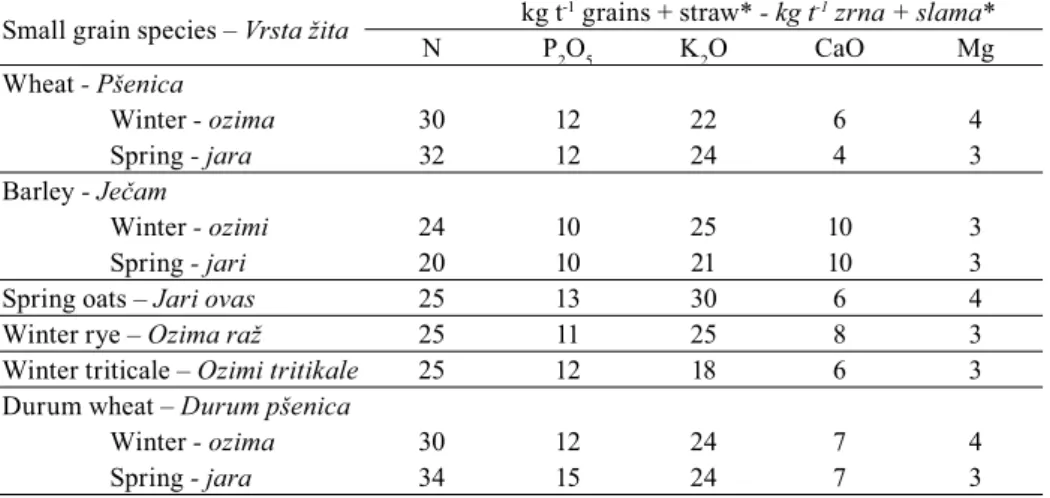
Table 1: Needs of small grains for nutritive elements in kg t-1 and for adequate straw quantity (average values by various authors)
Tab. 1: Potrebe strnih žita za hranljivim elementima u kg t-1 zrna i odgovarajuću količinu slame
(prosečne vrednosti date od strane više autora) Small grain species – Vrsta žita kg t
-1 grains + straw* - kg t-1 zrna + slama*
N P2O5 K2O CaO Mg Wheat - Pšenica Winter - ozima 30 12 22 6 4 Spring - jara 32 12 24 4 3 Barley - Ječam Winter - ozimi 24 10 25 10 3 Spring - jari 20 10 21 10 3
Spring oats – Jari ovas 25 13 30 6 4
Winter rye – Ozima raž 25 11 25 8 3
Winter triticale – Ozimi tritikale 25 12 18 6 3
Durum wheat – Durum pšenica
Winter - ozima 30 12 24 7 4
Spring - jara 34 15 24 7 3
*Given values vary ± 15-20% according to authors, growth conditions and yield height
Small grains nutrients requirements.
The adoption of elements of mineral
nutri-tion in cereal begins after forming the 2 leaf of seedlings, when young plants transfer to
autotrophic nutrition. The fertilization of small grains is based on their needs for NPK
nutrients and dynamics of their adoption. It is important to know critical periods during
vegetation, when the nutrients requirement is the greatest and when their deficiency
causes the highest yield decrease. Needs of small grains for nitrogen, sulphur and
potas-sium, in kg t
-1of grains and adequate quantity of straw are shown in the Tables 1 and 2
(Malešević et al., 2008a)
and these plants requirements should be compensated by using
organic and mineral fertilizers allowed in organic production.
According to presented data, the highest uptake/removal of nitrogen with grains
has durum wheat and common spring wheat (Table 2). In the straw of oats and durum
wheat, the nitrogen content is the highest, so the removal of this element is significant.
At the same time, these cereals have the unfavorable grain to straw ratio. Harvest index
is also very variable and it depends from environmental conditions. In favorable years
harvest index is much better than in the unfavorable ones. Lodging of crops extremely
lowers grain percentage in the total yield of small grains.
Table 2: Removal of nitrogen with grain and straw yield by various small grains (kg t-1) Tabela 2: Iznošenje azota prinosom zrna i slame kod različitih vrsta strnih žita (kg t-1)
Small grain species Vrsta žita Grain Zrno Strow Slama Totally Ukupno Harvest index -Žetveni index (%) Grain - Zrno Strow - Slama Wheat - Pšenica Winter - ozima 21 7 28 49 51 Spring - jara 25 7 32 50 50 Barley - Ječam Winter - ozimi 20 6 26 48 52 Spring - jari 18 8 26 46 54 Oat - Ovas Winter - ozimi 21 9 30 40 60 Spring - jari 22 12 34 38 62
Winter rye –ozima raž 22 6 28 42 58
Durim wheat - Durum pš.
Winter - ozima 24 9 33 45 55
Spring - jara 26 11 37 42 58
Winter triticale – oz. tritikale 23 8 31 49 51
Dynamics of small grain nutrients uptake is in close correlation with the process
of forming organic matter, i.e. growth and development of small grains. After the
win-ter vegetation break, when temperatures become stable at about 5 °C, nutrients uptake
continues with much greater intensity in comparison with autumn period. Tillering of
winter crops lasts until the end of March and the beginning of April. Presence of
suf-ficient quantities of easy-available forms of nutritive elements in the zone of root system
is of crucial importance.
From the stage of stem elongation until the stages of
flowering-pollination-be-ginning of kernel and milk development, cereals adopt remaining quantities of NPK
nutrients, about 75%. From the beginning of kernel development until the complete
maturity (45-50 days), most of small grains do not uptake new quantities of NPK, but
translocate them from the older organs towards ear and grain, respectively. In about 45
days (in favorable years ~50), big quantities of dry matter are formed in grain. Due to
high and intensive accumulation of organic matter in the period from pollination until
complete maturity, of crucial importance for plants is that they are supplied with
suf-ficient amounts of water and nutritive elements in soil solution, to have undamaged
leaves and absence of weeds. Among abiotic factors, temperature is very important
(daily about 25-26 °C, and nightly 11-12 °C) as well as direct sun radiation, without
significant cloudiness. High temperature shortens the stages of kernel development and
ripening.
Sowing.
One of the most delicate technological measures in growing small grains
is determining the optimal vegetative area for specific species and varieties of cereals. It
depends from sowing time, tillering potential and weather conditions
(Malešević et al.,
1994)
. In organic production, time and sowing quality are especially important. Lower
sowing rates should be used, and sowing time should be adjusted to specific
agroeco-logical conditions. Information in the Table 3 are valid for plain areas in Serbia and its
surrounding.
Table 3: Time and rate of seeding of small grains in plain areas of Serbia Tabela 3: Vreme i gustina setve strnih žita u ravničarskim krajevima Srbije Small grain species
Vrsta žita
Optimal seeding time Optimalno vreme setve
Average seeding rate Orijentaciona gustina setve Grains/m2 kg ha-1 of seed Winter wheat – oz. pšenica 1. X - 25. X 450-500-600 180-200-260 Spring wheat – jara pšenica 1. II - 5. III 500-550-650 200-220-260 Winter barley – oz. ječam 20. IX - 5. X 250-300-400 140-160-180 Spring barley – jari ječam 5. II - 10. III 300-350-500 150-170-200 Winter oats – oz. ovas 20. IX - 10. X 350-400-450 100-120-160 Spring oats – jari ovas 1. II - 10. III 350-450-500 120-130-150 Winter triticale – oz. tritikale 20. IX - 10. X 400-450-500 170-180-230 Winter durum wheat – oz. durum 15. X - 1. XI 350-400-500 200-240-260 Spring durum wheat – jari durum 1. II - 5. III 400-450-550 200-250-270 Winter rye – oz. raž 15. IX - 5. X 350-400-500 160-180-220
Spelt wheat - spelta 25. IX - 10. X 350-500 160-240
Small grains demand special cultivation measures during the whole vegetative
period, whose purpose is better development and protection of yield potential and
qual-ity. One of the most important measures is rolling after sowing, which enables quick
and equal growing, and helps better root development. Rolling is also used at the end
of winter, if the surface layer of the soil is soft. Harrowing is used on poorly structured
soils, whose purpose is better aeration and provoke of tillering. Comb harrow
can be
used for the weeds suppression. These measures are especially significant for barley,
oats, durum wheat and spelt. Bunt
(Tilletia sp.)
and Fusarium
(Fusarium sp.)
are the
most important diseases as they are transferred by seed or occur as a consequence of
frequent returning of grain at the same field. Late sowing and slow growth encourage
the diseases development. Preventive measures listed in previous chapters are possible
and efficient in suppressing diseases and pests.
The highest yield and the best quality of small grains are at the end of wax
ma-turity, when grain moisture is between 20 and 26%. At this stage harvest losses are
minimal, regardless of the fact if it is done in two or in one phase.
Alternative cereals suitable for growing in organic production
Many authors include
archaic wheat forms
in alternative crops. Archaic forms
were grown in ancient times and have almost completely disappeared from modern
pro-duction. These are Spelt (
Triti cum spelta
L.), Einkorn (German name for one-grained
wheat, also called small spelt -
Triticum monococcum
L.), Emmer (two-grained hulled
wheat -
Triticum dicoccum
[Schrank] Schübl.) - as representatives of hulled wheats (they
have tough glumes (husks) that tightly enclose the grains), and Kamut - Khorasan wheat
(T. turanicum
L.
; Triticum turgidum
L
. ssp. turanicum (Jakubz))
- archaic free-threshing
wheat species. They all have significant advantages in relation to standard wheat forms,
not only in nutritional aspect but in the productive and agro-economic aspects as well.
Alternative cereals can include and some species from standard production which
are used a lot in the world, however, in Serbia they are not grown much or they are not
grown at all. These cereals are important for nutritive and diet food completion with the
status of
functional products
(Demin and Žeželj, 2009)
. Rye
(Secale cereale),
Triticale
(Triticosecale),
Grain sorghum
(Sorghum bicolor
L. Moench
),
various Millets and
simi-lar species
belong to this group
.
Special group of alternative crops comprises of grain
species that are not botanically included in cereals, but are lately used in different ways
as raw materials in baking industry or production of special organic products.
Buck-wheat
(Fagopyrum esculentum
Moench
)
and Grain amaranth
(Amaranthus sp.)
can be
included in this group.
Spelt
(
Triticum spelta
L.) – (Serb.
spelta, krupnik, pir, pira
; Engl.
spelt
,
German
wheat, large spelt
,
Germ.
Dinkel
)
Production of spelt in the world is constantly increasing, so its products (baking
products and pastas) can be found in Serbian markets and healthy food stores. It has
minor needs for fertilization, and thus it is very popular in the world in organic
produc-tion systems. Spelt belongs to the group of hulled wheat types. In its spikelets there
are usually two grains, which must be extracted by peeling. Share of the grain in the
spikelet of spelt is about 75%, while the rest are glumes (husks). Mass of 1000 grains is
about 25-30g.
Chemical content and diet features of spelt:
spelt grain has much more proteins
(15-18%) compared to common wheat, which is closer to oats from the point of
nutri-tive values. Furthermore, spelt has higher content of vitamins and some microelements
(selenium) so its products have and antioxidant effects. Of particular importance is its
higher fiber content, which makes it suitable for weight-loss diet or in various other diets
for people exposed to stress and intellectual effort. Spelt has various uses: it is cooked,
which is the simplest way to use it, and it is usually combined with vegetables. Spelt
flakes are a common food for breakfast or as a component of musli. Very good food and
dietetic properties has a spelt seedling, which can be used in a raw state or in the form
of flakes, which is much more convenient for storage and preparation. Spelt bread with
no additives is visually bad (not growing), but the nutritionally is very useful because
it is much better digested than common wheat bread. White bread of spelt longer stays
soft and flexible compared to common wheat bread, and bread from integral flour (of
whole grain) stays fresh longer (up to one week), and has a pleasant, sweet taste. From
spelt flour can make the dough without adding eggs, so this bread can eat and people
sensitive to albumin. Also, people allergic to glutenin from other cereal can use spelt
bread - it does not cause allergic reactions.
tolerant to pests and diseases, and is very suitable for organic production. Its cultivation
does not differ significantly from conventional wheat breeding.
Kamut
(Triticum turanicum
L.
; Tritucum turgidum ssp. turanicum
) - also called
Khorasan wheat
, and some taxonomists suggest the names
T. turgidum ssp. polonicum
and Egyptian durum wheat
(T. turgidum ssp. durum
), because of this type of wheat
originate from Egypt to the Tigris-Euphrates valley. In many countries in the world this
wheat species gained its place in the production and use as one of the most perspective
cereal. Kamut has a large, high-quality grain with high gluten level in protein content.
The grains are used for all products like common wheat, due to the similar kernel
char-acteristics to durum wheats. Kamut is a free-threshing type of wheat, with big grains,
glassy grain structure, with specific, often branched ear. Absolute grain mass is about
60 g. Grain usually contains about 30% more protein than common wheat, and has
bet-ter mineral and amino acid balance. Also, it is characbet-terized by a much betbet-ter nutritional
value and dietary properties. Products of kamut can consume people allergic to gluten,
too.
In the Mediterranean regions it is grown as winter form. Although it is low yielded
(1-2 t ha
-1), the kamut grain’s ability to produce high quality without artificial
fertiliz-ers and pesticides makes it an excellent crop for organic farming. Technology of kamut
growing does not differ significantly from common wheat growing.
Rye
(
Secale cereale
L.): The increasing demand for rye bread, as the specialty of
bakery products, has made producers to return again to the production of rye as
alterna-tive crop to wheat. The reasons for that are its specific taste and aroma of its products. In
addition to the specific tastes, rye bread is attributed to certain medicinal value - it has
been found reduced of diseases and mortality of cancer in the countries with stronger
participation of rye bread in the diet. An important agronomic characteristic of rye are
its thickness and rapid growth, and is a great precrop in crop rotation, as effectively
suppress weeds.
Triticale
(
x
Triticosecale
Wittm. & Camus; syn.
x
T. rimpaui
Wittm., x
Triticale
Müntzing) is an artificial cereal species created from a cross between wheat and rye.
Favorable nutritional features and very high yields have made triticale one of the most
perspective cereals, not only in human diet but in the feed production as well.
One of the many agronomic advantages of triticale is its high grain yielding,
which with the application of appropriate agricultural technology, in our country can
reach up the level of 7 to 8,5 t ha
-1(Panković and Malešević, 2006)
. Triticale is much
more resistant to diseases in relation to wheat, and in this aspect is not behind the rye.
It was also found that well-tolerated adverse agro-climatic conditions, especially to low
temperatures. Triticale is appropriate for production in areas that are less favorable for
wheat production; it is a highly promising cereal in hilly regions where wheat and barley
production presents a certain risk
(Bavec, 2000)
. It can also successfully replace
exten-sive rye cultivars.
Grain sorghum
(
Sorghum bicolor
(L.) Moench): Grain of modern, low-tanine
sorghum hybrids today is almost the same in quality as the corn grain. It is edible, and
in many countries around the world used for human consumption. Sown areas of grain
sorghum in our country continue to rise, and domestic F1 hybrids Alba and Gold proved
to be very well adapted, high yielding and favorable grain quality
(Berenji et al., 2008).
Quality tests have shown that the grain of grain sorghum can successfully replace corn
in the diet of different categories of domestic animals.
The plant is native to tropical regions, adapted to temperate climate conditions.
Due to the C4-type of photosynthesis sorghum is characterized by high potential of
bio-mass production. Sorghum is a thermophilic species. It can endure tropical heats during
the middle of vegetation better than corn. In conditions of limited soil and air humidity
sorghum is capable of bigger biomass production than other crops. The most important
factor of its drought tolerance is its powerful developed root system. Very effectively
adopts the nutrients from the soil, and uses them more efficiently than corn.
As a precrop, sorghum dries soils a lot and intensively adopts nutrients from soil,
especially nitrogen. Thanks to the effective adoption and the modest demands of plant
towards nutrients, sorghum is satisfied with more rational fertilization.
Optimal time for regular seeding is in the second decade of April. Grain sorghum
is sown on 50-70 cm x 7-8 cm in a row; and the planting depth should be at 3-4 cm.
Rolling dry soil after planting encourages germination. Slow initial growth and
devel-opment takes about a month after sowing. Care of crops consists of inter-row cultivation
and hoeing, if necessary.
Millets -
the
Panicum
genus includes more than 400 species, but only two are
impor tant in production: proso millet (
Panicum miliaceum
L.), and foxtail millet (
Pani-cum italiPani-cum
L., syn.:
Setaria italica ssp. maxima
Alef.)
Proso millet
(common millet, broom-corn millet, Russian millet, Indian millet),
was already being used as food in the early Stone Age. Its primary genetic centre is
thought to be Middle and East Asia. Today, proso millet is produced in the U.S., South
America, Australia, Japan, and some European countries (including Greece, Hungary).
In Slovenia, during the years l986 to 1990, an average of 240 hectares were sown and
the average grain yield was 1850 kg ha
-1(Bavec, 2000a)
.
It is the plant of warmer, south areas, which grows well in drier regions, too. Its
distribution nearly matches with the zone of corn growing, but due to the short
vegeta-tion its growing area is wider than the one of corn. It has a relatively high yield potential.
Average grain yield of this plant in our conditions is 2-3 t ha
-1. In a stubble-crop
produc-tion, the yield is about 30% lower.
’Biserka’
(white) and ’
Rumenka
’ (red grain color) are
the first two domestic types of proso millet. Both are characterized by short vegetation
(which makes them convenient for stubble-crop production), also they have short stem
(tolerance factor on lodging), and they are stand out by high yielding
(Berenji et al.,
2008)
.
For the development of common millet best temperature condition are between 18
and 24 ºC. Seeding is done when soil reaches the temperature 12-15 ºC. Low
tempera-tures adversely affect growth at all stages of millet, especially during flowering and
ripening. Millet has smaller demands towards humidity in comparison to other cereals.
Hairiness of leaves and deep root system enables it to withstand stronger drought.
Millet can be cultivated in a monoculture, but in the system of organic crop
farm-ing it should be avoided. The best precrops for it are grain and forage legumes and
fertilized intertilled crops. Pre-seeding preparation demands special attention because
of its quite small seeds. Because of unequal seed maturation, two-phase harvest gives
the best results; when the seeds from the middle part of the tassel are at the beginning
of wax maturity.
Foxtail, foxtail millet
(Panicum italicum
L.,
Setaria italica (L.) Beauv.) (Serb.
italijansko proso, bar proso)
:
Peeled foxtail grains gives highly rated, tasteful and
nutri-tious groats, which can be cooked easily and quickly. In animal nutrition is used grain
and aboveground mass, in the green state or as hay. Whole or milled seed is excellent
food for poultry, too.
The length of vegetation period of the earlier foxtail varieties is 100-110 days and
at the later ones 120-130 days, so in various organic farming systems it’s suitable for
stubble-crop growing. According to biological characteristics it is similar to common
millet. It has slow initial growth and development. Until tillering it grows slowly, so
because of that it requires soil cleaned of weeds. Foxtail is tolerant to drought and high
temperatures, and has smaller demands towards soil than the common millet.
Buckwheat
(Fagopyrum esculentum
Moench
)
(Serb.
heljda, ajda, eljda, jeljda;
Germ.
buchweizen, heidenkorn):
used to grow primarily in Asia (Pendzab, Tibet and
Poamur regions); today, however, wild plants can be found in China (Hima laya
Moun-tains), Siberia, and the Far East. Buckwheat is grown for its fruits (achene), which when
peeled are used in human nutrition. Kernel is characterized with high nutritive value;
it is easily digested and very tasteful. Grain of buckwheat consists of kernel and outer
hull (shell) that is 25-35% of grain mass. The useful part is the kernel (65-75% grain
mass) that comprises of endosperm and germ. It is very rich in proteins, fat and
vita-mins, which makes grain very nutritious. By milling grains very respected buckwheat
flour is gained, whose most important ingredients are proteins (11-15%), carbohydrates
(starch; about 70%), fat (2-3%), raw fiber (10-20%) and mineral matter (1.5-2.5%). Due
to the lack of gluten, buckwheat is especially interesting as diet food for the ill and
older persons, and in the diet of children. Special interest for buckwheat was shown by
nutritionists and dieticians as it does not contain gluten and has increased content of
lysine and soluble proteins. Buckwheat is one of the main late bees grazing and it is the
plant that has high honey potential (it can give up to 200 kg/ha of honey, dark colored).
Finally, with numerous usages of buckwheat, in recent times especially emphasize and
its medicinal properties
(Jiang et al., 1995).
Agronomic importance of buckwheat
lies in the fact that it grows fast and
sup-presses weed plants. It adopts phosphorus from hardly available compounds. Thus, it is
an excellent precrop (especially as green manure) to other crops. Its main agricultural
value is its short vegetation, so it can give yield in such geographical places and altitude
where other plants would fail. Very short vegetative period enables buckwheat to be
grown as stubble crop which enables two harvests in the year. Traditional way of
grow-ing buckwheat in Slovenia is stubble-crop production, but grown as a full-season crop
it yields more
(Bavec et al., 2002)
.
Cold and wet climate is the most suitable for
buckwheat, which is typical for hills
and mountains, but it has equal yield in plains, too. Minimal temperature for
germina-tion of buckwheat is 4 °C. It is very sensitive to frosts and it is damaged at -2 °C.
Buckwheat has no special demands when it comes to precrops, although it reacts
well on growing after annual legumes, root plants and winter small grains. Monoculture
is not recommended in intensive production. Buckwheat responds very good on
fertiliz-ers from the previous crop and it uses them efficiently, and reacts especially well on the
manure. Sowing of buckwheat starts when the soil warms up at about 15 °C till depth of
10 cm. It can be sowed as main crop or stubble-crop, in narrow or in wide rows.
Assort-ment of buckwheat varieties was earlier based on old Russian varieties, while today in
our country there are registered varieties of buckwheat as well as some local varieties.
After seeding in dry soil if necessary rolling is conducted. If weed and crust occur
be-fore germination, harrowing with light harrows is recommended. After germination of
buckwheat, if planted in wide rows, cultivation between rows should be done.
Depend-ing of the of weeds population density and soil compaction, 1-2 cultivations are
recom-mended till 10 cm depth, together with manual weeding in the rows. Crops in dense
rows are weeded manually. Specific measure of buckwheat care, that can increase yield
up to 500 kg/ha is pollination with the help of bees by bringing hives close to the field.
Due to the long period of flowering and forming fruits, buckwheat matures unequally,
so it is necessary to carefully determine harvest time. It is the best to do the harvest
when about 2/3 of fruit are matured.
Grain yields are variable. In unsuitable soil or in conditions without pollination
by insects, the yield may be as low as 500 kg ha
-1. The approximate yield for buckwheat
is between 800 and 1000 kg grain ha
-1, but in favorable conditions, it can reach 2200
kg grain yield ha
-1(Bavec, 2000b)
.
Bavec et al., (2002)
suggest that the best-yielding
buckwheat geno types should be determined and introduced separately for stubble-crop
or full-season production systems. Buckwheat grown as a full-season crop has a higher
leaf area index, more clusters, better developed seeds, and 42% higher yield than the
stubble-crop buckwheat
(Bavec et al., 2006)
.
CONCLUSION
Cereals are inevitable plant species in organic production. Numerous species,
sub-species, forms, types and varieties make their growing possible in the whole world and
in almost all agricultural areas. In Serbia, there are valuable genetic collections of
cere-als which enable breeding of new genotypes intended for organic production, but they
also give opportunity to revitalize old, authentic varieties.
Number of organic producers and areas under certified organic production in
Serbia, especially in Vojvodina, are constantly increasing due to the growing market
demands for healthy and safe food. Because of the rising demands and impossibility of
production due to significant soil and air pollution, as well as violated relations in nature
i.e. unexistence of basic agroecological preconditions for organic production, in
devel-oped countries there is a great lack of organic products in the market. That is why less
developed countries, in which agro-ecosystem is undisturbed, have chance to increase
their export through organic products.
Regarding the potentials we have, development of organic agriculture could give
one new quality in life of local communities and our country as a whole. Development
of organic agriculture should contribute to the optimal use of natural resources, increase
of local production and overall improvement of status of inhabitants in rural regions.
The future of organic agricultural production in Serbia is still uncertain. There
are conditions for its further development. Also, methods and technologies of organic
production are known and available in many books, and even more on the many internet
pages. However, it is necessary to interest potential producers by continual education
and greater state encouragements and in that way provide grater penetration into world
of ’organic’ trends.
REFERENCES
BAVEC, F., BAVEC, M.: Organic Production and Use of Alternative Crops. Books in
Soil, Plants and the Environment, CRC Press, Taylor & Francis Group, 1-116, 2007.
BAVEC, M., BAVEC, F., PLAZOVNIK C., GROBELNIK S.: Buckwheat leaf area index
and yield performance depending on plant population under full-season and
stubble-crop growing periods. Die Bodenkultur, 57 (1), 5-12, 2006.
BAVEC, F.: Triticale (Triticosecale Wittm. & Camus). Some of Disregarded and/or New
Field Crops (in Slovenian), University of Maribor, Faculty of Agriculture, Maribor,
2000.
BAVEC, F.: Millets. Some of Disregarded and/or New Field Crops, University of
Maribor, Faculty of Agriculture, Maribor, 2000a.
BAVEC, F.: Ajda, buckwheat (Fagopyrum esculentum). Some of Disregarded and/or
New Field Crops, University of Maribor, Faculty of Agriculture, Maribor, 2000b.
BAVEC, F., PUŠNIK, S., RAJČAN, I.: Yield performance of two buckwheat genotypes
grown as a full-season and stubble-crop. Rostl. Vyroba, 48 (8), 351-355, 2002.
BEDÖ, Z., MALEŠEVIĆ, M., LANG, L.: Exploitation of genetic yield potential in small
grain crops. Genetics and Breeding of Small Grains, Agricultural Research Institute
Serbia, Beograd, 453-512, 2001.
BERENJI, J.: Uloga sorte i sortnog semena u organskoj poljoprivredi. Zbornik radova,
Naučni institut za ratarstvo i povrtarstvo, 46 (1), 11-16, 2009.
BERENJI, J., ADAMOVIĆ, D., SIKORA, V., SABO, J.: Dostignuća u unapređenju
proizvodnje i korišćenja alternativnih kultura u odeljenju za hmelj, sirak i lekovito bilje
instituta za ratarstvo i povrtarstvo. Zbornik radova, Institut za ratarstvo i povrtarstvo,
Novi Sad, 45, 145-158, 2008.
ČUVARDIĆ, M.: Primena đubriva u organskoj poljoprivredi. Zbornik radova, Naučni
institut za ratarstvo i povrtarstvo, Novi Sad, 42, 369-376, 2006.
ČUVARDIĆ, MAJA; ŠEREMEŠIĆ, S., NOVAKOVIĆ, N.: Soil fertility in organic
farming in the first years after transition. Paper presented at Joint Organic Congress,
Odense, Denmark, http://orgprints.org/7362/, 2006.
ĆUPINA, B., ERIĆ, P., MIHAJLOVIĆ, V., MIKIĆ, A.: Značaj i uloga međuuseva u
održivoj poljoprivredi. Zbornik radova, Naučni institut za ratarstvo i povrtarstvo, Novi
Sad, 40, 419-437, 2004.
DEMIN, M., ŽEŽELJ, M.: Alternativna žita i mogućnosti u organskoj proizvodnji.
Savetovanje na temu »Organska proizvodnja – stanje i perspektive«, Zbornik radova,
123-140, 2009.
ĐORĐEVIĆ, S.: Primena mikroorganizama u organskoj proizvodnji. „Agrobiznis u
ekološkoj proizvodnji hrane“, Ed. Babović J. i sar., Novi Sad, 257-264, 2005.
ĐURIĆ, S., JARAK, M., HAJNAL- JAFARI, T., MANOJLOVIĆ, M.: Microbial
Activity in Soil under the Organic and Conventional Plant Production. Contemporary
Agriculture / Savremena Poljoprivreda, 57 (3–4), 46–50, 2008.
GOSLING, P., SHEPHERD, M.: Long-term changes in soil fertility in organic arable
farming systems in England, with particular reference to phosphorus and potassium,
Agriculture, Ecosystems & Environment, 105 (1-2), 425-432, 2005.
http://www.ifoam.org; http://www.fibl.org/; http://www.organic-world.net/
JIANG, H.M., WHELTON, P.K., MO, J.P., CHEN, J.Y., QUIAN, M.C., MO P.S., HE
G.Q.: Oats and buckwheat intakes and cardiovascular disease risk factors in an ethnic
minority in China. Am. J. Clin. Nutr. 61, 366–372, 1995.
KARLEN, D.L., MAUBASH, M.J., DORAN, J.W., CLINE, R.G., HARRIS, R.F.,
SHUMAN, G.E.: Soil quality: A concept, definition, and framework for evaluation.
Soil. Sci. Soc Am. J., 61, 6-10, 1997.
KOVAČEVIĆ, D., MOMIROVIĆ, N.: Uloga agrotehničkih mera u suzbijanju korova u
savremenim konceptima razvoja poljoprivrede. Acta herbologica, 17, (2), 23-38, 2008.
KOVAČEVIĆ, D., OLJAČA, S., MOMIROVIĆ, N., VESKOVIĆ, M., JOVANOVIĆ, Z.,
MILOŠEV, D.: Agrotehničke mere u sistemu biljne proizvodnje zasnovane na konceptu
održive poljoprivrede. Zbornik radova, Eko-konferencija: Zaštita životne sredine
gradova i prigradskih naselja, I, Novi Sad, 519-523, 1999.
KOVAČEVIĆ, D., OLJAČA, S.: Organska poljoprivredna proizvodnja (monografija),
Poljoprivredni fakultet Beograd – Zemun, 2005.
LATKOVIĆ, D., MARINKOVIĆ, B., MALEŠEVIĆ, M., JAĆIMOVIĆ, G., JUG, D.:
Effect of different levels of nitrogen from plowed under harvest residues on grain yield
of corn. Contemporary Agriculture / Savremena Poljoprivreda, 58 (3-4), 16-22, 2009.
LAZIĆ BRANKA, MALEŠEVIĆ, M.: Organska poljoprivreda, Da!, „Moj Salaš“, Ed.
Prof. dr Branka Lazić, , Zelena Mreža Vojvodine, Novi Sad, 97-113, 2006.
LAZIĆ, BRANKA, MALEŠEVIĆ, M.: Osnovni principi organske poljoprivrede.
Zbornik radova, Naučni institut za ratarstvo i povrtarstvo, Novi Sad, 40, 439-445,
2004.
LIEBIG, M.A., DORAN, J.W.: Impact of Organic production practices on Soil Quality
indicators. Journal of Environmental Quality, 28, 1601-1609, 1999.
LOTTER, D.V.: Organic Agriculture. Journal of Sustainable Agriculture, 21(4), 59-128,
2003.
MALEŠEVIĆ, M.: Problematika azotne ishrane pšenice. Zbornik radova, Institut za
ratarstvo i povrtarstvo Novi Sad, 21, 149-163, 1987.
MALEŠEVIĆ, M.: Mineralna ishrana strnih žita u sistemu integralnog ratarenja.
Zbornik radova, Institut za ratarstvo i povrtarstvo, Novi Sad, 45, 179-193, 2008b.
MALEŠEVIĆ, M., JAĆIMOVIĆ, G., BABIĆ, M., LATKOVIĆ, D.: Upravljanje
proizvodnjom ratarskih kultura. Organska poljoprivreda, Monografija, Tom I, Institut
za ratarstvo i povrtarstvo, Novi Sad, 153-226, 2008.
MALEŠEVIĆ, M., JAĆIMOVIĆ, G., BERENJI, J., LATKOVIĆ, D.: Organska
proizvodnja žita, Magazin “Poljoprivreda”, 50, 25-37, 2009a.
MALEŠEVIĆ, M., JAĆIMOVIĆ, G., LATKOVIĆ, D.: Organska proizvodnja –
mogućnosti, stanje i perspektive u Srbiji. Savetovanje na temu »Organska proizvodnja
– stanje i perspektive«, Beograd, Zbornik radova, 7-22, 2009.
MALEŠEVIĆ, M., JAĆIMOVIĆ, G., LATKOVIĆ, D., MILOŠEV, D., ŠEREMEŠIĆ, S.,
ĐALOVIĆ, I., STIPEŠEVIĆ, B.: Utjecaj zaoravanja slame pri primeni različitih doza
dušika na prinos ozime pšenice. 2nd international conference »Agriculture in Nature
and Environment Protection«, Vukovar, Croatia, Proceedings, 99-105, 2009b.
MALEŠEVIĆ, M., JOVIĆEVIĆ, Z., ŠTATKIĆ, S., DOLAPČEV, S., STOJŠIN, V.:
Povratak ka višim i stabilnijim prinosima strnih žita. Zbornik naučnih radova, PKB
Agroekonomik, 14, 1-2, 13-29, 2008a.
MALEŠEVIĆ, M., STARČEVIĆ, LJ., JAĆIMOVIĆ, G., ĐURIĆ, V., ŠEREMEŠIĆ, S.,
MILOŠEV, D.: Prinos ozime pšenice u zavisnosti od uslova godine i nivoa đubrenja
azotom. XIII Savetovanje o biotehnologiji, Čačak, Zbornik radova, 13 (14), 135-141,
2008.
MALEŠEVIĆ, M., STARČEVIĆ, S., MILOŠEV, D.: Uslovi gajenja i tehnologija
proizvodnje strnih žita. Monografija “Mehanizovana proizvodnja strnih žita”, (Ed. T.
Furman), Institut za polj. tehniku, Poljoprivredni fakultet Novi Sad, 1-17, 1994.
MILOŠEV, D., ŠEREMEŠIĆ, S.: Značaj plodoreda u organskoj proizvodnji ratarskih
biljka. Zbornik radova sa III Međunarodne EKO konferencije,