Collaborative Governance
Collaborative Governance
A new era of public policy in Australia?
Published by ANU E Press
The Australian National University Canberra ACT 0200, Australia Email: [email protected]
This title is also available online at: http://epress.anu.edu.au/collab_gov_citation.html
National Library of Australia Cataloguing-in-Publication entry
Title: Collaborative governance : a new era of public policy in Australia? / editors, Janine O’Flynn ; John Wanna.
ISBN: 9781921536403 (pbk.) 9781921536410 (pdf)
Series: ANZSOG series.
Subjects: Public administration--Australia. Australia--Politics and government.
Other Authors/Contributors: O’Flynn, Janine. Wanna, John.
Dewey Number: 351.94
All rights reserved. No part of this publication may be reproduced, stored in a retrieval system or transmitted in any form or by any means, electronic, mechanical, photocopying or otherwise, without the prior permission of the publisher.
Cover design by John Butcher
Printed by University Printing Services, ANU
Funding for this monograph series has been provided by the Australia and New Zealand School of Government Research Program.
Professor John Wanna is the Sir John Bunting Chair of Public Administration at the Research School of Social Sciences at The Australian National University. He is the director of research for the Australian and New Zealand School of Government (ANZSOG). He is also a joint appointment with the Department of Politics and Public Policy at Griith University and a principal researcher with two research centres: the Governance and Public Policy Research Centre and the nationally-funded Key Centre in Ethics, Law, Justice and Governance at Griith University. Professor Wanna has produced around 17 books including two national text books on policy and public management. He has produced a number of research-based studies on budgeting and inancial management including: Budgetary Management and Control (1990); Managing Public Expenditure (2000), From Accounting to Accountability (2001) and, most recently, Controlling Public Expenditure (2003). He has just completed a study of state level leadership covering all the state and territory leaders — entitled
Yes Premier: Labor leadership in Australia’s states and territories — and has edited a book on Westminster Legacies in Asia and the Paciic — Westminster Legacies: Democracy and responsible government in Asia and the Paciic. He was a chief investigator in a major Australian Research Council funded study of the Future of Governance in Australia (1999-2001) involving Griith and the ANU. His research interests include Australian and comparative politics, public expenditure and budgeting, and government-business relations. He also writes on Australian politics in newspapers such as The Australian,
Contributors ix
Preface xi
Allan Fels
Editors’ introduction xv
Part 1. Setting the scene: challenges and prospects for collaboration
1. Collaborative government: meanings, dimensions, drivers and 3 outcomes
John Wanna
2. Governing through collaboration 13
Peter Shergold
3. The changing nature of government: network governance 23
William D. Eggers
4. Doing Things Collaboratively: Realizing the Advantage or 29 Succumbing to Inertia?
Chris Huxham and Siv Vangen
5. Hit or myth? Stories of collaborative success 45
Chris Huxham and Paul Hibbert
6. Collaborative governance: the community sector and collaborative 51 network governance
Paul Smyth
Part 2. The reality of collaboration: success, failure, challenges and
questions
7. What works and why: collaborating in a crisis 61
Shane Carmody
8. Collaboration in education 67
Rachel Hunter
9. From collaboration to coercion: a story of governance failure, 75 success and opportunity in Australian Indigenous afairs
Diane Smith
10. The PPP phenomenon: performance and governance insights 93
11. Perspectives of community organisations: The Smith Family 113 experience
Elaine Henry
12. Collaborative approaches to ‘people-based’ and ‘place-based’ 121 issues in Victoria
Jane Treadwell
13. Formal collaboration, collaborative councils and community 127 engagement
Margaret Allison
14. Collaborative democracy: the citizen’s ability to collaborate 137
efectively
Louise Sylvan
Part 3. Collaboration abroad: comparative perspectives
15. Galvanising government–non-proit/voluntary sector relations: 149 two Canadian cases to consider
Evert Lindquist
16. Collaboration with the third sector: UK perspectives 171
Ben Jupp
Part 4. Collaboration: rhetoric and reality
17. Elusive appeal or aspirational ideal? The rhetoric and reality of 181 the ‘collaborative turn’ in public policy
Janine O’Flynn
18. Postscript 197
Margaret Allison, Divisional Manager, Customer and Community Services, City of Brisbane
Shane Carmody, Deputy Chief Strategic Officer, Strategy and Support, Civil Aviation Safety Authority
Bill Eggers, Senior Fellow, Manhattan Institute for Policy Research and Global Director, Public Sector, Deloitte Research
Allan Fels AO, Dean, Australia and New Zealand School of Government
Carsten Greves, Professor, International Center for Business and Politics, Copenhagen Business School
Elaine Henry OAM, Chief Executive Officer, The Smith Family
Paul Hibbert, Research Fellow, University of Strathclyde Business School, United Kingdom
Graeme Hodge, Director, Centre for Regulatory Studies, Monash University
Rachel Hunter, Director-General, Department of Education, Training and the Arts, Queensland
Chris Huxham, Professor of Management, University of Strathclyde Business School and Senior Fellow of the Advanced Institute of Management Research Ben Jupp, Director, Office of the Third Sector, Government of the United Kingdom
Evert Lindquist, Director, School of Public Administration, University of Victoria, Canada
Janine O’Flynn, Research Fellow, Research School of Social Sciences and Crawford School of Economics and Government, The Australian National University
Peter Shergold, Professor and Head, Centre for Social Impact, University of New South Wales and former Secretary, Department of the Prime Minister and Cabinet Diane Smith, Research Fellow, Centre for Aboriginal Economic Policy Research, The Australian National University
Paul Smyth, Professorial Fellow in Social Policy, University of Melbourne
Louise Sylvan, Former Deputy Chair, Australian Competition and Consumer Commission
Jane Treadwell, Executive Director, Citizen Access and Transformation Department for Victorian Communities
Networked governance and collaboration to improve
outcomes
In introducing this monograph, I would like to begin by emphasising the importance of collaboration to better governance. This involves collaboration within and across government and between government and the community. These are the central relationships we explore here.
It is clear today that governments across the developed world are preaching the gospel of collaboration, cooperation and coordination, and are realising that their objectives cannot be achieved without collaboration with others. The big question is: is the rhetoric matched by the reality or are governments merely mouthing platitudes? Do they really mean what they profess; do governments talk of collaboration genuinely and meaningfully or do they do so partially and largely with their own interests at heart? Do their actions indicate that they are serious and, if so, what cultural changes are necessary, what changes are under way and what changes will be required in the future? Questions of motivation and integrity are fundamental to the process of collaboration.
We also need to consider how we can translate collaborative engagement (inter-agency relations, community engagement, collaborative ‘experiments’) into more effective outcomes, better public policy and a better use of community and government resources. This raises questions such as how and when do we choose to collaborate? On what topics or issues? Are there policy matters on which we should not collaborate or on which it would be preferable not to do so? In short, how do we determine on what matters to collaborate?
These questions in turn raise the issue of the capacity to collaborate across the various sectors. Are the stakeholders and players prepared for the effort required, the investment in time and resources, the consequences of going down such a path and the ‘loss of control’ or shared control in most instances? Are governments geared up to collaborate and do they have real ‘connections’ with the community, or have the arm’s-length cultures of contract management severed relations with providers and community representatives? Are community bodies themselves geared up to collaborate with government and with each other?
consumers or ordinary citizens? Whose voice counts and who gets a say? How do we engage with those who do not really want us to engage with them or with those who have other priorities?
Governments tend to think that all forms of collaboration need to be effectively managed, but how do we effectively manage collaboration—as government officials or as community representatives? How do we establish meaningful processes, maintain enthusiasm and involvement, sustain the decision-making process and deliver better outcomes for society and the public interest? How do we manage collaboration between sovereign governments?
Finally, public collaborations need to be accountable—meaning the collaborative partners will have to find ways to deal with the changing accountabilities involved in collaborative government. For governments, this will involve fewer ‘silo’ authoritative structures and more shared accountabilities. Some might want to think of this in Mark Moore’s terms as moving to an ‘authorising-regime’ notion of shared accountability in collaborative public-policy endeavours. What, however, would this mean in practice and how would things unravel if something went wrong?
In many ways, collaborative governance takes us beyond notions of responsible government and ministerial accountability. It takes us into the world of networked governance and governing by networks, in which collaboration becomes the dominant organisational culture and policymaking is by consensus and agreement. This is a world in which the skills of diplomacy are required: promoting dialogue, shared appreciations, participatory engagement and deliberative democracy. We will need new theoretical models of public policy and new understandings of how governance is going to work—not just by the active participants, but by parliament, by review committees, by auditors and evaluation teams and by the media and the general public.
Collaboration between governments could herald a new phase of federalism. If ‘cooperative federalism’ is about microeconomic reform and structural efficiencies, ‘collaborative federalism’ is about sharing intent, sharing goals and agreeing on delivery responsibilities. This new phase of federalism is likely to focus on social policies, national security and bio-security, the environment, infrastructure and communication. Above all, it is likely to dispense with the notion that ‘government knows best’, replacing it not just with intergovernmental agreements, but with community involvement in policy design and delivery. It could be more messy, but also more realistic and more results-based.
does not work and why. We asked them to assess how we might be able to better achieve public-policy outcomes through collaborative arrangements. We asked them to provide a practical focus but also to raise theoretical issues to assist our thinking and policy frameworks.
I would like to thank Peter Shergold, the former secretary of the Department of Prime Minister and Cabinet (PM&C), for suggesting the topic and for his involvement in the planning of this Australia and New Zealand School of Government (ANZSOG) event. I also thank Professor John Wanna and his staff at The Australian National University and ANZSOG staff in Melbourne for organising and hosting the conference. Special thanks must also be given to the following for supporting the conference and identifying and suggesting speakers: the ANZSOG board, the New Zealand Government, and New Zealand State Services Commission, and Isi Unikowski and staff at PM&C. Finally, I thank Professor John Wanna, Dr Janine O’Flynn and John Butcher for their efforts in compiling this book.
ANZSOG’s 2007 conference followed the successful 2006 conference on Improving Implementation: Program management and organisational change, which was subsequently published by ANU E Press in the highly successful ANZSOG monograph series. I recommend this series to all policymakers and those with an interest in public policy. The present publication provides a useful contribution to our continuing understanding about how to better deliver policy to the Australian community. I look forward to the further debates that will ensue.
Professor Allan Fels AO
Australia and New Zealand School of Government Melbourne
In this monograph, we present a collection of papers from the ANZSOG conference on collaboration held in 2007. We have been able to draw on a range of perspectives—practitioner and scholarly—to offer a collection focused on the issue of collaborative governance in Australia. Our contributors consider the drivers, challenges, prospects and promises of collaboration, from a conceptual and a practical perspective. We believe this provides a rich resource for readers who are interested in the issue of collaboration in the public sector, and more specifically in public policy.
Throughout the monograph, our contributors draw on their personal experience, their research and their visions for change to offer important insights into the potential of collaboration and the fiercely stubborn impediments to this ideal. You will note that there are differences of opinion, which, of course, are to be expected; we hope they will help in feeding the continuing debate about collaborative governance.
We have organised the monograph in four key sections. In the first, ‘Setting the scene’, there are six chapters, which provide an introduction for readers to a range of issues including the dimensions and drivers of collaboration, why governments are interested in collaboration, the Australian experience, the notions of collaborative advantage and collaborative inertia, what is meant by success in collaboration and the role of the community sector in collaborative governance.
In the second part, ‘The reality of collaboration’, we draw on the experience and research of experts to consider success, failure, challenges and questions that arise from attempts at collaboration. In the eight chapters in this section, a range of examples is provided by the authors and many point to traps and lessons that will be of considerable interest and value to readers.
In the third part, ‘Collaboration abroad’, there are two chapters that provide an international perspective. Drawing on experience and research in the United Kingdom and British Columbia, in Canada, the authors in this section give us a window into developments in other parts of the world, offering promise and words of warning.
Together, these sections offer readers the opportunity to consider collaborative governance in public policy from a range of perspectives, and to engage in the current debate about the value of collaboration.
One of the most important changes since the conference is, of course, the change of government and, along with many of our readers, we are keen to observe what will happen under the leadership of the new Prime Minister, Kevin Rudd. There is certainly a lot of talk, especially about intergovernmental collaboration, but will the Rudd Government be able to ‘walk-the-walk’? Only time will tell. We thank all of our contributors for their efforts in preparing their chapters for the monograph, in particular Peter Shergold, who was prepared to write a postscript after his move from the public service to academia. We especially thank John Butcher who, as usual, works tirelessly to ensure that the ANZSOG monographs are of the highest possible quality.
1. Collaborative government:
meanings, dimensions, drivers and
outcomes
John Wanna
Collaboration means joint working or working in conjunction with others. It implies actors—individuals, groups or organisations—cooperating in some endeavour. The participants are ‘co-labouring’ with others on terms and conditions that, as we know, can vary enormously. The word ‘collaboration’ originally came into use in the nineteenth century as industrialisation developed, more complex organisations emerged and the division of labour and tasks increased. It was a fundamental norm of utilitarianism, social liberalism, collectivism, mutual aid and, later, scientific management and human relations organisational theory.1 Explanations of collaboration could stress the descriptive/pragmatic side focusing on the practical realities of working with or through others, or the normative/intrinsic side emphasising participatory endeavour and the development of trust relations. For the most part, collaboration was portrayed at least as an essential imperative or more ideally as a highly desirable aspect of social, economic and political life.
Meanings and dimensions of collaboration
behaviour, planning or preparation to align activities. Finally, collaboration can involve engagement, the development of internal motivations and personal commitment to projects, decisions, organisational goals or strategic objectives. It is apparent, even with a cursory glance, that these six dimensions are not necessarily either consistent or complementary with one another—indeed, some could be mutually exclusive.
Collaboration, therefore, is a complex phenomenon. Different aspects of collaborative relations can be evident or come into play in various examples of real collaboration. Different parties could also perceive the collaborative process with diametrically opposed views.
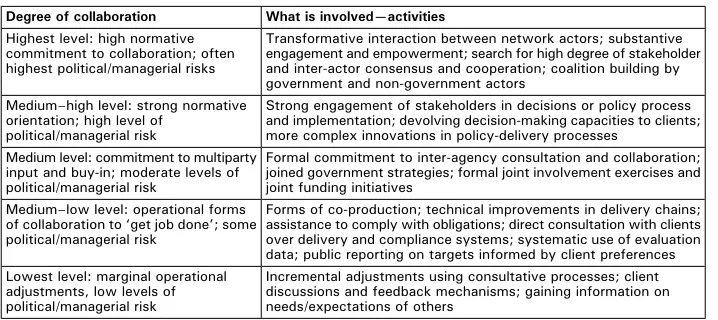
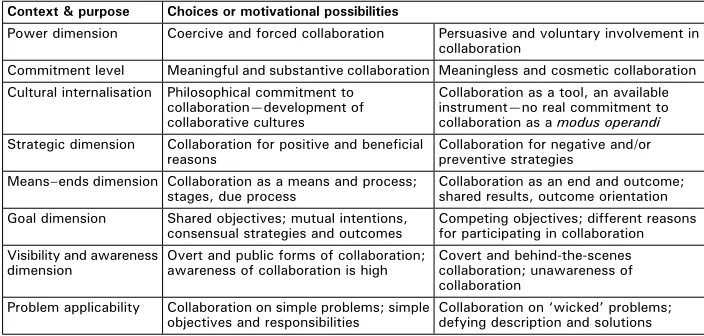
[image:20.499.79.438.462.622.2]Conceptually, therefore, we have two distinct dimensions of collaboration that intersect continually and differentially: first, the scale or degree of collaboration, and second, the context, purpose or motivation behind collaborative activity. The scale or degree of collaboration categorises patterns of activity that are either evident or intended. It focuses on what levels of collaborative activity are apparent and how extensive are the dimensions of collaboration. In tabular form, the scale of collaboration can be depicted as an escalating ladder of commitment—from the lowest level of perfunctory collaboration to the highest and most elaborate level of integration (this would be similar to Arnstein’s ladder of consultation). Table 1.1 lists the levels of collaboration relevant to the policy process and indicates what activities are involved at each of the various levels. Second, collaboration does not occur in a vacuum. We also need to consider the context, purposes, choices and motivations of actors seeking to collaborate. Here, rather than an escalating ladder, we have a set of possible intentions and motivations that provides us with a range of alternatives or contrasting approaches. These options are listed in Table 1.2.
Table 1.1 The scale of collaboration
What is involved—activities Degree of collaboration
Transformative interaction between network actors; substantive engagement and empowerment; search for high degree of stakeholder and inter-actor consensus and cooperation; coalition building by government and non-government actors
Highest level: high normative commitment to collaboration; often highest political/managerial risks
Strong engagement of stakeholders in decisions or policy process and implementation; devolving decision-making capacities to clients; more complex innovations in policy-delivery processes
Medium–high level: strong normative orientation; high level of
political/managerial risk
Formal commitment to inter-agency consultation and collaboration; joined government strategies; formal joint involvement exercises and joint funding initiatives
Medium level: commitment to multiparty input and buy-in; moderate levels of political/managerial risk
Forms of co-production; technical improvements in delivery chains; assistance to comply with obligations; direct consultation with clients over delivery and compliance systems; systematic use of evaluation data; public reporting on targets informed by client preferences Medium–low level: operational forms
of collaboration to ‘get job done’; some political/managerial risk
Incremental adjustments using consultative processes; client discussions and feedback mechanisms; gaining information on needs/expectations of others
Table 1.2 Contrasting context, purpose, choices and motivations of collaboration
Choices or motivational possibilities Context & purpose
Persuasive and voluntary involvement in collaboration
Coercive and forced collaboration Power dimension
Meaningless and cosmetic collaboration Meaningful and substantive collaboration
Commitment level
Collaboration as a tool, an available instrument—no real commitment to collaboration as a modus operandi
Philosophical commitment to collaboration—development of collaborative cultures Cultural internalisation
Collaboration for negative and/or preventive strategies
Collaboration for positive and beneficial reasons
Strategic dimension
Collaboration as an end and outcome; shared results, outcome orientation Collaboration as a means and process;
stages, due process Means–ends dimension
Competing objectives; different reasons for participating in collaboration Shared objectives; mutual intentions,
consensual strategies and outcomes Goal dimension
Covert and behind-the-scenes collaboration; unawareness of collaboration
Overt and public forms of collaboration; awareness of collaboration is high Visibility and awareness
dimension
Collaboration on ‘wicked’ problems; defying description and solutions Collaboration on simple problems; simple
objectives and responsibilities Problem applicability
Changing patterns of collaboration in public policy:
historical eras
In public policy, we can identify different historical eras with distinct patterns of collaboration, perhaps indicating an evolution of practice. For example, from the outset of Australia as a nation, there was very little attempt to build collaboration into the design of Australian federalism and/or to practise it in the early years of Federation. Indeed, federalism can be interpreted from a Jeffersonian standpoint as an intentionally fragmented model of government with a high degree of decentralised autonomous powers. Jurisdictions retained separate responsibilities (sometimes misleadingly called ‘coordinated federalism’). From this perspective, collaboration was not the essence of the chosen system of government, nor was it a particular priority of early governments. Attempts at collaboration would therefore have to work against the structural logic of federalism to succeed, and there would always remain a structural tension in such endeavours. This was characteristic of Australian governments in the first decades after Federation.
projects had to be controlled and planned; and often governments did not learn from or build on their experiences of collaboration.
In the era of managerialism and rationalisation of the 1980s and 1990s, governments selectively used competition and forms of collaboration with market players to deliver their core business activities (Entwistle and Martin 2005). They separated roles and responsibilities, then coordinated delivery systems through contract management, funding arrangements and purchaser–provider relations. Governments believed they could improve delivery methods only by engaging in collaboration—which itself implied that they had also to specify outputs or results, control prices and select and monitor external providers. Collaboration occurred less across government than between government and third-party providers—involving individual government agencies and a myriad non-government providers (firms, charity-based and community providers). From the government’s perspective, collaboration could involve a range of relationships, from arm’s-length, hands-off contract management to close interaction and mutual partnerships. The rationale for greater collaboration was often given in terms of cost containment and economic criteria and/or providing client groups with greater accessibility to government programs. The lessons from this era tended to stress the value of market testing and provision while avoiding incurring new dependencies or capture. Collaboration was often on the government’s terms or not at all.
By the turn of the century, governments were becoming interested in higher levels of collaboration—especially in vertical and horizontal collaboration, in whole-of-government integration, joint solutions and in various active partnerships. Governments began to redefine themselves as ‘facilitators’ engaged in ‘value chains’ and working through markets, rather than autarkic ‘doers’ who owned, operated and produced things themselves. They realised and accepted that they were reliant on a host of other actors in order to deliver effective outcomes. These other actors were potentially able to deliver better services because they had special knowledge and skills, had market access or specialisation or concentrated their efforts in key parts of the delivery chains. Four types of collaborative relations between actors became apparent:
• collaboration within government, involving different agencies and players • collaboration between governments, involving agencies from different
jurisdictions
• collaboration between governments and external third-party providers of goods and services
• collaboration between governments and individual citizens/clients.
instrument across the fields of public policy. Governments relied on collaboration to improve policy formulation (using such bodies as consultants and think tanks). They used collaboration to improve implementation and provide more integrated services (using firms, charity organisations and community associations). Governments could extend access regimes and widen the reach of policy using a matrix of local players, incentive payments and one-stop shops. Collaboration became an essential modus operandi for coping with crisis management and emergency situations, involving the coordination and mutual assistance of diverse specialist agencies. Collaboration now took on the mantle of managing mutual dependencies using diplomacy, dialogue and deliberation. Collaborators on all sides, however, questioned the effort–value equation and searched for ways to predict the ingredients of successful collaboration.
The vocabulary of governments also changed. They began to talk of engagement, connected government and collaboration as a new era of public administration (‘public administration of the future’). In part, the language change was strategic and transformational, but in part it was also exhortatory (encouraging administrators to attempt collaboration to assist them in doing their jobs better). Collaboration was not framed within the mind-set of bureaucracy, but was beyond bureaucracy. Collaboration was by now the next wave of public-sector reform (after hierarchy, managerialism, ‘new public management’ and outsourcing and market delivery). It allowed governments to reconsider where they could best direct their strategies and energies to achieve desired outcomes. Governments sometimes chose to keep selected services or assets in public hands (for example, the benefit-payments system, the national rail track, regimes of safety regulation), but such decisions were made because governments felt they then had the appropriate springboard to build collaborative arrangements to deliver preferred outcomes. Governments began to build networks, coalitions and partnerships, but these arrangements were not meant as ends in themselves; rather, the investment in such collaborative arrangements was intended to improve services and government-to-citizen relations. Collaboration began to mean working with and through others for greater effectiveness.
traditions of coordination through and across cabinet. Central and line agencies in these countries overtly recognised the need for collaboration across government jurisdictions and agencies (and eventually collaboration with business and community organisations).
Drivers of collaboration today
We can cluster the drivers of collaboration under three headings: external drivers, internal drivers and volition in relation to the roles and responsibilities of government. External drivers include the pressures of globalisation, greater international connectedness and travel, knowledge of other cultures, information technology (IT) and technological sophistication. Economic pressures have also played a crucial role—with the push to develop world markets, global trade, international investment patterns, business aggregations and demand for uniform regulation, competitive neutrality and specialisation. Terrorism and national security concerns (including immigration and people movement) have also crystalised these global pressures in ways that go to the heart of the authoritative nature of the State. Global environmental, physical and resource pressures have forced governments to engage in international dialogue and action to manage these problems. Community demands, education, changing demographics and social structures have also changed expectations and understandings.
Internal drivers and preconditions within government include the political demands for public officials to be ‘responsive’ to community needs. Policy reach and accessibility are powerful drivers, as are policy orientations towards mutual obligation and reciprocity. Making policy outcomes more effective is also a major factor. This can include responsive resource systems, flexible budgetary frameworks and the managerial focus on outcomes and performance results. The growing preference for and greater reliance on contract provision necessitates basic forms of collaboration with external providers and the management of relations. Capacity issues inside government agencies and the changing composition and skills base of the public sector (from an operational focus to an emphasis on policy and management roles, with staff recruits shifting from school-leavers to graduates) have made collaboration a necessary imperative of modern management.
Advantages and opportunities versus disadvantages and
weaknesses
The advantages of collaboration are that it often assists policymakers to identify and target problems and achieve stakeholder agreement or acceptance of directions or decisions. It can be a means to better policy solutions that have greater traction in the community. It can contribute new visions or perspectives on problems and thus offer new opportunities to implement strategies for change. It can allow governments to take the initiative and get on the front foot. For public officials engaged in policy formulation, it can be either a way of genuinely opening up the policy process to wider ideas and suggestions or a way of road-testing ideas and collating responses before implementation. For non-government players, it allows them to understand better the thinking and practices of government and to exert some influence on policy determination or amendment.
Collaboration can lead to mutual learning and shared experience. It can provide direction for capacity building inside and outside organisations (either through the recruitment of different profiles and skills or the development of networks of supportive/dependent contributors). Many government agencies now work jointly with private-sector providers to the mutual benefit of both parties. A commitment to collaboration is also likely to drive organisational change and affect resource reallocation. It can spawn new organisational and interactive forums—from dedicated task forces to reference groups and advisory bodies, or from new authorities and policy forums to new intergovernmental bodies.
Collaboration in implementation has the advantages of clarifying roles and responsibilities, combining relevant skills and capacities, allowing specialisation and enabling public bureaucracies to be far more effective in delivering policy to the ground. It can be used to develop markets and bring into the policy process additional players who were not previously involved. It can also make governments conscious of the real value-for-money issues involved in delivering policy effectively (specifying outputs, prices, reporting requirements, and so on).
Collaboration can blur lines of accountability even further than their current state. This raises questions about who is responsible for what and who is ultimately accountable for decisions taken, if problems emerge or if things go wrong. Collaboration can increase the blame game and excite complaints when the expectations of stakeholders are not met or are frustrated. Indeed, the promise of collaboration can heighten expectations that are likely to be dashed in practice. Collaboration can frustrate rather than expedite decision making. Interdepartmental committees once had the reputation of being the graveyard of decision making; the combatants of such committees went along to meetings to defend their turf and prevent decisions being taken contrary to their interests. Many considered a successful outcome of such meetings was that no decision was taken or that potential action was averted.
Non-government actors can have other problems. From the viewpoint of business and community associations, they could feel that they are not necessarily bound by collective processes or consensual agreements—or cannot speak for their sector or ensure compliance with collective agreements. Governments can impose formal or informal constraints on their behaviour—imposing ‘gag’ conditions in legal contracts, insisting on vetting public comments or presentations and vetoing the selection of staff working for non-governmental organisations. Conversely, non-government actors can disengage and disrupt policy delivery at times of their own choosing, and have no real accountability for any final outcome.
Collaborative exercises can run at cross-purposes if the objectives and incentives of the participants are not aligned or compatible. Shared preferences can be the exception rather than the rule. For some technical purists or expert specialists in the policy process, collaboration can be perceived as leading to second-best solutions (or even to lowest common denominator solutions) if participants possess veto rights or can sway decisions (even if such outcomes are workable). Governments have attracted criticism for not being entirely genuine in collaborative engagements. Collaboration can be undertaken for ulterior political motives. It can be cosmetic or a smokescreen for action. It can be used to ‘sell’ decisions decided elsewhere or taken previously by departments. Collaboration then becomes an exercise in the dissemination and promotion of government policy. Such examples of perfunctory collaboration can undermine trust in government and in the policy process more generally.
Lessons from collaboration
analyse the ‘black box’ of opacity that often characterises the practice of collaboration (Thomson and Perry 2006). Already from experiences and from the literature, we know that collaborative arrangements are costly in time and resources, are inherently fragile, need to be constantly managed and nurtured, involve trust and reciprocal obligations and are sui generis or uniquely distinct (Huxham 2005; Entwistle and Martin 2005; Agranoff 2006; Bardach 1998; and, for the private sector, see Simonin 1997). We know that successful collaboration requires commitment, trust, leadership, clarity of objectives and planning stages, developing understanding and mutual working relations (Huxham and Vangen 2000). From within government there is a belief that collaboration works best when responsibilities are clear and when a lead agency or ‘champion’ has been selected. Is this empirically valid? Can responsibilities be clearly separated in collaborative ventures and can leadership be successfully anointed in an a priori
manner? How can the momentum for collaboration be generated and sustained? In this monograph, many of the contributors speak from years of practical experience engaged in collaborative endeavours. Many identify general lessons from their specific if diverse experiences. Some of the lessons highlight the perspectives of the individual players (the official, the community representative, the business manager, or the end user) about what collaboration entails, how it impacts on them and how players can collaborate better. Others present collaboration as a new organising principle of government and policymaking—a structured set of collective choices from which new policy possibilities develop and germinate—feeding into policy formulation, implementation and evaluation. Others tend to see collaboration as a new form of democratic engagement bringing substantial deliberative benefit to the development of good public policy and quality services. Others disseminate comparative policy learning from overseas—indicating how other jurisdictions have gone about the journey of collaboration in policy setting, encouraging policy transfer or emulation and illustrating how beneficial outcomes have been achieved in their particular context.
References
Agranoff, R. 2006, ‘Inside collaborative networks: ten lessons for public managers’, Public Administration Review, December.
Bardach, E. 1998, Getting Agencies to Work Together: The practice and theory of managerial craftsmanship, Brookings Institution, Washington, DC. Entwistle, T. and Martin, S. 2005, ‘From competition to collaboration in public
service delivery: a new agenda for research’, Public Administration, vol. 83, no. 1.
Huxham, C. 2005, Managing to Collaborate: The theory and practice of collaborative advantage, Routledge, New York.
Huxham, C. and Vangen, S. 2000, ‘Leadership in the shaping and implementation of collaboration agendas’, Academy of Management Journal, vol. 43, no. 6.
Simonin, B. 1997, ‘The importance of collaborative know-how: an empirical test of the learning organisation’, Academy of Management Journal, vol. 40, no. 5.
Thomson, A. M and Perry, J. L. 2006, ‘Collaboration processes: inside the black box’, Public Administration Review, December.
Watt, I. and Dangerfield, G. 2007, Arrangements for Facilitating Trans-Tasman Government Institutional Co-operation, Australia New Zealand School of Government, Carlton, Victoria.
Wildavsky, A. 1973, ‘If planning is everything, maybe it’s nothing’, Policy Sciences, Volume 4, no.2, pp. 127-153.
ENDNOTES
1 Thomson and Perry (2006:20) state that collaboration in the United States has its roots in two competing
2. Governing through collaboration
Dr Peter Shergold
There are new and exciting changes occurring in the processes of governance, which have profound implications for public services. The provision of policy advice is becoming more contested. The views of officials now compete with those of political advisers, advocacy organisations and policy think tanks. The implementation of policy is increasingly contracted out and delivered through third parties, with the Public Service taking responsibility for oversight, evaluation and accountability.
At the same time—and significantly extending these developments—broader networks of policy influence are emerging. They demand new ways of doing things and new forms of leadership behaviour. At the heart of these changes lies the growing importance of collaboration—across government agencies and jurisdictions and between the public, private and not-for-profit sectors. In Australia, these trends are evolving within a Westminster form of government, set within a federal system, much (but not all) of it articulated in a written constitution. The Australian systems’ sovereignty, majority-party control of the Executive, ministers accountable to parliament, the cabinet as the basis of collective responsibility, institutionalised opposition and parliamentary conventions and rules of debate.
This system of representative and responsible government provides an institutional framework for managing political debate in democratic ways. Within this structure, the Australian Public Service (APS) plays a key role. Much of its influence is hidden, in that it provides advice to the government of the day in confidence. It works, however, within an environment of political contest in which decisions are subject to parliamentary questioning and intense media scrutiny. The delicate balance between responsiveness to government direction and Public Service independence is a matter of continuing public debate. Public servants provide support to ministers. They put forward non-partisan policy advice, but, sometimes after robust behind-the-scenes discussion, they accept the directions set by government. They implement the policy decisions of government whether or not their advice has been taken. They draft the legislation, deliver the programs and services and provide the regulatory and compliance framework for government.
not recruited or promoted on the basis of party affiliation or political allegiance. The APS serves successive governments with equal commitment. It accepts the right of the Executive to set directions and make decisions. It is accountable, through ministers, to parliament.
There have been some fundamental developments in the past 30 years, such as the emergence of ministerial advisers (employed outside the Public Service Act) and the growth of a panoply of mechanisms to provide administrative review of decision making. At the same time, in a form often characterised as ‘new public management’, the Public Service has increasingly assessed its performance against the achievement of explicit outputs and outcomes—not just the ethical deployment of inputs. Nevertheless, until now the traditional structures of Westminster have continued to frame the relationship between the government and the APS. Greater change could beckon.
Let me tell a personal story. My job seems to be getting harder. In part, that’s because government gets ever busier. The volume of legislation is rising. The number of policy measures is increasing. Here’s one example: whereas there were 353 individual budget items in 2001–02, there were 532 items in 2006–07. At the same time, my job is becoming more intense. I discern that the speed with which government expects programs to be delivered is intensifying. New forms of technology are adding immediacy to decision making and public communication.
Concurrently, new, more complex institutional structures of governance are emerging, which take many forms. Within the Public Service, much authority has been devolved to individual agencies. The number of these organisations has increased with time and many wield various levels of statutory independence. To some extent, specialist agencies have assumed the power that was traditionally the provenance of departments of state. Consequently, the need for inter-agency, cross-jurisdictional involvement is rising. So, too, is the requirement for contracts, memorandums of understanding, partnerships and alliances to establish continuing relationships across the public–private divide.
Partly in response, I have established a Cabinet Implementation Unit (CIU) in my department (Prime Minister and Cabinet, PM&C) to oversee the delivery of government programs. Today, 16 per cent of the programs the CIU is monitoring in its ‘traffic-light’ implementation reports to cabinet involve three or more Commonwealth agencies in delivery or are based on agreements between the Commonwealth and the states. The challenges of inter-agency and/or inter-jurisdictional cooperation are each responsible for one-quarter of the reasons given by agencies for programs accorded ‘amber lights’ (indicating potential delivery problems).
At the same time, more stakeholders are being given an opportunity to contribute to the processes of governance. An emerging trend is for policy to be progressed through task forces. My department has hosted no fewer than 62 individual task forces since 1999–2000. Many are internal to the Public Service, effectively operating as a full-time interdepartmental committee (IDC), brought together for a specific purpose. Increasingly, however, they are being widened to include participation from the private and not-for-profit sectors, often with secretariat support. They are being given the opportunity to provide advice to government on specific issues.
Typical is the Task Group on Emissions Trading, which I chaired (as Secretary of PM&C) from its establishment in December 2006 until it presented its report to the Prime Minister in May 2007. It comprised a group of seven private-sector business leaders and five Public Service secretaries, supported by a high-level secretariat drawn from a range of agencies. Innovatively, the secretariat was also widened to include outside representation (from the Business Council of Australia and the Australian Industry Greenhouse Network). Its conclusions—to support the introduction of an Australian cap-and-trade emissions trading system—were accepted by the government. The APS is now tasked with implementing that decision.
Such task forces are taking an increasingly significant role, including even the oversight of the implementation of government policy. I have just become a member, for instance, of the Northern Territory (NT) Emergency Response Taskforce. Its key role will be to provide advice to government on the diverse operational issues associated with Commonwealth intervention in remote Indigenous communities. It will require a high degree of collaboration between Commonwealth departments, the Australian Defence Force, the Australian Federal Police, NT government agencies and non-governmental organisations.
the basis of outcomes and procurement decided on the criterion of performance. The contracted organisations enjoy greater autonomy with respect to delivery processes than is normal in public-sector agencies. Crucially, the Public Service (the purchaser) remains accountable as manager for the ethical conduct of the contracted body (the provider).
Let me again give a personal instance. The Job Network was established in May 1998 to replace the 50-year-old government provider, the Commonwealth Employment Service (CES). I had responsibility for the network while I was secretary of the Department of Employment, Workplace Relations and Small Business from 1998 to 2002. Indeed, in 1999, I was the decision maker on a tender for the reallocation of business, which, controversially, saw the dominant public provider (Employment National) lose most of its work. It had found itself unable to compete effectively on performance with private and community-based organisations. Today, the network has more than 100 competing providers, predominantly from the private and not-for-profit sector, operating from 1100 locations around Australia. It delivers job placement, job-search training and customised assistance to job-seekers, worth about $1.2 billion annually.
Outsourcing began as a competitive form of procurement. It used the market to secure the best value for money in achieving required government outcomes. It required Public Service contract management to meet required standards and to assess performance. The rationale of third-party delivery is, however, now changing. Increasingly, it has become clear to me that the Job Network’s success depends on continuing collaboration between the APS and delivery agents. It calls for relationship management in order to facilitate innovation and continuing improvement in the long term.
A contractual relationship, based initially on compliance, has the potential to be transformed by collaboration. Third-party delivery has the capacity to evolve into a partnership in which public and private goals and values become ever more similar.
Stakeholders are also increasingly important. Again, let me inform my remarks by personal experience. In 2002, when I was secretary of the Department of Education, Science and Training, I launched an ‘Open for Business’ initiative, which was designed to make the department more externally focused. It sought to recognise formally as stakeholders those organisations and individuals who shared the department’s interest in university, vocational and school education, skills training and science policy.
A ‘Stakeholder Charter’ was drafted and used as the basis for informing expectations and assessing the extent to which they were met. It has proved an important vehicle for building and maintaining levels of trust across the ‘network’ of those who engage with government. The third Stakeholder Perception Survey
the relationship between public servant and external advocate had progressively improved. Indeed, overall satisfaction levels have risen since my time and are now at more than 85 per cent. The goals of accessibility, engagement and inclusiveness have largely been met.
Challenges remain. The department receives considerable positive feedback on the opportunities it now provides for networking, general discussion and helping stakeholders to understand government policies and programs. Perceptions, unfortunately, are less satisfactory in terms of the department consulting stakeholders early in the process of policy development and facilitating their influence on policy. Here, too, is a relationship, originally premised on notions of consultation and communication, that has the potential to be transformed through collaboration into participatory governance.
Other structures of governance are already evolving into partnerships. I take as my personal example the Area Consultative Committees (ACCs), which were established in 1994 to generate support for the government’s labour-market programs. Today, there are 54 ACCs. They take particular responsibility for promoting and facilitating projects under the Regional Partnerships Program. With time, the ACCs have also played a growing role in promoting government programs and helping small business to respond to them. To this end they have hosted Indigenous employment policy officers (to promote training and job opportunities for Aboriginal and Torres Strait Islanders), goods and services tax (GST) support officers (to advise and assist small business on changed tax arrangements), sugar resource officers (to facilitate the restructuring of the Queensland sugar industry) and AusIndustry/Austrade outpost officers.
The ACCs remain volunteer-based organisations whose administration is funded by government and supported by the Public Service. They have provided a vital conduit between regional areas and the Australian Government. They have proved an effective means by which to link government to business and the community at the local level, to facilitate public–private dialogue, to promote access to government programs, to advise on government projects and to build stakeholder networks. Here, again, is the potential for greater collaboration.
Australia. Initially, they focused on the funding of discretionary projects, but they have become progressively more complex.
The goal is not just to provide a vehicle for delivering publicly funded initiatives tailored to local need, or even to establish a mechanism for channelling whole-of-government effort: beyond that, SRAs serve to articulate in concrete terms the government ethos of mutual obligation. Success clearly requires a commitment to consultation and negotiation. Even more effective would be government–community collaboration.
This variety of new network arrangements—many still in the early stages of development—suggests an evolutionary process is under way. Government, it would appear, is being transformed into an ‘enabling state’. Sources of authority and influence are becoming more diffused. A ‘shared-power world’ beckons. Some argue that the State is becoming weaker and ‘hollowed out’. Sovereign decision making, it is argued, is increasingly constrained by the growing importance of international regulatory and legislative frameworks and by the impacts of globalisation. Both serve to weaken national autonomy.
At the same time, it is suggested, government is reducing the scope of its public interventions, leaving more to the market. The commercialisation of government enterprise continues apace. Accompanying this, the Public Service is becoming enmeshed in a series of horizontal networks that limit (or crowd out) its influence. It is left with only ‘rubber levers’ to achieve government objectives. Its influence is concomitantly weakened.
I am not persuaded by this interpretation. While the State certainly appears to be changing its mode of operation, I see no indication of a diminution in the government’s desire to shape society. Rather, government appears to be embracing new interventions. It now seeks to extend its influence to private behaviour (for example, smoking, the use of alcohol, sexual conduct, obesity and respect for the rights of others).
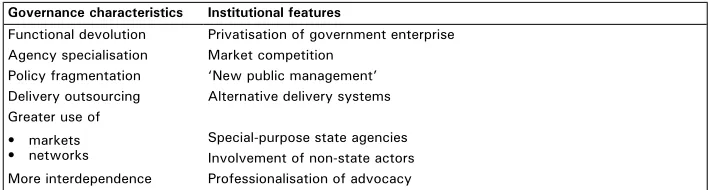
[image:34.499.78.432.552.647.2]Whether or not the State is weakening, the structures of governance are widening, influenced by a complex interrelationship of organisations. A ‘differentiated polity’ is emerging, distinguished by governance characteristics and institutional features. Table 2.1 summarises the key elements.
Table 2.1 The differentiated polity
Institutional features Governance characteristics
Privatisation of government enterprise Market competition
‘New public management’ Alternative delivery systems
Special-purpose state agencies Involvement of non-state actors Professionalisation of advocacy Functional devolution
What we are witnessing appears to be the emergence of a ‘centreless society’ in which public policy is made and delivered by an interdependent mix of government, markets and networks. Institutional networks in which sources of influence are fragmented are replacing the traditional hierarchical procedures, formal organisation and rules, procedures and conventions. The exercise of power is becoming more diffuse and opaque.
More players get to play a part, including advocacy groups and lobbyists. For this reason, I sometimes argue that this represents the democratisation of governance. More organisations are engaged with the political process, even as the number and influence of individual members of political parties wane. It is a new process of governing, involving non-state actors, in which the boundaries between the public, private and voluntary sectors are becoming more opaque. This is exciting. It opens new prospects. I do not, however, want to exaggerate the speed or substance of change. The Public Service remains the key to coordination. It retains positional authority. In exercising government will, the bureaucracy still dominates.
A public service remains at the political heart of governance networks. It retains extensive powers. There are many reasons for this: its resource capability; its collective experience and knowledge; its legislative and regulatory authority; the financial control it wields through grants, loans and contracts; its access to influence; and its exercise of covert power (by which I mean nothing more sinister than the provision of advice on the basis of confidentiality).
The processes of public-sector collaborations often continue to reflect implicit hierarchical relationships between the actors. The government (or its public service) often externally imposes the structure of public-sector collaborations. It decides on representation. Bureaucracy can exert covert power through access to information and its capacity to marshall resources. It benefits from direct access to government ministers.
Structures tend to maintain public service dominance. The real work of collaboration is generally done in committee or through a secretariat, usually provided by the bureaucratic ‘host’. Decision making continues to reside with the government, not with networks (although it is now subject to more contest, wider scrutiny and greater ‘outside’ influence). While the deliberative processes of networks result in agreements, conclusions or recommendations, most decisions are still taken outside the collaborative group. In short, neither the Public Service nor the government operates within the network of governance as ‘just another organisation’.
it is the responsibility of the government to decide that interest). The environment in which it wields its influence is, however, changing. The Public Service is playing out a traditional role in contemporary circumstances. Increasingly—outside or within government—its power is that of persuasion. Certainly, the coordinating mechanisms are changing—so are the modes of achieving outcomes. At the risk of gross simplification, I discern a move from command, through coordination and cooperation to collaboration (Table 2.2).
Table 2.2 The transformation of process
The process of centralised control—with clear lines of hierarchical authority Command
The process of collective decision making—imposed on participating institutions
Coordination
The process of sharing ideas and resources —for mutual benefit Cooperation
The process of shared creation—brokered between autonomous institutions Collaboration
Increasingly, governance outcomes (the development and delivery of public policy) require the collaboration of a diversity of interested parties. They possess varying degrees of influence, autonomy and capability and often exhibit competing interests, expectations and values.
At its best, collaboration adds public value to the process of governance. It allows participants to learn alternative modes of behaviour and new ways of doing things. It provides mutual benefit to participants, stimulates the development of a mutual inter-agency or inter-organisational culture and helps create and manage knowledge.
Genuine collaboration in governance involves recognition of interdependence within the network of institutional structures. It depends on accepting mutuality of interest. It should not naively assume consensus. The parties will often come to the table with competing interests. Their different perspectives will be resolved—indeed, they will be properly understood—only by interaction and negotiation. The entire process of seeking solutions needs to be iterative: not just reaching agreement on answers, but jointly framing the questions and identifying the problems.
The success or failure of collaboration lies not in the emerging network structures of governance or even in the evolving systems by which influence is wielded. It requires new forms of leadership behaviour, particularly on the part of the public servants who remain central to most discussions of public policy and administration. Instead of agendas being imposed, they need to be negotiated. Collaboration demands public servants who can stand in the shoes of those with whom they deal, who can understand their particular perspectives and interests and, by doing so, can build trust. Collaboration can also be enhanced by a clear indication that public servants will champion the collective decisions of the group—using their disproportionate power on behalf of the collaborative venture.
Genuine collaboration will not come about simply as a result of evolving networks of democratic governance or the changing role of the nation-state. It requires public servants who, with eyes wide open, can exert the qualities of leadership necessary to forsake the simplicity of control for the complexity of influence. More explicitly, they need to operate outside the traditionally narrow framework of government, which they have for so long worked within.
Public Service leadership has always been premised on the ability to influence. The challenge now is to extend that capacity from government structures to governance networks. While it will not be an easy path to travel, the prospect is alluring.
References
Agranoff, R. 2006, ‘Inside collaborative networks: ten lessons for public managers’, Public Administration Review, December.
Entwistle, T. and Martin, S. 2005, ‘From competition to collaboration in public service delivery: a new agenda for research’, Public Administration, vol. 83, no. 1.
Huxham, C. and Vangen, S. 2000, ‘Leadership in the shaping and implementation of collaboration agendas: how things happen in a (not quite) joined-up world’, Academy of Management Journal, vol. 3, no. 6, December. Kirkpatrick, L. 1999, ‘The worst of both worlds? Public services without markets
or bureaucracy’, Public Money and Management, vol. 19, no. 4.
Mandell, M. P. 1999, ‘Community collaborations: working through network structures’, Policy Studies Review, vol. 16, no. 1.
Rhodes, R. A. W. 1997, ‘From marketisation to diplomacy: it’s the mix that matters’, Australian Journal of Public Administration, vol. 56, no. 2. Sullivan, H. and Skelcher, C. 2003, Working Across Organisational Boundaries:
3. The changing nature of government:
network governance
William D. Eggers
Governing by network is at the heart of numerous major Australian Federal Government initiatives.
In the twentieth century, hierarchical government bureaucracy was the predominant organisational model used to deliver public services and fulfil public-policy goals. Public managers won acclaim by ordering those under them to accomplish highly routine—albeit professional—tasks with uniformity but without discretion. Today, increasingly complex societies force public officials to develop new governance models.
In many ways, twenty-first-century challenges and the methods of addressing them are more numerous and complex than ever. Problems have become both more global and more local as power disperses and boundaries (when they exist at all) become more fluid. One-size-fits-all solutions have given way to customised approaches as the complicated problems of diverse and mobile populations increasingly defy simplistic solutions.
The traditional, hierarchical government model simply does not meet the demands of this complex, rapidly changing age. Rigid bureaucratic systems with command-and-control procedures, narrow work restrictions and inward-looking cultures and operational models are particularly ill suited to addressing problems that often transcend organisational boundaries.
The hierarchical model of government is in decline, pushed by governments’ appetites to solve ever more complicated problems and pulled by new tools that allow innovators to fashion creative responses. This push and pull is gradually producing a new government model, in which executives’ core responsibilities no longer centre on managing people and programs but on organising resources—often belonging to others—to produce public value. We call this trend ‘governing by network’.
Complex public–private, network-to-network collaboration models now operate, with varying degrees of success, in nearly every area of Australian government. As outsourcing, partnerships and network models multiply, scores of Australian public agencies have become de facto contract-management agencies.
that service delivery by government is also adapting to a new context by relying on various partnerships with others. In such circumstances, networking becomes a critical skill for public-sector managers.
Whether the challenge is responding to natural disasters such as the South-East Asian tsunami or protecting Australia’s citizens and critical infrastructure from terrorism, there is a growing recognition that the traditional, hierarchical model of government is inadequate
Governing by network: a new model of achieving results
The fundamental issue facing many Australian government executives today, across the various levels of government, is how to conceptualise, configure and manage a network of public, private and non-profit providers in a way that generates increased value for citizens.
In the past year, I have spent time with dozens of senior Australian government officials and leaders from the private sector and Australia’s fledgling non-profit community, talking about the future of government. We have met with chief executives from many of the largest federal agencies in Canberra, senior public servants in Victoria, New South Wales and Queensland, and numerous local government officials. The purpose of these meetings has been to discuss the ways in which modern governments are changing to meet today’s challenges. Governing by network cannot succeed without robust knowledge sharing. Cross-sectoral knowledge sharing can help develop new knowledge, flesh out solutions to daily problems, enhance learning across the network and build trust and aid in learning from one another’s successes—and mistakes. These capabilities, in turn, can help government better integrate and align its own strategic objectives with those of its partners.
A fundamentally different approach
These discussions have convinced us that hierarchical government bureaucracy—the principal organisational model used for more than a century to deliver public services in Australia and most of the developed world—is beginning to give way to a fundamentally different approach.
Governing by network is at the heart of numerous major Australian Federal Government initiatives. The Department of Employment and Workplace Relations’ welfare-to-work program relies mostly on a network of hundreds of private and non-profit organisations to move individuals from dependency to independence. Different commercial and contractual arrangements and relationships exist across the different sub-national jurisdictions and regional markets.
government information and transactions relevant to business. Partners such as Westpac, CPA Australia (the sixth-largest accounting body in the world) and NineMSN (Australia’s top web site) are just a few of the active companies that use the Business Entry Point’s reverse portal service to offer value-added resources to their customers.
At the state level, Gary Tweedlie, the chief executive of Victoria’s WorkCover Authority—the state accident fund that insures about three million workers and oversees workplace safety—has used a networked model to dramatically improve the agency’s performance. Performance-based contracts with four major insurers and two third-party claims administrators have helped to reduce the agency’s liabilities by more than $1.5 billion. On the safety side, workplace injuries have been cut through a bevy of partnerships with trade unions, businesses and professional associations.
Challenges posed for governments by working through
networks
The movement from command government to networked governance is not just a recent phenomenon in Australia. It is a global development driven by various business and societal forces. It was led by the public’s growing demand for personalised and integrated services, the plummeting costs of engagement and collaboration (thanks to the Internet and other new technologies), the enhanced level of outsourcing and the growing number of complex problems that demanded cross-governmental and cross-sectoral responses. Network governance has also enabled governments to extend their influence and responsibilities into areas of community need and value. These expectations and societal forces have in turn confronted governments with other difficult choices.
As local, state and federal governments and agencies in Australia continue the journey to more networked governance, it is important to recognise that while government by network offers vast benefits (including greater reach and specialisation), it also poses serious challenges and policy dilemmas. It is not always a ‘win-win’ or ‘costless’ transition.
intervene? Should contracts be let to such providers in the future? Network governance places traditional and new forms of accountabilities on elected governments.
Safeguarding the public interest
Sometimes the public purpose or public value line blurs or becomes distorted. This is one reason why public officials must be careful to protect important values at every stage of the process. In many collaborations that involve a great deal of necessary messiness, it means asking questions such as: what are the core values that governments must protect; how can public officials maintain the integrity of these values; what is the best and most appropriate role for the government in the delivery of desired services; and how will accountabilities and potential risks be managed? Answering these questions requires working through issues such as access to services, citizen costs, fairness and equity, financial accountability, sustainability and stability and quality of service.
Networking also involves human-resource challenges for
traditional governments
Another daunting challenge for networked governance is dealing with the people issue. Managing in a networked environment requires a whole set of competencies and capabilities separate to and beyond those expected of hierarchical government. In addition to knowing about planning, budgeting, staffing and other traditional government duties, networked management requires becoming proficient in tasks such as collaboration, engagement skills, negotiating deals as well as working with and managing third-party service providers. These skills are not currently uppermost in government—and many of these skills defy or confound the traditional emphasis on due process and conventional control orientations. Such skills will also tend not to flourish in agencies in which a self-protective mentality reigns or in which a culture of turf ownership is prevalent. Networking means letting go to some extent in order to achieve better outcomes for citizens.
Today, government agencies need senior public officials who can see through restrictive government walls and defensive practices into the potentiality of relationships that might produce value. They need to develop agile managers with sophisticated skills in team building, project management and risk analysis.
Employees today need much more mobility and opportunity to move from project to project without sacrificing career advancement. Highly restrictive human-resource and public-sector regulations need updating to enable employees to bring broad skills to their assigned projects, unrestricted by the narrow ‘bands’ or grades in which they are employed.
Lynelle Briggs, Australia’s Public Service Commissioner, recently argued that government leaders must look for people with broader skill sets and more flexible deployment patterns. She argued that ‘the future will be one of greater diversity in careers…more movement in and out, with more part-time and different working patterns’. The question is: is the sector prepared for this change and can it anticipate and deal with the consequences?
A final summary
Sometimes networked governance fails not because of how a particular venture is managed, but because of what was delegated to the private sector in the first place. All too often, precious little thought is given to what policy goals an agency is trying to accomplish and how they relate to what is contracted out. Instead, agency officials pick up their organisational chart, look for something they are not doing very well and then get the private sector to do it for them. Before federal executives think about how they should do something, they need to figure out what they are trying to do in the first place. The government executive, hamstrung by precedent and reinforced by well-intentioned bureaucratic practices, often will find it difficult to step into the larger, more important and more exciting role of conceptualising new models and solutions.
I have argued that thriving in the networked age requires governments to change the way they think