1
Sona Suhartana and Yuniawati
ABSTRACT
This study was carried out in 2005 at a peat swamp forest company in Jambi. The aim of this study was to find out a technique to increase the utilization of renghas wood in a peat swamp forest by implementing the lowest possible felling technique (LPFT) and the conventional felling technique (CFT). Data collected in this study were: working time, log volume, waste volume, productivity, efficiency, stump height and felling cost. Two data categories were analyzed with respect to their possible differences by using a t-test.
The study showed that the implementation of LPFT produced better results compared to that
3
of CFT which was indicated by: (1) Felling productivity increased to 5.220 m /hour, (2) Felling cost
3
decreased Rp 341/m , (3) Felling efficiency increased 3.2%, and (4) The average stump heights were 41.2 cm for LPFT and 67.5 cm for CFT.
Keywords: LPFT, productivity, efficiency, cost, peat swamp forest
I. INTRODUCTION
Tree felling is a process to cut tree and to bring it down without taking out the root, or an activity to extract potential volume mechanically or non-mechanically from stand tree. It is the first commercial step which its efficiency and effectivity will affect the whole timber utilization efficiency.
A peat swamp forest is one of swamp forest types which has a fragile and specific ecosystem. Its land habitat is a peat with high organic and its depth is 1-20 m; the soil is always wet with low and flat soil. The types of soil are organosol, podsol and glei humus (Soerianegara and Indrawan, 1988). Generally, vegetations at a peat swamp forest in Kalimantan and Sumatra consists of 87 species of 45 families. The tree species are nyatoh, ramin, bintangur, swamp meranti, and renghas (Daryono, 2000).
Renghas (Gluta renghas L.) has a tree height up to 30 m with the diameter up to 60 cm. It has smooth and buttress stem with brown red at its outer skin and shallow groove (peeled top skin and produced black resin). This tree grows in Sumatera (except Bengkulu), Java, Kalimantan and Sulawesi. Renghas can grow at 0-300 m above sea level with light-weight soil texture. This wood is generally used for pillar, building, housing, bridge, sleeper, furniture, panel board, floor and resin veneer for varnish (Pratiwi, 2000).
1
Considering the very high timber price, stump height should be given more attention. Some rules corresponding felling technique had been issued. However, in field activity felling operation has not yet followed standard operational procedure. This could cause a high stump which will result in low timber utilization efficiency and large waste volume. Finally, timber utilization efficiency is lower than it should be. Suhartana and Yuniawati (2006) stated that if the Lowest Possible Felling Technique (LPFT) was implemented on gmelina wood felling in East Kalimantan, it could increase timber production as much as 14.4-17.7%.
Considering that felling activity is important, its operation should consider appropriate felling technique to achieve high productivity and timber utilization efficiency. This study was conducted to increase the utilizations of renghas wood in a peat swamp forest by implementing the LPFT.
II. METHODOLOGY
A. Time, Location and Tools
This research was conducted in October 2005 on the working area of PT. Putra Duta Indah Wood Logging Concession. This logging concession was located in Forest District of Muaro Jambi, Forest Service of Jambi Province.
The topography was mainly sloping between 0 and 3% with the elevation of 5-10 m above sea level . Based on the Schmidt and Ferguson's classification, the type of climate in the research area was catagorized as “A” with monthly rainfall of 172.6 mm. The soil type was organosol and aluvial. The vegetated area was dominated by renghas trees (80%) and the other 20% was dominated by swamp meranti trees with mostly buttreesed. Tree density was 213.3 trees/ha (for diameter 10 cm and up). The undergrowth in average had intermediate density. The logging operation used chainsaw for felling and bucking , excavator for skidding, and lorries for transportation.
The study was carried out in a felling plot which was included in the Company Annual Work Plan 2005. The material and tool used in this research were paint, paint brush, plastic rope, phi-band measuring meter, gauge, stopwatch, compass and chainsaw (Stihl type 070, 15HP).
B. Procedures
The stages of this research included : 1. Determining one felling plot for tree felling.
2. Felling of the renghas trees was carried out by two techniques i.e. CFT and LPFT. The CFT was a felling technique usually used by local operator whereas LPFT was a technique that leaves the stump with the height as low as possible (<45 cm).
a. Felling productivity: felling time and timber volume.
b. Felling cost : all expenses related to felling activity which included the expenses for fuel, oil, wages, productivity, depreciation, maintenance, interest, insurance, and tax. c. Efficiency of timber utilization: tree height and diameter at the bottom and the top,
and log length.
5. General data of field condition, and secondary data from the company which were taken from company profile and having interview with employees.
C. Data Processing
1. Felling productivity : Tv
3
FP = --- : where: FP = Felling productivity (m /hr); Tv = Tree volume
3
Ft (m ) and Ft = Felling time (hour). 2. Timber utilization efficiency :
Vt
UE = --- x 100% Va
3
where : UE = Utilization efficiency (%); Vt = volume of tree taken (m );
3
Va= volume of tree that is usable (m ). 3. Felling cost :
Ed + Eis + Eit +Et+ Ef + Eo + Em + Ew P x 0.9 FC = ---; Ed = ---; FP 1,000 hours
P x 0,6 x 3% P x 0.6 x 18%
Eis = ---; Eit = ---; Ef = 0.20 x P x 0.54 x F Pr; 1,000 hours 1,000 hours
P x 0,6 x 2%
Et = ---; Em = 1.0 x Ed ; Eo = 0,1 Ef 1,000 hours
3
where: FC = Felling cost (Rp/m ); P = Tool price (Rp); Ed = Depreciation expenses
3
4. To determine the suggested technique, two felling techniques were compared on the basis of felling productivity, timber utilization efficiency, and felling cost, using T-test (Prajitno, 1981).
III. RESULT AND DISCUSSION
A. Felling Productivity
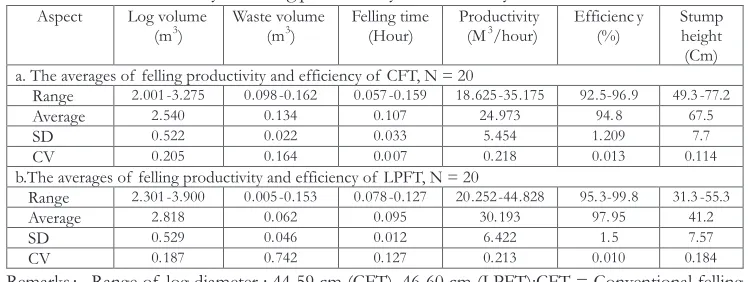
[image:4.454.40.415.229.370.2]The data summary of felling productivity using both the LPFT and the CFT is presented in Table 1, and the details are presented in Appendix 1 and 2.
Table 1. The data summary of felling productivity and efficiency Aspect Log volume
(m3) Waste volume(m3) Felling time (Hour) Productivity (M3/hour) Efficienc y(%) Stump height
(Cm) a. The averages of felling productivity and efficiency of CFT, N = 20
Range 2.001 -3.275 0.098 -0.162 0.057 -0.159 18.625 -35.175 92.5-96.9 49.3 -77.2
Average 2.540 0.134 0.107 24.973 94. 8 67.5
SD 0.522 0.022 0.033 5.454 1.209 7.7
CV 0.205 0.164 0.0 07 0.218 0.013 0.114
b.The averages of felling productivity and efficiency of LPFT, N = 20
Range 2.301 -3.900 0.005 -0.153 0.078 -0.127 20.252 -44.828 95. 3-99.8 31.3 -55.3
Average 2.818 0.062 0.095 30. 193 97. 95 41.2
SD 0.529 0.046 0.012 6.422 1.5 7.57
CV 0.187 0.742 0.127 0.213 0.010 0.184
Remarks : Range of log diameter : 44-59 cm (CFT), 46-60 cm (LPFT);CFT = Conventional felling technique; LPFT = Lowest possible felling technique; SD = Standar deviation; CV = Coefficient of variations; N = The number of replication.
Table 1 showes that the CFT which had range of log diameter felled of 44-59 cm with the
3
average log volume of 2.540 m required felling time of 0.107 hour. The felling productivity
3
was about 24.973 m /hour. While Table 1b for LPFT which had range of log diameter felled
3
of 46-60 cm, resulted in the felling productivity of 30.193 m /hour and required felling time of 0.095 hour. This indicated that the felling productivity of the LPFT was higher than that of the CFT. This was caused by LPFT log volume which was higher than that of CFT (LPFT =
3 3
2.818 m , CFT = 2.540 m ) and LPFT which was finished faster than that of CFT (LPFT = 0.095 hour, CFT = 0,107 hour). Based on the range of log diameter felled (LPFT = 46-60 cm, CFT = 44-59 cm), LPFT had high log volume and short felling time, resulted in high felling
**
productivity. The T-test result was of 2.771 , which was greater than T-table 99% = 2.705. This means that the differences of felling productivity from these two techniques were very significant. Furthermore, from felling productivity aspect, the LPFT is better than CFT.
Factors of felling productivity were log volume, felling time and the ability of chainsaw operator. The difference of felling productivity of these two techniques was 5.220
3
LPFT which could give the benefit to the company. On the other hand, the trees are mostly buttressed. This requires improvement of chainsaw operator ability in using this chainsaw in order to result high felling productivity.
B. Felling Cost
3
The felling cost per m were calculated based on productivity, purchasing, and operation cost using Stihl chainsaw type 070. The tool purchasing and operational cost were as follows; (1) Price per unit = Rp 6,500,000; (2) Fuel cost = Rp 4,500/litre (October 2005) ; (3) Expected life of tool = 1 year = 1000 hours; (4) Insurance = 3% /years; (5) Interest = 18% / year; (6) Tax = 2% / year; (7) Operator and helper wages = Rp 200,000/day; (8) Work hour per day = 7 hours; (9) Machine power = 15 HP. Based on the above data, the component expenses are presented in Table 2.
Table 2. Component felling cost of Renghas (Rp/hour)
Expense components Amount (Rp/hour) - Depreciation expenses
- Insurance expenses - Interest expenses - Taxes expenses - Fuel expenses
- Oil and grease expenses - Servicing and repairs expenses - Wage expenses
5,850 117 702 78 7,290 729 5,850 28,571
- Total machine expenses 49,187
Felling cost of renghas in each felling technique (LPFT and CFT) could be calculated by dividing the total machine expenses with the corresponding productivity of each
3
technique. The results of felling cost calculation were Rp 1,970/m using CFT and Rp
3
1,629/m using LPFT. The lower felling cost of LPFT was caused by the higher productivity
3
as of LPFT (30.193 m per hour). From felling time aspect, felling on LPFT could be finished faster than that on CFT. It indicated that fuel and oil cost can be saved. Considering felling cost aspect, LPFT is better than CFT.
C. Timber Utilization Efficiency
Table 1 also presents the average timber utilization efficiency (TUE). The average TUE value using CFT was 94.8 percent with the range of 92.5-96.9 percent. Meanwhile, the value using LPFT was 98.0 percent with the range of 95.3-99.8 percent. Such differences in
3
TUE could be caused by waste volume on LPFT which was lower (0.062 m ) than that on CFT
3 3
If the waste from stem is considered, the TUE will increase. In this paper, waste from stem is not discussed. The high waste volume indicates a decrease in TUE. Both techniques leaved varied stump height. The average stump height using CFT was 67.5 cm with the range of 49.3-77.2 cm. Whereas, the average of stump height using LPFT was 41.2 cm with the range of 31.3-55.3 cm. The difference of 26.3 cm means that CFT had loost in timber utilization because a part of stump height was still used. Further, the t-test shows that t-value was
**
7.375 , which was greater than T-table 99% = 2.705. This means that the differences of TUE from these two techniques were very significant. Moreover, LPFT was better than CFT in TUE aspect.
The measurement result of TUE also indicated that by implementing LPFT, the utilization efficiency could be improved up to 3.2%. Based on field data and quotation from
3
company office: based on the production target of 49,110.8 m /year, the average timber price
3 3
of Rp 550,000/ m , and the reasonable profit of 20% (Rp 110,000/ m ), the company was
3 3
expected to gain more profit of 3.2% x 49,110.8 m /year x Rp 110,000/ m = Rp 172,870,010/year or US $ 18,790.20. Considering the benefit of LPFT, it is promising to implement the technique.
IV. CONCLUSION
3
1. The average of felling productivity using LPFT was 30.220 m /hour and using CFT was
3 3
24.973 m /hour, while the average of felling cost using LPFT was Rp 1,629/ m and
3
using CFT was Rp 1,970/m , whereas the average of stump height using LPFT was 41.2 cm and using CFT was 67.5 cm.
2. Implementation of LPFT could increase TUE as much as 3.2%. It is equivalent with the
3
increase of timber production as much as 1,571.5 m /year. It is expected that by implementing the LPFT, the company will gain more profit of Rp 172,870,010/year. 3. If the LPFT is implemented properly in a logging concession company it could increase
the felling productivity and TUE, and also could decreased cost felling.
REFERENCES
Anonim. 1992. Cost control in forest harvesting and road construction. FAO Forestry paper No. 99, FAO of the UN. Rome.
sebaran dan beberapa data dasarnya. Info hutan 123:1-20. Pusat Penelitian dan Pengembangan Hutan dan Konservasi Alam. Bogor.
Prajitno, D. 1981. Analisa Regresi dan Korelasi untuk Penelitian Pertanian. Liberty, Yogyakarta.
Soerianegara, I dan A. Indrawan. 1988. Ekologi Hutan Indonesia. Fakultas Kehutanan, Institut Pertanian Bogor. Bogor.
Appendix 1. Productivity and efficiency of the conventional felling.
No Log volume
(M3) Waste volume(M3) Felling time(Hour) Productivity(M3/hour) Efficiency(%) Stump height(Cm)
(1) (2) (3) (4) (5) (6) (7)
1 3.275 0.145 0.095 34.474 95.8 70.3
2 3.169 0.150 0.147 21. 558 95. 5 72.4
3 2.135 0.125 0.094 22. 713 94. 5 66.8
4 2.001 0.130 0.059 33. 915 93. 9 67.1
5 3.205 0.155 0.122 26. 270 95. 4 74.2
6 2.146 0.109 0.071 30. 225 95.2 59.5
7 2.175 0.146 0.072 30. 208 93. 7 71.3
8 2.002 0.158 0.098 20. 429 92. 7 75.6
9 3.095 0.123 0.159 19. 465 96. 2 65.7
10 2.005 0.114 0.071 28. 239 94. 6 63.1
11 2.006 0.137 0.069 29. 073 93. 6 68.8
12 2.005 0.162 0.057 35. 175 92. 5 77.2
13 2.301 0.105 0.113 20. 363 95. 6 57.4
14 2.235 0.101 0.120 18. 625 95. 7 55.5
15 3.151 0.098 0.148 21. 291 96. 9 49.3
16 3.092 0.110 0.139 22. 245 96. 6 61.2
17 2.285 0.138 0.113 20. 221 94. 3 69.6
18 2.301 0.153 0.108 21. 306 93. 8 73.3
19 3.112 0.161 0.139 22. 388 95. 1 76.4
20 3.105 0.159 0.146 21. 267 95. 1 75.2
S
M SD CV
50.801 2.540 0.522 0.205
2.679 0.134 0.022 0.164
2.140 0.107 0.033 0.307
499 .450 24. 973
5.454 0.218
1.896 .7 94. 8 1.209 0.013
1,349.9 67.5
7.7 0.114
No Log volume
(M3) Waste volume(M3) Felling time(Hour) Productivity(M3/hour) Efficiency(%) Stump height(Cm)
(1) (2) (3) (4) (5) (6) (7)
1 2.572 0.093 0.127 20.252 96. 5 30.3
2 2.631 0.081 0.104 25. 298 97. 0 40.2
3 3.235 0.105 0.106 30. 519 96. 9 50.4
4 3.112 0.150 0.089 34. 966 95. 3 50.1
5 3.725 0.081 0.092 40. 489 97. 9 48.5
6 3.900 0.056 0.087 44. 828 98. 6 43.2
7 2.325 0.043 0.082 28. 354 98.2 55.3
8 3.140 0.153 0.095 33. 053 95. 4 55.1
9 3.209 0.017 0.078 41. 141 99. 5 45.4
10 2.435 0.022 0.083 29. 337 99. 1 39.2
11 3.159 0.069 0.104 30. 375 97. 9 37.3
12 2.485 0.005 0.103 24. 126 99. 8 41.1
13 2.453 0.066 0.093 26. 376 97. 4 42.2
14 2.375 0.095 0.106 22. 406 96. 2 31.3
15 3.712 0.065 0.105 35. 352 98. 3 36.4
16 2.501 0.089 0.091 27. 484 96. 6 34.5
17 2.430 0.005 0.095 25. 579 99. 8 40.1
18 2.365 0.015 0.087 27. 184 99. 4 32.2
19 2.315 0.007 0.085 27. 235 99. 7 33.3
20 2.301 0.012 0.078 29. 500 99. 5 38.5
S
M SD CV
56. 363 2.818 0.529 0.187
1.229 0.062 0.046 0.742
1.890 0.095 0.012 0.127
603 .854 30. 193
6.422 0.213
1.959 .0 97. 95 1.479 0.010
824.6 41.23 7.57 0.184