The Electronic Journal of Linear Algebra.
A publication of the International Linear Algebra Society. Volume 8, pp. 60-82, May 2001.
ISSN 1081-3810. http://math.technion.ac.il/iic/ela
ELA
NATURAL GROUP ACTIONS ON TENSOR PRODUCTS OF THREE
REAL VECTOR SPACES WITH FINITELY MANY ORBITS∗
DRAGOMIR ˇZ. D– OKOVI ´C† AND PETER W. TINGLEY†
Abstract. LetGbe the direct product of the general linear groups of three real vector spaces
U, V, W of dimensionsl, m, n(2≤l≤m≤n <∞). Consider the natural action ofGon the tensor product of these spaces. The number ofG-orbits inXis finite if and only ifl= 2 andm= 2 or 3. In these cases theG-orbits and their connected components are classified, and the closure of each of the components is determined. The proofs make use of recent results of P.G. Parfenov, who solved the same problem for complex vector spaces.
Key words. Matrix pencils, Kronecker-Weierstrass theory, prehomogeneous vector spaces, relative invariants.
AMS subject classifications.15A69, 15A72
1. Introduction. First we set up some notation. Let U, V, W be real vector spaces of dimensionl,m,nrespectively, where 2≤l≤m≤nand denote byUc,Vc, Wc their complexifications. SetX =U⊗RV ⊗RW andXc =Uc⊗C Vc⊗C Wc.
We consider the natural action of the group G= G L(U)×GL(V)×GL(W) on X, and that ofGc= G L(Uc)×GL(Vc)×GL(Wc) onXc.
It is well known that the number ofGc-orbits inXcis finite if and only ifl= 2 and m= 2 or 3; see [9]. Whenl=m=n= 2 there are seven orbits, their representatives and isotropy subalgebras were described in [6, Proposition 5.19] and [2]. Whenl= 2 andm=n= 3 there are eighteen orbits, and their representatives were obtained in [7, Table 1,ℓ=2]. In a recent announcement [8], Parfenov gives a list of representatives ofGc-orbits for all the finite cases. Moreover, he has determined the closure of each
of theGc-orbits inXc.
For any real vector spaceVdenote by GL+(V) the subgroup of alla∈GL(V) with positive determinant. ForU,V,W as above, letG+= G L+
(U)×GL+(V)×GL+(W). In this paper we enumerate theG+-orbits inX for the cases whenl= 2 andm= 2 or 3 (see Theorem 5.1), and also find their closures (see Theorem 6.1 and the Appendix). We found that for eachGc-orbitOc ⊂Xc, Oc∩X is either a singleG-orbit, or
a union of twoG-orbits, so there are a few moreG-orbits inX thanGc-orbits inXc.
Furthermore, in the cases wherenis small, many of theG-orbits are not connected. Since G+ is the identity component of G, the G+-orbits are simply the connected components of theG-orbits, so we get a larger number ofG+-orbits. The additional orbits make the closure diagrams more complicated than in the complex case. With the restriction to G+, orbits that are distinct for one space may be contained in a single orbit for a larger space. For this reason we have made several diagrams to
∗Received by the editors on 3 September 2000. Accepted for publication on 6 May 2001. Handling Editor: Daniel B. Szyld.
†Department of Pure Mathematics, University of Waterloo, Waterloo, Ontario, N2L 3G1, Canada ([email protected], [email protected]). The first author was supported in part by the NSERC Grant A-5285 and the second author by an NSERC Undergraduate Student Research Award.
ELA
Natural group actions on tensor products 61
capture all the cases, as opposed to the previous work of Parfenov [8] where one diagram could display all cases. Our main results are stated in Theorems 5.1 and 6.1. Theorem 5.1 gives the classification of theGand G+-orbits in X for eachmand n, and Theorem 6.1 discribes the closures of theG+-orbits.
Remark 1.1. Note that the G+-orbits in X are also the orbits of the smaller group SL(U)×SL(V)×SL(W)×R
∗
+, whereR
∗
+is the multiplicative group of positive real numbers which acts onX by scalar multiplication. Sincel= 2,−I∈SL(U) and (−I, I, I)·ξ=−ξ for allξ∈X. Consequently, there is a one-to-one correspondence between the nonzero orbits ofG+ inX and the orbits of SL(U)×SL(V)×SL(W) in the projective spaceP(X). Hence our results give also the classification of the orbits (and their closures) inP(X) under the action of SL(U)×SL(V)×SL(W).
2. Preliminaries. We fix a basis{u1, u2, ..., ul} ofU, a basis{v1, v2, ..., vm} of
V, and{w1, w2, ..., wn}ofW. Then the elementseijk =ui⊗vj⊗wk form a basis ofX (andXc). So, using summation convention, every tensorξ∈Xc can be written as a
linear combinationξ=ξijkeijk. An elementa∈GL(Uc) is identified with its matrix
representation (api) with respect to the above basis, so that a(ui) = apiup. Thus p
is the row index andithe column index in the matrix (api). Similar conventions are used forb∈GL(Vc) andc∈GL(Wc).
We assume, from now on, that l = 2 and m = 2 or 3. The tensor ξ will be associated with the pair (Aξ, Bξ) of m×n matrices Aξ = (ξ1jk) and Bξ = (ξ2jk),
where we agree thatj is the row index andkthe column index. We often replace the pair (Aξ, Bξ) by the matrix pencilλAξ+µBξ whereλandµare indeterminates.
For η = (a, b, c)·ξ we have, using summation convention, ηpqr = ap ib
q jcrkξijk.
When we look at the matrix pencils associated with each tensor, they are related by
λAη+µBη=b(λ(a1
1Aξ+a12Bξ) +µ(a21Aξ+a22Bξ))cT, wherecT denotes thetranspose ofc. So our group acts by left and right multiplication by nonsingular matrices, along with a nonsingular linear change in variablesλandµ.
The equivalence classes of matrix pencils, i.e., the orbits under left and right multiplication by invertible constant matrices (matrices that do not depend onλor
µ) have been studied in an old theory by Kronecker and Weierstrass, which is valid over any field. These correspond to the orbits in our X under the smaller group GL(V)×GL(W). From this we derive the following result:
For any matrices A and B, denote by A⊕B the matrix
A 0
0 B
, with the
obvious generalization for more than two matrices. We allow matrices having no rows or columns. Thus if, say, B is a 0 by k matrix, then A⊕B = [A 0] is the matrix obtained fromAby appendingk zero columns.
For any nonnegative integerεletLε be theε×(ε+ 1) matrix
λ µ 0 ... 0
0 λ µ ... 0 :
0 0 ... λ µ
ELA
62 D.ˇZ. D– okovi´c and P.W. Tingley
Then every matrix pencil is equivalent to one of the form
C⊕Lε1⊕Lε2⊕...⊕Lεp⊕L T η1⊕L
T
η2⊕...⊕L
T ηq,
where C is a square matrix pencil with non-vanishing determinant, which will be called theregular core of the pencil. Furthermore the minimal indicesεi and ηj are uniquely determined up to permutation, as are the elementary divisors ofC. As well, it was shown by Ja’Ja [5] that the minimal indices of a pencil remain unchanged by the action of GL(Uc). The elementary divisors ofC on the other hand are transformed
by a nonsingular linear change in variablesλandµ. As pointed out by Atkinson [1], there is an error in Ja’ja’s paper [5], which results in his Theorems 2, 3 and 4 being false. However the proof of his Theorem 1, quoted below, is correct. (We state it only for the case of the complex field.)
Theorem 2.1. [5, Theorem 1]Given anm×nsingular pencil of matricesλAξ+
µBξ overC, the Kronecker minimal indices are invariant under the action ofG
c.
We also need a theorem of Atkinson [1]. To state Atkinson’s theorem, we must first introduce some of his notation. His theorem deals with the case m = n and det(λAξ+µBξ)= 0 (the so calledregular case). LetDk(λ, µ) be the greatest common divisor of allk×k minors ofλAξ +µBξ. Then the classical homogeneous invariant polynomials are defined by
ik(λ, µ) = Dn−k+1(λ, µ)
Dn−k(λ, µ)
, 1≤k≤n.
It can be shown that these are in fact polynomials, and furthermore that ik(λ, µ) divides ik−1(λ, µ). Factor these invariant polynomials into powers of, sayr, distinct irreducible polynomials:
i1(λ, µ) =φ1(λ, µ)τ11φ2(λ, µ)τ12. . . φr(λ, µ)τ1r, i2(λ, µ) =φ1(λ, µ)τ21φ2(λ, µ)τ22. . . φr(λ, µ)τ2r, in(λ, µ) =φ1(λ, µ)τn1φ2(λ, µ)τn2. . . φr(λ, µ)τnr,
whereτst≤τs−1,t, andτ1s>0. Then define the family of vectors
v1= (τ11, . . . , τn1), v2= (τ12, . . . , τn2), . . . , vr= (τ1r, . . . , τnr).
(Again we specify the field to beC.)
Theorem 2.2. [1]Two regular tensors ξ1 andξ2 lie in the sameGc-orbit if and only if
(a)The familly of vectors defined above is the same forλAξ1+µBξ1 as forλAξ2+
µBξ2, and
(b)The action of GL(Uc)can simultaneously take each irreducible invariant
fac-tor ofλAξ1+µBξ1 to an irreducible invariant factor ofλAξ2+µBξ2 whose associated
vector (as above) is the same.
ELA
Natural group actions on tensor products 63
C1: [.] (the empty core)
Once these cores are known, Ja’ja’s theorem allows us to combine them with the singular pencils Lε and LT
η to get representatives for all the orbits in Xc under Gc.
See Table 3.1 (these orbits are also listed by Parfenov; see [8]).
Remark 2.3. There is a small error in Parfenov’s paper. His results are correct if we interchange orbit 8 with orbit 11 and orbit 9 with 13. However, his ordering is nice in that the orbits are in order of non-decreasing dimension for largen. For this reason we prefer to use his numbering and change the statement of his Theorems 2 and 3. The necessary changes are: The representatives for the case 2×2×3 are 1-7, 11, 13, not 1-9; the representatives for the cases 2×2×n, n≥4, are 1-7, 11, 13, 19, not 1-9, 19; in the graph of abuttings, there should be no arrow from 19 to 9, but instead an arrow from 19 to 13.
3. Gc-orbits inXc. In this section we list the dimensions of eachGcorbit, and
relative invariants for the action of Gc on Xc where they exist. The calculation of
these relative invariants gives rise to quadratic forms which will prove useful later on. In order to calculate the dimensions of each orbit, we first calculated the dimension of the stabilizer of the chosen representative in Gc. These calculations are fairly
straightforward, so we will include only one example.
In Table 3.1 we list our representatives for theGc-orbits for eachm= 2 or 3 and n≥m. The representatives are written for the smallest possible values of mand n
only. To get the orbits for a particular set of parameters, take all representatives with smaller or equal dimension and add zeros to make them fit.
Example 3.1. Calculation of the stabilizer of representative 6 (see Table 3.1). We must solve the equation
under the condition that the matrices
a=
ELA
64 D.ˇZ. D– okovi´c and P.W. Tingley
Table 3.1 Orbits inXc
and their dimensions
Orbit Dimension Orbit Dimension
ELA
Natural group actions on tensor products 65
This leads to eight equations:
a1
Solving this system is not difficult, and we end up with the solution
a=
From this we see that the dimension of the stabilizer is 5, so the dimension of the orbit is 4 + 4 + 4−5 = 7.
To find the dimension for generalmandnwe can use the following lemma. Lemma 3.2. Letξ∈Xc be such that both the rows and columns ofλAξ+µBξ are
linearly independent overC, and let δ be the dimension of G
c·ξ. Let V∗ The remaining condition for the equation to hold is just that the triple (a, B1, D1) is in the stabilizer ofξ forGc acting on Xc. So the dimension of the stabilizer of ξin
the dimensionδ∗
ofG∗
·ξis
δ∗= dim(G∗)−[m∗(m∗ −m) +n∗(n∗−n) + dim(G)−δ] =m(m∗−m) +n(n∗−n) +δ
as required.
ELA
66 D.ˇZ. D– okovi´c and P.W. Tingley
For instance, in Example 3.1 of orbit 6,n=m= 2 andδ= 7. So for a 2×m∗×n∗
dimensional space withm∗, n∗≥2, orbit 6 has dimension 2m∗+ 2n∗−1.
Now we need some more notation. For any vector spaceVoverC, denote byS(V
∗)
the algebra of all polynomial functions fromVtoC. S(V
∗) =
C⊕S
1(V∗)⊕S2(V∗)⊕. . .
where, for each k, Sk(V∗
) is the space of all homogeneous polynomial functions of degree k from V to C. There is a natural action of GL(V) onS(V
∗
) by a·f(v) =
f(a−1·v) wherea∈GL(V) andv ∈ V. EachSk(V∗
) is invariant under the action, so for eachkwe get a group action onSk(V∗
). We say that elements in the same orbit under this action areequivalentto each other.
Arelative invariantis a homogeneous polynomial functionf :Xc→
C such that
g·f(ξ) =χ(g)f(ξ) for some characterχofGcand arbitraryg∈Gc andξ∈Xc. Now
we move on to the calculation of our relative invariants. Note that the pair (Gc, Xc)
is aprehomogeneous vector space(PV), i.e., there exists aGc-orbit which is open and
dense in Xc. Its complement, the union of all the other orbits, is called thesingular
setof the space. In all cases, the action ofGc onXc is irreducible.
If the singular set is a hypersurface, then there exists a unique (up to a scalar multiple) irreducible relative invariantf onXc such that the singular set is precisely
the zero locus off. In such cases the PV is said to beregular.
Our basic reference for the theory of PV spaces is [9] which the reader should consult for more details. By consulting the tables in this paper, we see that (Gc, Xc)
is a regular PV only in the six cases 2×2×n, n= 2,3,4 and 2×3×n, n= 3,4,6. In the cases 2×2×2, 2×2×4, 2×3×3, and 2×3×6 the relative invariantf is described in [9, Section 7]. In the remaining two cases, 2×2×3 and 2×3×4, one can apply [9, Proposition 18] to compute the relative invariants. Except in the cases 2×2×4 and 2×2×6, these relative invariants are special cases of hyperdeterminants, which are studied extensively in [4], specifically see Proposition 1.4 of Chapter 14.
In many of the spaces considered, we have constructed a quadratic formpwhich will be useful later on in proving that certain orbits are not contained in the closures of other orbits of larger dimension. We use the notation|M|to mean to determinant of the matrix, or matrix pencil,M. Here are the results:
Case 2×2×2: For each tensorξ ∈Xc, ourp is|λAξ+µBξ|, and the relative
invariantf is the discriminant of this quadratic form. Its characterχ isχ(a, b, c) = |a|2|b|2|c|2. This means that if η = (a, b, c)·ξ, then f(η) = χ(a, b, c)f(ξ) for all (a, b, c)∈Gc.
Case 2×2×3: Let
Pξ =
ξ111 ξ121
ξ211 ξ221
, Qξ =
ξ112 ξ122
ξ212 ξ222
, Rξ=
ξ113 ξ123
ξ213 ξ223
.
Ourpis|λPξ+µQξ+νRξ|, and the relative invariantf is the discriminant ofp. Its character isχ(a, b, c) =|a|3|b|3|c|2.
Case 2×2×4: In this case, our relative invariantf is simply
f(ξ) =
ξ111 ξ121 ξ211 ξ221
ξ112 ξ122 ξ212 ξ222
ξ113 ξ123 ξ213 ξ223
ξ114 ξ124 ξ214 ξ224
ELA
Natural group actions on tensor products 67
which has character χ(a, b, c) = |a|2|b|2|c|. This expression can also be obtained in a similar method as before, yielding p. To do this, define Pξ, Qξ, and Rξ as in the
previous case, and letSξ =
ξ114 ξ124
ξ214 ξ224
. We letp=|λPξ+µQξ+νRξ+σSξ|.
The discriminant of p is then a relative invariant. However, in this case the discriminant turns out to bef2, sof is really the minimal invariant.
Case 2×3×3: If we put the tensorξin pencil form,λAξ+µBξ, then the relative invariantf is the discriminant of the binary cubic form|λAξ+µBξ|. Its character is
ELA
68 D.ˇZ. D– okovi´c and P.W. Tingley
f(ξ) =
ξ111 ξ121 ξ131 ξ211 ξ221 ξ231
ξ112 ξ122 ξ132 ξ212 ξ222 ξ232
ξ113 ξ123 ξ133 ξ213 ξ223 ξ233
ξ114 ξ124 ξ134 ξ214 ξ224 ξ234
ξ115 ξ125 ξ135 ξ215 ξ225 ξ235
ξ116 ξ126 ξ136 ξ216 ξ226 ξ236
.
It has degree 6 and characterχ(a, b, c) =|a|3|b|2|c|.
Remark 3.3. For the cases 2×2×nwith n > 4 and 2×3×nwith n= 5 or
n >6 there is no relative invariant as mentioned above. This also follows from the fact that there is no orbit of co-dimension one, or in the cases wherelm < nfrom the following argument (due to a referee).
Whenlm < nanyξ∈Xccan be written asξ=
ui⊗vj⊗wij wherewij∈Wc.
Since lm < n we can choose a direct decomposition Wc = H ⊕L where H is a
hyperplane containing all thewij’s. Letct∈SL(Wc) act onH as multiplication byt
and onLas multiplication bet1−n, so|ct|= 1. Then lim
t→0(I, I, ct)·ξ= 0. So the zero vector ofXc is in the closure of SL(Wc)·ξ and hence every relative invariant must
be a constant.
4. G-orbits inX. We now determine the equivalence classes of regular cores in the real case. So, assume that ξ ∈X is such that the associated pencil λAξ+µBξ
is regular, i.e., m =n≤3 and f(λ, µ) = |λAξ+µBξ| = 0. If f(λ, µ) splits (into a product of linear factors) then, just as in the complex case, the orbitG·ξcontains a representative whose associated pencil is one of the pencilsC1-C11listed in Section 3. Otherwise, eitherm=n= 2 and f(λ, µ) is irreducible, orm=n= 3 and f =f1f2 wheref1 is a linear form, andf2 an irreducible quadratic form. Then we claim that
G·ξ has a representative whose associated pencil is one of the following:
C5′ :
λ µ
−µ λ
, C11′ :
λ µ 0
−µ λ 0 0 0 λ
.
These cores are labeled C′
5 and C
′
11 since if we embed X in Xc then C5 and C5′ represent tensors in the sameGc-orbit, as doC
11 andC11′ .
We give a sketch of the argument justifying the above claim. First letm=n= 2. Clearly we may assume thatAξ =I. By replacingBξ by a similar matrix, we may
further assume that Bξ =
α β
−β α
, β > 0. If we let a =
1 0
−α/β 1/β
, we
find that (a, I, I)·ξ hasC′
5 as its associated pencil.
Now, letm=n= 3. Again, we may assume thatAξ =I. Further, by a change of variables, we may take f1(λ, µ) =λ. By similarity, we can transform Bξ to the
formBξ=
α β 0
−β α 0 0 0 0
ELA
Natural group actions on tensor products 69
Table 4.1 ExtraG-orbits inX
Orbit Dimension
7′
λ µ
−µ λ
2m+ 2n
18′
λ µ 0
−µ λ 0
0 0 λ
3m+ 3n
22′
λ µ 0 0
−µ λ 0 0
0 0 λ µ
3m+ 4n−3
If we then takea=
α2+β2 −α
0 β
, b= ((α2+β2)I−αBξ)−1, then it is easy
to verify thatC′
11 is the associated pencil of (a, b, I)·ξ.
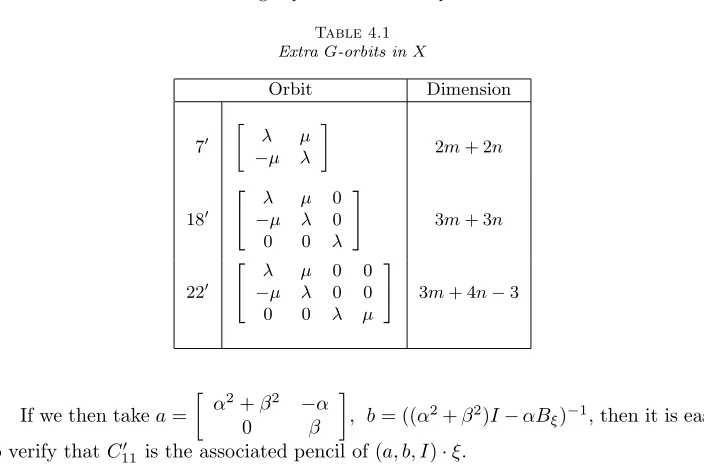
The representatives given in Table 3.1 are in fact all real, so, for theG-orbits in
X coming from coresC1throughC11, we use the same representatives. From the two new cores, we get threeG-orbits inX that do not have representatives in Table 3.1. They are given in Table 4.1.
5. G+-orbits inX. SinceG+is the identity component ofG, theG+-orbits in
X are just the connected components of the G-orbits. So, for ξ ∈ X, the number of G+-orbits contained inG·ξ is [G: G+Gξ] where Gξ represents the stabilizer of
ξ in G. By looking at Gξ, this quickly allows us to determine all the orbits in X
under the action by G+. Again, the calculations are straightforward, so only a few examples are included. Figuring out theG+-orbits from the stabilizers is simplified by the following notation:
For an element (a, b, c) of G, we define the sign signature of (a, b, c) to be the triple (s1, s2, s3) wheres1 is the sign of the determinant of a, either + or −, s2 the sign of the determinant ofb, ands3 the sign of the determinant ofc.
To illustrate this, consider orbit 6. In the case 2×2×2 the only possible sign sig-natures of elements in the stabilizer of our representative are (+,+,+) and (−,−,−) (see Example 3.1). So we see that this one G-orbit splits into four G+-orbits. To find representatives, we can choose elements ofGwith sign signatures, for instance, (+,+,+), (+,+,−), (+,−,+) and (+,−,−). We then act on our representative for the G-orbit with each of this four group elements to get the representatives of the four distinct G+-orbits. For simplicity we always use the identity for our element with signature (+,+,+).
ELA
fact the pattern for all the orbits, and it turns out that for the cases 2×3×n with
n≥7, theG-orbits are all connected.
It turns out that for every spaceXconsidered, and everyξ∈X, for eachG+-orbit
O∗⊂G·ξ it is always possible to choose someg ∈Gwith sign signature (+, s
2, s3) for some s2 and s3 such that g·ξ ∈ O∗. So, a G+-orbit is uniquely defined by a representative of the G-orbit which contains it, along with the values of s2 and s3. We denote aG+-orbit by the number of theG-orbit which contains it, withs
2 and
, since this representative can be obtained from
the same as theG-orbits, we do not include the signs. Furthermore, in the 2×3×n
cases it turns out that theG+-orbits are uniquely determined bys
3, so we only include one sign in the subscript. In choosing a representative we can takes1=s2= +.
In total, there are twelve G-orbits which, for some values of m and n, are not connected, and hence get split when the group is restricted to G+. Since they can split to different extents depending on the parametersmandn, we have included four Tables (5.1-5.4) to capture the different cases.
The cases 2×2×nforn≥3 are fairly similar, so we combine them in one table. For each of the orbits except 19+±theG+-orbits remain the same for alln≥3. Orbit
19 only occurs forn≥4, and remains a singleG+-orbit for n≥5 while it splits into two distinctG+-orbits only in the casen= 4.
The quadratic forms p:Xc →
ELA
Natural group actions on tensor products 71
ELA
72 D.ˇZ. D– okovi´c and P.W. Tingley
Table 5.5 G+-orbits inX
Dimension G G+ Representatives
2×2×2 8 17 1,2, 3±+, 4+±, 5+±, 6±±, 7′±±, 7
2×2×3 10 14 1, 2, 4, 5, 7, 11, 3±+, 6±+, 7′±+, 13±+ 2×2×4 11 16 1, 2, 4, 5 ,7, 11, 3±+, 6±+, 7′±+, 13±+, 19+±
2×2×n, n≥5 11 15 1, 2, 4, 5, 7, 11, 3±+, 6±+, 7′±+, 13±+, 19 2×3×3 20 20 1-18, 7′
, 18′
2×3×4 27 31 1-18, 7′
, 18′
, 19±, 20, 21±, 22, 22′±, 23, 24±
2×3×5 29 29 1-26, 7′, 18′, 22′
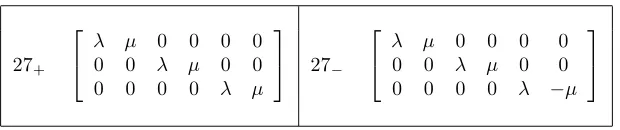
2×3×6 30 31 1-26, 7′, 18′, 22′, 27 ±
2×3×n, n≥7 30 30 1-27, 7′, 18′, 22′
spacesX for which we have defined p, for eachξ∈X we denote bypξ the quadratic form associated toξ.
For a real quadratic form we define thesignature to be (q, r, s) whereq, r, and
sare the number of +1’s, −1’s, and 0’s in the diagonalization ofp. It is well known that such triples (q, r, s) parameterize the equivalence classes of real quadratic forms. It can also be shown that taking a limit of a sequencegt·ξa 1 or−1 can be changed to zero, but its sign cannot change, and a zero must remain a zero. In other words,q
andr can decrease, but never increase. So, if the signature ofpη hasq (orr) larger than the value forpξ then we know thatη is not contained in the closure ofG+·ξ.
We are now ready to state our first theorem:
Theorem 5.1. For each case2×2×nand2×3×n, the number ofG-orbits, the number of connected components for these, and representatives for each component
G+-orbit are given in Table 5.5. The first column gives the case, the second gives the
number ofG-orbits, the third the number ofG+-orbits, and in the last column we list
the G+-orbits.
Proof. In the preceding discussion, we have successfully found allG-orbits inX.
The method we outlined above for finding the component G+-orbits relied on the ability to calculate the stabilizer in G of our representative for each G-orbit. This works, but for the three representatives in Table 4.1 the calculations are somewhat difficult. We shall therefore present a proof that the component G+-orbits for these three cases are as stated.
We first consider theG-orbit 7′
.
Case 2×2×2: We claim that theG-orbit 7′ consists of fourG+-orbits, 7′ ±±.
We calculated that the stabilizer of our representative ξ for orbit 7′ has two
connected components. Its identity component is the direct product of two copies of the multiplicative groupC
∗
. The first copy consists of the elements (a, b, c) with
a= 1
x2+y2
x −y
y x
, b=
x y
−y x
ELA
Natural group actions on tensor products 73
and the second with
a= 1
x2+y2
x y
−y x
, b=I, c=
x y
−y x
,
where (x, y) = (0,0). As a representative for the non-identity component, we can take the element
a=
1 0 0 −1
, b=
0 1 1 0
, c=
0 1 1 0
.
Hence the possible sign signatures of elements in the stabilizer are (+,+,+) and (−,−,−) and our claim is proven.
Case 2×2×n, n≥3: As in our calculations for the dimension of each orbit, we
see that the stabilizer ofξconsists of the elements (a, b, c)∈Gwithc=
C1 C2 0 C4
,
where (a, b, C1) belongs to the stabilizer of ξ in the case 2×2×2. Thus the sign signatures (s1, s2, s3) of elements in the stabilizer are arbitrary except that s1=s2. Hence 7′
is the union of twoG+-orbits, 7′
++ and 7
′ −+.
Case 2×3×n: It is not hard to find elements of the stabilizer with all possible sign signatures, so theG-orbit 7′
is connected. For the G-orbit 18′
, we can find elements of the stabilizer with all possible sign signatures. So 18′ is always connected.
Finally we consider theG-orbit 22′.
In the 2×3×5 case we can find elements of the stabilizer with all possible sign signature, so forn≥5 the G-orbit 22′
is connected. For n= 4 we can find elements of the stabilizer with any sign signature such that s3 = +. So there are at most two components, 22′
+ and 22
′
−. We see that the signature of our quadratic form p
is different on 22′
+ and 22
′
−. So, once we prove thatp is invariant onG+-orbits up
to equivalence, we will have proven that for the case 2×3×4, the G-orbit 22′
has exactly two componentG+-orbits. This is done in Lemma 7.1.
6. Closure diagrams. We note that ifη∈X is in the closure of an orbitG+·ξ, then for allg∈G+,g·η must also be in the closure ofG+·ξ. So the closure of any orbit in X is a union of itself with a number of smaller dimensional orbits. Hence to prove that oneG+-orbitO
2 is contained in the closure of anotherG+-orbitO1 we need only display a familygε∈G+,ε > 0, such thatgε·ξ→η as ε→0+ for some
ξ∈O1 andη ∈O2. Furthermore, to show that O2 is not contained in the closure of
O1 it is sufficient to choose oneη∈O2 and show that it is not in the closure ofO1. Theorem 6.1. The closures of the G+-orbits inX are as shown in the diagrams in the Appendix.
ELA
74 D.ˇZ. D– okovi´c and P.W. Tingley
Case 2×2×2: To simplify things, note that the symmetric groupS3acts naturally onX by permuting the tensor indicesi, j, k, and that this action preservesG+-orbits. So we can letS3act on the set ofG+-orbits inX. We can use a similar trick for the natural action ofG/G+on theG+-orbits. LetH be the group of permutations of our orbits generated by these two actions. Then H acts naturally on our diagrams, and it must take any pair of orbits (O1, O2) withO1→O2 to another pair (O1′, O
2. We then only need to show that one line in eachH-orbit of lines exists (or fails to exist), and the others follow.
It can be seen that all of the lines (7′
s1s2,6s1s2) are in the sameH-orbit, as are all
the lines from 7, all the lines from orbits of dimension 7 to orbits of dimension 5, and all the lines from orbits of dimension 5 to the orbit of dimension 4. So all that needs to be shown to prove all the lines exist is that 7′
++ → 6++, 7 →6++, 6++ →5++, 5++→2, and 2→1.
We shall give the family gε = (a, b, c)ε ∈ G+ in each case by specifying its
componentsa, b, cas functions ofε. To find these families, we proceeded by performing elementary row and column operations, along with changes in variables in λ and
µ until we get something close to the representative of the smaller orbit. So, for 7′
gives the required family.
For the rest of the cases we will not include the sequence of steps, just the final expressions fora, b, cin terms ofε.
2×2×3: All the lines starting with orbits of dimension at most 10 follow from the previous case. The action ofG/G+interchanges orbit 13
++ with 13−+and orbit 7′
++ with 7
′
ELA
Natural group actions on tensor products 75
2×2×4: SinceG/G+permutes transitively the four pairs (19
+±,13±+) we need explicitly included. The others are similar.
18→17: a=
2×3×4: Again we only include the more difficult lines.
22→21+: a=
The cases withn≥5 do not pose any significant problems with regards to proofs of containment, so they are all left to the reader.
7. Proofs of non-containment. Proving that a smaller orbit is not contained in the closure of a larger one is more interesting, and we have used several different types of arguments. It is clear that if inX aG+-orbitO
1 is contained in the closure of anotherG+-orbitO
2, then in Xc theGc-orbit which includes O1 is contained in the closure of theGc-orbit which includes O
2. Using this observation, the following results follow from Parfenov’s work, [8]:
4→3, 10→3, 10→4, 19→8, 12→9, 20→9, 20→12, 20→13, 16→15, 21→18, 21→18′, 25→24.
As well, numbering the orbits as we have, no orbit with a larger label is ever contained in the closure of an orbit with a smaller label. Also note that if a G-orbitO2 is not contained in the closure of O1, then noG+-orbit contained in O2 can be contained in the closure of a G+-orbit contained in O
1. So these results carry over even if the orbits split.
We need the following two lemmas.
Lemma 7.1. The quadratic formp, as defined for the case2×3×4, is invariant
ELA
76 D.ˇZ. D– okovi´c and P.W. Tingley
Proof. For each ξ ∈ X, we use the notation pξ to mean the quadratic formp
calculated forξ. Fix someξ∈X. We provepξ is invariant under GL+(U),GL+(V), and GL+(W) separately.
First, leta∈GL+(U). It is not hard to see that each coefficient ofpis multiplied by a factor of |a|2 when a acts on ξ. With a little calculation, we see that for
c ∈GL+(W), each coefficient of pis multiplied by a factor of |c| when c acts on ξ. Sincec has positive determinant, this clearly doesn’t change the equivalence class of
p. So it remains to show that the equivalence class is invariant under the action of GL+(V).
Here, we note that GL+(V) is generated by the diagonal matrices of positive determinant, along with matrices with ones on the diagonal and one non-zero entry either just above or just below the diagonal. So we need only prove invariance for matrices of these types.
First, the case whereb is a diagonal matrix,b=
t1 0 0
0 t2 0 0 0 t3
, t1t2t3>0.
We calculate how each of the coefficients of ptransforms. Let q′ , r′
, s′ , α′
, β′ , γ′
be the coefficients ofpb·ξ corresponding toq, r, s, α, β, γ. We see that:
q′=t22t 2 3q, r
′
=t21t 2 3r, s
′
=t21t 2 2s, α
′
=t21t2t3α, β
′
=t1t22t3β, γ
′
=t1t2t23γ.
So, pb·ξ(λ, µ, ν) =pξ(t2t3λ, t1t3µ, t1t2ν). This is a linear change of variables in
λ, µ, and ν, so the equivalence class ofpis not changed.
Now we look at the case b=
1 t 0 0 1 0 0 0 1
. Then the new coefficients are given
by:
q′ =q, r′ =r−tα+t2q, s′ =s, α′=α−tβ, β′=β, γ′ =γ−2tq.
It can then be verified thatpb·ξ(λ, µ, ν) =pξ(λ−tµ, µ, ν). Again, this is a change
of variables inλ, µ, νso the equivalence class ofpis unchanged. The other three types of matrices of this form withtin the position (2,3),(2,1), or (3,2) follow in the same way, so we see that the equivalence class ofpis invariant under the action of GL+(V), and hence under the action of the whole groupG+.
Lemma 7.2. LetW′be a subspace ofW andξ, η∈U⊗V⊗W′. Ifη is contained
in the closure of G+·ξ, then η is contained in the closure of GL+
(U)×GL+(V)× GL(W′)·ξ.
Remark 7.3. This is a variation of Parfenov’s Theorem 1 in [8].
Proof. We may assume that{w1, w2, . . . , wn′}, the firstn′ basis vectors forW,
form a basis forW′. Choose a sequencegs= (as, bs, cs)∈G+such thatgs·ξ→η. For
eachswritecs=
c′
s Xs
Ys Zs
,wherec′ sis ann
′×n′matrix and the other dimensions
ELA
Natural group actions on tensor products 77
Notice that, sinceξijk= 0 fork > n′
,gs·ξ= (as, bs,
c′
s 0
Ys I
)·ξ. Furthermore,
Ysonly affects components of gs·ξ withk > n′, so sinceηijk = 0 fork > n′, we see
that (as, bs, c′s)·ξalso approachesη in the spaceU⊗V ⊗W ′.
For the following cases we use the quadratic formspintroduced in Section 2 when we were calculating relative invariants.
Case 2×2×2: We show that 7′
++→5+−. By acting on the orbits by bothS3and
G/G+as described at the beginning of Section 6 we get proofs of all non-containments between orbits of dimension 8 and orbits of dimension 5.
To see that 7′
++→5+−simply note that for the representatives we have chosen,
the signature ofpfor the orbit 7′
++ is (2,0,0) while the signature for 5+−is (0,1,0),
which completes the proof by the argument stated just before Theorem 5.1.
Case 2×2×3: Using pas defined in Section 2 we see that its signature for the orbit 13++ is (1,2,0), for 7′−+ is (2,0,1), and for 3−+ is (0,1,0). So 13++ → 7′−+ and 7′
−+ → 3++. Using the natural action of G/G+ we also get 13−+ →7′++ and 7′
++→6−+, which completes the proof that there are no more lines in the diagram. Cases 2×2×n, n≥4: All non-containments in these cases follow from the cases 2×2×2 and 2×2×3 using Lemma 7.2.
Case 2×3×3: Everything here follows immediately from Parfenov’s work except 12→7′ and 14→7′.
12→7′
: Note thatξ∈U⊗v1⊗W+U⊗V⊗w3whereξis our representative for orbit 12. So ifξ′
is in the closure of orbit 12, there must be somev∈V andw∈W
such thatξ′
∈U⊗v⊗W+U⊗V ⊗w. We now show that our representativeη for orbit 7′
is not of this type, which will complete the proof.
Assume thatη ∈ U⊗v⊗W +U ⊗V ⊗w for some v ∈V and w∈ W. Using summation convention, we havev=djvj,w=rkwk, and
η=xikui⊗v⊗wk+yijui⊗vj⊗w= (xikdj+yijrk)eijk.
By equating the coefficients fori, j, k= 1,2, we obtain the system
x11d1+y11r1= 1, x21d1+y21r1= 0,
x12d1+y11r2= 0, x22d1+y21r2= 1,
x11d2+y12r1= 0, x21d2+y22r1=−1,
x12d2+y12r2= 1, x22d2+y22r2= 0. By eliminating thexik, we obtain
(y11d2−y12d1)r1=d2, (y21d2−y22d1)r1=d1, (y11d2−y12d1)r2 =−d1, (y21d2−y22d1)r2=d2. Hencer1d1+r2d2=r2d1−r1d2= 0. But
(r1d1+r2d2)2+ (r2d2−r1d2)2= ((r1)2+ (r2)2)((d1)2+ (d2)2),
so we see thatr1 =r2= 0 or d1=d2 = 0. In both cases our system of equations is inconsistent. So we have that 12→7′
.
14→7′: Let ξand η be our representatives for theG+-orbits 14 and 7′
ELA
78 D.ˇZ. D– okovi´c and P.W. Tingley
rank 1. On the other hand every non-trivial specialization ofλAη+µBη produces a matrix of rank 2.
Case 2×3×4: Using the previous cases, along with Lemma 7.2 and Parfenov’s work, we get everything except: 23→ 22′
±, 24+ →22′−, 24− → 22′+, 22′+ → 19−,
22′
−→19+, 22→18′, and 22′±→18.
By directly evaluating the coefficients for our representatives, we find the signa-tures of pfor the following orbits: 24+ : (1,2,0); 23 : (1,1,0); 22′− : (2,0,0); 19+ : (0,1,2).
It follows from this that 24+→22′−, 22 ′
−→19+, and 23→22′±. From the action
ofG/G+ we also see that 24
− →22′+and 22′+→19−.
In order to handle the remaining cases, we recall a property of real binary cubic formsc0λ3+c1λ2µ+c2λµ2+c3µ3. The discriminantD of this form is given by
D=c2
1c22+ 18c0c1c2c3−4(c0c32+c31c3)−27c20c23.
The cubic form splits (into linear factors) if and only ifD≥0. 22 → 18′
: Let ξ and η be our representatives of the G+-orbits 22 and 18′
re-spectively. The greatest common divisor of the 3×3 minors of λAξ +µBξ is λµ. Consequently, every 3×3 minor of this pencil splits, and so its discriminant is ≥0. Clearly this is also true for allξ′
in the orbitG+·ξ, and consequently for allξ′
in the closure of this orbit. On the other hand the first 3×3 minor ofηisλ(λ2+µ2) which has discriminant−4. Henceη is not in the closure ofG+·ξ.
22′
± → 18: Let ξ and η be our representatives for the G+-orbits 22 ′
± and 18
respectively. The greatest common divisors of the 3×3 minors of λAξ +µBξ is
λ2+µ2. Consequently, every 3×3 minor of this pencil has discriminant ≤ 0. As above this is also true for allξ′
in the closure ofG+·ξ. On the other hand the first 3×3 minor of λAη+µBη is λµ(λ+µ) which has discriminant 1. Henceη is not in the closure ofG+·ξ. This completes the 2×3×4 case.
For the cases 2×3×nwithn≥5 all non-containments follow from smaller cases, or from Parfenov’s paper [8], so the proof is now complete.
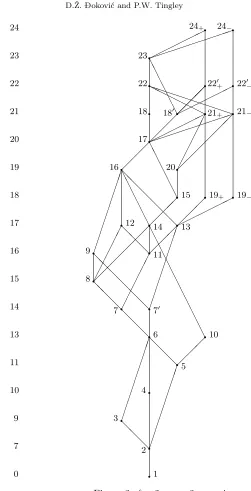
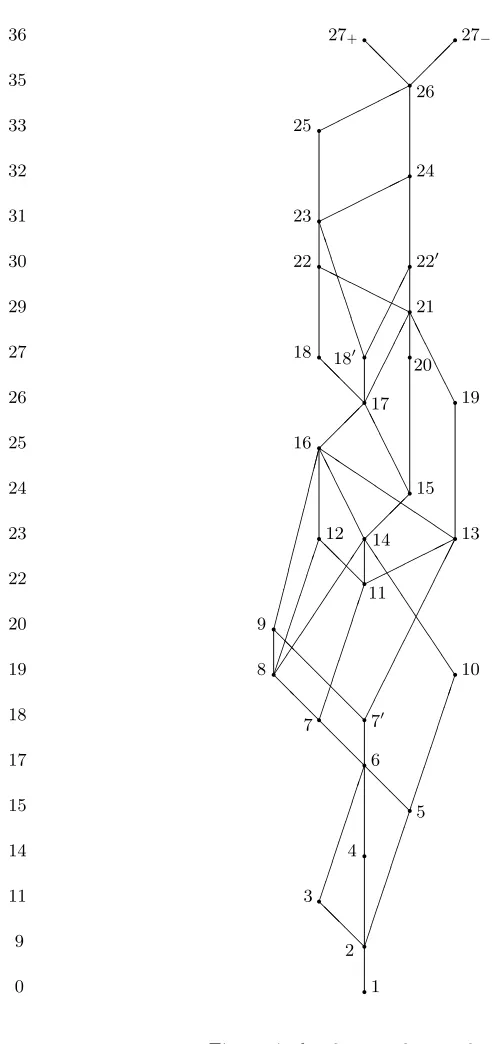
8. Appendix. In figures 1-4 we exhibit the closure diagrams for G+-orbits in
X in the cases 2×2×2, 2×2×4, 2×3×4, and 2×3×6. In these diagrams, the closure of an orbit is the union of itself with all orbits that can be reached from it by following lines in a downward direction in the diagram. The numbers on the left hand side show the dimensions of the orbits at each level. Some modifications need to be made to obtain the diagrams for cases not explicitly shown. These are as follows:
2×2×3: Drop orbits 19± from the diagram for 2×2×4 (Figure 2).
2×2×n, n≥5: Combine orbits 19+ and 19− to form the single orbit 19 in the
diagram 2×2×4 (Figure 2). Both orbits 13+and 13− are in the closure of orbit 19.
2×3×3: Take the portion of the diagram for the cases 2×3×4 (Figure 3) consisting of orbits present in the smaller space (see Table 5.5).
2×3×5: Take the part of the diagram for 2×3×6 (Figure 4) consisting of orbits present in the smaller space (see Table 5.5).
2×3×n, n≥7: Combine orbits 27+and 27−in the diagram for 2×3×6 (Figure
ELA
Natural group actions on tensor products 79
In the cases where the diagrams need to be modified, the dimensions of the orbits change. They are given in Tables 3.1 and 4.1.
ELA
Natural group actions on tensor products 81
ELA
82 D.ˇZ. D– okovi´c and P.W. Tingley
Acknowledgements. We would like to thank the referees for their comments and for supplying us with two additional references.
REFERENCES
[1] M.D. Atkinson. Extensions to the Kronecker-Weierstrass theory of pencils. Linear and Multi-linear Algebra, 29:235-441, 1991.
[2] R. Ehrenborg. Canonical forms of two by two by two matrices. J. Algebra, 213:195-224, 1999. [3] F.R. Gantmacher. The Theory of Matrices, vol. 1 and 2, Chelsea, New York, 1974.
[4] I.M. Gelfand, M.M. Kapranov, and A.V. Zelevinsky. Discriminants, Resultants, and Multidi-mensional Determinants, Birkha¨user, 1994.
[5] J. Ja’ja. An addendum to Kronecker’s theory of pencils. SIAM J. Appl. Math., 37:700-712, 1979.
[6] T. Kimura, S. Kasai, and O. Yasukura. A classification of the representations of reductive algebraic groups which admit only a finite number of orbits.Amer. J. Math., 108:643-692, 1986.
[7] T. Kimura and M. Muro. On some series of regular irreducible prehomogeneous vector spaces. Proc. Japan Acad. Ser. A Math. Sci., 55:384-389, 1979.
[8] P.G. Parfenov. Tensor products with finitely many orbits.Russian Math. Surveys, 53:635-636, 1998.