J.Food Pharm.Sci. 2 (2014) 57-62
Avalaible online at www. jfoodpharmsci.com
Control of
Aspergillus flavus
Growth in Tomato Paste by
Cinnamomum
zeylanicum
and
Origanum vulgare L.
Essential Oils
F. Kalantary, M. Barzegar
*, Z. Hamidi
Esfahani
Department of Food Science and Technology, Tarbiat Modares University, P.O. Box 14115-336, Tehran, Iran.
ARTICLE INFO ABSTRACT
Received 18/12/2013
Received in revised form 29/12/2013 Accepted 30/12/2013
Available online 15/06/2014
1. Introduction
Fungi are significant spoilage microorganisms that grow in fresh and processed foods during the storage. The presence and growth of fungi in food reduce its quality and also quantity. Some Aspergillus species are responsible for many cases of food and feed contamination. Aspergillus flavus and Aspergillus parasiticus are able to produce aflatoxin in food (Guo et al., 1996). These toxins are responsible for human hepatic and extra hepatic carcinogenesis (Massey et al., 1995; Kamkar, 2005).
In recent years, consumers are more concerned about the processed foods they use. Demands for natural, high quality and preservative-free products that are safe and stable introduce a great challenge for the food industry (Lopez-Malo et al., 2007). Currently, there is a strong debate about safety aspects of chemical preservatives since they are considered responsible for many carcinogenic and teratogenic attributes as well as residual toxicity (Omidbeygi et al., 2007).
Essential oils and their constituents have been used broadly as flavor ingredients in a wide variety of foods, beverages and confectionery products. Many of such This study was conducted to evaluate the antifungal activities of cinnamon (Cinnamomum zeylanicum) and oregano (Origanum vulgare L.) essential oils against Aspergillus flavusin culture media and tomato paste. The chemical compositions of the essential oils were determined by Gas Chromatography-Mass Spectroscopy (GC-MS). Trans- cinnamaldehyde was found to be the main constituent of Cinnamomum zeylanicum essential oil (CZEO), followed by methyl eugenol, - cadinene and - cadinene. The major components of Origanum vulgare L. essential oil (OVEO) were limonene, caryophyllene oxide, -ionone, germacrene– D, - terpinene, - pinene and terpinene-4-ol. For evaluating antifungal activities of CZEO and OVEO, A. flavus PTCC: 5006, was inoculated in Sabouraud Dextrose Broth (SDB) and tomato paste, then 0, 50, 100, 200, 300, 400, 500 and 600 ppm of essential oils were added to each sample and incubated at 25±0.5oC for 30 and 60 days, respectively. The antifungal activity was measured by Agar Dilution method. The EOs at all tested concentrations had inhibitory effect against A. flavus growth. 200 ppm of CZEO and 500 ppm of OVEO completely inhibited A. flavus growth in culture media, while in tomato paste 300 ppm of CZEO and 200 ppm of OVEO had the same effect. Test panel evaluations were carried out in tomato ketchup base and samples with 100 and 200 ppm CZEO were accepted by panelists. The results may suggest the potential replacement of antifungal chemicals by CZEO as natural inhibitor to control A. flavus growth in tomato paste.
Keywords: Essential oil, Cinnamomum zeylanicum, Origanum vulgare L.
Aspergillus flavus, tomato paste
compounds are classified as Generally Recognized as Safe (GRAS) (Kim et al., 1995). Simultaneously, several studies have reported the antifungal activity of spices and their essential oils (Nielsen et al., 2000; Lopez-Malo et al., 2007; Gangomi et al., 2009). In most cases, there is a relationship between the chemical structures of essential oils and their antifungal effects (Farag et al., 1989).
Recently considerable interest has developed on the preservation of food by use of essential oils to effectively retard fungal growth and mycotoxin production. Many investigators used essential oils such as cinnamon, marigold, basil and spearmint to assess their antifungal activity against A. ochraceaus, A. flavus, A. parasiticus and F. moniliforme (Soliman et al., 2002). Souza et al. (2007) reported the anti-yeast activity of Origanum vulgare L. essential oil against some yeasts recognized as potential food spoiling microorganisms. Origanum vulgare L., Laminaceae family, which is widely known as possessing therapeutic properties (diaphoretic, antiseptic and antispasmodic) is being used in traditional home remedy in many countries (Sagdic et al., 2002; Sahin et al., 2004). It has been widely used in agricultural, pharmaceutical and cosmetic industries as culinary herb, flavoring substances in food products, alcoholic beverages and perfumery for its spicy fragrance (Dorman et al., 2000; Aligianis et al., 2001). Origanum Vulgare L. is characterized by its high content of phenolic acids and flavonoids (Falerio et al., 2005). Cinnamomum zeylanicum, commonly known as cinnamon, refers to a tropical evergreen tree as well as a bark that is extracted from a plant. Cinnamon is classified in the botanical division Magnoliophyta, class Magnoliopsida, order Magnoliales and family Lauraceae (Thomas et al., 2000). Cinnamaldehyde is the major constituent of cinnamon leaf oil and provides the distinctive odor and flavor associated with cinnamon. In products with compatible flavor such as bakery products and tomato paste, where fungi are the most common Due to the danger of Aflatoxin produced by Aspergillus flavus, this study was conducted to assess the antifungal activity of cinnamon and oregano essential oils against A. flavus in culture media and tomato paste.
2. Materials and Methods
2.1. Essential Oils
500 g of dried oregano (Origanum Vulgare L.) or cinnamon (Cinnamomum zeylanicum) cultivated in Iran were obtained from Iranian Medical Plant Research Center (Karaj, Iran) and then these were extracted for 3 hours by distilled water, using a Clevenger type apparatus. The obtained essential oils were dried over anhydrous sodium sulphate and kept at 4 °C for later experiments.
2.2.Microorganism and chemicals
A. flavus (PTCC: 5006) was used as a test organism. Fungus was purchased from the National Scientific and Industrial Research Center of Iran (Tehran, Iran). All chemical and culture media (with the highest purity available) like PDA (Potato Dextrose Agar), SDB (Sabouraud Dextrose Broth) were purchased from Merck chemical Co (Darmstadt- Germany).
2.3.GC-MS analysis of essential oils
GC analysis was carried out on HP-6980 gas chromatograph equipped with a HP-5 capillary column (30m
×
0.25 mm; 0.25 µm film thickness). The oven temperature was held at 40oC for 5 min, and then programmed to reach 240oC at a 3oC/min rate, than increasing the temperature up to 280oC at a rate of 15oC/min (held for 3 min), and finally increased to 340oC at 3oC/min. Other operating conditions were: carrier gas, Helium with flow rate of 0.8 ml/min and the splitter used a 1:10 ratio; injector and detector temperature were 290oC; Mass spectra were taken at 70 eV. Mass range was from m/z 35-375 amu. Quantitative data were obtained from the electronic integration of the FID peak areas. The components of the essential oils were identified by comparison of their mass spectra and retention indices with those published in the literature (Adams, 2007).2.4.Cooler
As for sporulation in Petri dish A. flavus was cultured on Potato Dextrose Agar (PDA) medium during 5-7 days at 25±0.5oC. After spore formation, several sub cultures were prepared and stored in refrigerator. In order to determine CZEO and OVEO antifungal activity experimental test were organized in 2 stages: First, the volume of 106 CFU/ml of A. flavus was added to 10 ml of SDB media to obtain an inoculation level of 105 CFU/ml followed by addition of the 8 concentrations of CZEO and OVEO (0, 50, 100, 200, 300, 400, 500 and 600). The inoculated samples of SDB were incubated at 25± 0.5oC for 30 days. In the second stage, A. flavus, was inoculated (105 CFU/ml) in aseptic tomato paste (Brix =28o, pH= 4.4 and 1.0% salt), then different concentrations of essential oils (0, 50, 100, 200, 300, 400, 500 and 600 ppm) were added to each sample and incubated at 25±0.5oC for 60 days. The antifungal activity was measured by Agar Dilution method as described by Gul et al. (2002). (Diluents were 8.5 g NaCl, 1.0 g Peptone in one liter distilled water). Microbial tests were carried out on PDA medium. To evaluate the inhibition percent of each essential oil, the Petri dishes were incubated at 25oC for 3-5 days, and then numbers of colonies were enumerated and compared with the initial counts (105 CFU/ml). Each test was carried out in triplicate and averaged.
2.5.Test Panel
and 200 ppm of cinnamon, oregano and without essential oil. Four ketchup samples were prepared by mixing tomato paste with 100 and 200 ppm of CZEO and OVEO and other ingredients such as sugar, vinegar, salt and pepper. The blank sample was prepared without adding essential oil, and then ketchups were given to panelist to eat with potato chips. The panelists assessed flavor and odor of ketchup samples on the scale from 1 to 5 indicating increasing flavor and odor. The scores of all 25 panelists were pooled; then the mean values and standard deviations were calculated.
2.6. Statistical analysis
All tests were performed in triplicate and data were displayed as mean values with standard deviations. Statistical analysis was carried out using SAS software. Mean values were compared by LSD (least significant difference) test and significance was determined at P ≤ 0.01.
3. Result and Discussion
3.1. Compositions of essential oils
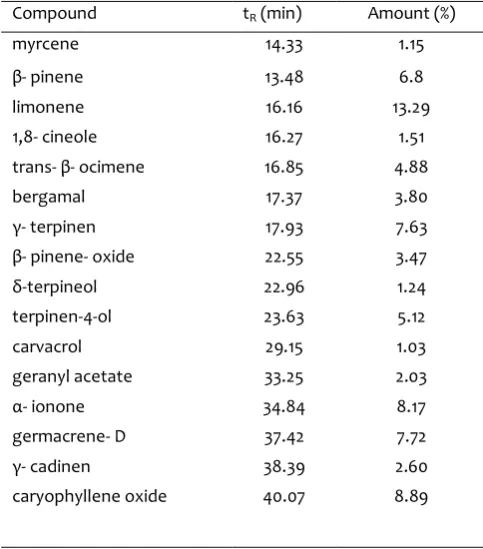
A summary of main component of CZEO and OVEO identified by GC-MS are listed in Tables 1 and 2, respectively. The major components of cinnamomum zeylanicum were: trans-cinnamaldehyde (47.25%), methyl eugenol . % , -cadinene . % and -cadinene (3.13%). The major components of origanum vulgare L. were: limonene . % , caryophyllene oxide . % , - ionone (8.17%), germacrene- D . % , - terpinen (7.63%) and - pinene (6.8%). Recently Singh et al. (23) reported (E)-cinnamaldehyde (97. % , -cadinene . % , -copaene . % and -amorphene (0.5%) as major components of cinnamon bark volatile oil. Mockute et al. (17) results showed that, sabinene . % , - caryophyllene (18.2%), germacerene- D (9.6%), caryophllene oxide . % and - terpinene (3.2%) were the main components of OVEO.
3.2. Screening antifungal activity in culture media
Both CZEO and OVEO have significant antifungal activity against A. flavus in culture media (Figure 1). Our statistical analysis showed that the type and amount of essential oil have a significant effect on antifungal activity (P≤ . . The results were the same for storage time. According Figure 1, it could be seen that as the EO concentration increases the inhibitory effect increases. CZEO had stronger antifungal activity than OVEO. Complete inhibition of A. flavus growth was observed at 200 ppm of CZEO, while 300 and 400 ppm of OVEO had inhibition percent of 97 and 97.3 respectively. Complete inhibition of A. flavus growth was observed at 500 ppm of OVEO. Cinnamon and oregano in comparison with other essential oils could inhibit the growth of A. flavus in lower concentrations. Soliman and Badeaa (2002) showed that cinnamon completely inhibited the growth of A. flavus in culture media at 1000 ppm, while spearmint, basil and marigold had the same effect at 3000 ppm.
Table 1. Chemical constituent of CZEO determined by GC-MS.
3.3. Screening antifungal activity of CZEO and OVEO in tomato paste
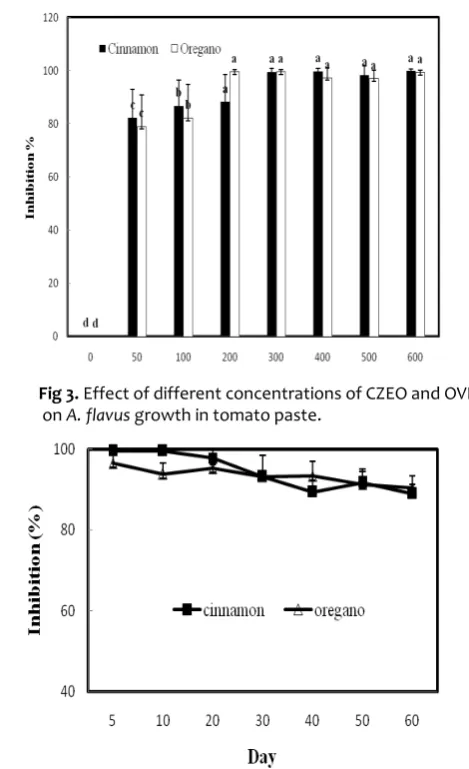
In this study we also evaluated the potential application of CZEO and OVEO in tomato paste as food model. The EOs at all concentrations tested, had inhibitory effect against A. flavus growth, 300 ppm of CZEO and 200 ppm of OVEO could inhibit A. flavus growth completely in tomato paste (Figure 3), but in control samples lots of colonies were observed that were not countable. Similar to culture media experiments, the storage time, kind and the amount of essential oils had significant effect on antifungal activity (P≤ 0.01). As observed in Figure 3, the inhibitory effect of essential oils on A. flavus increased by increasing their concentration. This effect was considerable even at low concentrations; 50 ppm of CZEO and OVEO could inhibit A. flavus growth 82 and 79 percent respectively. Figure 4 shows antifungal activity of CZEO and OVEO during the storage period. In the last day of storage, the inhibitory percent of CZEO and OVEO reduced but it was still high (73% for CZEO and 90.4% for OVEO). Cinnamon and oregano constituents play the main role in their antifungal activities. Trans-cinnamaldehyde as main component of CZEO (47.25%) seems to be responsible
for cinnamon inhibitory effect. Since its protective effect against various microorganisms have been reported by others (Cheng et al., 2006; Singh et al., 2007; Baskaran et al., 2010; Singh et al., 2010), Cinnamon antifungalactivity can be attributed to this component. Although the mechanism of action of these compounds have not completely elucidated, but Wang et al. (2005) reported that a compound having a conjugated double bond and a long CH chain outside the ring, i.e. cinnamaldehyde, possesses strong antifungal activity.
3.4. ffect of different drying condition on moisture
content of Ashwagandha
The moisture content of about 23% was removed in just 14 hours and the temperature lies in the range of 30-
Singh et al. (2010) claimed that DL-limonene, the major component of citrus sinensis, has strong antifungal and antiaflatoxigenic properties. These results are in agreement with those published by Ruberto and Baratta (2000) and Tyagi and Malik (2011) who suggested that monoterpenes (like limonene) in essential oils are the main reason for their antifungal activity. In view of the fact that limonene is the major component of OVEO, oregano antifungal activity can be attributed to this component.
3.4. Sensory evaluation
Several studies reported that addition of essential oils (as antimicrobial agents) impart strong flavor in foods (Harpez et al., 2003; Omidbeygi et al., 2007). Although the majority of the essential oils are classified
Fig 1. Effect of different concentrations of CZEO and OVEO on
A. flavus growth in culture media.
Fig 2. Effect of storage time on A. flavus growth in culture media.
Fig 3. Effect of different concentrations of CZEO and OVEO
on A. flavus growth in tomato paste.
Fig 4 Effect of storage time on A. flavus growth in tomato paste.
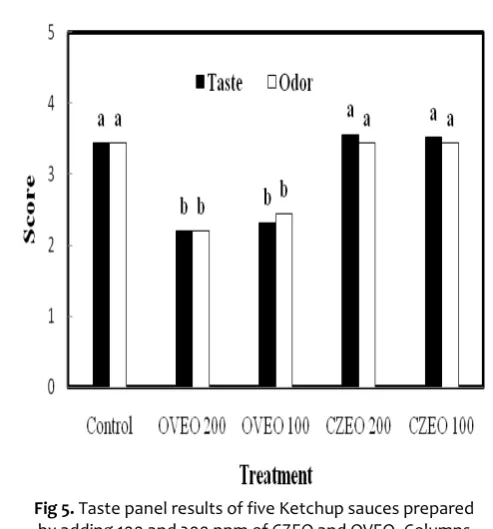
as GRAS, their use in foods as preservatives is often limited due to flavor considerations (Lambert et al., 2001). Careful selection of EOs according to the type of the food can moderate these effects. Our sensory evaluation showed that there was no significant differences (p≤ . between samples with and ppm of CZEO and the control (without essential oil), while samples with 100 and 200 ppm of OVEO had significant difference with its control (Figure 5).
Present study indicates that cinnamon can be added to tomato paste without any effect on organoleptic attributes. In conclusion essential oils of cinnamon and oregano have significant antifungal activity against A. flavus in vitro and tomato paste. The minimum concentration of essential oils that inhibit the growth of microorganisms is a key factor. CZEO and OVEO in comparison with other plant EOs inhibit A. flavus growth in lower concentrations. Furthermore, CZEO did not change tomato paste sensory attributes. As a result, CZEO can be introduced as a natural preservative for tomato paste.
Acknowledgment
The authors would like to thank Tarbiat Modares University for the financial support for this research.
Reference
Adams, R. P. Identification of essential oil components by gas chromatography - mass spectrometry, 4th ed. Allured Pub Corp, Carol Stream, 2007.
Aligianis, N. E.; Kalpoutzakis, S.; Mitaku; and Chinou I. B.. Composition and antimicrobial activity of the essential oil from Origanum species. J. Agric. Food Chem. 2001, 49, 4168 - 4170.
Baskaran, S.A.; Amalaradjou, M. A. R.; Hoagland, T.; and Venkitanarayanan K. Inactivation of Escherichia coli
O157: H7 in apple juice and apple cider by trans-cinnamaldehyde. Int. J. Food Microbiol. 2010,141, 126 - 129.
Cheng, S. S.; Liu, J. Y.; Hsui, Y. R.; and Chang S. T. Chemical polymorphism and antifungal activity of essential oils from leaves of different provenances of indigenous cinnamon (Cinnamomum osmophloeum). Bioresour. Technol. 2006, 97, 306 - 312.
Dorman, H. J. D.; and Dean S. G. Antimicrobial agent from plants: Antibacterial activity of plant volatile oils. J. Appl. Microbiol. 2000, 88, 308 - 316.
Faleiro, L.; Graca, M.; Gomes, S.; Costa, L.; Venancio, F.; Teixeira, A.; Figueiredo, A.; Barroso, J.; and Pedro. L. Antibacterial and antioxidant activities of essential oils isolated from Thymbra capitata L. (Cav.) and Origanum vulgare L. J. Agric. Food Chem. 2005, 53, 8162 - 8168.
Farag,R. S.; Daw, Z. Y.; Hewedi, F. M.; and EL-Baroty, G. S. A. Antimicrobial activity of some Egyptian spice essential oils. J. Food Prot. 1989,52, 665 - 667. Gandomi, H.; Misaghi, A.; Akhondzade, A.; Bokaei, S.;
Khosravi, A.; Abbasifar, A.; and Jebelli, A. Effect of Zataria multiflora Boiss. essential oil on growth and aflatoxin formation by Aspergillus flavus in culture media and cheese. Food Chem. Toxicol. 2009,47, 1 - 4.
Gul, H. I.; Ojanen, T.; and Hanninen, O. Antifungal evaluation of bis Mannich bases derived from acetophenones and their corresponding piperidinols and stability studies. Biol. Pharm. Bull. 2002, 25, 1307 - 1310.
Guo, B. Z.; Russin, J. S.; Brown, R. L.; Celveland, T. E.; and Widstrom, N. W. Resistance to aflatoxin contamination in corn as influenced by relative humidity and kernel germination. J. Food Prot. 1996, 59, 276 - 281.
Harpaz, S.; Glatman, L.; Drabkin, V.; and Gelman A. Effects of herbal essential oils used to extend the shelf life of freshwaterreared Asian sea bass fish (Lates calcarifer). J. Food Prot. 2003, 66, 410 – 417. Kamkar, A. A study on the occurrence of aflatoxin M1 in
raw milk produced in Sarab city of Iran. Food Control. 2005, 16, 593 - 599.
Kim, J. M.; Marshall, J. A.; Cornell, J. F.; Preston, J. F.; and Wei. C. I. Antibacterial activity of carvacrol, citral and geraniol against Salmonella typhimurium in culture medium and on fish cubes. J. Food Sci. 1995, 60, 1364 - 1368.
Lambert, R. J. W.; Skandamis, P. N.; Coote, P. J.; and Nychas, G. J. E. A study of the minimum inhibitory concentration and mode of action of oregano essential oil, thymol and carvacrol. J. Appl. Microbiol. 2001, 91, 453 - 462.
Lopez-Malo, A.; Barreto-Valdivieso, J.; Palou, E.; and Martın, F.S. Aspergillus flavus growth response to cinnamon extract and sodium benzoate mixtures. Food Control. 2007, 18, 1358 - 1362.
Massey, T. E.; Steward, R. K.; Daniel, J. M.; and Ling, L. Biochemical and molecular aspects of mammalian
Fig 5. Taste panel results of five Ketchup sauces prepared by adding 100 and 200 ppm of CZEO and OVEO. Columns with different letters are significantly different at p ≤ 0.01.
susceptibility to aflatoxin B1 carcinogenicity. Proceedings of the society for experimental biology and mericine. 1995, 208, 213 - 227.
Mockute, D.; Bernotiene, G.; and Judþentiene, A. Chemical composition of essential oils of Origanum vulgare L. growing in Lithuania. Biologica. 2004,4, 44 - 49.
Nielsen, P. V.; and Rios, R. Inhibition of fungal growth on bread by volatile components from spices and herbs, and the possible application in active packaging, with special emphasis on mustard essential oil. Int. J. Food Microbiol. 2000, 60, 219 - 229.
Omidbeygi, M.; Barzegar, M.; Hamidi, Z.; and Naghdibadi, H. Antifungal activity of thyme, summer savory and clove essential oils against Aspergillus flavus in liquid medium and tomato paste. Food Control. 2007, 18, 1518 - 1523.
Ruberto, G.; and Baratta, M. T. Antioxidant activity of selected essential oil components in two lipid model systems. Food Chem. 2000, 69, 167 - 174. Sagdic, O.; Kuscu, A.; Ozkan, M.; and Ozcelik, S. Effect of
Turkish spice extracts at various concentrations on the growth of E. coli 0157:H7. Food Microbiol. 2002, 19, 473 - 480.
Sahin, F.; Gulluce, M.; Daferera, D.; Sokmen, A.; Sokmen, M.; Polissiou, M.; Agar, G.; and Ozer, H. Biological activities of the essential oils and methanol extract of Origanum vulgare ssp vulgare in the Eastern Anatolia region of Turkey. Food Control. 2004, 15, 549 - 557.
Singh, G.; Marurya, S.; deLampasona, M. P.; and Catalan, C. A. N. A comparison of chemical, antioxidant and antimicrobial studies of cinnamon leaf and bark volatile oils, oleoresins and their constituents. Food Chem. Toxicol. 2007, 45, 1650 - 1661.
Singh, P.; Shukla, R.; Prakash, B.; Kumar, A.; Singh, S.; Mishra, P. K.; and Dubey, N. K. Chemical profile, antifungal, antiaflatoxigenic and antioxidant activity of Citrus maxima Burm. and Citrus sinensis (L.) Osbeck essential oils and their cyclic monoterpene, DL-limonene. Food Chem. Toxicol. 2010, 48, 1734 - 174.
Soliman, K. M.; and Badeaa, R. I. Effect of oil extracted from some medicinal plants on different mycotoxigenic fungi. Food Chem. Toxicol. 2002, 40, 1669 - 1675.
Souza, E. L.; Stamford, T. L. M.; Lima, E. O.; and Trajano, V. N. Effectiveness of Origanum vulgare L. essential oil to inhibit the growth of food spoiling yeasts. Food Control. 2007, 18, 409 - 413.
Thomas, J.; and Duethi, P. P. Cinnamon, In K.v. Peter (ed), Handbook of herb and spices, CRC press, Washington DC, 2000, p. 143- 152.
Tyagi, A. K.,; and Malik, A. Antimicrobial potential and chemical composition of Eucalyptus globules oil in liquid and vapour phase against food spoilage microorganisms. Food Chem. 2011, 126, 228 - 235. Wang, S. Y.; Chen, P. F.; and Chang, S. T. Antifungal
activities of essential oils and their constituents from
indigenous cinnamon (Cinnamomum osmophloeum) leaves against wood decay fungi. Bioresour. Technol. 2005, 96, 813 - 818.