• Tidak ada hasil yang ditemukan

HAEMAGLUTINATION OF Shigella flexneri SUBUNIT PILI PROTEIN 18 KDA AS A MOLECULE ADHESION IN MICE ENTEROCYTES

N/A
N/A
Protected

Academic year: 2018

Membagikan "HAEMAGLUTINATION OF Shigella flexneri SUBUNIT PILI PROTEIN 18 KDA AS A MOLECULE ADHESION IN MICE ENTEROCYTES"

Copied!
8
0
0

Teks penuh

(1)

J. Islamic Pharm.,an open access journal ISSN : 2527-6123

HAEMAGLUTINATION OF

Shigella flexneri

SUBUNIT PILI PROTEIN

18 KDA AS A MOLECULE ADHESION IN MICE ENTEROCYTES

Avin Ainur Fitrianingsih

School of Medicine Faculty of Medicine and Health Sciences Universitas Islam Negeri Maulana Malik Ibrahim Malang

Email : [email protected]

ABSTRACT

Diarrhoeal diseases are still a major cause of the high morbidity and mortality of children globally, especially in children under five years. Diarrhea caused by Shigella flexneri usual dealt with antibiotics seen it is getting resistant with various antibiotic. Prevention shigellosis with a vaccine that was developed and used now are still limited. This study attempts to explore hemaglutinin protein pili S . flexneri allegedly role in adhesion bacteria on the mice enterocyte. This research using hemaglutination test then adhesion test by means of reacting protein sub unit pili 18 kDa S. flexneri with mice enterocyte cells and observed the amount of bacteria inherent in a mice cell enterocyte. The research found that proteins sub unit pili with molecules weight 18 kDa is a protein that capable to agglutinate mice red blood cells with highest dilution and capable to inhibit adhesion bacteria on the mice enterocyte significantly.

Keywords: Shigella flexneri, protein sub unit pili , hemagglutinin protein, adhesin protein.

INTRODUCTION

Until now diarrheal disease remains a major cause of the high morbidity and mortality of children globally, especially in children under five years of age (Thapar et al., 2004). In Indonesia, diarrhea is the third leading cause of morbidity and mortality, especially in infants (Bhattacharya, et al., 2005).

Shigella vaccines developed using whole cells attenuated Shigella bacteria have drawbacks such as low or even absence of imunogenesitas, until the onset of meaningful immunoreactivity effect (Niyogi, 2005). Fimbriae or pili which is found throughout the body surface of Shigella is an instrument of adhesion to the mucosal surface of the host cell. Hemagglutinin protein has an important role in the development of shigellosis. Hemagglutinin protein serves as a receptor for adhesion on many cell types in the human body which has some similarities with erythrocytes, including cell enterocytes (Prabowo, 2011).

This research will prove whether the protein subunit of pili S. flexneri an adhesin molecule. It is expected to prove their adhesin molecules then can be developed manufacture of a vaccine against shigellosis are specific to the target.

MATERIALS AND METHODS Research design.

This research is an experimental study to prove that the protein subunits pili S. flexneri

(2)

J. Islamic Pharm.,an open access journal ISSN : 2527-6123

Procedures

S. flexneri preparation

S. flexneri isolates were cultured on medium SSA (Salmonella Shigella Agar) at 37 ° C for 24 hours to ensure the purity of samples of the bacterium. S. flexneri were harvested from the culture SSA separately and then transferred to Petri dishes containing MacConkey medium at a temperature of 37 ° C for 24 hours for bacterial multiplication. The results of bacterial culture medium MacConkey then dissolved in 10 ml PBS with a pH of 7.4. Furthermore inserted into the bottle containing the solution BHI (Brain Heart Infusion) 1000 ml. The bottle is then rocked in the water bath for 30 minutes at 37 ° C. Then once shaken, the contents of BHI medium are taken as much as 10 mL TCG put in a medium that has been made before. Incubation in the medium TCG carried out at 37 0C for 2 x 24 hours.

Protein Isolation Pili S. flexneri

Collection pili protein S. flexneri refers to methods performed by Ehara (Ehara, et al, 1987) with modifications Sumarno (Sumarno, et al, 1991). The results of the collection of bacteria collected in a sterile bottle which was then added Tricoleracetic Acid (TCA) with a concentration of 3%. Furthermore, a centrifuge at a speed of 6,000 rpm for 30 min at 4 ° C. The precipitate formed is a whole-cell supernatants of S. flexneri while the product is a metabolite of bacteria. Deposition results of centrifugation then diluted liquid use PBS pH 7.4 with a ratio of deposition: diluent = 1: 10 to form a new suspension. The suspension of bacteria and then cutting pili design Sumarno (Sumarno, 2000) assemblies Polytechnic Laboratory UB Malang. Cutting pili carried out with a speed of 5,000 rpm for 30 seconds at 4 ° C. After that the results of cuts added to falcon tube and centrifuged at 12,000 rpm for 30 minutes. Results supernatant is pili, being the sediment was diluted with PBS pH 7.4 with a ratio of deposition: PBS = 1: 1. Once diluted, the dilution deposition can be stored or can be done immediately made preparations pili characterization using electrophoresis method.

Sodium Dodecyl Sulfate - Polyacrilamide gel electrophoresis (SDS-PAGE).

Preparation of electrophoresis conducted with four stages, namely the running buffer stage of manufacture, preparation tools, manufacturing of sodium dodecyl sulfate gel polyacrilamide (SDS-PAGE) for medium electrophoresis and phase pili S. flexneri entry into SDS-PAGE gel. Electrophoresis machine is turned on with a voltage of 240 V to achieve basic pili proteins SDS-PAGE gel, strong currents setting done automatically when inputting voltage.

Haemagglutination test.

Haemagglutination test is the first step to explore the hemagglutinin pili proteins to be used in the adhesion test (Hanne et al., 1982). Sample dilution was made to concentrate on microplate wells V shape, each of which pits have a volume of 50 ml. Each of the wells is added a suspension of red blood of mice at a concentration of 0.5% by volume and shaken using a disk rotator for 1 minute. The next dish was placed at room temperature for 1 hour. Total titer is determined by observing the agglutination of red blood at the lowest dilution. The sample tested is a protein subunit of pili S. flexneri.

Mice Enterocytes Preparation

(3)

J. Islamic Pharm.,an open access journal ISSN : 2527-6123

discarded, and the tissue was transferred to the liquid PBS containing 1.5 mM EDTA and 0.5 mM DTT and incubated for 15 minutes at a temperature of 370 C while shaken firmer. The supernatant was discarded and the cells were washed with PBS with three or more centrifugation at 1,500 rpm for 15 minutes. Isolated enterocytes were collected by centrifugation at a speed of 1,500 rpm for 5 minutes and resuspended in PBS containing 1% bovine serum albumin (BSA) to a concentration of approximately 106 / ml. Number of enterocytes calculated by hemocytometer.

Gram Staining

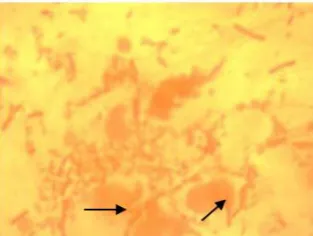
Gram Staining is done to look at a picture and describe the morphology of enterocytes and S. flexneri bacteria that attach to enterocytes. Glass slides were given liquid crystal violet and allowed to stand for 20 seconds and then rinsed with water. After being awarded iodine salt and allowed to stand for 1 minute, followed by rinsing the slides using 95% Ethyl alcohol is silenced in advance during the next 5 seconds rinsed with water. Furthermore, given safranin and allowed to stand 20 seconds after it is rinsed with water again. Slides are dried and observed using a microscope with a total magnification of 1000 times.

Analysis

The observation of the number of adhered bacteria per 100 enterocytes statistically

analyzed using SPSS with significance level of 0.05 (p = 0.05) and 95% confidence level (α =

0.05). With this method of data analysis using one way ANOVA test, Test Post hoc Mann-Whitney and Pearson correlation test.

RESULT

Pili proteins isolated S. flexneri

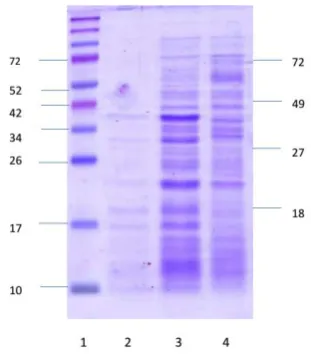
Pili protein isolation done using SDS-PAGE electrophoresis method. S. flexneri pili protein profile shown in Figure 1

.

Figure 1. Profile of Pili and Omp of S. flexneri (1: marker protein; 2 : pili slices 1 of s. flexneri; 3 : pili slices 2 of S. flexneri ; 3 : pili slices 3 of S. flexneri)

(4)

J. Islamic Pharm.,an open access journal ISSN : 2527-6123

calculation of molecular weight can be calculated molecular weight (MW) 72 kDa; 27 kDa; and 72 kDa. Third-weight proteins, which later will be tested hemagglutination and adhesion.

Haemagglutination test protein subunits pili S. flexneri

Protein subunits pili with MW 18 kDa; 27 kDa; and 72 kDa then test to see the ability of these proteins agglutinate erythrocytes of mice. The test results hemagglutination pili protein subunits S. flexneri shown in Figure 2.

Figure 2. Hemagglutination test of subunit pili protein S. flexneri shows negative agglutination (red arrow) and positive agglutination (blue arrow).

(A) Hemagglutination result of sub unit pili protein 72 kDa S. flexneri.

(B) Hemagglutination result of sub unit pili protein 27 kDa S. flexneri. (C) Hemagglutination result of sub unit pili protein 18 kDa S. flexneri

The aim of the erythrocyte agglutination test was to see whether purified subunit pili protein have the ability to perform mouse erythrocyte agglutination (hemagglutination). The results hem agglutination sub unit pili protein S. flexneri shown in Figure 2. The hemagglutination test results showed that the subunit pili protein 18 kDa S. flexneri showed the highest titer (1/128), therefore this protein was selected for further research.

Adhesion Index

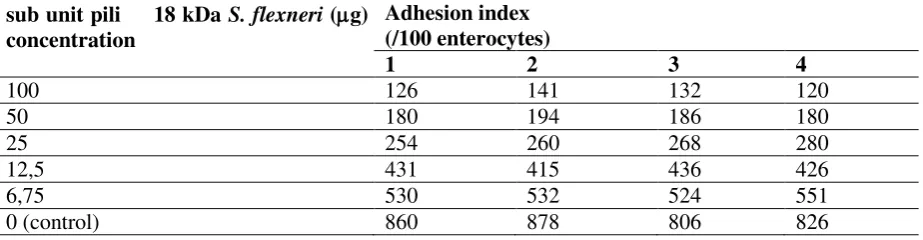
In this test S. flexneri will be presented at enterocytes isolates mice that had been coated with pili subunit proteins 18 kDa were purified. There are concentrations of different proteins in the treatment, namely with 100 ug, 50 ug; 25 g; 12.5 g; 6.75 g; 0 g (without the administration of protein). Adhesion index results in all treatment groups and control the repetition of four (4) times, are presented in Table 1 below:

Table 1.S. flexneri adhesion index to mice enterocytes after being exposed to 18 kDa sub unit of pili S. flexneri

sub unit pili 18 kDa S. flexneri (g) concentration

Adhesion index (/100 enterocytes)

1 2 3 4

100 126 141 132 120

50 180 194 186 180

25 254 260 268 280

12,5 431 415 436 426

6,75 530 532 524 551

0 (control) 860 878 806 826

Based on the results, smaller concentrations of protein sub-unit pili 18 kDa S. flexneri

(5)

J. Islamic Pharm.,an open access journal ISSN : 2527-6123

Figure 3.Attachment of S. flexneri to mice enterocytes

One way ANOVA test results showed that there were significant differences in the treatment group to the control group (p = 0.000) (95% confidence level). Then after the post hoc test, the results showed that all dose groups dilution give significantly different results. Researchers scores (r) at the Pearson correlation test amounted to - 0.733, it shows a strong relationship between the two variables. The minus sign (-) indicates that the relationship between the two is an inverse relationship, meaning increasing the concentration of the protein in enterocytes then overlaid with the index decreasing bacterial adhesion.

Based on the results of regression analysis showed that the data tested produced the equation Y = - 0.14 X + 540.525. It can be expressed every increase of 1 g protein concentration will reduce adhesion rate of 0.14 at 100 enterocytes. The coefficient of determination (R2) 0.659 (65.90%) indicates that 65.90% of the variation of the index of adhesion can be explained by the relationship of protein dilution dose concentrations. While 34.1% were other factors not included in the study variables.

DISCUSSION

In the calculation of molecular weight protein found in each piece pili S. flexneri had a band quite a lot. This is likely the pili S. flexneri contains many kinds of proteins that not only protein adhesion. According Nymu (2008), that in a single fimbria consists of all the structural components are proteins FIMA, FimF, FimG, and FimH. Both from the band's third pili protein consisting of a protein with a molecular weight of 72 kDa; 27 kDa; and 18 kDa were taken as the candidate adhesion proteins. Making the protein band because of the many proteins in polyacrylamide gel electrophoresis profiles has a ribbon thicker than the other tape.

During the formation of pili, sub unit pili (pilins) secreted into the periplasmic space through the secretory pathway and binds to chaperon (companion) who assist the folding process and prevent the formation of sub-units are premature. Then the complex pili / chaperones are brought into outer membrane usher who serves as a platform for the creation of pili. Then, the complex proteins form pores in the outer membrane that allows skippable strands stranded (Soto and Hultgren, 1999), (Proft, T and Baker, N, 2009).

Haemagglutination test is useful for identification of adhesion on some bacterial protein. Gram negative bacterial adhesion played by a protein that is able to agglutinate erythrocytes of mammals. This protein is called hemagglutinin protein, one example is an adhesin protein Klebsiella pneumoniae played by hemagglutinin protein 29 kDa. Hemagglutinin protein is an adhesion protein that acts as a virulence factor that influence the process of adhesion of bacteria to the epithelial cells of the small intestine (Sumarno, 2000).

(6)

J. Islamic Pharm.,an open access journal ISSN : 2527-6123

Hemagglutination test performed on protein S. flexneri pili subunits consisting of 3 bands and has a band thicker than the other. From these results, it turns out there is a difference in erythrocyte agglutination, in which the protein subunits pili S. flexneri has done purified using electroelution method can agglutinate erythrocytes of mice. In pili BM 72 kDa protein appears to begin agglutination titer ¼. While the pili with 27 kDa protein occurs agglutination titer began on 1/32. As well as the pili proteins with a molecular weight of 18 kDa can experience the start agglutination titer 1/128.

The occurrence of agglutination is indicated by the absence of erythrocyte sedimentation in the bottom of the wells. While the deposition that occurs on the basis of the well showed negative results. This is because the erythrocytes are not bound by a protein subunit of pili S. flexneri. S. flexneri has a molecular circuit long pili protein bands with molecular weight variety.

These results demonstrate that the S. flexneri pili proteins thought to contain adhesin protein which is a protein capable of binding erythrocytes or a protein called haemagglutinin. Adhesion proteins is the medium of bacteria in the enterocytes do attachment to host cells. Pili also known as fimbriae, is one of the adhesion factor which is expressed by most gram-negative bacteria. Fimbriae a bacterial cell surface protein polymer as an important mediator of the interaction of bacteria to the host and persist in the environment, the development of biofilms, motility, colonization and invasion in cell (Burrows, 2005).

Pili who did not produce positive agglutination on the pili Shigella possibility that there are still many proteins in addition to adhesin protein that does not specifically bind murine erythrocytes. In a previous study that S. dysenteriae pili proteins have been tested full (unpurified) which produce not significantly able to agglutinate effectively against erythrocytes (Prabowo, 2011).

Differences hemagglutination test results on each of the molecular weight is not the same. This is related to the ability of pili proteins that can bind to erythrocytes. If the protein can bind erythrocytes at a higher dilution, the protein can perform more powerful adhesion, as the highest dilution capable of binding erythrocytes. These results are consistent with studies Prabowo (2011) that by using a strain of S. dysentriae serotype 1, which causes the mannose-sensitive Haemagglutination (HA) with mouse cells. The results of these studies indicate the nature of the protein hemagglutinin pili S. dysentariae found in proteins with a molecular weight of 49.8 kDa. While protein with a molecular weight of 7.9 kDa is a protein that allows greater and faster establishment of the erythrocyte sedimentation compared with controls, this protein indicates anti-hemagglutinin protein.

Through Haemagglutination test in this study found that the hemagglutinin protein of this protein by bacterial pili serve as a useful model system for the preliminary determination of bacterial pili attachment mechanism against cell enterocytes S. flexneri host. Pili is a filamentary structure on the surface of bacterial cells composed of largely formed from protein subunits single repetition. Fimbriae binding of the adhesin (tip) that serves to bind to receptors on the host cell, and is generally found at the ends of the structure of pili (Starks, et al., 2006).

(7)

J. Islamic Pharm.,an open access journal ISSN : 2527-6123

adhesin. There have been many studies that examine the adhesin molecule of a wide variety of bacterial species, each bacterium has a distinctive characterictic that can be studied by the ability of mammalian erythrocyte agglutination (Prabowo, 2011).

To prove the role of pili subunit protein 18 kDa as adhesin molecule, then tested to determine the effect of protein concentration on bacterial attachment to cells enterocytes mice have receptors for molecular ligands form adhesin, especially those owned by pili. The concentrations used in this study, namely 100 mcg, 50 mcg, 25 mcg, 12, 5 mg and 6.75 mg and 0 mg use as a control. From the results of the study showed that the number of bacteria attached to enterocytes increases with decreasing concentration of a given protein. This is consistent with the theory that the higher the adhesin molecule that is overlaid on the enterocytes will attach receptors on enterocytes. Some of the experiments proved that between the receptor and the adhesin molecule that acts as a specific ligand that mediate adhesion of bacteria will attach to receptors that have been isolated or receptor analog, and isolated adhesin molecule or analogs will bind to the host cell surface. This is consistent with the explanation that the adhesion of the bacteria itself can be inhibited by adhesion molecules; or the receptor molecule that has been isolated, or a molecule which is analogous to adhesin molecules and receptors; enzyme or chemical component damage adhesin molecule or receptor, as well as specific antibodies induced by molecular adhesion (Todar, 2011).

This study proves that the pili subunit protein molecular weight 18 kDa as adhesin molecule. This is slightly different adhesin molecules associated with owned by Omp S. flexneri 2a and 3a is to MW 34 kDa and 38 kDa . 34 kDa Omp S. flexneri has been identified as an integral proteins, namely Omp A which has properties immunogen that can be used as a vaccine candidate. The protein was able to induce the formation of Ig A and Ig G and activates the formation of Th1, mediated stimulation of macrophages and to up-regulation of the expression of MHC, CD80 and CD 40 which then activates T cells CD 4 (Pore, 2013).

Erythrocytes are needed by all cells of the body in general, therefore the receptor in every cell of the body. Protein subunits pili MW 18 kDa S. flexneri can agglutinate erythrocytes of mice, then in theory heamglutinin pili proteins should also mediates the process of attachment (adhesion) S. flexneri into enterocytes, hereinafter referred to as molecular adhesin. As described Abrar (2009), there are differences in the ability to attach to epithelial cells veal cheek, where the group Esherichia coli, which has the hemagglutinin protein, has the inherent ability higher than the group that did not discount the haemagglutinin. There have been many studies that examine the adhesin molecule of a wide variety of bacterial species, each bacterium has a distinctive characterictic that can be studied by the ability to agglutinate mammalian erythrocyte (Prabowo, 2011). Sumarno et al. (2011; 2012) finding molecules of protein adhesin pili subunits V. cholerae and 37.8 kDa subunit protein 48 kDa pili of Salmonella Typhi also be haemagglutinin. Further explained in the study Prabowo (2011) that Shigella dysentriae HA protein with a molecular weight of 49.8 kDa which is an adhesin protein.

(8)

J. Islamic Pharm.,an open access journal ISSN : 2527-6123

CONCLUSION

Protein subunits pili S. flexneri proteins with molecular weight 18 kDa is a protein that is able to agglutinate red blood cells of mice and inhibit bacterial attachment to cells of mice significantly enterocytes that act as molecular adhesin.

REFERENCES

[1] Abrar, M. 2009. Peranan Hemaglutinin Escherichia coli dalam Proses Adhesi. Jurnal Kedokteran Hewan Vol.3. Halaman: 196-197.

[2] Bhattacharya S [et al.]. 2005. Prevalence of Shigella species and Their Antimicrobial Resistance Patterns in Eastern Nepal. 23(4): [Journal]. J HEALTH POPUL NUTR. Vol. 23. - pp. 339-342.

[3] Burrows L. 2005. Weapons of mass retraction. Mol Microbial. Vol. 57. p. 878-888. [4] Chmiela M, et al. 1997. Attachment of Helicobacter pylori strains to human epithelial

cells. J Physiol Pharmacol. Sep:48(3):393-404.

[5] Ehara, et al. 1987. Purification and Partial Characterization of Fimbriae of Fimbriae of

Vibrio cholerae 01. Vaccine. 5(4): 283-8

[6] Hanne, L. and Finkelstein. 1982. Characterization and Distribution of the Hemagglutinin Produced by Vibrio cholerae. Infect Immunn. 36(1): 209-14

[7] Niyogi SK. 2005. Shigellosis. The Journal of Microbiology. 2 : Vol. 43. - pp. 133-143..

[8] Pore D dan Chakrabarti M. 2013. Outer membrane protein A (OmpA) from Shigella flexneri 2a: A promising subunit vaccine candidate. Vaccine. 36 : Vol. 31. p.3644– 3650.

[9] Prabowo AS. 2011. Partial Characterization of Ahesions Pili on Shigella dysenteriae.

Tesis. Fakultas Kedokteran Universitas Brawijaya Malang.

[10]Proft, T and Baker, N. 2009. Pili in Gram negative and Gram positive bacteria - Structure, assembly and their Role in Disease. (review). Cell. Mol. Life Sci. 66. p. 613-635

[11]Soto G.E dan Hultgren S.J. 1999. Assembly of Bacterial adhesins across the Outer membrane via the chaperone-usher pathway. in : Broome-Smith JK (ed). Transport of Molecules Across Microbial Membranes. Cambridge University Press.England.p.124-137

[12]Starks A.M [et al.] 2006. Asembly of Csi Pili: The Role of Specific Residues of the Mayor pilin, CooA. [Journal] . J. Bacteriol. 1 : Vol. 188. - pp. 231-239.

[13]Sumarno. 2000. Karakterisasi Molekuler Protein Adhesi Vibrio cholera 01 dan Protein Reseptornya pada sel Epitel Usus Halus Tikus Putih (Wistar). Studi Patogenesis Vibrio cholera 01 . Disertasi. Program Pascasarjana Univ. Airlangga Surabaya.

[14]Thapar N and IR Sanderson. 2004. Diarrhoea in children: an interface between developing and developed countries. (Abstract) [Journal]. Pubmed. 363.

[15]Todar, K. 2011. Shigella and Shigellosis [Online]. http://www.textbookofbacteriology.net /Shigella.html.

[16]Winarsih. 2005. Imunitas Seluler dan Protektifitas In Vivo Protein Adh36 Salmonella typhii. Disertasi Program Pasca Sarjana Universitas Brawijaya Malang.

Gambar

Figure  1. Profile of Pili and Omp of  flexneriS.  flexneri (1: marker protein; 2 : pili slices 1 of s
Figure 2. Hemagglutination test of subunit pili protein S. flexneri shows negative
Figure 3 . Attachment of S. flexneri to mice enterocytes

Referensi

Dokumen terkait

!ebagian spesies nyamuk dari genus "no genus "nopheles dan pheles dan Cule# yang bersiat Cule# yang bersiat $ooilik berperan $ooilik berperan dalam penularan

[r]

Barang-barang yang dititipkan untuk dijualkan (dikonsinyasikan) haknya masih tetap pada yang menitipkan sampai saat barang-barang tersebut dijual.Sebelum barang-barang

Pendidikan nasional yang bertujuan untuk membentuk manusia seutuhnya searah dengan upaya Gereja Katolik yang antara lain melalui pendidikan agama untuk membentuk

Tingginya tingkat produktivitas primer bulan Juni 2001 disebabkan karena intensitas cahaya tinggi dan kekeruhan airnya tidak keruh, sehingga energi cahaya yang

Hasil studi literatur menunjukkan dalam penelitian minuman jeli untuk mendapatkan karakteristik gel yang disukai oleh panelis minimal konsentrasi jelly powder yang

Perubahan pandangan pembelajaran ini dimaksudkan agar pembelajaran lebih fokus pada proses pembelajaran yang mengaktifkan siswa, berdasarkan paham konstruktivisme yang

Hal ini dapat terjadi karena perubahan situasi yang tidak tergambarkan dalam spesifikasi model regresi (Santosa, 2002) Untuk mengetahui apakah model yang digunakan