i BY SITI HADIJAH NIM 1301120866
STATE ISLAMIC INSTITUTE OF PALANGKA RAYA FACULTY OF TEACHER TRAINING AND EDUCATION
DEPARTMENT OF LANGUAGE EDUCATION RESEARCH PROGRAM OF ENGLISH EDUCATION
ii
COVER ( Second Page)THE EFFECT OF GRAMMAR DISCOVERY TECHNIQUE ON STUDENTS’ PASSIVE VOICE MASTERY AT MA MUSLIMAT NU
PALANGKA RAYA
THESIS Presented to
State Islamic Institute of Palangka Raya In partial fulfillment of the requirements
For the degree of Sarjana in English Language Education
BY SITI HADIJAH NIM 1301120866
STATE ISLAMIC INSTITUTE OF PALANGKA RAYA FACULTY OF TEACHER TRAINING AND EDUCATION
DEPARTMENT OF LANGUAGE EDUCATION STUDY PROGRAM OF ENGLISH EDUCATION
iii
Faculty : Teacher Training and Education
Department : Language Education
Study Program : English Education
This is to certify that the thesis has been approved by the thesis advisors for Thesis Examination/Munaqasyah by the Board of Examiners of the Faculty of Teacher Training and Education of the State Islamic Institute of Palangka Raya.
iv
Faculty : Teacher Training and Education
Department : Language Education
Study Program : English Education
Has been examined by the Board of Examiners of the Faculty of Teacher Training and Education of the State Islamic Institute of Palangka Raya in the Thesis
Dean, Faculty of Teacher Training and Education
Drs. Fahmi, M.Pd
v
MOTTO AND DEDICATION
“ Life is short. Time is fast. No replay. No rewind. So enjoy every single moment as it comes..”
This Thesis is dedicated to:
My beloved parents Anang Muradi and Zubaidah for their pray, support, and believe in me, my beloved brothers and sister Abdul Kadir, M.Arsyad, and Rosmayati for their suggestion. beloved friends for their support, and my all of my beloved friends, especially
vi
DECLARATION OF AUTHORSHIP
Herewith, I:
Name : Siti Hadijah
NIM : 1301120866
Faculty : Teacher Training and Education Department : Language Education
Study Program : English Education
declare that:
1. This thesis has never been submitted to any other tertiary education institution for any other academic degree.
2. This thesis is the sole work of author and has not been written in collaboration with any other person, nor does it include, without due acknowledgement, the work of any other person.
3. If at later time is found that this thesis is a product of plagiarism, I am willing to accept any legal consequences that may be imposed to me.
Palangka Raya, October 2017 Yours Faithfully
vii ABSTRACT
Hadijah, S. 2017. The Effect of Grammar Discovery Technique on Students’ Passive Voice Mastery at MA Muslimat NU Palangka Raya. Thesis, Department of Language Education, Faculty of Teacher Training and Education, State Islamic Institute of Palangka Raya. Advisors: (I)Santi Erliana, M.Pd., (II) Akhmad Ali Mirza, M.Pd.
Key words: grammar discovery technique, students‟ passive voice mastery, passive voice
This study was aimed at finding out the effect of grammar discovery
technique on students‟ passive voice mastery at MA Muslimat NU Palangka Raya
in academic year 2017/2018. The population of this study was all of the eleventh grade students which consist of 88 students. The samples of this study were: XI-IPA as experimental group which consists of 44 students and XI-IPS as control group which consists of 44 students as well. Experimental group was taught passive voice by using grammar discovery technique whereas control group was taught by using grammar translation method. The researcher gave pre-test, treatment, and post-test to collect the data and used t-test formula to examine the hypothesis.
This study was quasi-experimental study with quantitative approach, where the researcher used nonrandomized control group, pre-test post-test design. The instrument of this study was test. For test drive the instrument, it was used: instrument validity, instrument reliability, discrimination power, index of difficulty, and distractor analysis. To analyze the data, it was through the same techniques: normality test, homogeneity test, and testing hypothesis.
The result of t-test using manual calculation showed that tobserved was higher than ttable at 5% and 1% significant level (1.988<3.456>2.634). It meant Ha was accepted and Ho was rejected. This finding indicated there is a significant
viii
ABSTRAK (Indonesian)
Hadijah. S. 2017. Pengaruh Teknik Grammar Discovery pada Penguasaan Kalimat Pasif Siswa di MA Muslimat NU Palangka Raya.Jurusan Pendidikan Bahasa, Fakultas Tarbiyah dan Ilmu Keguruan, Institut Agama Islam Negeri Palangka Raya. Pembimbing: (I) Santi Erliana, M.Pd., (II) Akhmad Ali Mirza, M.Pd.
Kata Kunci:teknik grammar discovery, penguasaan kalimat pasif siswa, kalimat pasif
Penelitian ini bertujuan untuk mengukur pengaruh teknik grammar discovery pada penguasaan kalimat passive voice sisw di MA muslimat NU palangka Raya pada tahun ajaran 2017/2018. Pupulasi penelitian ini adalah seluruh siswa kelas sebelas yang berjuamlah 88 siswa. Sample penelitian ini adalah: IPA sebagai kelompok eksperiment yang terdiri dari 44 siswa dan XI-IPS sebagai kelompok control yang terdiri dari 44 siswa juga. Kelompok eksperiment diajarkan kalimat pasif menggunakan teknik grammar discovery sedangkan kelompok control diajarkan menggunakan metode grammar translation. Peneliti memberikan pre-test, perlakuan, and post-test untuk mengumpulkan data dan menggunakan t-test untuk menguji hipotesis.
Penelitian ini adalah penelitian kuasi ekperiment dengan pendekatan kuantitatif, dimana peneliti menggunakan desain pra uji pasca uji, tidak mengacak kelompok kontrol. Untuk pengumpulan data digunakan instrument yaitu tes. Untuk menguji instrument digunakan: tes validitas, tes reliabilitas, daya beda, tingkat kesukaran, dan analisis pengecoh. Untuk menganilisi data, digunkan teknik antara lain: tes normality, tes homogeniti, dan tes hipotesis.
ix
ACKNOWLEDGEMENTS
The writer would like to express her sincere gratitude to Allah SWT., for the blessing bestowed in her whole life particularly during the thesis writing without which this thesis would not have come to its final form. Sholawat and salam always be bestowed to the last prophet Muhammad SAW., having shown
us the role of life to make our life true. Her appreciation is addressed to:
1. Dean of Faculty of Teacher Training and Education of the State Islamic Institute of Palangka Raya, Drs. Fahmi, M.Pd., for his invaluable assistance both in academic and administrative matters.
2. Vice Dean in Academic Affairs, Drs. Hj. Rodhatul Jennah,M.Pd., for her invaluable assistance both in academic and administrative matters.
3. Chair of Department of Language Education, Santi Erliana,M.Pd., for her invaluable assistance both in academic and administrative matters.
4. Chair of Study Program of English Education, M. Zaini Miftah, M.Pd., for his invaluable assistance both in academic and administrative matters. 5. Her thesis advisors, Akhmad Ali Mirza, M.Pd. and Santi Erliana,M.Pd, for
their generous advice, valuable guidance and elaborate correction during their busy time to the completion of her thesis.
x
7. All lecturers of Study Program of English Education from whom she got in-dept knowledge of English and English teaching.
8. The principle of MA Muslimat NU Palangka Raya, Mashudi MS, S.Ag., and English teacher Desi Arisandi, S.Pd M.Pd for giving the opportunity to conduct a research at MA Muslimat NU Palangka Raya.
9. Her classmates of Study Program of English Education, especially the 2013 period, for the support in sadness and happiness during the study in undergraduate program and for their spirits to accomplish my study
10.Her beloved parents, Anang Muradi and Zubaidah, for their moral support and endless prayer so that she is able to finish her study. May Allah SWT bless them all. Amin.
Palangka Raya, October 2017 The writer,
xi
TABLE OF CONTENT
COVER………. ... i
COVER (Second Page) ... ii
ADVISOR APPROVAL ... Error! Bookmark not defined. THESIS APPROVAL ... Error! Bookmark not defined. MOTTO AND DEDICATION ... v
CHAPTER I INTRODUCTION ... 1
A. Background of the Research ... 1
B. Research Problem ... 6
C. Objective of the Research ... 6
D. Hypothesis of the Research ... 6
E. Assumption ... 6
F. Scope and Limitation ... 6
G. Significance of the Research ... 7
H. Definition of Key Terms ... 8
CHAPTERII REVIEW OF RELATED LITERATURE ... 10
A. Related Studies ... 10
B. Grammar discovery technique ... 14
C. The Attributes of Grammar discovery technique ... 18
D. The Procedure of Grammar discovery technique ... 19
E. The Advantages and Disadvantages of Grammar discovery technique ... 23
F. Passive Voice ... 27
G. Assessment of Grammar ... 31
CHAPTER III RESEARCH METHOD ... 33
A. Research Design ... 33
B. Population and Sample... 34
1. Population ... 34
2. Sample ... 35
C. Research Instrument ... 36
1. Research Instrument Development ... 37
2. Instrument Try out ... 40
xii
4. Instrument Reliability ... 46
5. Discrimination Power ... 48
6. Index of difficulty ... 50
7. Distractor Analysis ... 51
D. Data Collection Procedures ... 52
E. Data Analysis Procedures ... 55
CHAPTER IV RESEARCH FINDINGS ADISCUSSION ... 59
A. Data presentation... 59
1. The Result of Pre-test Score ... 59
2. The Result of Post-test ... 68
3. The Comparison Result of Pre-Test and Post-test of Experimental and Control Group ... 76
B. Research Findings ... 79
1. Testing Normality and Homogeneity ... 79
2. Testing Hypothesis ... 83
3. Interpretation of the Result ... 88
C. Discussion ... 88
CHAPTER VCONCLUSION AND SUGGESTION ... 93
A. Conclusion ... 93
B. Suggestion ... 94 REFERENCES 96
xiii
LIST OF TABLES
Table Page
Table 3.1 Scheme of Quasi-Experimental Design Non-Randomized Control
Group, Pretest-Posttest Design ... 34
Table 3.2 The number of population ... 35
Table 3.3 The Number of Samples ... 36
Table 3.4 Scoring Rubric for students‟ passive voice score ... 40
Table 3.5 The Content Signification Validity of items research instrument . 42 Table 3.6 Syllabus of Passive Voice ... 44
Table 3.7 Distribution of Instrument Try Out in Grade XI IPS ... 46
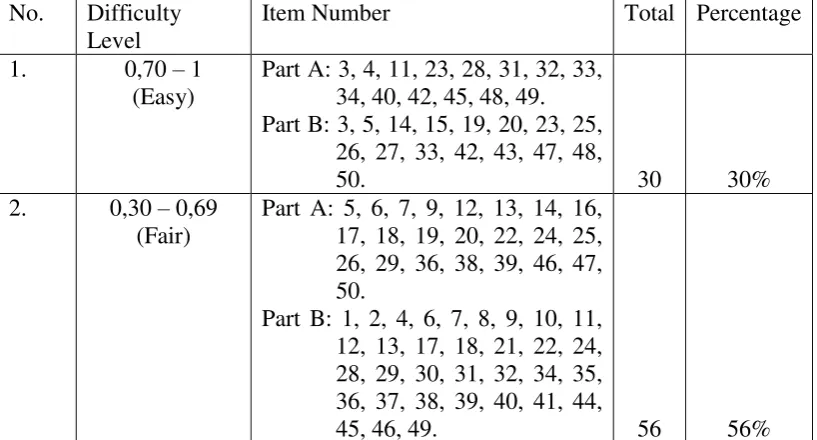
Table 3.8 Distribution of Instrument Try out in Grade XI-IPS ... 49
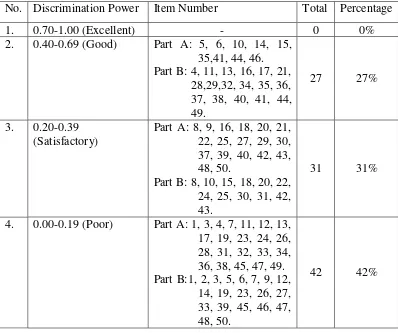
Table 3.9 Distribution of Instrument Try out in Grade XI-IPS ... 50
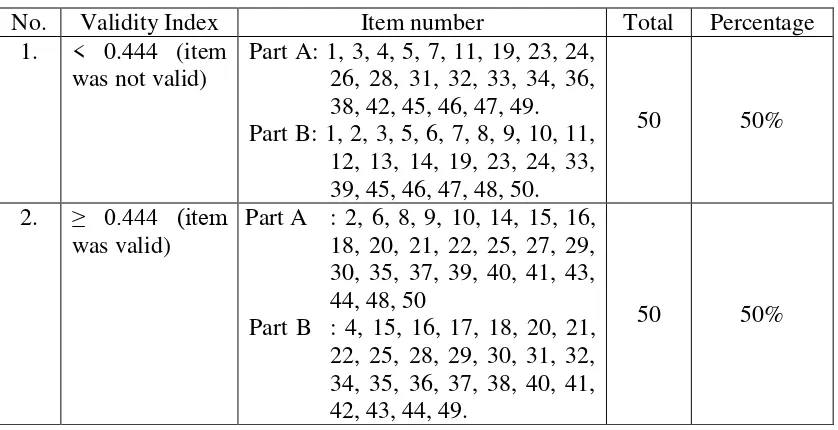
Table 3.10 The Recapitulation of the Instrument Try Out Test ... 51
Table 4.1 Pre- Test Score of Experimental and Control Group ... 60
Table 4.2 The Frequency distribution of the Pre-test Scores of Experimental Group ... 63
Table 4.3 The Calculation of Pre-Test Score in Experiment Group Using SPSS 18 .0 Program ... 64
Table 4.4 The Frequency Distribution of the Pre Test Scores of the Control Group ... 66
Table 4.5 The Calculation of Pre-test Score in Control Group Using SPSS 18.0 Program ... 67
Table 4.6 Post-Test Score of experiment and Control Group ... 68
Table 4.7 The Frequency Distribution of the Post Test Score of the Experimental Group ... 71
Table 4.8 The Calculation of Post-test Score of Experiment Group Using SPSS 18 .0 Program ... 72
Table 4.9 The Frequency Distribution of the Post Test Scores of the Control Group ... 74
xiv
Table 4.11 The Comparison of Pre-test and Post-test Score of Experiment
Group ... 76
Table 4.12 The Comparison of Pre-test and Post-test Score of Control Group ... 78
Table 4.13 Testing Normality of Pre-Test Experimental and Control Group Tests of Normality ... 80
Table 4.14 Testing Homogeneity of Pre-test Experimental and Control Group ... 81
Table 4.15 Testing Normality of post-test experimental and control group Homogeneity Test ... 82
Table 4.16 Testing Homogeneity of Post-test Experimental and Control Group ... 83
Table 4.17 The Standard Deviation and the Standard Error of X1and X2 ... 84
Table 4.18 The Result of T-test ... 85
xv
LIST OF FIGURES
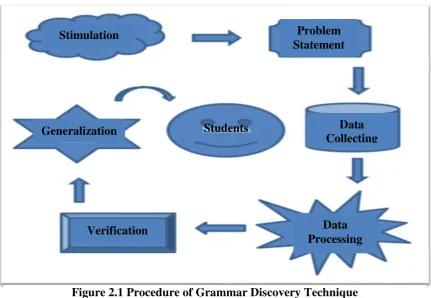
Figure 2.1 Procedure of Grammar Discovery Technique ... 23 Figure 4.2 The Frequency Distribution of Pre-test of Experimental Group ... 63 Figure 4.3 The Frequency Distribution of the Pretest Scores of the Control
Group ... 66 Figure 4.4 The Frequency Distribution of the Post Test Scores of the
Experimental Group ... 71 Figure 4.5 The Frequency Distribution of the Post Test Scores of the Control
xvi
LIST OF APPENDICES
1. Research Schedule, Syllabus, Lesson Plan, Students‟ Name and Code
2. Research Instrument, Instrument Validity, Instrument Reliability, Discrimination Power, Index of Difficulty, Distractor Analysis
3. Calculation of: Mean, Median, Modus, Standard Deviation, Standard Error 4. The Value of: R Table and T Table
xvii
LIST OF ABBREVIATION Ha : Alternative Hypothesis
1 CHAPTER IIN TRODUC TI ON
INTRODUCTION
This chapter consists of the background of the research, research problem, theobjective of the research, assumption, scope and limitation, significance of the research, and definition of key terms.
A. Background of the Research
Almost all aspects of life recommend people to master English, such as education, health, occupation, communication, and so on. In educational aspect, English is one of the important compulsory subjects that have to be learnt in Indonesian school (Kurniasih, 2013, p. 14). In Indonesian school, every student is drilled on and on in order to develop his communicative competency. In this case, if the students want to graduate from their junior and senior high school, the exam of English subject which is one of criteria should be well passed by them.
2
comments that grammar is a description of the rules that govern how a language‟s sentences are formed and it attempts to explain why the following sentence are acceptable. From some statements above, the researcher conclude that grammar will help students to communicate properly because it is the basic knowledge of English.
Hence, in learning a language student should know how language works (language usage) and how to learn its use (language use). It is the same case as learning musical instruments, a student who has been taught a lot of grammar but cannot use the language is the same as a guitarist who has learnt a lot about harmony but cannot play the guitar (Simbolon, 2015, p. 71). So, when students learn English, their first and target language could be mix and influence each other. The patterns of the English can be very different from their Indonesian. Mostly, students are using the Indonesian sentence patterns unconsciously when they write English sentence without paying attention to the rules. However, learning grammar cannot be avoided because it is a basic element which is used in every English skill, such as Speaking, Writing, Reading, or Listening. The purpose of teaching grammar in senior high school is to enable the students communicate each other by using correct grammar in daily life and their work environment. Besides that, by understanding English Grammar well, students can understand a message or information which will be conveyed by an author or speaker to the reader or listener in order to avoid misunderstanding.
3
speaker-listener. In the sense of learning grammar consecutively students have to be an active, creative, effective and fun learner taught by the teachers.
Therefore, it is important for English learners to have a good understanding on it. Based on 2013 curriculum, passive voice should be learnt to eleventh grade students at Senior High School. It means that passive voice is one of important grammar to be mastered by students. However, Indonesian students seem to have problem in constructing passive voice.
In learning Passive Voice, the students need to pay attention into tenses before change an active sentence into passive. The students still faced a lot of difficulties in using tenses, and tenses are generally still a big problem for Indonesian students. Moreover, the students who have low mastery at English do not master all the tenses well. As the result, Passive Voice has become one of grammar problem in the class. In this case, according to White (2009, p.188):
“Teaching the use of the Passive Voice constitutes a problem area
in many language courses. Often it is treated as transformation exercises, the students being required to rewrite active statements as passive ones. The result can be a confusion of forms, with a combination of elements which are neither active nor passive. Furthermore, the actual function of the passive, as a means of describing a sequent overtired process, may not be obvious to the
students as a result of such practice exercises”.
In relation to the statement above, in learning passive voice sentences, many students have some common difficulties, i.e. which tenses that will be used. It is known that there are four kinds of main tense: there are present tense, past tense, future tense, and past future.
4
MuslimatNU Palangka Raya are found. First, they have difficulty in identifying the form of passive voice; second, they have difficulty in identifying the form of verbs; and third, they have difficulty in changing active voice into passive. For example, *he reads the book. The students were asked to transform this sentence into a passive sentence and they wrote *book reads by he. Passive voice in English has be + past participle (regular and irregular verbs), while their first language does not have such rules. Therefore, the correct answer should be written*book is read by him.
Because of the English passive voice is important, but difficult to be learnt, some efforts have been done to solve the problem. The main objective is to make English passive voice become easier to be learnt, so that teacher has to have an interesting teaching technique. In other hand, the teacher should choose the best technique in teaching grammar in order to make students easier to master passive voice.
5
For example, there is a research entitled The Effect of Using Discovery Learning Strategy in Teaching Grammatical Rules to First Year General
Secondary Student on developing Their Achievement and Metacognitive Skill by
Prof. Dr.AbdelrahmanKamel Abdelrahman Mahmoud (2014). He is the Professor ofcurriculum and teaching methods, Faculty of Education,Fayoum University, Egypt. The purpose of this research is todetermine the effectiveness of discovery learning strategy inthe teaching of grammatical rules in the development and skillsbeyond the knowledge of students in the first grade secondary.The result of this research is Discovery learning strategysucceeded in teaching grammatical rules in the development ofskills beyond the knowledge of students in the first gradesecondary school year, which is reflected in the level of thestudents in the test scores.
In conclusion, the Grammar discovery technique is a teaching technique where students are given a chance to observe, think, ask, and discover the grammar material by themselves. The role of teacher is a facilitator and informant.
Based on the explanation above, it can be seen that how important grammar for Indonesian learners, especially in mastering passive voice. It is one of grammar point that is often learned in Senior High School. In this case, passive voice should be learned by students of MA Muslimat NU. While Grammar discovery technique is one of motivating learning and it can be used to find out
the students‟ mastery on passive voice. Therefore, the researcher is interested to
do a research entitled: “The Effect Grammar Discovery Technique on Students‟
6 B. Research Problem
Based on the background of research above, the problem of the research is
“Is there any effect of Grammar discovery technique on students‟ passive voice
mastery at MA Muslimat NU Palangka Raya? C. Objective of the Research
The objective of the research is to find out the effect of grammar discovery
technique on students‟ passive voice mastery at MA Muslimat NU Palangka
Raya.
D. Hypothesis of the Research
Ha : There is a significant effect of using grammar discovery technique on
the students‟ passive voice mastery of the eleventh grade at MA
Muslimat NU Palangka Raya.
Ho : There is no significant effect of using grammar discovery on the
students‟ passive voice mastery of the eleventh grade at MA Muslimat
NU Palangka Raya. E. Assumption
There are two researchers‟ assumptions in this research, they were:
Firstly, Grammar discovery technique could be applied in teaching
grammar, especially Passive Voice. Secondly, the students‟ Passive Voice
mastery would be better by using Grammar discovery technique. F. Scope and Limitation
7
technique on students‟ passive voice mastery at MA Muslimat NU Palangka
Raya. The researcher used only test to find out the students‟ mastery on passive voice. In this research, the researcher took the eleventh grade student at MA Muslimat NU Palangka Raya as the sample of the research and it consists of two classes and the numbers of students were 88 students: there were 44 students at XI-IPA class as the experimental group and there were 44 students at XI-IPS class which was control group. The limitation material of this research was passive voice material. The researcher decided the topic of passive voice in: simple present, simple past, simple future, and preset perfect.
G. Significance of the Research
This study has theoretical and practical significances. Theoretically, there were some benefits which were expected that the result of this research could: measure the effect of grammar discovery technique on students‟ passive voice mastery, relate a contribution to support the theory in teaching and learning passive voice or classroom technique, prove grammar discovery technique can be applied as one of the effective teaching technique in teaching passive voice.
Practically, the result of the research was expected to give a significant contribution to the English teacher, students, and the future researcher. Firstly, the significant for the teacher is that grammar discovery technique can be implemented by the teacher as an alternative technique in teaching and learning process, especially in teaching English passive voice. Secondly, the significant for
the students is that grammar discovery technique will overcome the students‟
8
some benefits for the future researcher: it can give empirical data about the use of grammar discovery technique in teaching and learning passive voice, give the reference of a study if they are interested in conducting the similar study, and develop the teaching and learning English passive voice at senior high school. H. Definition of Key Terms
1. An Experiment
An experiment refers to an attempt to establish a cause-and-effect relationship by some strategy such as administering a treatment to one group and withholding it from another (Toendan, 2007, p.215). In this research, the researcher did the experimental research with the quasi experimental approach at eleventh grade of MA Muslimat NU Palangka Raya in academic year 2017/2018.
2. Grammar discovery technique
Grammar discovery technique is included in discovery learning which is one of the cognitive instructional models was introduced by Jerome Bruner. He regarded that discovery learning agree with searching knowledge actively by human being, and automatically gives the best result (Trianto, 2007, p. 26). In this research, Grammar discovery technique is a technical way that researcher will use to find out its effect on students‟ Passive voice mastery.
3. Passive Voice
Hornby (2000, p.964) says, “Passive voice is the form of a verb that is
used when the subject is affected by the action of verb”. Therefore, the Passive
9
with an auxiliary verb (usually be or get) plus a participle (usually the past participle) of a transitive verb. However, passive is really needed in daily speaking and writing activity.
4. Mastery
10
CHAPTER IIREV IEW OF R ELA TED LI TERATUR E
REVIEW OF RELATED LITERATURE
In this chapter, the researcher presentssome theories and research studies which are relevant to the topic.
A. Related Studies
First of all, the thesis was conducted by Prawerti (2014). The result of analysis showed that Discovery Learning Method is an effective method to teach writing for the tenth grade students of SMAN 1 Durenan in the Academic Year of 2014/2015. Second related research is a thesis from Mukharomah (2015). The result of the research showed that the students improve their descriptive text writing effectively by using discovery learning model. Third, related research was conducted by Naila (2014). Based on the research results, it can be inferred that applying discovery learning model with scientific
approach is able to improve the high school students‟ science process skills. Forth, a
thesis was done by Hidayati (2016). The results of this research indicate that Discovery learning with learning journal writing can improve scientific working class VIII.1 SMP Negeri 1 Probolinggo. Fifth, a thesis was conducted by Mahmoud (2014). The result of this research was Discovery learning strategy succeeded in teaching grammatical rules in the development of skills beyond the knowledge of students in the first grade secondary school year, which is reflected in the level of the students in the test scores. Sixth, Mukharomah (2015) reported the research result showed that using discovery learning model can improve students‟ achievement in writing descriptive text. The Seventh related research was a research from Sandi (2016). In research finding, the
excellent level and the good level. Besides that, the researcher also found that most of
the students‟ difficulties in learning passive voice were in the mastering of past
participle. Eighth, a research was made by Aprilia (2011).Based on the recapitulation on the test result and the data analyzed, it was found that the students‟ ability in identifying passive voice in reading text was classified into poor and the factors that influence the
students‟ ability in identifying passive voice in reading text were low motivation,
in the methodology section. The last was Putthasupa (2009). The findings showed that the inductive approach positively affected the teaching of grammar in the writing course.
In conclusion, the current research is different with those previous studies. The first related research was conducted by Prawerti (2014) tried to reveal whether: (1) Discovery Learning Method is more effective than Direct Method to teach writing to the tenth grade of SMAN 1 DurenanTrenggalek in the Academic Year of 2014/2015; (2) the students who have high creativity have better writing skill than those who have low creativity of the tenth grade of that school; and (3) there is an interaction between teaching method and creativity to teach writing to the tenth grade that school. Second, a previous research conducted by Mukharomah (2015) tried to find out whether discovery
learning model is more effective to improve students‟ descriptive text writing than
non-discovery learning. The third, the thesis was conducted by Naila (2014). The result
showed that there were significant increases of students‟ science process skill values by
effective to improve students‟ descriptive text writing than non-discovery learning. The
seventh related research presented by Sandi (2016) wanted to see the students‟ ability in
using passive voice and also their difficulties in learning it. The eighth previous research by Aprilia (2011) had two objectives of the research were to find out the
students‟ ability in identifying passive voice in reading text and to find out the factors
that influences the students‟ ability in identifying passive voice in reading text. Ninth, a
paper was from Sally (2014). It highlights the use of discovery approach in the teaching General Studies. The overarching aims of the paper are to share researcher‟s experience of planning a unit of lessons and trying out the discovery approach in one school. The tenth related research was Nurhayati (2013), the purpose of her research is to find the
relationship between students‟ mastery ofIndonesian passive voice and passive voice in
passives used, and the contexts andforms in which they occurred. The last was a research which was conducted by Putthasupa (2009). The result showed that the
inductive approach, through the writing classes, could improve learners‟ grammatical
errors. It was also found that there were totally 25 issues of grammatical errors which were frequently produced by the students ranking from sentence to word levels.
Based on description above, then the researcher is interested to formulate this
research by using title “The Effect of Grammar discovery technique on Students‟
Passive Voice Mastery at MA Muslimat NU Palangka Raya” because this research
would find out the effect of Grammar discovery technique in many ways on students‟
passive voice mastery. The researcher chose passive voice because the students‟
mastery of passive voice is important to be conducted in this research. The researcher hoped that the use of Grammar discovery technique is effective in teaching passive voice because it has learning stages that can make the students understand about passive voice and make the students active in class.
B. Grammar discovery technique
aspects. Such activities help to correct the conceptual errors of students. On the other hand, the researcher adds that, the best result here should not force students to get the best mark in the end of teaching learningprocess. The students are given chance by the teacher to solve the problem which passed by themselves. It meansthat learning output is independently.
In addition, Grammar discovery technique emphasize the important of structure comprehend or the important ideas to a science discipline, through involvement of
students „activity in passive voice‟ teaching learning process. It is a model to improve
the way of the active students „learning by discovering and investigating themselves, so
the result that will get is permanentand memorable in their mind, it is unforgettable to students. By using discovery learning, students can also think analysis and try to solve their problem by themselves (Hosnan, 2014, p.282).When students were asked to understand, they got stress and worried, because of the grammatical rule in English uses
inpassive voice. Here, the researcher use discovery learning is to reducestudents „worry
about the grammatical rule. The students wouldwrite without any grammatical rule as usual at the first time, butthey would face the fact thing that must be assumed to be a thingthat must be written.
discovery technique occurs whenever the learner is not provided with the target information or conceptual understanding and must find it independently and with only theprovided materials. Within discovery learning methods, there isan opportunity to provide the learners with intensive, conversely,minimal guidance, and both types can take many forms (e.g.,manuals, simulations, feedback, example problems) (Alfieri et al, 2011, p.2).
Grammar discovery technique, in this case, is discussed as Discovery Learning, also can be called as an active learning. Here, the strategy for active learning has a purpose to makeindependent and creative growing in researching, so that studentscan make innovations. Learning aim is expected to make studentsenable to understand a concept through their discovery by doingexperiment. For this, it only can be achieved by using strategy ingrouping to make a report as well as communication. Based on Mallinson in Trianto (2007, p.133), suggested that “If the main goal of science program
is to getchildren to understand, remember, and apply science concept, there‟s probably
no more powerful tool than having writingscience. Research indicates that writing about science improvesnot only science vocabulary, but also performance in readingand
thinking in the discipline”.
Discovery occurs when an individual is involved, especially in the use of mental processes to find some of the concepts and principles. Discovery is done through observation, classification, measurement, prediction, and determination and inferring. The process is called cognitive. While the discovery processes itself is the mental process of assimilating concepts and principles in the mind (Sund in Malik, 2001, 219 in Mendikbud, 2013).
According to Murphy, et al (2010), Discovery learning is a learner centered mode of teaching most widely discussed by John Dewey and Jerome Bruner. In discovery learning students become active participants in learning by exploring concepts and answering their own questions through testing and experience. Discovery Learning refers to various instructional design models that engage students in learning through discovery. According to Joolingen (1999, p.285), discovery Learning is a type of method where learners construct their own knowledge by experimenting with a domain, and inferring rules from the results of these experiments. The basic idea of this kind of method is that because learners can design their own experiments in the domain and infer the rules of the domain themselves they are actually constructing their knowledge. Because of these constructive activities, it is assumed they will understand the domain at a higher level than when the necessary information is just presented by a teacher or an expository learning environment.
before. Discovery means from nothing to get something which they never know before. It emphasizes on the students‟ full participation through observation, classification, measurement, prediction, determination, and inferring until they discover their own concept.
C. The Attributes of Grammar discovery technique
Bicknell-Holmes and Hoffman (2000) describe the three main attributes of discovery learning as 1) exploring and problem solving to create, Grammar discovery, and generalize knowledge, 2) student driven, interest-based activities in which the student determines the sequence and frequency, and 3) activities to encourage Grammar
discovery of new knowledge into the learner‟s existing knowledge base. The first
attribute of discovery learning is a very important one. Through exploring and problem solving, students take on an active role to create, integrated, generalize knowledge. Instead of engaging in passively accepting information through lecture or drill and practice, students establish broader applications for skills through activities that encourage risk-taking, problem solving, and an examination of unique experiences (Bicknell-Holmes & Hoffman, 2000). In this attribute, students rather than the teacher drive the learning. Expression of this attribute of discovery learning essentially changes the roles of students and teachers and is a radical change difficult for many teachers to accept (Hooks, 1994).
achieved. Learning is not a static progression of lessons and activities. This attribute contributes greatly to student motivation and ownership of their learning.
A third major attribute of discovery learning is that it is based on the principle of using existing knowledge as a basis to build new knowledge (Bicknell-Holmes & Hoffman, 2000). Scenarios with which the students are familiar allow the students to build on their existing knowledge by extending what they already know to invent new ideas.
In addition, based on Husnan (2014, p.284),the main characteristics of discovery learning are:
1. Explore and solve the problem to create, merged, generalize knowledge 2. Students-centered
3. The activity is merged new knowledge and knowledge that available. D. The Procedure of Grammar discovery technique
According to Mendikbud (2013) also proposes some Application Procedure of Discovery Learning Method. According to Shah (2004, p.244) in applying the Discovery Learning method in the classroom, there some procedures that should be implemented in the teaching and learning activities in general as follows:
1. Stimulation (Stimulation / Giving Stimuli)
andhistorian. Lesson material is not given in the beginning ofteaching learning, but students should do some activitiescollect information, comparing, category, analyzing,integrating, reorganizing material as well as makingconclusions technique.
Related to the teaching English Passive Voice, the researcher showed a picture and asked the students a question for example “what do you expect from the picture?”. By giving such kind of questions and pictures, it will stimulate the students mind to familiar with the passive voice.
2. Problem Statement (Statement/Identify the Problem)
The next step is giving an opportunity to the student to identify as many agendas as possible which are relevant to lesson material, then one of them is selected and formulated in the form of hypotheses (answers while the question of the problem) (Shah, 2004: 244), while the problem chosen then will be formulated in the form of a question, or hypothesis, i.e. statement as a temporary answer to the questions proposed.
In teaching English Passive Voice for this stage, the researcher gave the opportunity to the students to guess the answer as much as possible. After that, one of the students was selected to convey his sentence. The researcher helped the student to fix the sentence. Then, asked all of the students to change the sentence into passive.
3. Data Collection
In this stage, the students are commanded to make some groups. Then, the students are asked to solve some challenges given by researcher; they should move active sentences to passive. The students are allowed to discuss the answer of the questions in each group. The students should complete the answer whether it false or true.
4. Data Processing
According to Shah (2004: 244) data processing is the activity of processing the data and information that has been obtained by the students either through interviews, observation, or others. All the information as a result of readings, interviews, observation, and so on then will be processed, randomized, classified, tabulated, even if it is calculated in a certain way and interpreted on a given confidence level (Djamarah, 2002, p.22).
Related to teaching English Passive Voice, in this step the researcher asked the students to process the answer, convey it in front of class. So one of the students from every group or one group presented their answer, while other groups listened the explanation.
5. Verification (Proof)
students to find a concept, theory, rule or understanding through examples that they might be encountered in their life.
In this phase, the role of the researcher was giving the materials and example about passive voice. Then, the teacher asks students to observe and research by
themselves. By this step, the students will compare their answer and teacher‟s example,
so the students will consider whether their answers are true or false. 6. Generalization (Interesting Conclusions / Generalization)
The generalization / draw the conclusion stage is that the process of drawing a conclusion which can be used as a general principle and applies to all events or the same problem with regard to the result of verification (Shah, 2004, p.244). Based on the results of the verification, it is formulated the principles underlying the generalization. After draw conclusions, the students should pay attention to the process of generalization that stressed to the importance of mastering the lesson over the meaning and rules or principles underlying the extensive experience of a person. In this stage, the students draw the conclusion about passive voice, such as the form of sentences and the use.
E. The Advantages and Disadvantages of Grammar discovery technique 1. The advantages of Discovery Learning
In general, Discovery Learning method may have several advantages as proposed by Mendikbud 2013. They are as follows:
a. Helping students to improve and enhance the writing skills and cognitive processes b. The knowledge gained through these methods is very personal and powerful
because can strengthen the understanding and retention
c. This method allows the students develop rapidly and in accordance with own pace. d. Helping the students to direct their own learning activities involving their wits and
their own motivation. It will improve their grammar and vocabulary in writing. e. This method can help students reinforce the concept of writing skill itself, because
they have a confidence in collaboration with others.
Statement
Generalization Students
Verification Data
Processing Data Collecting
f. This method is centered on students and teachers alike participate actively state the ideas. Even the teachers can act as a student, and as a researcher in the discussion part.
g. Helping students to overcome skepticism because the discovery learning leads to final and certain truths.
h. Students will understand the basic concepts of writing and ideas well so that it will improve their organization and content in writing.
i. Encouraging students to think and formulate their own hypotheses j. Providing decisions that are intrinsic.
k. Learning situation becomes more aroused.
l. Increasing the level of awards to the students so that it will improve the students‟ mechanic skill in writing.
m. Students learn to utilize various types of learning resources. n. It can develop their individual talents and skills.
The other advantages are also stated by Murphy, et al (2010) as follows: 1) Highly Motivating
a. Students are engaged actively in the learning process. b. They are responsible for their own successes and failures. c. They have something at stake.
2) Problem Solving
c. It instils lifelong learning skills 3) Personalization
a. The learning experience is tailored to each child. b. It gives the students autonomy and independence. 4) Developing an Interest in Learning
a. Students discover their own ways of learning.
b. Students must utilize their own prior knowledge and understanding. c. Develops curiosity.
5) Memory
a. Students may be more likely to retain the information if they learn it on their own terms.
b. When they learn the information in context, they may be more likely to remember it than if they are taught from a textbook exclusively.
2. The Disadvantages of Discovery Learning
According to Mendikbud (2013), some advantages of using Discovery Learning Method are:
a. This method raises the assumption that there is a readiness of mind to learn. The students who have low intelligent, will have difficulty in thinking or expressing abstract or relationships between concepts, written or oral, and finally will cause frustration.
c. Teacher and students who usually applied the old method will be difficult to understand the new concept in the new method. Consequently, the teaching learning process does not run
d. Teaching discovery is more suitable for developing understanding, whereas to develop aspects of concepts, skills and overall emotional still have less attention. e. In some disciplines, such as Science, it still lacks of facilities for measuring ideas
expressed by the students
f. Not provide opportunities to the students to find and discover the material of lesson they like because it has been pre-selected by the teacher.
Based on Murphy, et al (2010) in their article proposes some disadvantages of applying the Discovery Learning method. They are:
1) Not easy to implement
Learners need to possess a number of cognitive skills and be intrinsically motivated to learn.
2) Pure Model vs. Guided Model
Teachers have found that discovery learning is most successful when students have prerequisite knowledge and undergo some structured experiences. Most researchers would argue that pure discovery learning as general and global teaching strategy for beginning and intermediary learners doesn't work. The debate on how much guiding is needed is somewhat open.
4) Creations of misconceptions ("knowing less after instruction")
5) In order to benefit from a discovery situation, students must have basic knowledge about the problem and must know how to apply problem-solving strategies. Without this knowledge and skill, they will flounder and grow frustrated. Instead of learning from the materials, they may simply play with them.
6) Critics believe that discovery learning is so inefficient and so difficult to organize successfully that other methods are preferable. This seems especially true for lower-ability students. Discovery methods may make too many demands on these students because they lack the background knowledge and problem-solving skills needed to benefit.
F. Passive Voice
Passive voice is the opposite of active in sentence pattern, in the passive voice, the object of an active verb becomes the subject of the passive verb Azhar (2002, p.208), in another word the object in the active sentence move into subject position in the passive sentence. Both showed different understanding and function and have a dissimilar rule in use.
1. The Nature of Passive Voice
A passive sentence is one of language features of analytical exposition text. That is why students should know and can identify it in reading text Passive voice is known as one of the characteristics of a language. The use of passive voice is very popular in both daily conversation and many different reading books. In Indonesian, the form of
passive voice is well known as “kata kerja berawalan di”. Azar (2006, p.120) says that
in the passive, the object of an active verb becomes the subject of the passive verb. She adds that only transitive verbs (a verb that is followed by an object) that are used in the passive. Pyle (2002, p.167) says that a sentence can be either in the active or passive voice. In an active sentence, the subject performs the action. In a passive sentence, the subject receives the action. Furthermore, Pyle and Page (2002, p.168-169) states the steps how to form a correct passive voice as rules in Bahasa Indonesia or English follows:
a. The complement of the active sentence is placed at the beginning of the passive. b. If the active sentence uses an auxiliary verb, the auxiliary should be placed after the
new subject agreeing in number with the subject. c. Insert “be” after the auxiliary.
d. Place the subject of the active sentence become the object in passive preceded by the preposition by.
Dealing with this, Lado (1986, p.39), also gives some rules how to form passive voice, they are as follows:
b. The object in the active sentence becomes the subject in passive.
c. The verb in passive should be substituted into past participle preceded by to be. d. The tenses in passive should be agreeing with the active sentence.
For example:
- My brotherhelped mother yesterday.
S V O
- Motherwas helped by my brother yesterday. O V S
Based on the sentence above, the object of an active sentence becomes the subject of a passive voice, and the subject of an active sentence is the object of by in the by-phrase in a passive sentence.
2. The Use of Passive Voice
According to Martinet and Thomson (1986, p.266), the passive sentence is used: a. When we do not know, or do not know exactly, or have forgotten who did the action,
example:
You will be met at the station.
b. When the subject of the active verb would be „people‟, example: He is suspected of receiving stolen goods.
c. When the subject of the active sentence would be the indefinite pronoun one. One sees this sort of advertisement everywhere would usually be expressed, example: This sort of advertisement is seen everywhere Or
You see this sort of advertisement everywhere
e. The passive voice may be used to avoid an awkward or ungrammatical sentence. This is usually done by avoiding a change of subject, example:
When he arrived home a detective arrested him.
f. When it is not necessary to mention the doer of the action as it is obvious who he is/was/will be. Example:
The rubbish hasn’t been collected.
3. The Characteristics of Passive Sentence
The passive sentence has some characteristics. The characteristics of the passive sentence are:
a. The object in an active sentence will be the subject in the passive sentence. The subject in an active sentence will be the object in a passive sentence by using „by‟. Example:
- Sintia sold the computer (active)
- The computer was sold by Sintia (passive)
According to Azar (2006, p.125), a passive verb is followed with a „by phrase‟ only if it is important to know who performs an action. Usually, the „by phrase‟ is omitted from a passive sentence. The passive is most frequently used when it is not known or not important to know exactly who performs an action.
b. The use of “be + Past Participle (transitive verb)”. Students will recognize passive
sentence if they find “be + past participle” in a sentence. “Be” that is used can be in
future (will be, shall be). “be” can be also used in progressive (am being, is being,
are being, was being, were being).
c. Modal auxiliary + be + past participle. If the active sentence does not have a form of
“be”, but it has modals, we can add “be” after modals to construct a passive sentence.
d. Direct and Indirect Object
Sometimes there are two objects in a sentence, Alter (1991, p.219) they are the direct object and indirect object. In this case, the passive sentence can be formed as follows:
Example:
- He gives the womansome money Indirect Direct
- The woman is given some money by him (passive) G. Assessment of Grammar
Assessing is defined as an action which has the purpose to make a judgment about something. According to Brown (2004, p.4) states that assessment is an ongoing process that encompasses a much wider domain. Whenever a student responds to a question, offers a comment, or tries out a new word or structure, the teacher subconsciously makes an assessment of the students‟ performance. Therefore, test will
show the improvement of the students‟ competence when they learn a sample given by
the teachers. According to Heaton there are some types of grammar assessment: 1. Multiple-choice items
4. Completion items 5. Transformation items
6. Items involving the changing of words 7. „Broken sentence‟ items
8. Pairing and matching items 9. Combination items
10.Addition items
Grammar assessment has some aspects which have to be considered, first is about what is the purpose of the task, second is about what types of tasks are suitable to measure the grammar mastery, and third is about how to construct a grammar task in order to go in line with the purpose.
In relation to the statement above, the researcherfocused on testing the students‟ mastery with grammar test where it consisted passive voice test; moreover in this study, the researcher takes the multiple choice test, fill the blank test, and structural test by underlining sentence on the text.
Multiple-choice test is easy for the teacher to give the score quickly with a choice of four or five options (Brown, 2014, p.194). Multiple choice tasks are about choosing the best answer from the choices given; therefore, to avoid confusion, special care should be given in order to make sure that there is only one correct answer.
33
CHAPTER IIIRESEARCH METHOD RESEARCH METHOD
In this chapter, the researcher present research design, population and sample, research instrument, data collection procedure, and data analysis procedure.
A. Research Design
This studyused quantitative approach. The design of the study was an experimental research. It was used because this research used the data which is from of statistic number. This study belonged to experimental. Thisstudyused quasi-experimental design which had two variables in it. This study also took 2 classes as sample. Both group are experiment group and control group. Those groups were be given pretest and posttest. Pretest was given, because the researcher wants to know pre-ability before giving of treatment, and posttest was given to measure the students‟ score after giving treatment. Pretest and posttest helped in determining whether any difference exists or not. This is to see whether the treatment had changed the score from the pretest to the posttest (Lodico, et al, 2006). This research had taken in MA Muslimat NU Palangka Raya.
another conventional strategy as usual, in this case the control group was taught by using Grammar Translation Method (GTM). Post testwas given for both groups to
measure the students‟ mastery after treatment is given (Y2 and Y2). The scheme of this
model is:
Table 3.1. Scheme of Quasi-Experimental Design Non-Randomized Control Group, Pretest-Posttest Design
Subject Pre- test Treatment Post- test
E Y1 X Y2
C Y1 - Y2
Where:
E : Experimental group C : control group X : Treatment Y1 : Pre-test Y2 : Post-test
In this experiment, the researchertaught the students directly with the same material (Passive Voice). Grammar discovery had been applied in experiment group only, while Grammar Translation method had beenapplied in control group. Otherwise, the control group is not given the treatment.
B. Population and Sample
1. Population
events or objects. The population was the generalization that occurred over the subject/object: had certain qualities and characteristics set by the researchers to learn and drawn the conclusion Sugiono (2009, p.80). So, population is the whole groups of research.
In this research, the researcher took the students from the MA Muslimat NU Palangka Raya. The population of the research is all of the eleventh grade students of MA Muslimat NU Palangka Raya in Academic Year 2017/2018.
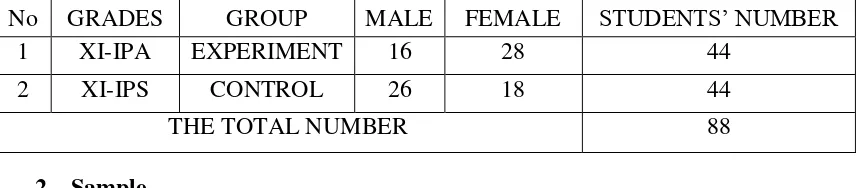
Table 3. 2. The number of population
No GRADES GROUP MALE FEMALE STUDENTS‟ NUMBER
1 XI-IPA EXPERIMENT 16 28 44
2 XI-IPS CONTROL 26 18 44
THE TOTAL NUMBER 88
2. Sample
The use of the lottery method of random sampling was easy because of the fact
that it did not need difficult procedure. In this case, each of the classes‟ names was
written on piece of paper. And then the paper was rolled and put into a slot of a box. After being well mixed, a paper was dropped out of the slot and these become the sample of the research.
In addition, the sample of this research was taken by using cluster random sampling. To determine which one is Experimental or control group, lottery method was the appropriate procedure.
Finally, the researcher consideredXI-IPS as controlgroup and XI-IPA as the experimental group. Both of those groups had the same teacher, had the same ability in English, and on the available time to teach them. They consist of 88 students
Table 3. 3. The Number of Samples
No GRADES THE NUMBER OF THE STUDENTS
1 XI-IPA 44
2 XI-IPS 44
THE TOTAL NUMBER 88
C. Research Instrument
1. Research Instrument Development
The researcher used the instrument in order to get the better data. The instrument of this research was a tool or facility. It meant, it was used by the researcher for collecting data in order to get better result or it could occur complete and systematic.
To complete this research, the researcher added the instrument of research include tests. There are pre-test and post-test. The pre-test was given before the teaching and learning process and the post-test was given after it. The researcher compared the achievement of pre-test and post-test; to find out the effect of grammar discovery technique on students‟ passive voice mastery.
a. Test
The researcher made the instrument of this research that consisted of 100 questions passive voice test. It was divided into three forms; first past is multiple choices, the second part is fill the blank and third part is structure test though underlining sentences in the text.
The researcher made test of multiple-choice item, because the multiple choice item is generally recognized as the most widely applicable and useful type of objective test. It can more effectively measure many of the simple learning outcomes measured by the short-item or completion (Ary, et al, 2010, p.201). So, the researcher used test of multiple choices item that consist of 50 items on part A. Besides that, fill in the blanks test are chosen because of the following advantages:
The technique of scoring is easy.
It is more practical for the students to answer.
Therefore, the researcher used test of fill the blank item which consist 0f 48 items on part B. In the third part of the test, the researcher used structure test though underlining sentences in the text. It was concluded that it is diagnostic test, because based on James Dean Brown who stated that diagnostic tests are designed to diagnose a
particular aspect of a language and can be used to check the students‟ in learning a
particular element of the course. It was used because the researcher wants to measure how well the students understand passive voice, and it can be seen only by underlining some passive voice sentences in the short text.
The test was made by researcher and Mr. Citra PriskaAbadi, S. s, M.Pd as the Validator of instrument. Initially, the test was made in fill the blank form with only two alternative choices below. Then, the researcher did validity judgment which was helped by Mr. LuqmanBaehaqi, S. s, M.Pd as the examiner to change the alternative choices from 2 become 4 alternative choice. It was done, because the researcher wants to minimalist the guessing/bias, therefore the students did not answer the test promiscuously. After that, the test was changed become multiple choice based on the suggestion by Mrs. SantiErlianaM.Pd.
Fill in the blank test consist of 48 items from number 1 to number 48 on part B.
It‟s score per item is 1 as well. It means if students can choose the answer of 1 item
correctly, they will get 1 score and if they can choose the answer of 48 items correctly, they will get 48 scores.
Structure test though underlining sentences in the text consists of 2 items from
number 49 to number 50 on part B. It‟s score per item is 1 also. It means if students can
choose the answer of 1 item correctly, they will get 1 score as well and if they can choose the answer of 2 items correctly, they will 2 scores. If the students answer all items correctly, they will get scores 100.
Consequently, from the description of each test from above, it can be seen that the high score of this test is 100 scores.
1) Pre-test
Before the researcher taught the English Passive Voice material by using Grammar discovery technique, the researcher gave a test to the students. A pre-test was given at the beginning of research before the treatment was run to both control and experimental class with similar question that related to the topic. A pre-test is given to know that the sample (control and experimental class) has the same ability.
2) Post-test
Post-test was given to the experiment class and control class. It was given in
order to know students‟ achievement on English passive voice. The post-test was given
class was taught passive voice by using grammar discovery technique and the control class was taught passive voice without using grammar translation method. The post-test questions have been rearranged from pre-test questions, because the researcher want to clarify that the students have mastered English passive voice well and they were not guessing in answer the post-test.
The score of students‟ achievement on English passive voice can be calculated
by using this following formula:
Score the number of true answersthe number of questions
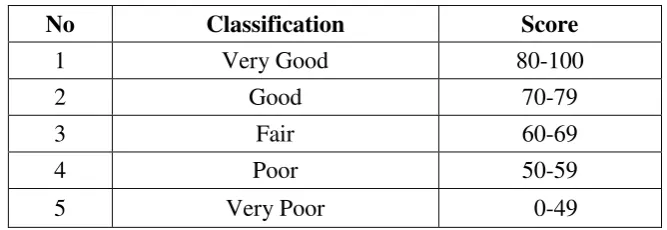
In connection with the score of students‟ test, the researcher used scoring rubric
as follows:
Table 3. 4. Scoring Rubric for students’ passive voice score
No Classification Score
1 Very Good 80-100
2 Good 70-79
3 Fair 60-69
4 Poor 50-59
5 Very Poor 00-49
2. Instrument Try out
Before the test was used as an instrument to collect the data, it would be tried out first to the students in another class or another school. Try out was used to measure
the suitability of the test and the students‟ ability in the sample class of this research, so
a result the researcher should conduct try out test to the eleventh grade students in other school that has same level. Consequently, the researcher chose MA DarulUlumPalangka Raya to try out the test; because in researcher‟s opinion, the school has same level with MA Muslimat NU palangka Raya. The tryout test conducted to the grade XI-IPS MA DarulUlumPalangka Raya. The instrument was given on Wednesday, 23th August 2017 at 09.30 – 11.00 and was done by 20 students.
There are 100 questions‟ item as the try out test that every single item is passive
voice‟ question. To get the data of try out, the researcher used some procedures as
follows:
a. The researcher made and prepared test of try out.
b. The researcher gave test of try out to the students at eleventh grade of MA DarulUlumPalangka Raya.
c. The researcher asked the students to do test of try out. d. The researcher collected the student‟s answer.
e. The researcher calculated and gave score to the students‟ answer.
f. The researcher analyzed the result of try out to know whether the test was valid or not.
3. Instrument Validity
a. Content Validity
It referred to the extent which the instrument represented the content of interest. In the other words, it was concerned with the question how well the content of the instrument represents the entire universe of content which might be measured (Ary, et al. 2010, p. 214). Specifically, in this research, the test must be made up of items testing knowledge. It would provide the test constructor with the basis for making principle selection of elements for inclusion in the test. In order to address the study, the researcher from the English textbook: English Grammar in Use published by Cambridge University Press, Advanced Grammar in Use published by Erlangga,Speaking, Grammar for Everyday Life given by GLC English.The test would really measure the grammar mastery of the students.
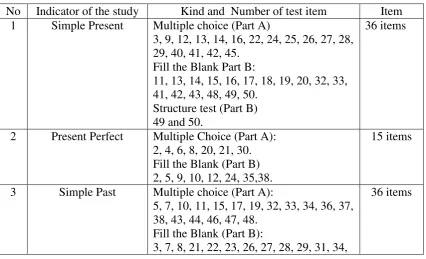
Table 3.5. The Content Signification Validity of items research instrument No Indicator of the study Kind and Number of test item Item
1 Simple Present Multiple choice (Part A)
3, 9, 12, 13, 14, 16, 22, 24, 25, 26, 27, 28,
2 Present Perfect Multiple Choice (Part A): 2, 4, 6, 8, 20, 21, 30. Fill the Blank (Part B) 2, 5, 9, 10, 12, 24, 35,38.
15 items
3 Simple Past Multiple choice (Part A):
5, 7, 10, 11, 15, 17, 19, 32, 33, 34, 36, 37, 38, 43, 44, 46, 47, 48.
Fill the Blank (Part B):
3, 7, 8, 21, 22, 23, 26, 27, 28, 29, 31, 34,
36, 39, 44, 46, 47. 4 Simple Future tense Multiple choice (Part A)
18, 23, 31, 39, 39. Fill the Blank (Part B): 1, 4, 6, 25, 30, 37, 40, 45.
13 items
Total Number of test item 100 items
b. Face Vvalidity
Face validity is a term sometimes used in connecting with a test‟s content. Face validity refers to the extent which examined believe the instrument in measuring what it is supposed to measure (Ary, et al, 2006, p. 228). The types of face validity, if the test item looked right to other testers, teacher, indicators, and test. The types of test items, which used in this research, could be suitable to the others at the same level in Senior High School.
For face validity of the test items as follow:
1) The test used written test in appropriate test instruction. 2) The evaluation based on scoring system.
3) Kind of test is multiple choices. 4) The item language is English.
5) The test based on syllabus of English Grammar mmastery for eleventh grade students at MA Muslimat NU Palangka Raya.
c. ConstructValidity.
researcher constructed the item to measure students‟ knowledge, comprehension,
application and analysis in Grammar lesson.
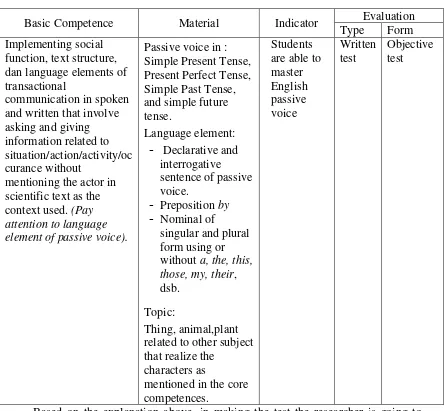
Table 3.6. Syllabus of Passive Voice
Basic Competence Material Indicator Evaluation