THESIS
BY
FAJAR MUKHTAR NIM 1301120923
STATE ISLAMIC INSTITUTE OF PALANGKA RAYA FACULTY OF TEACHER TRAINING AND EDUCATION
DEPARTMENT OF LANGUAGE EDUCATION STUDY PROGRAM OF ENGLISH EDUCATION
i
THE STUDENTS MOTIVATION IN ENGLISH LANGUAGE LEARNING OF EIGHT GRADERS AT MTS DARUL AMIN PALANGKARAYA
THESIS Presented to
State Islamic Institute of Palangka Raya In partial fulfillment of the requirements
For the degree of Sarjana in English Language Education
BY
FAJAR MUKHTAR NIM 1301120923
STATE ISLAMIC INSTITUTE OF PALANGKA RAYA FACULTY OF TEACHER TRAINING AND EDUCATION
DEPARTMENT OF LANGUAGE EDUCATION STUDY PROGRAM OF ENGLISH EDUCATION
vii
Imagination is more important than knowledge. Albert Einstein
This Thesis is dedicated to:
x ABSTRACT
Mukhtar, Fajar. 2017. The Students Motivation In English Language Learning of Eight Graders At MTs Darul Amin Palangka Raya. Thesis, Departement of Language Education Faculty of Teacher Training and Education, State Islamic Institute of Palangka Raya. Adivors: (I) Sabarun, M.Pd,. (II) Zaitun Qamariah, M.Pd.
Keywords : The Motivation in English Language Learning, Qualitative.
This study aims at the motivation in learning English in the eighth grade in MTs Darul Amin Palangkaraya 2017/2018, and then describe how the motivation use a learning English. Furthermore this research also aims to know what factors behind the motivation in learning English and how teachers motivate students in learning English.
This research uses a homogeneous sampling method of puposive with qualitative design. to collect data, researchers used several instruments, among others, questionnaires, interviews and documentation. In analyzing the data, researchers use several techniques, namely, (1) Data collection, (2) Data reduction, (3) Display data, (4) Conlcusion drawing verifying, (5) Credibility, (6) Transferability, (7) Dependability, Confirmability. As for the subject of this study are 27 eighth grade students in MTs Darul Amin Palangkaraya.
xi ABSTRAK
Mukhtar, Fajar. 2017, Motivasi dalam Belajar Bahasa Inggris Siswa Kelas delapan di MTs Darul Amin Palangka Raya. Skripsi. Jurusan Pendidikan Bahasa, Fakultas Tarbiyah dan Ilmu Keguruan, Institut Agama Islam Negeri Palangka Raya. Pembi,bimg : (II) Sabarun, M.Pd., (II) Zaitun Qamariah M.Pd.
Keywords : Motivasi dalam Pembelajaran Bahasa Inggris, Kualitatif.
Penelitian ini bertujuan untuk mengetahui motivasi dalam belajar bahasa inggris di kelas delapan di MTs Darul Amin Palangkaraya tahun 2017/2018, lalu mendeskripsikan bagaimana motivasi yang di gunakan dalam pembelajaran bahasa inggris. selanjutnya penelitian ini juga bertujuan untuk mengetahui apa faktor di balik motivasi dalam pembelajaran bahasa inggris dan bagaimana guru memotivasi siswa dalam pembelajaran bahasa inggris.
Penelitian ini menggunakan metode Puposive Sampling yang Homogen dengan desain kualitatif. untuk mengumpulkan data, peneliti menggunakan beberapa instrumen, antara lain, (1) Angket, (2) Wawancara dan (3) Dokumentasi. Dalam menganalisis data, peneliti menggunakan beberapa teknik, yaitu, (1) Data collection, (2) Data reduction, (3) Data display, (3) Conlcusion drawing verifying, (4) Credibility, (5) Transferability, (6) Dependability, (7) Confirmability. adapun subjek dari penelitian ini yaitu 27 siswa kelas delapan di MTs Darul Amin Palangkaraya.
xii
ACKNOWLEDGEMENTS
The writer would like to express her sincere gratitude to Allah SWT., for the blessing bestowed in her whole life particularly during the thesis writing without which this thesis would not have come to its final form. Sholawat and salam always be bestowed to the last prophet Muhammad SAW., having shown us the role of life to make our life true.
Her appreciation is addressed to:
1. Dean of Faculty of Teacher Training and Education of the State Islamic Institute of Palangka Raya, Drs. Fahmi, M.Pd., for his invaluable assistance both in academic and administrative matters.
2. Vice Dean in Academic Affairs, Drs. Hj. Raudhatul Jennah,M.Pd., for her invaluable assistance both in academic and administrative matters.
3. Chair of Department of Language Education, Santi Erliana,M.Pd., for her invaluable assistance both in academic and administrative matters.
4. Chair of Study Program of English Education, M. Zaini Miftah, M.Pd., for his invaluable assistance both in academic and administrative matters. 5. Her thesis advisors, Sabarun,M.Pd. and Zaitun Qamariah,M.Pd, for their
generous advice, valuable guidance and elaborate correction during their busy time to the completion of her thesis.
xiii
7. All lecturers of Study Program of English Education from whom she got in-dept knowledge of English and English teaching.
8. Her classmates of Study Program of English Education, especially the 2013 period, for the support in sadness and happiness during the study in undergraduate program and for their spirits to accomplish my study
9. Her beloved parents, Saefullah Hasyim and Linawati, for their moral support and endless prayer so that she is able to finish her study. May Allah SWT bless them all. Amin.
Palangka Raya, 25 October 2017 The writer,
xiv
TABLE OF CONTENT
COVER ... i
COVER (Second Page) ... ii
ADVISOR APPROVAL ... iii
THESIS APPROVAL ... iv
MOTTO AND DEDICATION ... v
DECLARATION OF AUTHORSHIP ... vi
ABSTRACT ... ix
ABSTRAK (Indonesia) ... xi
ACKNOWLEDGEMENTS ... xiii
TABLE OF CONTENT ... xv
LIST OF TABLE ... xvii
LIST OF APPENDICES... xvi
LIST OF ABBREVIATION ... xviii
CHAPTER I INTRODUCTION ... 1
A. Background of the Study ... 1
B. Problem of the Study... 4
C. Objective of the Study ... 4
D. Limitation ... 5
E. Significance of the Study ... 5
F. Definition of Key Terms ... 6
CHAPTER II REVIEW OF RELATED LITERATURE ... 7
A. Related Study... 7
B. Definition of Motivation ... 11
C. Types of Motivation ... 12
1. Intrinsic Motivation ... 13
2. Extrinsic Motivation ... 14
D. Motivation in Language Learning ... 16
E. The Importance of Motivation in Language Learning. 18 F. Benefit of Motivation ... 19
G. Descriptive Qualitative ... 21
CHAPTER III RESEARCH METHOD ... 23
A. Research Design ... 23
B. Subject of the Study ... 23
C. Source of the Data ... 24
xv
E. Data Collection Procedures ... 27
F. Data Analysis Procedures... 27
G. Endorsement Data ... 30
CHAPTER IV RESEARCH FINDINGS AND DISCUSSION ... 34
A. Research Findings ... 34
B. Discussion ... 54
CHAPTER V CONCLUSION AND SUGGESTION ... 56
A. Conclusion ... 56
B. Suggestion ... 59 REFERENCES
xvi
LIST OF TABLES
Table Page
2.1 Intrinsic and Extrinsic Motivation ... 15
3.1 Source of Data ... 24
4.1 The result of Questionnaire... 36
xvi
LIST OF APPENDICES
Appendix Page
1. Questionnaires ... 66
2. Interview ... 68
3. Photo of Research... 78
4. Curiculum Vitae.. ... 82
5. Research Schedule ... 83
0
LIST OF ABBREVIATIONS
Etc : Et Cetera
IAIN : Institut Agama Islam Negeri
CHAPTER I INTRODUCTION
This chapter covers the background of the study, previous study, research focus, research problem, objective of study, theoretical framework, significance of study, optional definition, and frame of discussion.
A. Background of the study
Foreign language learning and teaching refer to the teaching or learning of a nonnative language outside of the environment where it is commonly spoken. A distinction is often made between „foreign‟ and „second‟ language learning. A
second language implies that the learner resides in an environment where the acquired language is spoken. In the area of research, the term second language acquisition (SLA) is a general term that embraces foreign language learning and investigates the human capacity to learn languages other than the first language once it has been acquired ( Moeller,et .al, 2015..327).
A language is considered foreign if it is learned largely in the classroom and is not spoken in the society where the teaching occurs. Study of another language allows the individual to communicate effectively and creatively and to participate in real-life situations through the language of the authentic culture itself. Learning another language provides access into a perspective other than one‟s own,
2
better understanding of one‟s own language and culture (Moeller, et.al,
2015..327). Learners mainly learn one language in two channels: one is acquisition and the other is learning. Here the former means that a learner takes in and then uses a language unconsciously through language communication practice while the latter means that a conscious study and understanding of a language, (Li 2004..57). Acquisition is of greater importance than learning, hence emphasizing the significance of putting students into a language learning environment with feedback system to guarantee their contact with a large amount of understandable language input during our college English teaching ( Yulianti ,2016..4 ).
Communication is an essential need for human being. Language as a tool of communication has an important role to reveal an intention to someone else. People will be able to express their thought and feeling by using language. Language, communication and life can not be separated from one another. Language can be applied in many aspects, such as: education, society, politics, economics, and culture, Erisa Kurniati (2012). English also takes important role of in every aspect of human life, such as education, technology, communication, economics, and science. The students‟ acquisition in learning English is determined by several factors namely students‟ strategy in learning English,
intelligent, teachers‟ strategy in teaching English, students‟ experience in learning
English, motivation, students‟ facilities, background of the
places where society creative and skill can be development. One of the subjects to be offered by those initiations is English ( Kustiawati,2011..2).
Motivation is one of the most important factors affecting students‟ performance of English learning, which is widely concerned by foreign language teachers and researchers for a long time (Lei, 2012..100). Ryan and Deci considers, to be motivated means to progress or to be in motion to do something (Sepora,2013..230). Motivation plays an important role in foreign language learning. Learning motivation is to promote and guide and maintain learning activities which have been conducted an internal strength or internal mechanism. Learning motivation once formed, the student will use an active learning attitude to learn, and express a keen interest in learning, and can focus attention in class to master knowledge. Motivation that there is a dialectical relationship, which learning can produce motivation, and motivation can promote learning again, as Ausubel says, there is the complementary typically relationship between Motivation and Learning. Thus, learning motivation plays an essential role in learning English. In the course of learning foreign languages, students with strong motivation can always make good achievements while students without intrinsic motivation are often losers of language learning (Long, et.al 2013..136).
Darul Amen Palangkaraya, researchers will focus on knowing their motivation when learning English in the classroom.
From the fact above, this research will analyze : The Motivation in English Language Learning of Eight Graders at MTs Darul Amin Palangkaraya.
B. Problem of study
Based on the background of the study above, the problems of the study are as
mentioned below :
1. How is the students motivation in English language learning of eight graders at MTs Darul Amin Palangkaraya ?
2. What are the factor lies behind the motivation in English language learning of eight graders at MTs Darul Amin Palangkaraya ?
3. How does the teacher motivate the EFL students ? C. Objective of the study
Based on the problem of the study, the objectives of the study are as follows : 1. To describe the students motivation in English language learning of
eight graders at MTs DARUL AMIN Palangkaraya.
2. To describe the factors lie behind the motivation in English language learning of eight graders at MTs Darul Amin Palangkaraya.
3. To describe the teacher to motivate the EFL students. D. Limitation
The descriptive study. It studies the cured phenomenon on importance of
motivation in EFL class. It focuses on the motivation in language learning English
The subject of the study is the teacher and students in the class at eight graders of
MTs Darul Amin Palangkaraya. And the number of subject is 1 Teacher and 27
students in the class of eight grade at MTs Darul Amin Palangkaraya.
E. Significance of Study
The uses of this study that expected by the writer as below:
1. Theoretically, this study will support the theory of motivation in english language learning process. And motivation gives benefit study for researchers from the results of this study.
2. Practically, this study will give the empirical data about the motivation in English language learning process. The result of study can be useful for the students, teachers, and lecturers who teach English language in learning process. This study will also help researchers to find out the motivations that exist when learning and teaching English.
F. Definition of Key Terms
There are several definitions of the key term in this research. There are motivation, english language learning, MTs Darul Amin Palangkaraya.
1. Motivation
Motivation is internal and external factors that stimulate desire and energy in people to be continually interested and committed to a job, role or subject, or to make an effort to attain a goal.
The practice and theory of learning and teaching English for the benefit of people whose first language is not English.
3. MTs Darul Amin Palangkaraya
7 CHAPTER II
REVIEW OF RELATED LITERATURE A. Related Study
In order to make different research from the previous research, the study has found a few previous studies that are concerned with research above; the motivation in language learning. The first, research is from Shuib (2009..29), which identified Motivation and Attitudes Towards Learning English : A Study of Petroleum Engineering Undergraduates At Hadhramout University of Sciences and Technology.
The findings showed the subjects‟ greater support of instrumental reasons for
learning the English language including utilitarian and academic reasons. Personal reasons were also regarded as important motives by the students. However, regarding the integrative reasons, the results provided evidence that learning English as a part of the culture of its people had the least impact in students‟ English language motivation.
On the other hand, data for the students‟ attitudes revealed that most of
students had positive attitudes towards the social value and educational status of English. In addition, the findings showed the students‟ positive orientation toward the English language. Interestingly enough, the results indicated that a high number of the students showed their interest in the culture of the English speaking world as represented by English-language films. Finally, some pedagogical implications that would help tap the students‟
This study has in similarities and differences with My research. The similarities both use the same research design that is descriptive qualitative research design and focus on student motivation in learning English. But there is a difference between these studies. The object of research conducted by Atef Al-Tamimi and Munir Shuib is the Study of Graduate Petroleum Engineering at Hadhramout University of Science and Technology and also focuses on student behavior. While the object of this study is junior high school students in MTs Darul Amin in Palangkaraya, Central of Kalimantan, Indonesia. And focus only on student motivation when learning English.
Second , research from Vibulphol, (2016) about Students Motivation and Learning and Teachers Motivational Strategies in English Classroom in Thailand, The findings showed that most students had a relatively high level of motivation and many reported having internal interests in learning English; however, the level of learning was not assessed to be as high.
Furthermore, a few students in almost every class showed a lack of motivation. The teachers were found to employ a variety of motivational strategies, including autonomy-support and controlling styles. While autonomy controlling strategies were commonly used in these classes, autonomy-support strategies were found only in highly motivated and high performing classrooms. (Vibulphol, 2016..64).
Vibulphol focuses more on the motivational strategies used by teachers in English classroom learning, whereas this research only focuses on knowing how to motivate students when learning English in the classroom.
Third , research from Lamb (2007), about The Motivation of Junior high School Pupils To Learn English in Provincial Indonesia, Results showed a very high level of motivation to learn English, reflected in much autonomous learning of the language outside of school. Although there was evidence of dissatisfaction with aspects of school English lessons, this motivation was largely sustained throughout the period under study and appeared to contribute to significant gains in competence in the language among some learners. It is argued that this motivation derives its strength from identification processes, nurtured and developed through social interaction at home and in the community, which encouraged many young Indonesians in this context to view English as integral to their future lives.
This research has similarities and differences with My research. The similarity of both lies in the object of the researcher conducted in junior high school. And also examine the students' motivation in learning English. However, there is a difference in research done by Martin Veevers Lamb using quantitative research design while this research uses descriptive qualitative research design.
Fouth, research from Yulia (2013..1), about Teaching Challenges in Indonesia : Motivating Students and Teachers‟ Classroom language, The results show that
global language and the 2006 curriculum targets communicative competence. On the other hand, the data indicated that teachers found English difficult to use in class.
This research has similarities and differences with My research. Similarity both are the same in researching the students' motivation to learn English in class. However, there is a difference between those researches. Research design used by yuyun yulia is a quantitative research design, while this research uses descriptive qualitative research design. And the object of this research in other schools, while the object of this research in junior high school MTs Darul amin Palangkaraya, Central of Kalimantan, Indonesia.
Fifth, research from Nichols (2014), about Motivating English Language Learners : An Indonesia Case Study, The result, in Chinese Indonesian students in a Year 12 English classroom. Student surveys indicated preferences for the use of audiovisual material and the use of collaborative reading quizzes. The implementation of these strategies resulted in positive levels of attention and engagement in the classroom, but no increase in levels of intrinsic motivation were observed.
design done by Rebekah Nichols is the design of quantitative research, while the design of this research is descriptive qualitative research design.
B. Definition of Motivation
Motivation is considered as an integral part in the achievement of any goal. It is an important factor that has a positive influence in any educational learning process especially in learning second language (Abdur,et.al, 2014). Motivation is more than simply arousing interest. It also involves sustaining interest and investing time and energy into putting the necessary effort to achieve certain goals (IGAWA, 2014..383) .Johnstone considers motivation as a stimulant for achieving a specific target (Sepora,et. al, 2012..231). Ryan & Deci considers To be motivated means to progress or to be in motion to do something (Sepora,et.al, 2012..231). While Dornyei and Otto regarded motivation as a function of a person‟s thought and defined it as „the
dynamically changing cumulative aroused in a person that initiates, directs, coordinates, amplifies, terminates and evaluates the cognitive and the motor processes whereby initial wishes and desires are selected, prioritized, operational and acted out‟(Dornyei, 2001..9). Ellis considers motivation as the attempt which
learners make for learning a second language because of “their need or desire to
learn it”(Sepora, et.al, 2012..232). Lightbrown and Spada considers identifies
motivation in second language acquisition as “a complex phenomenon which can
be defined in terms of two factors: learners‟ communicative needs and their attitudes towards the second language community”. They believe that when
being in touch with others or accomplishing and achieving specialized and dedicated desires and goals, they will be stimulated and inspired to obtain expertise and skill in it. (Sepora, et.al,2012..232). According Brewer & Burgess, Motivation is a basic and essential part of learning (Sepora,at.al, 2012..233). According to Cook, states that acquisition of language is not the same among learners. He also believes that there are three main factors which influence the Second Language Acquisition. These three factors are: age, personality and motivation. Motivation is the most significant factor among the mentioned three factors that affect second language acquisition. (Sepora,et.al,2012..233).
In My opinion, Motivation is an encouragement that exists within a person that makes a person more eager to do something according to one's own goals. In terms of learning English, The motivation in My opinion is the passion or stimulant that exist in students so that students feel more eager to learn English. C. Types of Motivation
According to As Gardne, motivation is a very complex phenomenon with many facets (Shuib,et.al, 2009..31). Intrinsic and extrinsic types of motivation have been widely studied, and the distinction between them has shed important light on both developmental and educational practices (Ryan,et.al, 2000..54). Types of Motivation
1. Intrinsic motivation
motivation is the eagerness and interest to do and take part in some certain activities because an individual feels that they are attractive and pleasant.
According to (Sincero,2012) there are many factors that promote intrinsic motivation. Some of these include challenge, curiosity, control, fantasy, competition, cooperation and recognition :
a. Challenge is a factor that means a person is more likely to be motivated if the task involves activities that include continuously intermediate or escalating levels of difficulty towards personally meaningful goals.
b. Curiosity is a force in a person‟s environment that either gets his attention for new knowledge/skills or presents incongruity between his present knowledge/skills and the possible knowledge/skills that the activity may offer.
c. Control is a factor that means it is human nature for a person to want to have some degree of control over his situation. Intrinsic motivation may emerge from a person‟s autonomy in his
actions.
d. Fantasy is a factor that is in the form of mental images that stimulate a person to behave to achieve the fantasy. For instance, a student sees himself as a successful engineer after college.
f. Cooperation is a factor that involves achieving a sense of satisfaction when a person helps other people towards the fulfilment of their goals.
g. Recognition is a factor that also includes the sense of satisfaction when others appreciate their achievements.
2. Extrinsic motivation
And According Vansteenkiste, Lens, & Deci, Extrinsic motivation, on the other hand, is the propensity to take part in activities because of the reasons which do not link to the activity. These reasons can be the anticipation of reward or punishment, like being successful in the exam or getting a good mark. To come to the point, intrinsic motivation is a motivation to do an activity because of itself. In fact, the individuals who are intrinsically motivated do and practice the activities and works because they feel that those activities are enjoyable. Extrinsic motivation, on the other hand, is motivation to do a work or an activity as a means or way to achieve a target. Pintrich & Schunk cosiders, Those who are extrinsically motivated perform and do affairs as they think that their contribution will cause enviable results like a reward, teacher admiration, or evasion (prevention) of punishmen (Sepora,et.al, 2012..232-233).In order to offer a clear image of the intrinsic-extrinsic dichotomy :
Table 2.1 Intrinsic and Extrinsic Motivation
Intrinsic Extrinsic
problems
Independent judgement Reliance on teacher‟s judgment about what to do
Internal criteria for success External criteria for success
Following this model, it comes out clearly that the greater the value the individuals attach to the accomplishment of an activity, the more highly motivated they will be to engage in it and later to putsustained effort until they achieve their goal. This distinction also tells us that both internal and external factors have an important role to play in motivating learners (Veronica,2008..559). Traditionally, concepts of Richards (IGAWA, 2014..382) have been presented to understand the role of motivation.
Motivation Description
Intrinsic Motivation Enjoyment of language learning itself.
Extrinsic Motivation
Driven by external factors such as parental pressure, societal expectations, academic requirements, or other sources of reward or punishment.
D. Motivation in Language Learning
number of learners in the context of second or foreign language learning is improved and superior than others. The reason is that they are better motivated. Ellis considers sees the incident of learning by means of motivation and believes that the learning process simply occurs
when a person is motivated (Veronica,2008..233).
Motivation in language-learning plays a vital role. It is motivation that produces effective second-language communicators by planting in them the seeds of self-confidence. It also successfully creates learners who continuously engage themselves in learning even after they complete a targeted goal. Deci, Kasser & Ryan said, The relationship between students and schools is an interactive one that can synergize both positive and negative. Students influence the motivation and behavior of schools as schools affect students. But it is important to remember that part of the teaching task is to encourage students who facilitate positive cycles rather than negative cycles (IGAWA, 2014..383). In order for English instructors to motivate them, a number of methods are needed both in and outside of class. According to Hussin, Maarof, and D‟Cruz, “positive self-concept, high self-esteem, positive attitude, clear understanding of the goals for language learning, continuous active participation in the language learning process, the relevance of conductive environment that could contribute to the success of language learning” (2001). They state that six factors influence motivation in
language learning: attitudes, beliefs about self, goals, involvement, environmental support, and personal attributes (2001), (Ebata,2008).
An attitude is a relatively enduring organization of beliefs around an object or a situation, predisposing one to respond in some preferential manner. If the student enter to the class with fairly neutral attitudes about the language, or even positive ones, and has a personality structure which will permit him to have an openness and willingness to perceive and respond, his attitudes about language and language learning will be strongly influenced by the situation itself (Vahedi, 2011..997).
2. Beliefs about yourself
Expectancies about one's attitudes to succeed, self-efficacy, and anxiety.
3. Goals
Perceived clarity and relevance of learning goals as reasons for learning. 4. Involvement
Extent to which the learner actively and consciously participates in the language learning process.
5. Environmental support
Extent of teacher and peer support, and the integration of cultural and outside-of-class support into learning experience.
6. Personal attributes
Aptitude, age, sex, and previous language learning experience (Hussin, et.al,2001).
Motivation is one of influential factor in English learning. Motivation is a factor of high or low of the goal ( Brown,2001..75). According Ushioda, Motivation is an issue worthy of investigation because it seems implicated in how successful language learners are. And motivation is the answer that researchers and teachers provide when regarding to efficient language learning. For decades, studies in this area have been principally concerned with describing, measuring and classifying its role in theoretical models of the language learning process. Most teachers and researchers have widely accepted motivation as one of the key factors which influence the rate and success of second/foreign language learning. (Leila,2015..130). It is important to think about motivation as the essence of language teaching because of the stark realities of learning English for most of our learners. All of the conditions that we know contribute to successful second language learning are lacking in most EFL contexts: there just isn„t enough English input in the environment, there
probably aren„t enough opportunities for interaction with English speakers, there usually aren„t enough strong role models promoting the learning of
English, and there may not be widespread enough social acceptance for the idea of becoming proficient in English. Because of these adverse conditions, a learner has extraordinary motivation in order to succeed at learning a foreign language (Gilakjani, et.al,2012..10).
as well as a basis for learning the language to be called successful in learning English. Motivation can also develop interest, willingness and talent of students to learn English, so that students can easily learn English.
F. Benefit of Motivation
There can be other various factors which can have significant role in creating motivation for the language learners; That is, for instance, some of the main points that concerning this matter appear to the researcher‟s mind are as follows:
1. The language teacher is supposed to teach and instruct according to each learner‟s level. In the sense that, initially, the teacher should identify and
realize each student‟s placement. Afterwards,
2. The language learner should not be reproached or blamed, or even scorned for not doing his homework, for making mistake in pronunciation, or for hesitating to answer question(s) and so on.
3. Teacher should identify, perceive, and understand the language learners‟ social, cultural, economic, and sentimental features and
backgrounds in order to be able to help them and so that the language learners have a clear image from themselves and respect their own characters.
learners are susceptible, vulnerable, and sensitive, and they need love and affection from their teacher.
5. Teachers should admire, respect, and value the students' differences and they should never contrast the language learners with one another. 6. Teachers need to promote students´ alertness, knowledge,
inquisitiveness, and curiosity in the language classes as well as trying to uphold and preserve their motivation.
7. Teachers should bear in mind that learning a second or a foreign language means that the learners should also exploit and take advantage of social proficiencies and not just learn grammar rules ( Sepora,et.al , 2012..235). In my opinion Motivation is the essence of a language learning in which the teacher has a role in creating the motivation that exists in the learner's own language. By understanding all the aspects that exist in the student himself and afterwards determining how to create the motivation itself. So students feel comfortable and easy to learn the language.
G. Descriptive Qualitative
According to Sandelowski (2012), qualitative descriptive research: should be seen as a categorical, as opposed to a non-categorical, alternative for inquiry; is less interpretive than an „interpretive description‟ approach because it does not require
Data collection in qualitative descriptive studies is typically directed toward discovering the who, what, and where of events or experiences, or their basic nature and shape. Data collection techni- ques usually include minimally to moderately structured open-ended individual and/or focus group interviews. Focus groups can usefully be viewed as the qualitative counterpart to the quantitative survey, in that they are typically used in qualitative research to obtain a broad range of information about events. Data collec- tion techniques may also include observations of targeted events and the examination of documents and artifacts (Sandelowski, 2009..338).
22 CHAPTER III
RESEARCH METHOD
This chapter explains, research type, reseach design, subject of the study, source
of the data, data collection procedure, endosment of data, data analysis procedure.
A.Research Design
This research used mixed method. Mixed method is a research in which the researcher collects, analyzes and mixes both quantitative and qualitative data in single study or multiphase program of inquiry (Burke, et.al, 2007..112).
B.Subject of the Study
in MTs Darul Amin palangka raya. The object of the study is the motivation in english language learning at eight graders of MTs Darul Amin palangka raya.
C.Source of the Data
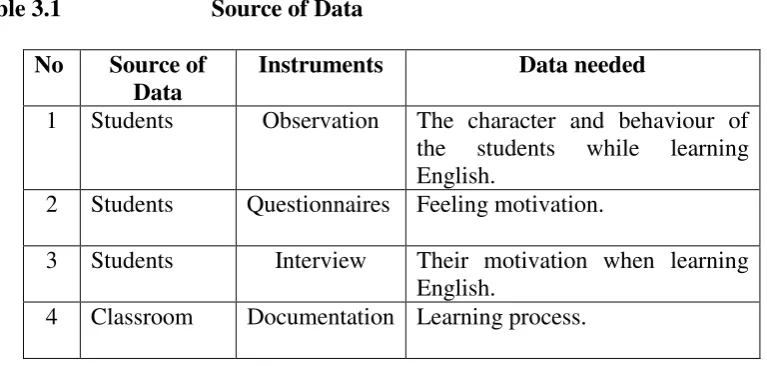
In this research writer will collect data from students. There are 27 students in eight grade at MTs Darul Amin Palangka Raya. The source of data and the data needed is ilustrated in Table 3.1.
Table 3.1 Source of Data No Source of
Data
Instruments Data needed
1 Students Observation The character and behaviour of the students while learning English.
2 Students Questionnaires Feeling motivation.
3 Students Interview Their motivation when learning English.
4 Classroom Documentation Learning process.
D.Research instrument
1. Observation
Observation is used as a technical term in research with its specific meaning.
Observation is usually to the use of our visual sense to record and make the
information. In research, observation refers to data gathering which involves the
use not only visual sense, but also all sense necessary to get valid and reable data.
Observation also refers to one of the tecniques in gathering data (Latief,2014..77).
Questionnaires is written questioning of a subject (Ary,2010..644). Questionnares
are used to gather data from people about opinions, beliefs, and feelings about
situations in their own words. They used to help understanding the experiences
people have and the meaning they make of them rather than to test hypotheses
(Ary, 2010..644). 3. Interview
Interview is oral questioning of a subject (Ary,2010..644). Interviews are used to gather data from people about opinions, beliefs, and feelings about situations in
their own words. They used to help understanding the experiences people have
and the meaning they make of them rather than to test hypotheses (
Ary,2010..644). According to Esterberg in Sugiyono stated that, interview is a
meeting of two persons to exchange information and idea through question and
responses, resulting, in communication and joint construction on meaning about a
particular topic (Sugiyono, 2007..300).
Meanwhile, still, according to Esterberg in Sugiyono stated that, there are three
kinds of the interview namely, structured interview, semi structure interview, and
unstructure interview. In this study, the researcher used unstructured interview.
According to sugiyono defines that,
“Unstructured interview is an interview that is free where researchers do not use
the interview guides that have been arranged in a systematic and complete
collection. Interview guides that are used only in the form outlines the issues to be
Lincoln and guba in sanapiah Faisal, said there are seven steps in the use of
interviews to collect data in qualitative research, namely:
1. Assign to whom the interview was going to do.
2. Set up the problem issues that will be the talk.
3. Initiate or open the interview flow.
4. Establish the interview flow.
5. Confirm overview of the results of the interview in the note field.
6. Write down the result of the interview in the note field.
7. Identify follow-up interviews have been obtained.
Moleong classifies six types of questions that are interrelated, namely:
1. Questions relating to the experience.
2. Questions relating to opinions.
3. Questions that deal with feelings.
4. The question of knowledge.
5. Questions relating to the senses.
6. Questions relating to the background or demographic.
4. Documentation
Documentation is aggregation data with stream styleor take the data from written
product, documentation, administration agree with problem in research. In this
study documentation finding are from documents or archives from institute
careful research (Nasution,2003..143). Documentation is documents required for
something or providing evidence or proof of something (Hornby AS,2000..342).
Data collecting procedure is one of the main duties in this study to answer the problem of the study. The data collected in natural setting without any manipulation of the setting. Data collecting procedure used in this study, namely: observation, questioner, interview,and documentation. It can be draw as follows:
Instruments of the study are needed in the research. It is because the instruments
are tools to get the data of the study. In which the data are the important things to
help the researcher in answering the problem of the study. In collecting the data
for this research, the researcher used observation, interview and questionnaires to
obtain the data in order to answer the problem ( Pahrina,S. 2014..48).
F. Data Analysis Procedure
According to Bogdan and Sugiono states:
“Data analysis is the process of systematically searching and arranging the
interview transcript, field notes, and other materials that you accumulate to
increase your own understanding of them and to enable you to present what you
have discovered to other” (Hornby AS,2000..334).
Miles and Huberman suggest that activities in data analysis qualitative done
interactively and continuously. The activities in data analysis are data collection,
data reduction, data display, and conclusion drawing/verification. Data collecting procedure
1. Data Collection
The collection of data on the main qualitative research is observation, in-depth
questioner study documentation, and combined of all three tools is triangulation.
Researcher does passive observation of participants. Then, researcher visits the
place of the activities, but does not get involved in such activities. By the above
research description, researcher collects data by three ways i.e. observation,
narrative inquiry and documentation. From the above explanation, the researcher
will collect the data by using observation technique, and by using a deep
questionnaire to the eighth grade students at MTs Darul Amin palangkaraya. And
using documentation techniques when the data collection process uses observing
and using questionnaires. The steps in data collection as a follow :
1.) Observing the class, and observe the atmosphere that is in the
classroom.
2.) Distributing questionnaire questions to students in the classroom.
3.) Asking interview questions to students.
4.) Documenting the process of collecting data and learning processes in
the classroom.
2. Data Reduction
Data reduction is resuming, choosing on basic things, focus on the important
things, and search the theme and pattern. In short, the data reduction will provide
a clearer picture and ease the researchers to collect the next data. (Hornby
AS,2000..247). From the above explanation after the researchers collected data
So researchers do, collect or summarize and record carefully and detailed data that
has been obtained from the observations, questionnaires and interviews to make it
easier in the next data view.
3. Data Display
In the display of qualitative research, data may present in a brief description,
chart, and relations between categories or text narrative ( Hornby AS,2000..249).
From the above explanation, the researcher will present or describe the results of
observations, questionnaires and interviews that have been reduced, briefly and
clearly.
4. Conclusion Drawing Verifying
Conclusions and verification are writing the conclusion and answering various
problems with formulating strong evidences and supporting in the stage of data
collection. Qualitative research is new findings that previously do not exist. The
findings in the form of a description or the description of the objects that are
previously still dimly lit so thoroughly after it becomes clear ( Hornby
AS,2000..252). From the explanation above, the researcher will conclude clearly
the results of the research.
G.Endorsment data
The relevant data will be observed and investigated by the writer. There are four
techniques to get validity of the data, namely credibility, transferability,
dependability, and confirmability.
The credibility of qualitative research is to test the credibility of the data or the
reliability in the data results of the research. The success exploring a complex
issue or benefiting towards the data results of the research ( Sugiono,2009..270).
In this study, researcher will betests the credibility of the data or the reliability of
the data results of the research, the researcher do some testing techniques, among
others, with the extent of participation and member check.
a. The Existence of Participation
The existence of participants is observations of the researchers returned to the
field, doing observation, interview with the data sources that ever met neither new
ones. In this case the researcher will return to the field to check out the data,
whether the data is correct or not (Sugiono, 2009..270). Related to this research,
the author will be more observe in class and teacher to know new condition and
recognize environment culture place and check the truth information that is in it.
b. Member Check
Membercheck is a process of checking the data obtained by research to the data
sources. The goal of membercheck is to know how much data match to the data is
given by the source of the data. If the data is agreed by the source of data, it
means the data is valid (Sugiono,2009..276). From the above description, the
researcher will conduct member checks on the findings or conclusions that will be
obtained after the discussion forum to the teacher in order to check whether the
findings are acceptable or not.
Transferability is External validity which indicates the degree of permanence or
can apply the research results to the population in which the samples are taken.
This transfer value relates to the question until the results of the research can be
applied or used in any situations (Sugiono,2009..276). From the above
description, the researcher will give a detailed, clear, systematic and reliable
description about the phenomenon that occurred in the eighth grade in MTs Darul
Amin Palangkaraya. Stages of research and research results so that readers can get
a very clear explanation. Then, it can apply the results of this research in other
places.
3. Dependability
Dependability is a test with the audit to the overall research process. Researcher
often does not the process of research field, but it can provide the data (
Sugiono,2009..277). From the explanation above, researcher show the evidences
of the field activity starting from decisive focus, time of gaining the data, how to
specify a data source, how to conduct data analysis, how to test the validity of
data, and make the conclusion.
4. Confirmability
Confirmability is the test of objectivity in research. The research judge is
objective when the research results have been agreed by a lot of people
(Sugiono,2009..277). Test conformability means to test research results link to the
process. From the above description, the researcher will test the result of research
by showing the research result to the teacher or principal at MTs Darul Amin
Summary
The steps in collecting data, It can be seen from scheme follow : Method for Verification
of the Research Findings
( Endorsment of data )
Credibility
Transferability
Dependability
Confirmability
The motivation in english language learning at eight grade of MTs Darul Amin Palangkaraya
Students motivation
for learning English The factors that lies behind the motivation in english language learning at eight grade of MTs Darul Amin Palangkaraya Teaching to motivate
students to learn english
Figure 3.1 The steps in collecting Data.
Description of the motivation in english language learning at eight graders of MTs Darul Amin Palangkaraya, teachers motivate students to learn English, and students are motivated to learn English, the factors that lies behind the motivation in english language learning at eight graders of MTs Darul Amin Palangkaraya.
Discussion
33 CHAPTER IV
RESEARCH FINDING AND DISCUSSION
A. Research Finding
This chapter presented the result of the findings. it was intended to answer the
problems of the study. The researcher described the process of calculating and
presenting result of the data. Where as in the discussion section the researcher
analyzed the finding. The researcher did the research and got the complete data
from all the research instruments including interview, questionnaire and
documentation. To get the objectives of the research, the researcher analyzed the
data systematically and accurately. The data were analyzed in order to draw
conclusion about the objective of study. researcher showed the findings in this
chapter into 3 points below.
1. The students motivation in English language learning
To get the data, the researcher observed 3 times on 21 August 2017 at 08.00 am,
and on 23 August 2017 at 07.40 am, and on 28 August 2017 at 08.20 am. and the
researchers also provided questionnaires to students on 28 August 2017 at 09.00.
In this study, the researchers used a motivational questionnaire to find out and
analyze the motivation of learning English eighth grade in MTs Darul Amin
Palangkaraya. Motivational questionnaire given by the author and given to 27
students in the class. Students are told by researchers to answer 10 questions and 5
statements about motivation. Students answered 10 questions on a scale of 1 to 5
from strongly disagree to strongly agree, and for 5 statements students replied on
a. Results of learning motivation in English class using descriptive analysis.
The result of the questionnaire shows that the motivation in learning English in
the moderate class, is 68, 07%, is it categorized as fair motivation. And show
enough motivation of students to learn english.
The students were motivated to learn EFL class since teachers in the class always
used interesting methods when teaching English to their students, and a pleasant
learning environment makes students easier and the spirit of language learning,
and when there were students who don‟t understand the material in the taught, the
students always ask with brave and confident circumstances, then the teacher then
re-explain the material in question by students, such as students who said students
named Miki Pranata, Naswa Ayu andita, and Yuliana Hidayat.
Miki Pranata (2017) said ” Cukup menarik dan cukup mudah dipahami, gurunya
lumayan menyenangkan, karena mengajar dengan semangat, jadi aku ikut
semangat kak, bercakap-cakap membuat dialog dalam bahasa inggris, maju
kedepan membaca, karena teman teman nyenengin, berani kalau disuruh maju
membaca dialog, perasaanku cukup senang belajar bahasa inggris." (... Quite
interesting and quite easy to understand, the teacher is quite fun, because teaching
with passion, so I join the spirit, conversing, making dialogue in English, going
forward to read, because friends are fun, courageous if told to go forward to read dialogue, my feeling Quite happy to learn english.”).
The other participant, Naswa Ayu Andita (2017) said, “Yah menyenangkan, karena dialognya dalam materi bahasa inggris itu menyenangkan banget, paling
di suruh maju membaca, enaknya mudah dimengerti ketika pak suryo ngajar,
tentang percakapan, abis tu pokoknya semuanya materi saya suka, perasaanya
senang. (....Well fun, because the dialogue in the English material is really fun, in
Mr. S teach, about conversation, after that just all the material I like, feeling happy.”).
Yuliana Hidayat (2017) said ,”Ya cukup menarik, ya pelajaranya yang
menyenangkan, karena pak suryonya semangat ngajar, ngga terlalu paham, tp
biasanya aku nanya ke pak suryo, ya rame, iya mudah dipahami, ngga terlalu,
tapi biasanya kalo ada anak yang salah di hukum maju, semuanya suka,
percakapan yang bikin sendiri terus maju saya suka.(...Yes it is interesting, yes
the lesson is fun, because Mr.S spirit of teaching, not very understand, but usually
I ask to Mr. S, yes crowded, yes easy to understand, not too, but usually if there is
a wrong child in law order forward class, everyone loves, self-made conversations keep coming forward in front of the class, I like.”).
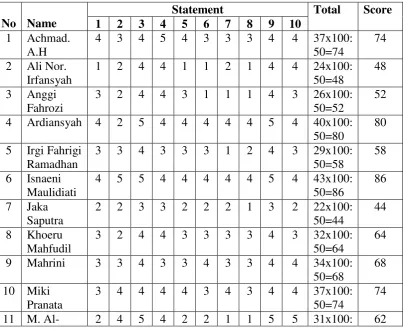
Besides the results of the interview, from the results of the questionnaire, see table
4.1. the research also need questionnaire to support the findings.
Table 4.1 The result of students questionnaire
No Name
Statement Total Score
1 2 3 4 5 6 7 8 9 10 1 Achmad.
A.H
4 3 4 5 4 3 3 3 4 4 37x100: 50=74
74
2 Ali Nor. Irfansyah
1 2 4 4 1 1 2 1 4 4 24x100: 50=48
48 3 Anggi
Fahrozi
3 2 4 4 3 1 1 1 4 3 26x100: 50=52
52 4 Ardiansyah 4 2 5 4 4 4 4 4 5 4 40x100:
50=80
80 5 Irgi Fahrigi
Ramadhan
3 3 4 3 3 3 1 2 4 3 29x100: 50=58
58 6 Isnaeni
Maulidiati
4 5 5 4 4 4 4 4 5 4 43x100: 50=86
86 7 Jaka
Saputra
2 2 3 3 2 2 2 1 3 2 22x100: 50=44
44 8 Khoeru
Mahfudil
3 2 4 4 3 3 3 3 4 3 32x100: 50=64
64
9 Mahrini 3 3 4 3 3 4 3 3 4 4 34x100: 50=68
68 10 Miki
Pranata
3 4 4 4 4 3 4 3 4 4 37x100: 50=74
74
Azhar 50=62 12 M. Ardi 3 3 3 5 1 1 3 1 3 2 25x100:
50=50
50 13 M. Busyiri 4 4 5 4 3 3 3 3 5 4 38x100:
50=76
76
14 M. Mulyadi
3 4 4 3 3 3 3 3 4 4 34x100: 50=68
68 15 Nanik
Nurwiri
4 4 4 2 4 4 4 4 4 4 38x100: 50=76
76 16 Naswa
Ayu. A
5 4 5 4 4 5 4 3 5 4 43x100: 50=86
86 17 Nor Wahid 3 3 5 4 4 5 4 4 5 4 41x100:
50=82
82 18 Nosy
Restina
3 4 4 4 4 3 4 3 4 4 37x100: 50=74
74 19 Nur
Ramdania
4 4 4 3 4 3 4 3 3 4 36x100: 50=72
72 20 Rudi
Wahyudi R
3 3 5 4 3 3 3 3 4 4 35x100: 50=70
70
21 Ryan Hidayat
3 2 3 3 3 3 3 4 3 3 30x100: 50=60
60 22 Shalsabila
Rahma. S
3 4 5 3 4 4 4 3 5 5 40x100: 50=80
80 23 Siti
Rahmah
4 4 4 2 4 3 3 4 4 4 36x100: 50=72
72 24 Siti Saniati
S
3 3 3 1 2 2 2 2 3 1 22x100: 50=44
44 25 Siti
Maysharoh
3 3 2 3 4 3 3 4 3 3 31x100: 50=62
62 26 Sofiera
Amalia
4 4 5 2 5 4 4 4 4 4 40x100: 50=80
80
27 Yuliana Hidayat
4 5 4 2 3 4 3 3 5 5 38x100: 50=76
76
Mean Arange 1838 : 27 =
68,07%
Based on the result, the averange since is 68, 07 % if mean that the students
motivation was in fair category.
To find out what are the factors behind the motivation in English learning, the
researcher uses questionnaire questions and interview questions related to what
factors behind the motivation to learn English and how the students' reasons
related to it. As for student responses related to the motivation to learn English.
To get the data, the researcher observed 3 times on 21 August 2017 at 08.00 am,
and on 23 August 2017 at 07.40 am, and on 28 August 2017 at 08.20 am. and the
researchers also provided questionnaires to students on 28 August 2017 at 09.00.
In this study, the researchers used a motivational questionnaire to find out and
analyze the motivation of learning English eighth grade in MTs Darul Amin
Palangkaraya. Motivational questionnaire given by the author and given to 27
students in the class. Students are told by researchers to answer 10 questions and 5
statements about motivation. Students answered 10 questions on a scale of 1 to 5
from strongly disagree to strongly agree, and for 5 statements students replied on
a scale of 1 to 5 not at all to very much.
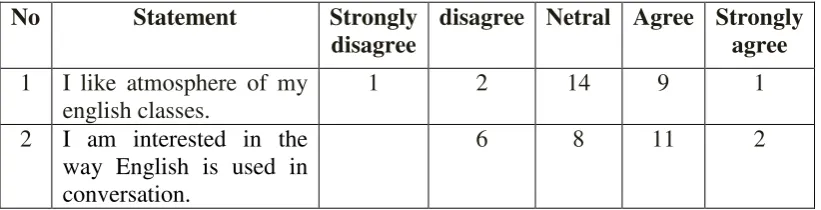
Table 4.2 The students questionnaire on Factors lies behind the motivation in
English language learning
No Statement Strongly
disagree
disagree Netral Agree Strongly agree
1 I like atmosphere of my english classes.
1 2 14 9 1
2 I am interested in the way English is used in conversation.
3 I believe that i will be capable of reading and undersanding most texts in English if i keep studying it.
1 4 13 9
4 I get nerveous and confused when i am speaking in My english class.
1 5 7 12 2
5 I find learning English really interesting.
2 3 10 11 6
6 I am prepared to expend a lot of effort in learning English.
3 3 12 7 2
7 I really enjoy learning English.
3 3 11 10
8 I always look forward to English classes.
5 2 13 7
9 I am sure i will be able to write in English comfortably if I continue strudying.
6 13 8
10 I think that I am doing My best to learn English.
1 2 6 15 3
Total 16 27 91 108 33
Based on the data above, it can be described as follow the motivation in english
language learning statement.
On statement number 1, “I like the atmosphere of my english classes” there was 1
student who strongly disagree, 2 students disagree, 14 students choose neutral, 9
students agree, and 1 student strongly agree. the researchers concluded, there was
37, 04 % students who like the atmosphere of the English class as the reason they
It refers to the theory according to (Sepora, et.al,2012..235) in chapter two on the
first point, “Attitudes” the researcher conclude that students like the English
learning atmosphere associated with a strong attitude towards learning English. in
addition, this refers to the fourth point, “Involvement” the student also
automatically aware and actively participate in learning English when he liked the
English learning atmosphere.
On statement number 2, “I am interested in the way English is used in
conversation” there was 6 students disagree, 8 students chose neutral, 11 students
voted agree, and 2 students voted strongly agree. Based on the data, the
researchers concluded there was 48, 15 % students who are interested in the way
English is used in conversations that make them motivated to learn english.
It refers to the theory according to (Sepora, et.al, 2012..235) in chapter two on the
first point, “Attittudes” the researcher concludes that the students are interested in
the way the English language is used in this lesson related to the students' strong
attitude in language learning. in addition to referring to the fourth point,
“Involvement” the researcher concludes that student interest is related to the
active involvement of the students themselves and consciously participates in the
learning.
On statement number 3, “I believe that i will be capable of reading and
undersanding most texts in English if i keep studying it” there was 1 student voted
disagree, 4 students were neutral, 13 students voted agree, and 9 students voted
that will be able to read and write some texts in english if continue to learn it as
the reason they are motivated to learn english.
It refers to the theory according to (Sepora, et.al,2012..235) in chapter two on the
first point, Attitudes, the researcher concludes that the student believes will be
able to read and write most of the texts in English if it continues to study it related
to the strong attitude to learn english. and also relates to the second point of
"believe in self-esteem" students' expectations for success in learning English; in
addition, it also refers to the point that when the "Goal" clarity of the student's
goal will be able to read and write english texts.
On statement number 4, “I get nerveous and confused when i am speaking in My
english class” there was 1 student strongly disagree, 5 students voted disagree, 7
students chose neutral, 12 students agreed and 2 students voted strongly agree.
from the data the researchers conclude there was 51,85 % students feel nerveous
and confused when speaking English in the class as their reason in the motivation
to learn English to continue to practice speaking English.
It refers to the theory according to (Sepora, et.al, 2012..235) in chapter two on the
first point "Attittudes", the researcher concludes the students become nerveous
and confused when speaking english it relates to the attitude of the students
depending on the atmosphere of the class, if positive then will confidently speak
English, and if negative then students will feel nerveous and confused. in addition
it also refers to the fourth point of "Environmental support" support from around
On statement number 5, “I find learning English really interesting” there was 2
students strongly disagree, 3 students vote disagree, 10 students are neutral, 11
students agree and 6 students choose disagree. the researchers conclude, there was
62,97 % students who found learning english really interesting in English class as
the reason they are motivated to learn english.
It refers to the theory according to (Sepora, et.al,2012..235) in chapter two on the
first point "Attittudes", the researchers conclude that students find an interesting
learning atmosphere refers to the attitude of students who believe and strong in
learning English, in addition also refers to points the fourth "Involvement"
involvement of students who actively participate in learning that makes the
learning environment interesting.
On statement number 6, “I am prepared to expend a lot of effort in learning
English” there was 3 strongly disagree, 3 students voted disagree, 12 students
neutral, 7 students agreed, and 2 students voted strongly agree. the researchers
conclude there was 33,34 % students who are ready to spend much effort in
learning English as the reason they are motivated to learn english.
It refers to the theory according to (Sepora, et.al, 2012..235) in chapter two on the
first point "Attittudes", the researcher concludes that students are ready to try to
learn english refers to the students' strong attitude in learning english. besides that
at the second point "Believe in yourself" students feel confident and ready to
learn.
On statement number 7, “I really enjoy learning English” there was 3 students
10 students voted in favor. the researchers conclude there was 37,04 % students
who really enjoy learning English as the reason they are motivated to learn
English.
It refers to the theory according to (Sepora, et.al,2012..235) in chapter two on the
fifth point of "Environmental support" students enjoy the learning atmosphere
because of environmental support such as teachers, friends in the classroom.
On statement number 8, “I always look forward to English classes” there was 5
students voted strongly disagree, 2 students voted disagree, 13 students were
neutral, and 7 students agreed. the researchers conclude there was 25,93 %
students who always look forward to the English class as the reason they are
motivated to learn English.
It refers to the theory according to (Sepora, et.al,2012..235) in chapter two on the
sixth point of the "Personal attribute" the researcher concludes the student who
awaits the English class because based on the experience of the students learning
before. In addition also refers to the fifth point "Support environment "support
from teachers and friends that creates an engorged english learning atmosphere.
On statement number 9, “I am sure i will be able to write in English comfortably
if I continue strudying” there was 6 neutral students, 13 students voted agree, and
8 students voted strongly agree. the researchers conclude there was 77,78 %
students who believe will be able to write in English comfortably if they keep
It refers to the theory according to (Sepora, et.al,2012..235) in chapter two on the
second point "Believe in yourself" the researcher concludes that students believe
in themselves if the students are trying hard to learn english.
On statement number 10, “I think that I am doing my best to learn English” there
was 1 students voted very dissatisfied, 2 students chose disagree, 6 students chose
neutral, 15 students voted agree, and 3 students voted strongly agree. the
researchers conclude there was 66,67 % students who think by doing their best to
learn english as the reason they are motivated to learn english.
It refers to the theory according to (Sepora, et.al, 2012..235) in chapter two on the
first point "attitudes" the researcher concludes that students do the best, also
strong in learning english.
Based on the overall data above, it was said that there were related some factors
behind the motivation to learn English. Such as they like the English class
atmosphere, are interested in the way English is used in conversation, and believe
that students will be able to read and understand most of the texts in English if
students continue to learn it, and also a bit nervous and confused when students
speaking in English class, students also find learning english really interesting,
besides students are also motivated ready to expend much effort in learning
english, student very enjoy learn english, and student always waiting for class
english, student also sure will be able to write in english comfortably if students
keep trying hard, and the last students motivated because students think that
Apart from