DEVELOPING ENGLISH LEARNING MATERIALS FOR GRAPHIC VISUAL DESIGNERS AT PETAK UMPET ADVERTISING
COMPANY, YOGYAKARTA
A Thesis
Presented as a Partial Fulfillment of the Requirements for the Attainment of A Sarjana Pendidikan Degree in English Language Education
By:
Muhamad Hilmi Ainunnajih 11202241059
ENGLISH EDUCATION DEPARTMENT FACULTY OF LANGUAGES AND ARTS YOGYAKARTA STATE UNIVERSITY
PERNYATAAN
Yang bertanda tangan di bawah ini, saya Nama : Muhamad Hilmi Ainunnajih NIM : 11202241059
Prodi : Pendidikan Bahasa Inggris
Fakultas : Bahasa dan Seni Universitas Negeri Yogyakarta
Judul Skripsi : Developing English Learning Materials for Graphic Visual Designers at Petak Umpet Advertising Company, Yogyakarta
menyatakan bahwa karya ilmiah ini adalah hasil pekerjaan saya sendiri. Sepanjang pengetahuan saya, karya ilmiah ini tidak berisi materi yang ditulis orang lain, kecuali bagian-bagian tertentu yang saya ambil sebagai acuan dengan mengikuti tata cara dan etika penulisan karya ilmiah yang lazim.
Apabila ternyata terbukti bahwa pernyataan ini tidak benar, sepenuhnya menjadi tanggung jawab saya.
Yogyakarta, Oktober 2016 Penulis
MOTTOS
“Fainna ma’al ‘ushriy yusron, inna ma’al ‘ushriy yusron”
(Quran Al-Insyiroh 5-6)
“The best among you are those who bring greatest benefits to many others.”
(Bukhari Muslim)
“Before death takes away what you are given, give away what there is to give.”
(Jalaluddin Ar Rumi)
“Ngeningna cipta mandeng pucuking grana.
DEDICATION
ACKNOWLEDGMENT
Alhamdulillahirobbil’alamin, all praise due to Allah, the Lord of the world, the Most Gracious and the Most Merciful, who always gives the writer all the best of
this life and there is no doubt about it to finish this research. Shalawat and Salaam
always be upon to the Prophet Muhammad SAW and his family.
I am willing to present my thanks for everyone who has helped me, especially
in completing this thesis. Then, I want to express my sincere thanks to:
1. The first Supervisor, Joko Priyana, Ph.D for his valuable guidance,
encouragement, patience, correlation, advice, and suggestion which are very
helpful in finishing this thesis.
2. The second Supervisor, Siti Mukminatun, M.Hum who has guided me with her
worthy, correction and suggestion to improve the quality of this thesis.
3. Siti Mahripah, M.App. Ling who has given suggestions and critics to the
materials through the expert judgment. It would be hard for the writer to make the
developed materials become perfect without her contributions.
4. All lecturers of English Department of Yogyakarta State University, who have
transferred much knowledge to me. For guidance, instruction and help during
study at the university.
5. The writer’s beloved Parents, Munawir Muazim, Nur Hayati, Chamdani Yusuf,
and Nailil Izza. Thank you so much for your prayer, support,affection, advices,
guidance, and help in allof my life, your love is beyond any words.
6. The writer’s sisters Farhati Maulida and Fahira Zulfia who always support, help
the writer, may Allah SWT does ever safeguard.
7. The Director of Petak Umpet Advertising Company who has given me
permission, helps for conductingthis research at this company.
8. Ahmad Asrori, S.Kom. who has given me information related Petak Umpet and
9. The designers of Petak Umpet Advertising Company who helped me conduct the
research.
10.The writer’s friends in Ponpes Inayatullah especially to the members of Umar 2
and Uwais rooms who always suggest, support, and motivate the writer. They all
have given me a cheerful and joyful world and beautiful togetherness.
11.The writer’s beloved friends in English Education Study Program’11, Wury,
Baity, Latif, Imron, Danar, Slamet, Aulia, Ismi, Erna, Kendite, Rekyan, Astika,
Erika, Karisa, Anindita, Nindya, Nisa, Christy, Anindika, Anin Karin, Yunita,
Riski, and Widiatmi. Thanks for our togetherness and your attention.
The last, this thesis is far from being perfect, but it is expected that this
thesis will be useful not only for the writer, but also for the readers. For this reason,
constructive thought, full suggestions and critics are welcomed to make this
research better.
Yogyakarta, October 2016 Writer,
TABLE OF CONTENTS
TITLE ... i
APPROVAL SHEET ... ii
RATIFICATION SHEET ... iii
PERNYATAAN ... iv
MOTTOS ... v
DEDICATION ... vi
ACKNOWLEDGMENT ... vii
TABLE OF CONTENTS ... ix
LIST OF APPENDICES ... xii
LIST OF TABLES ... xiii
LIST OF FIGURES ... xv
ABSTRACT ... xvi
CHAPTER I: INTRODUCTION A. Background of the Research ... 1
B. Identification of the Problems ... 2
C. Limitation of the Problems ... 3
D. Formulation of the Problems ... 3
E. Objectives of the Research ... 4
CHAPTER II: LITERATURE REVIEW AND CONCEPTUAL FRAMEWORK A. Literature Review
1. Graphic Design ... 5
2. Adult Learners ... 7
3. English for Specific Purposes (ESP) ... 10
4.Task-Based Language Teaching ... 15
5. Task Design ... 18
6. Materials Development ... 26
B. Conceptual Framework ... 30
CHAPTER III: RESEARCH METHOD A. Type of the Research ... 32
B. Subject of the Research ... 32
C. Setting ... 33
D. Data Collecting Technique and Instruments ... 33
E. Data Analysis Techniques ... 36
F. Procedure of the Research ... 37
CHAPTER IV: RESEARCH FINDINGS AND DISCUSSION A. Research Findings 1. The Results of Needs Analysis ... 39
2. Syllabus ... 57
3. Unit Design ... 60
4. The Expert Judgment ... 63
CHAPTER V: CONCLUSION AND SUGGESTION
LIST OF APPENDICES
APPENDIX A. The needs analysis instruments APPENDIX B. The needs analysis data
APPENDIX C. SKKNI APPENDIX D. Syllabus
APPENDIX E. The first draft of the materials APPENDIX F. The expert judgment questionnaire APPENDIX G. The expert judgment data
LIST OF TABLES
Table 1: Organization of the first questionnaire for needs analysis Table 2: Data conversion table
Table 3: Subjects’ view on target goals
Table 4: Subjects’ view on the demands of the target situation
Table 5: Subjects’ current levels of English proficiency Table 6: Subjects’ general wants in learning English
Table 7: Subjects’ view on the topics they want to learn in learning English
Table 8: Learning needs (listening input) Table 9: Learning needs (speaking input) Table 10: Learning needs (reading input) Table 11: Learning needs (writing input)
Table 20: Learners’ and teacher’s role
Table 21: The Objectives of Each Topic in the Materials
Table 22: The Appropriateness of the Content of Unit 1 Table 23: The Appropriateness of the Language of Unit 1 Table 24: The Appropriateness of the Presentation of Unit 1 Table 25: The Appropriateness of the Graphic of Unit 1 Table 26: The Revisions of Unit 1
Table 27: The Appropriateness of the content of Unit 2 Table 28: The Appropriateness of the Language of Unit 2 Table 29: The Appropriateness of the Presentation of Unit 2 Table 30: The Appropriateness of the Graphic of Unit 2 Table 31: The Revisions of Unit 2
LIST OF FIGURES
DEVELOPING ENGLISH LEARNING MATERIALSFOR GRAPHIC VISUAL DESIGNERSAT PETAK UMPET ADVERTISING
COMPANY, YOGYAKARTA By Muhamad Hilmi Ainunnajih
11202241059 ABSTRACT
The objectives of this research were 1) to describe the target needs of the graphic designers of Petak Umpet Advertising Company Yogyakarta in learning English, 2) to describe the learning needs of the graphic designers of Petak Umpet Advertising Company, Yogyakarta, and 3) to develop appropriate English learning materials for the graphic visual designers of Petak Umpet Advertising Company Yogyakarta.
CHAPTER I INTRODUCTION
A. Background of the Study
In this era, English has a big role in the world of technology. One of the developing technologies is graphic design. In the field of visual graphics, many experts from Indonesia have been already recognized in the world. With the inclusion of Indonesian human resources, it is a great opportunity for the graphic designers to develop working relationships, knowledge and their skills in the field of Visual Graphic Design. In their world of work, many clients are not only Indonesian but also foreign companies. In this situation, they must be able to communicate in English both written (email) and oral (video call) form. Thus, it is expected for them to reduce the occurrence of miss-communication. There are some unqualified actors’ graphic design in the English language to communicate both in oral and in writing. As their case work online, they are required to be able to understand what the customers’
wants are and also to reciprocate. In writing they would often communicate via e-mail, and infrequently, they would also contact their customers via video calls where they need to be able to hear and speak English orally. Therefore, English becomes one of the skills that they should learn.
designers, Petak Umpet Advertising Company’s workers also need to improve their English competence.
Materials are one of the important elements in the English teaching and learning process. However, it is difficult to find a course book for the specific purposes, especially the one that focuses on graphic design. Most English course books are for general English. This fact makes the graphic designers find it difficult to learn English.
Based on this situation, English Materials for Graphic Visual Designers, especially at Petak Umpet Advertising Company Yogyakarta, are highly needed. B. Identification of the Problems
Based on the preliminary observation done in Petak Umpet Advertising Company Yogyakarta, there are many problems identified related to English. The first problem was that many of the graphic designers did not have enough time to learn English in order to improve their skills in English. It was really hard for them to have spare time.
The different levels of English proficiency became the next problem. Although some of graphic designers at Petak Umpet Advertising Company hadgood English, the average of them hadlow level. Here, the additional time to learn English was really needed for them.
As the community that really needs to master English, graphic designers, at Petak Umpet Yogyakarta, did not have any specific way to learn it. Lack of opportunity and support make them difficult to learn English. In the internet, they were difficult to find any specific English materials related to their job. Therefore, they needed some English learning materials related to their job.
C. Limitation of the Problems
As stated in the identification of the problem, there were many problems involved in the Visual Graphic world related to English. Therefore, this study focused on how to design an English course book for the beginner level of Visual Graphic Designers at Petak Umpet Advertising Company, Yogyakarta.
D. Objectives Formulation
In reference to the background of the study, the problems of this research were formulated as follows:
1. What are the target needs of graphic designers of Petak Umpet Advertising Company, Yogyakarta?
3. What are the appropriate English learning materials for graphic designers at Petak Umpet Advertising Company, Yogyakarta?
E. Research Objectives
In line with the research questions, the research objectives are:
1. to describe the target needs of the graphic designers of Petak UmpetAdvertising Company, Yogyakarta;
2. to describe the English learning needs of the graphic designers of Petak Umpet Advertising Company,Yogyakarta; and
3. to develop the appropriate English learning materials for the graphic designers at Petak Umpet Advertising Company, Yogyakarta.
F. Significance of the Study
This study is expected to give some contributions to the following parties: 1. For English teachers
This research can encourage the teachers to develop the materials based on what the students need.
2. For other researchers
This research can be additional information to the othe researchers in developing English learning materials.
3. For graphic visual designers
CHAPTER II
LITERATURE REVIEW AND CONCEPTUAL FRAMEWORK
This chapter discusses some theories underlying the topic of the study. It is divided into four parts. The first part deals with the literature review of the theoretical descriptions, covering graphic design, adult learners, ESP, TBLT, task design, and materials development. The second part deals with the conceptual framework of the study.
A. Literature Review 1. Graphic Design
Cezzar (2005) states that graphic design is the art and practice of planning and projecting ideas and experiences with visual and textual content. It is also known as communication design. The variety of the communication can be physical or virtual, and may include images, words, or graphic forms. The experience can take place in instant or over a long period of time. It can also be for any purpose, whether commercial, educational, cultural, or political.
A graphic designer uses texts, illustrations, symbols, photography, textures, colors and letter forms to create print and web-based design for a huge variety of clients. They are essentially visual problem-solvers who work for various fields such as branding, packaging, publishing, advertising and digital design. Movie posters, concert tickets, corporate reports, and favorite apps all rely on an effective design to get the user's attention and get to the heart of what the client is trying to say.
The term of graphic design can be easily found everywhere, for example, at brochures, newspapers, letters bills, credit cards, utility bills, a Facebook page, twitter, BB, iPad, magazine ads, billboards, traffic signs, logos, nameplate restaurant, a candy wrapper, cards, and others.
All objects used to communicate convey identity and messages from one party to another, for example, a billboard shows motorcycle ads.It aims to convey identity and an invitation message from the producer to the public: "Let's buy this bike, agile, efficient”.
that in teaching English for specific purposes, the teacher must consider the students’
program and field of the study.
It can be concluded that English for graphic design is categorized as English for specific purpose. Therefore, it needs a special attention in teaching and learning it. 2. Adult Learners
In this research, the ones who will be the English learners are graphic designers who are commonly in the productive age. Therefore, they are categorized as adult learners.
As stated by Harmer (2001: 40), adult learners are notable for a number of special characteristics, e.g.
a. They can engage with abstract thought. This suggests that we do not have to rely exclusively on activities such as games and songs – though these may be appropriate for some students.
b. They have a whole range of life experiences to draw on.
c. They have expectations about the learning process, and may already have their own set patterns of learning.
d. Adults tend to be more disciplined than teenagers.
e. They come into classroom with a rich range of experiences which allow teachers to use a wide range of activities with them.
Pappas (2013) describes how adult learners learn through some points of their habits.
a. Self-direction
Adults have the need to take responsibilities for their lives and decisions and this is why it is important for them to have control over their learning. Therefore, self-assessment, a peer relationship with the instructor, multiple options and initial, yet subtle support are all imperative.
b. Practical and results-oriented
Adult learners, usually practical, resent theory, need information that can be immediately applicable to their professional needs, and generally prefer practical knowledge that will improve their skills, facilitate their work and boost their confidence. This is why it is important to create a course that will cover their individual needs and have a more utilitarian content.
c. Less open-minded and therefore more resistant to change.
Maturity and profound life experiences usually lead to rigidity, which is the enemy of learning. Thus, instructional designers need to provide the “why” behind
d. Slower learning, yet more integrative knowledge
Aging does affect learning. Adults tend to learn less rapidly with age. However, the depth of learning tends to increase over time, navigating knowledge and skills to unprecedented personal levels.
e. Use personal experience as a resource
Adults have lived longer, seen and done more, have the tendency to link their past experiences to anything new and validate new concepts based on prior learning. This is why it is crucial to form a class with adults that have similar life experience levels, encourage discussion and sharing, and generally create a learning community consisting of people who can profoundly interact.
f. Motivation
Learning in adulthood is usually voluntary. It is a personal choice to attend school, in order to improve job skills and achieve professional growth. This motivation is the driving force behind learning and this is why it is crucial to tap into a learner’s intrinsic impetus with the right thought-provoking material that will
question conventional wisdom and stimulate his mind. g. Multi-level responsibilities
instructional designer needs to create a flexible program, accommodate busy schedules, and accept the fact that personal obligations might obstruct the learning process.
h. High expectations
Adult learners have high expectations. They want to be taught about things that will be useful to their work, expect to have immediate results, seek for a course that will worth their while and not be a waste of their time or money. This is why it is important to create a course that will maximize their advantages, meet their individual needs and address all the learning challenges.
Then, Harmer (2001: 41) says about good teachers of adults wherethey should be aware that their learners will often be prepared to stick with an activity for longer than younger learners. Besides involving their students in more indirect learning, they also allow them to use their intellectual and their own life experience where this is appropriate in the learning process. Therefore, as the teachers of adults, they should recognize the needs to minimize the bad effects of past learning experiences. Moreover, they learn English as graphic designers which means that the learning of English is not a general English but categorized as English for specific purposes. 3. English for Specific Purposes (ESP)
a. Definition of ESP
According to Basturkmen (2006: 6), ESP has functioned to help language learners with the features of language or to develop the competencies needed to function in a discipline, profession, or workplace. Hutchinson and Waters (1987: 16) define that
the foundation of ESP is
thesimplequestionwhichaskswhyalearnerneedstolearnEnglish.Theanswerto this question relates to the learners, the language required, and the learning context.Thistheorysupportstheprevioustheory whichsaysthat the contentofESPisdifferentfromtheoneofgeneralEnglish.
AnothertheoryaboutESPcourseisproposedbyRobinson(1991: 12).Hesays thatESPisagoal-orientedcourseanditisdevelopedfromneedsanalysiswhich
aimstospecifyascloselyaspossiblewhatexactlyitisthatstudentshavetodo through the mediumof English.
On the other hand, Hutchinson and Waters prefer to show “what ESP is not”
(1987: 18-19):
1) ESP is not a matter of teaching ‘specialized varieties’ of English.
2) ESP is not just a matter of Science words and grammar for Scientists, hotel words and grammar for hotel staff and so on.
3) ESP is not different from any other form of language teaching, in that it should be based on the first instance on the principles of effective and efficient learning.
on learners ‘needs rather than as a “product”. It is “an approach to language teaching
in which all decisions, such as content and method are based on the learners’ reason for learning”.
It can be concluded that ESP is different from English for general. In this study, the teaching of English for graphic designers also will be different from general English teaching. ESP needs to adapt the slearners’ needs discipline,
profession, and workplace while English for general adapt the general needs. b. Needs Analysis
In designing the materials of English for specific purposes, needs analysis is badly needed. This is because what distinguishes ESP from General English is not the existence of a need as such but rather an awareness of the need. If learners and teachers know why the learners need English, that awareness will have an influence on what will be acceptable as reasonable content in the language course and, on the positive side, what potential can be exploited.
Graves (2000: 153) explains much about needs analysis. He says that the process of needs analysis involves a set of decisions, actions, and reflections that are cyclical in nature:
1) Deciding what information to gather and why.
2) Deciding the best way to gather it: when, how, and from whom. 3) Gathering the information.
5) Acting on the information.
6) Evaluating the effect and effectiveness of the action. 7) Deciding on further or new information to gather.
In order to meet the learners’ needs, it is necessary to gather information about
the current state of the learners, where they stand in terms of language ability, learning preferences, and the desired goals or change, and where they would like to be or what they want to achieve, change, and so on.
Hutchinson and Waters (1987: 54) state that it would be more useful to find out the ‘target needs’ (i.e. what the learners need to do in the target situation) which will
be used to determine the ‘learning needs’ (i.e. what the learners need to do in order to
learn). They suggest conducting needs analysis by considering necessities, lacks, and wants.
1) Necessities
It is what learners have to know in order to function effectively in the target situation. It is a matter of observing what situations the learner will need to function in and analyzing the constituent parts of them.
2) Lacks
3) Wants
It is the learners point of view related to what they want to learn.
Further, Hutchinson and Waters (1987: 59-60) suggest several means that can be used to gather information about needs.
1) Questionnaire 2) Interviews 3) Observation
4) Data collection, e.g. gathering text
5) Informal consultation with sponsors, learners and others.
They state that the analysis of target situation needs can be conducted by asking questions about the target situation and the attitudes of learners in the learning process. The analysis framework to collect information about target situation needs are:
1) Why is the language needed? 2) How will the language be used? 3) What will the content areas be?
4) Who will the learners use the language with? 5) Where will the language be used?
Further information about learners’ learning needs is attained through needs
analysis. Questions about the target situation and the attitudes of learners in the learning process are directed to find out their necessities, lacks, and wants.
4. Task-Based Language Teaching
Task-based language teaching is a methodology that concerns to plan and to delivery instruction by the use of communicative and interactive task. The tasks meet the criteria for essential language teaching since they include negotiation, meaningful interaction and communication. Furthermore, the tasks also allow students to learn the grammar as the result of authentic language use (Richard and Schmidt, 2002).
Task-based language teaching is also known as Task-based instruction. It is the process-based methodology in language classroom activities. According to TBLT, the language learning in class can be achieved through the use of instructional tasks. It also becomes a boost to enable the classroom interaction (Richards, 2006).
In addition, Bradden (2006: 1) says that to a great extent, the introduction of Task-based language teaching (TBLT) into the world of language education has been a ‘top-down’ process. Nunan (1993: 81) states that top-down processing is the
opposite direction from bottom-up processing: listeners or readers make a sense of discourse by moving from the highest units of analysis to the lowest ones.
insures that classroom activities will make the students practice using language they are learning. Furthermore, the use of tasks is the heart of the ultimate suggestions of Task-Based Instruction or TBLT. It is because the task used promotes meaningful interaction and communication which bring the principles of second language acquisition into language learning (Renandya and Richards, 2002).
Nunan (2004: 35) suggess seven principles for task-based language teaching. 1) Scaffolding
Lessons and materials should provide supporting frameworks within which the learning takes place. At the beginning of the learning process, learners should not be expected to produce language that has not been introduced either explicitly or implicitly.
2) Task dependency
Within a lesson, one task should grow out of and build upon, the ones that have gone before.
3) Recycling
Recycling language maximizes opportunities for learning and activates the ‘organic’ learning principles.
4) Active learning
Learners should be taught in ways that make clear the relationship between linguistic form, communicative function, and semantic meaning.
6) Reproduction to creation
Learners should be encouraged to move from reproductive to creative language use. Therefore, they have the opportunity to master the form, meaning, and function through reproductive tasks.
7) Reflection
Learners should be given opportunities to reflect on what they have learned and how well they are doing.
To have communicative and effective tasks, the tasks should be arranged in some stages. Willis (1996) in Hammer(2001) suggests three basic stagesas the framework of TBLT; the Pre-task, the Task-cycle, and Language focus.
In the Pre-task, a teacher explores the topic with the class and also can highlight useful words and phrases. Further, the teacher assists learners to understand the task instructions.
found in the previous tasks while the teacher may conduct some forms of practice of specific language features which have been promoted in the previous tasks.
5. Task Design a. Definition of Task
According to Long (1985) in Nunan (1989: 5), a task is a piece of work undertaken for oneself or for other freely or for some reward. In other words, by ‘task’ is meant the hundred and one things people do in everyday life, at work, at
play, and in between. Richards, Platt, and Weber (1986: 289) also say that a task is an activity or action which is carried out as the result of processing or understanding language. For example, drawing a map while listening to the recorder, listening to an instruction and performing a command, may be referred to as tasks.
A task usually requires the teacher to specify what will be regarded as successful completion of the task. The use of a variety of different kinds of tasks in language teaching is said to make language teaching more communicative.
b.The Components of Tasks
Figure 1: A Framework for Analyzing Tasks
In analytic terms, Nunan (2004 : 109) states that tasks will contain some forms of input data which might be verbal (for example, a dialogue or reading passage) or non-verbal (for example a picture sequence) and an activity which is in some ways derived from the input and which sets out what learners are to do. The tasks will also have a goal and roles for teachers and learners. The coherence of such lessons or units will depend on the extent to which the tasks have been integrated and sequenced in some ways.
Based on this description, there are some components of task design, i. e: 1 ) Goals
‘Goals’ are the vague, general intentions behind any learning task. They
provide a link between the task and the broader curriculum. They are what to reach behind the learning. They are not always explicitly stated, but they are as good starting points to be designed in the syllabus.
Goals may relate to a range of general outcomes (communicative, affective or cognitive) or may directly describe teacher or learners’ behavior. Another point
INPUT
TEACHER ROLE
TASK
LEAENER ROLEPROCEDURES SETTING
which is worth noting is that they can usually be inferred from the task itself. Additionally, there is not always a simple one-to-one relationship between goals and tasks. In some cases, a complex task such as a simulation with several steps and sub-tasks may have more than one underlying goal.
2 ) Input
‘Input’ refers to the spoken, written and visual data that learners work with in
the course of completing a task. Data can be provided by a teacher, a textbook or some other sources. Alternatively, it can be derived from the learners themselves. In other words, it can be said that input refers to the data that form the point of departure for the task. It can be found in many sources, such as letters, picture stories, memo notes, drawings, family trees, photographs, shopping lists, street maps, menus, recipes, etc. Since the sources are various, the teacher should be selective in deciding which input that will be used to design the communicative tasks.
3 ) Procedures
‘Procedures’ specifies what learners will actually do with the input that forms
the point of departure for the learning task. In considering criteria for task selection, some issues arise similar to those encountered when considering input.
practice, production), assumed that skill getting should logically precede skill using. It also overlooks, or denies, the notion that learners can learn by doing.
4 ) Teacher’s Role and Learners’ Role
The next components are teacher’s and learners’ roles. The role refers to the
part that learners and teachers are expected to play in carrying out learning tasks as well as the social and interpersonal relationships between the purpose of the tasks is to stimulate the real communication in the target language. When the learners are being involved in the tasks, they are trying to arrange what they want to say and to express what they think or feel. It means that the tasks provide opportunities for them to use the language for its natural purpose to communicate in the real life. It is expected that by the tasks related to vocabulary mastery, the learners can learn new words and phrases in the target language and can communicate better.
The tasks develop the communicative skills and the linguistic skills of the learners. Therefore, fluency and accuracy of the tasks are important. Fluency refers to the way how the learners deliver and communicate meaning. On the other hand, accuracy refers to the correctness of the language form. However, the focus of communicative tasks is more on the meaning and on the communication than on the correctness of the language form.
5 ) Setting
‘Setting’ refers to the classroom arrangements specified or implied in the
wholly or partly outside the classroom. c. Task Types
Pattison (1987: 7) sets out seven tasks and activity types. 1) Questions and answers
These activities are based on the notion of creating an information gap by letting learners make a personal and secret choice from a list of language items which all fit into a given frame (e.g. the location of a person or object). The aim is for learners to discover their classmates’ secret choice. This activity can be used to
practice almost any structure, function or notion. 2)Dialogues and role plays
These can be wholly scripted or wholly improvised. However, if learners are given some choices of what to say, and if there is a clear aim to be achieved by what they say in their role plays, they may participate more willingly and learn more thoroughly than when they are told to simply repeat a given dialogue in pairs.
3)Matching activities
Here, the task of the learners is match items, or to complete pairs or sets. ‘Bingo’, ‘Happyfamilies’ and ‘Split dialogues’ (where learners match given phrases)
4)Communication strategies
These are activities designed to encourage learners to practice communication strategies such as paraphrasing, borrowing or inventing words, using gesture, asking for feedback and simplifying.
5)Pictures and picture stories
Many communication activities can be stimulated through the use of pictures (e.g. spot the difference, memory test, and sequencing pictures to tell a story).
6)Puzzles and problems
There are many different types of puzzles and problems. These require learners to make guesses, draw on their general knowledge and personal experience, use their imagination and test their powers of logical reasoning.
7)Discussions and decisions
These require learners to collect and share information to reach a decision (e.g. to decide which items from a list are essential to have on a desert island).
More recently, Richards (2001: 162) has proposed the following typology of pedagogical tasks:
1)Jigsaw Tasks
2)Information-gap Tasks
These are tasks in which one student or group of students has one set of information and another student or group has a complementary set of information. They must negotiate and find out what the other party’s information is in order to
complete an activity. 3)Problem-solving Tasks
Students are given a problem and a set of information. They must arrive at a solution to the problem. There is generally a single resolution of the outcome.
4)Decision-making Tasks
Students are given a problem for which there are a number of possible outcomes and they must choose one through negotiation and discussion.
5)Opinion Exchange Tasks
d. Grading and Sequencing Tasks
According to Richard, Platt, and Weber (1983) in Nunan (1989: 40), grading is the arrangement of the content of a language course or textbook so that it is presented in a helpful way. Gradation would affect the order in which words, word meanings, tenses, structures, topics, functions, skills, and others are presented. Gradation maybe based on the complexity of an item, its frequency in written or spoken English, or its importance for the learners. In line with Richard, Platt, and Weber, Nunan (2004: 111) states that grading and sequencing tasks are decisions on what to teach first, what second, and what last in a course book or a program.
6. Materials Development a. The nature of materials
Tomlinson (1998: 2) states that materials development refers to anything which is done by writers, teachers or learners to provide sources of language input and to exploit those sources in a way which maximizes the likelihood of intake; in other words the supplying of information about and/or experience of the language in ways designed to promote language learning. In addition, materials could obviously be cassettes, videos, dictionaries, grammar books, readers, workbooks or photocopied exercises.
Brown (1995: 139) defines materials as any systematic description of the techniques and exercises to be set in classroom teaching. The key in developing sound materials is to ensure that they are described and organized well so that teacher can use them with no confusion and with minimum time for preparation. The material itself contains crafted teaching materials that will suit the specific field or particular learners (Hutchinson and Waters, 1987).
b. The process of materials development
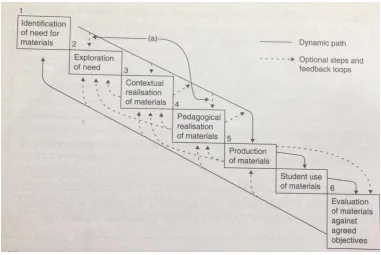
Figure 2: The Process of Material Writing (Jolly & Bolitho, 1998)
From Figure 2, the process of writing materials consists of the following steps. 1) Identification of need for materials
The process of material writing is initiated by the process of need identification for materials. The identification does not only cover the needs from the learners andfrom the teachers but also a problem to solve by the creation of materials. 2) Exploration of need
3) Contextual realization of materials
At this step, the material developer has to know how to make learners interested to learn English using the avaliable materials. The materials should be suitable with the culture, needs, and learners’ daily activity.
4) Pedagogical realization
This step means translating or putting the materials that have been processed in steps a and b into appropriate texts, exercises, repetition of language use, activities, and instructions to enable the achievement of the goals using the materials that have been identified and selected.
5) Physical production
This step refers to the writing of the first draft of materials. In writing the draft, the materials developer must consider the language and content of the materials. He also has to consider the layout, type and size of font used, visuals, tape lengths, number of pages in each unit, etc.
6) Learners’ use of materials
This step refers to the try-out or the use of the materials in the classroom followed by the assignment given to be done at home or outside the classroom. The purpose is to find the learners’ impression, whether or not they like the materials after
7) Evaluation of materials against agreed objectives
There are two kinds of evaluation, expert judgment and try-out. In the expert judgment process, the materials are evaluated by the experts in the materials development. In try-out process, the materials are used in the teaching and learning process. After using the materials in teaching and learning process and completing the assignment at home, the learners are asked to comment on the materials used. The material developer needs to know whether or not the materials are already appropriate for the learners and enable them to achieve the learning objectives that have been determined in advance.
c. Criteria of Good Materials
Tomlinson (1998) proposes several criteria of the good language materials: 1) Materials should achieve impact.
2) Materials should help learners feel at ease.
3) Materials should help learners develop confidence.
4) What is being taught should be perceived by learners as relevant and useful. 5) Materials should require and facilitate learners’ self-investment.
6) Learners must be ready to acquire the points being taught.
7) Materials should expose the learners to language in authentic use.
8) The learners’ attention should be drawn to linguistic features of the input.
10) Materials should take into account that the positive effects of instruction are usually delayed.
11) Materials should take into account that learners differ in learning styles. 12) Materials should take into account that learners differ in affective attitudes. 13) Materials should permit a silent period at the beginning of instruction.
14) Materials should maximize learning potential by encouraging intellectual, aesthetic, and emotional involvement which simulates both right and left brain activities.
15) Materials should not rely too much on controlled practice. 16) Materials should provide opportunities for outcome feedback.
B. Conceptual Framework
Graphic design is the art and practice of planning and projecting ideas and experiences with visual and textual content.Graphic designers are essentially visual problem-solvers who work for various fields such as branding, packaging, publishing, advertising and digital design. They need English as the tools for them to have communication with the clients. In some occasion, they have to communicate both in oral and written media. It means that English used by the graphic designer is in the scope of graphic design which is categorized as English for Specific Purposes.
and Bolitho (1998). Thus, therearesomefactorsthatneedtobeconsideredindevelopingEnglish learning materials for graphic designers at Petak Umpet Advertising Company, Yogyakarta.
Graphic designers are classified as adult learners. They have their characteristicsthat the way they learn language is different from how young learners learn. As adult learners, the teacher also should give the ways of teaching for the adults which are not simply adapted from teaching English as in a school.
Englishforgraphic designers iscategorizedasEnglishforSpecific Purposes(ESP)sinceitfocusesonaspecificfield.Thefirstwhich sould be done in ESPis conducting needsanalysis. In thisresearch, theneedsanalysis is conducted by distributingquestionnaire.Thequestionnaireanalyzethesubjectstargetneedsand
learningneeds.
In this study, the
materialswhicharedevelopedintheformofstudents’bookconsistof
someunits.Theunitsarebuiltaroundthemes which fit to the graphic design world.Those supportgoalsorobjectivesof thestudy.Aunitconsistsofseveraltasksthatenablethe learnerstoachievethe goal. The tasks are sequenced from the easiest to the hardest one and from the receptivetoproductiveactivities.
Thisstudy is needed
CHAPTER III RESEARCH METHOD
A. Type of the Research
This study examinedthe developing of English learning materials for graphic designers.Educational research and development was adopted as a guideline to developEnglish learning materials for graphic designers.Borg and Gall (2003) state that Research and Development is a process used to develop educational products and validate the product by testing it. Some common products developed in R&D are a variety of teaching tools such as curriculum, syllabus, learning modules, includingteaching materials.Therefore, this research belonged to Research and Development. There were five major steps of educational research anddevelopment employed in this research, namely research and information collection, planning, prelimenary form of product developing, prelimenary field testing, and main product revision.
B. Subject of the Research
C. Setting
The research took place atPetak Umpet Company located at Jalan Gedongkiwo MJ No. 1001, Mantrijeron, Yogyakarta. It has three main divisions of the advertising service; they are the planning sector which has the duty as the maker of the script, the main designer sector which uses the creativity and artistic soul in producing the design, and the marketing sector which has to have interaction and promotion to the public. The observation was held on August 2015.
D. Data Collecting Technique and Instruments
There were two types of data in this research. They were quantitative daata and qualitative data. In terms of quantitative data, the first were used to identify the information related learning and target needs which were taken from the learners. The second were used to gain the iinformation to evaluate the materials. This data was gathered from the evaluator.
Based on the types of data in this research, there were two kinds of data collection techniques.
1. Survey
2. Interview
This technique that was used in this research was non-formal interview. The qualitative data were gained through interviewing some graphic designers and the manager of human resources at Petak Umpet Advertising Company Yogyakarta in order to support the information about learning needs and target needs. The manager’s information was used to trace the designers’ problem related to English in
their job.
This study used two questionnaires as the research instruments. The first questionnaire was used to assess the learners’ needs. The second questionnaire was used to evaluate the designed materials and to find out whether the materials were already suitable with the learners’ needs or not. This questionnaire was distributed to
evaluator.
Table 1: Organization of the Questionnaire for Needs Analysis
To find out the learners’ goal in using and included in the materials
Hutchinson and Waters (1987: 56)
Lacks 5 To find out the gap between what the students have known and what they should know
Hutchinson and the input within the tasks
Nunan (2004: 52)
Setting 22, 23 To find out in what situations the learning process will take place
Nunan (2004: 70)
Students’ role 24 To find out what the students expect to take in carrying out the tasks
Nunan (2004:
Agree (SA), Agree (A), Disagree (D), or Strongly Disagree (SD). The questions of this questionnaire were derived from the instruments item of evaluation of English learning materials for graphic designers. The questions were divided into four parts, i.e. content, language, presentation, and graphic.
E. Data Analysis Techniques
The data from the questionnaires were analyzed quantitatively.Those from non-formal interview were analized qualitatively. The questionnaires result was analyzed by using several steps.
The quantitative data were analyzed to yield frequencies and percentages of respondents checking each respond category on particular closed-form questions (Borg& Gall, 2007: 242). After that, the results of the analyzed data were presented in table. In order to interpret the result, he made the interpretation of the questionnaire result in the form of paragraph.
In addition, non-formal interview to the one of the senior designers in Petak Umpet Advertising was held. It was used as the additional data to strengthen the quantitative data.
Then, the result of the data was converted to descriptive analysis as proposed by Suharto (2005: 52-53). The means (X) were calculated by using the following data conversion.
Table 2: Data Conversion Table (Suharto, 2005)
Scales Interval Descriptive
Categories
1 1.00 ≤ X ≤ 1.74 Poor
2 1.75 ≤ X ≤ 2.24 Fair
3 2.25 ≤ X ≤ 3.25 Good
4 3.25 ≤ X ≤4 Very Good
F. Procedure of the Research
This research followed the steps of R & D proposed by Borg and Gall (1983). The steps are:
1. Research and information collection
2. Planning
The step was used to design the materials. It was done by stating the goals, topics and general purposes based on the data from the questionnaires.
3. Preliminary Form of Product Developing
In this step, the materials were designed. It was based on the planning in the previous step. In this study, a set of English learning material was designed for graphic designers of Petak Umpet, Yogyakarta.
4. Preliminary Field Testing
When the designed materials were completed, they should be evaluated. Since this design was not implemented, the researcher distributedthe questionnaires to a lecturerof English Language Education Study Program, Faculty of Languages and Arts, Yogyakarta State University. The purpose of this step was to gain opinions, comments, suggestions, and criticisms as an evaluation for the designed materials.
5. Main Product Revision
CHAPTER IV
RESEARCH FINDINGS AND DISCUSSION
This chapter provides the description of the research findings and discussion. The research findings consist of the results of the needs analysis, the syllabus, the first draft of the materials, the expert judgment data, and the final draft of the materials.
A. Research Findings
1. The Results of the Needs Analysis
The needs analysis was conducted to assess the target and learning needs of the learners by distributing the questionnaire on 4thDecember 2015. There were some questions in which the respondents were only allowed to choose one option, and there were some others in which they were allowed to choose more than one option. The high percentages were considered as the subjects’ needs.
a. Target needs
According to Hutchinson and Waters (1987: 54), a target need is what learners need to do in the target situation. The analysis of the target needs is divided into three points, i.e. necessities, lacks, and wants.
1) Necessities
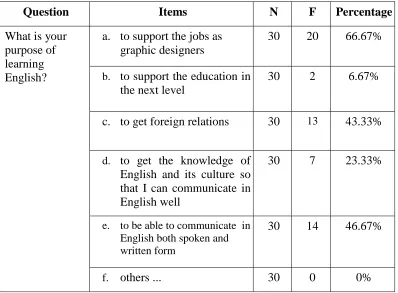
Table 3: Subjects’ View about Target Goals
Question Items N F Percentage
What is your purpose of learning English?
a. to support the jobs as graphic designers
30 20 66.67%
b. to support the education in the next level
30 2 6.67%
c. to get foreign relations 30 13 43.33%
d. to get the knowledge of English and its culture so that I can communicate in English well
30 7 23.33%
e. to be able to communicate in English both spoken and written form
30 14 46.67%
f. others ... 30 0 0%
Table 4: Subjects’ View about the Demands of the Target Situation
a. beginner: can understand simple sentences and expressions used in a daily life
30 8 26.67%
b. intermediate:canunderstand the main idea or purpose of complicated texts and give comments about that
30 18 60%
c. advanced: can understand a variety of texts and
understand implicit ideas in a text
a. beginner: can understand simple sentences and expressions used in a daily life
30 3 10%
b. intermediate: can
understand the main idea or purpose of complicated texts and give comments about that
30 6 20%
c. advanced: can understand a variety of texts and
understand implicit ideas in a text
30 20 66.67%
d. others ... 30 0 0%
2) Lacks
Lacks is the gap between what the learners have known already and what the learners have not known. The respondents’ views on their lacks are shown in the following table.
Table 5: Subjects’ Current Levels of English Proficiency
Question Items N F Percentage
Your current level of English proficiency is in the level of ...
a. beginner: can understand simple sentences and expressions used in a daily life
30 22 73.33%
b. intermediate: can
understand the main idea or purpose of complicated texts and give comments about that
30 8 26.67%
c. advanced: can understand a variety of texts and understand implicit ideas in a text
30 0 0%
d. others ... 30 0 0%
3) Wants
Wants is learners’ view as to what their needs are. The following table shows respondents’ general wants in learning English.
Table 6: Subjects’ General Wants in Learning English
Question Items N F Percentage
a. understand expressions in English
30 9 30%
b. understand a variety of texts in English
d. communicate well in English
30 21 70%
e. others ... 30 0 0%
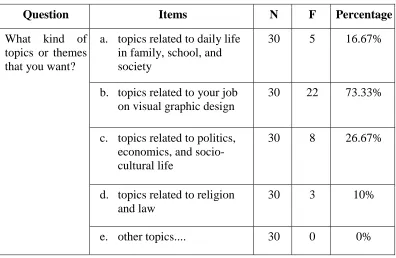
Table 7: Subjects’ View about Topics They Want to Learn in Learning English
Question Items N F Percentage
What kind of topics or themes that you want?
a. topics related to daily life in family, school, and society
30 5 16.67%
b. topics related to your job on visual graphic design
30 22 73.33%
c. topics related to politics, economics, and socio-cultural life
30 8 26.67%
d. topics related to religion and law
30 3 10%
e. other topics.... 30 0 0%
Based on Table 7, 73.33% of the respondents choose topics related to their job in visual graphic design. The comparison of the results from respondents’ view about
topic is too high. Therefore, it will be better to give the topics that they mostly want. b. Learning needs
The analysis of learning needs of the students is divided into some points, e.g. input, procedures, setting, learners’ role,and teacher’s role.
1) Input
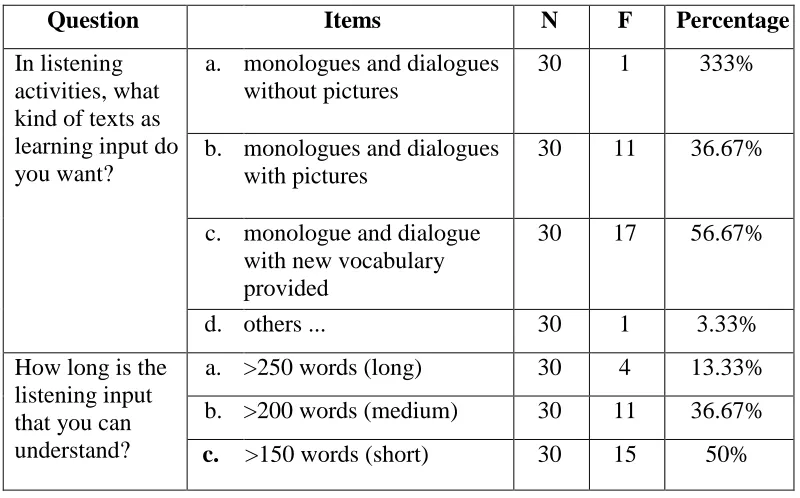
Table 8: Learning Needs (listening input)
a. monologues and dialogues without pictures
30 1 333%
b. monologues and dialogues with pictures
30 11 36.67%
c. monologue and dialogue with new vocabulary
According to the table, it can be seen that 56.67% of respondents thought that the appropriate materials for listening activities were monologues and dialogues with new vocabulary provided. Then, in terms of the length of listening input, 50% of the respondents claimed that they could understand short number of words.
Table 9: LearningNeeds (speaking input)
Question Items N F Percentage
a. monologues and dialogues without pictures.
30 6 20%
b. monologues and dialogues with pictures provided.
30 7 23,33%
c. monologue and dialogue with new vocabulary provided.
30 17 56,67%
In the spaking input, 56.67% of the respondents liked to learn monologues and dialogues in the intermediate number of words with new vocabulary provided while some other respondents liked to learn monologue and dialogue with provided pictures (23.33%).
Table 10: Learning Needs (reading input)
Question Items N F Percentage
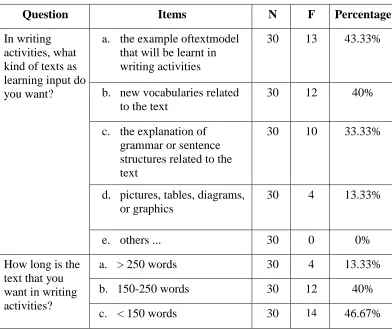
Table 11: Learning Needs (writing input)
a. the example oftextmodel that will be learnt in writing activities
30 13 43.33%
b. new vocabularies related to the text
30 12 40%
c. the explanation of grammar or sentence structures related to the text
30 10 33.33%
d. pictures, tables, diagrams, or graphics related to the text as the inputs with less than250 numbers of words.
2) Procedures
The following table shows the students’ view on the procedures of what they
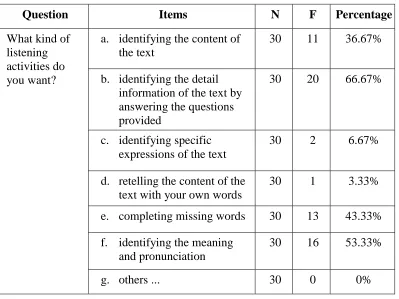
Table 12: Learning Needs (listening learning activities)
Question Items N F Percentage
What kind of listening activities do you want?
a. identifying the content of the text
30 11 36.67%
b. identifying the detail information of the text by answering the questions provided
30 20 66.67%
c. identifying specific expressions of the text
30 2 6.67%
d. retelling the content of the text with your own words
30 1 3.33%
e. completing missing words 30 13 43.33% f. identifying the meaning
and pronunciation
30 16 53.33%
g. others ... 30 0 0%
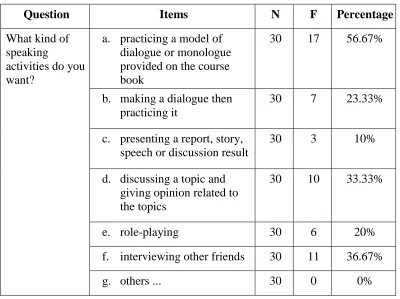
Table 13: Learning Needs (speaking learning activities)
Question Items N F Percentage
What kind of speaking
activities do you want?
a. practicing a model of dialogue or monologue provided on the course book
30 17 56.67%
b. making a dialogue then practicing it
30 7 23.33%
c. presenting a report, story, speech or discussion result
30 3 10%
d. discussing a topic and giving opinion related to the topics
30 10 33.33%
e. role-playing 30 6 20%
f. interviewing other friends 30 11 36.67%
g. others ... 30 0 0%
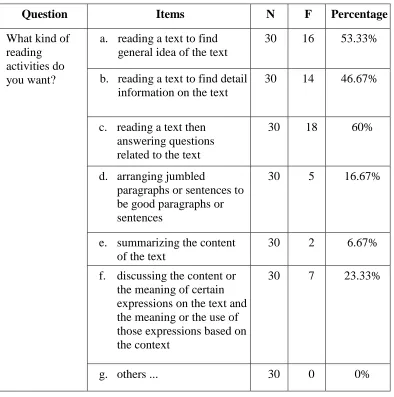
Table 14: Learning Needs (reading learning activities) general idea of the text
30 16 53.33%
b. reading a text to find detail information on the text
30 14 46.67%
c. reading a text then answering questions related to the text
30 18 60%
d. arranging jumbled
paragraphs or sentences to be good paragraphs or sentences
30 5 16.67%
e. summarizing the content of the text
30 2 6.67%
f. discussing the content or the meaning of certain expressions on the text and the meaning or the use of those expressions based on the context
30 7 23.33%
g. others ... 30 0 0%
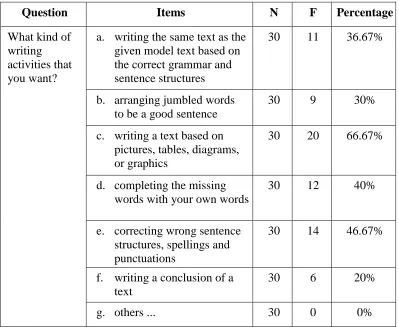
Table 15: Learning Needs (writing learning activities)
a. writing the same text as the given model text based on the correct grammar and sentence structures
30 11 36.67%
b. arranging jumbled words to be a good sentence
d. completing the missing words with your own words
30 12 40%
e. correcting wrong sentence structures, spellings and punctuations
30 14 46.67%
f. writing a conclusion of a text
30 6 20%
g. others ... 30 0 0%
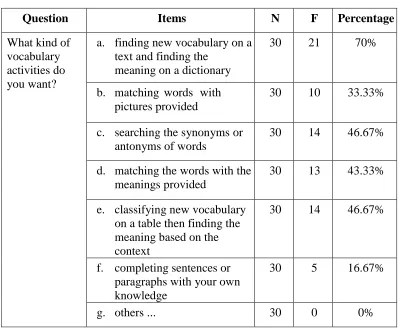
Table 16: Learning Needs (vocabularies learning activities)
a. finding new vocabulary on a text and finding the
meaning on a dictionary
30 21 70%
b. matching words with pictures provided
30 10 33.33%
c. searching the synonyms or antonyms of words
30 14 46.67%
d. matching the words with the meanings provided
30 13 43.33%
e. classifying new vocabulary on a table then finding the meaning based on the context
30 14 46.67%
f. completing sentences or paragraphs with your own knowledge
30 5 16.67%
g. others ... 30 0 0%
Table 17: Learning Needs (grammar learning activities)
a. memorizing sentence structure/grammar missing words on the text based on the context
30 14 40%
e. making your own sentences based on the given pattern
Table 18: Learning Needs (pronunciation learning activities) pronunciation on a dictionary
30 10 33.33%
b. reading aloud and looking for the pronunciation on a dictionary
30 4 13.33%
c. listening and repeating the pronunciation from the teacher
30 7 23.33%
d. learning to pronounce every sentence including the stress and intonation
30 16 53.33%
e. others ... 30 0 0%
Learning to pronounce every sentence including the stress and intonation was considered to be the most frequent way chosen as the pronunciation activities that 53.33% of the respondents wished. Besides, searching the pronunciation on the dictionary and listening it from the teacher were also considered to do in their activities in order to have correct pronunciation in English.
3) Setting
Table 19: Setting
Question Items N F Percentage
You feel more comfortable if the Englishlearning
activities is conducted in ...
d. language laboratory or practice room
30 7 23.33%
e. others ... 30 3 10%
In English teaching and learning process, you
The result shows that the respondents preferred to learn inside the classroom rather than outside and more than half respondents, 60%, liked to learn in pairs. Since some of them wanted to learn individually and in small group, learning process could be set with those ways in the different tasks.
4) Learners’ role and teacher’s role
Role refers to the part that learners and teachers were expected to play in carrying out learning tasks as well as the social and interpersonal relationships.The following table shows students’ opinion of the role they expected to play and the roles
Table 20: Learners’ and Teacher’s Role
a. onlylisten to teacher’s explanation
30 5 16.67%
b. propose your questions and opinions
30 10 33.33%
c. do discussions and actively involved in the investigation to solve problem and do the tasks
30 16 53.33%
d. use your creativity in doing the task
30 6 20%
e. be guided by the teacher in every task or exercise
30 13 43.33% learners to have discussion
30 19 63.33%
d. guide the learners to show up their opinions and to solve the problems
30 22 73.33%
e. give the learners tasks and exercises
30 10 33.33%
f. others ... 30 1 3.33%
In addition, the researcher held a non-formal interview to one of the senior designers in Petak Umpet Advertising. It was used as the qualitative data which were to support the quantitative data from the questionnaire. It was held in non-formal way in which the researcher directly held the interview without preparing list of questions.
2. Syllabus
After the needs analysis was done, the next step was designing a syllabus by formulating the objectives of the learning. In this stage, topics were selectedand decided the objectives. The selected topics were based on the needs analysis and job description taken from SKKNI for graphic designer. The topics were closely related to the visual graphic commonly used in Petak UmpetAdvertising Company Yogyakarta. Those topics are arranged as follows:
Unit 1: Good morning, Sir!
Unit 2: Could you tell me about your product? Unit 3: Why don’t you try to get the license?
Table 21: The Objectives of each Topic in the Materials
No. Topic Objectives
1. Unit 1:
“Good morning, Sir!”
At the end of the lesson, the learners are able to:
1. greet the costumers
2. give recommendation and confirmation 3. find the social function and generic
structure of email
4. analyze and make future sentences 5. distinguish the phonetic symbols
2.
Unit 2:
“Could you tell me about your product?”
At the end of the lesson, the learners are able to:
1. ask information
2. describe a product design
3. find social function and generic structure of the procedure text
4. analyze and make passive sentences 5. analyze and make an English poster
3.
Unit 3:
“Why don’t you try to get the license?”
At the end of the lesson, the learners are able to:
1. ask and give feedback
2. present an English product related to graphic design
3. find social function and generic structure of the exposition text
After the objective of the study was formulated, the syllabus of this study was developed. It was used as the framework and as the guideline to develop the units of the materials. In this step, the researcher used some aspects such as the results of needs analysis and the job description provided in SKKNI for graphic designers. The syllabus consisted of number, unit name and title, indicators, language function, language focus, input text, and learning activities.
a. Syllabus of Unit 1
The title for Unit 1 was “Good Morning, Sir!” This unit was based on the results of the needs analysis and the job description of SKKNI for graphic designers unit code TIK.DG02.010.01about greet the client and give the recommendation to the client. In this unit, the studentswere expected to understand how to respond the customers’ order, e.g. greeting, confirming something and giving recommendation.
Besides, theywere also expected to comprehend email text and able to reply it. b. Syllabus of Unit 2
The title for Unit 2 was “Could youtell me about your product?” This unit was based on the results of the needs analysis and the job description of SKKNI for the graphic designer unit code TIK.DG02.004.01 and TIK.DG02.008.01 about taking a note of the order. In this unit, the students were expected to understand how to asksomething related to the client’s order, interview someone, and analyze the
c. Syllabus of Unit 3
The title for Unit 3 was “Why don’t You Try to Get the License?” This unit was based on the results of the needs analysis and job description of SKKNI for graphic designer unit code TIK.DG01.003.01 about developing their knowledge. In this unit, the studentswere expected to understand how to give comment and feedback, and present product design in English related their job. Besides, they were also expected to understand the social function and the generic structure of an exposition text.
The complete form of the three units’ syllabus of English materials for graphic designer can be found in Appendix D.
3. Unit Design
The next step was developing the materials. In this stp, the researcher used three parts in each unit. They were Introduction, Main Lesson, and Reinforcement.
The units started with the title of the unit and the objectives of the unit. The first part was introduction. It is the form of getting started activity on Task 1. This part consisted of questions related to the topic. The activity brought the learners to understand the topic and prepared them for the main lesson. The next part was the main lesson which has many tasks containing the skills of language. In this part, learners started to do the tasks given by the teachers while the teachers monitor the learners’ work. Besides, learners also started to draft and rehearse what they wanted