i A Thesis
Presented as a Partial Fulfillment of the Requirements for the Attainment of the SarjanaPendidikanDegree in English Education
By: LaelaFebriatun
1120224106
ENGLISH EDUCATION DEPARTMENT FACULTY OF LANGUAGE AND ART YOGYAKARTA STATE UNIVERSITY
ACCOMMOI}ATION DEPATMENTS IN SMK PI AMBART]KMO 1 SLEMAN
A Thssis
Presmted as a Partial Flrlfilhrerrt of
th Rquiremrit
for the Attairmentof
th*
fujma
Petdrdikm&gree infu Engti*
Lryrmge EducdionL^ffilaFebrieltr 11w224t026
Acceptd by &e board of examiners of Engtish E<lucatior
@armw,
faculty I^aaguage md Arts, Yogyaktrta Sute University on Jult l5&, ZOIOd
declfid
have fulfilled the rquirements todais lstei@
Fendidikan D%pe in English Lam$*ge RlucationBOARD SF E}(AMINHRS Position
Chairyermn S€ctettry Examiner
Nme
: Ella trulaadari,MA
: Siti S&anini,
M.A
: Drs. Samsul Maaifl tU.a.Date
2o
*o/
-2ots
Au*"1
-
?ntS7> -<57
_ tOtl.
t
Yogyakarta July I 5tr,2016 Faculty of Language and Arts
State Universir! of Yogyakarta
Dean
ilt
Sigrature
Yang bertandatrgan di bawah ini: NAMA
NIM JUR-USAN
FAKULTAS ruDUL SKEIPSI
Laela Febriatuin
1120224t0226
Pendidikan Bahasa Inggns
Fakultas Bahasa dan Seni
Developing English speaking Materilasfor x'h Grade of Hotel
Accommodation Department in sMK pI Ambarulcrno
I
slemanMenyatakan dengan sesungguhnya bahwa skripsi
ini
adalah hasil karya saya sendiri dan sepanjang sepengetahuan saya tidak beisi materi yang ditulis atau dipublikasikan oleh oranglain kecali bagian-bagiab tertentu yang saya ambil sebagai acuan dengan mengikuti satu cara
dan etika penulisan karya ilmiah yang lazim.
Apabila ternyata terbulci bahwa pernyataan ini tidak benar sepenuhnya melrjadi tanggung jawab saya.
Yogyakarta, Juli 2016 Penulis
*
v
Start where you are. Use what you have. Do what you can.
-Arthur Ashe-
Aim for the moon. If you miss, you may hunt a star.
vi I dedicate this thesis to:
1. My beloved parents. I express my sincere thanks for their love and support. 2. My brother, Wiwin Surajiono. I express my appreciation for his devotion and
vii
ACKNOWLEDGEMENTS
Alhamdulillah, praise to God the Almighty and the most Merciful. This thesis would not be possible without the support of many people.
First of all, I would like to express my highest appreciation to Ella Wulandari M.A for her valuable and constructive suggestions during the planning and development of this thesis. Her willingness to give her time so generously has been very much appreciated. My deepest gratitude is also devoted to B. Yuniar Diyanti, S.Pd., M.Hum. as the material expert who gave me guidance and suggestions for the improvement of my product as well.
Then, I would like to express my sincerest appreciation to my parents and my brothers for their love, support and encouragement throughout my study. Moreover, I am particularly grateful for the assistance given by my friends Nining and Hanan, thank you so much for not getting bored supporting me in this way. Then, to the students of SMK PI 1 Ambarukmo Sleman, especially Class X, I would like to say thank you for the participation.
Finally, I invite the readers who are interested in this topic to give critical comments and suggestions. However, I expect that this thesis will give worthwhile contributions to all readers.
Yogyakarta, Juni 2016
viii
Laela Febriatun 11202242026 ABSTRACT
The objectives of this study are: (1) to find the target and learning needs of Xth grade students of hotel accommodation department at SMKPI 1 Ambarukmo Sleman, Yogyakarta, and (2) to develop appropriate English speaking materials for Xth grade students of hotel accommodation department at SMK PI Ambarukmo 1 Sleman, Yogyakarta.
The type of this study is Research and Development (R&D). The subjects of the research were X grade students of hotel accommodation department at SMK PI Ambarukmo 1 Sleman, Yogyakarta, class X AP 1 and X AP 2. The instruments used in this research were the needs analysis questionnaire and expert evaluation questionnaire. The steps of the research were conducting the needs analysis, writing the course grid, developing the first draft of materials, consulting the first draft of materials to the experts, and revising and developing the final draft of materials. The data from the needs analysis were analyzed quantitatively using frequency and percentage and the data obtained from the materials evaluation were analyzed through descriptive statistics.
ix
RATIFICATION... iii
PERNYATAAN ... iv
MOTTOES ... v
DEDICATIONS ... vi
ACKNOWLEDGEMENT ... vii
ABSTRACT ... viii
TABLE OF CONTENTS ... ix
LISST OF TABLES ... xiii
LIST OF FIGURES ... xv
LIST OF APPENDICES ... xvi
CHAPTER I ... 1
A. Background of the Study ... 1
B. Identification of the Problem ... 3
C. Delimitation of the Problem ... 5
D. Formulation of the Problem ... 5
E. Objectives of the Study ... 6
F. Significance of the Study ... 6
CHAPTER II ... 8
A. Literature Review ... 8
x
d. Classroom Speaking Activity ... 13
e. Principles in Designing Speaking techniques ... 14
f. Speaking in Hotel Accommodation Department ... 16
2. English for Specific Purposes (ESP) ... 18
3. Teacher’s Role in ESP ... 21
4. Learners’ Role in ESP ... 22
a. Standard of English for Vocational School content ... 22
5. Development ... 24
a. The Nature of Materials Development ... 24
b. The Role of Instructional Materials ... 26
c. The Purpose of Instructional Materials ... 27
d. Materials Model Design ... 28
e. Materials Evaluation ... 32
6. CLT (Communicative Language Teaching) ... 35
a. Goal of CLT ... 36
b. The Principles of CLT ... 37
c. PPP (Presentation, Practice, Production) ... 39
B. Relevant Study ... 40
C. Conceptual Framework ... 41
CHAPTER III ... 43
xi
E. Data Analysis Techniques ... 46
F. Research Procedure ... 48
CHAPTER IV ... 50
A. Research Finding ... 50
1. The Result of needs Analysis ... 50
a. Description of the Students’ Profile ... 50
b. Description of the Students’ Needs... 51
a. Target Needs ... 51
1. Necessities ... 52
2. Lacks ... 53
3. Wants ... 54
b. Leaning Needs ... 55
1. Input ... 55
2. Goals ... 57
3. Procedures ... 58
4. Setting ... 61
5. Teacher’s Role ... 62
6. Students’ Role ... 63
2. Course Grid ... 64
3. Materials Design ... 66
xii
a. The Result of Expert Judgment of Unit 1 ... 80
b. The Result of Expert Judgment of Unit 2 ... 84
c. The Result of Expert Judgment of Unit 3 ... 88
5. The Review of the First Draft Materials ... 95
6. The Final Draft of the Materials ... 101
B. Discussion ... 101
CHAPTER V A. Conclusion ... 108
B. Implication ... 112
C. Suggestion ... 112
REFFERENCES ... 113
xiii
Table 2 The organization of needs analyze instrument ... 44
Table 3 The organization of expert judgment questionnaire ... 45
Table 4 Quantitative Data Conversion ... 47
Table 5 The result of students’ profile ... 49
Table 6 Students’ view of necessities ... 52
Table 7 Students’ view of students lacks ... 53
Table 8 Target needs (students’ wants) ... 54
Table 9 Learning needs (speaking input) ... 55
Table 10 Learning needs (Goals) ... 57
Table 11 Learning needs (learning procedures) ... 58
Table 12 Learning needs (setting) ... 61
Table 13 The result of teachers’ role ... 62
Table 14 The result of students’ role ... 63
Table 15 The Appropriateness of the Content of Unit 1 ... 81
Table 16 The Appropriateness of the Presentation of Unit 1 ... 82
Table 17 The Appropriateness of the Language of Unit 1 ... 82
Table 18 The Appropriateness of the Lay-out of Unit 1 ... 83
Table 19 The Appropriateness of the Content of Unit 2 ... 84
Table 20 The Appropriateness of the Presentation of Unit 2 ... 85
xiv
Table 25 The Appropriateness of the Language of Unit 3 ... 90
Table 26The Appropriateness of the Lay-out of Unit 3 ... 90
Table 27 The Appropriateness of the whole Materials ... 91
Table 28.The Revision of Unit 1 ... 93
Table 29 The Revision of Unit 2 ... 96
xv
Figure 2: Materials design model 1 ... 31
Figure 3: Materials evaluation process purposed by Hutchinson and Waters (1987:97) 32
Figure 4 Steps in conducting an evaluation of task in Tomlinson (1998:227) ... 33
Figure 5. the diagram of conceptual framework ... ... 42
xvi
Appendix C : Course Grid of Speaking English Materials Appendix D : The Questionnaire for Expert Judgment
Appendix E : The First Draft of Speaking English Materials for Hotel Accommodation
1 CHAPTER I INTRODUCTION
A. Background of the study
Hotel Accommodation is one the departments in of vocational high schools departments which belong to the tourism program. This department aims to train students to able to (1) work in front office area such as receptionist, reservation telephone and porter (2) do housekeeping job area public attendant, room attendant, order taker, linen and uniform attendant, and laundry attendant. In addition, the graduates are expected to have good competence to compete in the global industry. One of the competences that should be mastered is English. This is also regulated in Keputusan Menteri Tenaga Kerja dan Transmigrasi Republik Indonesia no.158 year 2010 about SKKNI (Standard Kompetensi Kerja Nasional Indonesia) sektor pendidikan bahasa inggris which states some English unit competencies that should be mastered by students, such as make short conversation by telephone and handling complain. From four prominent English skills; speaking, listening, reading and writing, speaking becomes the most urgent for Hotel Accommodation department. It is because, later on, Hotel Accommodation students will deal with some activities that need speaking ability such as serving local and foreign guests, telephoning, starting conversation with the guest, showing direction and many others.
2006, has purposes to make students able to (a) achieve the English proficiency to support the achievement of professional program competency, (b) apply their competency and English skills orally and in written. Hence, it is clear that English teaching and learning process for hotel accommodation departments should be relevant to their specific program. Students should be supplied with specific speaking materials that related to their future professional context. In addition, speaking English teaching and learning in Hotel Accommodation department should be based on the curriculum used in the school.
Despite the high importance of speaking skill for hotel accommodation students, it rarely meets the target needs in the class ESP in SMK PI AMBARUKMO Sleman. Students in SMK PI AMBARUKMO Sleman use general English materials when they are learning English. They do not have special English materials that relevant to their department. Then, to support
students’ needs, teacher give additional materials from the internet. Unfortunately,
the taken materials do not always represent the language use in the real life activities. Moreover, the materials given tend to focus only on reading and writing
skill. Students have not got materials that cover students’ need of speaking skill.
The reason behind this is because teacher got difficulties in finding appropriate materials to teach speaking for specific purposes. Hence, it is necessary that speaking materials for hotel accommodation to be developed.
B. Identification of the Problem
As stated in the background of the study, speaking skill becomes a must for students of Hotel Accommodation. Unfortunately, in SMK PI AMBARUKMO1 Sleman students lack speaking activities that can develop their speaking skill. In additions, it is difficult to find appropriate speaking materials that cover students’ needs. Thus, it is important to develop speaking materials for Hotel Accommodation department. In developing speaking materials for Hotel Accommodation department, learning needs and target needs are important.
their program. The additional worksheets given by teachers, also, have no yet
fulfilled the students’ needs. Moreover, teachers rarely give variation of speaking
activities. Teachers are always asking students to work in pairs and having short conversation. Looking to the characteristic students of Hotel Accommodation, this monotonous activity will make them less motivated in learning English. They need variation and fun and interesting activities in learning speaking. In additions, students of SMK PI AMBARUKOMO 1 Sleman tend to shy in speaking English. Thus, teachers should be able to choose activities that can encourage students in speaking English.
In addition, the students of this vocational high school lack real-life activities. It is because teachers do not have special text book for hotel accommodation. Of course, teachers could take some real life activities from internet or even design the activities, but limited time makes it difficult. Teachers
finally use the available activities in the students’ worksheets that sometimes do
not bring real life activities.
Although SMK PI AMBARUKMO 1 Sleman has computers in the language laboratory, but the computers do not cover all the students in a class. Hence, students could not use the available computers media maximally. Because of this reason, students rarely have listening activity which becomes the input of speaking.
PI AMBARUKMO1 Sleman. In relation to that issue, the speaking English materials for Hotel Accommodation are urgent to be developed.
C. Delimitation of the problem
Based on the identification the problems above, there are two potential problems identified in SMK PI AMBARUKMO1 Sleman. One of them is related to the speaking materials. Students need speaking materials that is relevant to their social context and enable them to communicate well.
In this study, the researcher develops the speaking English Materials for X grade students of Hotel Accommodation department in SMK PI AMBARUKMO1 Sleman. As stated before, it is important to develop their speaking ability since it is the most skill used for hotel accommodation program. Moreover, students rarely get speaking activities in the English learning. The speaking materials will be developed based on the Standard of Competence and Basic of Competence of English from the school based curriculum.
D. Formulation of the Problems
Based on the background, identification and delimitation of the problem, the problems can be formulated as follows:
1. What are the target needs of students of SMK PI AMBARUKMO 1 Sleman?
3. What are the appropriate speaking materials for students of SMK PI AMBARUKMO 1 Sleman in learning English?
E. Objectives of the Study
In line with the he formulation of the problem, the objectives of this research are:
1. To identify target needs of SMK PI AMBARUKMO 1 Sleman in learning English
2. To identify the learning needs of SMK PI AMBARUKMO 1 Sleman 3. To develop appropriate materials for students of SMK PI AMBARUKMO
1 Sleman in learning English.
F. Significance of the Research
The researcher expects the result of this study will give some advantages to the theoretical as well as practical use.
1. In theory, the researcher expects that the result of this research can be a reference and contribute to other researchers.
2. In practice, the researcher expects that the result of this research will be useful for:
a. English teacher of Hotel Accommodation program
students with learning materials that is suitable to the students’ department.
b. English Department
The researcher expects that this research will inspire other English students to do more investigations and references in materials development.
c. Students of Hotel Accommodation program
8
CHAPTER II
THEORETICAL REVIEW AND CONCEPTUAL
FRAMEWORK
A. Literature Review 1. Speaking
a. Definition of Speaking
Language is a way to communicate. When someone can speak a language it means that he can carry on a conversation reasonably competently (Brown, 2001:267). In addition, he states that the benchmark of successful acquisition of language is almost always the demonstration of an ability to accomplish pragmatic goals through an interactive discourse with other language speakers.
Brown (2007: 237) also states that social contact in interactive language functions is a key importance and in which it is not what you say that counts but how you say it what you convey with body language, gestures, eye contact, physical distance and other nonverbal messages. There are three components to make fluent in producing speech, namely vocabulary, pronunciation, and grammar. Hence, it can be inferred that speaking is a way of communication and it uses words and produce the sounds to express ourselves either ideas, feelings and thought.
1) The ability to articulate phonological features of the language comprehensibly.
2) Mastery of stress, rhythm, intonation patterns. 3) An acceptable degree of fluency.
4) Transactional and interpersonal skills.
5) Skills in taking short and long speaking turns. 6) Skills in the management of interaction. 7) Skills in negotiating meaning.
8) Conversational listening skills (successful conversations require good listeners as well as good speakers).
9) Skills in knowing about and negotiating purposes for conversations.
10) Using appropriate conversational formula and fillers
b. Macro-skills and Micro-skills of Speaking
Brown (2001: 142 – 143) divides language skills of speaking into macro-skills and micro-skills. The macro-skills of speaking deal with larger elements such as fluency, discourse, functions, style and cohesion nonverbal communication, and strategic options. Those macro-skills of speaking are:
2. Using appropriate styles, registers, implicature, pragmatic conventions, conversation rules, floor – keeping and – yielding, interrupting, another sociolinguistics features in face – to – face conversations,
3. Conveying links between events and communicate such relations as focal and peripheral ideas, events and feelings, new and given information, generalization and exemplifications,
4. Conveying facial features, kinesics, body language, and other nonverbal cues along with verbal languages, and
5. The ability in developing and using speaking strategies.
Meanwhile, the micro-skills of speaking refer to producing the smaller chunks of languages such as phonemes, morphemes, words, collocations, and phrasal units. Those micro-skills are explained below:
1. Producing differences among English phonemes and allophonic variants,
2. Producing chunks of language of different lengths, 3. Producing English stress patterns,
4. Producing reduced forms of words and phrases. 5. Using an adequate number of lexical unit (words) 6. Producing fluent speech at different rates of delivery.
7. Monitoring one’s own oral productions and uses various strategic
8. Using grammatical word, systems, patterns, rules, and elliptical forms.
9. Producing speech at natural constituent,
10. Expressing a particular meaning in different grammatical forms, 11. Using cohesive devices in spoken discourse.
Macro-skills and micro-skills are the important things in oral communication to be considered. By considering those macro-skills and micro-skills students will be able to speak and express their feeling and thought. Not only that, students also will be able to join a conversation based on the context of situation by using an adequate number of lexical unit, grammatical forms, and cohesion devices. Those macro-skill and micro-skill of speaking are used to fulfill the students’ needs in learning speaking. Hence, the speaking material for students should cover those relevant macro-skills and micro-skills of speaking.
c. Types of Classroom Speaking Performance
a. Imitative: students copy how to pronounce certain element of language form of the teacher or the tape recorder focusing on stress and intonation, not meaning.
b. Intensive: students can practice both phonological and grammatical form of language that can be done alone or in pairs, where they have to put a lot of efforts to study certain form of language.
c. Responsive: students give a short reply to comments or questions from the teacher or to the students.
d. Transactional (dialogue): students have a dialogue to express or exchange specific information. While in interpersonal (dialogue) students have dialogue to maintain social relationship.
e. Extensive (monologue): students perform oral monologue in the form of speeches, summaries, or reports. The monologue can be planned or impromptu.
d. Classroom Speaking Activities
There are several activities that can be used in classroom. Teacher can use these activities in teaching English to give variety in teaching. Harmer (2001:271-274) state 6 classroom speaking activities as explained below:
2. Communicative games: communicative games are games designed to demand to students to talk to their pairs or partners to solve the games.
3. Discussing: it can be planned or just happened in the middle of the lesson. Both kinds of discussion can be productive activity if the teacher can encourage the students to speak and give their opinion in front of their friends by giving them familiar topic/topic they master. 4. Prepared talks: students are given a period of time to prepare a script of presentation on a topic of their own performance. However when they perform, the better speak is from the note not from the script.
5. Questionnaire: students can make questionnaire on any topic. While students make it, teacher helps them by being resources. The result take from questionnaire can be prepared for discussion or talks. 6. Simulation and role play: students pretend to be in a certain situation, whether being themselves or to be someone else.
e. Principles in Designing Speaking Techniques
Brown (2001:275-276) proposes principles for designing speaking techniques as follows.
techniques designed to help students to perceive and use the building block. At the same time, do not make the students feel bored with repetitious drills. Teachers should make any drilling as meaningful as possible.
2) Provide intrinsically motivating techniques. Try at all times to appeal to students’ ultimate goals and interests, to their need for knowledge, for status, for achieving competence and autonomy, and
for “being all thatthey can be.” Even in those techniques that does sent
students into ecstasy, help them to see how the activity benefits them. Inform the students why we ask them to do certain things; so they know how the activity benefits them.
3) Encourage the use of authentic language in meaningful context. It takes energy and creativity to design authentic contexts and meaningful interaction, but with the help of storehouse of teacher resource materials can be done. Even drilling can provide a sense of authenticity.
4) Provide appropriate feedback and correction. In most EFL situations, students are dependent on the teacher for useful linguistic feedback. Feedback can be found outside of the classroom but it is important to inject the kinds of corrective feedback that are appropriate for the moment.
Don’t lose out on opportunities to integrate these two skills. As you are
perhaps focusing on speaking goals, listening goals may naturally coincide, and the two skills can reinforce each other. Skills in producing language are often initiated through comprehension.
6) Give students opportunities to initiate oral communication. Part of oral communication competence is the ability to initiate conversations, to nominate topics, to ask questions, to control conversations, and to change the subject. As you design and use speaking techniques, ask yourself if you have allowed students to initiate language.
7) Encourage the development of speaking strategies. The concept of strategic competence is one that few beginning language students are aware of. They simply have not thought about developing their own personal strategies for accomplishing oral communicative purposes. Teachers should help their students develop strategic competence to accomplish oral communicative purposes.
f. Speaking in the Hotel Accommodation Department
English learning of vocational high schools have some characteristics according to Standar Isi dan Standar Kompetensi Lulusan untuk Satuan Pendidikan Menengah SMK-MAK, 2006. Those characteristics can be seen below:
subjects. Therefore, learning English is not only to communicate but also to develop the students so that they can be the people that have global competition.
2) Effective communication demands the use of language well i.e. the language that is appropriate with the rules of language and the demand of communicative context.
3) Real communication always happens in natural context. Because of it, learning English should be done by involving the students and their environment in the context of daily life. So, it should be authentic and natural.
4) The communication is a means to achieve the true goal i.e. to fulfill life need. Therefore, learning English is to develop the life skill, and not vice versa, use life skill to teach English.
5) English is a means of global communication. Mastering English is expected to help the students to understand and make strong local and national culture, also know and understand international culture. Therefore, learning English should be done by noticing all those three aspects.
6) Mastering English well can be the effective means to improve knowledge and technology so that it can improve the competition of Indonesia human resources.
improve students’ skill to compete in the global world. For Hotel
Accommodation students, they need special language use related to their professional context. It doubts for students to success in their field without having good skill in English, since they will deal with foreign guests. Considering that student of Hotel Accommodation will deal with some activities that need speaking skill better than other skill, it is important for them to have appropriate speaking materials that related to their professional context. In fact, they have not got materials to cover their needs yet.
The students of Hotel Accommodation department in vocational school are categorized into adolescent learners. According to Harmer (2001: 83 – 84), the characteristics of adolescent learners are still searching for their self-identity and need to feel good and be valued of their self – esteem. Moreover, most of the adolescent learners understand the need for learning and, with the right goals, can be responsible enough to do what is asked for them.
interesting speaking materials to build up students’ interest in learning English.
It can be concluded that developing speaking materials are important for the students of the Hotel Accommodation program for their need after graduating from the school. In addition, in developing materials, it is important to look at the characteristics of the students. Hence, the materials will be able to help them to communicate in their later profession.
2. English for Specific Purposes (ESP)
English for specific purposes is an approach to language teaching in which all decision about the content and method of instruction are based
on the learner’s needs (Hutchinson and Waters, 1987:19). In addition,
Richard and Schmidt (2002), also state that ESP is a role of English in language course of program of instruction which the content and aims of the course are fixed by specific needs of a particular group of learners. It means that ESP is given to a specific program and the materials depend on the learners.
target situation, that is, what learners have to know in order to function effectively in the target situation. Wants is the type of need that comes from the learners, what the learners wants is learning English. On the other hand, lacks is the gap between the learners need alone, however, are not enough.
From the above definition, we can take a conclusion that a fundamental based of ESP is learners’ needs. Hence, teachers should consider the learners and their purpose in learning English. This, also, becomes the most important difference between ESP (English for Specific Purpose) and ESL (English as a Second Language).
According to Hutchison and Waters (1987:16.) ESP can be
classified based on the general nature of leaner’s needs “ ESP is divided
into three broad categories : (a) English for Science and Technology (EST); (b) English for Business and Economics (EBE) and; (c) English for Social Science (ESS). Each categories is divided into two smaller categories which help to distinguish two situation, namely English for Occupation Purposes (EOP) and English for Academic Purposes (EAP)
English in their study. The language may be based on particular discipline at higher levels of education.
Meanwhile, Dudley (2001:132) categorized ESP into two main categories: English for Academic Purpose (EAP) and English for Occupational Purpose (EOP). The biggest branch of EOP is business English. Further, two other commonly used abbreviation are EST (English for Science and Technology), which was widely used when most EAP teaching was for students of engineering and science. It is a branch of EAP. EVP (English for Vocational Purposes) is frequently used for teaching English for specific trades of vocations. This branch of EOP is often sub-divided into vocational English (concerning skills needed for applying for jobs and being interviewed). According to Dudley and
Evans’s classification, English learning in vocational high school is
categorized to EPP (English for Professional Purpose), specifically to EBP (English for Business Purpose).
have experience in occupational work. Teachers should prepare students be able use English in their profession later on.
From those explanations, it is clear that English for X grade of Hotel Accommodation Program belongs to English for Occupational Purpose since students need to prepare their English for their future profession. They have no experience yet. They need to learn English to work in the future.
3. Teachers’ Role in ESP
ESP teachers are different from general English Teacher. ESP teachers deal with the needs analysis, syllabus design, materials writing or adaption and evaluation (Hutchinson and Waters. 1987:157). In the ESP
teaching and learning process, teachers’ duty is as a language consultant
and has an equal status with the learners who have their own expertise in the subject matter (Dudley and Evan, 1998:185).
Teaching ESP must be more specific since ESP students will achieve a certain goal. They need English not just because they are interested in general English, it is because they need English for their work purpose. Just like Robinson’s statement many years ago (1992:2) that ESP
is “ordinary goal directed”. Moreover, ESP teachers also could provide
materials by selecting, adapting the materials as it is necessary or
4. Learners’ Role in ESP
a. Standard of English for vocational school content
Based on the minister decree No.22 year 2006, there are three groups of specific lessons of vocational high school. Those three groups of specific lessons are normative group, adaptive group and productive group. English belongs to adaptive group. In addition, there are three levels for English lesson in vocational high school namely, novice level, elementary level and intermediate level. So English learning for X grade of Hotel Accommodation belongs to novice level.
In KTSP, the central government determines the standard competence for the graduates from each school level, the standard of curriculum content, and guidelines for developing the school level curriculum based on its right. In line with the national standard and its guidelines, every school, under the supervision of the local government, could design the curriculum for its own school. It means that schools have the authority to develop their curriculum
based on their own needs and schools’ characteristics.
Table 1.1 Standard Competences and Basic Competences
Standard of Competence Basic competence
1. Able to
communicate in English on the novice level
1.1.Comprehending basic expressions in the social interactions for the importance of life
1.3.Describing things, people, characteristics, times, days, months, and years
1.4.Producing simple expression for basic functions
1.5.Explaining ongoing activities 1.6.Understanding memos and
simple menus
1.7.Understanding foreign words and simple sentence based on some patterns
1.8.Writing simple invitation letters 2. Communicating
trough English in the elementary level
2.1.Understanding daily simple conversations in both professional and personal contexts with non-native speakers
2.2.Taking notes of simple messages both in direct interaction and communication using devices
2.3.Describing jobs and educational background both in spoken and in written languages
2.4.Telling past jobs and planning for future jobs
2.5.Expressing feelings
2.6. Understanding simple instructions
2.7.Making short messages, directions, and lists in acceptable dictions, spellings, and grammar
3. Communicating trough English in the interaction level
3.1.Understanding monologs in certain jobs
3.2.Understanding conversations with native speakers
3.3.Presenting reports
3.4.Understanding manual of devices
3.5.Understanding simple business letters
3.6.Understanding technical documents
5. Material Development
a. The Nature of Materials Development
Nunan (1991:.208) argues that material is an important element within curriculum and often the most visible aspect of it. According to Tomlison (2010), materials mean anything which is used to facilitate the learning of a language.
It is suggested long ago by Hutchinson and Waters (1987:107) that good materials supposed to do are:
1. Materials provide a stimulus to learning. Good materials do not teach, they encourage learners to learn. In addition good materials will contain; interesting text, enjoyable activities, opportunities for learners to use their existing knowledge and skills.
2. Materials help to organize the teaching and learning process that provide clear and coherent unit structure which will guide teachers and learners through various activities in order to maximize the chances of learning.
3. Materials represent a view of the nature of language and learning. In addition, materials should reflect what the author think and feel about the learning process.
4. Materials reflect the nature of the learning task.
5. Materials can have a very useful function in broadening the basis of teacher training, by introducing teachers to a new technique
In addition, Tomlinson (1998:7-21) that good materials should have some of these following characteristics:
1. Material should achieve impact: through novelty, variety, attractive presentation, appealing content.
2. Material should help learners to feel at ease
3. Material should help learners to develop confidence
4. What is being taught should be perceived by learners as relevant and useful
5. Materials should require and facilitate learner self-investment 6. Learners must be ready to require the points being taught
7. Materials should expose the learners to language in authentic use 8. The learners’ attention should be drawn to linguistics features of
the input
9. Materials should provide the learners with opportunities to use the target language to achieve communicative purpose
10. Materials should take into account that the positive effects of instruction are usually delayed
11. Materials should take into account that learners different learning style
12. Materials should take account that learners differ in affective attitude
14. Materials should maximize learning potential by encouraging intellectual, aesthetic and emotional involvement which is stimulate both right and left brain activities
15. Material should not rely too much on controlled practice
16. Material materials should provide opportunities for outcome feedback
b. The role of Instructional Material
Teachers use instructional material as primary teaching source. Instructional material provides the fundamental for the content of lesson, the balance of skills taught, and the kinds of language practice students take part in the classroom (Richards. 2001:252). The role of instructional materials in communicative methodology, Richard and Rodgers (1986:25) in Nunan (1991:213) propose three role as describe below,
1. Materials will focus on the communicative abilities of interpretation, expression, and negotiation
2. Materials will focus on understandable, relevant, and interesting exchanger of information, rather than on the presentation of grammatical form.
c. The Purpose of Instructional Materials
There are four purposes of instructional material; (1) as a source of language, (2) as a learning support, (3) as a stimulation and motivation and (4) as a reference (Dudley-Evan and St, John 1998:170). Those parts will be described briefly as below:
1. As a Source of Language
In some situation, where English is a foreign language not as a second language in which the ESP classroom may be almost the only source of English, materials play an important role in exposing learners to the language. The materials have to present the real language use and the full range that learners require. 2. As a Learning Support
Materials need to be reliable, that is, to work, to be consistent and to have some recognizable pattern. To improve the quality of
learning, materials have to involve learners’ thinking about the use
of language. The activities inside the materials should stimulate cognitive and mechanical processes.
3. As a Stimulation and Motivation
the learners’ experiences and knowledge. In addition, the materials
should encourage fun and creativity. 4. As a Reference
As a reference purpose, the material have to be complete, well laid out and self-explanatory. The materials should give to the learner explanations, examples and practice activities that have answer and discussion keys.
d. Materials Model design
[image:44.595.267.394.496.709.2]There are various different kinds of materials model suggest that the materials design should come at a later stage of the process (Tomlinson.1998, p. 247). A sequence material model design recommended by some experts could be illustrated in the Model below:
Figure 1Model X of a course design in (Tomlinson.1998:247). Need analysis
Goals and objectives
Syllabus design
Methodology/material s
This Model X displays how teaching context and learners’ needs
provide a framework for objectives, and then, the decisions about choosing the best methods and materials have to be made.
Hutchinson and Waters (1987:65) state “course design is the process by which the raw data about learning needs are interpreted in order to produce an integrated series of teaching-learning experience, whose ultimate aim is to lead the learners to a particular state of knowledge”. Based on this statement, Hutchinson and Waters propose three main types of approaches to course design; language-centered, skills-centered and learning-centered.
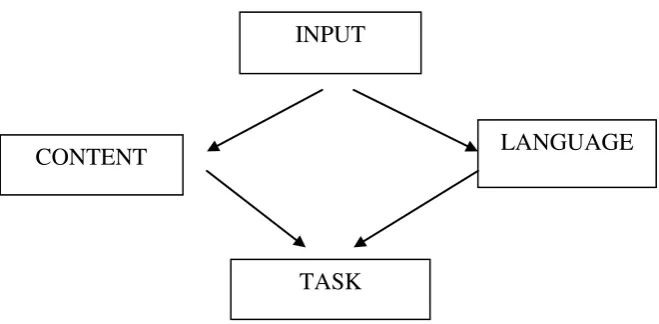
Materials design consists of four elements; input, content focus, language focus, and task (Hutchinson and Waters, 1987:108-109). Each of the elements will be described below:
a. Input
b. Content
Language is not an end in itself, but a means of conveying information and feeling about something. Non-linguistics content should be exploited to generate meaningful communication in the classroom
c. Language
Good materials should involve the opportunities for the analysis and synthesis. In language focus, learners have the chance to take the language to pieces, study how it works and practice putting it back together again. It is unfair to give the learners communicative task and activities for which they do not enough of necessary language knowledge. So, if teachers have an aim to enable learners to use the language, teachers should give students language knowledge that they needs. d. Task
The purpose of language learning is language use. Materials should be designed, therefore, to lead towards a communicative task in which learners use the content and language knowledge they have built up through the unit.
Figure 2 materials design model 1
The language and content are drawn from the input and are selected
according to what learners will need in order to do the task. This model
creates coherence in terms of both language and content throughout the unit.
This provides the support for more complex activities by building up a fund
of knowledge and skills.
e. Materials Evaluation
Hutchinson and Waters say that evaluation is basically a matching process; matching needs to available solution. So, evaluation is needed in the end of the course design to know if the materials design
already fulfill the learners’ needs or suitable for the learners. There are
four evaluation process purposed by Hutchinson and Waters (1987:97) as follow:
INPUT
LANGUAGE
Figure 3 Material evaluation process purposed by Hutchinson and Waters(1987:97)
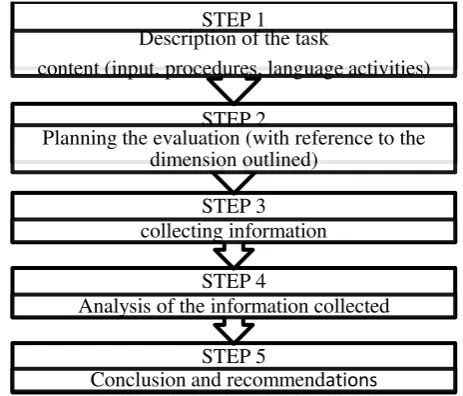
Meanwhile, Tomlinson (1998:227) argue that there are five steps in conducting an evaluation of a task. Those five steps can be seen below:
Figure 4 Steps in conducting an evaluation of task in Tomlinson
(1998:227)
STEP 5
Conclusion and recommendations
STEP 4
Analysis of the information collected STEP 3
collecting information STEP 2
Planning the evaluation (with reference to the dimension outlined)
STEP 1 Description of the task
content (input, procedures, language activities) Define Criteria
On what bases will you judge materials?
Which criteria will be more interesting?
Matching
How far does the material match your need?
Objective Analysis
How does the material being evaluated realize the criteria? Subjective Analysis
[image:48.595.196.428.488.686.2]Step 1: Describing the task
The goal of evaluation is to match learners’ needs to available
solution. Evaluator should be able to know the objective of the task to be evaluated and specify the content of the task.
Step 2: Planning the evaluation
It is important to have a plan of how the task evaluation takes places. Making a plan a task evaluation will give advantages on the choices and the design of task.
Step 3: Collecting information
According to Tomlinson (1998:229), a task evaluation will need to consider collecting three types of information: (1) information about how the task was performed, (2) information about what learning took place as a result of performing the task and (3) information regarding
the teachers’ and learners’ opinions about the task. In addition,
Tomlinson says that information can be collected before the task is used, while the task is being used and on completion of the task.
Step 4: Analyzing the information collected
Step 5: Conclusion and recommendations
Conclusion relate to what has been discovered as a result of the analysis while recommendation concern the proposal for future teaching. Each recommendation should be supported by reverence to relevant conclusion.
6. CLT (Communicative Language Teaching)
Larsen and Freeman (2000:121) state that communicative language teaching aims broadly to apply the theoretical perspective of the communicative approach by making communicative competence of the goal of language teaching and by acknowledging the interdependence of language and communication. Other sources, Richard and Rodger (2002:17) explain that communication language learning is based on the view that language is a vehicle for the expression of functional meaning. It emphasize on the semantics and communicative dimension rather than merely on the grammatical characteristics of language. It focuses on communicative proficiency rather than on mere mastery of language structure.
Communicative Language Teaching makes use of real life situation that necessitates communication. The teacher set up situation that students are likely to encounter in the real life (Galloway: 1993). This statement is
in line with Hariyanto’s view in Sadtono (1997:113) that CLT enables the
There are some differences between activities used in CLT that focus on fluency and those that focus on accuracy. Those Differences can be summarized as follows (Richard .2001: 14):
Activities focusing on fluency
a. Reflect natural use of language b. Focus on achieving communication c. Require meaningful use of language
d. Require the use of communication strategies e. Produce language that may not be predictable f. Seek to link language use to context
Activities focusing on accuracy
a. Reflect classroom use of language
b. Focus on the formation or correct example of language c. Practice language out of context
d. Practice small samples of language
e. Do not require meaningful communication f. Control choice of language
a. The Goal of CLT
Communicative competence includes the following aspects of language knowledge:
1. Knowing how to use language for a range of different purpose and functions
2. Knowing how to vary our use of language according to the setting and the participants (e.g. knowing when to use formal and informal speech or when to use language appropriately for written as opposed to spoken communication)
3. Knowing how to produce and understand different types of texts (e.g. narrative, reports, interviews, conversation)
4. Knowing how to maintain communication despite having
limitation in one’s language knowledge (e.g. through using kinds
of communications strategies)
On the other hand, Larsen and Freeman (2000:128) state that the goal of CLT is to enable the students to communicate in the target language. To do this, the students need the knowledge of linguistics forms, meaning and functions. They need to know that many different forms can be used to perform a function and also that a single form can often serve a variety of function.
b. The principle of CLT
more than the sum of the part, (3) the process are as important as the form, (4) to learn it, to do it and (5) mistakes are not always mistakes.
The first principle is that knowing what one is doing, it means that the focus of every lesson or part of the lesson should be performing of some operation-learning of how to do something. The second principle is that the whole is more than the sum of the parts, it means that the communicative method operates stretches of language above the sentence level, either the real language in the real situation. The third principle is that the processes are important as the form. There are three processes which can be isolated and which can be incorporated either individually or together in teaching procedures, namely information gaps, choices and feedbacks. The forth principle is to learn it, to do it. Education must concern not just on teaching but also on learning. So, what happens in the classroom must involve the learners and must be judges in terms of its effects on them. The last principle is that mistakes not always mistakes, it means that students are learning from the mistakes that they made. Teacher cannot simply blame or punish students that made mistakes. Otherwise, teacher should make the mistake as a learning process for the students.
Meanwhile, Richard (2001: 13) summarized some principles of communicative language teaching as below:
2. Provide opportunities for learners to experiment and try out what they know.
3. Be tolerant of learners’ errors as they indicate that the learner is building up his or her communicative competence.
4. Provide opportunities for learners to develop both accuracy and fluency
5. Link the different skill such as speaking, reading, listening, together, since they usually occur so in the real world
6. Let students induce or discover grammar rules
c. PPP (Presentation, practice, and production)
An approach to CLT which has been widely used in language teaching materials is PPP (Presentation, practice, and production). Willis (1996:134) in www.educationbridge.com stated that normally PPP lesson proceeds like the following:
1. Presentation stage
2. Practice stage
Students repeat target items and practice sentences or the dialogues until they can say them correctly.
3. Production stage
Students are expected to produce in a situation language items they have just learned
In line with Willis, Richard (2006: 33) describes three stages in PPP as follow:
a. Presentation: The new grammar structure is presented, often by means of a conversation or short text. The teachers explain the new structure and checks students’ comprehension of it.
b. Practice: students practice using the new structure in a controlled context through drill and substitution exercises c. Production: students practice using the new structure in
B. Relevant Study
This Research is about developing speaking materials for Xth grade of Hotel Accommodation department. Based on the research’s knowledge there are some previous studies related to developing English speaking materials and for the Hotel Accommodation. Although those research studies are not completely same with this research, those research studies contribute much to this research.
The first relevant research study is Parwaka (2013) who developed English speaking materials for automotive engineering. The next is from Barilan Kristanto (2010) who developing effective learning materials for Hotel Accommodation department. The developed materials on that study cover all skills (reading, writing, listening, speaking). Hence, the researcher in this study is developing English speaking materials for hotel accommodation program.
C. Conceptual Framework
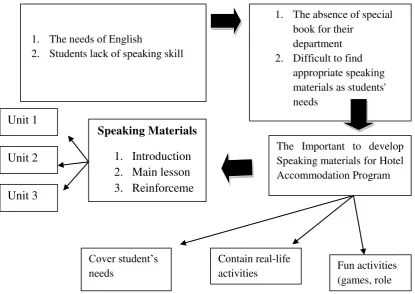
In SMK PI AMBARUKMO 1 Yogyakarta, the speaking English materials for Hotel Accommodation are limited. The English teaching and learning in this department is using general English text book. In addition, the students lack speaking activities. They are rarely practicing speaking which is becomes the most urgent for them.
Figure 2.The diagram of conceptual framework
1. The needs of English
2. Students lack of speaking skill
1. The absence of special book for their
department 2. Difficult to find
appropriate speaking materials as students' needs
The Important to develop Speaking materials for Hotel Accommodation Program Speaking Materials
1. Introduction 2. Main lesson 3. Reinforceme
nt Unit 1
Unit 3
Cover student’s
needs
Contain real-life
43 CHAPTER III
RESEARCH METHOD
A. Research Type
As the purpose of this study is to develop English speaking learning materials for the students of Hotel Accommodation department, hence this research study classified into Research and Development category (R&D). Gall, Borg and Gall (1983:772) defines R&D as a process that can be used to develop and validate the educational product, such as teaching method. Furthermore, Gay (1987:10) defines R&D as an effort to develop effective products that are used in educational program including objectives, teaching materials and so on.
B. Research Setting and Subject
C. Research Instrument
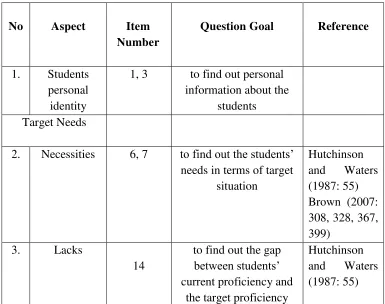
In this research, the instrument used to gain the data was questionnaire. There are two kinds of questionnaire in this research. Those are needs analysis questionnaire and expert judgment questionnaire. The aim of needs analysis questionnaire is to find out the data about the
learners and the learners’ needs. The organization of the first questionnaire
[image:60.612.152.537.386.690.2]is adapted from Hutchinson and Waters (1987) and Nunan (2004). Table 2. The organization of need analysis instrument
No Aspect Item
Number
Question Goal Reference
1. Students personal identity
1, 3 to find out personal information about the
students Target Needs
2. Necessities 6, 7 to find out the students’ needs in terms of target
situation
Hutchinson and Waters (1987: 55) Brown (2007: 308, 328, 367, 399)
3. Lacks
14
to find out the gap
between students’
current proficiency and the target proficiency
The aim of expert judgment questionnaire is to know options and suggestions the materials from the expert of speaking and materials. The questionnaire is adapted from BNSP (Badan Standar Nasional Pendidikan) as follow:
4. Wants 17, 18 to find out the students’ needs based on their
point of view
Hutchinson and Waters (1987: 56) Learning Needs
5.
Goals 2
to find out the reason of learning English
Nunan (2004: 41)
6.
Input 4,5
to find out the input, the topic, and the length of
the text which is ideal for them
Nunan (2004: 47)
7.
Procedures
8,9,10, 11, 12,13
to find out the activities that the students like
most
Nunan (2004: 52)
8.
Setting 15,16
to find out the setting of doing tasks that the
students like most
Nunan (2004: 70)
9.
Teacher’s
Role
19
to find the information about the role that the teacher should perform
Nunan (2004: 64)
10.
Learners’
Role
20 to find the information about the role of the
students
Table 3. The organization of expert judgment questionnaire
Topik Area Source
Appropriateness of the material BSNP
Input for the material BSNP
Content of the material BSNP
Layout of the material BSNP
D. Data collection Techniques
As mentioned before, in this research the researcher use needs analysis and expert judgment questionnaire. Firstly, the need analysis questionnaire
were distributed to analyze the learners’ needs in learning speaking
English. Secondly, expert judgment questionnaire were distributed to the speaking and materials expert. It is done to ask opinion and suggestion about the developed materials. Hence, it is done after designing the speaking materials.
E. Data Analysis Technique
1. The First Questionnaire ( The Need analysis Questionnaire)
The data from the first questionnaire were analyzed by calculating the percentage of each answer on the questionnaire using this following formula:
f : Frequency
N : Total Number of Respondents (100) : Fixed Number
The highest percentage of answers on each question is considered as the tendency of the students related to the condition.
2. The Second Questionnaire (Expert Judgment Questionnaire)
In this second questionnaire, the researcher used descriptive statistic to analyze the data. To obtain the data, the researcher used Likert-Scale. The data of this second questionnaire were obtained by central tendency measure that proposed by Suharto (2006: 52-53). The indicator to measure is mean (x). The mean were calculated as bellow:
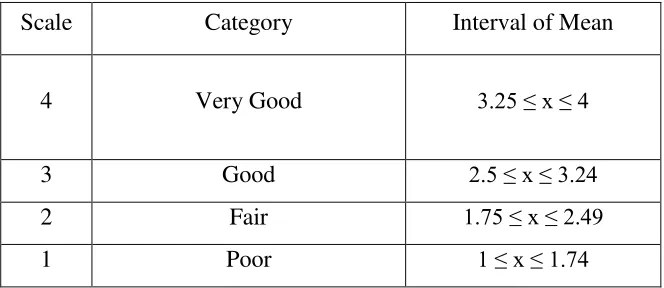
In order to make the quantitative data easier to read, the mean values can be put into category. Suharto (2006:52-53) states that the range with the objected categories as follows:
With R = Range Xh = the highest score
Table 4. Quantitative Data Conversion
Scale Category Interval of Mean
4 Very Good 3.25 ≤ x ≤ 4
3 Good 2.5 ≤ x ≤ 3.24
2 Fair 1.75 ≤ x ≤ 2.49
1 Poor 1 ≤ x ≤ 1.74
F. Research procedure
The research procedure was adapted from Masuhara’s model (in Tomlinson, 1998: 247) which proposed five steps in designing materials. Those steps are need analysis, goals and objectives, syllabus design, methodology or materials, and testing and evaluation. Then, the researcher modified the model as follow:
1. Conducting need analysis
In this step, the researcher conducted need analysis in order to
obtain the data related to the learners’ need.
2. Writing the Course Grid
3. Designing materials or writing the first draft
In this stage, the materials were designed based on the course grid that has been developed. Then the materials are called as first draft. 4. Getting the expert judgments
After the first draft was designed, the materials were consulted to the speaking and materials expert before trying out the materials to the students. The designed materials which have been approve by the expert are called as second draft.
5. Revising and writing the final draft
50 A. Research Finding
1. The Result of Needs analysis
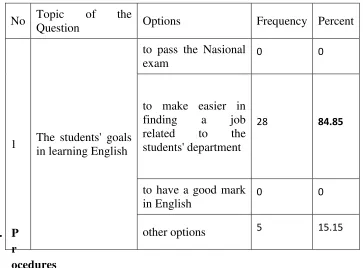
In order to assess the target and learning needs of the students, a needs analysiswas conducted. The questionnaire was distributed to the students during August-October 2015.
a. Description of the students’ Profile
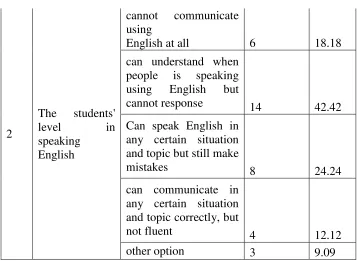
There are two classes of tenth grade in this SMK namely X AP1 and X AP2 with 21 the students in each class.Unfortunately, when the first questionnaire was distributed, there were only17the students in the class XAP1 and 16 the students in the class XAP2The result of the first questionnaire about the students’ profile is described below.
Table 5.The result of the students’ profile
No Topic of the
Question Options Frequency Percent
1
Length of time in learning English
From Elementary
school 17 51.52
From Junior High
School 5 15.15
never 1 3.03
2
The students' level in speaking
English
cannot communicate using
English at all 6 18.18
can understand when people is speaking using English but
cannot response 14 42.42 Can speak English in
any certain situation and topic but still make
mistakes 8 24.24
can communicate in any certain situation and topic correctly, but
not fluent 4 12.12
[image:67.612.180.537.105.366.2]other option 3 9.09
Table 2 shows that 51.52 % of the studentshave already learned English from elementary school. The second highest experiment percentage of learning English is that the studentslearned English from Junior High School or SMP (Sekolah Menengah Pertama).
b. Description of The students’ Needs a. Target Needs
1. Necessities
Necessities are defined as a list of abilities that the students should posses in order to function properly in the target situation (Hutchinson and Waters 1987:5). The following table presents the view about the demand of target situation of X grade of Hotel Accommodation the students’ in SMK PI AMBARUKMO 1 Sleman.
Table 6.The students’ view of necessities
No Topic of the
Question Options Frequency Percent
1
Topic needed in in learning English speaking
Topic related to
daily life 10 30.30
Topic related to
Hotel 12 36.36
Topic related to
school 1 3.03
Topic related to
tourism 4 12.12
Other option 7
21.21
2
After graduate, the students will use English
speaking skill in….
in the
workplace
14 42.42
in the
university
9 27.27
Daily life 3 9.09
other option 8 24.24
36.36% of the students needed topic related to the Hotel. It shows that the students have been aware about the importanceof materialstopic related to their departments. The relevant topic would help the students in later in their profession. It is in line with the research statement that the students should have topic related to their department. The second highest percentage of topic needed for the students is topic related to daily life. For next question, it was about place where the students will use English ability much. As many 42.42% of the students thought that they will use English very often in the work place. Hence, it is clear that they need appropriate materials which usually usedin their future workplace related to their department.
2. Lacks
The gap between the students’ existing knowledge and agreed objectives they have to achieve refers to lack (Hutchinson & Waters, 1987). The students’ view about their lacks is shown in the following table.
Table 7 .The students’ view of the students lacks
No Topic of the
Question Options Frequency Percent 1
Main difficulties when learning English speaking
Vocabularies 12 36.
36
42
Grammar 8 24.
24 Do not know
how to use the proper
expression in a certain situation
2 6.0
6
other option
1 3.0
3
The table above shows about the main difficulties of learning English. Most of the students found that their main difficulty in learning English is about pronunciation. Then, 36.36% the students found that vocabulary becomes an obstacle in speaking English.
3. Wants
The students’ view about their needs refers to wants (Hutchinson and Waters, 1987:56). The table below explains about the result ofthe students want in learning English speaking activity.
Table 8.Target needs (the students’ wants)
No Topic of the
Question Options Frequency Percent
1
Narrator that the students want for listening activities
children 0 0
Adult 15 45.45
mature
17 51.52
other option
1 3.03
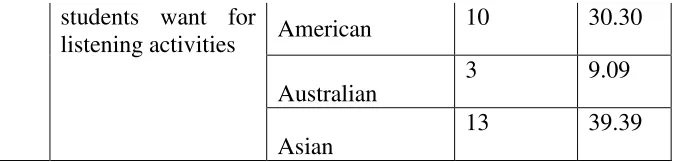
The table tells us that 51.52% of the studentswant to have mature people in delivering the listening input. Meanwhile, 13 the students wanted to have Asian accent as the input of listening. In addition, 10 the studentswant to have American accent as the input of listening.
b. Learning Needs
Learning needs are the knowledge and abilities that learners will require in order to be able to perform to the required degree of competence in the target situation. Learning needsare related to input, procedures, setting, learner’s role, and teacher’s role.
1. Input
[image:71.612.166.508.112.193.2]Input refers to what sources they have to get in learning English, so that they are able to learn English and to achieve the intended objectives. The table below is the result of speaking input that the students want in learning English speaking.
Table 9. Learning need (speaking input)
No Topic of the
Question Options Frequency Percent students want for
listening activities American
10 30.30
Australian
3 9.09
Asian
1
Materials that the students
want to
practice English speaking
Dialog 21 63.64
Monolog 4 12.12
Vocabularies list 9 27.27
Picture 10 30.30
Article 5 15.15
story texts 19 57.58
2
the length of materials that the students
want to
practice English speaking
less than 150 words/less than 2 minutes
minutes/less than 5 vocabularies list/less than 2 pictures
9 27.27
150-200 words/2-3 minutes/
5 vocabularies list/2-3 pictures
11 33.33