ABSTRACT
Kusuma, Leo Bayu. (2014). A Study of Leetspeak among Young Hispanic Americans in MocoSpace Mobile Social Network. Yogyakarta: English Language Education Study Program, Sanata Dharma University.
The rapid development of internet worldwide has brought impact to the emergence of social networking sites, including Facebook, Twitter, Myspace, etc. There is also a small social networking site called MocoSpace, which targets the mobile users. Some users of MocoSpace mobile network are literate in newly-popularised internet language called Leetspeak, which is actually a secret-code language used mostly by hackers worldwide. In Indonesia, Leetspeak also exists and is known as Bahasa Alay, which has developed since 2007. In the United Staes, this phenomenon coexists with the influence of Hispanic population in the United States, who are also found among the users of the mobile network. This study focused on the use of Leetspeak among young Hispanic Americans and the influence of Hispanic background to the language in MocoSpace mobile network.
This study discussed three main problems. The first one was how young Hispanic Americans in MocoSpace mobile network use Leetspeak. The second one was the characteristics of Leetspeak used by young Hispanic American users. The third one was the influence of Spanish to the Leetspeak used by young Hispanic American users. The researcher functioned as the primary agent to collect the data by creating an account in the mobile network. Document
instruments in this study were contents on the users’ profile pages.
This research was mixed-methods. To answer the first problem, the data compiled from 200 profile pages of the Hispanic users were sorted out and classified according to the presence of Leetspeak. After that, the sorted data were
analysed and categorised according to Jakobson’s six functions of language, i.e.
referential, expressive, conative, poetic, phatic, and metalingual. To answer the second problem, the data were examined in order to find its characteristic, which includes the orthography and morphology of Leetspeak. To answer the third problem, the data were again sorted out according to the presence of Leetspeak-English and Leetspeak-Leetspeak-English-Spanish code-switching.
From the study, three conclusions can be drawn. First, Leetspeak contained the six functions of language described by Jakobson. Although the nature of Leetspeak functioned as multilingual, it was mutually intelligible among the users, and mostly functioned as referential. Second, Leetspeak had unique orthography based on similar-looking characters and morphology that was different from the base language. Third, even though the users were mostly Hispanic descendants, Spanish brought minor influence to the use of Leetspeak in form of code-switching.
ABSTRAK
Kusuma, Leo Bayu. (2014). A Study of Leetspeak among Young Hispanic Americans in MocoSpace Mobile Social Network. Yogyakarta: English Language Education Study Program, Sanata Dharma University.
Perkembangan pesat internet di seluruh dunia telah membawa pengaruh pada kemunculan situs-situs jejaring sosial, termasuk Facebook, Twitter, Myspace, dll. Terdapat juga laman jejaring sosial yang bernama MocoSpace, yang menyasar pengguna telepon seluler. Beberapa pengguna jaringan seluler MocoSpace juga berkomunikasi dengan Leetspeak, bahasa internet yang digunakan para peretas jaringan sebagai kode rahasia mereka. Di Indonesia, Leetspeak juga dikenal dengan Bahasa Alay yang telah berkembang sejak 2007. Di Amerika Serikat, fenomena ini berdampingan dengan pengaruh dari populasi Hispanik, yang juga merupakan bagian dari jaringan sosial ini. Studi ini difokuskan pada penggunaan Leetspeak pada kaum muda Hispanik Amerika dan pengaruh latar belakang Hispanik mereka terhadap Leetspeak di MocoSpace.
Studi ini membahas tiga permasalahan utama. Yang pertama adalah bagaimana kaum muda Hispanik Amerika di MocoSpace menggunakan Leetspeak. Yang kedua adalah karakteristik dari Leetspeak yang digunakan oleh kaum muda Hispanik Amerika. Yang ketiga adalah pengaruh Bahasa Spanyol terhadap Leetspeak yang mereka gunakan. Peneliti berfungsi sebagai agen utama dalam mengumpulkan data dengan cara menjadi anggota dalam laman tersebut. Instrumen dokumen dalam studi ini berupa isi dari halaman profil pengguna.
Penelitian ini adalah penelitian campuran (mixed-methods). Untuk menjawab permasalahan pertama, data yang terkumpul dari 200 halaman profil pengguna Hispanik dipisahkan dan digolongkan menurut ada tidaknya Leetspeak. Kemudian, data yang telah dipisahkan dianalisis dan dikategorikan sesuai dengan teori fungsi bahasa menurut Jakobson, yaitu referential, expressive, conative, poetic, phatic, dan metalingual. Untuk menjawab permasalahan kedua, data tersebut diperiksa untuk menemukan karakteristik dari Leetspeak, meliputi ortografi dan morfologinya. Untuk menjawab pertanyaan ketiga, data tersebut dipisahkan lagi menurut ada tidaknya alih-bahasa Leetspeak dan Bahasa Inggris serta Leetspeak, Bahasa Inggris, dan Bahasa Spanyol.
Dari penelitian ini, diperoleh tiga kesimpulan. Pertama, Leetspeak mengandung enam fungsi bahasa yang digambarkan oleh Jakobson. Meskipun pada dasarnya Leetspeak berfungsi sebagai multilingual, bahasa ini dapat dimengerti di antara penggunanya, dan kebanyakan berfungsi sebagai referential. Kedua, Leetspeak memiliki ortografi unik yang didasarkan pada karakter yang kelihatan mirip dan morfologi yang berbeda dengan bahasa asalnya. Ketiga, meskipun pengguna yang diteliti adalah keturunan Hispanik, Bahasa Spanyol membawa sedikit pengaruh pada penggunaan Leetspeak dalam bentuk code-switching.
Kata Kunci: Language Variation, Morphology, Leetspeak, Internet language,
A STUDY OF LEETSPEAK
AMONG YOUNG HISPANIC AMERICANS
IN MOCOSPACE MOBILE SOCIAL NETWORK
A SARJANA PENDIDIKAN THESIS
Presented as Partial Fulfillment of the Requirements to Obtain the Sarjana Pendidikan Degree
in English Language Education
By
Leo Bayu Kusuma Student Number: 081214111
ENGLISH LANGUAGE EDUCATION STUDY PROGRAM DEPARTMENT OF LANGUAGE AND ARTS EDUCATION
FACULTY OF TEACHERS TRAINING AND EDUCATION SANATA DHARMA UNIVERSITY
i
A STUDY OF LEETSPEAK
AMONG YOUNG HISPANIC AMERICANS
IN MOCOSPACE MOBILE SOCIAL NETWORK
A SARJANA PENDIDIKAN THESIS
Presented as Partial Fulfillment of the Requirements to Obtain the Sarjana Pendidikan Degree
in English Language Education
By
Leo Bayu Kusuma Student Number: 081214111
ENGLISH LANGUAGE EDUCATION STUDY PROGRAM DEPARTMENT OF LANGUAGE AND ARTS EDUCATION
FACULTY OF TEACHERS TRAINING AND EDUCATION SANATA DHARMA UNIVERSITY
vi
ABSTRACT
Kusuma, Leo Bayu. (2014). A Study of Leetspeak among Young Hispanic Americans in MocoSpace Mobile Social Network. Yogyakarta: English Language Education Study Program, Sanata Dharma University.
The rapid development of internet worldwide has brought impact to the emergence of social networking sites, including Facebook, Twitter, Myspace, etc. There is also a small social networking site called MocoSpace, which targets the mobile users. Some users of MocoSpace mobile network are literate in newly-popularised internet language called Leetspeak, which is actually a secret-code language used mostly by hackers worldwide. In Indonesia, Leetspeak also exists and is known as Bahasa Alay, which has developed since 2007. In the United Staes, this phenomenon coexists with the influence of Hispanic population in the United States, who are also found among the users of the mobile network. This study focused on the use of Leetspeak among young Hispanic Americans and the influence of Hispanic background to the language in MocoSpace mobile network.
This study discussed three main problems. The first one was how young Hispanic Americans in MocoSpace mobile network use Leetspeak. The second one was the characteristics of Leetspeak used by young Hispanic American users. The third one was the influence of Spanish to the Leetspeak used by young Hispanic American users. The researcher functioned as the primary agent to collect the data by creating an account in the mobile network. Document
instruments in this study were contents on the users’ profile pages.
This research was mixed-methods. To answer the first problem, the data compiled from 200 profile pages of the Hispanic users were sorted out and classified according to the presence of Leetspeak. After that, the sorted data were
analysed and categorised according to Jakobson’s six functions of language, i.e.
referential, expressive, conative, poetic, phatic, and metalingual. To answer the second problem, the data were examined in order to find its characteristic, which includes the orthography and morphology of Leetspeak. To answer the third problem, the data were again sorted out according to the presence of Leetspeak-English and Leetspeak-Leetspeak-English-Spanish code-switching.
From the study, three conclusions can be drawn. First, Leetspeak contained the six functions of language described by Jakobson. Although the nature of Leetspeak functioned as multilingual, it was mutually intelligible among the users, and mostly functioned as referential. Second, Leetspeak had unique orthography based on similar-looking characters and morphology that was different from the base language. Third, even though the users were mostly Hispanic descendants, Spanish brought minor influence to the use of Leetspeak in form of code-switching.
vii
ABSTRAK
Kusuma, Leo Bayu. (2014). A Study of Leetspeak among Young Hispanic Americans in MocoSpace Mobile Social Network. Yogyakarta: English Language Education Study Program, Sanata Dharma University.
Perkembangan pesat internet di seluruh dunia telah membawa pengaruh pada kemunculan situs-situs jejaring sosial, termasuk Facebook, Twitter, Myspace, dll. Terdapat juga laman jejaring sosial yang bernama MocoSpace, yang menyasar pengguna telepon seluler. Beberapa pengguna jaringan seluler MocoSpace juga berkomunikasi dengan Leetspeak, bahasa internet yang digunakan para peretas jaringan sebagai kode rahasia mereka. Di Indonesia, Leetspeak juga dikenal dengan Bahasa Alay yang telah berkembang sejak 2007. Di Amerika Serikat, fenomena ini berdampingan dengan pengaruh dari populasi Hispanik, yang juga merupakan bagian dari jaringan sosial ini. Studi ini difokuskan pada penggunaan Leetspeak pada kaum muda Hispanik Amerika dan pengaruh latar belakang Hispanik mereka terhadap Leetspeak di MocoSpace.
Studi ini membahas tiga permasalahan utama. Yang pertama adalah bagaimana kaum muda Hispanik Amerika di MocoSpace menggunakan Leetspeak. Yang kedua adalah karakteristik dari Leetspeak yang digunakan oleh kaum muda Hispanik Amerika. Yang ketiga adalah pengaruh Bahasa Spanyol terhadap Leetspeak yang mereka gunakan. Peneliti berfungsi sebagai agen utama dalam mengumpulkan data dengan cara menjadi anggota dalam laman tersebut. Instrumen dokumen dalam studi ini berupa isi dari halaman profil pengguna.
Penelitian ini adalah penelitian campuran (mixed-methods). Untuk menjawab permasalahan pertama, data yang terkumpul dari 200 halaman profil pengguna Hispanik dipisahkan dan digolongkan menurut ada tidaknya Leetspeak. Kemudian, data yang telah dipisahkan dianalisis dan dikategorikan sesuai dengan teori fungsi bahasa menurut Jakobson, yaitu referential, expressive, conative, poetic, phatic, dan metalingual. Untuk menjawab permasalahan kedua, data tersebut diperiksa untuk menemukan karakteristik dari Leetspeak, meliputi ortografi dan morfologinya. Untuk menjawab pertanyaan ketiga, data tersebut dipisahkan lagi menurut ada tidaknya alih-bahasa Leetspeak dan Bahasa Inggris serta Leetspeak, Bahasa Inggris, dan Bahasa Spanyol.
Dari penelitian ini, diperoleh tiga kesimpulan. Pertama, Leetspeak mengandung enam fungsi bahasa yang digambarkan oleh Jakobson. Meskipun pada dasarnya Leetspeak berfungsi sebagai multilingual, bahasa ini dapat dimengerti di antara penggunanya, dan kebanyakan berfungsi sebagai referential. Kedua, Leetspeak memiliki ortografi unik yang didasarkan pada karakter yang kelihatan mirip dan morfologi yang berbeda dengan bahasa asalnya. Ketiga, meskipun pengguna yang diteliti adalah keturunan Hispanik, Bahasa Spanyol membawa sedikit pengaruh pada penggunaan Leetspeak dalam bentuk code-switching.
Kata Kunci: Language Variation, Morphology, Leetspeak, Internet language,
viii
ACKNOWLEDGEMENTS
The completion of this thesis has been made possible by the support and
courage of The Almighty, my advisor, lecturers, family, and friends. Firstly, I
would like to send my genuine gratitude to my advisor, Carla Sih Prabandari, S.Pd., M.Hum. for her guidance, constructive feedback, helpful suggestions,
encouragement, and support in my difficult time. I would also like to thank my
lecturers at Sanata Dharma University whose teachings have enriched my
knowledge and thus have facilitated me to complete this study.
My most genuine gratitude also goes to my parents, Leo Unda Krismowo, S.Pd, and Lusia Endang Yulita Sakti for their great love, attention,
and financial support. I would also like to thank my sister Christina Anggita for
her encouragement and support.
Finally, I deliver my best thanks to my girlfriend, my friends of English
Language Study Programme, my workmates at Realia Language and Culture
Center, my travel mates, and all of my friends anywhere.
ix
TABLE OF CONTENTS
Page
TITLE PAGE ... i
PAGE OF APPROVAL ... ii
PAGE OF ACCEPTANCE ... iii
STATEMENT OF WORK’S ORIGINALITY ... iv
PERNYATAAN PERSETUJUAN PUBLIKASI ... v
ABSTRACT ... vi
LIST OF APPENDICES ... xii
LIST OF ABBREVIATIONS ... xiii
CHAPTER 1 INTRODUCTION ... 1
1.1. Research Background ... 1
1.2. Research Problems ... 8
1.3. Problem Limitation ... 8
1.4. Research Objectives ... 8
1.5. Research Benefits ... 9
1.6. Definition of Terms ... 9
CHAPTER 2 REVIEW OF RELATED LITERATURE ... 12
2.1. Theoretical Description ... 12
2.1.1. Word Formation ... 12
2.1.2. Functions of Language ... 15
x
2.1.4. Code-Switching... 18
2.1.5. Internet Linguistics... 20
2.2. Theoretical Framework ... 25
CHAPTER 3 METHODOLOGY ... 27
3.1. Research Method... 27
3.2. Research Setting ... 28
3.3. Research Subjects ... 28
3.4. Instruments ... 30
3.5. Research Procedure ... 31
CHAPTER 4 RESEARCH FINDINGS AND DISCUSSIONS ... 40
4.1. The Use of Leetspeak among Young Hispanic Americans in MocoSpace Mobile Network ... 42
4.2. Characteristics of Leetspeak Used by Young Hispanic Americans in MocoSpace Mobile Network ... 51
4.3. The Influence of Spanish in Leetspeak ... 65
CHAPTER 5 CONCLUSIONS, RECOMMENDATIONS, AND IMPLICATIONS ... 74
5.1. Conclusions... 74
5.2. Recommendations ... 75
5.3. Implications ... 76
REFERENCES ... 78
xi
LIST OF TABLES
3.1.Checklist of Function of Language and Code-Switching ... 34
3.2.Table of distribution of the selected users ... 37
3.3.Table of the functions of Leetspeak ... 37
3.4.Table of Leetspeak writing system ... 38
3.5.Table of the languages used in writing Leetspeak ... 39
4.1.Distribution of the selected users according to the state where they resided .. 41
4.2.Hispanic population percentage of the states where selected users resided.. .. 42
4.3.Functions of Leetspeak Used by Young Hispanic Americans in MocoSpace 43 4.4.Greetings in Leetspeak ... 48
4.5.Summary of Leetspeak Writing System ... 51
4.6.Numbers used in Leetspeak to replace letters ... 53
4.7.ASCII characters in Leetspeak ... 55
4.8.Specific terminology found in Leetspeak... 61
xii
LIST OF FIGURES
2.1.Latinate letters in Leetspeak ... 24 3.1.Venn Diagram showing the Code-Switching of English, Spanish and
xiii
LIST OF ABBREVIATIONS
ASCII : American Standard Code for Information Interchange
E : Standard English only
EL : Standard English and Leetspeak code-switching
ESL : Standard English, Standard Spanish, and Leetspeak
code-switching
ID : Identity
Le : Leetspeak with English as the base language
Les : Leetspeak with English-Spanish code-switching as the base
language
Ls : Leetspeak with Spanish as the base language
Lx : Leetspeak only
MCIT : Ministry of Communication and Information Technology of
Republic of Indonesia
S : Standard Spanish only
SL : Standard Spanish and Leetspeak code-switching
1
CHAPTER 1
INTRODUCTION
This chapter is an introductory part of the thesis. It provides the readers
with the research background, problems formulation, problems limitation,
research objectives, research benefits, and definition of terms. Research
background will mainly discuss the reason of the researcher chooses the topic.
Problems formulation focuses on the problems formulated and discussed through
the study. Problems limitation will limit the scope of the discussion of the study.
Research objectives describe the purposes of the study. Research benefits give the
readers information on the benefits of the conducted study to future researchers
and the readers. Finally, the definition of terms will give the readers information
of the related terms discussed through the study.
1.1. Research Background
In this part, the researcher would like to give the background why the
study is conducted. This part includes the development of communication, mobile
network and MocoSpace mobile network, demography of the United States and
Hispanics in the United States, and finally language used in the internet.
1.1.1. Development of Communication
Technology has been developing rapidly nowadays. This rapid
development has affected many aspects in life. Innovation after innovation has
resulted from the development of technology has improved the society and the
advanced technology, computer has played role in advancing the way of life of the
society. Computer, which has been developed in the middle of the 20th century,
has led to the advancement of humans‟ lives in many aspects, including education,
communication, etc. As an expansion of the development of computer, the
Internet has developed in such a sophisticated way that we barely draw how 30%
of the world‟s population, which is about two billions, are connected in one
network named internetwork, or popularly the Internet (World Internet Usage
Statistics, 2011).
1.1.1.1. Social Networking Sites (SNS)
As the Internet develops, it causes significant changes to the way how
people communicate. Telecommunication, which is a technology that makes
communication among people in such a huge distance closer without the presence
of a messenger (Huurdeman, 2003), has now developed rapidly. The Internet,
which is the latest telecommunication media succeeding telegraph, telephone,
radio, and television, has created a way where people with the same interest, as in
the real life, can move their social life into the virtual one. This is what is called
social networking sites (SNS) where people would connect to a site, or service,
providing them features to get connected with people virtually under certain
system administered by the site (Boyd & Ellison, 2007). There are many social
networking sites found in the Internet. Some SNSs are aimed at certain people,
some have broader market.
With more than one billion users, currently Facebook is the most
3
in 2004 by Mark Zuckerberg offers the registered users a personal page for them
to share their feelings, activities, photos, etc. This has created an on-line
community around the world. The purposes of the users creating Facebook also
vary, i.e. social networking, sales, political campaign, etc. Facebook has also gone
mobile, in which the users can still access their accounts even though they are not
in touch with their personal computer. Other SNSs, such as Myspace, Friendster,
and MocoSpace, have also played a role in creating an on-line community.
In Indonesia, internet has also played significant rule on the development
of communication and at the same time it has been rapidly growing. According to
the Indonesian Ministry of Communication and Information Technology (MCIT)
(2013), the internet users in Indonesia has reached 63 million users, which is
slightly more than a quarter of the total Indonesian population. It is also reported
that 95% of the users utilised internet to access social networking sites. Indonesia
is also included in the top-five users of Facebook and Twitter, which is placed
fourth and fifth worldwide respectively.
1.1.1.2. Mobile Internet
Technology of communication has tried to combine previously existed
technologies into one in order to maximise their usefulness. Television combines
previously muted flicks into ones with sounds. The same thing happens to
telephone. Telephone in Bell‟s era was much simpler in features, but was
incompact in terms of physical appearance. However, now telephone has become
mobile, hence it is called mobile phone, or cellular phone, which is featured with
After succeeding the commercialisation of the Internet in the personal
computer world in the 1990s, the Internet has started to play in the mobile area as
telephones are getting more and more advanced. The attempt of a Finnish
telecommunication corporation Nokia to launch a mobile phone that was able to
connect to the Internet has caused telecommunication providers, such as NTT
DoCoMo from Japan, to endorse the development of full mobile internet (NTT
Docomo, 2012). Along with the development of mobile internet, companies seek
ways to get involved in the technology. Social networking sites have also gone
mobile. MocoSpace is an example of SNS that aims on mobile users, yet can be
accessed through personal computer as well.
Being one of the top-five users of Facebook and Twitter worldwide,
mobile internet in Indonesia has also played significant role. According to
Webershandwick, a communication provider, which was cited by the Indonesian
MCIT (2013), there were 55 million Facebook users in Indonesia who actively
accessed their accounts by utilising mobile devices per month, and there were 28
million users who actively accessed it on a daily basis.
1.1.2. MocoSpace Mobile Social Network
As a social networking site, Mocospace provides a „space‟ for the Internet
users to connect through the Internet, either by mobile phone or personal
computer. There are some features offered by the website for the users of
Mocospace including photo and video sharing, instant messaging, and games that
can be accessed both by personal computer or mobile phone, either by mobile
5
Android‟s Playstore. The JNJ Mobile, Inc., the share owner of Mocospace, stated
in their website that the aim of the creation of Mocospace is “to be the best place to find friends, play games and stay connected on your mobile phone”. The
founders of Mocospace, Justin Siegel and Jamie Hall, saw that the young
generation are now mobile and they still need to connect with their friends. Thus,
they found that the three emerging trends, which include the mobile web, social
networking and mobile advertising, as their reason to start with Mocospace.
Founded in 2005, Mocospace has now accommodated over 20 million registered
users around the world (JNJ Mobile, 2011). MocoNews reported that most of the
registered users reside in the United States, and classified as young people.
MocoSpace lists nine ethnicities for the users to choose: African American
(black), Asian, Caucasian (white), East Indian, Latino/Hispanic, Middle Eastern,
Native American, Pacific Islander, and other races not listed above. According to
MocoSpace, 31% of 40,000 gamers chosen as respondents by MocoSpace are
Hispanic. It means that the Hispanic users of MocoSpace is significant that JNJ
Mobile, Inc. launched MocoSpace Latino in 2009 (JNJ Mobile, 2009) as an
answer of the increasing numbers of Hispanic users who speak Spanish.
MocoSpace is not a popular mobile social network in Indonesia. However,
there are several users who admit that they reside in Indonesia.
1.1.3. Demography of the United States and Hispanics in the United States
The United States is one of the nations in the world with high diversity of
ethnic groups, with complexity of racial make-ups. According to the United States
in all of its 50 states, District of Columbia, Puerto Rico, and other dependent
territories. The government classify the ethnicities into seven ethnic groups,
American Indian and Alaska Native, Asian, Black or African American, Native
Hawaiian and Pacific Islanders, White, Some Other Race, and Two or more races
(United States Census Bureau, 2010). However, Latino or Hispanic is not
categorised as a race by the government. Therefore, the term Hispanic or Latino
can be applied to the ethnic groups mentioned above.
The history of Hispanic Americans began with the Mexican-American
War in the 19th century with the victory of the United States. This has resulted
large part of Mexico with significant Mexican population seized by the United
States (Bergad & Klein, 2010). The migration of Hispanics population has
continuously increased since then, constitutes 16% of the national population.
Previously, Hispanic Americans were concentrated in the southwestern states,
Florida, and New York, now every state has significant number of Hispanic
population.
1.1.4. Internet Language and Leetspeak
The development of the Internet has influenced how the users use the
language. Crystal (2006) coins a term for internet language, Netspeak. Netspeak
itself covers any languages spoken in the Internet. The Internet users would likely
to have different ways to use their language in the Internet. Languages and styles
used in e-mail might be different compared to those used in instant messaging,
and so are those used in chat groups or blogs. The hackers, for instance, use codes
7
meaning conveyed behind certain word or sentences, which is called Leetspeak
(Ferrante & Ferrante, 2008).
While it is known as Leetspeak worldwide, there are various names to
refer to internet slangs similar to Leetspeak, including Bahasa Alay in Indonesia. According to an article in The Jakarta Post (2009), this language emerged in Indonesia around 2007 along with the development of social networking site.
While there is no convention in Indonesian society whether this language is
acceptable or not, the language has also developed rapidly.
Leetspeak and its regional variations show distinct morphological features
compared to usual writing system as it does not obey any writing rule system.
Although this Leetspeak is primarily used by hackers, some of the users of
MocoSpace would use leetspeak in writing what they want to put on their profile.
MocoSpace users who use Leetspeak as their Netspeak would employ alphabets,
numbers, and any other writing symbols to form morphologically distinctive
words. Hispanics who speak Spanish would also write Leetspeak in Spanish, or
mix both English and Spanish.
The researcher previously owned an account on MocoSpace mobile
network in which he could communicate to other MocoSpaceusers who resided in
the United States. The researcher observed that several users would employ
Leetspeak in writing their profiles, comments, and/or instant messaging. The
researcher also found out that some users who classified themselves as
Hispanic/Latino would use Spanish in their English. The combination of
of the researcher interacted in that SNS. The researcher saw that Leetspeak is a
new phenomenon in language variation. Therefore, from of the rationales above,
the writer conducted a research to investigate how Hispanics users of MocoSpace
made up words in the form of leetspeak from what they wrote in their profiles.
1.2. Research Problems
Based on the background explained, the writer would like to formulate the
problems to discuss in this research, i.e.:
1. How do young Hispanic Americans use Leetspeak in MocoSpace?
2. What are the characteristics of Leetspeak used by young Hispanic Americans
in MocoSpace?
3. How does Spanish influence the Leetspeak used by young Hispanic
Americans in MocoSpace?
1.3. Problem Limitation
The writer would like to limit this research from certain aspects of
linguistics, which includes the morphology and syntax of Leetspeak, and also the
social aspects of language used by young Hispanic Americans. The writer also
limits the study in MocoSpace mobile network only.
1.4. Research Objectives
The aim of this research is to answer three problem formulations proposed
9
1. To find out how young Hispanic Americans use Leetspeak in MocoSpace.
2. To find out the characteristics of Leetspeak used by young Hispanic
Americans in MocoSpace.
3. To see how Spanish influences the Leetspeak used by young Hispanic
Americans in MocoSpace.
1.5. Research Benefits
The researcher expects that the study conducted would not only be a thesis
report but also be beneficial for future researchers and linguistics students.
Hopefully, this study would not end up here. Instead, the study would be a basic
reference to conduct further researches.
It is expected that this study would be useful for future researchers who are
going to study the Internet language in the relation of Hispanic Americans. This
study is only a part of study about language variation among Hispanic population
of the United States. Leetspeak is also only a part of Netspeak, which would have
more areas to study. This study can be a reference to those conducting research in
the same field. For linguistic students, the researcher hopes that this study would
be beneficial in obtaining more references in language variation as this study
provides linguistic students with examples of newly-formed English used in the
Internet among Hispanic population of the United States.
1.6. Definition of Terms
There are some terms used in this study. To help avoiding any
1.6.1. Leetspeak
Leetspeak, or Leet, is “a text-based communication method primarily used
on the Internet which uses combinations of ASCII characters to replace traditional
western style Latin letters” (Sampat as cited in McQuade, et al., 2009). Leetspeak
is mainly used by hackers as a code among them so that leetspeak illiterate would
not convey the meaning of words hidden in leetspeak. This Leetspeak is also
applied in MocoSpace by several users. The example of Leetspeak is “l33t” for
leet. Sampat described that Leetspeak comes from the word leet, which is the shortened form of eleet. Eleet itself comes from the word elite, which refers to the elite computer users (Ferrante&Ferrante, 2008). Leetspeak itself is becoming
more popular among young people to hide the meaning of what they are writing
from the Leetspeak illiterate (Zelkowitz, 2008).
1.6.2. Young Hispanic Americans
In the United States, the term Hispanic does not belong to a racial group
grouped as Hispanic. In fact the term Hispanic refers to several ethnic groups
listed in the United States Census Bureau (Bergad & Klein, 2010). Rodriguez
(1997) stated that Hispanic is an ethnic category, in which any racial groups
acknowledged by the government can be included in the category; hence, there
would be Black Hispanic, White Hispanic, etc.
As this paper would mainly discuss about the use of leetspeak among
young Hispanic Americans in MocoSpace, the writer would like to define young
11
who claim themselves as Hispanic by stating their ethnicity as Latino/Hispanic in
their profile.
1.6.3. Mobile Social Network
Mobile social network is a social networking site (SNS) that is based
on mobile phone (Mansfield, 2012). Mobile social network connects people
virtually through internet, and can be accessed from a mobile phone that supports
internet connection.
1.6.4. MocoSpace
MocoSpace is a mobile social network launched in 2005 by
co-founders Jamie Hall and Justin Siegel with the website www.mocospace.com.
MocoSpace is an example of social networking site that can be accessed by
personal computers (PC) or mobile phones supporting internet connection either
by mobile internet browser or downloadable application from AppStore or
12
CHAPTER 2
REVIEW OF RELATED LITERATURE
This chapter consists of two main sections: theoretical description and
theoretical framework. Theoretical framework focuses on the theories applied in the
research, which include theory of language change, theory of language choice, theory
of code-switching, and theory of internet language – which focuses on Leetspeak.
Theoritical framework focuses on the summary of the theories that becomes the basis
for relating the theories with the study.
2.1. Theoritical Description
In this part of the study, the researcher would like to discuss the related
theories which include theory of language change, theory of language choice, theory
of code-switching, and theory of internet language – which focuses on Leetspeak.
2.1.1. Word Formation
Word can be formed by morphological phenomena which could change the
meaning of a word. Fromkin, Rodman, and Hyams (2003) mention some types of
word coinage such as compounds, acronyms, backformations, abbreviations, word
from names, and blends. These words can be obtained from derivational processes
13
2.1.1.1. Derivation
Affixation, a process of adding affixes, results in the formation of new words
with different category compared to the base (O‟Grady, et al. 2010), which is
common in English. A word that is derived would be stored in dictionary as a lexicon
item. Affixes are the nuclei of derivation, as affixes change either the meaning or
speech category of each base to be derived. There are some affixes in both English
and Spanish that would make up words. O‟Grady, et al. (2010) also state that words
can be derived without adding affixes, or without showing any changes, which is
called zero derivation or conversion, as a word‟s category is converted into another
one without any changes.
2.1.1.2. Inflection
Inflection is a process of attaching affixes to the base (O‟Grady, et al., 2010).
This process, unlike derivation, will not derive the category of the inflected words.
2.1.1.3. Compounding
Compounding is a process of combining two or more words to form another
new word (Fromkin, et al. 2003). The newly-formed word can be formed from
different figures of speech, i.e. adjective, noun, or verb, for example bittersweet,
poorhouse, whitewash, headstrong, homework, spoonfeed, pickpocket, and sleepwalk. According to O‟Grady, et al. (2010), compounding is “a common technique
new lexical item. The result of this process is in the form of adjective, noun, or verb,
with few exceptions, such as into and onto.
Compounding is not merely two or more words in which the meaning is able
to be literally guessed from the meaning of both already existent words. Compounds
can be literal and idiomatic, or O‟Grady et al. (2010) describe as endocentric and
exocentric compounds respectively.
Crystal (2006) has written in his book conversations that happen frequently in
the internet. From those conversations, it is quite easy to point out some
compounding used in the internet. It is easy to understand that (1) „download‟ comes
from „down‟ and „load‟, which becomes a new word with new meaning. So does „off‟
when it is combined with „line‟ to become „offline‟; the compounding creates a new
word with new meaning.
(1) It‟s my turn to download now. (2) Let‟s go offline for a few minutes.
2.1.1.4. Cliticization
Cliticization is a process of word formation where a morpheme is attached to
the host and becomes phonologically united (O‟Grady et al., 2010). English has this
process, as showed in the formation of I’m which comes from I and am, in which am
15
2.1.1.5. Clipping
Sometimes language speakers may shorten longer words in their language and
create shorter words without changing the meaning. This process of word formation
is called clipping (O‟Grady, et al., 2010). The example that can be found easily in the
internet is blog. Blog actually comes from web log, which is a log-based personal website.
2.1.1.6. Acronyms and Initalisms
O‟Grady, et al. (2010) describe acronyms as a process of making up word-like
lexeme by taking some or all initial letters of each word to be formed. Acronyms are
different from initialisms on how they are pronounced. While acronyms are
pronounced as words, as in UNESCO (United Nations Educational, Scientific and
Cultural Organization), initalisms would go for letters, as in USA (United States of
America). However, O‟Grady, et al, also give a case in the combination of acronyms
and initialisms, such as CD-ROM (compact disc – read-only memory). In English,
there are also words that are actually acronyms, but language speakers may find it as
a word, as in laser (light amplification by stimulated emission of radiation).
2.1.2. Functions of Language
When a user of a language involves in communication, one delivers a message
towards the receiver of the message. The message delivered will function differently
(Jakobson, 1960). Using these six factors, the function of language in a
communication can be determined. Jakobson mentioned six functions of languages in
human communication, i.e. referential, expressive, conative, poetic, phatic, and
metalingual.
1. Referential function
A verbal communication functions as referential if the message uttered by the
language user refer to an object, situation, or mental state. The message itself has
denotative meaning and it can be obviously seen that the message refers to a certain
object understood by both the addresser and the addressee.
2. Expressive function
Sometimes a message delivered by the addresser does not refer to an object,
situation, or mental slate. Instead, it only consists of a phrase or utterance as an
emotive reaction towards the denotative message. It does not change the meaning of
the denotative message, yet it adds information towards it. The examples of a
message that functions as expressive are best found in expressions or interjections.
3. Conative function
A message delivered by the addresser may also contain a command. This can
be easily found in the form of imperatives or vocatives. An imperative can be
classified to have conative function and its truth cannot be challenged. Hence, it
17
4. Poetic function
Instead of referring to a physical object or mental slate, a message may also
have its own meaning. Although the lexicons used in the message may refer to an
object, it does not necessarily have denotative meaning. Messages functioning as
poetic are best found in slogans or poems.
5. Phatic function
Some messages are addressed by the addresser in order to establish, maintain,
or end communication. Jakobson classified message that contains this function as
phatic. This function of language is commonly found in greetings.
6. Metalingual
Some messages can only be understood by two parties that have convention
upon certain messages. This kind of message is categorized by Jakobson as
metalingual.
2.1.3. Language Policy in the United States
The United States of America does not acquire any de jure official language, as it is not stated in any federal constitution (Jones & Singh, 2005). The
American-ness is not expressed through an official language, as according to history, the
present-day US was flocked by a lot of different ethnicities with different languages.
Jones and Singh also cite Heath and Mandabach (1983) who say that language in
America context is a matter of personal choice instead of governed by constitution.
does not mean that Spanish enjoys a good position as co-national language. This
happens as a result of the English-only Movement coined by US President Theodore
Roosevelt. (Heath & Mandabach, 1983).
2.1.4. Code-Switching
Speakers with two or more acquired languages may get used to speaking both
languages in one context or in one sentence. A speaker who code-switches languages
he has acquired may employ both features of the two languages simultaneously
(Fromkin, Rodman & Hyams, 2003, p. 377), and the code-switching only happens in
a bilingual situation. Poplack (2005) describes code-switching as a phenomenon in a
language speaker in which the speaker “alternate two languages within a single
discourse, sentence, or constituent.” These alternation would be in the form of
integrating phonological, morphological, and syntactical patters of the first and the
second language.
Poplack (2005) cited Lance (1975) who stated that the code-switching
phenomena were actually a random utterance coming from a bilingual speaker.
However, Poplack also cited Gingràs (1974), Timm (1975), and Gumperz (1976) who
proposed that code-switching actually featured a pattern. These proposals are
supported by Poplack (1978/81) who investigated the rule and pattern of
code-switching among speakers who spoke both English and Spanish. Based on the data
19
how Chicano spoke, she proposes two constraints of code-switching, i.e. the free
morpheme constraint and the equivalence constraint.
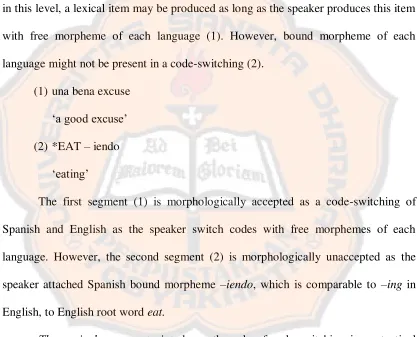
The free morpheme constraint proves how code-switching among bilingual English-Spanish speakers is rule-governed in the lexical level. Poplack explains that
in this level, a lexical item may be produced as long as the speaker produces this item
with free morpheme of each language (1). However, bound morpheme of each
language might not be present in a code-switching (2).
(1) una bena excuse
„a good excuse‟
(2) *EAT – iendo
„eating‟
The first segment (1) is morphologically accepted as a code-switching of
Spanish and English as the speaker switch codes with free morphemes of each
language. However, the second segment (2) is morphologically unaccepted as the
speaker attached Spanish bound morpheme –iendo, which is comparable to –ing in English, to English root word eat.
The equivalence constraint shows the rule of code-switching in syntactical level. Poplack explains that the “juxtaposition of L1 and L2 elements does not violate
a syntactic rule of either language, i.e. at points around which the surface structures of
the two languages map onto each other.” This can be seen in the code-switching
A Eng I told him that so that he would bring it fast.
B Spa (Yo) le dije eso pa' que (él) la trajera ligero.
C CS I told him that PA’ QUE LA TRAJERA LIGERO.
Poplack also cited Gingràs (1974) who shows how code-switching would not happen
almost in every other word (3), instead a bilingual speaker would code-switch in
larger part of the constituent (4).
(3) El MAN que CAME ayer WANTS JOHN comprar A CAR nuevo.
„The man who came yesterdat wants John to buy a new car.
(4) Tell Larry QUE SE CALLE LA BOCA.
„Tell Larry to shut his mouth.‟
2.1.5. Internet Linguistics
Linguistics dealing with internet, which would later be called Internet
Linguistics, is a wide area of Linguistics to study as internet itself includes email,
blog, instant messaging, etc. (Crystal, 2005). Internet also gives language a time to
change rapidly. Crystal (2005) categorises Internet Linguistics into four points of
view: the sociolinguistic perspective, the educational perspective, the stylistic
perspective, and the applied perspective.
2.1.5.1. Netspeak
Crystal (2006) explains that the term Netspeak “is an alternative for Internet
21
lot, where words are later coined through the language of technology. Crystal also
gives examples on how this development of technology has formed words through
the processes of word formations as follows.
(1) It‟s my turn to download now.
According to the theory of word formation suggested by O‟Grady et al.
(2010), the italicized word (1), download, is formed through the compounding of
down and load which becomes download, of which the meaning is „to copy files from the internet‟. However, what is meant by download in Netspeak as suggested by Crystal is „to tell a gossip after you hear one‟. Thus, the sentence (1) means „I‟ve
heard all your gossip, now hear mine.‟ as suggested by Crystal. The same thing
would also happen to conversations below (Crystal, 2006).
(2) She‟s multitasking. (said of someone doing two things at once) (3) Let‟s go offline. (i.e. Let‟s talk in private.)
(4) I got a pile of spam in the post today. (i.e. junk-mail)
Besides the use of techie words in Netspeak, internet users might also employ
characters which are commonly found in the internet, such as @ or at (Crystal, 2006), which is commonly found in an e-mail address, as in [email protected]. However, there is a phenomenon, or what Crystal calls as irony, where @ replaces at, and even a, as in @llgood, @tractions, @cafe, @Home, @pex, and even a Bill Gates‟ book is titled Business @ the speed of thought (Crystal, 2006). The use of such
2.1.5.2. Leetspeak
Sampat, as quoted by McQuade, Colt, and Meyer (2009), says that leetspeak
comes from the word “elite” which refers to the writing system used mainly on the
internet employing ASCII1 characters to replace Latinate letters. Leet differs from the
standardised language mainly in the grammatical rule and spelling. Sampat also says
that “intuitive parsing of Leet determines the meaning of a sentence rather than the
actual sentence form.” Leetspeak itself is referred as 1337$|>3/-\ |< by the users, who
are mainly hackers (Ferrante & Ferrante, 2008), or is referred as l3375p34K by the
users (Rosen, 2007). In a novel entitled Roadside Crosses: A Kathryn Dance Novel
written by Jeffery Deaver (2010), there is a conversation between two characters in
the novel, Dance and Boling, as follows:
“And what is „p-h-r-3-3-k‟?”
“That‟s leetspeak for „freak.‟”
“Leetspeak?”
“It‟s a sort of language that‟s been created by teens over the past few years. You only
see it with keyboarded text. Numbers and symbols take the place of letters. And
spellings are altered. Leetspeak comes from „elite‟, as in the best and the chicest. It
can be incomprehensible to us old folks. But anybody who‟s mastered it can write
and read it as fast as we do English.”
“Why do kids use it?”
23
“Because it‟s creative and unconventional…and cool. Which, by the way, you should
spell „K-E-W-L.‟”
“The spelling and grammar are awful.”
Although leetspeak may have risen from gaming and hacking world, it has now
turned into mainstream language used for advertisement, such as HE4T, Sears‟
product of clothes dryers, and Numb3rs, a CBS TV show (Rosen, 2007).
Although some users of leetspeak may understand leetspeak written by other
users, there is no standardisation of leetspeak itself (Stobart & Parsons, 2008). This
statement is also supported by Sampat who states that the use of leetspeak differs
from one user to another, and is characterised by the ignorance of certain language
writing system. McQuade, et al. (2009) explain that many youths would employ
leetspeak in the form of acronyms to be “safe” from their parents, as parents might
not be able to read such kind of writing system, as in:
P911 = parent emergency (parents are coming!)
PAW = parents are watching
PIR = parent in room
POS = parent over shoulder
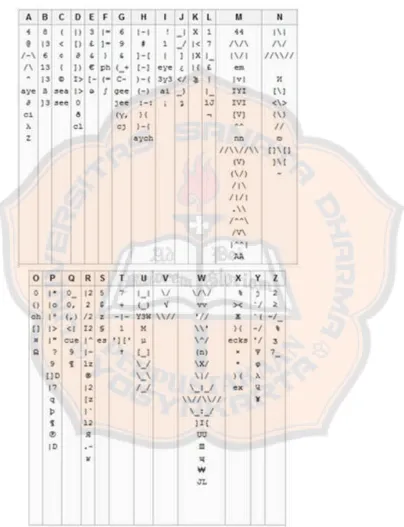
The ASCII characters used for leetspeak may not be universal, but Wikipedia
Figure 2.1. Latinate letters in Leetspeak compiled by a user of Wikipedia
25
2.1.5.3. Social Networking Sites
Social networking sites (SNS) are websites which provides a media for people
to communicate virtually under an administered system (Boyd & Ellison, 2007), such
as the well-known Facebook, Twitter, Myspace, etc. SNS enable people to communicate with those who are miles apart. SNS can be accessed from either
personal computer or mobile phones. Mobile social network is an SNS that is based
on mobile phone (Mansfield, 2012), such as MocoSpace, a leading US-based mobile
social network (Netsize & Salz, 2009).
2.2. Theoretical Framework
This study deals mainly with internet linguistics, in which, according to
Crystal (2005) internet linguistics can be viewed from four perspectives, i.e. the
sociolinguistic perspective, the educational perspective, the stylistic perspective, and
the applied perspective. From those perspectives, the readers can see where the
internet linguistics will go. This study will see the internet from the perspectives of
sociolinguistic and stylistic, as the main purpose of this study is to find out how
leetspeak, which is part of Netspeak as seen from stylistic perspective, is used by
Hispanic Americans, who might happen to be English-Spanish bilinguals.
The theory of word formations is the base for the morphological study
conducted to leetspeak to see how the Hispanic Americans in MocoSpace mobile
description of how words are actually formed. The theory of leetspeak gives the
readers illustration what leetspeak is and how it is used. Although the theory of word
formations is actually explaining the word formations in general, it can be applied to
the subject to be researched in this study. Along with the theory of word formations,
this theory will be the base to answer the first and second formulated problems of this
study. In the first part, the researcher attempts to describe how leetspeak is used
among young Hispanic Americans in MocoSpace mobile network. In the second part,
the researcher would like to describe the characteristics of leetspeak, including the
morphology of Leetspeak.
The users of MocoSpace who claim themselves as Latino/Hispanic might be
English-Spanish bilinguals. Thus, the utterances found in their profile pages might
also contain code-switching of English and Spanish. The theory of code-switching
will be base for answering the third question of the research. The researcher will
present description on how the young Hispanic Americans in MocoSpace mobile
27
CHAPTER 3
METHODOLOGY
This chapter presents the description of the methodology used in
conducting the study. It would be used to answer the research problems, i.e. how
young Hispanic Americans use Leetspeak in MocoSpace, what the characteristics
of Leetspeak used by young Hispanic Americans in MocoSpace are, and how
Spanish influence the Leetspeak used by young Hispanic Americans in
MocoSpace. This chapter consists of the method of the research, the setting of the
research, a description of the subjects, the instruments to be used, data analysis
technique, and the procedure.
3.1. Research Method
This study was mixed-method research. According to Gardner (2008),
mixed-methods research “involves the use of both quantitative and qualitative
data in a single study”. The use of both methods in the same study will provide a
better understanding towards the problems formulated in the research in
comparison to using one method for a study (Creswell and Clark, 2010). The data
of quantitative method is characterized by the systematic statistical, mathematical,
or numerical data (Given, 2008), while the data in qualitative research is
characterized by the use of words or pictures instead of numbers (Fraenkel and
quantitative and qualitative simultaneously, which were presented in the forms of
numerical information and descriptive information.
The required data was recorded through content analysis. According to
Fraenkel and Wallen (2008), content analysis is “a technique that enables
researchers to study human behaviour in an indirect way, through an analysis of
their communication”. Content analysis tries to search the answer of the
formulated problems related to recorded human interactions, such as
advertisements, speeches, internet data, etc. (Neuendorf, 2002). This study would
like to find out how human communicate through Leetspeak in MocoSpace
mobile network. The researcher studied how the Leetspeak was used among
young Hispanic Americans by analysing the recorded written content taken from
their MocoSpace profile pages. Through an analysis of the morphology and
code-switching of Leetspeak used by the users, the researcher would like to find out the
characteristics of Leetspeak exclusively used by young Hispanics Americans in
MocoSpace mobile network. The way they use Leetspeak was recorded to the
internet database and was showed up on their profile publicly. Therefore, the data
were accessible by the researcher.
3.2. Research Setting
The study was conducted on March to April 2012. The researcher accessed
MocoSpace mobile network from Indonesia with the help of the Internet
29
in order to be able to access other profiles. Thus, the researcher was also part of
the MocoSpace community.
3.3. Research Subjects
The study focused on a mobile network named MocoSpace, which was
launched in 2005 by co-founders Justin Siegel and Jamie Hall. As the study talked
about Leetspeak used by young Hispanics American, the researcher had decided
to point members of MocoSpace claiming their ethnicity to be Latino/Hispanic
aged 15 to 25 settling down in the United States. The researcher limited the
subjects into those who put Leetspeak in their profile. The subjects of this study
were the status update and „About Me‟part of the profile information.
Fraenkel and Wallen (2008) clearly state that categorisation is a part of
content analysis and the data obtained will be categorised based on either previous
theories or not. The first
categorisation requires theories
related to the study to be used as
an instrument to categorise the
data obtained. However,
categorisation may also be based
on the analysis as the researcher
analyses the data. As there is no
such categorisation in Leetspeak,
and that Leetspeak might differ from one user to another (Stobart & Parsons, Figure 3.1. Venn Diagram showing the Code-Switching of
2008), the researcher categorised the data obtained as the study reveals the
characteristics of Leetspeak used by young Hispanic Americans.
The study focused on the characteristics and morphology of Leetspeak,
and also code-switching used by the Hispanic users to write Leetspeak.
Code-switching to be discussed in this research would include English-Leetspeak
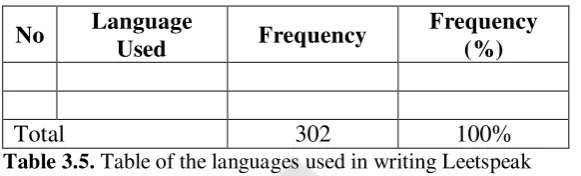
code-switching (2) and English-Spanish-Leetspeak code-code-switching (4) (see Figure 3.1). Thus, the data were taken only from profile pages which contained Leetspeak, and
only be taken from status updates, „About Me‟ part, and friends‟ comments. The
researcher used purposive sampling in order to obtain the data required. In
purposive sampling, the samples are purposely chosen among the entire
population because the samples are in unique position (Engel & Schutt, 2009).
Thus, the data taken from the profile pages of the users were purposely chosen
because they contain Leetspeak.
3.4. Instruments
The instruments employed for this study were human instrument and the
content. The researcher played role as human instrument to collect and analyse the
data (Merriam, 2002). He had the duty to be one who collected the data needed for
the research, broke down the data into several categories according to the
functions of language and the code-switching, and examined the characteristics of
the Leetspeak used according to its orthography and word formation. In obtaining
the data, the researcher must create an account in MocoSpace in order to see the
31
Fraenkel and Wallen (2008) state that the contents to be analysed in
content analysis include the contents of any type of communication. In order to
analyse the content of a communication, the researcher should collect a large
amount of material. The materials were the content of the profile pages that were
broken down into written utterances, which were found in the status update and
„About Me‟ sections of the pages of the selected users.
3.5. Research Procedure
In order to obtain the data needed, the researcher should follow the
procedures taken in the study. This would help the researcher to conduct the
research effectively in order to answer the problems formulated. The research
procedure includes data gathering technique, data analysis technique, and
presentation of the result.
3.5.1. Data Gathering Technique
In order to obtain the data needed for the study, the researcher needed to
specify the data. The collection of the data can be described as following.
1. Browse MocoSpace profiles
The data was obtained from the profile pages of the Hispanic users of
MocoSpace mobile network (www.mocospace.com), in which the researcher
should own an account to access the profile pages. The researcher used the „Find
2. Specify the users
This study was meant to research the use of Leetspeak among young
Hispanic Americans. Therefore, the researcher limited the users into those who
resided within the federal territory of the United States, which would include 48
contiguous states, District of Columbia, Alaska, and Hawaii, excluding the
outlying territories of the United States by choosing United States in the country options.
To obtain the data from the intended subjects, the researcher needed to
limit the ethnicity of the users into Hispanics by choosing Hispanic/Latino in the ethnicity options featured in the Find Friends tool. MocoSpace featured ethnicity
to be put in the users‟ profiles. By limiting the ethnicity, the system would show
the intended subjects of the study, i.e. young Hispanic Americans.
33
The system of MocoSpace was able to show 200 profiles in one search.
Therefore, the researcher opened 200 female users‟ profiles and 200 male users‟
profiles. Those which were not set to private would be observed if they contained
Leetspeak by using the description of Leestpeak described by McQuade, Colt, and
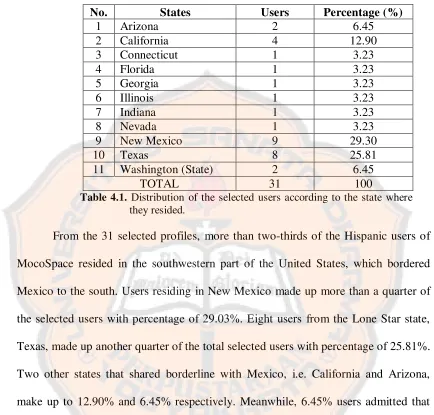
Meyer (2006). Based on the limitations mentioned, there were total 31 profile
pages found, consisting of 23 female users‟ profiles and 8 male users‟ profiles.
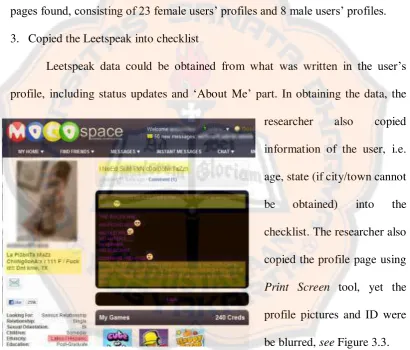
3. Copied the Leetspeak into checklist
Leetspeak data could be obtained from what was written in the user‟s
profile, including status updates and „About Me‟ part. In obtaining the data, the
researcher also copied
information of the user, i.e.
age, state (if city/town cannot
be obtained) into the
checklist. The researcher also
copied the profile page using
Print Screen tool, yet the profile pictures and ID were
be blurred, see Figure 3.3.
3.5.2. Data Analysis Technique
The researcher needed to analyse the data obtained from the selected
profile pages. According to Creswell (2007), the initial steps of the data analysis
are “preparing” and “organising”.
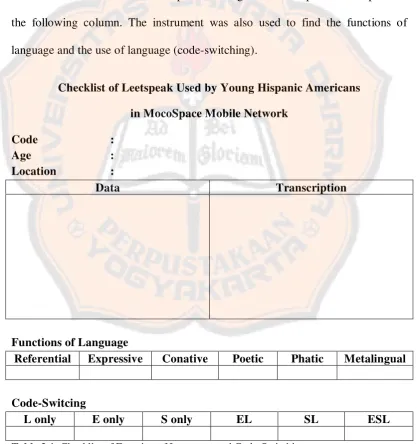
In order to do the analysis, the researcher employed a checklist, see Table 3.1. The checklist was used to analyse the data obtained in order to find the
answers to the problems formulated. The checklist contained the code of the user,
in which the code starting with F is for female users, and M is for male user, age
of the users, and the location of the users. The raw data in Leestpeak were put into
the data column and their transcriptions in English and/or Spanish were put into
the following column. The instrument was also used to find the functions of
language and the use of language (code-switching).
Checklist of Leetspeak Used by Young Hispanic Americans in MocoSpace Mobile Network
Code :
Age :
Location :
Data Transcription
Functions of Language
Referential Expressive Conative Poetic Phatic Metalingual
Code-Switcing
L only E only S only EL SL ESL
35
1. Transcribing the data
In this part, the researcher browsed profile pages using the „Find Friends‟
tool and selected the profile pages according to the subject limitation and copied
the contents of the profile pages. The researcher transcribed the data found in the
profile by translating the contents of the profile pages into the standard languages
in order to ease the readers who were not digital native.
2. Break down the transcription into utterances
The researcher broke down the transcribed data in each profile page into
written utterances. According to Crystal as cited in DRCC (2005), the term utterance is more appropriate to describe spoken English that is written in the
internet communication than the term sentence. In this study, the researcher found
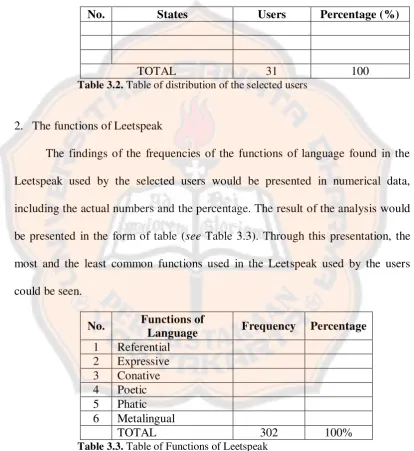
302 written utterances from the 31 profile pages.
3. Classify the data based on Jakobson‟s six functions of language
The next step was sorting the data into some categories through a process
of “coding” (Creswell, 2007). To obtain data on the function of language, the
researcher classified each written utterance according to the underlying function
of the utterances. The classification was based on Jakobson‟s six function of
language (1960), i.e. referential, expressive, conative, poetic, phatic, and
metalingual.
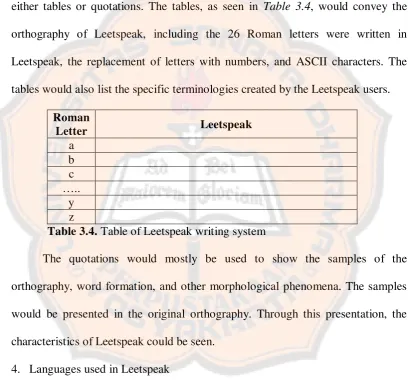
4. Classify the data based on the characteristics of Leetspeak
To obtain data on the Leetspeak characteristics, the researcher divided the
data into orthography and morphology. The researcher listed each letter and