Contact
Meat and Livestock Australia Ph 02 9463 9333 Livecorp Ph 02 9929 6755
Published by Meat & Livestock Australia Limited ABN: 39 081 678 364
October 2008
© Meat & Livestock Australia ISBN: 1 74036 394 9
Acknowledgements
The advice and assistance provided by Dr Phil Reeves (APVMA) during the preparation of this manual is gratefully acknowledged.
Photo acknowledgement
Cover photo supplied by Geoff Bennett, Department of Primary Industries, Victoria
This publication has been jointly funded by Meat & Livestock Australia and LiveCorp.
Important notice
This document is published for information purposes only and is published on the following terms:
1 The information contained in this document is subject to change. No assurance is given that it is accurate or up to date.
2 Users of this document should seek professional advice in relation to individual circumstances.
3 MLA and LiveCorp make no representations, and to the extent permitted by law exclude all warranties, in relation to the information contained in this document.
4 MLA and LiveCorp are not liable to you or to any third party for any losses, costs or expenses, including any direct, indirect, incidental, consequential, special or exemplary damages or lost profit, resulting from any use or misuse of the information contained in this document.
Responsible drug use 3
Cattle Anthelmintics 11
Cattle Antibiotics 21
Cattle Anti-inlammatory drugs 28
Cattle Which appetite stimulant/tonic? 31
Cattle Calcium/magnesium 33
Cattle External parasites 35
Cattle Fluke 42
Cattle Hormonal growth promotants 48
Cattle Pinkeye 50
Cattle Prostaglandins 52
Cattle Ringworm 54
Cattle Sedation 56
Cattle Vaccines 58
Sheep and Goats Anthelmintics 63
Sheep and Goats Antibiotics 72
Sheep and Goats External parasites 78
Sheep and Goats Fluke 84
Sheep and Goats Pinkeye 87
Sheep and Goats Vaccines 88
Appendix A Acronyms and abbreviations 93
Appendix B Drug Schedules 94
Appendix C Injection techniques 95
arrival overseas and go directly into the human food chain.
When using veterinary medicines and pesticides, we must be careful to ensure that treatment will not cause unacceptable residues in the carcase at the time of slaughter. Our markets are becoming more sophisticated, with chemical residue testing of meat randomly carried out in some of our customer countries. Food safety is a sensitive issue. The live export trade does not need the bad publicity and market damage that occurs with a drug residue incident.
For the health and wellbeing of the animals under our care, it is important that treatment is given where necessary, using the most appropriate drug, dose rate and method of application. Treatments required under the export protocol must also be carried out with a suitable drug, applied appropriately. However, it is also important that veterinary drugs are not used unnecessarily so that the costs of export preparation and delivery and the risk of adverse side effects are kept to a minimum.
This manual is a ‘glove-box’ guide for exporters, managers of live export assembly depots, Masters and Chief Officers of livestock ships, and stockmen working with cattle, sheep or goats exported live from Australia. The manual has four separate parts:
• A description of ‘best practice’ use of veterinary drugs and chemicals – storage, record keeping, off-label use, inventory control, disposal of unwanted drugs and the like.
• A listing of common veterinary drug uses for live export cattle.
• A listing of common veterinary drug uses for live export sheep and goats. • A description of recommended injection techniques.
Responsible drug use
Legislation controlling the use of veterinary medicines and pesticides is state legislation. Requirements vary from one state to another.
The exporter’s veterinarian must be familiar with the relevant legislation in the state(s) in which export preparation occurs and be able to provide professional advice about responsible use of veterinary drugs.
Although legal responsibility may cease once a livestock vessel leaves Australian waters, the live export industry has committed to best practice standards, assuming the duty of care that applies to veterinary drug use in Australia extends to arrival at the destination port overseas. The recommendations throughout this manual are therefore based on best practice in Australia.
National registration of veterinary drugs
All proprietary veterinary medicines and pesticides used to treat livestock in Australia must be registered by the Australian Pesticides and Veterinary Medicines Authority (APVMA).
On registration, products are classified into a drug Schedule, which determines the legal requirements for possession, storage, handling and use. The Australian Drug Schedules are listed in Appendix B of this manual.
Before registering a veterinary medicine, the APVMA must be satisfied that the product does not pose an undue hazard to public health or the environment, it is safe and effective when used according to approved recommendations, and it will not unduly prejudice trade between Australia and its trading partners. Companies submitting a veterinary medicine or pesticide for registration must provide the results of detailed safety and efficacy studies to support their registration claims. Directions for use, dose rates and any necessary safety precautions and warnings must be provided. The company must also demonstrate that the product will be produced using good manufacturing practice. This ensures that each pack meets the approved quality standards and contains what it is supposed to, without contaminants that might cause adverse effects.
The APVMA registration process is onerous, but it ensures that the veterinary medicines and pesticides available in Australia, when used as directed, are safe and effective. All registered products contain an APVMA number on the label. It is illegal to sell unregistered veterinary drugs in Australia.
However, product quality is often suspect and/or the directions for use, withholding period or expiry date are inadequate. There is too much at stake to use such products.
Storage
The veterinary drugs used to treat export livestock must be stored in accordance with the manufacturer’s recommendations, which will be identified on the container.
Some products must be stored in a refrigerator. Others do not need to be refrigerated, but must be kept below a specified temperature, eg less than 30°C. Such drugs can be kept in an air conditioned room, but not in an outside shed or deck locker on a ship where the temperature will exceed the recommended maximum.
Some veterinary medicines and pesticides must be protected from direct sunlight. They must be stored in a drug cabinet that excludes light when closed.
All veterinary medicines and pesticides used to treat export livestock should be stored in a watertight secondary container, or above a drip tray that will effectively contain any leakage.
Schedule 4 drugs must be stored in a locked area (room, cupboard, drawer or refrigerator), with access restricted to authorised persons only. Schedule 4 drugs are veterinary prescription only medicines that have the words ‘PRESCRIPTION ANIMAL REMEDY’ or ‘PRESCRIPTION ONLY MEDICINE’ on the label. They are commonly used for treating livestock. Examples are antibiotics, non-steroidal anti-inlammatories, corticosteroids, local anaesthetics and tranquilizers.
Schedule 8 drugs must be stored in a locked drug cabinet or safe, with access restricted to veterinarians only. The drugs in Schedule 8 are medicines liable to misuse, causing physical or psychological harm or dependence. An example is the drug pethidine. Schedule 8 drugs are not commonly used to treat export livestock, though there may be an occasional need.
Authority to use
Export livestock should only be treated with Schedule 2, 3, 5 and 6 drugs by a veterinarian, the exporter, the manager of an export assembly depot, the Master of a vessel at sea, or a person directly authorised by one of the above.
Schedule 4 drugs must only be used by a veterinarian or person directly authorised by a veterinarian. Schedule 8 drugs must only be used by a veterinarian.
At sea, the authority to treat export livestock should not be delegated to a person other than the Master, Chief Officer, bosun or a stockperson accredited by LiveCorp.
livestock must not authorise another person to treat export livestock unless satisfied that the person giving the treatment:
• is able to recognise when treatment is required; • is able to recognise when treatment is not appropriate;
• understands any instructions that go with the treatment, including compliance with the recommended dose rate, method of application, withholding period and any safety warnings;
• is able to give the treatment competently; and • is able to keep appropriate treatment records.
Product quality and spoilage
Export livestock must not be treated with any veterinary medicine or pesticide that is not in its original container, is contaminated or spoilt in any way, or has passed the product expiry date.
Withholding period
The withholding period for meat is the minimum time after an animal is treated with a veterinary medicine or pesticide before it may be legally slaughtered for human consumption in Australia. Withholding periods are set to ensure that chemical residues, if any, in the carcase are below the maximum residue limit (MRL) allowed for that chemical in food.
In general, slaughter and feeder animals should not be treated with a veterinary drug if the withholding period exceeds the expected date of arrival overseas. However, there are two exceptions:
• where treatment is specified in the importing country’s protocol; or
• where an animal has already been loaded for export, treatment is necessary for animal welfare reasons, and there are no drugs available with comparable efficacy and a shorter withholding period.
If treatment is carried out to comply with protocol requirements, the importing country, having set the treatment requirements, is an informed buyer. It is not necessary to individually identify treated animals or advise the consignee.
During a voyage, records of any treatments administered to animals must be maintained2. If treatment of slaughter or feeder animals is necessary for animal welfare reasons and the withholding period exceeds the date of arrival overseas, the treated animal(s) must be clearly identified and the consignee advised.
Where treatment involves individual animals (eg an injured animal treated with antibiotics) the consignee may be given prior written advice that animals identified in a particular manner have been treated at sea and slaughter is not recommended until the relevant withholding period has expired. No further advice is necessary at the time of discharge.
Ear tagging (as shown in Table 1) is the preferred method for identifying treated animals. If the handling required for ear tagging cattle at sea would involve significant stress on the treated animal or undue occupational health and safety risks, alternative methods of animal identification, such as spray raddle, are acceptable. The required outcome is that all slaughter and feeder animals that may contain drug residues at the time of discharge can be identified, and that they are delivered to an informed buyer.
Table 1. Tagging for individual animals treated at sea
Eartag Meaning
Orange eartag T7 Slaughter not recommended within 7 days of discharge overseas.
Orange eartag T14 Slaughter not recommended within 14 days of discharge overseas.
Orange eartag T28 Slaughter not recommended within 28 days of discharge overseas.
Where treatment involves mass medication (eg oxytetracycline in the drinking water) the consignee must be advised at the time of discharge.
Withholding periods in milk-producing animals
Some products should not be used in lactating cattle, sheep or goats, or in animals that may produce milk in the future for human consumption. This has been indicated in the product tables but note that domestic milk withholding periods have not been specified and may still apply. Carefully check whether a product you are intending to use can be used in animals that are lactating, close to calving, or may be used in the future for milk production.
Export slaughter interval
Many veterinary medicines and pesticides now have an export slaughter interval (ESI) listed in addition to the meat withholding period. The ESI is the minimum time recommended after an animal is treated before slaughter for consumption in an overseas country that has a lower maximum residue limit than applies in Australia. Compliance with ESIs is voluntary, but strongly recommended for animals exported to residue-sensitive destinations.
ESIs are not available for all veterinary drugs and chemicals. Just because a product listed in this manual does not have an ESI does not mean that only the Australian withholding period applies. Check with the product’s manufacturer for current information.
Withholding periods or export slaughter intervals may vary according to the way the product is used. For example, the ESI when a product is used as a spray may be longer than when it is used with a backrubber or the ESI may vary depending on whether single or multiple treatments have been given. In these situations, a withhold range has been specified and the individual product should be checked to ensure that the proper withholding time has been observed.
Off-label use
A drug is used ‘off-label’ if it is used other than strictly in accordance with the manufacturer’s label or product insert. With a few specific exceptions, it is not illegal to use a veterinary medicine or pesticide off-label. However, off-label use must be prescribed by a veterinarian, who assumes full responsibility.
While it is generally important to follow the manufacturer’s directions for use, there are occasions when off-label drug use is appropriate. Off-label treatment is often necessary for
minor species, such as goats or buffalo, when there is no suitable drug registered for that species, so a product registered for sheep or cattle must be used instead. It may also be necessary to use a product off-label because the drug of choice is temporarily not available, and an alternative is required.
Veterinary drugs should only be used off-label if there is no suitable product registered, or the only registered products are not available.
Off-label uses that are banned include:
• using a veterinary medicine or pesticide registered for oral or external use as an injection; • using chloramphenicol, organochlorines, reserpine, diethylstilboestrol or nitrofuran
antibacterials to treat livestock;
• using arsenical compounds as an external livestock treatment;
• using hormonal growth promotants (HGPs) or clenbuterol products other than precisely in accordance with label directions; or
• the use of a product in any manner if the manufacturer’s label specificallystates that the product is not to be used in that manner.
Human use
Veterinary drugs must not be used for human treatment unless prescribed by a medical practitioner.
Inventory control
In Australia
Recommended quantities of different kinds of veterinary drugs are listed in Standard 4 of the Australian Standards for the Export of Livestock3. The quantity of veterinary drugs stored for treatment of export livestock should not exceed what might reasonably be required for the consignment in question, or where multiple shipments are expected, what might reasonably be required during the subsequent six-month period.
At each site where veterinary medicines and/or pesticides are stored a drug inventory must be prepared at least once every three months with disposal of any drug that is surplus to requirements, has reached its expiry date or is unsuitable for use for any other reason.
At sea
The quantity of veterinary drugs on board a livestock vessel should not exceed what might reasonably be required for the subsequent three-month period.
A drug inventory must be prepared at the completion of each voyage with disposal of any drug that is surplus to requirements has reached its expiry date, or is unsuitable for use for any other reason.
Record keeping
A record must be maintained of all veterinary medicines and pesticides used to treat export livestock. This record must include:
• the product name • treatment date(s)
• dose rate
• manner and duration of administration
• animal identification (individual or mob identification as appropriate) • withholding period.
Disposal of unwanted drugs and empty containers
In Australia
Unwanted drugs and empty drug containers must be disposed of in accordance with the manufacturer’s recommendations and local environment protection authority requirements.
At sea
Unwanted drugs and empty containers must not be thrown overboard at sea. Rather, they must be stored on the vessel, landed in port, and disposed of in accordance with the manufacturer’s recommendations and local quarantine and environment protection authority requirements.
Treatment check list
It is important to think carefully before treating export livestock with any veterinary medicine or pesticide. A useful checklist is as follows:
• Is treatment really necessary?
• Will treated animals get an effective dose and course of treatment? • Are there likely to be adverse side effects?
• Is there a better treatment alternative?
Anthelmintics
There are numerous anthelmintics (worm treatments) registered for treating gastrointestinal worms in cattle. The active ingredients in these products can be classified into three main categories, depending on their chemical structure and mode of action:
• macrocyclic lactones or ‘mectins’ – abamectin, doramectin, eprinomectin, ivermectin and
moxidectin
• benzimidazoles – albendazole, fenbendazole and oxfendazole
• levamisole – levamisole
Macrocyclic lactones
These products are generally very effective against gastrointestinal worms in cattle, killing both mature worms and inhibited larvae. They are also effective against lungworm, biting and sucking lice, mange mites and cattle tick.
The ‘mectin’ chemicals all act in a similar way – binding to invertebrate nerve and muscle cells, causing paralysis to the affected parasite. When given as directed, they have a wide safety margin. There are subtle differences between the chemicals in this group, such as their persistence and hence protective period after treatment and their impact on dung beetles and other friendly insects in the environment. However, these differences are relatively minor, with the choice of product within the group based largely on availability and cost.
The mectins are usually applied by injection or as a pour-on. The injectable products must be given subcutaneously – injection into the muscle causes a severe reaction at the injection site. Ease of application, good efficacy against a broad spectrum of cattle parasites and moderate cost usually makes a ‘mectin’ chemical the product of choice for worm control in export cattle.
Benzimidazoles
The benzimidazole, ‘BZ’ or ‘white’ drenches are registered for use against gastrointestinal worms and lungworm in cattle, but are not effective against lice, mites or ticks. They are very safe and are generally much cheaper than the mectin products. However, most are oral drenches and few are available as pour-ons. Drenching large numbers of cattle with a hook is slow and labour intensive.
Levamisole
margin. It is quite safe when used as directed, but toxicity can occur if cattle are given more than twice the recommended dose, especially if the cattle are stressed.
Some of the above active ingredients are found in combination with a liver luke treatment. These products are listed in the section on products for treating liver luke in cattle, starting on page 42.
Table 2. Anthelmintics for cattle – pour-ons
Class of Anthelmintic
Trade Name Withholding Period (meat) Export Slaughter Interval Use in Dairy Cows? macrocyclic
lactone (mectin) (Coopers) Paramax Pour-On for Cattle 28 days 28 days
(Virbac) Beefmec Pour-on Endectocide for Cattle
35 days 42 days
(Virbac) Dairymec
Ivermectin Pour-on for Dry & Lactating Dairy Cattle
21 days 21 days
(Virbac) Ivermectin Pour-on for Beef & Dairy Cattle
42 days Not avail.
Acatak Duostar Tick Development Inhibitor and Broad Spectrum Pour-On
42 days 42 days X
Ausmectin Pour-on 42 days 42 days
Baymec Ivermectin Pour On for Cattle
42 days 42 days * (28
days)
Bomectin Pour-on For Cattle
42 days 42 days
Bovimectin Pour On for Cattle
42 days 42 days
Cattlemax Pour-on For Cattle
28 days 28 days
Cydectin Pour-On for Cattle and Red Deer
Nil Nil
Class of Anthelmintic
Trade Name Withholding Period (meat) Export Slaughter Interval Use in Dairy Cows? macrocyclic
lactone (mectin) Ecomectin Pour-On 42 days 42 days Genesis Abamectin
Pour-On for Cattle
35 days Not avail.
Genesis Ivermectin Pour-on for Cattle
21 days 21 days
Imax CD Pour-on for Cattle 42 days 42 days
Ivomec (Ivermectin) Pour-On for Cattle
42 days 42 days * (28
days)
Ivomec Eprinex (Eprinomectin) Pour-On
Nil Nil
Noromectin Pour-On for Cattle
42 days 42 days
Paramectin RV Pour-on for Cattle
35 days Not avail.
Paramectin Pour-On for Cattle
35 days 42 days
Vet’s Choice Ivermectin Pour-on for Cattle
42 days 42 days
Vetmec (Ivermectin) Pour-on for Cattle
42 days 42 days
Virbamax Pour-on for Beef & Dairy Cattle
21 days 21 days
Virbamec LV Pour-On for Cattle
21 days 21 days
Virbamec Pour-on / Virbamec Pour-On Endectocide for Cattle
35 days 42 days
WSD Abamectin / Endomec Abamectin Pour-on Endectocide for Cattle
Class of Anthelmintic
Trade Name Withholding Period (meat)
Export Slaughter Interval
Use in Dairy Cows? benzimidazole Alternate Pour-on Wormer
for Cattle
21 days 21 days
Bomatak Pour-On Wormer for Cattle
21 days Not avail.
levamisole (Coopers) Nilverm Pour-On Cattle Wormer
3 days 7 days
(Virbac) Levamisole Pour-On
3 days 7 days
Levipor Pour-On Anthelmintic for Cattle
3 days 7 days * (28 days)
Sykes Big L Pour-On 3 days Not avail. * (28 days)
X: product specifically not to be used in cows that are producing or may in the future produce milk for human consumption
* (n days): do not use on lactating cows, or cows that will calve in less than the indicated number of days, if milk will be used for human consumption. For example, “* (28 days)” means product cannot be used in lactating cows or cows less than 28 days before calving if milk may be used for human consumption.
Note that domestic milk withholding periods may still apply.
Table 3. Anthelmintics for cattle – injectable preparations
Class of Anthelmintic
Trade Name Withholding Period (meat) Export Slaughter Interval Use in Dairy Cows? macrocyclic
lactone Avomec Antiparasitic Injection for Cattle 30 days 42 days * (30 days)
Bomectin Antiparasitic Injection for Cattle and Pigs
28 days 42 days * (28
days)
Cydectin Injection for Cattle / Cydectin Injection for Cattle & Sheep
14 days 28 days (single treatment); 40 days (multiple treatments) * (60 days)
Cydectin Long Acting Injection for Cattle
Do not use in cattle destined for live export
* (80 days)
Dectomax Injectable 42 days 42 days * (60
days)
Ecomectin Injection 28 days * (28
days)
Genesis Injection (Abamectin) for Cattle & Sheep
42 days 42 days * (30
days)
Genesis Injection Abamectin Plus Vitamin B12 Antiparasitic for Cattle & Sheep
49 days 49 days * (30
days)
Genesis Injection (Ivermectin) for Cattle
42 days 42 days * (28
days)
Ivomec Antiparasitic Injection for Cattle
28 days 42 days * (28
days)
Noromectin Injectable / Noromectin Antiparasitic Injection for Cattle & Pigs
42 days 42 days * (28
days)
Paramectin Injection for Cattle
30 days 42 days * (30
Class of Anthelmintic
Trade Name Withholding Period (meat) Export Slaughter Interval Use in Dairy Cows? macrocyclic
lactone Vetimec Ivermectin Injection for Cattle 28 days * (28 days)
Vetmec Antiparasitic Cattle Injection
30 days 42 days * (30
days)
Virbamec Antiparasitic Injection for Cattle
30 days 42 days * (30
days)
(Virbac) Virbamec LA Injection Endectocide for Cattle
42 days 42 days * (42
days)
* (n days): do not use on lactating cows, or cows that will calve in less than the indicated number of days, if milk will be used for human consumption. For example, “* (28 days)” means product cannot be used in lactating cows or cows less than 28 days before calving if milk may be used for human consumption.
Note that domestic milk withholding periods may still apply.
Table 4. Anthelmintics for cattle – oral drenches
Class of anthelmintic
Trade name Withholding
period (meat) Export Slaughter Interval Use in Dairy Cows?
benzimidazole 4farmers Fenbendazole Oral Anthelmintic for Sheep, Goats and Cattle
14 days Not avail
(WSD) Albendazole Cattle Mini Drench
10 days 10 days X
Bomatak.C Anthelmintic for Dairy Cattle, Beef Cattle & Horses
8 days Not avail
Bovamax CC Broad Spectrum Cattle Drench
10 days Not avail X
Class of anthelmintic
Trade name Withholding
period (meat) Export Slaughter Interval Use in Dairy Cows?
benzimidazole (Virbac) Combat White Anthelmintic for Sheep, Cattle and Goats
10 days Not avail
Farnam Worma Drench Broad Spectrum Oral Anthelmintic for Horses & Cattle Drench
8 days 14 days
(under review— may be longer)
(WSD) Fenbendazole 100 Oral Anthelmintic for Cattle and Horses
14 days 14 days
(WSD) Fenbendazole Oral Anthelmintic for Sheep, Goats and Cattle
14 days 14 days
(Virbac) Fencare 100 Anthelmintic for Cattle and Horses
21 days 21 days
(Virbac) Fencare 25 Anthelmintic for Sheep and Cattle
21 days 21 days
Mineralised Fencare Anthelmintic for Sheep and Cattle
21 days 21 days
(Virbac) Oxfen C Anthelmintic for Cattle
8 days 14 days
Oxazole Concentrated Worming Drench for Cattle and Horses
8 days 14 days
Oxazole LV Worming Drench for Sheep, Cattle and Goats
8 days 14 days
Class of anthelmintic
Trade name Withholding
period (meat) Export Slaughter Interval Use in Dairy Cows?
benzimidazole Oxfen LV Anthelmintic for Sheep Cattle and Goats
10 days 14 days
Panacur 100 Oral Anthelmintic for Cattle and Horses
14 days 14 days
Panacur 25 Oral Anthelmintic for Sheep Cattle and Goats
14 days 14 days
Parafend LV 8 days 14 days
Strategik Mini-dose Worming Drench for Cattle
10 days 10 days X
(Coopers) Systamex Anthelmintic Drench for Cattle Oral
8 days 14 days
(Coopers) Systamex Concentrated Drench
8 days 14 days
Valbazen Broad Spectrum Mini-Dose Cattle Drench
10 days 10 days X
levamisole 4farmers Levamisole Oral
Anthelmintic for Sheep and Cattle
3 days Not avail X
Clear LV Oral Anthelmintic for Sheep and Cattle
3 days Not avail X
(Virbac) Combat Clear Oral Anthelmintic for Sheep and Cattle
3 days Not avail X
Coopers Nilverm LV Oral Drench
3 days 7 days
Coopers Nilverm Oral Drench
3 days 7 days
Class of anthelmintic
Trade name Withholding
period (meat) Export Slaughter Interval Use in Dairy Cows? levamisole Levamisole Gold LV Oral
Anthelmintic for Sheep and Cattle
3 days 7 days X
Levamisole Gold Mixadrum Concentrate Oral
Anthelmintic for Sheep and Cattle
3 days 7 days
Levamisole Gold Oral Anthelmintic for Sheep and Cattle
3 days 7 days X
Levimax LV Oral Broad Spectrum Anthelmintic Drench
3 days Not avail
Levimax Oral Broad Spectrum Anthelmintic Drench
3 days Not avail
Mineralised Levamisole Mini Dose Oral Anthelmintic for Sheep and Cattle
3 days 7 days X
Rycozole Oral Anthelmintic for Sheep & Cattle
3 days 7 days X
Rycozole RV Oral Anthelmintic for Sheep & Cattle
3 days 7 days X
Rycozole RV Plus Selenium Oral Anthelmintic for Sheep & Cattle
3 days 7 days X
Sykes Big L Worm Drench for Sheep & Cattle
3 days Not avail
WSD Levamisole Oral Anthelmintic for Sheep and Cattle
3 days 7 days X
WSD Low Volume
Levamisole Oral Anthelmintic
3 days 7 days X
X: product specifically not to be used in cows that are producing or may in the future produce milk for human consumption
* (n days): do not use on lactating cows, or cows that will calve in less than the indicated number of days, if milk will be used for human consumption. For example, “* (28 days)” means product cannot be used in lactating cows or cows less than 28 days before calving if milk may be used for human consumption.
Note that domestic milk withholding periods may still apply.
Antibiotics
Antibiotics are used to prevent and treat bacterial infections.
Antibiotic treatment is generally recommended for cattle with open wounds, abrasions on the lower legs and/or foot related lameness. At sea, a bacterial infection in the feet or lower legs, with swelling and lameness, is bad news. Some of these cattle are not suitable to discharge and end up being destroyed on the vessel.
Antibiotic treatment is also appropriate for cattle with pneumonia and for cattle that are clinically ill, but where the cause of ill-health is uncertain – especially if rectal temperature is above 39.5ºC.
Use injectable rather than oral antibiotics
If antibiotics are required, they should be given by injection rather than orally in the feed or drinking water. There are good reasons for not using oral antibiotics:
• Oral antibiotics disrupt the bacterial lora in the rumen.
Apart from disrupting digestion, oral antibiotics can actually increase the risk of disease. For example, many strains of salmonella bacteria are resistant to oxytetracycline. Putting oxytetracycline in the feed or water increases the risk of salmonellosis by knocking out competing bacteria and allowing salmonella to grow more freely.
• Cattle that are sick and in need of antibiotics often have a depressed appetite and may not drink much, so they don’t get an effective dose of antibiotic when administered via feed or drinking water. By contrast, they are certain to get a full dose of any antibiotic given by injection.
• Unless there is a header tank designed for drug administration, putting antibiotics in the drinking water can be very hit and miss. If an antibiotic powder or pre-mixed concentrate is added to individual troughs, the first cattle to drink may get many times the recommended dose, with the concentration of antibiotic getting progressively less with dilution as the trough re-fills.
Short or long-acting?
If an animal requires antibiotics, it is generally desirable to maintain a therapeutic concentration of antibiotic in the animal’s body for at least three days. This can be achieved with a long-acting antibiotic preparation, or with repeat doses of a short-acting antibiotic.
There is no benefit in giving antibiotics at a dose above that recommended by the
When deciding whether to use a short or long-acting injectable antibiotic, you need to consider:
• Residue risk – avoid using a product if the animal is likely to be slaughtered during the withholding period.
• Ease of treatment – if the animal is quiet and the facilities allow repeat handling that is safe and without undue stress, a short-acting antibiotic is generally preferred. However, if the animal is not quiet, or the facilities do not allow daily treatment that is safe and involves minimal stress, a long-acting preparation is generally better.
Narrow or broad spectrum?
When selecting an antibiotic, the spectrum of antibacterial activity required must also be considered. Antibiotics used as wound treatments need to have a broad spectrum of activity against the array of bacterial contaminants that occur in open wounds. If the cause of infection can be narrowed down, for example with pneumonia, an antibiotic that has a narrower spectrum of activity but is highly effective against the target organism may be more appropriate.
Which antibiotic?
Injectable antibiotics registered for use in cattle are listed in Table 5. They are all Schedule 4 veterinary drugs. Injectable neomycin is not recommended for the treatment of export livestock and as a result products containing neomycin are not listed in the table.
Although there are a number of antibiotics registered for use as a feed or water medicant for cattle, they are not listed in this manual. This is because there are no obvious circumstances where oral antibiotics are the treatment of choice for live export cattle.
Key features of the different classes of antibiotic are described below.
Tetracyclines
These are broad-spectrum antibiotics suitable for general purpose use, such as wound treatment. The most commonly used is oxytetracycline. All are relatively cheap and widely used. The longer acting preparations often cause irritation and pain at the injection site. To minimise injection site reactions, deep intramuscular injection is recommended, with no more than 10mL injected at any one site. The long withholding periods may present a problem with slaughter and feeder animals.
Hexasol LA contains oxytetracycline combined with the anti-inlammatory drug lunixin.
Penicillins
used. The products on the market contain a number of different forms of penicillin. Amoxycillin, benzathine penicillin and procaine penicillin are the most common. These have the same basic mode of action, but different absorption and other characteristics.
Products containing procaine penicillin and/or benzathine penicillin are typically sold as a thick liquid that settles out in the bottle and must be shaken well before use. These forms of penicillin are relatively insoluble and are only absorbed slowly from the injection site.
The concentration of procaine penicillin in the bloodstream peaks a few hours after treatment, then steadily declines. Daily treatment is required to maintain an effective dose. With benzathine penicillin there is a lower peak concentration in the bloodstream, but the drug persists longer. A therapeutic concentration is maintained for up to 72 hours after treatment. Products that contain both procaine penicillin and benzathine penicillin combine the two effects, with antibacterial activity initially provided by the more rapid but shorter-acting procaine penicillin and sustained activity from the benzathine penicillin.
Erythromycin
This is a broad-spectrum antibiotic suitable for general purpose use, such as wound treatment. Products that contain erythromycin are not widely used to treat cattle, mainly because of cost – erythromycin is about five times the cost of oxytetracycline. Daily treatment is required.
Tulathromycin
Like erythromycin, tulathromycin is a macrolide antibiotic but belongs to a different chemical subclass that has a long duration of action. It is relatively new, semisynthetic compound indicated for the treatment of bovine respiratory disease. The registered product is
Draxxin
Injectable Solution.
A single injection only is required and cattle should not be retreated for 12 weeks.Streptomycin
Streptomycin binds to the tubules in the kidney, persisting there for an extended time. Because of residue concerns, streptomycin treatment of food animals is now banned in Australia. Currently, streptomycin may only be used, under special permit, to treat animals producing semen or embryos in artificial breeding centres for export. Animals treated with streptomycin have a two year withholding period for meat.
Sulphonamides
Tilmicosin
There is only one product registered for cattle use –
Micotil 300
. It is a narrow-spectrum antibiotic used specifically to treat respiratory disease caused byPasteurella sp.
bacteria. It is the antibiotic of choice forPasteurella
pneumonia.Micotil 300
must be injected subcutaneously, not into the muscle like most other antibiotics. It is a very expensive antibiotic that should only be used for cattle with respiratory disease.Ceftiofur
This is a narrow-spectrum cephalosporin antibiotic that is used in cattle specifically to treat respiratory disease caused by Pasteurella haemolytica, Pasteurella multocida and
Haemophilus somnus bacteria. It is a very expensive antibiotic that should only be used for
cattle with respiratory disease. Daily treatment is required.
Tylosin
Products that contain tylosin have a narrow spectrum of antibacterial activity, and are mainly used where mycoplasma infection is a concern. There is little to recommend their use with live export cattle – as mycoplasmal infections are not a major concern, and tylosin has a narrower spectrum of antibacterial activity and is generally more expensive than oxytetracycline.
Neomycin
Neomycin offers no real advantage over the other antibiotics available, but is a serious residue concern. Neomycin binds to the tubules in the kidney, persisting there for an extended time. It is the antibiotic most commonly detected in cattle residue testing in Australia. Neomycin can also cause deafness and kidney failure, and its use as an injectable antibiotic is not recommended.
Florfenicol
Florfenicol is a synthetic broad spectrum antibiotic, relatively new in veterinary therapy. It is a phenicol drug like chloramphenicol and is indicated for the treatment of a range of cattle conditions including respiratory disease. The registered product is Nulor LA Injectable
Solution. Two intramuscular injections are given 48 hours apart or the total dose is
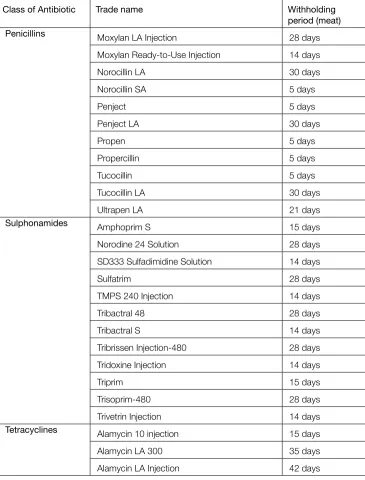
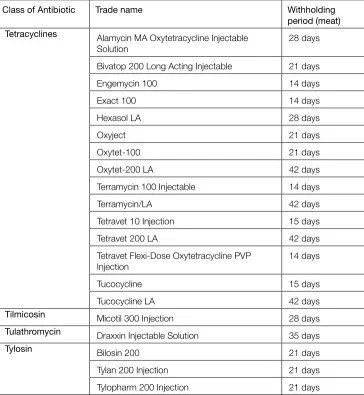
Table 5. Injectable antibiotics for cattle
Class of Antibiotic Trade name Withholding
period (meat)
Ceftiofur Accent Powder for Injection 24 hours
Excenel Powder for Injection 24 hours
Excenel RTU 3 days
Erythromycin Boe-e-mycin 200 Injectable Antibiotic 14 days
Erymicin 200 Injection 14 days
Gallimycin 200 Injectable Antibiotic Not Avail.
Florfenicol Nulor LA Injectable Solution 42 days
Penicillins Amoxycillin Injection 14 days
Amoxyject 14 days
Amoxyvet Injection 28 days
Amoxycillin LA 28 days
Aquacaine G Injectable Suspension 5 days
Aquacaine LA Injectable Suspension 30 days
Benacillin 30 days
Betamox Injection 28 days
Bimoxyl LA 30 days
Bomacillin LA 30 days
Bomacillin SA 5 days
Bomox LA 30 days
Bomox SA 14 days
Depocillin 5 days
Duphapen 5 days
Duphapen LA 30 days
Duplocillin 30 days
Mamyzin 5 days
Class of Antibiotic Trade name Withholding period (meat)
Penicillins Moxylan LA Injection 28 days
Moxylan Ready-to-Use Injection 14 days
Norocillin LA 30 days
Norocillin SA 5 days
Penject 5 days
Penject LA 30 days
Propen 5 days
Propercillin 5 days
Tucocillin 5 days
Tucocillin LA 30 days
Ultrapen LA 21 days
Sulphonamides Amphoprim S 15 days
Norodine 24 Solution 28 days
SD333 Sulfadimidine Solution 14 days
Sulfatrim 28 days
TMPS 240 Injection 14 days
Tribactral 48 28 days
Tribactral S 14 days
Tribrissen Injection-480 28 days
Tridoxine Injection 14 days
Triprim 15 days
Trisoprim-480 28 days
Trivetrin Injection 14 days
Tetracyclines Alamycin 10 injection 15 days
Alamycin LA 300 35 days
[image:30.420.18.383.71.551.2]Alamycin LA Injection 42 days
Class of Antibiotic Trade name Withholding period (meat) Tetracyclines Alamycin MA Oxytetracycline Injectable
Solution
28 days
Bivatop 200 Long Acting Injectable 21 days
Engemycin 100 14 days
Exact 100 14 days
Hexasol LA 28 days
Oxyject 21 days
Oxytet-100 21 days
Oxytet-200 LA 42 days
Terramycin 100 Injectable 14 days
Terramycin/LA 42 days
Tetravet 10 Injection 15 days
Tetravet 200 LA 42 days
Tetravet Flexi-Dose Oxytetracycline PVP Injection
14 days
Tucocycline 15 days
Tucocycline LA 42 days
Tilmicosin Micotil 300 Injection 28 days
Tulathromycin Draxxin Injectable Solution 35 days
Tylosin Bilosin 200 21 days
Tylan 200 Injection 21 days
[image:31.420.41.405.70.465.2]Tylopharm 200 Injection 21 days
Anti-inlammatory drugs
Anti-inlammatory drugs are used to provide stress relief and reduce the muscular pain and inlammatory response that occurs with injury and disease.
Which anti-inlammatory?
Key features of the anti-inlammatory drugs used in cattle are listed below. They are all Schedule 4 veterinary drugs. Care should be taken with use due to the potential for side effects, especially affecting the gastric system and kidneys. The administration of any of the different anti-inlammatory drugs concurrently is contraindicated.
Corticosteroids
Corticosteroids are used principally to provide stress relief and damp down the inlammatory response that occurs with disease. They help treated animals mobilise the body’s energy reserves and act as an appetite stimulant. However, they also delay wound healing and are less effective than non-steroidal anti-inlammatory drugs at controlling muscular pain.
Corticosteroids slow down the immune response, which makes an animal more vulnerable to bacterial infection. As a general rule, corticosteroids should not be used without concurrent antibiotic cover.
Unless specifically prescribed by a veterinarian, corticosteroids should not be given to pregnant cattle. This is because corticosteroid treatment can induce premature calving.
Corticosteroid formulations vary in their duration of action in the body, and therefore vary widely in their withholding periods. Care should be taken in formulation selection.
Non-steroidal anti-inlammatory drugs
There is a wide range of non-steroidal anti-inlammatory drugs (NSAIDs) now available for the treatment of cattle. These drugs act by blocking inlammatory pathways in the body and reduce fever as well as providing analgesia.
Flunixin
Flunixin is an effective anti-inlammatory drug for cattle that are lame and/or have muscular injuries. It provides good pain relief, without increasing susceptibility to infection.
Ketoprofen
Meloxicam
Meloxicam is an anti-inlammatory drug that is indicated for the treatment of acute respiratory infections and mastitis in cattle, in conjunction with appropriate antibiotic therapy. Repeat treatments are contraindicated due to extended duration of activity.
Tolfenamic acid
Tolfenamic acid is an anti-inlammatory drug that also provides pain relief. It is used to treat musculoskeletal problems and, in conjunction with antibiotics, to treat cattle with respiratory conditions or acute mastitis.
Phenylbutazone
[image:33.420.36.383.281.545.2]Phenylbutazone is an anti-inlammatory drug that is used widely in the horse industry, and is sometimes, though inappropriately, used in cattle. None of the products available in Australia are registered for use in cattle. Phenylbutazone is associated with blood disorders in humans and its use in food-producing animals is specifically contraindicated.
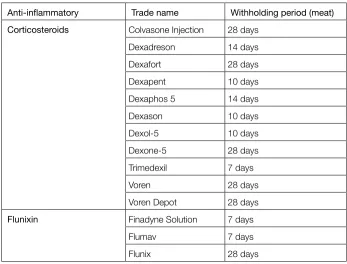
Table 6. Anti-inlammatory agents for cattle
Anti-inlammatory Trade name Withholding period (meat)
Corticosteroids Colvasone Injection 28 days
Dexadreson 14 days
Dexafort 28 days
Dexapent 10 days
Dexaphos 5 14 days
Dexason 10 days
Dexol-5 10 days
Dexone-5 28 days
Trimedexil 7 days
Voren 28 days
Voren Depot 28 days
Flunixin Finadyne Solution 7 days
Flumav 7 days
Anti-inlammatory Trade name Withholding period (meat)
Flunixin Flunixil 7 days
Flunixon 7 days
Fluximine Injection 7days
Flunixin plus oxytetracycline Hexasol LA 28 days
Ketoprofen Ketoprofen Injection 4 days
Key Injection 4 days
Meloxicam Metacam 8 days
Tolfenamic acid Tolfedine CS Injection 10 days (IM)
4 days (IV)
Appetite stimulants/tonics
Appetite stimulants and tonics are sometimes used to treat cattle that are recovering from injury or disease, or have not adapted to their shipboard environment and are not eating well.
There is a wide range of products on the market, however, most are registered for use in horses, dogs and/or cats and cannot be recommended for cattle.
If treatment with an appetite stimulant or tonic is considered necessary and the animal has yet to be loaded for export, it should be excluded from the export consignment.
At sea, if treatment with an appetite stimulant or tonic is considered necessary, the animal should be moved to a hospital pen with at least three times the pen area that would otherwise apply for an animal of that weight. Unlimited feed and water should be provided ad lib, and if there is good quality hay on board, it should be provided as well. Simply moving a beast that is struggling to a less competitive, less stressful environment is often more beneficial than any drug treatment.
Which appetite stimulant/tonic?
Coforta 100 and Richtafortare appetite stimulants specifically registered for use in cattle.
Repeated treatments may be required.
Corticosteroids
Corticosteroids are principally used for stress relief, but they also help mobilise the body’s energy reserves and stimulate appetite. Corticosteroids are the treatment of choice for cattle that are simply stressed and not coping well with their environment.
Corticosteroids slow down the immune response and increase susceptibility to bacterial infection. As such, they are less suitable for animals debilitated by injury or disease. As a general rule, corticosteroids should not be used without concurrent antibiotic cover. The corticosteroids registered for use in cattle are listed and discussed in more detail under the heading ‘anti-inlammatory agents’.
Vitamin B12
Table 7. Appetite stimulants for cattle
Appetite stimulant Trade name Withholding period (meat)
Phosphorus plus Vitamin B12
Coforta 100 Nil
Richtafort Nil
Corticosteroids See
Calcium/magnesium
Live export cattle rarely suffer from overt calcium deficiency. They can draw on stores of calcium in their bones to meet a short-term dietary deficiency. However, marginal calcium status may complicate a deficiency of magnesium.
Cattle are not able to rapidly utilise their body stores of magnesium. Much of the magnesium required is met on a day-to-day basis from the diet, which usually has more than enough magnesium. A shortfall usually only occurs if feeding stops and there is a high magnesium requirement (eg late pregnancy, lactation or severe transport stress).
In practice, there are two situations where calcium and/or magnesium deficiencies occur in the live export trade:
• downers – cattle that go down for another reason (such as a leg injury), stop eating and are severely stressed; and
• cows in late pregnancy or early lactation.
In these cases, immediate treatment is usually required. Oral products are available but injectable products are more suitable in such circumstances. The calcium/magnesium infusions listed below are registered treatments. There is limited benefit in the range of ‘extras’ – sugars and/or phosphorus and/or vitamin B12, which do no harm but do not usually address the primary deficiency.
When injected into the jugular vein, calcium/magnesium solutions go directly into circulation, but if infused too quickly, there is a real risk of cardiac arrest. Intravenous treatment must be by slow infusion, with the heartbeat monitored as the solution drips into the vein. Straight magnesium solutions should never be administered intravenously.
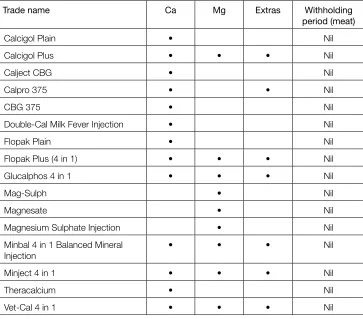
Table 8. Calcium/magnesium infusions for cattle
Trade name Ca Mg Extras Withholding
period (meat)
Calcigol Plain • Nil
Calcigol Plus • • • Nil
Calject CBG • Nil
Calpro 375 • • Nil
CBG 375 • Nil
Double-Cal Milk Fever Injection • Nil
Flopak Plain • Nil
Flopak Plus (4 in 1) • • • Nil
Glucalphos 4 in 1 • • • Nil
Mag-Sulph • Nil
Magnesate • Nil
Magnesium Sulphate Injection • Nil
Minbal 4 in 1 Balanced Mineral Injection
• • • Nil
Minject 4 in 1 • • • Nil
Theracalcium • Nil
External parasites
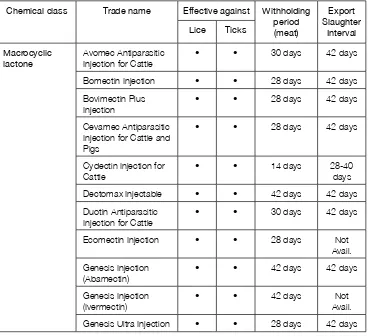
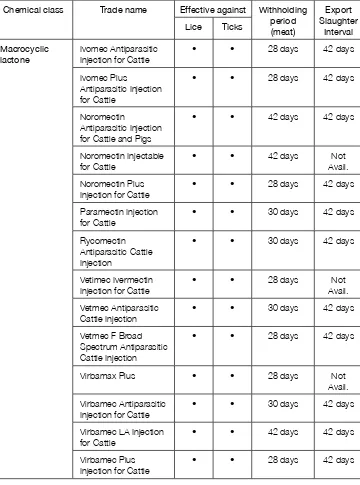
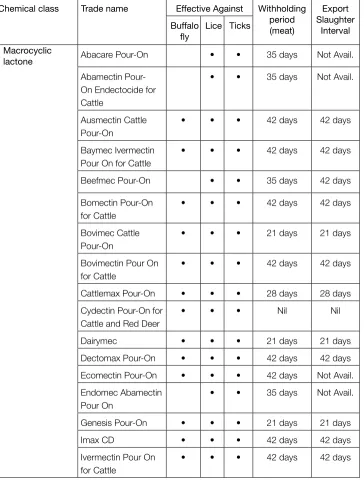
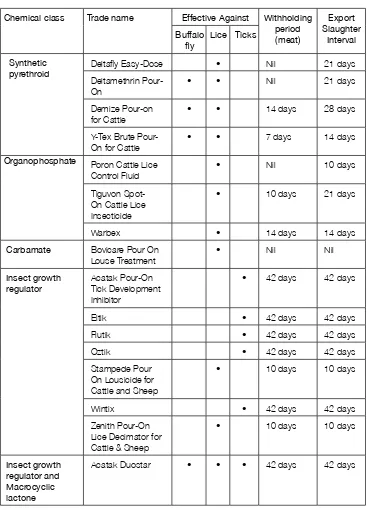
The products registered for treating cattle against ticks, lice and/or buffalo lies are listed in Table 9, Table 10 and Table 11. General purpose ly repellents and insecticide impregnated eartags are not listed because of their limited application to the live export industry.
Products that are effective in control of lice and ticks, but that are primarily used for their lukicide and broad spectrum anthelmintic activity, are listed elsewhere according to their primary function.
Most live export protocols require freedom from external parasites. The challenge is to reliably achieve this, with large numbers of cattle sourced from multiple properties, and a treatment program that is as streamlined and low-cost as possible.
Ticks
Macrocyclic lactones
The treatment of choice for ticks is generally a macrocyclic lactone, or ‘mectin’, either by injection or as a pour-on. This is because of high efficacy and ease of application. In addition to killing ticks on treated cattle, some of the mectin products also claim protection against the development of immature cattle tick, for up to three or four weeks after treatment.
A long acting injectable moxidectin formulation is also available but is not recommended for use in cattle destined for live export. Likewise, some pour-on mectin formulations include triclabendazole for control of liver luke, resulting in export slaughter intervals of up to 140 days. These products are therefore not the first choice specific treatment for external parasites in export cattle, and are not included in the tables in the section below.
Amitraz
Wet dipping with a product containing amitraz is the alternative recommended treatment. Amitraz resistance is an emerging problem, however dipping with amitraz is generally effective at killing ticks. Good dipping technique (wetting heads, maintaining an effective concentration of active ingredient in the dip at all times, etc) is essential. The major downside with wet dipping cattle for ticks is that it is so labour intensive.
Synthetic pyrethroids and organophosphates
Lice
The injectable mectin preparations and pour-ons registered for treatment of cattle lice are the products of choice for sucking lice. Choice is based on ease of application, cost and likely side benefits from the broad spectrum of activity of the mectin chemicals.
[image:40.420.17.388.211.547.2]Injectable and pour-on preparations tend not to be as effective against biting lice, which browse on the skin surface and don’t suck blood, and are therefore less exposed to drugs in the bloodstream. If biting lice are present, a pour-on mectin preparation should be used in preference to an injectable product.
Table 9. Lice and/or tick treatments for cattle – injectable preparations
Chemical class Trade name Effective against Withholding period (meat)
Export Slaughter
Interval Lice Ticks
Macrocyclic lactone
Avomec Antiparasitic Injection for Cattle
• • 30 days 42 days
Bomectin Injection • • 28 days 42 days
Bovimectin Plus Injection
• • 28 days 42 days
Cevamec Antiparasitic Injection for Cattle and Pigs
• • 28 days 42 days
Cydectin Injection for Cattle
• • 14 days 28-40
days
Dectomax Injectable • • 42 days 42 days
Duotin Antiparasitic Injection for Cattle
• • 30 days 42 days
Ecomectin Injection • • 28 days Not
Avail.
Genesis Injection (Abamectin)
• • 42 days 42 days
Genesis Injection (Ivermectin)
• • 42 days Not
Avail.
Chemical class Trade name Effective against Withholding period (meat) Export Slaughter Interval Lice Ticks Macrocyclic lactone Ivomec Antiparasitic Injection for Cattle
• • 28 days 42 days
Ivomec Plus
Antiparasitic Injection for Cattle
• • 28 days 42 days
Noromectin
Antiparasitic Injection for Cattle and Pigs
• • 42 days 42 days
Noromectin Injectable for Cattle
• • 42 days Not
Avail.
Noromectin Plus Injection for Cattle
• • 28 days 42 days
Paramectin Injection for Cattle
• • 30 days 42 days
Rycomectin Antiparasitic Cattle Injection
• • 30 days 42 days
Vetimec Ivermectin Injection for Cattle
• • 28 days Not
Avail.
Vetmec Antiparasitic Cattle Injection
• • 30 days 42 days
Vetmec F Broad Spectrum Antiparasitic Cattle Injection
• • 28 days 42 days
Virbamax Plus • • 28 days Not
Avail.
Virbamec Antiparasitic Injection for Cattle
• • 30 days 42 days
Virbamec LA Injection for Cattle
• • 42 days 42 days
Virbamec Plus Injection for Cattle
[image:41.420.43.403.70.555.2]• • 28 days 42 days
Table 10. Fly, lice and/or tick treatments for cattle – pour-ons, spot-ons and back-liners
Chemical class Trade name Effective Against Withholding period (meat)
Export Slaughter
Interval Buffalo
ly Lice Ticks
Macrocyclic
lactone Abacare Pour-On • • 35 days Not Avail.
Abamectin Pour-On Endectocide for Cattle
• • 35 days Not Avail.
Ausmectin Cattle Pour-On
• • • 42 days 42 days
Baymec Ivermectin Pour On for Cattle
• • • 42 days 42 days
Beefmec Pour-On • • 35 days 42 days
Bomectin Pour-On for Cattle
• • • 42 days 42 days
Bovimec Cattle Pour-On
• • • 21 days 21 days
Bovimectin Pour On for Cattle
• • • 42 days 42 days
Cattlemax Pour-On • • • 28 days 28 days
Cydectin Pour-On for Cattle and Red Deer
• • • Nil Nil
Dairymec • • • 21 days 21 days
Dectomax Pour-On • • • 42 days 42 days
Ecomectin Pour-On • • • 42 days Not Avail.
Endomec Abamectin Pour On
• • 35 days Not Avail.
Genesis Pour-On • • • 21 days 21 days
Imax CD • • • 42 days 42 days
Ivermectin Pour On for Cattle
Chemical class Trade name Effective Against Withholding period (meat) Export Slaughter Interval Buffalo ly Lice Ticks Macrocyclic lactone
Ivomec Pour-On for Cattle
• • • 42 days 42 days
Noromectin Pour-On • • • 42 days 42 days
Paramax Pour-On for Beef and Dairy Cattle
• • • 28 days 28 days
Paramectin Pour-On for Cattle
• • • 35 days 42 days
Paramectin RV Pour-On for Cattle
• • • 35 days 42 days
Phoenectin Pour-On for Cattle
• • • 42 days Not
Avail.
Vetimec Ivermectin Pour-On for Cattle
• • • 42 days Not
Avail.
Vetmec Pour-On for Cattle
• • • 42 days 42 days
Virbamax Pour On • • • 21 days 21 days
Virbamec LV Pour-On for Cattle
• • • 21 days 21 days
Virbamec Pour-On Endectocide
• • • 35 days 42 days
Virbamec Pour-On for Cattle
• • • 35 days 42 days
Synthetic pyrethroid
Arrest Easy-Dose • Nil 21 days
Bayticol Pour-On Live Export Clearing Tickicide
• Nil Not
Avail.
Bombard Pour-On • Nil Nil
Coopaly • • Nil 21 days
Chemical class Trade name Effective Against Withholding period (meat) Export Slaughter Interval Buffalo
ly Lice Ticks
Synthetic pyrethroid
Deltaly Easy-Dose • Nil 21 days
Deltamethrin Pour-On
• • Nil 21 days
Demize Pour-on for Cattle
• • 14 days 28 days
Y-Tex Brute Pour-On for Cattle
• • 7 days 14 days
Organophosphate Poron Cattle Lice
Control Fluid
• Nil 10 days
Tiguvon Spot-On Cattle Lice Insecticide
• 10 days 21 days
Warbex • 14 days 14 days
Carbamate Bovicare Pour On Louse Treatment
• Nil Nil
Insect growth regulator
Acatak Pour-On Tick Development Inhibitor
• 42 days 42 days
Eltik • 42 days 42 days
Flutik • 42 days 42 days
Oztik • 42 days 42 days
Stampede Pour On Lousicide for Cattle and Sheep
• 10 days 10 days
Wintix • 42 days 42 days
Zenith Pour-On Lice Decimator for Cattle & Sheep
• 10 days 10 days
Insect growth regulator and Macrocyclic lactone
[image:44.420.14.381.61.571.2]Acatak Duostar • • • 42 days 42 days
Table 11. Fly, lice and/or tick treatments for cattle – wet dips, sprays and washes
Chemical class Trade name Buffalo Fly
Lice Tick Withholding period (meat)
Export Slaughter
Interval
Amitraz Amitik EC • Nil Nil
Amitik WP • Nil Nil
Amitraz EC Cattle and Pig Spray
• Nil Nil
Taktic EC • Nil Nil
Taktic WP • Nil Nil
Tickoff WP • Nil Not Avail.
Synthetic pyrethroid
Bayticol Cattle Dip and Spray
• Nil Nil
Cypaly Buffalo Fly Spray
• 3 days 3 days
Sumily Buffalo Fly Insecticide
• Nil Nil
Organophosphate Diazinon • 3 days 3-10
days
Di-Jet • • 3 days 3-10
days
Maldison 50 • • 7 days Not Avail.
Nucidol 200 EC • • 3 days 3-10
days
Supona Buffalo Fly Insecticide
• Nil 0-10
days
Synthetic pyrethroid and organophosphate
Arrest Fly & Tick Dip & Spray for Cattle
• • Nil Not Avail.
Barricade ‘S’ Cattle Dip and Spray
• • • 8 days 21 days
Blockade-S • • • 8 days 21 days
Fluke
The drugs registered for treatment of cattle luke can be classified into four groups, based on their active ingredient:
• triclabendazole; • clorsulon;
• oxyclozanide and nitroxynil; and • albendazole.
Triclabendazole
Triclabendazole is the most effective lukicide on the market. It kills both immature luke in the liver tissue and mature luke in the bile duct – the other products available have little if any effect on early, immature luke.
Triclabendazole is available as an oral drench, which is registered for treating beef and dairy cattle, and as a pour-on, which is only registered for use with beef cattle.
Triclabendazole is nearly always the luke treatment of choice for beef cattle.
Drenching large numbers of cattle with a hook is slow and labour intensive. With dairy cattle, where pour-on treatment with triclabendazole is not an option, an injectable preparation containing clorsulon is often preferable.
Clorsulon
There are a number of injectable preparations that contain clorsulon combined with ivermectin, which are listed in Table 12. Clorsulon kills mature luke in the bile duct, but has limited effect against immature luke. However, the advantage of these products is that they can be given by injection, with the clorsulon/ivermectin combination effective against a broad spectrum of internal parasites.
Some products for treating luke contain a chemical active against luke plus a chemical active against other gastrointestinal worms, such as a mectin. It is important to determine the kind of worm infection you wish to treat, and whether a single chemical or combination chemical product is most appropriate. Products that treat both luke and gastrointestinal worms are listed here. Treatments only effective against other worms are listed in Table 2, Table 3 and Table 4.
Oxyclozanide and Nitroxynil
no obvious advantages over products containing triclabendazole or clorsulon, although they are listed in Table 12 for completeness.
Albendazole
The cattle worm drenches that contain albendazole typically have a secondary claim to ‘aid the control of liver luke’. Few luke are killed by albendazole. However, there is a reduction in the number of viable luke eggs passed by infected animals. To achieve this effect cattle must receive a higher dose than is recommended for worm control. Albendazole is not recommended as the treatment of choice in any situation. For this reason, products containing albendazole are not listed in Table 12.
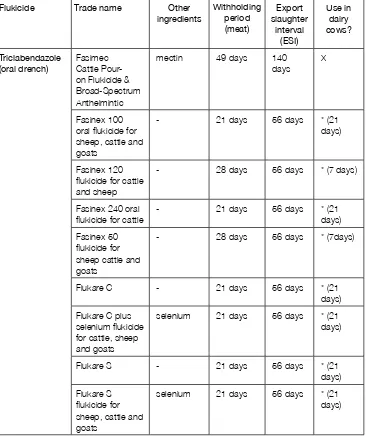
Table 12. Fluke treatments for cattle
Flukicide Trade name Other ingredients Withholding period (meat) Export slaughter interval (ESI) Use in dairy cows? Triclabendazole (pour-on) Anluke Pour-on for Cattle
mectin 49 days 140
days X Clorsulon (injection) Bovimectin Plus Injection roadspectrum Antiparasitic Injection for Cattle
mectin 28 days 42 days
Triclabendazole (pour-on)
Coopers Sovereign Pour-on for Cattle
mectin 28 days 70 days Only
replacement heifers that will not calve within 70 days Triclabendazole (oral drench)
Fasicare 120 - 21 days 56 days * (21
days) Triclabendazole (oral drench) Fasimec Cattle Oral Flukicide and Broad Spectrum Drench
mectin 21 days 56 days * (28
Flukicide Trade name Other ingredients Withholding period (meat) Export slaughter interval (ESI) Use in dairy cows? Triclabendazole (oral drench) Fasimec Cattle Pour-on Flukicide & Broad-Spectrum Anthelmintic
mectin 49 days 140
days
X
Fasinex 100 oral lukicide for sheep, cattle and goats
- 21 days 56 days * (21
days)
Fasinex 120 lukicide for cattle and sheep
- 28 days 56 days * (7 days)
Fasinex 240 oral
lukicide for cattle - 21 days 56 days * (21 days)
Fasinex 50 lukicide for sheep cattle and goats
- 28 days 56 days * (7days)
Flukare C - 21 days 56 days * (21
days)
Flukare C plus selenium lukicide for cattle, sheep and goats
selenium 21 days 56 days * (21 days)
Flukare S - 21 days 56 days * (21
days)
Flukare S lukicide for sheep, cattle and goats
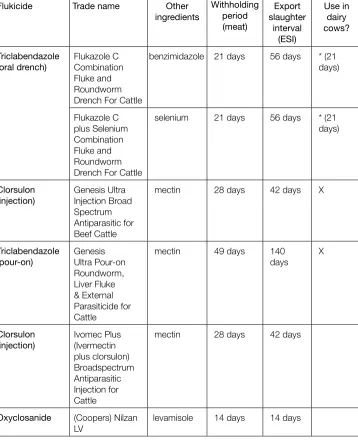
[image:48.420.19.385.72.509.2]Flukicide Trade name Other ingredients Withholding period (meat) Export slaughter interval (ESI) Use in dairy cows? Triclabendazole (oral drench) Flukazole C Combination Fluke and Roundworm Drench For Cattle
benzimidazole 21 days 56 days * (21 days) Flukazole C plus Selenium Combination Fluke and Roundworm Drench For Cattle
selenium 21 days 56 days * (21 days) Clorsulon (injection) Genesis Ultra Injection Broad Spectrum Antiparasitic for Beef Cattle
mectin 28 days 42 days X
Triclabendazole (pour-on) Genesis Ultra Pour-on Roundworm, Liver Fluke & External Parasiticide for Cattle
mectin 49 days 140
days X Clorsulon (injection) Ivomec Plus (Ivermectin plus clorsulon) Broadspectrum Antiparasitic Injection for Cattle
mectin 28 days 42 days
Oxyclosanide (Coopers) Nilzan LV
[image:49.420.44.402.75.515.2]Flukicide Trade name Other ingredients Withholding period (meat) Export slaughter interval (ESI) Use in dairy cows? Clorsulon (injection) Noromectin Plus Broadspectrum Antiparasitic Injection for Cattle
mectin 28 days 42 days
Triclabendazole (oral drench)
Tremacide 120 Flukicide for Cattle and Sheep
- 21 days 56 days * (21
days)
Clorsulon (injection)
Vetmec F Broad Spectrum Antiparasitic Cattle Injection
mectin 28 days 42 days X
Clorsulon (injection)
(Virbac) Virbamax Plus Antiparasitic Injection For Beef And Dairy Cattle
mectin 28 days 42 days
Clorsulon
(injection) (Virbac) Virbamec Plus Injection
Endectocide & Flukicide for Cattle
mectin 28 days 42 days
Triclabendazole (pour-on)
Young’s Triclamec Cattle Pour-on Flukicide & Broad-spectrum Anthelmintic
mectin 49 days 140 days X
Triclabendazole (oral drench) Young’s Triclamec Cattle Oral Flukicide and Broad Spectrum Drench
mectin 21 days Not avail * (28 days)
Triclabendazole (oral drench)
WSD LV Triclabendazole Oral Flukicide for Sheep, Cattle and Goats
[image:50.420.21.382.66.557.2]- 21 days 56 days * (21 days)
Table 12. Fluke treatments for cattle cont...
Flukicide Trade name Other ingredients
Withholding period (meat)
Export slaughter
interval (ESI)
Use in dairy cows?
Triclabendazole (oral drench)
Young’s Tricla 120 Flukicide for Cattle and Sheep
- 28 days Not avail * (21 days)
Triclabendazole (oral drench)
Young’s Tricla 50 Flukicide for Sheep, Cattle and Goats
- 21 days Not avail * (21 days)
X: product specifically not to be used in cows that are producing or may in the future produce milk for human consumption
* (n days): do not use on lactating cows, or cows that will calve in less than the indicated number of days, if milk will be used for human consumption. (For example, “* (28 days)” means product cannot be used in lactating cows or cows less than 28 days before calving if milk may be used for human consumption.)
Hormonal growth promotants
The hormonal growth promotants (HGPs) for cattle increase both weight gain and feed conversion efficiency. The increase in body weight is predominantly lean meat and not fat, so the carcase is more valuable. However, to achieve this growth response there must be a plentiful supply of good quality feed available.
HGPs work well and are generally very cost effective if young cattle are to be held for any length of time and there is adequate feed available. There is no scientific evidence that cattle treated with HGPs are a human health risk, however there is strong consumer concern about the use of HGPs in animals destined for human consumption. Meat from cattle treated with HGPs is not allowed into the European Union, and some of our live export markets have restrictions on the importation of HGP-treated cattle. Food safety is an emotive issue. The Australian live export trade must be very mindful of the market sensitivities involved.
HGP sales are subject to close inventory control and government audit. HGPs must be stored securely and used strictly in accordance with the manufacturer’s recommendations.
The HGPs registered for cattle are all pellets that must be implanted under the skin of the ear. No other implantation site is acceptable. Nor is it acceptable to use an HGP registered for cattle in any other species. Treated cattle must be individually identified with an approved ear punch. Adverse side effects include bulling, preputial prolapse (mainly in Bos indicus cattle), vaginal prolapse and rectal prolapse. However, the incidence of serious problems is low. Breeding cattle should not be treated with HGPs, as they can interfere with subsequent fertility.
Table 13. Hormonal growth promotants for cattle
Growth promotant Trade name Withholding period (meat)
Oestradiol Compudose 100 Nil
Compudose 200 Nil
Compudose 400 Nil
Oestradiol and testosterone
Progro H Nil
Synovex H Nil
Oestradiol and progesterone
Progro S Nil
Synovex C * Nil
Synovex S Nil
Oestradiol and
trenbolone Compudose G Nil
Progro TE-H Nil
Progro TE-S Nil
Revalor G Nil
Revalor H Nil
Revalor S Nil
Revalor I * Nil
Synovex with Trenbolone Acetate Nil
Trenbolone Progro T-S Nil
Pinkeye
Pinkeye is an infectious disease caused by the bacterium Moraxella bovis. Initially there is conjunctivitis and production of clear, watery tears. The cornea then develops a blue haze, which becomes more opaque and turns white over 3–4 days. Shallow ulcers develop on the cornea, and in a small proportion of cases there is perforation through into the eyeball. Sight i