HANDBOOK OF NATURE-INSPIRED
AND INNOVATIVE COMPUTING
HANDBOOK OF NATURE-INSPIRED
AND INNOVATIVE COMPUTING
Integrating Classical Models with
Emerging Technologies
Edited by
Albert Y. Zomaya
Handbook of Nature-Inspired and Innovative Computing: Integrating Classical Models with Emerging Technologies Edited by Albert Y. Zomaya
ISBN-10: 0-387-40532-1 e-ISBN-10: 0-387-27705-6
ISBN-13: 978-0387-40532-2 e-ISBN-13: 978-0387-27705-9 Printed on acid-free paper.
© 2006 Springer Science+Business Media, Inc.
All rights reserved. This work may not be translated or copied in whole or in part without the written permission of the publisher (Springer Science+Business Media, Inc., 233 Spring Street, New York, NY 10013, USA), except for brief excerpts in connection with reviews or scholarly analysis. Use in connection with any form of information storage and retrieval, electronic adaptation, computer soft-ware, or by similar or dissimilar methodology now known or hereafter developed is forbidden. The use in this publication of trade names, trademarks, service marks and similar terms, even if they are not identified as such, is not to be taken as an expression of opinion as to whether or not they are subject to proprietary rights.
Table of Contents
Contributors ix
Preface xiii
Acknowledgements xv
Section I: Models
Chapter 1: Changing Challenges for Collaborative Algorithmics 1
Arnold L. Rosenberg
Chapter 2: ARM++: A Hybrid Association Rule Mining Algorithm 45
Zahir Tari and Wensheng Wu
Chapter 3: Multiset Rule-Based Programming Paradigm
for Soft-Computing in Complex Systems 77
E.V. Krishnamurthy and Vikram Krishnamurthy
Chapter 4: Evolutionary Paradigms 111
Franciszek Seredynski
Chapter 5: Artificial Neural Networks 147
Javid Taheri and Albert Y. Zomaya
Chapter 6: Swarm Intelligence 187
James Kennedy
Chapter 7: Fuzzy Logic 221
Javid Taheri and Albert Y. Zomaya
Chapter 8: Quantum Computing 253
J. Eisert and M.M. Wolf
Section II: Enabling Technologies
Chapter 9: Computer Architecture 287
Joshua J. Yi and David J. Lilja
Chapter 10: A Glance at VLSI Optical Interconnects:
From the Abstract Modelings of the 1980s
to Today’s MEMS Implements 315
Chapter 11: Morphware and Configware 343
Reiner Hartenstein
Chapter 12: Evolving Hardware 387
Timothy G.W. Gordon and Peter J. Bentley
Chapter 13: Implementing Neural Models in Silicon 433
Leslie S. Smith
Chapter 14: Molecular and Nanoscale Computing and Technology 477
Mary M. Eshaghian-WIlner, Amar H. Flood, Alex Khitun, J. Fraser Stoddart and Kang Wang
Chapter 15: Trends in High-Performance Computing 511
Jack Dongarra
Chapter 16: Cluster Computing: High-Performance, High-Availability and
High-Throughput Processing on a Network of Computers 521
Chee Shin Yeo, Rajkumar Buyya, Hossein Pourreza, Rasit Eskicioglu, Peter Graham and Frank Sommers
Chapter 17: Web Service Computing: Overview and Directions 553
Boualem Benatallah, Olivier Perrin, Fethi A. Rabhi and Claude Godart
Chapter 18: Predicting Grid Resource Performance Online 575
Rich Wolski, Graziano Obertelli, Matthew Allen, Daniel Nurm and John Brevik
Section III: Application Domains
Chapter 19: Pervasive Computing: Enabling Technologies
and Challenges 613
Mohan Kumar and Sajal K. Das
Chapter 20: Information Display 633
Peter Eades, Seokhee Hong, Keith Nesbitt and Masahiro Takatsuka
Chapter 21: Bioinformatics 657
Srinivas Aluru
Chapter 22: Noise in Foreign Exchange Markets 697
George G. Szpiro
Editor in Chief Oak Ridge, TN 37831, USA
Mary Eshaghian-Wilner Dept of Electrical Engineering University of California, Los Angeles Los Angeles, CA 90095, USA
Gerard Milburn
University of Queensland St Lucia, QLD 4072, Australia
Franciszek Seredynski
Institute of Computer Science Polish Academy of Sciences Ordona 21, 01-237 Warsaw, Poland
Authors/Co-authors of Chapters
Matthew Allen
Computer Science Dept University of California, Santa
Barbara
Santa Barbara, CA 93106, USA
Srinivas Aluru
The University of New South Wales
Santa Barbara, CA 93106, USA
Rajkumar Buyya
Grid Computing and Distributed Systems Laboratory and NICTA
Victoria Laboratory
Dept of Computer Science and Software Engineering The University of Melbourne Victoria 3010, Australia
Sajal K. Das
Center for Research in Wireless Mobility and Networking (CReWMaN)
The University of Texas, Arlington Arlington, TX 76019, USA
Jack Dongarra
University of Tennessee Knoxville, TN 37996
and Oak Ridge National Laboratory Oak Ridge, TN 37831, USA
Peter Eades University of California, Los Angeles Los Angeles, CA 90095, USA
Rasit Eskicioglu
Parallel and Distributed Systems Laboratory
Dept of Computer Sciences The University of Manitoba Winniepeg, MB R3T 2N2, Canada
Amar H. Flood Dept of Chemistry
University of California, Los Angeles Los Angeles, CA 90095, USA
Claude Godart Winniepeg, MB R3T 2N2, Canada
Lili Hai
State University of New York College at Old Westbury
Old Westbury, NY 11568–0210, USA
Reiner Hartenstein
Los Angeles, CA 90095, USA
E. V. Krishnamurthy
Dept of Electrical and Computer Engineering
University of British Columbia Vancouver, V6T 1Z4, Canada
Mohan Kumar
Center for Research in Wireless Mobility and Networking (CReWMaN)
The University of Texas, Arlington
David J. Lilja
Dept of Electrical and Computer Engineering
Santa Barbara, CA 93106, USA
Graziano Obertelli Computer Science Dept University of California, Santa
Barbara
Santa Barbara, CA 93106, USA
Olivier Perrin Winniepeg, MB R3T 2N2, Canada
Fethi A. Rabhi
School of Information Systems, Technology and Management The University of New South Wales Sydney, NSW 2052, Australia Ordona 21, 01-237 Warsaw, Poland
Leslie Smith
Dept of Computing Science and Mathematics Los Angeles, CA 90005, USA
J. Fraser Stoddart Dept of Chemistry University of California,
Los Angeles
Los Angeles, CA 90095, USA
George G. Szpiro University of California, Los Angeles Los Angeles, CA 90095, USA
M.M. Wolf
Chee Shin Yeo
Grid Computing and Distributed Systems Laboratory and NICTA Victoria Laboratory
Dept of Computer Science and Software Engineering The University of Melbourne Victoria 3010, Australia
Joshua J. Yi
Freescale Semiconductor Inc, 7700 West Parmer Lane Austin, TX 78729, USA
Albert Y. Zomaya
Advanced Networks Research Group
School of Information Technology The University of Sydney
PREFACE
The proliferation of computing devices in every aspect of our lives increases the demand for better understanding of emerging computing paradigms. For the last fifty years most, if not all, computers in the world have been built based on the von Neumann model, which in turn was inspired by the theoretical model proposed by Alan Turing early in the twentieth century. A Turing machine is the most famous theoretical model of computation (A. Turing, On Computable Numbers, with an Application to the Entscheidungsproblem,Proc. London Math. Soc. (ser. 2), 42, pp. 230–265, 1936. Corrections appeared in: ibid., 43 (1937), pp. 544–546.) that can be used to study a wide range of algorithms.
The von Neumann model has been used to build computers with great success. It has also been extended to the development of the early supercomputers and we can also see its influence on the design of some of the high performance com-puters of today. However, the principles espoused by the von Neumann model are not adequate for solving many of the problems that have great theoretical and practical importance. In general, a von Neumann model is required to execute a precise algorithm that can manipulate accurate data. In many problems such con-ditions cannot be met. For example, in many cases accurate data are not available or a “fixed” or “static” algorithm cannot capture the complexity of the problem under study.
Therefore, The Handbook of Nature-Inspired and Innovative Computing: Integrating Classical Models with Emerging Technologies seeks to provide an opportunity for researchers to explore the new computational paradigms and their impact on computing in the new millennium. The handbook is quite timely since the field of computing as a whole is undergoing many changes. Vast litera-ture exists today on such new paradigms and their implications for a wide range of applications -a number of studies have reported on the success of such tech-niques in solving difficult problems in all key areas of computing.
It is also hoped that the topics covered will get readers to think of the impli-cations of such new ideas for developments in their own fields. Further, the enabling technologies and application areas are to be understood very broadly and include, but are not limited to, the areas included in the handbook.
The handbook endeavors to strike a balance between theoretical and practical coverage of a range of innovative computing paradigms and applications. The handbook is organized into three main sections: (I) Models, (II) Enabling Technologies and (III) Application Domains; and the titles of the different chap-ters are self-explanatory to what is covered. The handbook is intended to be a repository of paradigms, technologies, and applications that target the different facets of the process of computing.
The book brings together a combination of chapters that normally don’t appear in the same space in the wide literature, such as bioinformatics, molecular computing, optics, quantum computing, and others. However, these new para-digms are changing the face of computing as we know it and they will be influ-encing and radically revolutionizing traditional computational paradigms. So, this volume catches the wave at the right time by allowing the contributors to explore with great freedom and elaborate on how their respective fields are con-tributing to re-shaping the field of computing.
ACKNOWLEDGEMENTS
First and foremost we would like to thank and acknowledge the contributors to this volume for their support and patience, and the reviewers for their useful comments and suggestions that helped in improving the earlier outline of the handbook and presentation of the material. Also, I should extend my deepest thanks to Wayne Wheeler and his staff at Springer (USA) for their collaboration, guidance, and most importantly, patience in finalizing this handbook. Finally, I would like to acknowledge the efforts of the team from Springer’s production department for their extensive efforts during the many phases of this project and the timely fashion in which the book was produced.
Chapter 1
CHANGING CHALLENGES FOR
COLLABORATIVE ALGORITHMICS
Arnold L. Rosenberg
University of Massachusetts at Amherst
Abstract
Technological advances and economic considerations have led to a wide variety of modalities ofcollaborative computing: the use of multiple comput-ing agents to solve individual computational problems. Each new modality creates new challenges for the algorithm designer. Older “parallel” algorith-mic devices no longer work on the newer computing platforms (at least in their original forms) and/or do not address critical problems engendered by the new platforms’ characteristics. In this chapter, the field of collaborative algorithmicsis divided into four epochs, representing (one view of) the major evolutionary eras of collaborative computing platforms. The changing chal-lenges encountered in devising algorithms for each epoch are discussed, and some notable sophisticated responses to the challenges are described.
1
INTRODUCTION
Collaborative computingis a regime of computation in which multiple agents are enlisted in the solution of a single computational problem. Until roughly one decade ago, it was fair to refer to collaborative computing as parallel computing. Developments engendered by both economic considerations and technological advances make the older rubric both inaccurate and misleading, as the multi-processorsof the past have been joined by clusters—independent computers inter-connected by a local-area network (LAN)—and by various modalities ofInternet computing—loose confederations of computing agents of differing levels of com-mitment to the common computing enterprise. The agents in the newer collabo-rative computing milieux often do their computing at their own times and in their own locales—definitely not “in parallel.”
efficiency (measured in time and/or space and/or cost). This chapter presents one algorithmicist’s view of the paradigm-challenges milestones in the evolution of collaborative computing platforms and of the algorithmic challenges each change in paradigm has engendered. The chapter is organized around a some-what eccentric view of the evolution of collaborative computing technology through four “epochs,” each distinguished by the challenges one faced when devising algorithms for the associated computing platforms.
1. In the epoch ofshared-memory multiprocessors:
● One had to cope with partitioning one’s computational job into
dis-joint subjobs that could proceed in parallel on an assemblage of identi-cal processors. One had to try to keep all processors fruitfully busy as much of the time as possible. (The qualifier “fruitfully” indicates that the processors are actually working on the problem to be solved, rather than on, say, bookkeeping that could be avoided with a bit more cleverness.)
● Communication between processors was effected through shared
vari-ables, so one had to coordinate access to these variables. In particular, one had to avoid the potential races when two (or more) processors simultaneously vied for access to a single memory module, especially when some access was for the purpose of writing to the same shared variable.
● Since all processors were identical, one had, in many situations, to craft
protocols that gave processors separate identities—the process of so-calledsymmetry breakingorleader election. (This was typically neces-sary when one processor had to take a coordinating role in an algorithm.)
2. The epoch of message-passing multiprocessorsadded to the technology of the preceding epoch a user-accessible interconnection network—of known structure—across which the identical processors of one’s parallel computer communicated. On the one hand, one could now build much larger aggregations of processors than one could before. On the other hand:
● One now had to worry about coordinating the routing and transmission
of messages across the network, in order to select short paths for mes-sages, while avoiding congestion in the network.
● One had to organize one’s computation to tolerate the
often-consider-able delays caused by the point-to-point latency of the network and the effects of network bandwidth and congestion.
● Since many of the popular interconnection networks were highly
sym-metric, the problem of symmetry breaking persisted in this epoch. Since communication was now over a network, new algorithmic avenues were needed to achieve symmetry breaking.
● Since the structure of the interconnection network underlying one’s
is that one often needed quite disparate algorithmic strategies for dif-ferent classes of interconnection networks.
3. The epoch ofclusters—also known as networks of workstations(NOWs, for short)—introduced two new variables into the mix, even while rendering many sophisticated multiprocessor-based algorithmic tools obsolete. In Section 3, we outline some algorithmic approaches to the following new challenges.
● The computing agents in a cluster—be they pc’s, or multiprocessors, or
the eponymous workstations—are now independent computers that communicate with each other over a local-area network (LAN). This means that communication times are larger and that communication pro-tocols are more ponderous, often requiring tasks such as breaking long messages into packets, encoding, computing checksums, and explicitly setting up communications (say, via a hand-shake). Consequently, tasks must now be coarser grained than with multiprocessors, in order to amortize the costs of communication. Moreover, the respective compu-tations of the various computing agents can no longer be tightly coupled, as they could be in a multiprocessor. Further, in general, network latency can no longer be “hidden” via the sophisticated techniques developed for multiprocessors. Finally, one can usually no longer translate knowledge of network topology into network-specific optimizations.
● The computing agents in the cluster, either by design or chance (such as
being purchased at different times), are now often heterogeneous, dif-fering in speeds of processors and/or memory systems. This means that a whole range of algorithmic techniques developed for the earlier epochs of collaborative computing no longer work—at least in their original forms [127]. On the positive side, heterogeneity obviates sym-metry breaking, as processors are now often distinguishable by their unique combinations of computational resources and speeds.
4. The epoch of Internet computing, in its several guises, has taken the algo-rithmics of collaborative computing precious near to—but never quite reaching—that of distributed computing. While Internet computing is still evolving in often-unpredictable directions, we detail two of its circa-2003 guises in Section 4. Certain characteristics of present-day Internet com-puting seem certain to persist.
● One now loses several types of predictabilitythat played a significant
background role in the algorithmics of prior epochs.
– Interprocessor communication now takes place over the Internet. In this environment:
* a message shares the “airwaves” with an unpredictable number and assemblage of other messages; it may be dropped and resent; it may be routed over any of myriad paths. All of these factors make it impossible to predict a message’s transit time.
* a message may be accessible to unknown (and untrusted) sites, increasing the need for security-enhancing measures.
dedicated to the collaborative task. Even the modalities of Internet computing in which remote computing agents promise to complete computational tasks that are assigned to them typically do not guar-anteewhen. Moreover, even the guarantee of eventual computation is not present in all modalities of Internet computing: in some modalities remote agents cannot be relied upon everto complete assigned tasks.
● In several modalities of Internet computing, computation is now unre-liablein two senses:
– The computing agent assigned a task may, without announcement, “resign from” the aggregation, abandoning the task. (This is the extreme form of temporal unpredictability just alluded to.)
– Since remote agents are unknown and anonymous in some modal-ities, the computing agent assigned a task may maliciously return fallacious results. This latter threat introduces the need for computa-tion-related security measures (e.g., result-checking and agent moni-toring) for the first time to collaborative computing. This problem is discussed in a news article at 〈http://www.wired.com/news/technology/ 0,1282,41838,00.html〉.
In succeeding sections, we expand on the preceding discussion, defining the collaborative computing platforms more carefully and discussing the resulting challenges in more detail. Due to a number of excellent widely accessible sources that discuss and analyze the epochs of multiprocessors, both shared-memory and message-passing, our discussion of the first two of our epochs, in Section 2, will be rather brief. Our discussion of the epochs of cluster computing (in Section 3) and Internet computing (in Section 4) will be both broader and deeper. In each case, we describe the subject computing platforms in some detail and describe a variety of sophisticated responses to the algorithmic challenges of that epoch. Our goal is to highlight studies that attempt to develop algorithmic strategies that respond in novel ways to the challenges of an epoch. Even with this goal in mind, the reader should be forewarned that
● her guide has an eccentric view of the field, which may differ from the views
of many other collaborative algorithmicists;
● some of the still-evolving collaborative computing platforms we describe will
soon disappear, or at least morph into possibly unrecognizable forms;
● some of the “sophisticated responses” we discuss will never find application
beyond the specific studies they occur in.
This said, I hope that this survey, with all of its limitations, will convince the reader of the wonderful research opportunities that await her “just on the other side” of the systems and applications literature devoted to emerging collaborative computing technologies.
2
THE EPOCHS OF MULTIPROCESSORS
computing on this computing platform. The following books and surveys pro-vide an excellent detailed treatment of many subjects that we only touch upon and even more topics that are beyond the scope of this chapter: [5, 45, 50, 80, 93, 97, 134].
2.1
Multiprocessor Platforms
As technology allowed circuits to shrink, starting in the 1970s, it became fea-sible to design and fabricate computers that had many processors. Indeed, a few theorists had anticipated these advances in the 1960s [79]. The first attempts at designing such multiprocessors envisioned them as straightforward extensions of the familiar von Neumann architecture, in which a processor box—now pop-ulated with many processors—interacted with a single memory box; processors would coordinate and communicate with each other via shared variables. The resulting shared-memory multiprocessors were easy to think about, both for computer architects and computer theorists [61]. Yet using such multiproces-sors effectively turned out to present numerous challenges, exemplified by the following:
● Where/how does one identify the parallelism in one’s computational problem?
This question persists to this day, feasible answers changing with evolving technology. Since there are approaches to this question that often do not appear in the standard references, we shall discuss the problem briefly in Section 2.2.
● How does one keep all available processors fruitfully occupied—the problem
of load balancing? One finds sophisticated multiprocessor-based approaches to this problem in primary sources such as [58, 111, 123, 138].
● How does one coordinate access to shared data by the several processors of a
multiprocessor (especially, a shared-memory multiprocessor)? The difficulty of this problem increases with the number of processors. One significant approach to sharing data requires establishing order among a multiprocessor’s indistinguishable processors by selecting “leaders” and “subleaders,” etc. How does one efficiently pick a “leader” among indistinguishable processors— the problem of symmetry breaking? One finds sophisticated solutions to this problem in primary sources such as [8, 46, 107, 108].
● How can one route large numbers of messages within a network without
engen-dering congestion (“hot spots”) that renders communication insufferably slow? This is one of the few algorithmic challenges in parallel computing that has an acknowledged champion. The two-phase randomized routing strategy devel-oped in [150, 154] provably works well in a large range of interconnection net-works (including the popular butterfly and hypercube netnet-works) and empirically works well in many others.
● Can one exploit the new phenomenon—locality—that allows certain pairs of
processors to intercommunicate faster than others? The fact that locality can be exploited to algorithmic advantage is illustrated in [1, 101]. The phenome-non of locality in parallel algorithmics is discussed in [124, 156].
● How can one cope with the situation in which the structure of one’s
compu-tational problem—as exposed by the graph of data dependencies—is incom-patible with the structure of the interconnection network underlying the multiprocessor that one has access to? This is another topic not treated fully in the references, so we discuss it briefly in Section 2.2.
● How can one organize one’s computation so that one accomplishes valuable
work while awaiting responses from messages, either from the memory sub-system (memory accesses) or from other processors? A number of innovative and effective responses to variants of this problem appear in the literature; see, e.g., [10, 36, 66].
In addition to the preceding challenges, one now also faced the largely unan-ticipated, insuperable problem that one’s interconnection network may not “scale.” Beginning in 1986, a series of papers demonstrated that the physical realizations of large instances of the most popular interconnection networks could not provide performance consistent with idealized analyses of those net-works [31, 155, 156, 157]. A word about this problem is in order, since the phe-nomenon it represents influences so much of the development of parallel architectures. We live in a three-dimensional world: areas and volumes in space grow polynomially fast when distances are measured in units of length. This physical polynomial growth notwithstanding, for many of the algorithmically attractive interconnection networks—hypercubes, butterfly networks, and de Bruijn networks, to name just three—the number of nodes (read: “processors”) grows exponentiallywhen distances are measured in number of interprocessor links. This means, in short, that the interprocessor links of these networks must grow in length as the networks grow in number of processors.Analyses that pre-dict performance in number of traversed links do not reflect the effect of link-length on actual performance. Indeed, the analysis in [31] suggests—on the preceding grounds—that only the polynomially growing meshlike networks
can supply in practice efficiency commensurate with idealized theoretical analyses.1
1Figure 1.1 depicts the four mentioned networks. See [93, 134] for definitions and discussions of
We now discuss briefly a few of the challenges that confronted algorithmicists during the epochs of multiprocessors. We concentrate on topics that are not treated extensively in books and surveys, as well as on topics that retain their rel-evance beyond these epochs.
2.2
Algorithmic Challenges and Responses
Finding Parallelism. The seminal study [37] was the first to systematically distinguish between the inherently sequential portion of a computation and the parallelizable portion. The analysis in that source led to Brent’s Scheduling Principle, which states, in simplest form, that the time for a computation on ap-processor computer need be no greater than t+n/p, where tis the time for the inherently sequential portion of the computation and nis the total num-ber of operations that must be performed. While the study illustrates how to achieve the bound of the Principle for a class of arithmetic computations, it leaves open the challenge of discovering the parallelism in general computa-tions. Two major approaches to this challenge appear in the literature and are discussed here.
Parallelizing computations via clustering/partitioning. Two related major approaches have been developed for scheduling computations on parallel com-puting platforms, when the computation’s intertask dependencies are represented by a computation-dag—adirected acyclic graph, each of whose arcs (x→y) beto-kens the dependence of task yon task x; sources never appear on the right-hand side of an arc; sinks never appear on the left-hand side.
The first such approach is to clustera computation-dag’s tasks into “blocks” whose tasks are so tightly coupled that one would want to allocate each block to a single processor to obviate any communication when executing these tasks. A number of efficient heuristics have been developed to effect such clustering for general computation-dags [67, 83, 103, 139]. Such heuristics typically base their clustering on some easily computed characteristic of the dag, such as its critical
1,0
000 001 010 011 100 101 110 111 000 001 010 011 100 101 110 111 000 001 010 011 100 101 110 111
000 001 010 011 100 101 110 111 Level
0 1 2
0
path—the most resource-consuming source-to-sink path, including both compu-tation time and volume of intertask data—or its dominant sequence—a source-to-sink path, possibly augmented with dummy arcs, that accounts for the entire makespan of the computation. Several experimental studies compare these heuristics in a variety of settings [54, 68], and systems have been developed to exploit such clustering in devising schedules [43, 140, 162]. Numerous algorithmic studies have demonstrated analytically the provableeffectiveness of this approach for special scheduling classes of computation-dags [65, 117].
Dual to the preceding clustering heuristics is the process of clustering by graph separation. Here one seeks to partition a computation-dag into subdags by “cut-ting” arcs that interconnect loosely coupled blocks of tasks. When the tasks in each block are mapped to a single processor, the small numbers of arcs intercon-necting pairs of blocks lead to relatively small—hence, inexpensive—interproces-sor communications. This approach has been studied extensively in the parallel-algorithms literature with regard to myriad applications, ranging from circuit layout to numerical computations to nonserial dynamic programming. A small sampler of the literature on specific applications appears in [28, 55, 64, 99, 106]; heuristics for accomplishing efficient graph partitioning (especially into roughly equal-size subdags) appear in [40, 60, 82]; further sample applications, together with a survey of the literature on algorithms for finding graph separa-tors, appears in [134].
Parallelizing using dataflow techniques. A quite different approach to finding parallelism in computations builds on the flow of datain the computation. This approach originated with the VLSI revolution fomented by Mead and Conway [105], which encouraged computer scientists to apply their tools and insights to the problem of designing computers. Notable among the novel ideas emerging from this influx was the notion of systolic array—a dataflow-driven special-pur-pose parallel (co)processor [86, 87]. A major impetus for the development of this area was the discovery, in [109, 120], that for certain classes of computations— including, e.g., those specifiable via nested for-loops—such machines could be designed “automatically.” This area soon developed a life of its own as a tech-nique for finding parallelism in computations, as well as for designing special-pur-pose parallel machines. There is now an extensive literature on the use of systolic design principles for a broad range of specific computations [38, 39, 89, 91, 122], as well as for large general classes of computations that are delimited by the struc-ture of their flow of data [49, 75, 109, 112, 120, 121].
Network emulations. The theory of network emulations focuses on the prob-lem of making one computation-graph—the host—“act like” or “look like” another—theguest. In both of the scenarios that motivate this endeavor, the host
H represents an existing interconnection network. In one scenario, the guest Gis a directed graph that represents the intertask dependencies of a computation. In the other scenario, the guest G is an undirected graph that represents an ideal interconnection network that would be a congenial host for one’s computation. In both scenarios, computational efficiency would clearly be enhanced if H sl inter-connection structure matched G sl —or could be made to appear to.
Almost all approaches to network emulation build on the theory of graph embeddings, which was first proposed as a general computational tool in [126]. Anembedding〈a,r〉of the graph G= (VG,EG)into the graph H = (VH,EH) con-sists of a one-to-one map a:VG"VH, together with a mapping of EG intopaths inH such that, for each edge ( , )u u !EG, the path r(u,u) connects nodes a(u) and a(u) in H. The two main measures of the quality of the embedding 〈a,r〉are the
dilation, which is the length of the longest path of H that is the image, under r, of some edge ofG; and the congestion, which is the maximum, over all edges eof
H, of the number ofr-paths in which edge eoccurs. In other words, it is the max-imum number of edges ofG that are routed across eby the embedding.
It is easy to use an embedding of a network G into a network H to translate an algorithm designed for G into a computationally equivalent algorithm for H. Basically: the mapping aidentifies which node of H is to emulate which node of
G; the mapping ridentifies the routes in H that are used to simulate internode message-passing in G. This sketch suggests why the quantitative side of network-emulations-via-embeddings focuses on dilation and congestion as the main meas-ures of the quality of an embedding. A moment’s reflection suggests that, when one uses an embedding 〈a,r〉of a graph G into a graph H as the basis for an emulation ofG by H, any algorithm that is designed for G is slowed down by a factorO(congestion×dilation) when run on H. One can sometimeseasily orches-trate communications to improve this factor to O(congestion+dilation); cf. [13]. Remarkably, one can alwaysimprove the slowdown to O(congestion+dilation): a nonconstructive proof of this fact appears in [94], and, even more remarkably, a constructive proof and efficient algorithm appear in [95].
computations, is embedded into hypercubes in [57] and into the de Bruijn net-work in [142]. The emulations in [11, 12] attempt to exploit the algorithmic attrac-tiveness of the hypercube, despite its earlier-mentioned physical intractability. The study in [13], unusual for its algebraic underpinnings, was motivated by the (then-) unexplained fact—observed, e.g., in [149]—that algorithms designed for the butterfly network run equally fast on the de Bruijn network. An intimate algebraic connection discovered in [13] between these networks—the de Bruijn network is a quotientof the butterfly—led to an embedding of the de Bruijn network into the hypercube that had exponentially smaller dilation than any competitors known at that time.
The embeddings discussed thus far exploit structural properties that are peculiar to the target guest and host graphs. When such enabling properties are hard to find, a strategy pioneered in [25] can sometimes produce efficient embeddings. This source crafts efficient embeddings based on the ease of recursively decomposing a guest graph G into subgraphs. The insight underlying this embedding-via-decomposition strategy is that recursive bisection—the repeated decomposition of a graph into like-sized subgraphs by “cutting” edges—affords one a representation ofGas a binary-tree-like structure.2The root of this structure is the graph G; the root’s two children are the two subgraphs ofG—call them G0andG1—that the first bisection partitions
G into. Recursively, the two children of node Gx of the tree-like structure (where x is a binary string) are the two subgraphs of Gx—call them Gx0 andGx1—that the bisection partitions Gx into. The technique of [25] transforms an (efficient) embed-ding of this “decomposition tree” into a host graph H into an (efficient) embedding ofG intoH, whose dilation (and, often, congestion) can be bounded using a stan-dard measure of the ease of recursively bisecting G. A very few studies extend and/or improve the technique of [25]; see, e.g., [78, 114].
When networks G andH are incompatible—i.e., there is no efficient embed-ding of G into H—graph embeddings cannot lead directly to efficient emula-tions. A technique developed in [84] can sometimes overcome this shortcoming and produce efficient network emulations. The technique has H emulate G by alternating the following two phases:
Computation phase. Use an embedding-based approach to emulate Gpiecewise for short periods of time (whose durations are determined via analysis).
Coordination phase. Periodically (frequency is determined via analysis) coor-dinate the piecewise embedding-based emulations to ensure that all pieces have fresh information about the state of the emulated computation.
This strategy will produce efficient emulations if one makes enough progress during the computation phase to amortize the cost of the coordination phase. Several examples in [84] demonstrate the value of this strategy: each presents a phased emulation of a network Gby a network H that incurs only constant-fac-tor slowdown, while any embedding-based emulation of G by H incurs slow-down that depends on the sizes of Gand H.
We mention one final, unique use of embedding-based emulations. In [115], a suite of embedding-based algorithms is developed in order to endow a multi-processor with a capability that would be prohibitively expensive to supply in
hard-2See [134] for a comprehensive treatment of the theory of graph decomposition, as well as of
ware. The gaugeof a multiprocessor is the common width of its CPU and memory bus. A multiprocessor can be multigaugedif, under program control, it can dynam-ically change its (apparent) gauge. (Prior studies had determined the algorithmic value of multigauging, as well as its prohibitive expense [53, 143].) Using an embed-ding-based approach that is detailed in [114], the algorithms of [115] efficiently endow a multiprocessor architecture with a multigauging capability.
The use of parameterized models. A truly revolutionary approach to the prob-lem of matching computation structure to network structure was proposed in [153], the birthplace of the bulk-synchronousparallel (BSP) programming para-digm. The central thesis in [153] is that, by appropriately reorganizing one’s com-putation, one can obtain almost all of the benefits of message-passing parallel computation while ignoring all aspects of the underlying interconnection net-work’s structure, save its end-to-end latency. The needed reorganization is a form of task-clustering: one organizes one’s computation into a sequence of computa-tional “supersteps”—during which processors compute locally, with no inter-communication—punctuated by communication “supersteps”—during which processors synchronize with one another (whence the term bulk-synchronous) and perform a stylized intercommunication in which each processor sends hmessages tohothers. (The choice ofhdepends on the network’s latency.) It is shown that a combination of artful message routing—say, using the congestion-avoiding tech-nique of [154]—and latency-hiding techtech-niques—notably, the method of parallel slackthat has the host parallel computer emulate a computer with more proces-sors—allows this algorithmic paradigm to achieve results within a constant fac-tor of the parallel speedup available via network-sensitive algorithm design. A number of studies, such as [69, 104], have demonstrated the viability of this approach for a variety of classes of computations.
The focus on network latency and number of processors as the sole architectural parameters that are relevant to efficient parallel computation limits the range of architectural platforms that can enjoy the full benefits of the BSP model. In response, the authors of [51] have crafted a model that carries on the spirit of BSP but that incorporates two further parameters related to interprocessor communica-tion. The resulting LogPmodel accounts for latency(the “L” in “LogP”),overhead
(the “o,”)—the cost of setting up a communication,gap(the “g,”)—the minimum interval between successive communications by a processor, and processor number
(the “P”). Experiments described in [51] validate the predictive value of the LogP model in multiprocessors, at least for computations involving only short inter-processor messages. The model is extended in [7], to allow long, but equal-length, messages. One finds in [29] an interesting study of the efficiency of parallel algo-rithms developed under the BSP and LogP models.
3
CLUSTERS/NETWORKS OF WORKSTATIONS
3.1
The Platform
cluster(or, equally commonly, a network) of computers to cooperate in the solu-tion of a computasolu-tional problem; see [9, 119]. Note that while one typically talks about a network of workstations(aNOW, for short), the constituent computers in a NOW may well be pc’s or multiprocessors; the algorithmic challenges change quantitatively but not qualitatively depending on the architectural sophistication of the “workstations.” The computers in a NOW intercommunicate via a LAN— local area network—whose detailed structure is typically neither known to nor accessible by the programmer.
3.2
Some Challenges
Some of the challenges encountered when devising algorithms for NOWs differ only quantitatively from those encountered with multiprocessors. For instance:
● The typically high latencies of LANs (compared to interconnection
net-works), coupled with the relatively heavyweight protocols needed for robust communication, demand coarse-grained tasks in order to amortize the costs of communication.
Some new challenges arise from the ineffectiveness in NOWs of certain multi-processor-based algorithmic strategies. For instance:
● The algorithm designer typically cannot exploit the structure of the LAN
underlying a NOW.
● The higher costs of communication, coupled with the loose coordination of a
NOW’s workstations, render the (relatively) simple latency-hiding techniques of multiprocessors ineffective in clusters.
Finally, some algorithmic challenges arise in the world of collaborative com-puting for the first time in clusters. For instance:
● The constituent workstations of a NOW may differ in processor and/or
mem-ory speeds; i.e., the NOW may be heterogeneous(be an HNOW).
All of the issues raised here make parameterized models such as those dis-cussed at the end of Section 2.2 an indispensable tool to the designers of algo-rithms for (H)NOWs. The challenge is to craft models that are at once faithful enough to ensure algorithmic efficiency on real NOWs and simple enough to be analytically tractable. The latter goal is particularly elusive in the presence of het-erogeneity. Consequently, much of the focus in this section is on models that have been used successfully to study several approaches to computing in (H)NOWs.
3.3
Some Sophisticated Responses
3.3.1 Cluster computing via workstealing
Workstealingis a modality of cluster computing wherein an idle workstation seeks work from a busy one. This allocation of responsibility for finding work has the benefit that idle workstations, not busy ones, do the unproductive chore of searching for work. The most comprehensive study of workstealing is the series of papers [32]–[35], which schedule computations in a multiprocessor or in a (homogeneous) NOW. These sources develop their approach to workstealing from the level of programming abstraction through algorithm design and analy-sis through implementation as a working system (called Cilk [32]). As will be detailed imminently, these sources use a strict form of multithreading as a mech-anism for subdividing a computation into chunks (specifically, threads of unit-time tasks) that are suitable for sharing among collaborating workstations. The strength and elegance of the results in these sources has led to a number of other noteworthy studies of multithreaded computations, including [1, 14, 59]. A very abstract study of workstealing, which allows one to assess the impact of changes in algorithmic strategy easily, appears in [110], which we describe a bit later.
A. Case study [34]: From an algorithmic perspective, the main paper in the series about Cilk and its algorithmic underpinnings is [34], which presents and analyzes a (randomized) mechanism for scheduling “well-structured” multi-threaded computations, achieving both time and space complexity that are within constant factors of optimal.
Within the model of [34], a thread is a collection of unit-time tasks, linearly ordered by dependencies; graph-theoretically, a thread is, thus, a linear computa-tion-dag. A multithreaded computationis a set of threads that are interconnected in a stylized way. There is a root thread. Recursively, any task of any thread Tmay have k ≥ 0spawn-arcs to the initial tasks of k threads that are children of T. If thread T′is a child of thread Tvia a spawn-arc from tasktof T, then the last task of T′has a continue-arc to some task t′of Tthat is a successor of task t. Both the spawn-arcs and continue-arcs individually thus give the computation the structure of a tree-dag (see Figure 1.2). All of the arcs of a multithreaded com-putation represent data dependencies that must be honored when executing the computation. A multithreaded computation is strictif all data-dependencies for the tasks of a thread Tgo to an ancestor of thread Tin the thread-tree; the com-putation is fully strict if all dependencies in fact go to T’s parent in the tree. Easily,
t
t’
T’ T
s’ s
T"
u’ v’
u v
any multithreaded computation can be made fully strict by altering the depend-ency structure; this restructuring may affect the available parallelism in the com-putation but will not compromise its correctness. The study in [34] focuses on scheduling fully strict multithreaded computations.
In the computing platform envisioned in [34], a multithreaded computation is stored in shared memory. Each individual thread Thas a block of memory (called anactivation frame), within the local memory of the workstation that “owns”T, that is dedicated to the computation of T’s tasks. Space is measured in terms of activation frames.
Time is measured in [34] as a function of the number of workstations that are collaborating in the target computation. Tp is the minimum computation time when there are pcollaborating workstations; therefore,T1is the total amount of work in the computation. T∞ is dag-depthof the computation, i.e., the length of the longest source-to-sink path in the associated computation-dag; this is the “inherently sequential” part of the computation. Analogously,Spis the minimum space requirement for the target computation,S1being the “activation depth” of the computation.
Within the preceding model, the main contribution of [34] is a provably effi-cient randomized workstealing algorithm,ProcedureWorksteal (see Figure 1.3), which executes the fully strict multithreaded computation rooted at thread T. In the Procedure, each workstation maintains a ready dequeof threads that are eli-gible for execution; these deques are accessible by all workstations. Each deque has a bottomand a top; threads can be inserted at the bottom and removed from either end. A workstation uses its ready deque as a procedure stack, pushing and popping from the bottom. Threads that are “stolen” by other workstations are removed from the top of the deque. It is shown in [34] that Procedure Worksteal
is close to optimal in both time and space complexity.
● For any fully strict multithreaded computation,Procedure Worksteal,when run on a p-workstation NOW, uses space≤S1p.
Normal execution. A workstation Pseeking work removes (pops) the thread at the bottom of its ready deque—call it thread T—and begins executing T’s tasks seriatim.
A stalled thread is enabled. If executing one ofT’s tasks enables a stalled thread T′, then the now-ready thread T′is pushed onto the bottom ofP’s ready deque. (A thread stallswhen the next task to be executed must await data from a task that belongs to another thread.) /*Because of full strictness: thread T′must be thread T’s parent; thread T’s deque must be
empty when T′is inserted.*/
A new thread is spawned. If the task of thread Tthat is currently being executed spawns a child thread T′, then thread Tis pushed onto the bottom ofP’s ready deque, and Pbegins to work on thread T′.
A thread completes or stalls. If thread Tcompletes or stalls, then Pchecks its ready deque. Nonempty ready deque. If its deque is not empty, then Ppops the bottommost thread and
starts working on it.
Empty ready deque. If its deque is empty, then Pinitiates workstealing. It chooses a work-station P′uniformly at random, “steals” the topmost thread in P′’s ready deque, and starts working on that thread. If P′’s ready deque is empty, then Pchooses another random “victim.”
● LetProcedure Workstealexecute a multithreaded computation on a p-worksta-tion NOW. If the computap-worksta-tion has dag-depth T∞and work T1,then the expected running time, including scheduling overhead, is O(T1/p + T∞). This is clearly within a constant factor of optimal.
B. Case study [110]: The study in [34] follows the traditional algorithmic par-adigm. An algorithm is described in complete detail, down to the design of its underlying data structures. The performance/behavior of the algorithm is then analyzed in a setting appropriate to the genre of the algorithm. For instance, since
Procedure Workstealis a randomized algorithm, its performance is analyzed in [34] under the assumption that its input multithreaded computation is selected uniformly at random from the ensemble of such computations. In contrast to the preceding approach, the study in [110] describes an algorithm abstractly, via its state space and state-transition function. The performance/behavior of the algo-rithm is then analyzed by positing a process for generating the inputs that trigger state changes. We illustrate this change of worldview by describing Procedure Worksteal and its analysis in the framework of [110] in some detail. We then briefly summarize some of the other notable results in that source.
In the setting of [110], when a computer (such as a homogeneous NOW) is used as a workstealing system, its workstations execute tasks that are generated dynamically via a Poisson process of rate λ< 1. Tasks require computation time that is distributed exponentially with mean 1; these times are not known to work-stations. Tasks are scheduled in a First-Come-First-Served fashion, with tasks awaiting execution residing in a FIFO queue. The loadof a workstation Pat time
tis the number of tasks in P’s queue at that time. At certain times (characterized by the algorithm being analyzed), a workstation P′can steal a task from another workstation P. When that happens, a task at the output end ofP’s queue (if there is one) instantaneouslymigrates to the input end ofP′’s queue. Formally, a work-stealing system is represented by a sequence of variables that yield snapshots of the state of the system as a function of the time t. Say that the NOW being analyzed has nconstituent workstations.
● n
is the fraction of workstations of load l.
● s tl( ) p ti( ) m t nl( )/
Thestate of a workstealing system at time t is the infinite-dimensional vector ( ) ( ), ( ), ( ),
s tdefGs t s t s t0 1 2 fH.
view time as a continuousvariable, thereby enabling the use of differentials rather than differences when analyzing changes in the variables that characterize a sys-tem’s state.
We enhance legibility henceforth by omitting the time variable t when it is clear from context. Note that s0/1and that the slare nonincreasing, since sl–1
−sl=pl. The systems analyzed in [110] also have liml→∞sl= 0.
We introduce the general process of characterizing a system’s (limiting) per-formance by focusing momentarily on a system in which no workstealing takes place. Let us represent by dta small interval of time, in which only one event (a task arrival or departure) takes place at a workstation. The model of task arrivals (via a Poisson process with rate λ) means that the expected change in the variable ml
due to task arrivals is λ(ml–1−ml) dt. By similar reasoning, the expected change in ml due to task departures—recall that there is no stealing going on—is just (ml − ml+1)dt. It follows that the expected net behavior of the system over short
or, equivalently (by eliminating the ubiquitous factor of n, the size of the NOW),
( ) ( )
This last characterization of state changes illustrates the changes’ independ-ence from the aggregate number of workstations, depending instead only on the densities of workstations with various loads. The technical implications of this fact are discussed in some detail in [110], with appropriate pointers to the under-lying mathematical texts.
In order to analyze the performance of Procedure Workstealwithin the cur-rent model, one must consider how the Procedure’s various actions are perceived by the workstations of the subject workstealing system. First, under the Procedure, a workstation Pthat completes its last task seeks to steal a task from a randomly chosen fellow workstation, P′, succeeding with probability s2 (the probability that P′has at least two tasks). Hence,Pnow perceives completion of its final task as emptying its queue only with probability 1 −s2. Mathematically, we thus have the following modified first equation of system (3.1):
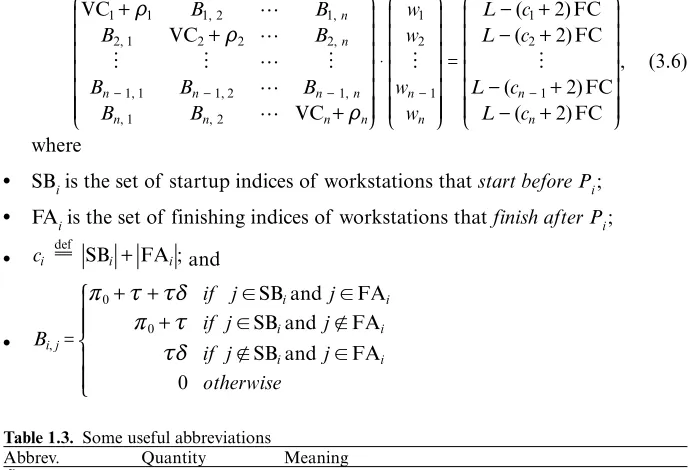
( ) ( )( )
For l> 1,slnow decreases whenever a workstation with load l eithercompletes a task orhas a task stolen from it. The rate at which workstations steal tasks is justs1−s2, i.e., the rate at which workstations complete their final tasks. We thus complete our modification of system (3.1) as follows:
> , ( ) ( )( )
– tasks complete at rate s1n, the number of busy workstations; – tasks arrive at rate λn; and
– at the fixed point, tasks arrive and complete at the same rate;
● from (3.2) and the fact that ds
The message of the preceding analysis becomes clear only when one performs the same exercise with the system (3.1), which characterizes a “workstealing sys-tem” in which there is no workstealing. For that system, one finds that pl= λl, indicating that, in the limiting state, tasks are being completed at rate λ. Under the workstealing regimen ofProcedure Worksteal, we still have the pl, for l> 2, decreasing geometrically, but now the damping ratio is < .
1+m r- 2
m m In other
words, workstealing under the Procedure has the same effect as increasing the service rate of tasks in the workstealing system!
Simulation experiments in [110] help one evaluate the paper’s abstract treat-ment. The experiments indicate that, even with n= 128 workstations, the model’s predictions are quite accurate, at least for smaller arrival rates. Moreover, the quality of these predictions improve with larger nand smaller arrival rates.
The study in [110] goes on to consider several variations on the basic theme of workstealing, including precluding
(1) stealing work from workstations whose queues are almost empty; and (2) stealing work when load gets below a (positive) threshold. Additionally,
one finds in [110] refined analyses and more complex models for work-stealing systems.
3.3.2 Cluster computing via cycle-stealing
Cycle-stealing, the use by one workstation of idle computing cycles of another, views the world through the other end of the computing telescope from work-stealing. The basic observation that motivates cycle-stealing is that the worksta-tions in clusters tend to be idle much of the time—due, say, to a user’s pausing for deliberation or for a telephone call, etc.—and that the resulting idle cycles can fruitfully be “stolen” by busy workstations [100, 145]. Although cycle-stealing ostensibly puts the burden of finding available computing cycles on the busy workstations (the criticisms leveled against cycle-stealing by advocates of work-stealing), the just-cited sources indicate that this burden can often be offloaded onto a central resource, or at least onto a workstation’s operating system (rather than its application program).
“borrowed” workstation before its owner returns—which event results in the cycle-stealer’s job being killed!
A. Case study [16]: One finds in [16] a randomized cycle-stealing strategy that, with high probability, succeeds within a logarithmic factor of optimal work pro-duction. The underlying formal setting is as follows.
● All of the nworkstations that are candidates as cycle donors are equally
pow-erful computationally; i.e., the subject NOW is homogeneous.
● The cycle-stealer has a job that requires d steps of computation on any of
these candidate donors.
● At least one of the candidate donors will be idle for a period of D≥3dlog n
time units (= steps).
Within this setting, the following simple randomized strategy provably steals cycles successfully, with high probability.
Phase 1. At each step, the cycle-stealer checks the availability of all n worksta-tions in turn: first P1, then P2, and so on.
Phase 2. If, when checking workstation Pi, the cycle-stealer finds that it was idle at the last time unit, s/he flips a coin and assigns the job to Piwith probabil-ity (1/d)n3x/D−2, where xis the number of time units for which P
ihas been idle. The provable success of this strategy is expressed as follows.
● With probability≥1−O((dlog n)/D+1/n),the preceding randomized strat-egy will allow the cycle-stealer to get his/her job done.
It is claimed in [16] that same basic strategy will actually allow the cycle-stealer to get log n d-step jobs done with the same probability.
B. Case study [131]: In [26, 128, 129, 131], cycle-stealing is viewed as a game against a malicious adversary who seeks to interrupt the borrowed workstation in order to kill all work in progress and thereby minimize the amount of work pro-duced during a cycle-stealing opportunity. (In these studies, cycles are stolen from one workstation at a time, so the enterprise is unaffected by the presence or absence of heterogeneity.) Clearly, cycle-stealing within the described adversarial model can accomplish productive work only if the metaphorical “malicious adversary” is somehow restrained from just interrupting every period when the cycle-donor is doing work for the cycle-stealer, thereby killing all work done by the donor. The restraint studied in the Known-Riskmodel of [26, 128, 131] resides in two assumptions: (1) we know the instantaneous probability that the cycle-donor has notbeen reclaimed by its owner; (2) the life functionQthat exposes this probabilistic information—Q( )t is the probability that the donor has not been reclaimed by its owner by time t—is “smooth.” The formal setting is as follows.
● The cycle-stealer,A, has a large bag of mutually independent tasks of equal sizes(which measure the cost of describing each task) and complexities(which measure the cost of computing each task).
● Each pair of communications—in which Asends work to the donor,B, and B
returns the results of that work to A—incurs a fixed cost c. This cost is kept independent of the marginal per-task cost of communicating between Aand
● Bis dedicated to A’s work during the cycle-stealing opportunity, so its
com-putation time is known exactly.
● Time is measured in work-units (rather than wall-clock time); one unit of work
is the time it takes for
– workstation Ato transmit a single task to workstation B(this is the mar-ginal transmission time for the task: the (fixed) setup time for each com-munication—during which many tasks will typically be transmitted—is accounted for by the parameter c);
– workstation Bto execute that task; and
– workstation Bto return its results for that task to workstation A.
Within this setting, a cycle-stealing opportunity is a sequence ofepisodes dur-ing which workstation Ahas access to workstation B, punctuated by interrupts
caused by the return ofB’s owner. When scheduling an opportunity, the vulnera-bility of Ato interrupts, with their attendant loss of work in progress on B, is decreased by partitioning each episode into periods, each beginning with A send-ing work to B and ending either with an interrupt or with B returning the results of that work.A’s discretionary power thus resides solely in deciding how much work to send in each period, so an (episode-) schedule is simply a sequence of positive period-lengths: S = t0, t1, . . . . A length-t period in an episode accomplishes t6cdefmax( ,0t-c) units of work if it is not interrupted and 0 units of work if it is interrupted. Thus, the episode scheduled
bySaccomplishes (ti c)
!
units of work when it is interrupted during period k. Focus on a cycle-stealing episode whose lifespan (def its maximum possible duration) is Ltime units. As noted earlier, we are assuming that we know the risk ofB’s being reclaimed, via a decreasing life function,( )t def r
Q Q (Bhas not been interrupted by time t),
which satisfies (1) Q( )0 =1 (to indicate B’s availability at the start of the episode); and (2) Q( )L =0 (to indicate that the interrupt will have occurred by timeL). The earlier assertion that life functions must be “smooth” is embod-ied in the formal requirement that Q be differentiable in the interval (0, L). The goal is to maximize the expected work production from an episode gov-erned by the life function Q, i.e., to find a schedule S whose expected work production,
is maximum, over all schedules for Q. In summation (3.4): each Tiis the partial sum
.
Ti t t ti
def
0+ +2 f+
The presence of positive subtraction,6, in (3.4) makes analyses of life
● One can effectively3replace any schedule S for life function Qby a productive schedule St such thatEXP-WORK( ;S Pt )≥EXP-WORK( ;S P).
One finds in [131] a proof that the following characterization of optimal schedules allows one to compute such schedules effectively.
● The productive schedule S t t, , ,t m
0 1 f 1
= - is optimal for the differentiable life
functionQif, and only if, for each period-index k ≥0, save the last, period-length tkis given by4
( ) ( , ( ) ( ) ( )).
P Tk =max 0 P Tk-1 + tk-1-c P Tl k-1 (3.5) Since the explicit computation of schedules from system (3.5) can be compu-tationally inefficient, relying on general function optimization techniques, the fol-lowing simplifying initial conditions are presented in [131] for certain simple life functions.
● When P is convex (resp., concave),5the initial period-length t
0is bounded above
3.3.3 Cluster computing via worksharing
Whereas workstealing and cycle-stealing involve a transaction between two workstations in an (H)NOW, worksharingtypically involves many workstations working cooperatively. The qualifier cooperativelydistinguishes the enterprise of worksharing from the passive cooperation of the work donor in workstealing and the grudging cooperation of the cycle donor in cycle-stealing.
In this section, we describe three studies of worksharing, namely, the study in [2], one of four problems studied in [20], and the most general HNOW model of [17]. (We deal with these sources in the indicated order to emphasize relevant sim-ilarities and differences.) These sources differ markedly in their models of the HNOW in which worksharing occurs, the characteristics of the work that is being shared, and the way in which worksharing is orchestrated. Indeed, part of our motivation in highlighting these three studies is to illustrate how apparently minor changes in model—of the computing platform or the workload—can lead to major changes in the algorithmics required to solve the worksharing problem (nearly) optimally. (Since the model of [20] is described at a high level in that paper, we have speculatively interpreted the architectural antecedents of the model’s features for the purposes of enabling the comparison in this section.)
All three of these studies focus on some variant of the following scenario. A master workstation P0has a large bag of mutually independent tasks of equal sizes and complexities.P0has the opportunity to employ the computing power of
3The qualifier effectivelymeans that the proof is constructive. 4As usual,f′denotes the first derivative of the univariate function f.
5The life function P isconcave(resp.,convex) if its derivative Plnever vanishes at a point x
an HNOW Ncomprising workstations P1,P2, . . .,Pn.P0transmits work to each of N sl workstations, and each workstation (eventually) sends results back to P0. Throughout the worksharing process, N sl workstations are dedicated to P0’s workload. Some of the major differences among the models of the three sources are highlighted in Table 1.1. The “N/A” (“Not Applicable”) entries in the table reflect the fact that only short messages (single tasks) are transmitted in [17]. The goal of all three sources is to allocate and schedule work optimally, within the context of the following problems:
The HNOW-Utilization Problem.P0seeks to reach a “steady-state” in which the average amount of work accomplished per time unit is maximized.
The HNOW-Exploitation Problem.P0has access to N for a prespecified fixed period of time (thelifespan) and seeks to accomplish as much work as pos-sible during this period.
The HNOW-Rental Problem.P0seeks to complete a prespecified fixed amount of work on N during as short a period as possible.
The study in [17] concentrates on the HNOW-Utilization Problem. The studies of [2, 20] concentrate on the HNOW-Exploitation Problem, but this concentration is just for expository convenience, since the HNOW-Exploitation and -Rental Problems are computationally equivalent within the models of [2, 20]; i.e., an opti-mal solution to either can be converted to an optiopti-mal solution to the other.
A. Case study [2]: This study employs a rather detailed architectural model for the HNOW N, the HiHCoHP model of [41], which characterizes each worksta-tionPiof N via the parameters in Table 1.2. A word about message packaging and unpackaging is in order.
● In many actual HNOW architectures, the packaging (p) and unpackaging (r)
rates are (roughly) equal. One would lose little accuracy, then, by equating them.
● Since (un) packaging a message requires a fixed, known computation, the
(com-mon) ratio ri/piis a measure of the granularity of the tasks in the workload.
● When message encoding/decoding is not needed (e.g., in an HNOW of
trusted workstations), message (un)packaging is likely a lightweight opera-tion; when encoding/decoding is needed, the time for message (un)packaging can be significant.
In summary, within the HiHCoHP model, a p-packet message from workstation
Pito workstation Pjtakes an aggregate of (v m x+ - )+(ri+r xrj )ptime units.
Table 1.1. Comparing the models of [2], [20], and [17].
Model Feature [2] [20] [17]
Does each communication incur a substantial “setup” Yes No No overhead?
Is complex message (un)packaging allowed/accounted for? Yes No N/A Can a workstation send and receive messages simultaneously? No No Yes Is the HNOW N sl network pipelineable? (A “Yes” allows
savings by transmitting several tasks or results at a time, with Yes Yes N/A only one “setup.”)
DoesP0allocate multiple tasks at a time? Yes Yes No Are N sl workstations allowed to redistribute tasks? No No Yes Are tasks “partitionable?” (A “Yes” allows the allocation of Yes No No