1
Heat Waves
INDIA – URBAN CLIMATE CHANGE FACT SHEETS
JULY- 2016
Prepared by
2
Introduction
India falls in tropical and subtropical zones and receives plenty of sunshine throughout the year. India has a distinct summer season which is followed by monsoon season. Presence of desert in the western and north-western parts of India, Himalayas in the north and north east, and the physiography of northern plains and central plateau are key factors which play a role in determining the strength of Indian summer. As the sun’s path shifts to the northern hemisphere, the Indian subcontinent gets hot, which is a precursory to pull the monsoon winds from southern Indian Ocean. India experiences summer season between March to May in the tropical peninsular part of India, while in the sub tropical northern part summer season is from April to June.
Some periods of summer season in India, are exceptionally hot. Dry winds from Thar Desert in the state of Rajasthan plays a pivotal role in raising temperatures several degrees above normal in northern, central and western parts of India. As per the Indian Meteorological Department (IMD), “Heat wave is a condition when departure of maximum temperature from normal is + 4oC to + 5oC or more for the regions where
the normal maximum temperature is more than 40oC and
departure of maximum temperature from normal is + 5oC to
+ 6oC for regions where the normal maximum temperature
is 40oC or less”. Similarly IMD defines severe heat wave condition as, “a condition when departure of maximum
temperature from normal is +6oC or more for the regions
were the normal maximum temperature is more than 40oC
and +7oC or more for regions where the normal maximum
temperature is 40oC or less” These definitions are for Indian conditions.
Higher daily peak temperatures and longer, more intense heat waves are becoming increasingly frequent globally due to climate change. India too is feeling the impact of climate change in terms of increased instances of heat waves which are more intense in nature with each passing year, and have severe adverse impacts on human health, increasing the number of heat wave casualties. Graph 1 presents the rising trend in annual mean temperature of India.
Heat waves in India
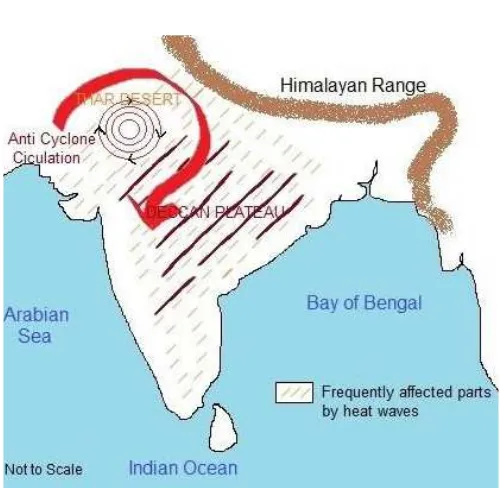
Northern, western, central and south central parts of India experience heat waves during summer. These conditions arise due to winds which blow from the hot and dry state of Rajasthan. Anti cyclone which develops over this state, prevents western disturbances from entering into the Indian subcontinent, leading to clear skies. It should be noted that Anti cyclone over Rajasthan’s Thar desert (see figure 1) leads to hot winds blowing out and increases the temperature of the surrounding regions.
The reason for heat waves in central and south central parts of India is partially the wind originating from hot and arid regions of western India, and partially due to the rugged and barren physiography of plateau in these parts of India.
In the years when the monsoon is delayed or weak, the incidence of heat waves is higher. This is because the rainfall which brings down the temperature over the heated landmass is absent or deficient. This leads to overheating
Source: Annual Climate Summary 2012, IMD.
GRAPH 1: AVERAGE ANNUAL TEMPERATURE ANOMALIES FOR INDIA (DEPARTURES FROM 1961- 1990 AVERAGE)
FIGURE 1: A PICTORIAL PRESENTATION OF REASONS BEHIND HEAT WAVE.
3
of the land in the sub continent and temperatures rise above normal. In year 2014, delayed and weak monsoon contributed to widespread extreme heat wave conditions over most parts of the country.
Impact of heat waves in urban areas
Effects of heat wave exacerbate in urban areas owing to the density of population, closely spaced concrete structures, leading to a phenomenon called “Urban Heat Island” effect. Pollution and dust also play their role in trapping the heat in the urban areas. Incidence of heat strokes, dehydration and deaths are reported. Business hours shrink during these extreme heat waves. Areas devoid of trees or any shade become unbearably hot. Informal labour force like construction workers, rickshaw pullers, street vendors, hawkers and small shopkeepers become extremely vulnerable to heat strokes. Most deaths reported from cities are from these exposed and under privileged sections.
Those living in slums and squatter settlements, unauthorized and congested residential areas where ventilation is
minimal also are at risk (health). These settlements have narrow streets which prevents air circulation. Unauthorized residential areas also lack open spaces or green spaces. In slums, indoor temperature is high as plastic sheet or tin sheet roofs absorbs heat, making these dwelling units behave like an oven.
Heat wave affected states
Heat wave is a regular feature of Indian summer, especially in certain pockets of India. West India, west, north-central, central and south-central India are the regions which experience heat wave. Graph 1 presents heat wave incidences state-wise between 2005 and 2015. As per the data available from IMD, three states namely, Andhra Pradesh (erstwhile), Odisha and Uttar Pradesh have been most frequently affected by heat waves. In Jammu and Kashmir, it is
mainly the plain areas of the Jammu region and in Himachal Pradesh it is the foothill regions that experience heat wave conditions.
Heat waves in 2014, 2015 and 2016
The year 2014 saw several heat wave incidences in India, affecting different regions in different months. First intense spell of heat affected most of north and north western India, starting from May 1st and lasting for 3 weeks. The second spell affected almost the entire country when extreme heat conditions developed around June 5th and went on till June 12th and the third spell was in the third week of June1. Due to El Nino activity in the Pacific, monsoon was predicted to be weak in 2014. Late onset and weak progress of monsoon winds over India in June led to clear skies and prolonged the duration of high temperature. For example, Indian capital city Delhi, experienced a long heat wave spell for 7 days in a row, killing 79 people in the city2. The city recorded 45oC and above temperatures. At 47.8oC (118.04oF), temperature broke the record of 62 years on 9th June 2014. Power breakdown increased the already high uncomfortable levels, raising the death toll further.
The El Nino which developed in mid 2014, did not dissipate in 2015, and continued to affect the monsoon rains in 2015 also and the rainfall for the monsoon season was 86% of the normal. The maximum and minimum temperature in May was 2°C - 3°C above normal for most parts of the country. The heat wave spell between May 21st and June 3rd, lead to 1400 fatalities in Andhra Pradesh and 580 in Telangana3.
Heat waves set a new record in the summer of 2016. On May 19th, a town named “Phalodi” in Rajasthan at 51°C recorded highest ever temperature recorded in India. It was the second day in a row the town experienced temperatures in excess of 50°C. Other towns in the state, such as Churu, also recorded highs of 50.2°C (122° Fahrenheit) the same day.
GRAPH 2: STATES WHERE HEAT WAVE HAS BEEN DECLARED BY IMD
Heat wave events between 2005-15
1 Climate diagnostics bulletin of India – June 2014
What cities can do?
State governments should assist municipalities in preparing Heat Action Plan, on the lines of Ahmedabad Municipal Corporation. Cities must prepare for heat wave or extreme temperature days. The following steps should be taken by cities:
1. Build public awareness and community outreach programmes.
2. Install an Early Warning System.
3. Build capacity of health care professionals to deal with heat waves.
Other simple steps which a city can take to protect its citizens and prevent deaths due to heat wave events are:
1. Build makeshift shelters having water dispensing facility during summer season for those who are engaged in non formal economic activities.
2. Change working hours for offices and commercial activities.
3. Plant trees having wide canopies along roads and traffic junction islands.
4. Plant trees in residential areas, especially in low income residential areas.
5. Provide information on power cuts through media, whenever the situation warrants.
6. Manage uses of power through dynamic tariff at different times of the day.
It is important that the cities realize and proactively take steps, as heat wave are projected to be harsher and longer in future. Ahmedabad took that step and came up with Heat Action Plan for the city.
AHMEDABAD HEAT ACTION PLAN
Ahmedabad city experienced extreme heat wave condition in May 2010 and reported high death rate of 300 deaths/day, which exactly coincided with the high temperature day of 21 May 2010, when Ahmedabad recorded more than 46oC. An excess of
1,344 all-cause deaths occurred, an estimated 43.1% increase when compared to the reference period (3,118 deaths).
Ahmedabad Municipal Corporation decided to address health and mortality associated with heat. Led by the Natural Resources Defense Council (NRDC) and the Indian Institute of Public Health (IIPH), a coalition of academic, health and environmental groups partnered to prepare local communities for increasingly extreme heat in the city of Ahmedabad through an early warning system and heat
preparedness plan.
The city appointed its health department to lead and coordinate with all the municipal departments, collect and assess meteorological data, send health alerts in different departments and media. A framework like this where municipality, community, IMD are engaged can be replicated in other cities.
Source: CDKN Inside stories – Ahmedabad Heat Action Plan
Source of cover page photographs (from left to right): Photo 1: Effect of heat on roads - Source: ABC7 News
Photo 2: Mirage on the Rajpath due to heat in New Delhi - Source: Reuters
Photo 3: Girls protecting themselves from blazing sun in Nagpur - Source: Indian express newspaper.