Online Comic in Mandarin Chinese’s Vocabulary Learning: A Case Study of Budi Utama Multilingual School in Yogyakarta, Indonesia
Nuning Catur Sri Wilujeng, Yogyakarta State University, Indonesia Yu-Ju Lan, National Taiwan Normal University, Taiwan
Asian Conference on Education 2014 Official Conference Proceedings
Abstract
This study was aimed to investigate 1) the improvement of CFL elementary-school students’ skill in learning Mandarin Chinese (hereafter referred to as Mandarin) vocabulary through creating comic without online resources, creating online comics individually and collaboratively, 2) the CFL elementary-school students’ attitude towards the application of comics in learning Mandarin vocabulary, and 3) the CFL elementary-school students’ attitude towards the application of collaborative activities in learning Mandarin vocabulary. The research design was based on a
quasi-experiment using both qualitative and quantitative approaches. Three classes
participated in this study: one class was the control group using text-based instruction without online resources; the other two classes were the experimental groups 1 and 2. In the experimental group 1, students worked individually on online comic whereas in the experimental group 2, students worked collaboratively on online comic. All participants were Grade 5 students of Budi Utama Multilingual School in Yogyakarta, Indonesia. The collected and analyzed data included performances on Mandarin vocabulary, in-class observation, questionnaires, and interview. In Mandarin vocabulary performances, the experimental group 2 outperformed the other two groups and the experimental group 1 performed better than the control group. In the students’ attitude, the experimental group 2 behaved more positively than the two other groups, and the control group behaved more positively than the experimental group 1.
iafor
The International Academic Forum www.iafor.org
Introduction
At the present, Mandarin is an increasingly popular language to learn around the world and it has the largest number of people who speak it as their first language. Saville-troike (2006) noted that the four most commonly used languages in the world are Chinese, English, Spanish, and Hindi.
In Indonesia, there were more than 620 Mandarin schools between 1965 and 1966. Due to the political problems, most of those schools were forced to close in 1967 (Wen, 1997, p.1). After reformation began in 1998 under President Abdurrahman Wahid, a new policy was implemented that would improve the status of Chinese-Indonesians by allowing them to acquire Chinese names and learn/speak Mandarin. In early 2000, a number of private multilingual schools were established in Indonesia. Budi Utama is one of these multilingual schools where three languages (Indonesian, English, and Mandarin) are used daily as the languages of instruction. Established in 2007, this is the only multi-language school in Yogyakarta, Indonesia. Mandarin is taught in Budi Utama Multilingual School from kindergarten to secondary school. Presently, grade 7 is the highest level in that school. The school uses a Chinese
Language textbook (小学华文) from Singapore for teaching primary school students. The students from Grade 5 who participate in this research have high competence in both pronunciation and speaking. According to the interview with one of the local teachers, some of the students have already achieved level 3 on the Youth Chinese Test (YCT). The school supports the students to take this Chinese proficiency test which is an internationally standardized test launched by Hanban in Mainland China. YCT is directed at examining non-native primary and secondary school students’ capability in applying Chinese language in their studies, personal lives, and work. This would mean that the students already have acquired more than 300 words and characters in their vocabulary (Hanban, 2010). Yet, they still have some difficulties in dictation and writing Chinese characters, particularly because these students have been accustomed to writing in pinyin. These students may attempt to apply techniques used when they were brought up learning the Indonesian language, which is written using the Latin alphabet. Therefore, students find it difficult to write Chinese characters (Cook, 2003; Larsen-Freeman & Long, 1991; Jiang, 2008). The use of technology to enhance language learning, especially in writing Chinese characters (Zhao, 2003) can potentially improve their ability.
Based on the preliminary survey, Grade 5 students at that school stated that they have a PC computer at home, a laptop, tablet, and/or smart phone. The school also provides a computer class of two periods a week (total 80 minutes). However, the technology has not been integrated in supporting their Mandarin language learning. Therefore, many students rely on Google translate to help them complete their homework assignments.
projects are structured. Moreover, the abundance of resources and relationships made easily accessible via internet is increasingly challenging us to constantly refocus on our roles as educators. Therefore, the education paradigms are shifting to include online learning and collaborative models. As a result of these conditions above, there consequently will be a new emphasis on more challenge-based and active learning in classrooms.
In regards to comics as a learning activity, a research work done by Clark (2000) shows that comics have positive effects on students. Comics engage our attention and serves as entertainment; moreover, it presents information in a non-threatening manner. Doring (2002) adds that comics can also be used as stimuli to encourage thinking and discussion skills. Other research by Rule and Auge (2005) shows that students who learn using comics achieve higher test scores and can provide examples of why they enjoy learning in this manner. By using comics, the students engage themselves in self-motivated practice.
Mandarin Teaching in Indonesia
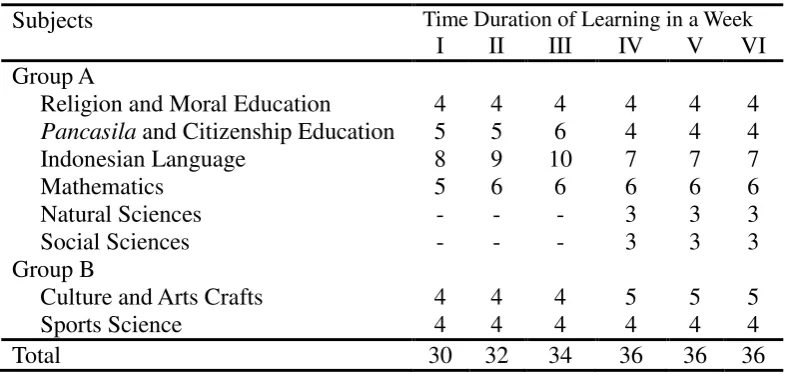
According to the Ministry of National Education of Indonesia, Curriculum of 2013 has been applied throughout the levels of education in Indonesia. Mandarin has the similar status as those of local languages and/or foreign languages; therefore, it is integrated into the local content of the subjects of Culture and Art Crafts (Group B) provided in Table 2-1 (KPK, 2013, p.3). Schools are allowed to teach Mandarin for Grade 5 students up to 5 periods in a week. Each period lasts for roughly 35 minutes. The integrative thematic learning is implemented in this 2013 curriculum.
Table 1. Curriculum 2013 for Elementary School (KPK, 2013,p.3)
Subjects Time Duration of Learning in a Week
I II III IV V VI
Group A
Religion and Moral Education 4 4 4 4 4 4
Pancasila and Citizenship Education 5 5 6 4 4 4
Indonesian Language 8 9 10 7 7 7
Mathematics 5 6 6 6 6 6
Natural Sciences - - - 3 3 3
Social Sciences - - - 3 3 3
Group B
Culture and Arts Crafts 4 4 4 5 5 5
Sports Science 4 4 4 4 4 4
Total 30 32 34 36 36 36
However, the school forms the learning unit, meaning it has the right to develop its own curriculum based on the needs of the students. It precisely means that the school may reduce or add the period’s number and/or the time duration of subjects belonging to Group B in Table 1.
Table 2.
Table 2. Mandarin Teaching Composition for 5 Grade Students Language Skills/ Contents Periods per Week Teacher
Mandarin Speaking 3 Native
Chinese Culture 2 Native
Mandarin Reading and Writing 2 Local
People in Yogyakarta are either bilingual or multilingual (Margana, 2009). Somehow, Mandarin is a foreign language to most Indonesians, as it plays no major role in the community and it is primarily learnt only in the classroom. The students are getting language exposure only during the school period. During the class break, the students soon switch into Javanese or Indonesian language in oral communication with other students. Therefore, there is a lack of writing activity using Chinese characters. Despite this, Budi Utama is flexibly allowed to modify the periods of teaching the subject in Group B in Table1; however, the language skills listed in Table 2 does not reflect the needs of the students. Students encounter more language differences in writing skills rather than other language skills (Sutami, 2008). Furthermore, since students in Budi Utama are used to using Hanyu Pinyin, the experiment would consist of both Chinese characters and Hanyu Pinyin. This is also stated by Saville-troike (2006) about the learner characteristic and circumstances.
Collaborative Learning
Collaborative learning has been found to benefit students in various disciplines as it contributes to student learning. Liao (2014) states that the contribution can be divided into two aspects: academic and social. In regards to the academic aspect, studies find that collaborative learning benefits students in academic achievement, as well as positive attitudes toward the subject matter, commitment to learning, critical thinking, and problem solving skills (Liao, 2006; Wong & Abbruzzese, 2011; Huynh, Jacho-Chaves, & Self, 2010; McDuff, 2012; Xie, 2011). In terms of the social aspect, researchers find that collaborative learning sharpens and strengthens students’ overall communication skills, such as team working skills, emotional skills, and conflict resolution skills (Jarvenoja & Jarvela, 2009; Prichard, Stratford, & Bizo, 2006; Yates, 2006).
Other advantages are also shown by Liao’s (2014) research towards high school collaborative learning students in public speaking. The students managed to increase speech efficacy and decrease their speech anxiety.
Another set of researchers find that collaborative learning that includes groups working together and peer assistance have been widely used in reading programs to create the necessary intensity and strong support for learning (Lan, Sung, & Chang, 2007). Collaborative learning (or peer-assisted learning) can improve their reading outcomes (Ranker, 2007; Cary, 2004; Liu, 2004). Collaborative learning does not only promote the development of positive attitudes towards other group members and learning material, but also builds social relationships and group cohesion (Kreijns 2004).
characteristics. They are 1) positive interdependence, 2) individual accountability, 3) promotive interaction, 4) interpersonal and small-group skills, and 5) group
processing.
CSCL is synchronous cooperation/collaboration through shared workspaces (Baker & Lund, 1996). However, most of the empirical studies using innovative CSCL-specific tools (beyond windows sharing as part of video conferencing periods, etc.) were usually based on selective experiments that were often conducted in a laboratory (Fischer & Mandl, 2001).
Online Comics
Persha and Nawvi (2004) states that vision is the primary sensory system for most people. Vision plays an important role in all areas of development, especially the cognitive area, where intellectual function is the product of this early sensory input through the eyes. Furthermore, the simplified visual representation and the recurrent plot typical of comics help to elicit children's interest in them (Jylhä-Laide, 1994). Students have assessed comics positively as they make the course more entertaining and make learning easier. They can reduce repetition and allow teachers to run classes without the need of textbooks. They also make remembering words easy and promote creative skills and motivate students to learn. In addition, Liu (2004) states that because comics are highly visual texts, they have been shown to be especially
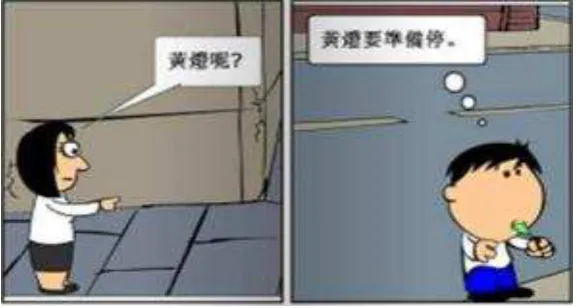
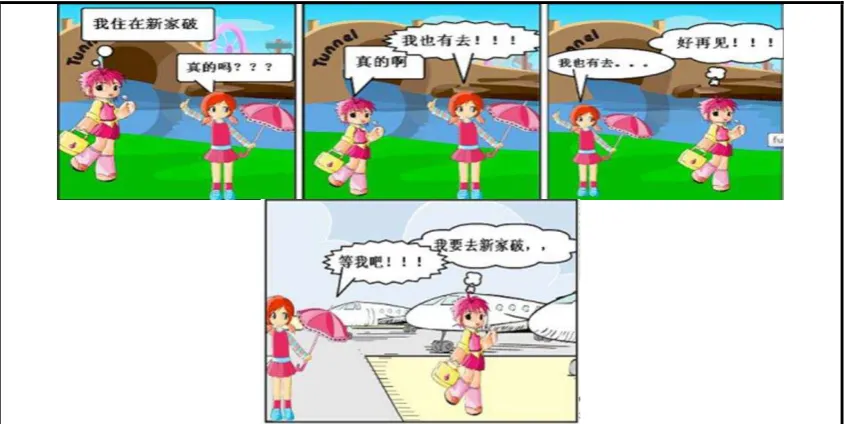
effective for increasing reading comprehension for second and/or additional language learners. Figure 1 presents an example of an online comic.
Figure 1. Example of an Online Comics
Previous comics’ research conducted by France (2010) based on the different foreign language learning style provides learners with a prototype. An experiment toward high school students shows that the approach attracts the students to learn foreign languages. However, online comics have some limiting aspects such as limited collection that users cannot easily identify the best characters, the different poses, or different moods to represent their ideas.
Based on the explanation above and the literature reviews the potential of online comics in collaborative learning in improving vocabulary learning will be confirmed by answering and the following questions:
individually online comics, and collaborative learning online comics)?
2. What are the different attitudes among CFL elementary-school students towards application of three comic creation approaches (paper-based learning, individually online comics, and collaborative learning online comics) in learning Mandarin vocabulary?
3. What are the different attitudes of CFL elementary-school students towards the online comics application between individual and collaborative creation in learning Mandarin vocabulary?
Online Comic in Mandarin Vocabulary Learning
Participants
Students of Grade 5 from Budi Utama Multilingual School were the participants of the research. There were three classes participating in this study: students in the control group were taught under a text-based instruction and created comics individually without online resources; those in the experimental group 1 created online comics individually; and those in the experimental group 2 created online comics collaboratively.
Table 3. Students’ Profile
Items Criterion Have computer, tablet, or smart
phone
Yes 16 12 16
No 0 2 0
Experience in using computer, tablet or smart phone in learning
Mandarin
Yes 1 6 7
No 15 8 9
Research Design
The research design was based on the quasi-experiment design. Qualitative and quantitative approaches have been used to collect and analyze data.
Instruments
Vocabulary Performance Test
A vocabulary performance test consists of both a pretest and posttest. This parallel test between pre and posttest was developed based on the Student Book and Student Activity Book. It was also combined with the Standard test YCT and TOCFL beginner level.
Comic Lesson Plan
The lesson plan was arranged based on the school curriculum for grade 5 students (日 惹崇德三語國民學校 課程活動安排表) and Mandarin writing activity for lesson 1
Table 4. Comic Lesson Plan
Task Topic
Grammar Point Pre-Activity Students’ Main Task
去野餐 回答這些疑問
Control group: teacher distributes paper, and asks the students to create comics; they can create a story by answering the questions that have been prepared by the teacher; teacher uses PPT to expose some pictures that would stimulate students in creating the story.
Example: 1)
The teacher asks the students about the weather of that day,”今天天氣怎麼樣?or 今天天氣好 好? This question tends to stimulate students in creating a story.
2) Students can answer “去 山下野餐”, “去海邊野 餐”or “去公園野餐”
Experiment Group 1: the students need to move to the computer lab; students operate the computer in the laboratory and go to www.toondoo.com to create comics individually using online resources; teacher also uses PPT to expose some pictures that would stimulate students in creating the story
The students create comics individually online on
Experiment Group 2: the students work in small groups; the teacher gives an animal name to the groups such as 青蛙,貓,蛇子,狗,兔子和老 虎; the student also needs to move to the computer laboratory, 1 set computer for 1 group; the teacher also uses PPT to expose some pictures that would stimulate students in creating the story
The students work in groups to create the story. In the group, students will communicate each other before deciding the story. Students also negotiate prior to making group decision.
Toondoo Online Comics
Toondoo (www.toondoo.com) is a free comic website which will be used as a media source in the learning of Mandarin during the course of this research. The website says, “Toondoo is a cool, comic-creating tool from Jambay, a fun site for kids. Jambay is devoted to creating a unique array of free and customizable online games of
educational value for children of all abilities.”
In-Class Observation List
The observation list was revised from the previous research proposed by Lan, Sung, and Chang (2007). The list consists of three related behaviors and learning-unrelated behaviors.
Questionnaire about Students’ Attitude towards Applying Comic in Learning Mandarin.
dimensions: usefulness, satisfaction, and easiness.
Interview List
There are 6 questions about the application of online comic and collaborative learning.
PC Computers
There were 18 sets of computers in the computer lab which were connected to the internet. On the keyboard, the Simplified Chinese Language feature has been added to the language choice.
Procedure
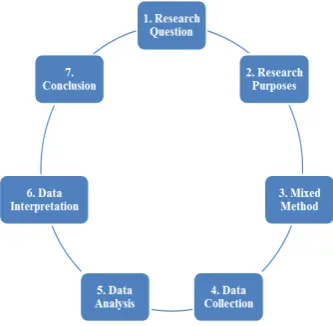
To obtain both qualitative and quantitative data, the mixed method has been applied in this research. Figure2 shows the cycles about this mixed method in collecting data.
Figure 2. Mixed Research Model Data Collection
The quantitative data was collected from scores of students’ pre and posttest vocabulary performance.
The qualitative data will consist of 1) students comic creation of two teaching units, 2) a video recording to document in-class activity, 3) an in-class observation in an
observation checklist, 4) questionnaire, and 5) interview. Data Analysis
The quantitative data were students’ scores from pretest and posttest on Mandarin vocabulary performance. A two-way analysis of covariance was conducted, while the covariate is the students’ summative score in the previous semester. The score of comics creation will be analyzed using a one-way anova. Qualitative data consists of an in-class observation about students’ behaviors. Data were collected from the video recording, and then rated by two raters, which is noted on the in-class observation list; later, the data was analyzed by using Chi-Square analysis. Descriptive statistics were conducted to analyze the qualitative data.
Result
Pretest and Posttest of Vocabulary Performance
Table 5. The Mean and Standard Deviation (SD) of Pretest and Posttest’s Score Test Control Group
(N=16)
Individual Comics (N=14) Collaborative Learning (N=16)
M SD M SD M SD
Pretest 60.68 17.12 60.00 12.61 60.25 13.65
Posttest 63.43 19.57 62.21 15.64 68.18 11.37
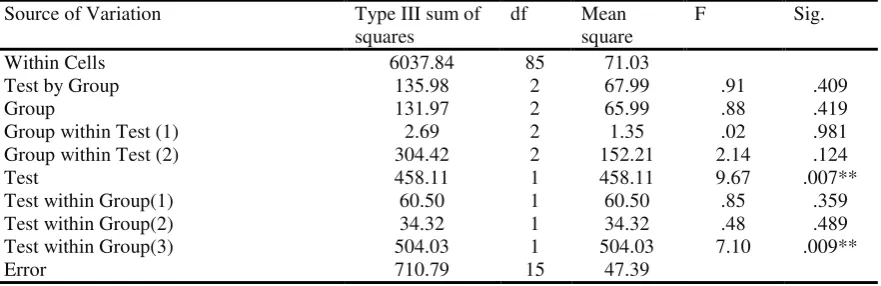
Table 5 presents a summary of the two-way analysis of covariance on students’ scores in pre and posttest of vocabulary performance, with the score of previous semester as the covariates. The table shows that the interaction effect between test and group is not significant. This means that there are no differences varied according to levels. The group factor is not significant (F(0.88)=0.41, p>.05). This means that no difference exists between the scores between pretest and posttest in the three groups. The test factor is significant (F(9.67)=0.007, p<.05), meaning that the grouping of control group, individual comics, and collaborative learning gives significantly different scores between pre and posttest. Test within group (1) or control group is not significant (F(0.85)=0.359, p>.05); neither is the test within group (2) or individual comics group (F(0.48)=0.489, p>.05). This means that both groups still made some improvements due to the training, yet does not vary. While the test within group (3) or the collaborative learning group is significant (F(7.10)=.009, p<.05), meaning that the experiment significantly benefited students’ vocabulary performance in the collaborative learning group.
Table 6. Two-Way Analysis of Covariance of Vocabulary Performance Source of Variation Type III sum of
squares
This section provides the comics creation done by control group, individual comics, and collaborative learning. First, each comics creation will be scored based on a writing rubric (Jacobs et als, 1981); then, after being scored by two teachers, the final comics score stood as the dependent variable in a one-way analysis of variance.
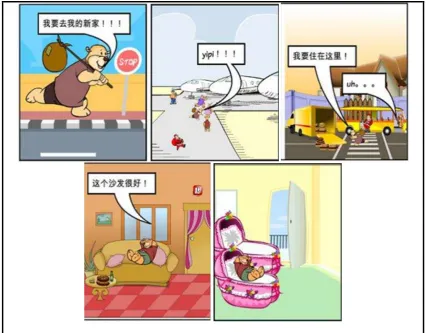
Comic creations done by the control group, the individual group, and the collaborative learning group are then being commented by the teachers and also scored based
Figure 3. Example of Control Group’s Comic Creation
Figure 5. Example of Collaborative Learning’s Comic Creation
Table 7 presents a summary of the one-way analysis of variance on students’ scores of comics creation. This analysis is then followed by the post hoc analysis in Table 8.
Table 7. One-way Analysis of Variance of Comic Creation
Source of Variation Sum of
Squares
df Mean Square
F Sig.
Between Groups 428.826 2 214.413 33.523 .000***
Within Groups 275.027 43 6.396
Total 703.853 45
Table 8. Post Hoc Analysis
(I) Students_Group (J) Students_Group
Sig. 95% Confidence Interval
Note *p<.05 **p<.01 ***p<.001
In-Class Observation
There are 2 categories of students’ behaviors in the classroom: learning related and learning unrelated behavior (Lan, Sung, & Chang, 2007). In-class observation is based on their activities in the classroom that has been recorded and then decoded by 2 raters. The Pearson correlation was 0.000 and it is significant at the 0.01 level.
Table 9. Chi Square Analysis Result
Groups Value df
Asymp. Sig. (2-sided) Control Group Pearson Chi-Square 495.000 25 .000***
Likelihood Ratio 230.067 25 .000 Linear-by-Linear Association 72.094 1 .000 N of Valid Cases 99
Individual Comics Pearson Chi-Square 500.000 25 .000*** Likelihood Ratio 319.851 25 .000 Linear-by-Linear Association 84.017 1 .000 N of Valid Cases 100
Collaborative Learning Pearson Chi-Square 400.000 25 .000*** Likelihood Ratio 235.901 25 .000 Linear-by-Linear Association 76.320 1 .000 N of Valid Cases 100
Table 10. The Frequency of the Learning Behavior (in %)
Group Learning-Related Behavior Learning-Unrelated Behavior Create
Students’ Perception about Comics Learning
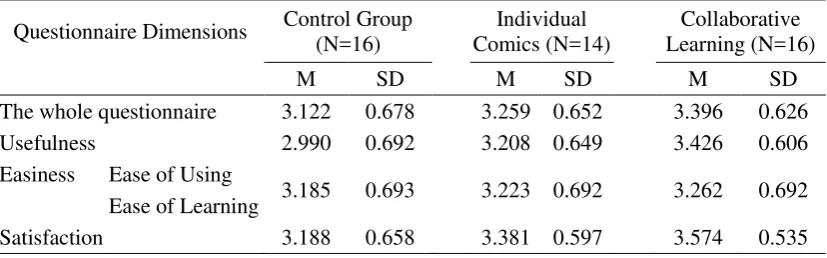
Students’ perspective about Comics learning is presented in Table 11. Based on the learning group students, the easiness was at the lowest dimension.
Table 11. Usability of Comic Learning Questionnaire Dimensions Control Group
(N=16) Easiness Ease of Using
3.185 0.693 3.223 0.692 3.262 0.692 Ease of Learning
Satisfaction 3.188 0.658 3.381 0.597 3.574 0.535
Interview
Table 12 listed the interview report.
Table 12. Interview Reports
Questions Individual Q1. Can you create comics using
Toondoo? Q2. Do you like create comics
using Toondoo? Q3. Do you practice Toondoo at
home? Q5. If you are interested in
Toondoo, will you tell about it to your friends? How?
42 58 75 25
Note *p<.05 **p<.01 ***p<.001`
Conclusions, Limitation, and Recommendations
Conclusions
There is development in students’ Mandarin vocabulary, the collaborative learning group shows the uppermost result, followed by the individual comics group and control group. The mean between pre and posttest for the control group is 60.68 and 63.43 respectively; individual comics group is 60.00 and 62.21 respectively; and collaborative learning group is 60.25 and 68.18 respectively. This performance was also reinforced by their comic creation performance where the collaborative learning group got the highest score based on the rubric writing score with the mean of 5.90, followed by the individual comic group with the mean of 1.14, and the control group with the mean of 1.02.
Students from three group who created comic in different approaches showed that satisfaction is the highest dimension (Mean= 3.381). Control group and individual comics students declared that the easiness dimension is better than the usefulness dimension. Students from the experimental groups stated that they are satisfied about applying online comic in learning Mandarin. The satisfaction dimension showed the highest percentage (28.26%), followed by the usefulness dimension (26.80%), and the easiness dimension (22.34%). From the essay section, students also mentioned about adding some periods of time and increasing the stability of internet connection during the experiment.
The general attitude among students about collaborative learning was strongly positive. They managed time to accomplish the task, and showed no signs of distractions such as playing around, chatting with other, etc. For most of the time, they would discuss about which character they should choose, how to deliver the story, etc. This attitude also reinforced their comics creation performance, that they can do better than the other 2 groups. Based on the further interview, there were 5 students who preferred to work individually, 7 students who preferred to work collaboratively, and 4 students who can work both individually and collaboratively.
stability are inevitable in online activity, and that 3) creating story or writing activity is hard for any children of that age.
Limitations
This research does not cover the different preference about male and female students in creating their character in comics creation, nor the different styles between male and female students in delivering dialogue. Some comic creations showed the tendency that male students prefer adding the animal character into their comic
creation, while the female students prefer the female character to represent themselves in the story. Male students use more interjection (oh, yipi, wow, arghhghgh, etc.) than female students. In the future, it will be more sounding if both terms were included in the research area.
It was the first time for the students to practice typing Chinese characters. Therefore, it is ideal for the need of more training towards typing Chinese characters. Students were still confused when they tried to switch into typing Chinese characters, in which case they asked the teacher for assistance. After typing the Chinese character, they still chose which one was deemed the most correct. A student typed xīn 新 jiā 家 pò 破* instead of xīn 新 jiā 加 pō 坡 given the same Hanyu Pinyin. If only learning strategy was incorporated into this scope of research, the finding would be more abundant. A student opened Google Translate to know whether his typing was correct or not; other students checked their textbook to confirm the Chinese character. This phenomenon implies that even the Hanyu Pinyin system is still needed in learning Mandarin, yet when typing a character, there is always another application that they can use to support their writing. Based on the school curriculum, the higher level they learn Mandarin, the more writing activity they will practice.
This research also neglected the learning style of the students. Some students may have visual style, audio style, or kinesthetic style. For higher level of education, the regrouping based on the different learning style in creating comics may give better impact not only in learning language, but also in developing skills in the animation business in the future.
Recommendations
It is highly recommended for the schools in Indonesia, especially in Yogyakarta, to apply online learning.
References
Baker, M.J. & Lund, K. (1996). Flexibly structuring the interaction in a CSCL environment. In P. Brna, A. Paiva & J. Self (Eds), The European Conference on Artificial Intelligence in Education Euro - AIED 1996 (pp. 401–407). Lisbon: Colibri. Cary, S. (2004). Going graphic: Comics at work in the multilingual classroom.
Portsmouth, NH: Heinemann.
Clark, C. (2000). Innovative Strategy: Concept Cartoon, Instructional and Learning Strategies, 12, 34-45.
Cook, V. (2003). Introduction: The changing LI in the L2 user's mind. In V. Cook (Ed.), Effects of the second language on the first (pp. 1–18).Clevedon: Multilingual Matters.
Doring, A. (2002). The Use of Cartoons as a Teaching and Learning Strategy with Adult Learners, New Zealand journal of adult learning, 30(1), 56-62.
Fischer, F. & Mandl, H. (2001). Facilitating the construction of shared knowledge with graphical representation tools in face-to-face and computer-medited scenarios. In P. Dillenbourg, A. Eurelings, & K. Hakkarainen (Eds), The First European
Conference on Computer-Supported Collaborative Learning (pp.230–236). Maastricht: Maastricht McLuhan Institute.
France, L. (2010). Conception of lesson notes as cartoon for foreign language learning. Retrieved January 24, 2014, from http://cdn.intechopen.com/pdfs-wm/8924.pdf Hanban.(2010). Introduction and guidelines for new youth Chinese test. Retrieved May 12, 2013, from http://www.chineseeducationservices.org
Hanban.(2013). Confucius Institute. Beijing. Ret May 13, 2013, Retrieved from http://english.hanban.org/node_8001.htm
Horizon. (2012). The NMC Horizon Report: 2012 Higher Education Edition. Texas: The New Media Consortium.
Huynh, K. P., Jacho-Chávez, D. T., and Self, J. K. (2010). The efficacy of
collaborative learning recitation sessions on student outcomes." American Economic Review, 100(2), 287-91.
Jacobs, H. L., Zinkgraf, S.A., Wormouth, D.R., Hartfiel, V. F., & Hughey, J. B. (1981). Testing ESL composition: A practical approach. Rowely, MA: Newbury House.
Jiang, X. (2008). Research on Words of Teaching Chinese as a Second Language and Learning to Read. Beijing, CN: Beijing Language and Culture University Press. Jylhä-Laide, J. (1994). Learning by Viewing: Cartoons as foreign language learning material for children—a case study. Journal of Educational Television, 20(2), 93-109. Kementrian Pendidikan dan Kebudayaan.( 2013). Kompetensi dasar Sekolah Dasar (SD)/ Madrasah Ibtidaiyah (MI). Jakarta: Kemendikbud.
Kreijns, K. (2004). Sociable cscl environments: Social affordance sociability and social presence. Educational Technology Expertice Center (OTEC). Maastricht: Open University.Ladson-Billings, G. 1995. Toward a theory of culturally relevant pedagogy. American Educational Research Journal 32(3), 465 – 91.
Lan, Y-J, Sung, Y-T., & Chang, K-E. (2007). A mobile-device-supported peer assisted learning system for collaborative early EFL reading. Language learning and technology, 11(3), 130-151.
Larsen-Freeman, D. & Long, M. (1991). An introduction to second language acquisition research. London: Longman.
Liao, H-A. (2014). Examining the Role of Collaborative Learning in a Public Speaking Course. College teaching, 62, 47–54.
Liao, H-Ch. (2006). Effects of cooperative learning on motivation, learning strategy utilization, and grammar achievement of English language learners in Taiwan. (Dissertations, University of New Orleans). Retrieved July 20, 2014, from http://scholarworks.uno.edu/cgi/viewcontent.cgi?article=1362&context=td.
Liu, J. (2004). Effects of comic strips on L2 learners’ reading comprehension. TESOL Quarterly, 38, 225–243.
Margana. (2009). Analisis gramatika alih kode dari bahasa Inggris ke dalam bahasa Indonesia atau sebaliknya di prodi PBI. Diksi, 134-142.
Persha, A.J. & Nawvi, K.R. (2004). Visual stimulation activity for infants and toddlers. Secunderabad: National Institutes for Mentally Handicapped.
Prichard, J.S., Stratford, R. J., &Bizo, L.A. (2006). The effect of team-skills training on collaborative learning in a controlled environment. Learning and Instruction, 16, 256-265.
Ranker, J. (2007). Using Comic Books as Read-Alouds: Insights on Reading
Instruction From an English as a Second Language Classroom. The Reading Teacher, 61(4), 296–305.
Saville-troike, M. (2006). Introducing Second Language Acquisition. Cambridge, UK: Cambridge University Press.
Sutami, H. (2008). Pelaksanaan Kursus Bahasa Mandarin Dinilai Belum Berhasil. Retrieved September 23, 2013, from www.antaranews.com
Tielman, K., Brok, P., Bolhuis, S., & Vallejo, B. (2012). Collaborative learning in multicultural classrooms: a case study of Dutch senior secondary vocational education. Journal of Vocational Education and Training 64 (1),103 – 118.
Wen, G Y. (1997). 1967年以乘印尼華文教育的沉浮 Retrieved May 13, 2013, from http://history.cdblp.cn/author/.
Wong, C.K. and Abbruzzese, L.D. (2011). Collaborative learning strategies using online communities. Journal of Physical Therapy Education, 25 (3). 81-86. Xie. (2011). Older adults, e-health literacy, and collaborative learning: An experimental study. Journal of American Society for Information Science and Technology, 62(5), 933-946.
Zhao,Y. (2003). Recent development in technology and language learning: a literature review and meta-analysis. CALICO Journal, 21 (1), 7-27.
新加坡教育部课程规划 发展司。小学华文课程组 (2007)。 小学华文。 新加坡:
人民教育出版社。 [Singapore Ministry of Education, Curriculum Planning and Development Division • Primary Chinese Language Curriculum Group (2007). Xiǎoxué huáwén . Singapore: People's Education Press.]
朱芳華 (2006)。 對外漢語教學難點問題研究與對策。 廈門: 廈門大學出版社。 [Zhufang Hua. (2006). Study of foreign language teaching difficult problems and countermeasures. Xiamen: Xiamen University Press.]