Metodologi Penelitian C
Oleh:
SISMANTO
Program Studi DOKTOR FISIKA Departemen FISIKA
Fakultas MIPA
UNIVERSITAS GADJAH MADA 2020 GENAP
A. Identitas Matakuliah / Course Detail
1. Nama Matakuliah /
Course Name : Metodologi Penelitian 2. Kode/SKS/Sifat /
Code/Credits/Status : MFF 7000 A/3/Wajib (Compulsory) 3. Prasyarat / Prerequisite : Tidak ada
4. Deskripsi Singkat / Short
Description :
Mata kuliah Metodologi Penelitian adalah mata kuliah wajib untuk mahasiswa S3 khususnya sebelum menempuh ujian komprehensif. Tujuan dari mata kuliah ini agar mahasiswa dapat belajar bagaimana memahami dan merancang penelitian yang berkaitan dengan topik penelitian masing masing khususnya topik penelitian di bidang geofisika.
Metode pembelajaran yang digunakan adalah diawali dengan pemberian arahan kepada mahasiswa untuk mencari, memahami dan menganalisis beberapa permasalahan yang dipilih mahasiswa sebagai topik penelitianya serta karya ilmiah berupa jurnal
bereputasi Q1 atau Q2 khususnya bagian metode penelitian yang sesuai dengan topik penelitian masing- masing. Dosen pengampu mengarahkan mahasiswa untuk membuat permasalahan yang bisa diambil sebagai pokok penelitian dan mendesain penelitiannya setelah mampu memahami desain penelitian dari beberapa jurnal yang telah ada. Dosen pengampu akan memberikan ruang diskusi dan menjelaskan serta arahan untuk hal-hal yang berkaitan dengan desain metode penelitian yang telah disusun oleh mahasiswa, proses pengambilan data, analisis dan pembuatan laporan penelitian. Diharapkan mahasiswa dapat mengidentifikasi, memilih dan merumuskan masalah, tujuan, menyusun hipotesis penelitian, merumuskan metode penelitian, mengolah data dan
menginterpretasi hasil penelitian. Mahasiswa juga diharapkan dapat melakukan penelitian secara mandiri terbimbing berdasarkan desain penelitian yang telah disusun.
5. Tujuan Pembelajaran / Learning Objective :
Mata Kuliah ini memberikan pengetahuan tentang metodologi penelitian sehingga mahasiswa diharapkan mampu:
a. Mempersiapkan penelitian dengan menyusun desain penelitian secara terbimbing
b. Memahami proses penelitian
c. Menulis usulan penelitian/ membuat prelimanary karya ilmiah untuk publikasi
6. Dosen Pengampu
Matakuliah / Lecturers : SISMANTO
(CPMK/CLO) Kode /
Code Deskripsi / Description PLO/SO/ELO/CPL/LG
LO1 Memahami prinsip-prinsip dan prosedur kerja penelitian
khususnya penelitian geofisika dan kebumian PLO1,FD4 LO2 Menguasai teknik akuisisi data, menganalisis dan
menginterpretasi data penelitian PLO1,FD7
LO3 Mampu menulis proposal/ paper, menyajikan dang
mengkomunikasikan/ mempublikasikan hasil peneltian FD10
PLO / PI Detail
PLO1 Values and Principles
possess a set of universal and fundamental values and principles: universal ethics, patriotism and world peace, social and environmental sensitivity, pluralism and fair play, and rule of law.
FD4 Capaian Pembelajaran Umum Wawasan Kependidikan FD7 Capaian Pembelajaran Umum Kemampuan Publikasi FD10 Capaian Pembelajaran
Peendukung Pembelajar sepanjang Hayat
B. Topik Perkuliahan / Course Materials
Bahasan / Main Discussion
Estimasi Waktu / Estimated
Times (Hour)
Kompetensi (Course Learning Outcomes)
1. Pengantar metodologi penelitian 3
Mahasiswa memahami berbagai metode penelitian secara ilmiah
2. Memilih dan mereview masalah penelitian 3
Diskusi berbagai masalah topik yg dipilih
serta review berbagai paper jurnal yang berkaitan dengan topik
penelitian yg sdh ditentukan oleh
mahasiswa
Times (Hour)
Learning Outcomes)
3. Mereview dan mencari masalah penelitian 3
Diskusi berbagai masalah topik yg dipilih
serta review berbagai paper jurnal yang berkaitan dengan topik
penelitian yg sdh ditentukan oleh
mahasiswa
4. Menentukan masalah penelitian 3
Diskusi berbagai masalah topik yg dipilih serta menentukan topik yang akan dikaji lebih jauh sebagai penelitian
disertasi
5. Mengkaji permasalahan topik yang telah dipilih. 3
Diperolehnya topik yang lebih jelas untuk dibuat propsal disertasi
6. Menyusun Proposal 3 Menyusun Proposal
7. Menyusun Proposal 3 Menyusun Proposal
8. Presentasi Proposal 3 Presentasi Proposal
9. Mencari data sekunder yang telah disediakan di internet 3
Mahasiswa mencari data sekunder yg telah
dipublikasikan di internet dari instansi
profesi
nasional/internasional
10. Pemrosesan data 3 Pemrosesan data
11. Pemrorosesan data 3 Pemrorosesan data
12. Analisis dan interpretasi data 3 Analisis dan
interpretasi data
13. Penulisan Paper/ karya ilmiah 3 Penulisan Paper/ karya
ilmiah 14. Panulisan paper dan publikasi ke Jurnal internasional 3 Publikasi sebagai
laporan
C. Rencana Asesmen / Assesment Plan
CO/CPMK Tipe / Type Deskripsi / Description Persentase /
Percentage PLO/SO/ELO/CPL/LG
LO1 DISKUSI tanya jawab 20 FD4
LO2 TUGAS presentasi 40 FD7
LO3 TUGAS paper publikasi 40 FD10
D. Referensi / References
1. Kothari. 2004. Research Methodology. New Delhi: New Age International (P) Limited, Publishers.
2. Pembahasan journal-journal terkait bidang penelitian sesuai topik yang diajukan mahasiswa.
E. Rencana Kegiatan Pembelajaran Mingguan (RKPM) / Weakly Teaching Plan
Pertemuan
Ke / Week Tujuan Ajar / Learning
Objective Topik / Topic
Media Ajar / Teaching
Media
Metode Assesment /
Assesment Method
Metode Ajar / Teaching
Method
Aktivitas Mahasiswa
/ Student Activity
Aktivitas Dosen / Lecturer Activity
Sumber Ajar / Learning Resources
1
Mahasiswa memahami berbagai metode penelitian secara ilmiah dan batasan serta syarat- syaratnya
Pengantar metode penelitian
LCD, jaringan internet dan papan tulis, laptop
Pengajuan
pertanyaan/jawaban dan keaktifan mhs dalam diskusi
presentasi dan diskusi
menyimak dan berdiskusi
Presentasi materi dan
Kothari.
2004.
Research Methodology
2
Mahasiswa mampu memaparkan berbagai masalah topik yg dipilih serta review berbagai paper jurnal yang berkaitan dengan topik penelitian yg sdh ditentukan oleh mahasiswa
Memilih dan mereview masalah penelitian
LCD, jaringan internet dan papan tulis, laptop
Pengajuan
pertanyaan/jawaban dan keaktifan mhs dalam diskusi
presentasi dan diskusi
presenstasi dan diskusi
menyimak dan berdiskusi
Kothari.
2004.
Research Methodology, dan berbagai paper jurnal yang relevan.
3
Mahasiswa mampu mencari masalah topik yg dipilih serta mereview berbagai paper jurnal yang berkaitan dengan topik penelitian
Mereview dan mencari masalah penelitian
LCD, jaringan internet dan papan tulis, laptop
Pengajuan
pertanyaan/jawaban dan keaktifan mhs dalam diskusi
presentasi dan diskusi
presenstasi dan diskusi
menyimak dan berdiskusi
Kothari.
2004.
Research Methodology, dan berbagai paper jurnal yang relevan.
4
Mahasiswa mampu memparkan berbagai masalah topik yg dipilih serta menentukan topik yang akan dikaji lebih jauh sebagai penelitian disertasi
Menentukan masalah penelitian
LCD, jaringan internet dan papan tulis, laptop
Pengajuan
pertanyaan/jawaban dan keaktifan mhs dalam diskusi
presentasi dan diskusi
presenstasi dan diskusi
menyimak dan berdiskusi
Kothari.
2004.
Research Methodology, dan berbagai paper jurnal yang relevan.
5 Diperolehnya topik yang lebih jelas untuk dibuat propsal disertasi
Mengkaji permasalahan topik yang telah dipilih.
LCD, jaringan internet dan papan tulis, laptop
Pengajuan
pertanyaan/jawaban dan keaktifan mhs dalam diskusi
presentasi dan diskusi
presentasi dan diskusi
menyimak dan berdiskusi
Kothari.
2004.
Research Methodology, dan berbagai paper jurnal yang relevan.
6 Mahasiswa mampu menyusun proposal dengan baik
Menyusun Proposal
LCD, jaringan internet dan papan tulis, laptop
Pengajuan
pertanyaan/jawaban dan keaktifan mhs dalam diskusi
presentasi dan diskusi
presentasi dan diskusi
menyimak dan berdiskusi
Kothari.
2004.
Research Methodology, dan berbagai paper jurnal yang relevan.
7 Mahasiswa mampu menyusun proposal dengan baik
Menyusun Proposal
LCD, jaringan internet dan papan tulis, laptop
Pengajuan
pertanyaan/jawaban dan keaktifan mhs dalam diskusi
presentasi dan diskusi
presentasi dan diskusi
menyimak dan berdiskusi
Kothari.
2004.
Research Methodology, dan berbagai paper jurnal yang relevan.
8 Mahasiswa mampu mempresentasikan proposalnya dengan baik
Presentasi Proposal
LCD, jaringan internet dan papan tulis, laptop
Pengajuan
pertanyaan/jawaban dan keaktifan mhs dalam diskusi
presentasi dan diskusi
presentasi dan diskusi
menyimak dan berdiskusi
Kothari.
2004.
Research Methodology, dan berbagai paper jurnal yang relevan.
9
Diperolehnya data sekunder yg telah dipublikasikan/disediakan di internet dari instansi profesi
nasional/internasional
Mencari data sekunder yang telah disediakan di internet
LCD, jaringan internet dan papan tulis, laptop
Pengajuan
pertanyaan/jawaban dan keaktifan mhs dalam diskusi
presentasi dan diskusi
presentasi dan diskusi
menyimak dan berdiskusi
Kothari.
2004.
Research Methodology, dan berbagai paper jurnal yang relevan.
10 Mahasiswa mampu memproses data dengan benar
Pemrosesan data
LCD, jaringan internet dan papan tulis, laptop
Pengajuan
pertanyaan/jawaban dan keaktifan mhs dalam diskusi
presentasi dan diskusi
presentasi dan diskusi
menyimak dan berdiskusi
Kothari.
2004.
Research Methodology, dan berbagai paper jurnal yang relevan.
11 Mahasiswa mampu memproses data dengan benar
Pemrosesan data
LCD, jaringan internet dan papan tulis, laptop
Pengajuan
pertanyaan/jawaban dan keaktifan mhs dalam diskusi
presentasi dan diskusi
presentasi dan diskusi
menyimak dan berdiskusi
Kothari.
2004.
Research Methodology, dan berbagai paper jurnal yang relevan.
12
Mahasiswa mampu menganalisis dan menginterpretasikan data dengan logis
Analisis dan interpretasi data
LCD, jaringan internet dan papan tulis, laptop
Pengajuan
pertanyaan/jawaban dan keaktifan mhs dalam diskusi
presentasi dan diskusi
presentasi dan diskusi
menyimak dan berdiskusi
Kothari.
2004.
Research Methodology, dan berbagai paper jurnal yang relevan.
13 Mahasiswa mampu menulis sebuah paper/
karya ilmiah
Penulisan Paper/ karya ilmiah
LCD, jaringan internet dan papan tulis, laptop
Pengajuan
pertanyaan/jawaban dan keaktifan mhs dalam diskusi
presentasi dan diskusi
presentasi dan diskusi
menyimak dan berdiskusi
Kothari.
2004.
Research Methodology, dan berbagai paper jurnal yang relevan.
14
Mahasiswa mampu mempublikasikan karya ilmiahnya pada jurnal internasional sebagai laporan
Panulisan paper dan publikasi ke Jurnal internasional
LCD, jaringan internet dan papan tulis, laptop
Pengajuan
pertanyaan/jawaban dan keaktifan mhs dalam diskusi
presentasi dan diskusi
presentasi dan diskusi
menyimak dan berdiskusi
Kothari.
2004.
Research Methodology, dan situs jurnal yang relevan.
A. Evaluasi hasil Pembelajaran
Secara keseluruhan mahasiswa yang bersangkutan sudah menguasai topik penelitianya, mampu merumuskan dengan baik, dan mampu bekerja sama dengan pihak yang terkait yaitu BATAN untuk analisis sampel radioaktifnya. Pemaparan di dalam papernya sudah memadai, sehingga dosen tinggal menyelaraskan dan mengarahkan ke Jurnal yang bersesuaian.
CO/CPMK Performance
CO/CPMK Presentase Standar Performance
(of 100) Evaluasi
LO1 20 75,00 90,00
Dari diskusi yang berlangsung mhs cukup menguasai pemasalahan sehingga pekerjaan
penelitian bisa dilanjutkan sebagian besar
LO2 40 75,00 90,00
Beberapa data sampel lapangan yang sudah diperoleh mahasiswa sudah bisa dikerjakan analisisnya dan interpretasi, sehingga dosen
tinggal mengarahkan saja
LO3 40 75,00 100,00
Paper yang dibuat sudah dapat di submit ke Jurnal Internasional yang bereputasi terindek scopus Q2, direvisi dua kali dan diterima untuk
diterbitkan tahun 2022
Umum) Umum) Peendukung)
90,00 90,00 100,00
B. Rencana Pengembangan
Untuk membantu mahasiswa yang bersangkutan dosen memberikan beberapa alternatif lab lab yang mampu menguji dan mempunyai alat yang memadai, seperti Lab Fisika ITB, BATAN Serpong, Lab.
Kimia-Fisika UII dan lainnya.
C. Lampiran
https://mail.google.com/mail/u/0?ik=06da185f4e&view=pt&search=all&permthid=thread-f%3A1710856234633270366&simpl=msg-f%3A1710856… 1/1
Sismanto Sismanto <[email protected]>
[KJS] Editor Decision - #15423 - Accepted - Radiogenic heat production of S-type and I-type granite rocks in Bangka Island, Indonesia
1 message
Mrs. Mashael Al-Abdullah via Kuwait Journal of Science <[email protected]> Tue, Sep 14, 2021 at 1:07 PM Reply-To: "Mrs. Mashael Al-Abdullah" <[email protected]>
To: Rahmat Nawi Siregar <[email protected]>, Kurnia Setiawan Widana <[email protected]>, Sismanto
Dear Rahmat Nawi Siregar, Kurnia Setiawan Widana, Sismanto,
I am pleased to inform you that your paper entitled: "Radiogenic heat production of S-type and I-type granite rocks in Bangka Island, Indonesia" has been accepted for publication in Kuwait Journal of Science.
We would also like you to consider citing some papers related to your work, which are already published in KJS, with a view to demonstrate the relevancy of our Journal.
Your paper will be published in tentatively 2022 issue.
Please confirm and acknowledge the receipt of this mail.
With best wishes.
Kind Regards,
Prof.Shafiqah Abdulhamid Alawadhi Editor-in-Chief
_______________________________________________ Kuwait Journal of Science Academic Publication Council Kuwait University P.O. Box: 17225, Khaldia-72453 Kuwait Telephone No. (965) 249 86180, 249 84625
http://journalskuwait.org/kjs/index.php/KJS
B-Radiogenic Heat Production of S-type and I-type Granite Rocks in Bangka Island, Indonesia.docx 682K
Lampiran: Sampel Hasil Pekerjaan Mahasiswa
Radiogenic heat production of S-type and I-type granite rocks in Bangka Island, Indonesia
Rahmat Nawi Siregar1, 2*, Kurnia Setiawan Widana3, Sismanto1
1 Department of Physics,Universitas Gadjah Mada, Sekip Utara 55281, Indonesia
2 Department of Physics, Institut Teknologi Sumatera, Indonesia
3 Center for Nuclear Minerals Technology, National Nuclear Agency, Indonesia
* Corresponding author: [email protected]
Abstract
Radiogenic heat production (RHP) has been investigated from widely types of rocks based on regional setting and metamorphism grade. In this study, we analyze the abundance of heat producing elements (U, Th, K) and Radiogenic Heat Production (RHP) on I-type and S-type granite rocks in Bangka Island, one of the main provinces in Tin Belt Island. The average U, Th and K concentrations for both S-type and I-types granite are 10.27 ppm, 79.6 ppm, 3.1% and 87.79 ppm, 99.2 ppm and 1.93 % respectively. The highest concentration of U (681.22 ppm) and Th (99.2 ppm) are found in Pangkal Pinang and K (3.79%) in West Bangka. We analyze that RHP average for I-type granite is higher with 27.87 (N=17, range from 12.97 to 550.28) than S-type with 8.43 (N=11, range from 4.93 to 12.64). The Th/U ratio shows an exponential correlation with RHP and classifies S-type granite tectonic discriminant as continental collision and I-type granite as continental arc.
Keywords: Continental lithosphere; I-type granite; radiogenic heat production; S-type granite, Th/U ratio
1. Introduction
Radiogenic Heat Production (RHP) is a major key to study temperature and heat flow of crust and mantle of earth (Sclater et al., 1980), whereas RHP contains information about the relation of tectonic age and evolution of the earth’s crust. Radiogenic heat mostly produced by the existence of radioactive elements in the igneous rocks both volcano and plutonic rocks (Singh and Vallinayagam, 2016). Thorium, Uranium and Potassium are widely discovered in granite and has been studied by numerous researchers (He et al., 2010; Lamas et al., 2015; Zhang et al., 2020) for contribution to radiogenic heat production. These elements were processed in the mantle, but are concentrated mainly in the crust.
In the uppermost crust, heat distribution is mostly controlled by Uranium and Thorium hence in the upper mantle is controlled by potassium (Cermak and Bodri, 1991). The heat generated by radioactive in continental crust (roughly equally granodioirite and granulite) contains about 10%
from the total outflow, where oceanic crust and mantle are 0.15% and 30% respectively (Brown and Musset, 1993).
Radiogenic heat generation in granite has been analyzed by numerous researchers (Artemeiva et al., 2017; Hasterok et al., 2019; Veikkolainen et al., 2019). The Th/U ratio of granite can be used to explain the geodynamic evolution and represent the genesis of continental arc magmas (Maden and Akaryali, 2015). Moreover, studies on radioactive heat generation have been
applied to igneous, metamorphic and sedimentary rocks (Hasterok et al., 2018; Jaupart et al., 2016). Overall, researchers provide information of heat production as a general compiled data from different continental settings and tend to relate it to variation of lithology and regional settings.
Unfortunately, research on the same rock type (e.g granite as one of the most promising radioactive element host) is hardly analyzed due to small abundance in regional studies. Meanwhile, the vast variety of granite can be easily found in Bangka Island, Indonesia.
Bangka is one of the main provinces in the Southeast Asia granite tin belt extending from Burma, Malaysian peninsular, to Tin Islands (Riau Archipelago and Bangka Island). Thorium in Bangka Island granite has been investigated (Ngadenin et al., 2014) from 41 samples leading to thorium exploration potential. Furthermore, granite in Central and Northern Bangka are identified as I-type which indicated by significant presences of magnetite, magnesian, and more primitive, while S-type in South and West Bangka are indicated by high K2O and the abundance of biotite, muscovite and cordierite (Widana, 2013).
In this study, we investigate radiogenic heat production (RHP) on granite in West-South Bangka and Central-North Bangka. The goal of this study is to examine correlation between RHP and magmatic type of granite rocks in Bangka Island, S-type and I-type. The purpose of this study is interesting since we found little research reference of granite’s RHP based on its types.
2. Geological Setting
Bangka Island is a part of South East Asia tin belt from Malaya peninsula, Riau islands, Bangka and Belitung Island to West Kalimantan. Regional granites have been classified into four provinces; the main range province (S type granite mainly Triassic age), the eastern province
(permo-triassic of I type granite), the western – peninsular Thailand-Burma (mostly S type with smaller I type of cretaceous age) and the north Thailand migmatite province with S type of Triassic age (Hutchison, 1977).
The granitoids of Bangka island are the combination of main range province and eastern province (Schwartz et al., 1995). The main range overlaps in time with the eastern province produced at different source regions and mobilized within the same crustal segment (Barber et al., 2005). Magmatic sources of Southern Bangka granite are mixed of crust and mantle with Calc- Alkaline affinity, where Northern Bangka granite sources are characterized as crust product with high-K Calc-Alkaline affinity (Widana and Priadi, 2015). The forming of S type affinity is in continental acr-post collisional and I type Calc-Alkalic is related to subduction with protolyte as a product of hydrous, mafic igneous and metamorphic rocks (Roberts and Clemens, 1993). The tectonic activity was subduction of Paleo-Thetys oceanic from Perm to Trias period followed by collision of Sibumasu (Siam-Burma-Malaysia-Sumatra) block with East Malaya. This collision along Bentong Raub Suture lead to magmatic activity and the forming of I and S type in Bangka Island (Metcalfe, 2000).
3. Method
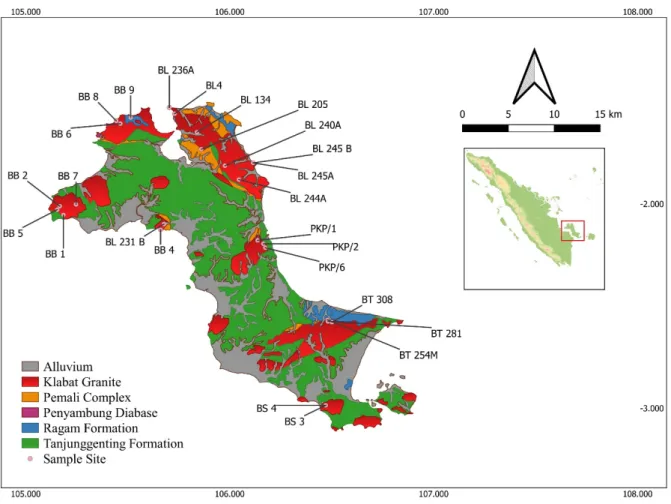
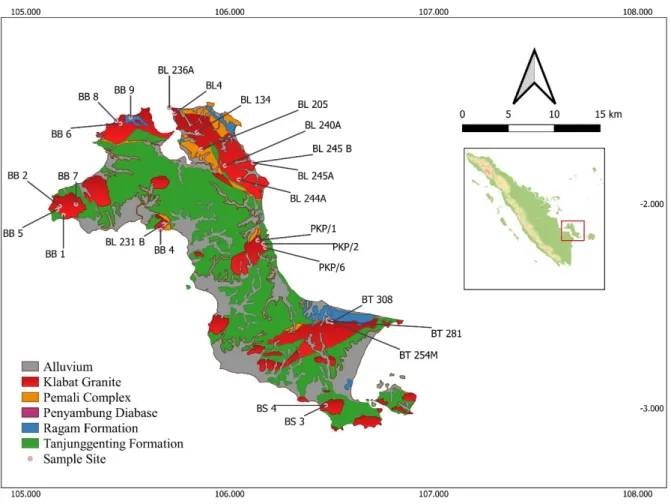
The interest of calculating radiogenic heat production in Bangka Island comes from the previous research (Ngadenin and Karunianto, 2016; Ngadenin et al., 2014; Widana and Priadi, 2015). This lead to data sampling where the data were collected from 27 granite samples from Klabat granite formation as shown in Fig. 1. X-Ray Fluorescence analysis was performed to characterize Major
and trace elements. Analysis Activation Neutron (AAN) was also performed to characterize Thorium and Uranium in Pusdiklat- National Nuclear Energy Agency of Indonesia after radiated in Siwabessy Reactor in Serpong.
Fig. 1. The major granite body and sample data collection area
Uranium, Thorium and Potassium concentrations in granite decay and converted to energy.
The energy emitted from radioactive decay process yield kinetic energy from α and β particles and the γradiation contributed to heat produced in rocks. So, radiogenic heat production (RHP) can be calculated by considering Uranium, Thorium and Potassium concentrations of rocks (Rybach, 1988):
(
952 +256 +348)
10−5=ρ . CU . CTh . CK
RHP (1)
where ρ is the bulk density of granite which is 2.7 kg/m3, CU and CTh are concentration of Uranium and Thorium in ppm and CK is for Potassium in %.
4. Result and discussion
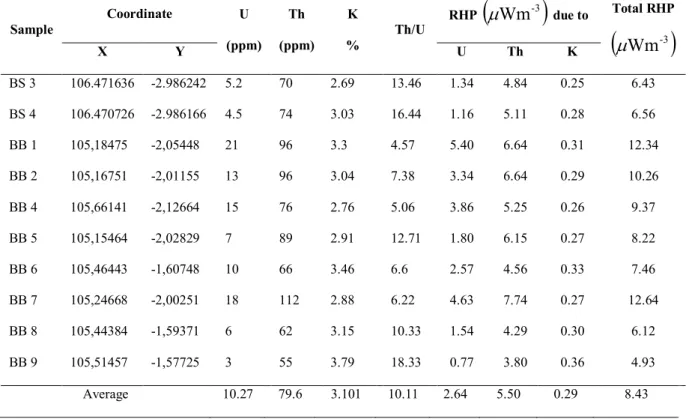
4.1 Radiogenic Heat Production (RHP) of S-type granite and I-type granites
Radiogenic heat production (RHP) is a petrophysical quantity resulting from the decay of radioactive elements in the earth crust and mantle which leads to terrestrial heat flow of some areas in the earth. The crustal granite in West Bangka and South Bangka shows lower average radiogenic heat production than crustal-mantle mixed granite in Central and North Bangka as shown in Table 1 and Table 2. The S-type granites show highest concentration of U (21 ppm); Th (112 ppm); and K (18.3 %) which were found in BB1, BB7 and BB9 respectively. In I-type granite, the highest concentration of U (681 ppm); Th (99.2 ppm); and K (3.55%) were found in PKP/10B and BL 240A respectively. The concentration of radioactive elements in I-type is quite interesting;
especially from 17 samples shows the average U and Th are 87.79 ppm, 65.68ppm respectively.
But as we investigate the average concentration of K, S-type granite investigation provides a higher value (average 3.1 %) than I-type (average 1.93 %).
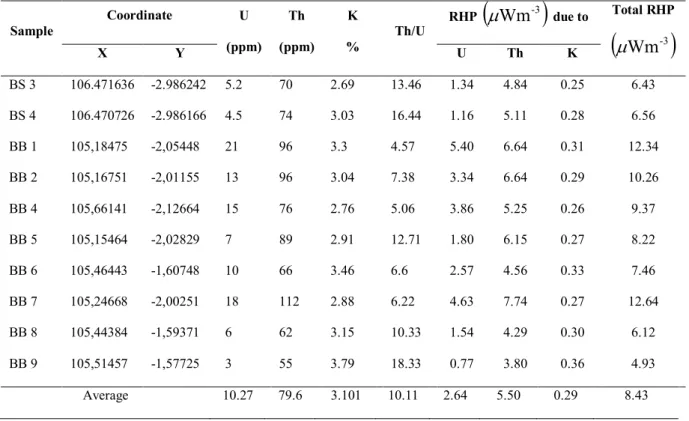
Table 1. Heat production of S-type Granite from South Bangka (sample code: BS) and West Bangka (sample code: BB)
Sample Coordinate U
(ppm) Th (ppm)
K
% Th/U RHP
(
µWm-3)
due to Total RHP(
µWm-3)
X Y U Th K
BS 3 106.471636 -2.986242 5.2 70 2.69 13.46 1.34 4.84 0.25 6.43 BS 4 106.470726 -2.986166 4.5 74 3.03 16.44 1.16 5.11 0.28 6.56
BB 1 105,18475 -2,05448 21 96 3.3 4.57 5.40 6.64 0.31 12.34
BB 2 105,16751 -2,01155 13 96 3.04 7.38 3.34 6.64 0.29 10.26
BB 4 105,66141 -2,12664 15 76 2.76 5.06 3.86 5.25 0.26 9.37
BB 5 105,15464 -2,02829 7 89 2.91 12.71 1.80 6.15 0.27 8.22
BB 6 105,46443 -1,60748 10 66 3.46 6.6 2.57 4.56 0.33 7.46
BB 7 105,24668 -2,00251 18 112 2.88 6.22 4.63 7.74 0.27 12.64
BB 8 105,44384 -1,59371 6 62 3.15 10.33 1.54 4.29 0.30 6.12
BB 9 105,51457 -1,57725 3 55 3.79 18.33 0.77 3.80 0.36 4.93
Average 10.27 79.6 3.101 10.11 2.64 5.50 0.29 8.43
Granites from South and West Bangka are characterized by abundances of Uranium range from 3 ppm to 21 ppm, from 55 ppm to 112 ppm for Thorium, and from 2.69 % to 3,79 % for Potassium. The mean values for uranium, thorium and potassium are 10.27 ppm, 79.6 ppm and 3.101% respectively. Thorium give the biggest contribution to RHP, followed by Uranium and Potassium. The highest thorium concentration is found on sample BB7 with 112 ppm. The major minerals on this sample are quartz-rich granite, K-feldspar, biotite, and cordiorite, while the minor mineral is plagioclase and muscovite as accessory mineral (Refaat et al., 1978).
The RHP of S-type granite indicates higher average than continental crust rock’s RHP.
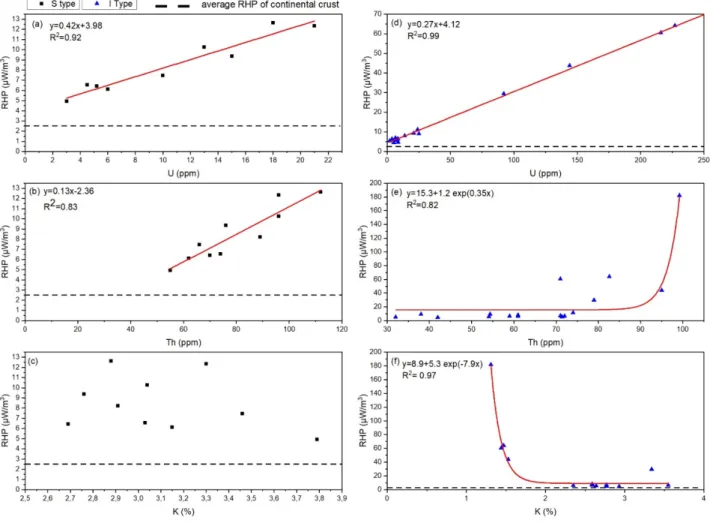
Furthermore, there are some correlation between U and Th to RHP, but they tend to not correlate between K and RHP for S-type. The best fitting linear relation between U and RHP is linear
correlation with coefficient 0.92 for S granite and 0.99. Th graphic show good correlation for S- type with 0.83 with linear regression, but Th curve for I-type exponential trend with 0.82 correlation. Even though the correlation is clear, but Th data are somewhat scattered around the trend, especially for sample BB 1 with 96 ppm of Th. The data is influenced by relatively high U concentration with 21 ppm, whereas the same concentration of Th for BB 1 has 13 ppm of U. K curve for I-type show exponential trend due to the absence of K in BT 308 and PKP/1 samples.
Fig. 2.Plots of U, Th and K versus Radiogenic heat production sorted by S type (a-c) and I type granite (d-e). Horizontal dash line is presented as average RHP on continental crust (Taylor and
McLenna, 1985)
The U, Th and K concentrations of I-type granite are given in Table 3 and plotted in Fig. 2 related to RHP. Generally, the relationship of RHP to U and Th is increasing linearly for S-type, and for I-type RHP to U is increasing linearly but to Th is increasing exponentially. Meanwhile, the relationship of RHP to K decreasing exponentially for I-type, and no good pattern for S-type.
It means that for S-type and I-type the higher concentration of U and Th, the higher of radiogenic heat production, but not for Pottasium K. Total abundance of U concentration range from 2 ppm to 681 ppm, 32 ppm to 99.2 ppm for Th and 0.07% to 3.55% for K. The average concentrations for U, Th and K are 87.79 ppm, 65.7ppm and 1.93 % respectively. Anomaly in this region is represented by concentration of U and Th in sample PKP/10B with 681 ppm and 99.2 ppm which produce 550.28 RHP. This value is the highest among all the data in Bangka Island. Data obtained from 7 samples (Irvani and Pitulima, 2017), U and Th concentration range from 6.7 ppm to 200.7 ppm and 30.3 ppm to 197 ppm respectively. Th of PKP/10B sample is also higher than previous study on the same region. Data from Ngadenin et al (2014) revealed that Th concentration range from 23.5 ppm to 78.5 ppm of Th with 42.0 ppm on average. K concentration is relatively low compared to S-type granite with 1.93 %, where K concentration from two samples, BT 308 and PKP/1 are negligible. The average of RHP value is 27.28 which is higher than S type RHP average.
Table 2. Heat production of I-type granite from North Bangka (sample code: BL), Central Bangka (sample code: BT) and Pangkalpinang (sample code: PKP)
Samples Coordinate U
ppm Th ppm
K
%
Th/U RHP
(
µWm-3)
due to Total RHP(
µWm-3)
X Y U Th K
BL4 105,729740 -1,558996 6.6 71 2.77 10.76 4.04 11.68 247.78 263.50 BL 134 105,839026 -1,649234 13.8 61 2.59 4.42 8.45 10.04 231.68 250.16 BL 205 105,861200 -1,732480 7 61 2.35 8.71 4.28 10.04 210.21 224.53 BL 231 B 105,677880 -2,098920 5.3 42 2.93 7.92 3.24 6.91 262.09 272.24 BL 236A 105,704440 -1,528120 92 79 3.34 0.86 56.30 13.00 298.76 368.07 BL 240A 105,976740 -1,813410 3.9 72 3.55 18.46 2.39 11.85 317.55 331.78 BL 244A 106,045560 -1,881340 8.8 32 2.77 3.64 5.39 5.27 247.78 258.43 BL 245A 106,114790 -1,799550 8.5 59 2.59 6.94 5.20 9.71 231.68 246.59 BL 245 B 106,114790 -1,799550 6.6 54.1 2.64 8.20 4.04 8.90 236.15 249.09 BT 254P 106,480170 -2,568000 144 95 1.53 0.66 88.13 15.63 136.86 240.62 BT254M 106,480170 -2,568000 227 82.6 1.47 0.36 138.92 13.59 131.49 284.01 BT 281 106,48212 -2,57532 24 74 0.07 3.08 14.69 12.18 6.26 33.13 BT 308 106,501840 -2,578870 2 71.4 0 35.70 1.22 11.75 0.00 12.97 PKP/1 106,137160 -2,178770 25 38 0 1.52 15.30 6.25 0.00 21.55 PKP/2 106,164880 -2,195530 21 54.4 1.34 2.59 12.85 8.95 119.86 141.67 PKP/6 106,174620 -2,214750 216 71 1.44 0.33 132.19 11.68 128.81 272.68 PKP/10B 106,134917 -2,185250 681 99.2 1.31 0.15 416.77 16.33 117.18 550.28 Average 87.79 65.7 1.93 6.72 22.566 4.540 0.181 27.288
4.2 Th/U ratio of I-type and S-type granites
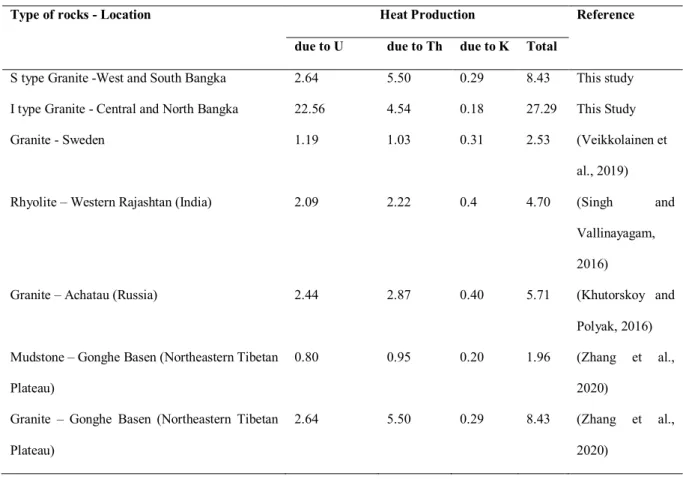
Uranium and Thorium concentration varies with granite types and show that I-type produce higher RHP than S-type. Furthermore, we carried out heat production from some areas all around the
world. Table 3 clearly shows that I type granites from Central and North Bangka have high RHP from all the data. RHP enrichment usually occur on the upper continental crustal rocks as a product of partial melting on subducted crust (Vilà et al., 2010). Thus, we investigate the origin of magmatism and tectonic setting by characterizing Th/U ratio of samples.
Table 3. Heat produced compared to other published data. The data shows that Central - North Bangka shows high heat production
Type of rocks - Location Heat Production Reference
due to U due to Th due to K Total
S type Granite -West and South Bangka 2.64 5.50 0.29 8.43 This study I type Granite - Central and North Bangka 22.56 4.54 0.18 27.29 This Study
Granite - Sweden 1.19 1.03 0.31 2.53 (Veikkolainen et
al., 2019)
Rhyolite – Western Rajashtan (India) 2.09 2.22 0.4 4.70 (Singh and
Vallinayagam, 2016)
Granite – Achatau (Russia) 2.44 2.87 0.40 5.71 (Khutorskoy and
Polyak, 2016) Mudstone – Gonghe Basen (Northeastern Tibetan
Plateau)
0.80 0.95 0.20 1.96 (Zhang et al.,
2020) Granite – Gonghe Basen (Northeastern Tibetan
Plateau)
2.64 5.50 0.29 8.43 (Zhang et al.,
2020)
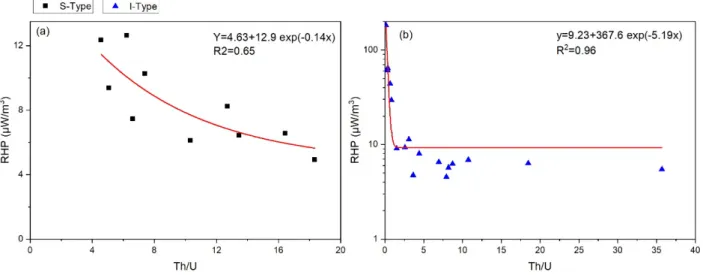
Characterization of S type granite based on Th/U ratio (Fig. 3a) are showed by relatively high Th/U ratio range from 4.57 to 18.33, meanwhile I-type granite (Fig. 3b) Th/U ratio range from 0.15 to 35.7. The distribution of RHP and Th/U shows negative exponential correlation with coefficient of 0.65 and 0.96 for S type and I type granite respectively. For S-type, the data are
scattered around the trend line. The anomaly in this data is shown by PKP/10B, PKLP 6, BT 254M, BT 245P, BL 236A with ratio 0.15, 0.33, 0.36, 0.66 and 0.86 respectively. Based on Friedrich et al (1987), at lower Th/U ratios, the U concentration related to uraninite increases up to 80% for Th/U=1. Theoretically, Uraninite will contribute to high RHP based on their concentration where in this data, the lowest Th/U tend to have the highest U. On the other hand, Uranium is located in monazites with Th/U ratios exceeding 4. The low Th/U ratio on I type data produce exponential plot with correlation coefficient 0.96, while some of S-type data are not fit to exponential trend due to the >1 Th/U ratio.
Fig. 3. Characterization of (a) S type and (b) I type granite based on Th/U ratio
A Th/U ratio higher than 1 is normally produced from mantle-derived volcanic rocks as mid-ocean ridge basalts and continental materials (Maden and Akaryali, 2015). Th/U range from 3-7 (Wasserburg et al., 1964) is normally classified into continental crust material, which in this research are mostly found in I-type granite with average 6.72. This result is fairly close with Th/U ratio in when compared to typical ratio for continental crust value of 5 (Paul et al., 2003). The Th/U ratio > 8 is classified as the limit for continental crust characteristics which differs granite of
West Bangka and South Bangka. Based on Widana and Priadi 2015), granitoid in Bangka Island were produced from two sources, shoshonitik for Belinyu and Central Bangka and crust for South and West Bangka. This source different can be interpreted as magmatic episode from different geodynamics on continental margin as product of subduction and collision. S-type granites from West Bangka and South Bangka are classified as Eurasia continental collision product, whereas I- type granites from Central Bangka, Pangkal Pinang and North Bangka as continental arc product (Chappell and White, 2001; Clemens and Wall, 1981).
5. Conclusions
Radiogenic heat production (RHP) have been determined by calculating the concentration of Uranium, Thorium and Potassium within Bangka Island’s granite. In this study, we evaluate RHP based on type of granite; S-type from South Bangka and West Bangka, I type from North Bangka, Pangkal pinang and Central Bangka. The S-type granite shows lower RHP than I-type granite with average 8.43 µWm-3 and 27.28 µWm-3respectively. We also investigate RHP of granite based on the type by comparing with other published data, we get the same result where S-type produce lower RHP than I-type.
We evaluate Th/U ratio from both type for investigating tectonic setting and magmatic source. Th/U and RHP show the same exponential trend for both type, with remarkable fitting for I-type plot but unfortunately poor for S-type due to lack of data. Th/U ratio classifies S-type granite as continental collision product from partial melting of metasedimentary source rock in collisional zones (Artemeiva et al., 2017). I-type granite is classified as continental arcs from partial metling
of igneous protolith. But, it remains an open question whether RHP on each type from different regional setting show similar behavior.
ACKNOWLEDGEMENTS
This study is supported by Universitas Gadjah Mada for RTA Project Research grant No.
3143/UNI.P.III/DIT-LIT/PT/2021. The authors would like to thank to National Nuclear Energy Agency of Indonesia for permission to use the helpful data in this research. We would also like to Prof. Subagyo Pramuwijoyo, Dr. Ade Anggraini, Dr. Mochamad Nukman and Happy Christin Natalia for wonderful discussion.
References
Artemeiva, I. M., Tybo, H., Jakobsen, K., Sorensen, N.K. & Nielse, L.S. (2017) Heat production in granitic rocks: Global analysis based on a new data compilation GRANITE2017.Earth-Science Reviews, 172: 1–26.
Barber, A. J., Crow, M. J. & Milsom, J. S. (2005) Sumatra: Geology, Resources and Tectonic Evolution. The Geological Society, London. Pp. 54.
Brown, G. C. & Musset, A. E. (1993) The Inaccessible Earth An integrated view to its. 2nd edn.
Chapman & Hall Row, London. Pp. 153.
Cermak, V. & Bodri, L. (1991) A heat production model of the crust and upper mantle.
Tectonophysics, 194(4):307–323.
Chappell, B. W. & White, A. J. R. (2001) Two contrasting granite types: 25 years later.
Australian Journal of Earth Sciences, 48(4):489–499.
Clemens, J. D. & Wall, V. J. (1981) Origin and crystallization of some peraluminous (S-type) granitic magmas. Canadian Mineralogist, 19(1):111–131.
Friedrich, M. H., Cuney, M. & Poty, B. (1987) Uranium geochemistry in peraluminous leucogranites. Uranium, 3(2–4): 353–385.
Hasterok, D., Gard, M., Cox, G. & Hand, M. (2019) A 4 Ga record of granitic heat production:
Implications for geodynamic evolution and crustal composition of the early Earth. Precambrian Research, 331(June).
Hasterok, D., Gard, M. & Webb, J. (2018) On the radiogenic heat production of metamorphic, igneous, and sedimentary rocks. Geoscience Frontiers, 9(6): 1777–1794.
He, Z., Xu, X. & Niu, Y. (2010) Petrogenesis and tectonic significance of a Mesozoic granite – syenite – gabbro association from inland South China. Lithos, 119(3–4), pp. 621–641.
Hutchison, C. (1977) Granite emplacement and tectonic subdivision of Peninsular Malaysia.
Bulletin of the Geological Society of Malaysia 9:187–207.
Irvani & Pitulima, J. (2017) Studi Unsur Radioaktif Thorium (Th) dan Uranium (U) di Pulau Bangka. Promine Journal, 5(2):36–41.
Jaupart, C., Mareschal, J. C. & Iarotsky, L. (2016) Radiogenic heat production in the continental crust. Lithos, 262: 398–427.
Khutorskoy, M. D. & Polyak, B. G. (2016) Role of radiogenic heat generation in surface heat flow formation. Geotectonics, 2(March):179–195.
Lamas, R., Miranda, M. & Neves, L. (2015) Radiogenic heat production from a deep borehole in the Beiras Granite (Almeida, Central Portugal). Energy for Sustainability, (June):1–5.
Maden, N. & Akaryali, E. (2015) A review for genesis of continental arc magmas: U, Th, K and radiogenic heat production data from the Gümüşhane Pluton in the Eastern Pontides (NE Türkiye).
Tectonophysics, 664:225–243.
Metcalfe, I. (2000) The Bentong-Raub Suture Zone. Journal of Asian Earth Sciences, 18(6):691–
712.
Ngadenin & Karunianto, A. J. (2016) Identification of radioactive minerals occurances in Muncung granite as the initial stage for assesment of Uranium and Thorium prospect in Singkep
Island. Eksplorium, 37(2): 63–72.
Ngadenin, N., Syaeful, H., Widana, K. S., Sukadana, I.G. & Indrastomo, F. D. (2014) Studi potensi thorium pada batuan granit di pulau bangka. Jurnal Pengembangan Energi Nuklir, 16(545):143–155.
Paul, D., White, W. M. & Turcotte, D. L. (2003) Constraints on the 232Th/238Uratio (K) of the continental crust. Geochemistry, Geophysics, Geosystems, 4(12). doi: 10.1029/2002GC000497.
Refaat, A.M., Kabesh, M.L., Hilmy, M.E. & Abdallah, Z.M. (1978). Geochemistry of granitic rocks in Ras Barud area, Eastern Desert, Egypt. J. Univ. Kuwait (Sci), 5: 129-146
Roberts, M. P. & Clemens, J. D. (1993) Origin of high-potassium, talc-alkaline, I-type granitoids.
Geology, 21: 825–828.
Rybach, L. (1988) Determination of heat production rate.in Haenel, Ralph. Rybach, Ladislaus.
Stegena, L. (ed.) Handbook of Terrestrial Heat-flow Density Determination with Guidelines and Recommendations of the International Heat Flow Commision. 1st edn. Dordrecht: Kluwer Academic Publishers:125–141.
Schwartz, M. O., Rajah, S. S. & Askury, A. K. (1995) The Southeast Asian tin belt.Earth Science Reviews, 38(2–4): 95–293.
Sclater, J. G., Jaupart, C. & Galson, D. (1980) The heat flow through oceanic and continental crust and the heat loss of the Earth. Reviews of Geophysics, 18 (1): 269–311.
Singh, L. S. & Vallinayagam, G. (2016) High Heat Producing Volcano-Plutonic Rocks of the Siner Area , Malani Igneous Suite , Western Rajasthan , India. International Journal of Geoscience, 2012(June):1–5.
Taylor, S. R. & McLenna, S. M. (1985) The continental crust: Its composition and Evolution.
Backwell, Oxford. Pp.
Veikkolainen, T., Kukkonen, I. T. & Naslund, J.-O. (2019) Radiogenic heat production analysis of Fennoscandian Shield and adjacent areas in Sweden. Geophysics Journal International, 218(1):640–654.
Vilà, M., Fernández, M. & Jiménez-Munt, I. (2010) Radiogenic heat production variability of some common lithological groups and its significance to lithospheric thermal modeling.
Tectonophysics, 490(3–4):152–164.
Wasserburg, G. J., MacDonald, G.J.F., Hoyle, F. & Fowler, W.A. (1964) Relative Contributions of Uranium, Thorium, and Potassium to Heat Production in the Earth. Science, 143(3605):465–467.
Widana, K. S. (2013) Petrografi dan geokimia unsur utama granitoid Pulau Bangka: kajian awal
tektomagmatisme. Eksplorium, 34(2):1–16.
Widana, K. S. & Priadi, B. (2015) Karakteristik unsur jejak dalam diksriminasi magmatisme granitoid Pulau Bangka. Eksplorium, 36(1): 1–16.
Zhang, C., Hu, S., Zhang, S., Li, S., Zhang, L., Kong, Y., Song, R., Jiang, G. & Wang, Z.
(2020) Radiogenic heat production variations in the Gonghe basin, northeastern Tibetan Plateau:
Implications for the origin of high-temperature geothermal resources. Renewable Energy, 148(November): 284–297.
https://mail.google.com/mail/u/0?ik=06da185f4e&view=pt&search=all&permthid=thread-f%3A1710856234633270366&simpl=msg-f%3A1710856… 1/1
Sismanto Sismanto <[email protected]>
[KJS] Editor Decision - #15423 - Accepted - Radiogenic heat production of S-type and I-type granite rocks in Bangka Island, Indonesia
1 message
Mrs. Mashael Al-Abdullah via Kuwait Journal of Science <[email protected]> Tue, Sep 14, 2021 at 1:07 PM Reply-To: "Mrs. Mashael Al-Abdullah" <[email protected]>
To: Rahmat Nawi Siregar <[email protected]>, Kurnia Setiawan Widana <[email protected]>, Sismanto
Dear Rahmat Nawi Siregar, Kurnia Setiawan Widana, Sismanto,
I am pleased to inform you that your paper entitled: "Radiogenic heat production of S-type and I-type granite rocks in Bangka Island, Indonesia" has been accepted for publication in Kuwait Journal of Science.
We would also like you to consider citing some papers related to your work, which are already published in KJS, with a view to demonstrate the relevancy of our Journal.
Your paper will be published in tentatively 2022 issue.
Please confirm and acknowledge the receipt of this mail.
With best wishes.
Kind Regards,
Prof.Shafiqah Abdulhamid Alawadhi Editor-in-Chief
_______________________________________________ Kuwait Journal of Science Academic Publication Council Kuwait University P.O. Box: 17225, Khaldia-72453 Kuwait Telephone No. (965) 249 86180, 249 84625
http://journalskuwait.org/kjs/index.php/KJS
B-Radiogenic Heat Production of S-type and I-type Granite Rocks in Bangka Island, Indonesia.docx 682K
Lampiran: Dokumen Tugas
Radiogenic heat production of S-type and I-type granite rocks in Bangka Island, Indonesia
Rahmat Nawi Siregar1, 2*, Kurnia Setiawan Widana3, Sismanto1
1 Department of Physics,Universitas Gadjah Mada, Sekip Utara 55281, Indonesia
2 Department of Physics, Institut Teknologi Sumatera, Indonesia
3 Center for Nuclear Minerals Technology, National Nuclear Agency, Indonesia
* Corresponding author: [email protected]
Abstract
Radiogenic heat production (RHP) has been investigated from widely types of rocks based on regional setting and metamorphism grade. In this study, we analyze the abundance of heat producing elements (U, Th, K) and Radiogenic Heat Production (RHP) on I-type and S-type granite rocks in Bangka Island, one of the main provinces in Tin Belt Island. The average U, Th and K concentrations for both S-type and I-types granite are 10.27 ppm, 79.6 ppm, 3.1% and 87.79 ppm, 99.2 ppm and 1.93 % respectively. The highest concentration of U (681.22 ppm) and Th (99.2 ppm) are found in Pangkal Pinang and K (3.79%) in West Bangka. We analyze that RHP average for I-type granite is higher with 27.87 (N=17, range from 12.97 to 550.28) than S-type with 8.43 (N=11, range from 4.93 to 12.64). The Th/U ratio shows an exponential correlation with RHP and classifies S-type granite tectonic discriminant as continental collision and I-type granite as continental arc.
Keywords: Continental lithosphere; I-type granite; radiogenic heat production; S-type granite, Th/U ratio
1. Introduction
Radiogenic Heat Production (RHP) is a major key to study temperature and heat flow of crust and mantle of earth (Sclater et al., 1980), whereas RHP contains information about the relation of tectonic age and evolution of the earth’s crust. Radiogenic heat mostly produced by the existence of radioactive elements in the igneous rocks both volcano and plutonic rocks (Singh and Vallinayagam, 2016). Thorium, Uranium and Potassium are widely discovered in granite and has been studied by numerous researchers (He et al., 2010; Lamas et al., 2015; Zhang et al., 2020) for contribution to radiogenic heat production. These elements were processed in the mantle, but are concentrated mainly in the crust.
In the uppermost crust, heat distribution is mostly controlled by Uranium and Thorium hence in the upper mantle is controlled by potassium (Cermak and Bodri, 1991). The heat generated by radioactive in continental crust (roughly equally granodioirite and granulite) contains about 10%
from the total outflow, where oceanic crust and mantle are 0.15% and 30% respectively (Brown and Musset, 1993).
Radiogenic heat generation in granite has been analyzed by numerous researchers (Artemeiva et al., 2017; Hasterok et al., 2019; Veikkolainen et al., 2019). The Th/U ratio of granite can be used to explain the geodynamic evolution and represent the genesis of continental arc magmas (Maden and Akaryali, 2015). Moreover, studies on radioactive heat generation have been
applied to igneous, metamorphic and sedimentary rocks (Hasterok et al., 2018; Jaupart et al., 2016). Overall, researchers provide information of heat production as a general compiled data from different continental settings and tend to relate it to variation of lithology and regional settings.
Unfortunately, research on the same rock type (e.g granite as one of the most promising radioactive element host) is hardly analyzed due to small abundance in regional studies. Meanwhile, the vast variety of granite can be easily found in Bangka Island, Indonesia.
Bangka is one of the main provinces in the Southeast Asia granite tin belt extending from Burma, Malaysian peninsular, to Tin Islands (Riau Archipelago and Bangka Island). Thorium in Bangka Island granite has been investigated (Ngadenin et al., 2014) from 41 samples leading to thorium exploration potential. Furthermore, granite in Central and Northern Bangka are identified as I-type which indicated by significant presences of magnetite, magnesian, and more primitive, while S-type in South and West Bangka are indicated by high K2O and the abundance of biotite, muscovite and cordierite (Widana, 2013).
In this study, we investigate radiogenic heat production (RHP) on granite in West-South Bangka and Central-North Bangka. The goal of this study is to examine correlation between RHP and magmatic type of granite rocks in Bangka Island, S-type and I-type. The purpose of this study is interesting since we found little research reference of granite’s RHP based on its types.
2. Geological Setting
Bangka Island is a part of South East Asia tin belt from Malaya peninsula, Riau islands, Bangka and Belitung Island to West Kalimantan. Regional granites have been classified into four provinces; the main range province (S type granite mainly Triassic age), the eastern province
(permo-triassic of I type granite), the western – peninsular Thailand-Burma (mostly S type with smaller I type of cretaceous age) and the north Thailand migmatite province with S type of Triassic age (Hutchison, 1977).
The granitoids of Bangka island are the combination of main range province and eastern province (Schwartz et al., 1995). The main range overlaps in time with the eastern province produced at different source regions and mobilized within the same crustal segment (Barber et al., 2005). Magmatic sources of Southern Bangka granite are mixed of crust and mantle with Calc- Alkaline affinity, where Northern Bangka granite sources are characterized as crust product with high-K Calc-Alkaline affinity (Widana and Priadi, 2015). The forming of S type affinity is in continental acr-post collisional and I type Calc-Alkalic is related to subduction with protolyte as a product of hydrous, mafic igneous and metamorphic rocks (Roberts and Clemens, 1993). The tectonic activity was subduction of Paleo-Thetys oceanic from Perm to Trias period followed by collision of Sibumasu (Siam-Burma-Malaysia-Sumatra) block with East Malaya. This collision along Bentong Raub Suture lead to magmatic activity and the forming of I and S type in Bangka Island (Metcalfe, 2000).
3. Method
The interest of calculating radiogenic heat production in Bangka Island comes from the previous research (Ngadenin and Karunianto, 2016; Ngadenin et al., 2014; Widana and Priadi, 2015). This lead to data sampling where the data were collected from 27 granite samples from Klabat granite formation as shown in Fig. 1. X-Ray Fluorescence analysis was performed to characterize Major
and trace elements. Analysis Activation Neutron (AAN) was also performed to characterize Thorium and Uranium in Pusdiklat- National Nuclear Energy Agency of Indonesia after radiated in Siwabessy Reactor in Serpong.
Fig. 1. The major granite body and sample data collection area
Uranium, Thorium and Potassium concentrations in granite decay and converted to energy.
The energy emitted from radioactive decay process yield kinetic energy from α and β particles and the γradiation contributed to heat produced in rocks. So, radiogenic heat production (RHP) can be calculated by considering Uranium, Thorium and Potassium concentrations of rocks (Rybach, 1988):
(
952 +256 +348)
10−5=ρ . CU . CTh . CK
RHP (1)
where ρ is the bulk density of granite which is 2.7 kg/m3, CU and CTh are concentration of Uranium and Thorium in ppm and CK is for Potassium in %.
4. Result and discussion
4.1 Radiogenic Heat Production (RHP) of S-type granite and I-type granites
Radiogenic heat production (RHP) is a petrophysical quantity resulting from the decay of radioactive elements in the earth crust and mantle which leads to terrestrial heat flow of some areas in the earth. The crustal granite in West Bangka and South Bangka shows lower average radiogenic heat production than crustal-mantle mixed granite in Central and North Bangka as shown in Table 1 and Table 2. The S-type granites show highest concentration of U (21 ppm); Th (112 ppm); and K (18.3 %) which were found in BB1, BB7 and BB9 respectively. In I-type granite, the highest concentration of U (681 ppm); Th (99.2 ppm); and K (3.55%) were found in PKP/10B and BL 240A respectively. The concentration of radioactive elements in I-type is quite interesting;
especially from 17 samples shows the average U and Th are 87.79 ppm, 65.68ppm respectively.
But as we investigate the average concentration of K, S-type granite investigation provides a higher value (average 3.1 %) than I-type (average 1.93 %).