ABSTRACT
Renwarin, FransiskaDwiningsih. (2014). Using Student Team Achievement Division Method to Improve Student Participation in VIIB English Extracurricular Class of SMP PL 1 Yogyakarta. Yogyakarta: English Language Education Study Program, Sanata Dharma University.
In order to master the language being learned and create a meaningful learning process, active student participation is needed. However, students of the VIIB English Extracurricular class in SMP Pangudi Luhur I Yogyakarta were not actively participating in the learning process. The observation results showed that there were two causes of low student participation. The first one was the learning method used by the teacher which did not give enough chance for the students to participate actively. The second one was the characteristics of the students in the 7th grade.
Cooperative learning is an approach which allows students to participate more through small group activities. The researcher applied the Cooperative learning approach in this Classroom Action Research to answer question: To what extent does the use of the Student Team Achievement Division method increase student participation in the teaching learning process of the English extracurricular class?
This research used the Classroom Action Research (CAR) method. The research was implemented on 7th, 14th, 22nd, and 23rd of April 2014. Research respondents were 36 students of VIIB in SMP Pangudi Luhur I Yogyakarta in the 2013/2014 academic year. The instruments used were observation checklist, field notes, questionnaires, and interview guide. In analyzing the data, the researcher used triangulation technique.
From the data analysis, it was found that the Student Team Achievement Division (STAD) method of the Cooperative Learning Approach facilitated the students to participate actively in the learning process. By applying this method, the student participation was improved based on five basic essential elements in Cooperative Learning. During the research implementation, students learned to lean on others, motivate, encourage and help each other master material presented by the teacher. The students encourage their group members to do their best in order to achieve group goals. They learned to be responsible to their own learning
and also others’. Through the students’ active participation in every activity in this
method, the students got more chance to take part in learning. Thus, learning became more meaningful and students’ skills were improved.
ABSTRAK
Renwarin, FransiskaDwiningsih. (2014). Using Student Team Achievement Division Method to Improve Student Participation in VIIB English Extracurricular Class of SMP PL 1 Yogyakarta. Yogyakarta: Program Studi Pendidikan Bahasa Inggris, Universitas Sanata Dharma.
Agar dapat menguasai bahasa yang dipelajari dan menciptakan proses pembelajaran yang berarti, partisipasi aktif siswa sangat dibutuhkan. Akan tetapi, siswa ekstrakurikular bahasa Inggris kelasVIIB SMP Pangudi Luhur I Yogyakarta tidak berpartisipasi aktif dalam proses pembelajaran. Hasil observasi menunjukan bahwa terdapat dua penyebab rendahnya partisipasi siwa. Penyebab pertama adalah penggunaan metode pembelajaran yang tidak member kesempatan lebih kepada siswa untuk berpartisipasi secara aktif. Penyebab kedua adalah karakteristik dari siswa-siswi kelas VII.
Pembelajaran kooperatif adalah sebuah pendekatan yang memudahkan siswa untuk lebih banyak berpartisipasi melalui aktifitas-aktifitas dalam kelompok kecil. Peneliti melaksanakan Pembelajaran Kooperatif dalam Penelitian Tindakan Kelas ini untuk mejawab pertanyaan: Sejauh mana penggunaan metode Student Team Achievement Division meningkatkan partisipasi siswa dalam proses pembelajaran di kelas ekstrakurikular bahasa Inggris?
Penelitian ini menggunakan metode Penelitian Tindakan Kelas. Penelitian dilaksanakan pada tanggal 7, 14, 22, dan 23 April 2014. Peserta penelitian merupakan 36 siswa kelas VIIB SMP Pangudi Luhur I Yogyakarta tahun akademik 2013/2014. Instrumen penelitian yang digunakan adalah lembar observasi, catatan lapangan, kuesioner, dan petunjuk wawancara. Dalam menganalisis data, peneliti menggunakan teknik triangulasi.
Dari hasil analisis data, ditemukan bahwa metode Student Team Achievement Division memudahkan siswa untuk dapat berpartisipasi aktif dalam proses pembelajaran. Dengan menerapkan metode ini, partisipasi siswa meningkat berdasarkan lima unsur pokok dalam Pembelajaran Kooperatif. Selama pelaksanaan penelitian, siswa-siswa belajar untuk bergantung pada yang lain, memotivasi, menyemangati dan membantu satu sama lain untuk menguasai materi yang dijelaskan oleh peneliti. Siswa mendukung anggota kelompoknya untuk melakukan yang terbaik dalam rangka mencapai tujuan kelompok. Mereka belajar untuk bertanggung jawab terhadap hasil belajar diri sendiri dan orang lain. Melalui partisipasi aktif siswa dalam metode ini, siswa mendapat kesempatan lebih untuk mengambil bagian dalam proses pembelajaran. Dengan demikian pembelajaran menjadi lebih berarti dan kemampuan-kemampuan siswa semakin berkembang.
i
USING STUDENT TEAM ACHIEVEMENT DIVISION
METHOD TO IMPROVE STUDENT PARTICIPATION
IN VIIB ENGLISH EXTRACURRICULAR CLASS
OF SMP PL 1 YOGYAKARTA
A SARJANA PENDIDIKAN THESIS
Presented as Partial Fulfillment of the Requirements to Obtain the Sarjana Pendidikan Degree
in English Language Education
By
Fransiska Dwiningsih Renwarin Student Number: 101214104
ENGLISH LANGUAGE EDUCATION STUDY PROGRAM DEPARTMENT OF LANGUAGE AND ARTS EDUCATION FACULTY OF TEACHERS TRAINING AND EDUCATION
SANATA DHARMA UNIVERSITY YOGYAKARTA
iv
DEDICATION PAGE
This thesis is dedicated to
my beloved parents
Emanuel Renwarin and Sri Kilatsih Lusia
Thank you for teaching me
vii
ABSTRACT
Renwarin, Fransiska Dwiningsih. (2014). Using Student Team Achievement Division Method to Improve Student Participation in VIIB English Extracurricular Class of SMP PL 1 Yogyakarta. Yogyakarta: English Language Education Study Program, Sanata Dharma University.
In order to master the language being learned and create a meaningful learning process, active student participation is needed. However, students of the VIIB English Extracurricular class in SMP Pangudi Luhur I Yogyakarta were not actively participating in the learning process. The observation results showed that there were two causes of low student participation. The first one was the learning method used by the teacher which did not give enough chance for the students to participate actively. The second one was the characteristics of the students in the 7th grade.
Cooperative learning is an approach which allows students to participate more through small group activities. The researcher applied the Cooperative learning approach in this Classroom Action Research to answer question: To what extent does the use of the Student Team Achievement Division method increase student participation in the teaching learning process of the English extracurricular class?
This research used the Classroom Action Research (CAR) method. The research was implemented on 7th, 14th, 22nd, and 23rd of April 2014. Research respondents were 36 students of VIIB in SMP Pangudi Luhur I Yogyakarta in the 2013/2014 academic year. The instruments used were observation checklist, field notes, questionnaires, and interview guide. In analyzing the data, the researcher used triangulation technique.
From the data analysis, it was found that the Student Team Achievement Division (STAD) method of the Cooperative Learning Approach facilitated the students to participate actively in the learning process. By applying this method, the student participation was improved based on five basic essential elements in Cooperative Learning. During the research implementation, students learned to lean on others, motivate, encourage and help each other master material presented by the teacher. The students encourage their group members to do their best in order to achieve group goals. They learned to be responsible to their own learning and also others’. Through the students’ active participation in every activity in this method, the students got more chance to take part in learning. Thus, learning became more meaningful and students’ skills were improved.
viii
ABSTRAK
Renwarin, Fransiska Dwiningsih. (2014). Using Student Team Achievement Division Method to Improve Student Participation in VIIB English Extracurricular Class of SMP PL 1 Yogyakarta. Yogyakarta: Program Studi Pendidikan Bahasa Inggris, Universitas Sanata Dharma.
Agar dapat menguasai bahasa yang dipelajari dan menciptakan proses pembelajaran yang berarti, partisipasi aktif siswa sangat dibutuhkan. Akan tetapi, siswa ekstrakurikular bahasa Inggris kelas VIIB SMP Pangudi Luhur I Yogyakarta tidak berpartisipasi aktif dalam proses pembelajaran. Hasil observasi menunjukan bahwa terdapat dua penyebab rendahnya partisipasi siwa. Penyebab pertama adalah penggunaan metode pembelajaran yang tidak memberi kesempatan lebih kepada siswa untuk berpartisipasi secara aktif. Penyebab kedua adalah karakteristik dari siswa-siswi kelas VII.
Pembelajaran kooperatif adalah sebuah pendekatan yang memudahkan siswa untuk lebih banyak berpartisipasi melalui aktifitas-aktifitas dalam kelompok kecil. Peneliti melaksanakan Pembelajaran kooperatif dalam Penelitian Tindakan Kelas ini untuk mejawab pertanyaan:Sejauh mana penggunaan metode Student Team Achievement Division meningkatkan partisipasi siswa dalam proses pembelajaran di kelas ekstrakurikular bahasa Inggris?
Penelitian ini menggunakan metode Penelitian Tindakan Kelas. Penelitian dilaksanakan pada tanggal 7, 14, 22, dan 23 April 2014. Peserta penelitian merupakan 36 siswa kelas VIIB SMP Pangudi Luhur I Yogyakarta tahun akademik 2013/2014. Instrument penelitian yang digunakan adalah lembar observasi, catatan lapangan, kuesioner, dan petunjuk wawancara. Dalam menganalisis data, peneliti menggunakan teknik triangulasi.
Dari hasil analisis data, ditemukan bahwa metode Student Team Achievement Division memudahkan siswa untuk dapat berpartisipasi aktif dalam proses pembelajaran. Dengan menerapkan metode ini, partisipasi siswa meningkat berdasarkan lima unsur pokok dalam Pembelajaran Kooperatif. Selama pelaksanaan penelitian, siswa-siswa belajar untuk bergantung pada yang lain, memotivasi, menyemangati dan membantu satu sama lain untuk menguasai materi yang dijelaskan oleh peneliti. Siswa mendukung anggota kelompoknya untuk melakukan yang terbaik dalam rangka mencapai tujuan kelompok. Mereka belajar untuk bertanggungjawab terhadap hasil belajar diri sendiri dan orang lain. Melalui partisipasi aktif siswa dalam metode ini, siswa mendapat kesempatan lebih untuk mengambil bagian dalam proses pembelajaran. Dengan demikian pembelajaran menjadi lebih berarti dan kemampuan-kemampuan siswa semakin berkembang.
ix
ACKNOWLEDGEMENTS
First of all, I would like to send my deepest gratitude to JESUS CHRIST
for his love, guidance, strength and blessings during the process of completing
this thesis. With Him I learned to encounter any obstacles in my life.
I would also like to thank my greatest supervisor, Ag. Hardi Prasetyo, S.Pd., M.A. for his motivation, suggestions, unpredictable jokes and patience in guiding me to finish this thesis.
I express my greatest gratitude to my dear parents, Emanuel Renwarin
and Sri Kilatsih Lusia for their trust, prayer, motivation, support, and advice for me. Both of my parents are the energy donor for me during the hard times in my
life. I also thank my beloved sisters Laura Wiliana Pratami Renwarin, Monica Gisela Trinita Renwarin and my brother Alfredo Lefaan for their support, motivation, advice, and laughter during the completion of my thesis. I thank my
dearest uncle and aunty, Yohanes Bambang Suharya and Agnes Bekti Tyas Utami for the support, love, trust, and advice for me during the hard times in my life.
I sincerely express my gratitude to my beloved partner, Marinus Skotus Febrianto, who had accompanied me in completing this thesis. I thank him for the support and love whenever I feel down.
It is also an honor for me to thank all lecturers of English Language Study
Program of Sanata Dharma University for the guidance and knowledge which had
been given to me. I specially thank my academic advisor, Mr. Barli Bram for being a great academic advisor. I thank him for the support, guidance, and
cheerfulness.
I am also indebted to the teachers and staff of SMP Pangudi Luhur I
Yogyakarta for their hospitality and help during the implementation of my
x
support, help and motivation for me. He is the best extracurricular supervisor who
gave big contribution to my research.
I want to thank my best friends Adreana Pritha Murtinigtyas, Silviana Piar, and Ikha Tyas Intani as my partners in crimes during this unforgettable 4 years. I hope this friendship would last forever. I thank them for the cheerfulness,
awkward stories, unforgettable moments, love, advice, motivation and
togetherness. Those journeys we had done together will always be good
memories.
I would also thank my best friends, Maria Angelina Ekoningsih,
Veronica Pradanti, and Karolyn Kris Nadia for all the sweet memories, laughter, and great experiences during my high school and college. I thank them
for teaching me the meaning of friendship.
I address my gratitude to my sister, Theresia Yayuk Liem, for the support, motivation and love during the process of finishing this thesis.
I thank my crazy and beloved PBI friends, Diah, Siwi, Narima, There, Sandra, Satya, Ria, and Dea Wrest. I want to thank all of PBI 2010 students especially my mates in B class. Thank for the good times we shared, love, laugh
and togetherness. I also thank my thesis fighter friends, Bita, Heny, Yoga, Tito, Vivi, Duma, Arnis, Mbak Yuyun, Tiwi, Vincent and Nande. I thank them for the strength and motivation during this time.
Lastly, I thank everyone whom I cannot mention one by one for their help
and support.
xi
TABLE OF CONTENTS
TITLE PAGE ... i
APPROVAL PAGES ... ii
DEDICATION PAGE ... iv
STATEMENT OF WORK’S ORIGINALITY ... v
PERNYATAAN PERSETUJUAN PUBLIKASI ... vi
ABSTRACT ... vii
ABSTRAK ... viii
ACKNOWLEDGEMENTS ... ix
TABLE OF CONTENTS ... xi
LIST OF TABLES ... xiv
LIST OF FIGURE ... xv
LIST OF APPENDICES ... xvi
CHAPTER I. INTROUCTION A. Research Background... 1
B. Research Problem... 6
C. Problem Limitation ... 6
D. Research Objectives ... 7
E. Research Benefits ... 7
F. Defenition of Terms ... 8
CHAPTER II. REVIEW ON RELATED LITERATURE A. Theoretical Description ... 11
1. Teaching Adolescent ... 11
a. Nature of Teaching Adolescent ... 11
b. Characteristic of Adolescent ... 15
2. Student Participation ... 16
a. Definition ... 16
xii
3. Cooperative Learning Approach ... 18
a. Definition of Cooperative Learning ... 18
b. Essential components of Cooperative Learning… 20
c. Goal of Cooperative Learning ... 21
d. Student Team Achievement Division... 23
B. Theoretical Framework ... 26
CHAPTER III. RESEARCH METHODOLOGY A. Research Method ... 29
B. Research Setting ... 31
C. Research Participants ... 31
D. Instruments and Data Gathering Technique ... 32
1. Research Instruments Used in Preliminary Study ... 32
a. Observation Checklist... 32
b. Field Notes ... 32
2. Research Instruments during the Implementation ... 33
a. Observation Checklists ... 33
b. Field notes... 33
c. Interview ... 33
d. Questionnaire ... 34
e. Tests ... 34
E. Data Analysis Technique ... 35
F. Research Procedure ... 36
CHAPTER IV. RESEARCH RESULTS AND DISCUSSION A. Positive Interdependence ... 39
B. Individual Accountability ... 43
C. Face-to-Face Promotive Interaction ... 46
D. Interpersonal and Small Group Skills ... 49
xiii
b. Decision Making ... 51
c. Trust-building ... 52
d. Communication ... 52
e. Conflict Management Skills ... 53
E. Group Processing ... 54
F. Students’ Improvement in Participation ... 55
G. Students’ Score Improvement ... 57
CHAPTER V. CONCLUSIONS AND RECOMMENDATIONS A. Conclusions ... 59
B. Recommendations ... 61
REFERENCES ... 63
xiv
[image:16.595.97.497.190.610.2]LIST OF TABLES
xv
LIST OF FIGURES
[image:17.595.99.500.205.604.2]Figure 3.1 Action Research Model ... 29
xvi
LIST OF APPENDICES
Appendix 1 Letters of Permission ... 66
Appendix 2 Lesson Plan and Teaching Instrument of Cycle One ... 69
Appendix 3 Lesson Plan and Teaching Instrument of Cycle Two ... 81
Appendix 4 Samples of Students’ Individual Quiz Worksheet in Cycle One ... 90
Appendix 5 Samples of Students’ Individual Quiz Worksheet in Cycle Two ... 95
Appendix 6 Samples of Students’ Questionnaire ... 100
Appendix 7 Questionnaire Raw Data ... 105
Appendix 8 Interview Guide for Observer ... 108
Appendix 9 Interview Transcript ... 110
Appendix 10 Interview Guide for Students... 113
Appendix 11 Interview Transcript ... 115
Appendix 12 Observation Checklist and Field Notes in Cycle One ... 121
Appendix 13 Observation Checklist and Field Notes in Cycle Two ... 128
Appendix 14 Students’ Individual Test Scores in Cycle One & Two ... 135
Appendix 15 Picture of Students’ Work in Study Group (Cycle One) ... 137
Appendix 16 Pictures of Students’ Work in Study Group (Cycle Two) ... 139
1
CHAPTER I
INTRODUCTION
In this chapter, the researcher provides the informational background and
rationale of the research. It includes the research background, research problem,
problem limitation, research objectives, research benefits and definition of terms.
A. Research Background
Learning languages is now becoming a compulsory demand of people in
the globalization era. As the means of communication, language plays an
important role in human‟s life. It connects people, even those from different
countries across the world.
The acquisition of international language is needed to communicate with
other people with different native languages. Therefore, the demand of mastering
English as one of the international languages is also improving. In Indonesia,
students are taught English in all levels of education, starting from kindergarten
up to the university level.
In SMP Pangudi Luhur 1 Yogyakarta, the students from grade 7 to 9 are
taught English as a compulsory subject based on the Kurikulum Tingkat Satuan
Pendidikan (KTSP) curriculum and as an extracurricular activity after school to
improve their English proficiency. The 7th grade students of English
extracurricular class are 11 to 12 years old which are considered as adolescent
learners. Every classroom has 36 to 40 students. It is quite large for a good
The VIIB English extracurricular class in SMP Pangudi Luhur I
Yogyakarta consists of 36 students with different backgrounds. Those students are
adolescents that are dealing with the changes in their body and mind. According
to Nunan (1995) “teenagers are young adult whose ages range between twelve and
eighteen or so; they are an age of transition; they are in between childhood and
adult” (as cited by Setiyadi, 2006, p. 181).
Teaching English to adolescents is challenging since adolescence is the
crucial time when many changes happen physically and emotionally. Lounsbury
(2000) defines adolescence as “a time of unprecedented growth and change for
young people” (as cited by Salyers & McKee, 2009, p. 1). This is the stage where
the teacher has to be carefully capable in controlling the students and keeping
them to be focused on the learning by giving the materials that are interesting and
easy to be learned. Otherwise, the students will get bored easily and out of focus
due to the unstable emotion and the feeling of curiosity.
In class VIIB, the teacher tended to use the teacher-centered teaching
method in almost all the meetings. In this method, most of the activities in the
classroom were done by the teacher. The activities were teacher‟s explanation
about the material, question and answer session, and written or spoken tasks.
Firstly, the teacher gave explanation about the material by using power point
presentation as the media. Then, the teacher asked questions orally to the students
to check their understanding and continued the lesson by giving exercises to the
students. When the teacher asked questions to the students, the teacher could only
that the teacher did most of the activities in the learning process and gave small
chance for the students to participate more. As a result, the students were very
noisy during the lesson. Some of the students would quickly finish the task and
started to do something else. The other students were shouting and talking to their
friends behind them. There were also some students who came to the teacher to
get explanation about several questions. However, they would start talking to
other students again as soon as they got the explanation. The situation of the class
was uncontrollable. When the English extracurricular teacher asked them to sit
and keep silent, the students would sit nicely, but it did not last longer than 10
minutes.
After evaluating the students, the researcher found out that basically most
of the students in this class were active and smart. They were fast learners who
could easily understand the materials given by the teacher. However, the
researcher also found that the adolescent learners like VIIB students would be
influenced by the changing of their emotions and get bored easily. When they
were not interested in the material given or not given enough chance to participate
in the activities, the students would not pay attention to the teacher and were not
even engaged in the learning process. It showed that the emotional climate of the
students also plays an important role in teaching the adolescents. It is further
explained by Hamachek (1985) that the social-emotional climate of a classroom
can also make a big difference in how a student performs academically and
According to Harmin and Toth (2006), “when the students show up with
the emotion, there are four different types of students; the fully active learners, the
responsible students, the half hearted workers, and the work avoiders” (p. 12). The
same types of students can also be found in the VIIB English extracurricular class.
To deal with these different types of students, the teacher must have the knack to
increase the students‟ motivation to participate in the learning process. The
teacher must create a way that could attract all of the four types of students to love
their lesson more and participate actively.
In VIIB English extracurricular class, the students did not really participate
in the learning process because they were not motivated to do so. The researcher
also found that not every student in the classroom was given enough opportunity
to participate. “Students in their adolescence will respond well to opportunities for
creative expression, given a supportive environment and an experiential
background” (Department of Education of Government of Newfoundland and
Labrador, p. 6). If the teacher cannot provide interactive and interesting teaching
strategies in dealing with adolescent learners, the teacher will probably lose the
control of the classroom.
Therefore, the teacher needs to give the same chance for every student to
participate. The teacher should also create a positive learning environment which
triggers and enhances the students‟ participation in the classroom. The activities
which are planned must be adequate with the amount of time given and involve
In this research, the researcher used the cooperative learning approach to
improve the student participation. In the cooperative learning approach, as stated
by Richards and Rodgers (2001), “the primary role of the learner is as a member
of a group who must work collaboratively on task with other group member.
Learners have to learn teamwork skills. Learners are also directors of their own
learning. They are taught to plan, monitor, and evaluate their own learning. Thus,
learning is something that requires students‟ direct and active involvement and
participation” (p. 199).
Referring to Richards and Rodgers‟ (2001) explanation, the researcher
expected that cooperative learning could improve the students‟ participation
through the active involvement in every activity planned. The researcher also
focused on applying the cooperative learning approach through the reading skill.
The researcher chose reading skill regarding the students‟ ability in reading that
still needed to be improved. The students‟ mastery of vocabulary was also very
low. As an example, when the teacher gave the students work, the students would
ask the teacher about the meaning of most of the words, even the simplest one
such as „where‟ and „when‟. It was not because the students were not smart, but
they were too lazy to open their dictionary or memorize the word, so they leaned
on to the teacher all the time. This example was also the reason for the researcher
to choose the Student Team-Achievement Division method as the way to improve
student participation in the VIIB English extracurricular class. In this method the
other to improve themselves. They should try to solve the problem on their own
with the help from their friends.
B. Research Problem
The researcher formulates the following question which is based on the
research background:
To what extent does the use of the Student Team Achievement Division method
increase student participation in the teaching learning process of the English
extracurricular class?
C. Problem Limitation
The researcher conducted this research in the Class VIIB of SMP Pangudi
Luhur I Yogyakarta in academic year 2013-2014 to improve the student
participation in English extracurricular class. This class consisted of 36 students.
In improving the participation of the students, the researcher used cooperative
learning approach which engaged the students to participate more through a group
work. The method for the cooperative learning approach used in this research is
the Student Team Achievement Division method. The students‟ participation will
be observed by the researcher and an observer who is also the supervisor of
English extracurricular program. The students are considered participating when
the students do each activity in the Student Team Achievement Division method,
discuss their work with their friends, respond to the teacher‟s questions, and ask
questions to the teacher. In this research, the researcher focused on reading skill
of the Student Team Achievement Division method to improve the student
participation through reading material narrative text.
D. Research Objectives
The objective of this research is to overcome the low participation of students
of VIIB SMP Pangudi Luhur I Yogyakarta in English extracurricular class. The
Student Team Achievement Division method in Cooperative Learning approach is
implemented in order to improve the student participation. The aim of the
implementation is to identify to what extent the Student Team Achievement
Division method improves the students of class VIIB in SMP PL Yogyakarta‟s
participation in English extracurricular class. By using the STAD method, it is
expected that the students will be encouraged to be more active in participating in
the learning process.
E. Research Benefits
This research presents several benefits. The benefits of the research are
expected to give contribution to the people as follows:
1. Class VIIB Students of SMP Pangudi Luhur I Yogyakarta
By applying the STAD method, the students are expected to be able to
increase their participation in the English extracurricular class. It can enhance
students‟ motivation and create a positive affective classroom climate. The
students are given the chance to succeed as a team, in which each of them will
encourage their teammates to excel and will help them to do so. The students will
also directly do the learning through the group discussion, peer interaction,
memorable for the students because according to Richards and Rodgers (2001)
cooperative learning approach applied requires a structured program of learning
which carefully designed so that learners interact with each other and are
motivated to increase each other‟s learning.
2. The Teacher of English Extracurricular class of SMP Pangudi Luhur Yogyakarta
The research is beneficial for English teachers, especially the English
teacher for extracurricular classes in SMP PL 1 Yogyakarta. The teacher will be
able to find that the STAD method can be applied in English extracurricular class
in order to help the students improve their participation in the learning process.
3. The Other Researchers
The other researchers who are interested in the same topic may use the
results of this research as their reference to write their research in accordance with
the use of the STAD method to improve the student participation.
F. Definition of Terms
To provide a better understanding of the content of the research, some
terms used in the study are defined as follows.
1. Student Team Achievement Division
In this research, the researcher used the Student Team Achievement
Division (STAD) method. According to Slavin (1990), in the STAD method
students are assigned to four-member learning groups that are mixed in the
performance level, gender and ethnicity. Students have to work together to
their groups to make sure that all group members have mastered the lesson. The
students should help each other in the group work; however, when they take
individual quizzes they may not help each other.
2. Cooperative Learning Approach
According to Richards and Rodgers (2001), “Cooperative learning is an
approach to teaching that makes maximum use of cooperative activities involving
pairs and small groups of learners in the classroom” (p. 192).
3. Student Participation
Student engagement has been defined by Kuhas “participation in
educationally effective practices, both inside and outside the classroom, which
leads to a range of measurable outcomes” (as cited in Trowler, 2010, p. 7). It is
also defined by Krause and Coates as “the extent to which students are engaging
inactivities that higher education research has shown to be linked with
high-quality learning outcomes” (as cited in Trowler, 2010, p. 7).
In this research, the student participation implies a condition in which
class VIIB students of SMP PL I Yogyakarta are actively engaged in the learning
activities such as reading, discussing, sharing and deeper thinking.
4. VIIB English Extracurricular Class Students in SMP PL I Yogyakarta
VIIB is one of the classes in SMP PL I Yogyakarta which has English
extracurricular class as an after-school activity. This class consists of diverse
group of students with multiple backgrounds. There are 36 students in this class.
Their ages are around 11 to 12 years old. Most of them are smart and fast learners;
they have no motivation to participate, the opportunity given to participate is also
limited. Therefore, the STAD method which will help them to improve their
participation in the learning process through the peer interaction, cooperation, and
communication was chosen as the solution to their problem.
5. Classroom Action Research
Fraenkel and Wallen (1990) state that “action research is a research
conducted by one or more individuals or group for the purpose of solving a
problem or obtaining information in order to inform local practice”. Fraenkel and
Wallen add that action research rooted in the interests and needs of practitioners.
Burns (1990) states that “action research involves taking a self-reflective, critical
and systematic approach to exploring your own teaching contexts” (p. 2).
Therefore, in action research the teacher become an investigator or explorer of his
or her own teaching contexts.
6. Approach, Method and Technique
According to Setiyadi (2006), “an approach is a set of correlative
assumptions dealing with the nature of language and the nature of language
learning and teaching” (p. 8).
Based on Anthony‟s model as cited by Richards and Rodgers (2001) that
“approach is the level at which assumptions and beliefs about language and
language learning are specified; method is the level at which theory is put into
practice and at which choices are made about the particular skills to be taught, the
content to be taught, and the order in which the content will be presented;
11
CHAPTER II
REVIEW OF RELATED LITERATURE
In this chapter, the researcher presents the theoretical description and
theoretical framework of the research. The theoretical description section covers
the elaboration of each theory related to the research topic, namely the elaboration
of teaching adolescents, student participation, and the Cooperative Learning
Approach. In the theoretical framework, the researcher describes how the theories
are employed in the research.
A. Theoretical Description
In this part, the researcher discusses three topics to strengthen the results
and findings of the research, i.e. teaching adolescent, student participation, and the
Cooperative Learning Approach.
1. Teaching Adolescents
This part discusses two theories of teaching adolescents related to this
research. They are nature of teaching adolescents and characteristics of
adolescents.
a. Nature of Teaching Adolescents
Teaching adolescents is always becoming a challenging experience.
Teacher cannot directly teach the young adult students or the adolescents without
having the knowledge about their natural condition. Without understanding their
nature of growth, both physically and emotionally, the teacher will not have
the teacher has to understand them by trying to know them and find out what the
students really need. Setiyadi (2006) states that “since they are in the age of
transition from childhood to adult, some assumptions about teaching English to
children apply to teaching them and to some extent assumptions about teaching
adults may also work for this group”. This emphasizes the teacher’s duty to decide
what kind of teaching model which might be applicable for the adolescent
students.
Many adolescent students are immature because they are still in the early
adulthood. They are in need of support from their environment, especially from
their family and school to face the conflicts and confusions that arise in their
adolescence. According to Clark and Starr (1991), “the adolescents need a
transitional program like that of the middle school rather than the complexities of
the high school departmentalized program” (p. 24). The teaching program applied
should not be complicated even though in this age of transition, the students are
starting to understand the concepts of formal abstract knowledge. As explained by
Setiyadi (2006), “teenagers have more increasing capacities for abstraction as a
result of intellectual maturation. They are more ready to learn the target language
without the absence of physical object because they are already good at handling
abstract rules and concepts” (p. 182). This characteristic will help the teacher to
determine a suitable language teaching method of technique for the adolescents.
The teaching given should not also stop their creativity. The adolescents
tend to regard school as their enemy because of school’s rules that tend to limit
likely to be sources of frustration, failure, humiliation, and punishment as well as
presenting opportunities for social growth, pleasure, learning skills and
knowledge, and gaining experience in the art of becoming adult” (p. 23).
Socially, adolescents, 11 to 18 years old students, are more vulnerable than any
other age group. Since they are entering a new world, the adolescents are still
unsure about their position and they need to adapt. The adolescents call for much
support from the family and school, as well as the support from their friends. In
this moment, the teacher has the full responsibility to guide and support them
because their friends are still adolescents who need guidance too. According to
Clark and Starr (1991), “sympathetic guidance at this point is most critical
because it is at this time that one begins to form one’s value, life view and mode
of living” (p. 24).
They need support from their friends because self-recognition between
their friends is also important. For the adolescent students, social relationship is
more likely to be the part of recognizing themselves. Many learning activities are
better done in pair or even in group. It is because through the pair and group
work, adolescent students can learn both directly and indirectly with the help of
their friends as the model. As stated by Hamachek (1985), “the participants’
primary motivation is not necessarily to know others, but to know themselves
through feedback from others”.
As the growth of the adolescent students, a peer group involvement takes
big contribution in the development of the social and cognitive skill of young
have been identified that are most directly associated with peer group
involvement”. They are as follows:
a. To some extent, peer group takes the place of the family.
b. Peer group membership is a useful stabilizer during a period of rapid transition.
c. The peer group can be an important source of self-esteem in the sense of being
important to someone outside the family.
d. The peer group insulates and protects adolescents to some extent.
e. The peer group provides the opportunity to practice by doing.
f. The peer group offers a psychosocial model that many parents simply cannot
provide.
The involvement of peer group relations can be the inspiration of teachers
to make the learning process becomes more memorable and enjoyable for the
students through group learning. It may also suitable for the nature of the
adolescent students, in which the learning environment must be a place where the
students want to be and creatively developed through the process of learning.
Dealing with the situation, the researcher suggested cooperative learning as a
teaching approach that maybe applicable for the adolescents learners to improve
their participation. Glasser (1990), states that “cooperative learning is a way to
make the classroom a place learners want to be. Classrooms emphasizing
cooperative learning motivate all learners to engage in learning activity” (as cited
by Borich, 1996:511). It may also give good result to the learning process because
in cooperative learning, the idea is that the students want to succeed as a team, so
b. Characteristic of Adolescent
Adolescence is actually a remarkable and complex period of human
growth (Hamachek, 1985: p. 93). Hamachek (1985) states that “in this period,
boys and girls move from childhood to young adulthood. They experience
changes in themselves that influence their behaviour and life. Practically every
aspect of a growing youngster’s physical being, emotional functioning, social
existence, and cognitive ability is subject to change” (p. 93). They are starting to
experience some physical changes and their socially friendship become more
important and deeper. According to Clark and Starr (1991), they are facing many
conflicts and moment of indecision. At one side, they may searching for
self-actualization independently as young adult, but on the other side they may feel
confused, afraid, and need assurance as children. As they enter early adolescence,
they encounter personal, social, educational, and vocational problems that they are
incapable of analyzing and logically solving.
As a teacher, if we understand the characteristics and reasons behind the
adolescents’ behavior, we may, as well becoming big help for them to find
solution for their problems. Firstly, as their teacher we need to understand and
know our students’ personality. Then the teacher should approach them and create
friendly atmosphere between teacher and students in order to get their trust.
According to Clark and Starr (1991), “the early adolescent, now more
descriptively called a transescent, confused by the mysteries of physiological
changes and concerned over the development of secondary sex characteristic and
also from school (p. 23)”. The support from the teacher can be the way the teacher
understands about the problem and rebellion that they make. Their level of
maturity is different. Some of the students look mature enough to face their
changes in body and mind, but the others maybe are not ready yet and still
childish like. Clark and Starr (1991) state that “Consequently, adolescents tend to
be emotional, moody, and flighty – a combination of naivete and sophistication”
(p. 23). The Teacher has to understand those situations and that in this period of
time some of the adolescents may try to create problems and rebellion because of
their feeling of uncertainties and confusions. As their guidance, the teacher has to
give them support and encourage them.
2. Student Participation
In this part, the researcher discusses two theories of student participation.
They are definition of student participation and strategies to improve student
participation.
a. Definition
Siragusa (2000) defines involvement or participation as involving learners
in the instructional process by having them perform activities. Even though the
one who can control the level of the learners’ participation are themselves,
through engaging activities which have clear and direct relationship to the real-life
task, the learners’ involvement are more likely to be encouraged and improved.
According to Borich (1996), “engagement rate is the percentage of time
devoted to learning when students is actually on tasks, engaged with the
Students’ enthusiasm, involvement and willingness to participate affect the quality
of class discussion as the opportunity to learning”.
b. Strategies to Improve Student Participation
Davis (1993), states that “there are several tactics to increase student
participation that have been adapted by the researcher to teaching Junior High
School students” (p. 107). They are as follows:
a. Create opportunities for all students to talk in class
The longer a student goes without speaking in class, the more difficult it will
be to speak up. Use small-group or pair works so that all students can
participate in non threatening circumstances.
b. Limit your own comments
Avoid the temptation to responds to every student’s contribution. Instead,
allow the students to develop their ideas and respond to one another.
c. Periodically divide students into small groups.
Students might find it easier to speak to group of three to four. Once students
have spoken in small group, they may be less hesitant to speak to the class as a
whole.
d. Assign roles to students
Ask two or three students to lead a discussion session in the classroom.
e. Use tokens to encourage discussion
In this research, the tokens will be obtained when the student have achieved
Emmer et al. (1994) has also provided the following suggestions for
teachers to promote student engagement:
a. Set rules that let pupils attend to their personal and procedural needs without
obtaining teacher’s permission each time.
b. Move around the room to monitor pupils’ seatwork and to communicate your
awareness of students’ progress.
c. Ensure that independent assignments are interesting, worth-while, and easy
enough to be completed by each pupil with the teacher’s direction.
d. Make abundant use of resources and activities that are at, or slightly above, a
student’s current level of functioning. (As cited by Borich, 1996).
According to Freire and Macedo (1987), education is meaningful to the
extent that it engages learners in reflecting on their relationship to the world they
live in and provides them with a means to shape the world (as cited by
Larsen-Freeman, 2000). In order to obtain students participation in the learning process,
the teacher should also provide functional learning materials that give the students
vision of their world, environment or things around them that are meaningful and
related to them.
3. Cooperative Learning Approach
This part discusses four theories of the Cooperative Learning approach
related to this research. They are definition of Cooperative Learning, essential
components in Cooperative Learning, and goals of Cooperative Learning and the
Student Team Achievement Division Method.
a. Definitionof Cooperative Learning
As explained by Richards and Rodgers (2001), “cooperative learning is an
involving pairs and small groups of learners in the classroom” (p. 192). Therefore,
in cooperative learning approach, the group members are supposed to help each
other to succeed the learning process. They work cooperatively between group
members instead of competing with each other. As stated by Larsen and Freeman
(2000), “cooperative learning essentially improves students learning from each
other in group. But it is not the group configuration that makes cooperative
learning distinctive; it is the way that students and teachers work together that is
important” (p. 164).
In cooperative learning, all of the students as the members of group have
to take part in doing the assigned task from the teacher. They work together to
find the solution for their work. Each of them are given the chance to actively
participate in group learning and given the responsibility to take part in the
learning process. Richard and Rodgers (2001), state that “Cooperative learning is
viewed as a learner-centered approach to teaching held to offer advantages over
teacher-fronted classroom methods” (p. 193).
As the opposite, the traditional models of classroom learning where the
teacher became the center of learning process that also proposed competition
between students, would only help the majority students, while the minority
students would not get the chance to participate. Richards and Rodgers (2001),
describe that “educators were concerned that traditional models of classroom
learning were teacher-fronted, fostered competition rather than cooperation, and
favored majority students” (p. 192). The minority students may be left behind in
the teacher to build positive relation among students and also replace the
competitive organizational structure of most classrooms and school with
team-based, high-performance organizational structure (Richards and Rodgers, 2001).
According to Hamachek (1985), “warm, stimulating, interpersonal
classroom relations not only facilitate current learning, but also foster positive
attitudes toward future learning” (p: 402). In this context, the teacher as the
facilitator of learning has to create structured and interesting tasks in the teaching
process so that the students will be stimulated to do the learning. In cooperative
learning, the students not only have to learn teamwork skill but also become the
director of their own learning. They learn to plan, monitor and evaluate their own
learning. Thus, learning is something that requires students’ direct and active
involvement and participation (Richards & Rodgers, 2001).
b. Essential Components of Cooperative Learning
According to Johnson and Johnson’s model (as cited by Gillies et al.,
2008), cooperative learning is instruction that involves students working in team
to accomplish a common goal, under conditions that include these elements;
namely Positive Interdependence, Individual Accountability, Face-to-Face
Promotive Interaction, Interpersonal and Small Group Skills, and Group
Processing. Here are the explanations of the five essential elements.
1). Positive Interdependence
Group members should rely on one another to achieve their shared goal.
They have to realize the importance of each member since they personally will
2). Individual Accountability
Each member of the group has the responsibility to do their part of work in
the group or individual tasks, and to master all of the materials which should be
learned by the students.
3). Face-to-face Promotive Interaction
Not all of the activities in cooperative learning will be done in a group
work. However, when there are group work activities, there have to be promotive
interactions between students to promote their productivity such as providing
feedback for one another, teaching and encouraging one another, sharing and
evaluating group work.
4). Interpersonal and Small Group Skills
Interpersonal and small group skills are very important in the group work
activities. The group will not function effectively without the use of collaborative
skills such as instructorship, decision-making, trust-building, communication, and
conflict-management skills.
5). Group processing
In group processing, the group members should discuss how well they
have achieved their goals and maintained effective working relationships among
members. They should discuss the way to improve their performance in learning.
c. Goal of Cooperative Learning
Johnson et al., (1981), and Slavin (1983) have the same perspective that
“cooperative goal structures create a situation in which the only way group
by Slavin, 1990:16). In this context, group member should help the group mates to
do things that can help their group to succeed, for example by encouraging their
group mates, improving their own mastery of materials etc., in order to achieve
their personal goal.
When one member fails to do his or her responsibility, it will become the
failure for every member of the group. This is when each member should work
together to achieve shared goals and they work together to maximize their own
and each other’s learning. Johnson and Johnson (as cited by Gillies et al, 2008)
called this “we sink or swim together”.
According to Richards and Rodgers (2001), in language teaching
cooperative learning has goals such as:
a. To provide opportunities for naturalistic second language acquisition through the use of interactive pair and group activities.
b. To provide teachers with a methodology to enable them to achieve this goal and one that can be applied in a variety of curriculum settings.
c. To enable focused attention to particular lexical items, language structures, and communicative functions through the use of interactive task.
d. To provide opportunities for learners to develop successful learning and communication strategies.
e. To enhance learner motivation and reduce learner stress and to create a positive affective classroom climate.
Based on the goals of cooperative learning from Richard and Rodgers, the
researcher draws description that when the students learn interactively in pair or
group work, they will learn from their friends indirectly. Their friends should
become their model and also encourage them to succeed. This is when the
acquisition of language happens naturally. Every student has the same chance in
taking part in the learning process. Each of them has been given group and
a group member. They have to develop good cooperation and communicative skill
within the group members. Each student also has to act as resources to each other
so that they can create more active roles in their learning.
Based on the fifth point of Cooperative Learning goals by Richard and
Rodgers, we understand that Cooperative learning can be used to enhance
students’ motivation. The adolescents tend to have fear, confusion and even
stressful emotion in learning process. By using the cooperative learning approach,
the positive environment is proposed to them in order to reduce their stress
through group work and participation.
d. Student Team Achievement Division Method
There are several methods of the Cooperative Learning approach that are
used in teaching, namely Student Team Learning, Student Team Achievement
Division (STAD), Teams-Games-Tournament, Jigsaw, Team Accelerated
Instruction, Cooperative Integrated Reading and Composition, etc. In this
research, the researcher is going to use STAD or Student Team Achievement
Division as the cooperative learning method in improving student participation.
According to Slavin (1990), “the Student Team Achievement Division is a
learning method in which students are assigned to group of four students that are
mixed in performance level, gender, and ethnicity” (p. 5). In the STAD method,
the teacher presents the lesson to the students. Students have to work in their
group to make sure that every member has comprehended and mastered the
their result will be added to the group score for the recognition of the groups.
When the group meets certain criteria, they will be given rewards.
According to Slavin (1990), the main idea behind Students
Team-Achievement Division is to motivate students to encourage and help each other to
master skill presented by the teacher (p. 6). In this context, each student definitely
has to take part in the learning process. Their friends act as the supporter and also
their observer, because besides giving encouragement to other group mates, group
member also has the role as the supervisor of their friends learning. As described
by Slavin (1990), the students must encourage their teammates to do their best,
expressing norm that learning is important, valuable, and fun (p. 6). Even though
teamwork is essential in STAD method, when the students do their individual
quizzes, they cannot help each other. This is when the students use their own
understanding of the material which they learn in group activities with their group
mates before. Since there is an urge for every member to master the material and
help each other, from five essential elements of cooperative learning, the
individual accountability of each student is mostly needed.
Slavin (1990), states that “this individual accountability motivates students
to do a good job in explaining to each other, as the only way for the team to
succeed is for all team members to master the information or skill being taught”.
As stated by Richards and Rodgers (2001), individual accountability involves
both group and individual performance, for example, by assigning each student a
grade on his or her portion of a team project or by calling on a student at random
According to Slavin (1990), STAD consists of five major activities. They
are class presentation, group discussion, individual quiz, individual scores, and
team recognition.
1). Class Presentation.
In class presentation the teacher presents the materials to be learned and
the explanations about the materials to the students. The students should pay
careful attention during the class presentation because the knowledge acquired
will help the students to do well on their quizzes.
2). Teams or Study Group
In this activity, the students will gather in group with their group members
and do tasks given by the teacher. In group work, the students should encourage,
teach and help each other to master the material learned. In group work, the other
students who have less knowledge can learn from their friends.
3). Individual quiz
In this activity, each student will have to do quiz provided by the teacher
based on the materials which have been learned during class presentations and
study group. The students must do their quiz individually without any help from
their other members.
4). Individual Improvement Score
According to Slavin (1990), the idea behind the individual improvement
score is to give each student a performance goal that can be attained if he or she
5). Team Recognition
In team recognition, the group who earned group average score above the
criteria given by the teacher will receive award. The criteria given by the
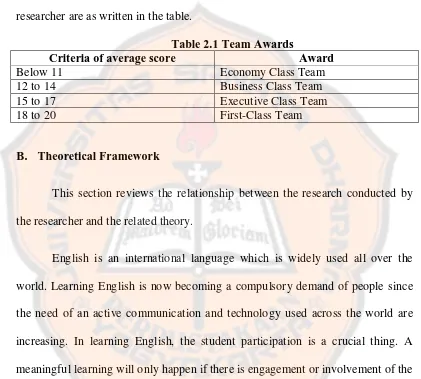
[image:44.595.97.518.187.566.2]researcher are as written in the table.
Table 2.1 Team Awards
Criteria of average score Award
Below 11 Economy Class Team 12 to 14 Business Class Team 15 to 17 Executive Class Team 18 to 20 First-Class Team
B. Theoretical Framework
This section reviews the relationship between the research conducted by
the researcher and the related theory.
English is an international language which is widely used all over the
world. Learning English is now becoming a compulsory demand of people since
the need of an active communication and technology used across the world are
increasing. In learning English, the student participation is a crucial thing. A
meaningful learning will only happen if there is engagement or involvement of the
students in the activities presented in the learning process.
The students of class VIIB English Extracurricular students in SMP
Pangudi Luhur I Yogyakarta had low participation in the English learning
process. Even though basically they were smart and fast learner, they did not fully
participating in the learning process. This could be influenced by their age group
as the adolescents that were facing many changes in body and mind, both
influence their motivation to participate in the learning process. Based on the
observation, the researcher found that the students had lower chance to participate
in the learning activities done.
Since the students of VIIB English Extracurricular class were not actively
participating in the learning process, the researcher proposed one of cooperative
learning Approach’s methods as the solution of the problem. It was Student Team
Achievement Division method. According to Slavin (1990), the main idea behind
Student Team Achievement Division is to motivate students to encourage and
help each other master skill presented by the teacher (p. 6). Most importantly,
STAD method also acquires students’ individual accountability in which when
they do the individual quizzes, students are responsible for their own work. In
cooperative learning, the students not only have to learn teamwork skill but also
become the director of their own learning. They learn to plan, monitor and
evaluate their own learning. Thus, learning is something that requires students’
direct and active involvement and participation (Richards and Rodgers, 2001:
199).
The researcher did the classroom action research to see whether
cooperative learning’s method: Student Team Achievement Division was
applicable in Class VIIB of English Extracurricular and able to improve the
students’ participation. The researcher set an indicator of success in conducting
this classroom research. The success is when the student participation in VIIB
English extracurricular class were improved through the use of STAD method.
doing each activity in STAD, discussed their work with their friends, responded to
the teacher’s questions and asked question to the teacher, and gave good
29 CHAPTER III
RESEARCH METHODOLOGY
In this chapter, the researcher presents the rationale of research method,
research setting, research participants, instruments and data gathering technique,
data analysis technique, and research procedure.
A. Research Method
This research was conducted in order to improve the student participation
and English learning process in the VIIB in English extracurricular class. The
methodology used to conduct the research was Classroom Action Research
(CAR). According to Burns (2009), one of the main aims of Action research is to
identify a problematic situation or issue that the participants–who may include
teachers, students, managers, administrators, or even parents – consider into
looking more deeply and systematically. She explains further that the central idea
of the action part of Action Research is to intervene in a deliberate way in a
problematic situation in order to bring about changes, and even better
improvement in practice (p. 13). Therefore, in doing the research, the researcher is
going to try to manage complex situation or problem in the classroom through the
implementation of action research to find the solution for the problem.
The problem in the VIIB of English extracurricular class was the students
were barely participating in the learning process. The teacher tended to conduct
the lesson using the teacher-centered method which did not required much student
cooperative learning approach to see how it improves the student participation in
English extracurricular class. Through cooperative learning approach planned, it
was expected that the student participation was improved and create a memorable
and meaningful learning process.
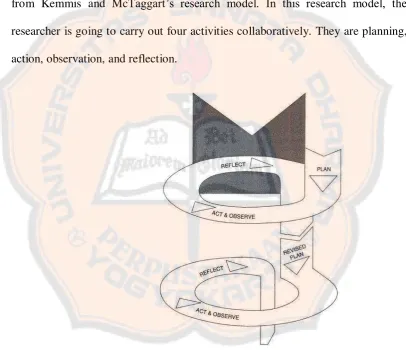
The Classroom Action Research conducted by the researcher was adopted
from Kemmis and McTaggart’s research model. In this research model, the
researcher is going to carry out four activities collaboratively. They are planning,
[image:48.595.102.509.255.605.2]action, observation, and reflection.
Figure 3.1 Kemmis and McTaggart’s Model of CAR ( McNiff .J. and Whitehead .J., 2002)
According to McNiff and Whitehead (2002), ”Kemmis and McTaggart’
model of action research process shows a self-reflective spiral of planning, acting,
action to improve an educational situation. The diagram shows the principles in
action, the movement from one critical phase to another, and the way in which
progress may be made through systematic steps (p. 46)”.
B. Research Setting
This research was conducted in the VIIB English Extracurricular Class
SMP Pangudi Luhur 1 Yogyakarta academic year 2013/2014. The school was
located in Jl. Timoho 2 No 29, Yogyakarta, Daerah Istimewa Yogyakarta,
Indonesia. The researcher conducted the observation during the process of
teaching the students of VIIB because the researcher was also the English
extracurricular teacher of this class.
This research was conducted in two cycles on 7th, 14th, 22nd, and 23rd of April 2014. The interview with the observer, who is also the supervisor for
English extracurricular program, was conducted on 24th of April 2014 in school lobby. The interview lasted for 30 minutes. The questionnaires were distributed to
the students on 23rd of April 2014.
C. Research Participants
The participants of this research were students of VIIB English
Extracurricular Class in SMP Pangudi Luhur I Yogyakarta academic year
2013/2014. There were 36 students in total. All of them were participating in this
D. Instruments and Data Gathering Technique
In conducting the research, a number of instruments to gather the data are
used. The instruments used are divided into two parts. They are instruments used
before the implementation and during the implementation.
1. The research instruments used in preliminary study
In the preliminary study, the instruments used to identify the problem in
the