Corresponding Author: Yusita Kusumarini, Interior Design Department, Faculty of Art and Design, Petra Christian University, Indonesia.
E-mail: [email protected]
2176
Sustainable Interior: A Holistic Approach of Eco-Socio-Econo Interior
1
Yusita Kusumarini,
2Sri Nastiti Nugrahani Ekasiwi,
2Muhammad Faqih
1
Interior Design Department Petra Christian University and PhD Student of Architecture Institut.
2Teknologi Sepuluh Nopember,
2Architecture Department Institut Teknologi Sepuluh Nopember.
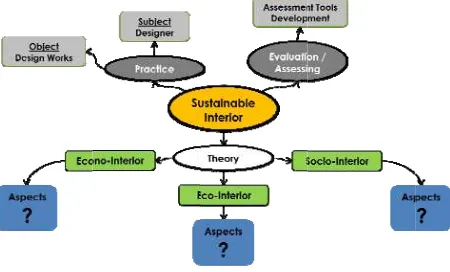
Abstract: Sustainable interior theory construction model with the contextual eco-socio-econo interior holistic approach become a problem and also research objective. Theoretical study was started from the sustainable development to the sustainable interior understandings, hypothesis of eco-socio-econo interior and terminology and theory of the sustainability of product-interior-structure scope. Generally, method used in the research execution was referring to the theoretical construction method. The research stages were the theoretical problem that continued by hypothesis and argumentation idea for the theory construction in general. Methods used were: logical and critical argumentation, report and description. Fisrt stage result of this research from the literature study was general theory in nature, the sustainable interior consisted of 3 holistic and balanced consider of major pillars namely: eco-interior, socio-interior, econo-interior.
Key words: sustainable interior, eco-interior, socio-interior, econo-interior.
INTRODUCTION
The Design Interior scholarly responsibility to engage in role in responding the environmental global issues became the background of research construction of sustainable interior theory. The anxiety for the sustainable, holistic and contextual interior design science development underlay the effort to make the sustainable interior theory construction. The global issues which accommodate as the focus of research background was the availability of globally environmental degradation as an impact of climate shift and as a result of global warming.
Sustainable developmental concept proposed as one of responses to the global environmental degradation. Implication of the sustainable development concept of the Our Common Future published by the Brundtland Commission (1987). The sustainable developmental concept to be the principle expected can be mutually faced in the implementation of each of developmental aspects, both in international and national scopes. Three sustainable developmental pillars are ecology, social and economic. In the concept understanding socialization stage and the sustainable development implementation are needed the development and adaptation consistent with ecological, social and economical context in each setting.
Likewise with the sustainable development in Indonesia, it is, of course, also needed the reasoning considering the global phenomenon and responds it by the locality wealth capital owned. In the sustainable development in Indonesia, exploitation of the entire natural and human resources nowadays should be spelled out on the goals of (Sumarwoto, 2001): Ecology, for the ecosystem wholly and balance, supporting power, biological diversity and global environment. Social, for the empowering, participation, social mobility, social cohesion, cultural identity and institutional matter. Economic, for the growth, even distribution and efficiency.
The three goals are to be considered as the main factors in the sustainable development. The balance consideration of all three ones as the thorough approach in development is highly needed. Thus it is important for the researchers and practitioners to refer again all consideration bases and exploitation techniques of the entire natural and human resources worked to the three goals.
The different understanding of every designer to the sustainable development concept result in the different emphasizes in design. The different emphasizes result in the different design applied shape as well. Frequently, the last result was the partial and holistically less optimum application (Kusumarini, 2007). Therefore, then a holistic sustainable design approach involving ecological, social and economical aspects in every physical development area is needed to consider included in interior space.
Interior Design Theory and Practice Development:
Space or consists of sp
limits (floor, mplement elem
nstallations ap the space and o does ‘interior’ n is that ‘interio
ant human acti in partial in na e design under ion and their in it theories for he sustainable e. Interior can e creation made or’ is the envir ivities direct-in in the space (in ucted in it. ed in the sustain ation to a num cal aspects disc n less discussed ive researcher ssion intended ogy, social and
cology, social r is activity c uctivity of ever nt to discuss an ronmental close nterface intens nterior), thus in vided into 2
ented to real ob Theory develo statement, it i gure 1) as follo
or. d is the econom
and or write le and holistic
al and family y, state and ear
nt elements. Sp
nterior to be th large domain hat faced in th
setting (mainly grated in the s ur definition p function needed nfluencing the rth).
pace forming e ll of shapes va o activities), ac ed on the under he tentative min nt to the susta
2178
necessity of advanced study in more contextual interior scope (for example, in Indonesia). Sustainable interior theoretical formulation highly usable in assessment system development process to quantify the sustainable interior design applied success.
Sustainable Interior Theory Construction Method:
Method in the research execution referred to theoretical construction method. Theoretical construction method used to construct ideal theory. Ideal theory formulated by collecting the interrelated theories by logical explanation for achieving the optimum understanding to something conceptual.
Following are three research stages conducted, referred to the research regular cycle to achieve research result validity (developed in the sustainable interior context):
1. Theoretical Problem (description and interpretation), initiated from general description and implication about the sustainable development to the sustainable interior. Result in this stage is gap of knowledge in the sustainable interior science scope.
2. Idea Diagnosis and Argumentation (theoretical construction), is done by explain the idea diagnosis and argumentation, concept and interrelationship of theoretical and practical scope to formulate the sustainable interior theory principles prevailing globally.
3. Conclusion (conclusion and suggestion), structuring the research result analysis conclusion, namely the theoretical formulation of sustainable interior, a holistic approach of eco-socio-econo interior.
The objectives of this research were not only to describe the developing theory up to this time and facts existing on object, but also analyzing application in a given discussion context (sustainable interior). The case conducted to achieve the end objective of new theory development in interior design science area, namely sustainable interior by the ecological, social and economical holistic approach.
From Sustainable Development to Sustainable Interior:
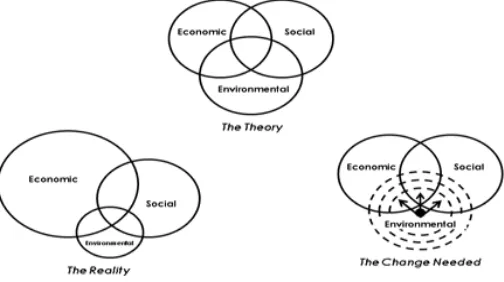
Discussion on the theory of sustainable interior strongly interrelated to that discussion trace that starts from the concept and theory of sustainable development. Sustainable development is a concept which is stated as an approach to respond to global environmental issues, implicated as a macro perspective to all areas of development. The concept of sustainable development that emerged and developed in their respective studies underwent a process of adjustment in terms of emphasis and detail terms to discuss for each of its aspect. There are many definitions are less clear and varied interpretations of 'sustainable development' which were adopted within the scope of their respective disciplines. Representative definition of sustainable development is issued by Brundland Commission in their report, "Our Common Future" (1987), also commonly referred to as the Brundtland Report, as follows: ‘Development that meets the basic need of the present and increases the opportunity to pursue a better life without compromising the ability of future generations to meet their own needs’. Sustainable developmentconcept consists of 3 main pillars which are ecology (environment), social and economy.
In the theoretical description, the three pillars are balanced with equal circles. This indicates that in theoretical description, all three pillars are ideally discussed and applied in balanced. In the discussion of reality, the economic pillar becomes the discussion and consideration of the most dominant large circle, followed by a social pillar and the smallest one is the environmental pillar. The composition works mainly on the reality of the global capitalism. In the discussion of changes needed for the future, the three pillars are the same balanced in a large circle. Pillars need to be considered in the context of environmental improvement and conservation, so that it will affect the economic and social pillars in order to approach the balance consideration (figure 3).
Grunkemeyer (2000) stated matter about the existence of sustainable development definition as follows: Sustainability has many definitions which are vague ambiguous, thus underlining the diversityof perspectives related to the concept whose power resides in the integration of economic, social and ecological systems,
previously treated in a separate manner. This research explained the sustainability concept in the aspect scope with the ecological, social and economical terms options as proposed by Grunkemeyer. Further, the discussion would focus on each of aspects and terms selected consistent with the discussion scope, namely of sustainable development – sustainable design – sustainable interior. Of course, with the aspects order as follows: eco-socio-econo development eco-socio-eco-socio-econo design eco-socio-eco-socio-econo interior.
Hypothesis of Sustainable Interior Theory:
Hypothesis process logically based on the interior design responsibility, especially in the context of ecological, social and economical responsibility. Hypothesis process conducted in a deduction manner to various literature sources with sustainable design topic. The deductive process on the theory and substance of sustainable design (products, interiors, structures) underlying the sustainable interior theory hypothesis would be further constructed. Classification of discussion into the study substances of ecology, social and economy become the initial resource in formulating whatever substances would be a part of sustainable interior theory. Hypothesis is arranged by sorting and selecting the design discussion classification results related to ecology, social and economy that may be included in the interior design scholarly study scope.
In the sustainable interior discussion, scope to be the study object involved inner space and outer space limited to around the building. The inner space scope is involving building envelope, complement and interior system elements. The limited outer space scope involved things to be the determinant factors or factors influencing the interior design decision (inner space).
Inner Space (Interior):
Eco-Interior: Related to the interrelationships of the user human and the environment in the building. The interrelationships intended are the benefits and impacts of each of interior stages for the user (occupant). Socio-Interior: Related to interpersonal relationship in the space. Interpersonal relationship intended is the social relationship enabled to be formed and maintained as the effect of its interior application. The social relationship closely related to the psychological and cultural conditions of space users.
Econo-Interior: Related to the economic consideration for the building user and or owner. The economic consideration intended is the considerations on cost must be spent and the benefit gained from the decision and application of interior design. The considerations also related to the product and technology development applied.
Limited Outer Space (Exterior):
Eco-Interior: Related to the design decision considering issue and or condition of outer space environment. The issue or condition of outer space environment intended is those which influencing the decision and application of interior design.
Socio-Interior: Related to the social relationship from inside to outer of building. Social relationship intended is the social interaction enabled to be formed from the user in the space to the individual or community in the outside of space and vice versa influenced by interior decision and application.
Econo-Interior: Related to the design decision oriented to the local environmental economic empowering. Economical empowering intended is the economic development support (both service and product industries) as a result of interior design decision and application effect both in small and large scales.
Identification of Eco-Socio-Econo Interior Aspect:
Identification started by the deductive investigation of about 50 literature sources discussing about sustainable design related topic with the limitation of built environmental science scope from product to construction. Identification process is done by sorting of study aspects brought out into each of discussions in the ecological, social and economical classification. The process is repeated in each of identification stages, both eco-interior, socio –interior and econo-interior.
Eco-Interior Aspect:
The theories developing related to the discussion about the interior specific scope ecology and design are dominated by the discussion on material aspect, lighting system and ventilation system. The least discussed aspects are the electromagnetic emission and indoor waste management.
2180
Socio-Interior Aspect:
The developing theories related to discussion about social and design of interior specific are dominated by discussion on interaction-cohesion and cultural identity aspects. The least discussed aspect is the universal design (inclusive design).
Study aspect identified in the eco-interior theory scope is: cultural identity, universal design, human behavior, participation and interaction-cohesion. Each of them has orientation to achieve the optimum condition.
Econo-Interior Aspect:
Theories developing related to discussion on social and design of interior specific scope are dominated by the discussion on the efficiency aspect. The least discussed aspect is the equity.
Study aspects identified in econo-interior theory scope are: efficiency, empowering-growth, potential, equity and soft benefit. Each of them has orientation to achieve the optimum condition.
Identification of Each Aspects of Eco-Socio-Econo Interior Orientation:
Further process is identifying the orientation of each aspect of eco-interior, socio-interior and econo-interior thus it will be obtained the orientation formulation of each aspect to be made as the principle reference of each aspect. Identification was conducted by elaborating what study points are proposed by each of literature sources related to eco-interior, socio-interior and econo-interior aspects as follows:
Eco-Interior Aspect Orientation:
Space organization, oriented on the space activities and needs analysis application, space grouping, space determinant side, circulation and accessibility and direction of the architectural-interior design-construction object to the directions of sun revolution and wind.
Material selection, oriented to the ecological building materials application comply with the exploitation and production requirements with energy as little as possible and the entropy condition as low as possible, does not undergo transformation cannot returned to nature and more stemmed from the local natural resources and have no impact for health and of economical value.
Lighting system, oriented to the energy conservation effort application by the economizing in determination of lighting type and level, natural light reflection technique, heat and glare reduction technique and using the renewable energy resources.
Ventilation system, oriented to energy conservation effort application by maximizing the natural air circulation technique and exploiting the solar energy passively by the convective, radiative and evaporative passive methods.
Water sanitation, oriented on the circulation effort application between clean water source and its waste management.
Indoor pollution, oriented on the application of effort to minimize impacts and anticipating the chemical, biological and physical pollutants developing in the space.
Electromagnetic emission, oriented to the application of effort to anticipate technical radiation in the form of artificial electrical field, artificial magnetic field and static artificial magnetic field.
Indoor waste management, oriented to the effort application of consumption economizing and sorting for the goal with the principles to reduce, reuse, refunction and recycle.
Socio-Interior Aspect Orientation:
Culture identity, oriented on the necessarily of socio cultural effect in facing the adaptation problem to environmental condition. Cultural identity also highly needed in facing the rapid of global technology change.
Universal design (inclusive design), oriented to the necessarily of human in the space in the effort of process of making aware to the sustainable design implementation. Behavior expected is the aware behavior for the consequence of activities shall influence the design decision. Both indoor human individual and group behaviors may affect the sustainable design application decision.
Participation, oriented on the involvement all of activities carried out in the spaces planned to be the part in the concrete action achieves the sustainable design.
Interaction and cohesion, oriented on the effort to accommodate human activity via space design enabling the optimization of social interaction and cohesion occurrence among the user humans.
Econo-Interior Aspect Orientation:
Efficiency, oriented on the efficient design application in the whole realization process, especially in the construction and operational processes.
Potential, oriented on the creative design encouraging the emergence of economic potential can be developed.
Equity, oriented on the design application making use the local potentials evenly, not dominant to make use just a certain potential.
Soft benefit, oriented to get additional profit in the form of space user health and the user growth of psychology-social interaction.
Conclusion:
Research as an effort of theory construction by the holistic eco-socio-econo interior approach was initiated with the construction of sustainable interior of principally universal characteristics and orientation. The results were the sustainable interior theory concept consisted of 3 holistic and balanced consideration of major pillars namely: eco-interior, socio-interior, econo-interior. Eco-interior discussion aspects were: space organization, material selection, lighting system, ventilation system, air sanitation, indoor pollution, electromagnetic emission and indoor waste management. Socio-interior discussion aspect were: cultural identity, universal design, human behavior, participation and interaction-cohesion. Econo-interior discussion aspects were: efficiency, empowering and growth, potential, equity and even soft benefit.
REFERENCES
Mc Clure, R. Wendy and Bartuska, J. Tom, 2007. The Built Environment. New Jersey: John Wiley and Sons, Inc.
Soemarwoto, Otto, 2001. Ekologi Lingkungan Hidup dan Pembangunan.Bandung: Penerbit Djambatan. Stieg, Cathy, 2006. The Sustainability Gap.Journal of Interior Design., 32(1): 7-21.
Kusumarini, Yusita, 2007. Kajian Terapan Eko-Interior pada Bangunan Ramah Lingkungan. Studi Objek: Rumah Tinggal Heinz Frick di Semarang, Pusat Pendidikan Lingkungan Hidup di Seloliman Mojokerto, dan Perkantoran Graha Wonokoyo di Surabaya. ITB Journal of Visual Art and Design, Vol.1 No.2.
Grunkemeyer, B., 2000. History and Definitions of Sustainability. Session1, tutorial of the Sustainable Communities Program in Ohio, (on line): http://www.ag.ohio-state.edu/-esco/inserv1.html
.
Sustainable Development: A Case for Indonesia: www.ide.go.jp/Japanese/Ideas/pdf/followup_14/03.pdf UN Sustainable Development – Indonesia: www.un.org/esa/agenda21/natlinfo/countr/indonesia
.
UNDP Indonesia – Environmental Sustainability: www.undp.or.id/environemnt.
A National Strategy for Sustainable Development – Agenda 21Indonesia: www.searo.who.int/en/Section23/Section1328/Section1792.htm