LANGUAGE IMPOLITENESS AND GENDER IN INDONESIA
LAWAK KLUB (ILK) COMEDY PROGRAM
A Thesis
Submitted to the English Applied Linguistics Study Program in
Partial Fulfillment of the Requirements for the Degree of
Magister Humaniora
By:
YENI PURTIKA SIMANJUNTAK
Registration Number: 8136112087
ENGLISH APPLIED LINGUISTICS STUDY PROGRAM
POSTGRADUATE SCHOOL
STATE UNIVERSITY OF MEDAN
MEDAN
ABSTRACT
Simanjuntak, Y. P. Registration Number: 8136112087. Language Impoliteness and Gender in Indonesia Lawak Klub (ILK) Comedy Program. A Thesis. English Applied Linguistics Study Program, Post Graduate School, State University of Medan. 2015.
ABSTRAK
ACKNOWLEDGEMENT
Alhamdulillahirabbil’alamin. Praise and thank to the Almighty Allah SWT, for
the blessings and guidance to the writer so that the writing of this thesis can
finally be accomplished as it should be. This thesis is a scientific writing that has
to be completed in order to fulfill one of the academic requirements for the degree
of Magister Humaniora at the English Applied Linguistics Study Program; Post
Graduate School, State University of Medan. It has also shown the responsibility
and capability of the writer as an academician to be able to conduct a research that
would contribute to the development of scientific knowledge.
However, without the assistance of these following number of people who have
given valuable suggestions and useful influences on the writing of this thesis, it
would be much more difficult for the writer to finish her work. She is then deeply
indebted to these people and would like to express her sincere thanks.
The writer would like to deliver her grateful appreciation and gratitude to her
first adviser Prof. Dr. Hj. Sumarsih, M.Pd, and her second adviser Dr. Sri Minda
Murni, M.S. for their great care, patient guidance, excellent advices, and precious
time in guiding her in the process of completing this thesis.
Her gratefulness also goes to the Head and Secretary of the English Applied
Linguistics Study Program, Prof. Dr. Busmin Gurning, M.Pd. and Dr. Sri Minda
Murni, M.S. for their kind support toward the prerequisites of the thesis
submission as well as the encouragement to work hard toward the thesis proposal.
Her sincere gratitude is also given to Prof. Dr. H. Abdul Sibuea, as the Director of
express her gratefulness to Prof. Jonathan Culpeper from Lancaster University,
UK, for his contributive input in clarifying and guiding her through the concept of
his impoliteness theories and his generosity to spend some time to read her emails
and respond to her questions.
Furthermore, the writer would like to thank Prof. Dr. Amrin Saragih, M.A.,
Ph.D., Dr. Zainuddin, M.Hum., and Dr. Rahmad Husein, M.Ed. for their
constructive comments and suggestions in advancing the thesis quality.
Her deepest gratitude and tremendous appreciations are presented to her
parents, Togu Simanjuntak, SH, MH and Sri Sudiartin for their never ending
support, care and love to encourage her to learn and pursue her education to the
master degree. To all her beloved families who always pour her with all their
compassion; especially to her younger brothers, Yudha Prayogie Simanjuntak,
S.Kom and Yumnaa Rifqi Simanjuntak.
Last but not least, the writer would like to thank all of her beloved friends in
B4 Class, Applied Linguistics Study Program, Post Graduate School at State
University of Medan, Siti Marlina, Ersika Puspita Dani, Mia Rizana, Ika
Swantika, Evi Lestaria, Muvidah, Lamia Deareni, Fitri Erawati, and Adinda
Zoraya Alvin. Thank you very much for their time to discuss and exchange ideas
while working on the thesis as well as their prayers, encouragement and support.
Medan, June 2015
The Writer,
Yeni Purtika Simanjuntak
TABLE OF CONTENTS
CHAPTER II: REVIEW OF LITERATURE ... 11
2.1 Impoliteness ... 11
2.1.1 Culpeper’s Impoliteness Theory ... 13
2.1.2 Impoliteness and Context Dependence ... 16
2.2 The Forms of Impoliteness ... 18
2.2.1 Conventionalized Impoliteness Formulae ... 18
2.2.2 Non Conventionalized Impoliteness: Implicational Impoliteness ... 21
2.3 Responding to Impoliteness ... 25
2.4 The Process of Impoliteness... 26
2.4.1 Discourse ‘beginnings’... 26
2.4.2 Discourse ‘middles’ ... 27
2.4.3 Discourse ‘ends’ ... 28
2.5 Language, Gender, and Impoliteness ... 30
2.6 The Reasons of Using Impoliteness ... 33
2.7 Television ... 35
2.7.1 Comedy Program ... 36
2.7.2 Indonesia Lawak Klub ... 37
2.8 Relevant Studies ... 39
2.9 Conceptual Framework ... 43
CHAPTER III: RESEARCH METHODOLOGY ... 46
3.1 Research Design ... 46
3.2 The Source of Data... 46
3.3 The Technique of Data Collection ... 47
3.4 The Instrument of Data Collection ... 47
3.5 The Technique of Data Analysis ... 48
3.6 The Trustworthiness of the Study ... 49
3.6.1 Credibility ... 50
3.6.3 Dependability... 51
3.6.4 Conformability... 51
CHAPTER IV: DATA ANALYSIS, FINDINGS AND DISCUSSIONS ... 52
4.1 Data Analysis ... 52
4.1.1 Types of Impoliteness Forms ... 52
4.1.2 Types of Impoliteness Responses ... 79
4.1.3 The Process of Language Impoliteness ... 89
4.1.4 The Reasons of Language Impoliteness ... 106
4.2 Findings ... 117
4.2.1 Types of Impoliteness Forms and Responses by Male and Female Comedians in ILK Comedy Program ... 118
4.2.2 The Process of Language Impoliteness Conducted by Male and Female Comedians in ILK Comedy Program ... 123
4.2.3 The Reasons of Using Language Impoliteness Conducted by Male and Female Comedians in ILK Comedy Program ... 124
4.3 Discussions ... 126
CHAPTER V: CONCLUSIONS AND SUGGESTIONS ... 132
5.1 Conclusions ... 132
5.2 Suggestions ... 134
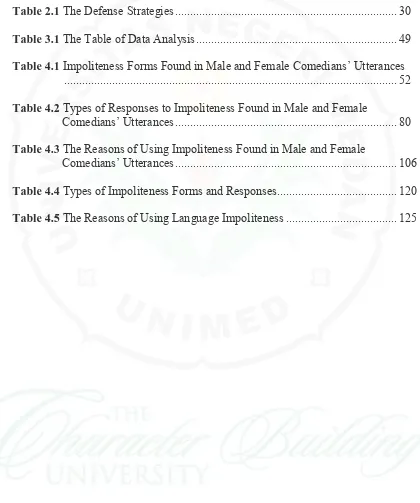
LIST OF TABLES
Page
Table 2.1 The Defense Strategies ... 30
Table 3.1 The Table of Data Analysis ... 49
Table 4.1 Impoliteness Forms Found in Male and Female Comedians’ Utterances ... 52
Table 4.2 Types of Responses to Impoliteness Found in Male and Female
Comedians’ Utterances ... 80
Table 4.3 The Reasons of Using Impoliteness Found in Male and Female
Comedians’ Utterances ... 106
Table 4.4 Types of Impoliteness Forms and Responses... 120
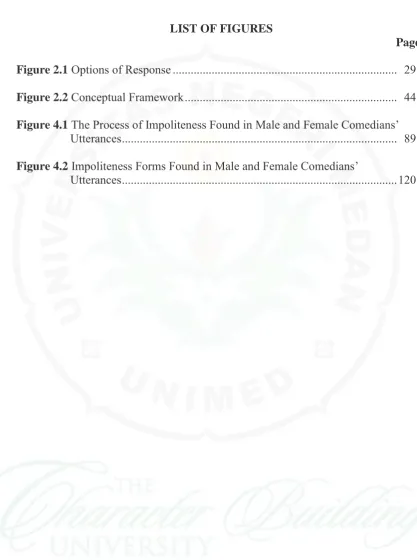
LIST OF FIGURES
Page
Figure 2.1 Options of Response ... 29 Figure 2.2 Conceptual Framework ... 44 Figure 4.1 The Process of Impoliteness Found in Male and Female Comedians’
Utterances ... 89
Figure 4.2 Impoliteness Forms Found in Male and Female Comedians’
LIST OF APPENDICES
Appendix Page
I The Transcription of Male and Female Comedians’ Utterances
In Pro Kontra Hukuman Mati (PKHM) ... 138 II The Transcription of Male and Female Comedians’ Utterances
in Mundurnya Moralitas (MM) ... 157 III The Transcription of Male and Female Comedians’ Utterances
in Jomblo atau Asik Sendiri (JAAS) ... 175 IV The Data Display of the Types of Impoliteness Forms and
Responses, the Process of Language Impoliteness and the
CHAPTER I INTRODUCTION
1.1 The Background of the Study
For more than 100 years, engineers and scientists have developed a
considerable measure of helpful machines, and television or usually called as TV
is one of them. TV has turned into an imperative part of individuals' life as a
source of information and a great tool for learning and communication. TV today
has a ton of beneficial outcomes and impacts on our society. It is an incredible
method for educating people with the vital issues that influence their daily lives.
Whether it is social, political, economical, or medical, there is continually
something new to be told, and TV is the fastest approach to get it out to people.
Alongside informational and educational purposes, though it is not expected
to be one of its objectives, TV serves as an entertainer too. As time goes on,
individuals start to sit and watch TV for that reason. TV has expanded its
entertaining aspects into many forms, such as dramas, reality shows, and
apparently comedy programs.
Considering the importance of the role of TV in the life of society, the
function of TV as entertainment particularly comedy, nowadays, is growing very
rapidly. However, in practice, this leads to the comedians’ use of strategies that do
not conform to the primary function of TV as a source of learning for the
communities. One of them is the application of impoliteness forms in comedian’s
Impoliteness form applied in these comedy programs is not ultimately seen
as an actual ‘negative’ attitude toward specific behaviors occurring in specific
contexts (Culpeper, 2011). It is rather a planned verbal attack that stays on the
surface and is not intended to insult anyone (Culpeper, 1996:4).
This kind of impoliteness framework is called mock impoliteness, which is
one of two categories that Culpeper (1996) suggested. The other category is called
inherent impoliteness in which there are acts that innately threaten one’s face
regardless of the context of the act.
The impoliteness forms occurred therefore would be realized as not to be
taken literally by the participants. Unlike inherent impoliteness which will cause
social conflict and disharmony as studied by Nasution (2014) in a TV talk show
Jakarta Lawyers Club, these forms are intended to only entertain the third party
and even create bonding between these participants.
This concept of impoliteness fits the atmosphere of the comedy programs. It
specifically utilizes the entertaining function of impoliteness. Culpeper (1996)
claimed that in entertaining function, the use of impolite speech event is aimed to
a third-party audience that finds it humorous. This function has been utilized
creatively and easily found during comedy programs that though may not follow
the society norms, has been used as an efficient formula to trigger laughter.
This impoliteness concept is adopted that the politeness strategies used to be
fully maintained are disrupted by the impolite utterances and attitude that are not
performers, especially comedians, tend to mock their partners in order to entertain
the audience as exemplified in the following conversation.
DC : Saya bertanya dulu ni, sebelum kita mulai ini ya. Meng, Anda sebetulnya ngerti ga sih dengan konsep bully ini!”
(‘Let me ask you before we start. Meng, do you really understand with this ‘bullying’ concept!’)
K : Anda meremehkan saya!
(‘You underestimate me!’) (Everybody in the studio laughs.)
At the beginning, DC as the host mocks the other comedian by raising an
unpalatable question of his role in the program. He performed an attitude in which
he pretended to seriously question the capability of K. This impoliteness form
occurs due to the behavior of K who often provides irrelevant explanation to the
topics presented. K responded offensively by standing up and pointing DC and
rather than triggering awkwardness among the audience, the conflict ends by
laugh.
This impoliteness practice is considered successful in cheering up the
audience since they may derive enjoyment of feeling safe from the face-attacks,
(Lorenzo-Dus and Blitvich, 2013). It is not the case whether the target of the
utterances is aware of the impoliteness. What matters is the audience who are
entertained, are aware of who the target is; providing a safe zone to enjoy the
pleasure of the target being ridiculed.
Furthermore, these impolite utterances along with the provocative attitude
give self-reflexive pleasure for the audience in observing the target in a worse
state than themselves and therefore becoming more entertained (Culpeper, 2005).
the comedian attacks the other comedian’s face with impolite utterances, the
audience would feel they are better than the target and find it amusing.
This situation is an apparent evident that impolite utterances occur in
communication and its entertaining function has been exploitative to a degree. It
becomes an effective formula for comedians to create humor and entertain the
audience. This led more comedians to become reluctant to find qualified jokes and
more inclined to seek out areas of the targets to be mocked for instance the
physical appearance.
This phenomenon of using impoliteness to entertain the viewers on national
TV shows ironically causes the moral deterioration of the society. TV which has
become an integral part of human life that its shows should reflect the role models
and contribute to the decent advancement of the moral of the society, somehow
uses this concept as main entertainment for its audience. TV shows which have
been the primary source of entertainment of Indonesian citizens have changed
their basic course and become a place for inappropriate program containing
impolite linguistic behavior and less moral values.
The fact that this phenomenon is appeared on national TV and watched by
the communities provoked other problematic issues especially for children.
Recent study by Yusuf and Fahrudin (2013) claimed that nowadays children in
school-age show behaviors such as name calling and verbal abuse which is
certainly caused by what they imitate from TV shows. Murni (2012) points out
that recent discussion on negative effects of TV on children, for example, raises
to mention that in order to provoke laughter, these comedians would even criticize
his own face, as for instance a comedian says, “Saya dikatain ganteng. Saya
marahlah Pak! Karena gak sesuai dengan muka saya Pak!” (‘I was told that I
was handsome. I got angry because I wasn’t’). By the utterance, it can be seen the
comedian tries to admit that he has ugly face so that the audience would find it
humorous and then laugh.
This phenomenon actually can slowly damage the morale of the audience
and make the audience accustomed to using impolite forms of speech in
communication. It is expected that these ways are not used and the comedian
should be able to use smart ways of joking and creating humor, which is
educational and doesn't not use any forms of ridicule. However in fact, because it
is easier, much preferable by the audience and has become a trend, the national
TVs still follow the pattern of this impoliteness function and more programs like
these are produced.
Indonesia Lawak Klub broadcasted by Trans7 is one of comedy programs
that utilize this function of impoliteness to entertain the viewers. The format of the
program is to position the comedians in Indonesia in the debate forum and each
comedian represents a certain fake organization showing their statuses as the
expert of the issue. The comedians collaborate in discussing a problem and
attempting to provide solutions in an entertaining and humorous way. In the
duration of 60 minutes, the host will invite 7-8 well-known comedian or
entertainer in Indonesia to become a panelist. In addition to listening to comments
their opinions aired through videos, and at the end of the show, the summary of
the minutes of the discussion was delivered.
Despite the well-managed concept of the show, during the process of
discussion, the comedians would utter statements that are considered impolite and
mock the face of the other comedians in the aim of entertaining the audience. It is
mainly because of the format of the program which places several comedians as
the experts of the issues are set up to give wrong or even non relevant information
and therefore causing a pique and provoking impoliteness. These non-relevant
information, then, are further continued by the responses of all panelists mocking
each other assuming that particular comedians have no capacity to discuss about
the issue.
Furthermore, in the show, impoliteness is without exception used by almost
all comedians regardless their gender. As previously exemplified, a male
comedian easily mocks a female comedian which is responded by laughing. The
same thing also occurs when a female comedian without any hesitation insults a
male comedian’s physical appearance, for instance, “Bapak. Intrupsi! Bisa saya
gak duduk dekat kakek – kakek ini!” (‘Sir, interruption! Can I please not sit near
this old man!’). She vents her negative feelings that she isn’t comfortable sitting
near the male comedian. She stands up and gets angry to the host for the seating
arrangement. This utterance is even not responded and simply ignored by the male
comedian. It is then, terminated by a stand-off of a topic change.
Lakoff (1975), who made one of the early studies on gender differences in
connections” which they will produce less impolite speech events. Most past
feminist researches supported this theory by claiming that women use “powerless”
speech, for example, using tentative language features such as tag questions,
deference, modality, hesitation and so on. It is assumed that women are
necessarily ‘nicer’ than men that women choose to be more cooperative.
However, this concept may not be applicable in terms of entertainment
shows, especially comedy program. It has slightly changed that in terms of
entertaining audience that female comedians also apply the impoliteness forms as
an effective tool to create humor. ILK, for instance, has shown the equal chance
for male and female comedian to use the impoliteness to entertain the viewers.
This phenomenon is fascinating to be further examined due to its existence
as one of the examples that impoliteness is fun and tolerable to do. It is not in line
with the expectation that TV shows should provide a good model of
communicative strategies. It is also necessary to discuss the applications of
impolite language specifically related to gender as a significant factor which may
explain the increase of impoliteness forms use in the society. Moreover, given
that the research in this study since linguistic impoliteness has not gained nearly
as much as attention as linguistic politeness, the study of gender and impoliteness
is an area ripe for future development building. Not to mention that the results of
the study may contribute something new to the development of impoliteness
theories due its different research settings with the previous studies.
This present study aims at exploring the model of impoliteness as stated by
concept of gender and impoliteness and Beebe’s (1995) and Culpeper’s
framework of the reasons of utilizing impoliteness in communication. In line with
the theories, the researcher is very much interested in conducting a study on the
forms of impoliteness, the responses used by the male and female comedians in
Indonesia Lawak Klub, how and why they occur. This present study, however,
would not aim to clarify the frequency of male or female in using the impoliteness
forms or to prove which is more impolite, male or female, but rather to expose the
gender difference in using and responding to impoliteness utterances.
1.2 The Problems of the Study
In relation to the background of study presented above, the problems of the
study are formulated as in the following.
1. What are the forms of impoliteness and the responses used by the male
and female comedians in Indonesia Lawak Klub?
2. How are the processes of language impoliteness conducted by the male
and female comedians in Indonesia Lawak Klub?
3. Why are the language impoliteness conducted by the male and female
comedians in Indonesia Lawak Klub realized the way they are?
1.3 The Objectives of the Study
In line with the problems of the study, the objectives are to:
1. find out the forms of impoliteness and responses used by the male and
2. describe the process of language impoliteness conducted by the male and
female comedians in Indonesia Lawak Klub;
3. explain the reasons why the language impoliteness conducted by male
and female comedians in Indonesia Lawak Klub are realized the way
they are.
1.4 The Scope of the Study
Linguistic impoliteness can be used as one of the strategies to create humor
and this phenomenon has benefited the comedians appearing on TV. Rather than
seeking for qualified materials to create laughter, the comedians tend to use the
impolite utterances which are somehow simpler to enact and more efficient to
reach the goal. It has become a trend that either male or female comedian in
almost every show on TV, without any hesitation tend to use the shortcut (as to
mock the other comedians) to provoke an effective laughter. Due to its influence
on various TV programs, this study is limited to the discussion of impoliteness
appeared in Indonesia Lawak Klub comedy program. The main aspects to be
observed are the impoliteness forms (insults, pointed criticisms, challenging or
unpalatable questions, condescensions, message enforcers, dismissals, silencers,
threats, negative expressives, form-driven, context-driven, and convention driven)
appeared when comedians contribute an opinion in the forum and the comedians’
responses (no response, accept the impoliteness, offensive and defensive
1.5 The Significance of the Study
The findings of the study are expected to be useful theoretically and
practically. Theoretically, the research findings are useful for: a) linguists to
enrich their knowledge of the application of the impoliteness theory as
specifically about how impoliteness can be used to face-attack hearers as well as
entertaining the audiences, the dynamics of impolite utterances in the
conversation, and the expansion of impoliteness in its relation to gender as a
significant factor; b) other researchers to get information of what forms of
impoliteness and responses occur in a comedy program, and for those who would
conduct a further study about linguistics impoliteness in relation to gender which
remains tantalizing and fruitful line of academic inquiry in other discourses such
as novels, plays and so on.
Practically, the findings of this research are expected to be useful as a
reference for lecturers, teachers and students which helps to lead toward how to
deal with impoliteness, how impoliteness should be seen as a controlled and
managed phenomenon, and why impoliteness occurs in entertainment, especially
CHAPTER V
CONCLUSION AND SUGGESTIONS 5.1 Conclusions
This study focused on language impoliteness and gender in ILK Comedy
Program. It was aimed to find out the forms of impoliteness and responses,
describe the process of language impoliteness and explain the reasons why
language impoliteness were conducted by male and female comedians in ILK
Comedy Program. After analyzing the data, conclusions are drawn as follow.
1. There were 8 forms of impoliteness that could be found in both data of male
and female comedians’ utterances, 5 conventionalized formulae, namely a)
insults, b) dismissals, c) silencers, d) threat, and e) negative expressives and 3
non-conventionalized formulae, such as form-driven, convention-driven and
context-driven were found in both male and female comedians’ utterances.
There were 3 conventionalized forms which were only found in the data of
male comedians’ utterances such as a) pointed criticisms or complaints, b)
challenging or unpalatable questions and/or presuppositions, and c) message
enforcers. Condescensions were not found in both data but a new form of
interruption was found instead. All types of responses to impoliteness were
found to be performed by male and female comedians, namely 1) no
responses, 2) accepting the impoliteness, 3) offensive response, and 4)
defensive response. Offensive response was found to be the most dominant
response expressed by male and female comedians. There was a new type of
2. The processes of language impoliteness conducted by male and female
comedians were mostly the same except for the slight differences in the
variation of response patterns and the conflict endings. In discourse
beginnings, male and female were upon the same goal which was to entertain
the viewers and the phenomena triggering their production of impoliteness
were basically the same such as, physical appearance, age, the language,
behavior, personal matter and the role of the comedian. In discourse middles,
male and female comedians’ participation also led to the same patterns,
namely, a) single or multiple attacks with no response, b) single or multiple
attacks and accepting the impoliteness, c) OFF-DEF pairings and d) OFF-OFF
pairings. There was a new pairing, OFF-SNG pairings which were only
conducted by the male comedians. In discourse ‘ends’, it was found that there
were 2 conflict terminations conducted by male and female comedians,
namely third party intervention and stand-off. Stand-off was the most
dominant conflict resolution. There were 2 conflict resolutions found only in
male comedians namely withdrawal and submission to the opponent which
were only found once for each category. Singing was a conflict resolution
used only by female comedians.
3. The use of language impoliteness during the program by male and female
comedians shared several same reasons, namely a) to vent negative feelings,
b) to mock the panelist, c) to show disagreement, d) to disturb the panelist’s
participation of the discussion, e) to threaten the panelist’s face, and f) to
and female comedians was to mock the panelist and the least frequent reason
is to show power for male comedians and to dismiss the panelist for female
comedians. There were only 2 reasons found only in male comedians’
speeches namely to show power and to provoke laughter.
5.2 Suggestions
In line with the conclusions mentioned above, this study offers some
suggestions for the readers as provided in the following items.
1. To the lecturers teaching sociolinguistics, psycholinguistics; it is suggested to
conduct, elaborate, and perform deep research in the study.
2. To other researchers; it is suggested that this study could be further expanded
in the use of impoliteness to self-attack in the comedy program and explored
in terms of other discourses to contribute to the development of impoliteness
theories, such as the use of impoliteness in literary works or its application in
terms classroom interactions.
3. To all the readers; it is suggested to use this study as references for
understanding the application of impoliteness in media studies, especially for
its entertaining function on the television comedy program.
4. To the television producers and comedians; it is suggested to move the
showtime to be later at night and include the notice of PG (parental guide) as
well as prepare a more qualified joke that conforms to the primary function of
TV as a source of learning for the communities.
5. To the parents; it is suggested that the display of comedy shows such as ILK
REFERENCES
Beebe, L. M. (1995) Polite fictions: Instrumental rudeness as pragmatic competence. In: Culpeper, J. (2011). Impoliteness: Using language to cause offence. Cambridge: Cambridge University Press.
Bousfield, D. (2007). Beginnings, middles and ends: A biopsy of the dynamics of impolite exchanges. Journal of Pragmatics, 39(12), 2185-2216.
Bousfield, D. (2008). Impoliteness in interaction (Vol. 167). John Benjamins
Publishing.
Bousfield, D., & Locher, M. A. (Eds.). (2008). Impoliteness in language: Studies on its interplay with power in theory and practice (Vol. 21). Walter de
Gruyter.
Brain, M. (2014). The Laughing Brain 1: How We Laugh. Retrieved September 8, 2014 from http://sciencenetlinks.com/lessons/the-laughing-brain-1/
Bryman, A. (2004). Encyclopedia of Social Science Research Methods. Retrieved September 8, 2014 from http://www.crec.co.uk/docs/Trustworthypaper.pdf
Brown, P., & Levinson, S. C. (1987). Politeness: Some universals in language usage (Vol. 4). Cambridge University Press.
Culpeper, J. (1996). Towards an anatomy of impoliteness. Journal of Pragmatics, 25(3), 349-367.
Culpeper, J., Bousfield, D., & Wichmann, A. (2003). Impoliteness revisited: with special reference to dynamic and prosodic aspects. Journal of Pragmatics, 35(10), 1545-1579.
Culpeper, J. (2005). Impoliteness and entertainment in the television quiz show: The Weakest Link. Journal of Politeness Research. Language, Behaviour, Culture, 1(1), 35-72.
Culpeper, J. (2011). Impoliteness: Using language to cause offence. Cambridge:
Cambridge University Press.
Denzin, N. K. (1970). The research act in sociology. Chicago: Aldine
Effendy, O. (2000). Ilmu teori dan filsafat komunikasi. Bandung : Rosdakarya.
Grice, H. P. (1970). Logic and conversation (pp. 41-58). na.
Held, G. (2005). Politeness in linguistic research. In K. Ehlich & S. Ide (Eds.),
Politeness in language : Studies in its history, theory and practice. Berlin:
Mouton de Gruyter. Retrieved from
http://site.ebrary.com/lib/masaryk/docDetail.action?docID=10318141&p00 Lacey, N. & Stafford, R. (2002). Comedy films for GCSE media. Riddlesden:
Keighley.
Lakoff, R. (1973). Language and woman's place. Language in society, 2(01),
45-79.
Lorenzo-Dus, N., & Blitvich, P. G. C. (2013). Real talk: reality television and discourse analysis in action. Palgrave: Macmillan.
Meakins, F. (2001). Lashings of Tongue: A Relevance Theoretic Account of Impoliteness. University of Queensland.
Miles, M. B., & Huberman, A. M. (1994). Qualitative data analysis: An expanded source book. Thousand Oaks, CA: Sage Publications.
Mills, S. (2005). Gender and impoliteness. Journal of Politeness Research. Language, Behaviour, Culture,1(2), 263-280. doi:10.1515/jplr.2005.1.2.263
Murni, S. M. (2012). Linguistic impoliteness: A small corpus analysis on the use of impolite language by children. Aceh International Journal of Social Sciences Volume I. Retrieved August 27, 2014 from
http://dx.doi.org/10.12345/aijss.1.1.1521
Nasution, M.F. (2014). Language impoliteness in Jakarta Lawyers Club talk show. State University of Medan.
Patton, M. Q. (1990). Qualitative evaluation and research methods. Newbury
Park: Sage.
Rukmananda, N. (2004). Menjadi sutradara televisi. Jakarta: Grasindo.
Spencer-Oatey, H. D. M. (2000) Rapport management: A framework for analysis. In: H. D. M. Spencer-Oatey (ed.) Culturally Speaking: Managing Rapport Through Talk Across Cultures. London and New York: Continuum, pp. 11– 46.
Subon, F. (2013). Gender differences in the use of linguistic forms in the speech of men and women in the malaysian context. IOSR Journal Of Humanities And Social Science (IOSR-JHSS) Volume 13, Issue 3 (Jul. - Aug. 2013), PP 67-79
Wardhaugh, R. (1998) An Introduction to Sociolinguistics: 3rd Edition. Oxford:
Blackwell Publishers.
Xie, C., He, Z., & Lin, D. (2005). Politeness: Myth and truth. Studies in Language, 29(2), 431-461.
Yule, G. (1996). Pragmatics. Oxford: Oxford University Press.
Yusuf, H., & Fahrudin, A. (2012). Perilaku bullying: asesmen multidimensi dan intervensi sosial. Jurnal Psikologi Undip, 11(2), 10. Retrieved August 23,
2014from http://s3.amazonaws.com/academia.edu.documents/31297730/