THE IMPLEMENTATION OF INTERCULTURAL APPROACH IN EFL LEARNING AT SMAN 5 MAKASSAR
Yanti Budiarti
State University of Makassar
Abstract
The objectives of the research was (1) to know the Implementation of Intercultural Approach
in EFL Learning at SMAN 5 Makassar and (2) to know the benefits of the Implementation of
Intercultural Approach in EFL Learning at SMAN 5 Makassar.
The researcher applied mixed method namely triangulation mixed method design (Quan-Qual). The Population of this research were English Teacher at SMAN 5 Makassar which consisted of 6 teachers. The researcher chose all of population because was less than 100 samples. So, the total samples of this research are 6 people. The research data were collected using questionnaire and analyzed by means descriptive statistic through SPSS version 16 for windows program.
The result of this research showed that (1) the implemention of intercultural approach was a challenging, demanding task for the language teacher, who had to possesed at least some intercultural knowledge and very often keep developing it alongside his or her students. The EFL teachers must implement the intercultural approach in a tactful, skillful, and conscious way, and (2) the benefits of intercultural approach to teaching (easily done in literature and history classes) tells students that you, the teacher open to teaching and therefore understanding differences and diversity. This is a way to provide emotional security in your classroom and to approach difficult subjects, often the roots of conflict, in a safe and healthy way
Keywords: Implementation, Intercultural Approach, EFL Learning
Tujuan dari penelitian ini adalah (1) untuk mengetahui implementasi pendekatan antarbudaya dalam Pembelajaran Bahasa Inggris sebagai Bahasa Asing di SMAN 5 Makassar dan (2) untuk mengetahui manfaat implementasi Pendekatan Antarbudaya dalam Pembelajaran Bahasa Inggris sebagai Bahasa Asing di SMAN 5 Makassar.
Peneliti menggunakan metode campuran yaitu metode triangulasi campuran (Quan-Qual). Populasi penelitian ini adalah Guru Bahasa Inggris di SMAN 5 Makassar yang terdiri dari 6 orang guru. Peneliti memilih semua populasi karena kurang dari 100 sampel. Jadi, total sampel penelitian ini adalah 6 orang. Data penelitian dikumpulkan dengan kuesioner yang dianalisis dengan statistik deskriptif melalui program SPSS versi 16 for windows.
Hasil penelitian ini menunjukkan bahwa (1) penerapan pendekatan antar-budaya merupakan tugas yang menantang dan menuntut guru bahasa Inggris setidaknya memiliki beberapa pengetahuan antar budaya dan terus mengembangkannya pada siswa-siswanya. Guru Bahasa Inggris harus menerapkan pendekatan antar budaya dengan cara yang bijaksana, terampil, dan sadar, dan (2) manfaat pendekatan antar budaya dalam pembelajaran memberitahu siswa bahwa guru terbuka untuk mengajar dan memahami perbedaan dan keragaman. Ini adalah
cara untuk memberikan keamanan emosional di kelas dan untuk memeberikan pendekatan pada pelajaran yang sulit dengan cara yang aman dan sehat.
Kata kunci: Implementasi, Pendekatan antar budaya, Pembelajaran EFL Introduction
English is one of the international languages that are used worldwide. According to Hutchinson & Waters (1986), it was started soon after the Second World War when a large expansion in scientific, technical and economic activity began on an international scale. This expansion created a demand for an international language. For various reasons, most notably the economic power of the United States in the post-war world, the role of international language fell to English.
In Indonesia, English is a subject to learn from elementary school to university levels. Elementary school provides English as a local content which is not a “must” to teach. Whereas, junior high school and senior high school levels provide English as a compulsory subject that is included into the national curriculum. English as a compulsory subject for the students in secondary levels is because the students in that level are considered able to learn four English skills. The students can coordinate what they listen, speak, read and write. Besides that, it is prepared for the students in secondary levels to have a skill that perhaps will support their future career. One of the crucial skills is English that is considered important to support their career. It is because the role of English as international language, so that the students are expected able to communicate on global scale and do their career easier than those who are not mastering English. Finally, English is become a compulsory subject in secondary levels in Indonesia.
Although the students had learned English from a very early stage in elementary school levels to university level for more than six years, students’ proficiency in using English is still considered low in level. Many students are not able to speak in English. One of the causes is that English is taught as a foreign language in Indonesia (Astika, 2009). Troike (2006) said that foreign language has no immediate or necessary practical application. The students rarely apply English as their societal dominant language. They do not necessarily wish to use English to socialize at home, with their best friends or in their neighborhoods; they have a native language (Indonesian Language) for those purposes.
In today’s EFL teaching-learning situation, it goes without saying that teaching English as a foreign language is not only related to the teaching of linguistic facts of the target language such as phonology, morphology, vocabulary and syntax. The contemporary models of communicative competence demonstrated that learning a foreign language brings together the vital components of cultural knowledge together with awareness, favorable attitudes to the target language and its culture and the motivation to learn them. To put it differently, the learning of English as a foreign language requires, in addition to the skills and mechanics of the language, a knowledge of some socio-cultural aspects of the target language.
Dobrovol‘skij & Piirainen (2006), Colson (2008) and Williams (2010) claim that language is inseparable from its culture. Therefore, teaching any language will inevitably involve teaching its culture. Only through understanding the culture of the target language will a language learner be able to function properly in the language s/he is learning
One of the most significant changes in language learning and teaching over the past few decades has been the recognition of the cultural dimension as a key component. This change has
transformed the nature of the experience of teaching and learning languages to a great extent. The objective of language learning is no longer defined in terms of the acquisition of communicative competence in a foreign language, which refers to a person’s ability to act in a foreign language in linguistically, sociolinguistically and pragmatically appropriate ways (Council of Europe, 2001). Rather, it is defined in terms of the intercultural competence, which is “the ability of a person to behave adequately in a flexible manner when confronted with actions, attitudes and expectations of representatives of foreign cultures” (Meyer, 1991, p. 138). This definition, in fact, adds to the notion of communicative competence and enlarges it to incorporate intercultural competence. As stated by Byram (1997) the success of interaction implies not only an effective interchange of information, as was the goal of communicative language teaching, but also the “the ability to decenter and take up the other’s perspective on their own culture, anticipating and where possible, resolving dysfunctions in communication and behavior ”.
The intercultural dimension in the teaching of foreign languages has become a special concern for teachers and researchers. Studies in the field of social psychology, as well as studies of intercultural communication (Wiseman & Koster, 1993) have provided insights into the linguistic and social skills, knowledge and attitudes needed to communicate effectively and appropriately in intercultural contact situations. The intercultural dimension in foreign languages emphasizes effective cross-cultural communication based on the acquisition of a key set of competences as suggested by Byram’s model of intercultural communicative competence. This model identifies five different factors involved: Knowledge, Attitudes, Skills of interpreting and relating,
Jokikokko (2005) defines intercultural competence as “an ethical orientation in which certain morally right ways of being, thinking and acting are emphasized”. Kramsch and McConnell-Ginet (1992) further claim that the primary focus of teaching based on the intercultural approach is on the target cultures, yet, it also includes comparisons between the learner’s own country and target country, thereby helping learners to develop a reflective attitude to the culture and civilization of their own countries. Thus, educating students to use a second/foreign language means to accustom them to being intercultural sensitive, by supporting them to build the ability to act as a cultural mediator, to see the world through the other’s eyes, and to consciously use culture learning skills (Sen Gupta, 2002).Within this framework, the foreign language learner is viewed as an “intercultural speaker”, someone who “crosses frontiers, and who is to some extent a specialist in the transit of cultural property and symbolic values” (Byram & Zarate 1997, p. 11). Review of Literature
Definition and Perception of Culture
Discussing culture means discussing many aspects and things among a certain community or society. Culture itself seems more complicated than what it looks like. Levine D. R. et al. (2003:343–364) stated that, Culture has been described as the system of knowledge, beliefs and behavior shared by a group of people. People use cultural knowledge and beliefs to understand their world (what exists), their own experience (what happens to them) and to guide their own actions and behavior (what they do). When people share a culture, this means that they also have shared language and communication style as well as shared customs, beliefs, attitudes and values. This shared knowledge is learned and is passed on from generation to generation.
Meanwhile, Fay (1996) in Holliday et al. (1999: 237–264) stated that a culture is a complex set of shared beliefs, values, and concepts which enables a group to make sense of its life and which provides it with directions for how to live. Besides, Kramsch (1998: 10) described culture
as membership in a discourse community that shares a common social space and history, and common imaginings. And Liddicoat et al. (2003: 45) defined culture as a complex system of concepts, attitudes, values, beliefs, conventions, behaviours, practices, ritualsand lifestyles of the people who make up a cultural group, as well as the artefactsthey produce and the institutions they create. Sysoyev (2002: 513) in Fleet (2006:6) defined culture as a system of symbols, meanings, and norms passed from onegeneration to the next, which differentiates groups of people united by certain characteristics such as origin, race, ethnicity, gender, religion, socioeconomic class, or political views. So from some definitions above, it can be stated that culture is a complex set of inherited concepts, attitudes, values, beliefs, conventions, behaviours, practices, history, rituals and lifestyles of a certain groupthat becomes a group identity which differentiates it to the other groups of culture.
Culture usually is not easy to be observed because only a small part of culture that can be seen clearly by people. Hall (1976) cited in Wang (2006: 3)stated that culture hides more than it reveals, and strangely enough what it hides, it hides most effectively from its own participants. Years of study have convincedme that the real job is not to understand foreign cultures but to understand ourown.
There are many different perspectives deals with culture. Some experts have their own focus on discussing culture. One of them, Kramsch (1996: 2) recognized two kinds of definitions which influence the manner in which culture learning is dealt with. The first definition comes from humanities and it focuses on the way a social group represents itself and others through its material productions, be they works of art, literature, social institutions, or artefacts of everyday life. The second definition derives from social sciences and refers to the attitudes and beliefs, ways of thinking, behaving and remembering shared by members of that community. Based on the explanation above, ‘culture’ that will become the focus of this research is culture as social practice. So the main focus of this research is not discussing culture as products such as art, literature, music, dances etc. But, it will be more focus on culture as communication; it means verbal and nonverbal communication as well as the social situations under which communication takes place (Valdes, 1986: 5).
Language and Culture
Basically, language and culture are related each other. Language itself refers to what the members of a particular society speak (Ronald, 2006: 1). Language is used as media of communication. Besides, Richard (2012: 94) explained the role of language in culture by saying. The words that members of a speech community use refer to that stock of knowledge about the world that other members of that community likely share, not least, the language itself (though individual cultural literacy is of course variable). Speakers help bring about their social identity by their use of language which symbolizes their cultural reality, distinct from other cultures. And this cultural reality is expressed by words, which reflect attitudes, beliefs, and points of view. Particular meanings come to be adopted by the speech community.
Holliday et al. (2004: 75) explained the relationship between language and culture is the nature and relative importance of all the different actions and activities that accompany language and help express meaning, as well as what underlies language in terms of such things as values, beliefs, attitudes, intentions, political considerations and historical baggage. In addition, Mitchell and Myles (2004: 235) argued that language and culture are not separate, but are acquired together, with each providing support for the development of the other.
Moreover, Samovar, Porter and Jain (1981) in Kuo and Lai (2006: 2) stated that culture and communication are inseparable because culture not only dictates who talks to whom, about what and how the communication proceeds, but also helps to determine how people encode messages, the meaning they have for messages and the conditions and circumstances under which various messages may or may not sent, noticed and interpreted. In a word, culture is the foundation of communication.
In Vrbova (2006: 12-13), Sapir explained that language and culture are not correlated only to admit later that language and our way of thinking are inseparably linked and can be considered the same. The ideas by which he supported his presumptions could be summarized as following: structure of cultural patterns is encoded in language of its culture; language is a guide to “social reality” and strongly conditions human thinking about social problems and processes. He believed that understanding the world is determined by language habits of society.
Kuo and Lai (2006: 4-5) added that language and culture are intertwined and one will affect the other. Language and culture have a kind of deep and symbolic relationship. Language stands for the whole culture because language represents culture in the minds of its speakers. Conversely, culture also symbolizes language and is summed in the economic, religions, and philosophical systems of a country. They also explained that language is formed to present our ideas or concepts; these can change depending on which cultural elements are dominant at any given moment. Whenever language expands, the culture changes. An obvious advantage of human language as a learned symbolic communication system is that language has infinite flexibility. Meanwhile, culture not only changes people’s values and habits, but also affects people’s language and behaviors. Cultural knowledge is crucial in achieving linguistic proficiency, and the culture of a society can be changed depending upon the language used. In addition, Clouet (2008: 151) elaborated a language will always be affected by the context in which it is found and understood by people who share the same understanding of that context. So, in order to be able to communicate with other people from different culture, someone should recognize and understand well the context of the communication which is in this case is the culture where the communication takes place.
Besides, Liddicoat et al. (2003) in Kiet Ho (2009: 64) also claimed that language and culture interact with each other in a way that culture connects to all levels of language use and structures; i.e. there is no level of language which is independent of culture. The relationship between language and culture which has been explained above shows that language and culture are related and interconnected each other. It is impossible to learn a language without its culture base. Language and culture should be learned together because in communication practice the use of a language is influenced by the situation and cultural context.
1) Culture Learning in English Language Teaching in Indonesia
In Indonesia, English has the role as a foreign language. English has become one of the main subjects in education curriculum since long time ago. English is not used as the main language in daily life although it has been taught in every level of education. It is also used as one of the requirement of passing grade at school, entering university, taking job and other formal matters. But it is hard to find the English use in daily conversation. Moreover, the limited contact happened between Indonesian and English native speakers bring the consequence that not many Indonesian do understand and use English actively and communicatively. Sometimes it also affects Indonesian mindset that learning English is only about learning the language. Most of the Indonesian English teachers focus more in teaching grammatical and language structure and teach
the culture context implicitly in the classroom. English textbooks which are used in the teaching and learning process also still provide the cultural material implicitly.
In addition, stereotypes and prejudices of Western culture made Indonesian people have judgment that Western culture is not appropriate with Indonesia culture. All of them make the learners find difficulties in learning Western culture deeply. Here, the role of language teachers is truly needed to solve these kinds of problems. The teachers should be able to give explanation and encourage the students to learn English and its culture without losing and neglecting Indonesian culture. The students are expected to be able to differentiate Western culture which is not appropriate with Indonesian culture without forgetting the essential and advantages of learning other cultures.
Indonesia itself is a multicultural country. It has many ethnics who live in many islands of Indonesia. They have different traditions, religions, languages, beliefs, values, attitudes and other cultural differences. Marcellino (2008: 1) stated that the linguistic situations and conditions in Indonesia are quite complex by their own natures as more than seven hundred vernaculars with their various dialects from a great number of ethnic groups have been used as media of communication in the country. And this becomes a big challenge for Indonesian themselves to know and recognize the diversity of Indonesia before they learn about the other cultures coming from the other countries. Indonesian culture majority has been taught at school on Civics and Social Science subject. But the students do not find some significant difficulties in learning Indonesian culture because it is reflected in their daily life.
Definition of Intercultural Competence
In Kramsch (1993) the use of the term “intercultural” reflects the view that EFL learners have to gain insight into both their own and the foreign culture. Intercultural communicative competence refers to the ability to ensure a shared understanding by people of different social identities, and the ability to interact with people as complex human beings with multiple identities and their own individuality. Council of Europe (2009) elaborated that, Interculturality refers to the capacity to experience cultural otherness, and to use this experience to reflect on matters that are usually taken for granted within one’s own culture and environment. Interculturality involves being open to, interested in, curious about and empathetic towards people from other cultures, and using this heightened awareness of otherness to evaluate one’s own everyday patterns of perception, thought, feeling and behaviour in order to develop greater knowledge and self-understanding.
Interculturality thus enables people to act as mediators among people of different cultures, to explain and interpret different perspectives. It also enables people to function effectively and achieve interactional and transactional goals in situations where cultural otherness and difference are involved. Some experts have different opinion toward intercultural competence. Salo-Lee (2006: 81) defined that ‘competence’ refers to an ability and skills to do something. It means preparedness, both in terms of motivation and knowledge. Competence also means sufficiency: good enough, yet able and willing to learn. The term ‘intercultural competence’ is used broadly to refer to intercultural awareness, knowledge and skills, i.e. both competence and performance. For professional purposes, both theory and practice are needed. Besides, Hammer, Bennet and Wiseman (2003) cited in Irving (2009: 6) stated that intercultural competence may be understood as the ability to think and act in interculturally appropriate ways. Meanwhile, Fantini (2000: 27) mentioned that intercultural competence stands for: (1) the ability to develop and maintain relationships, (2) the ability to communicate effectively and appropriately with minimal loss or
distortion, and (3) the ability to attain compliance and obtain cooperation with others. Owens (2005: 5) defined intercultural communicative competence as the ability to acknowledge, respect, tolerate and integrate cultural differences that qualifies one for enlightened global citizenship. So it can be stated that intercultural communicative competence is the ability to communicate interculturally making use of intercultural awareness, knowledge and skills in order to maintain the global relationship.
Byram, Gribkova and Starkey (2002: 11-13) stated that the components of intercultural competence are knowledge, skills and attitudes, complemented by the values a person holds as a part of belonging to a number of social groups. These values are also representative of a person’s social identities. Those components are:
1. Intercultural attitudes (savoir être): curiosity and openness, readiness to suspend disbelief about other cultures and belief about one’s own. This means a willingness to relativize one's own values, beliefs and behaviors, not to assume that they are the only possible and naturally correct ones, and to be able to see how they might look from an outsider's perspective who has a different set of values, beliefs and behaviors. This can be called the ability to 'decentre'.
2. Knowledge (savoirs): of social groups and their products and practices in one’s own and in one’s interlocutor’s country, and of the general processes of societal and individual interaction. So knowledge can be defined as having two major components: knowledge of social processes, and knowledge of illustrations of those processes and products; the latter includes knowledge about how other people are likely to perceive you, as well as some knowledge about other people.
3. Skills of interpreting and relating (savoir comprendre): ability to interpret a document or event from another culture, to explain it and relate it to documents or events from one’s own.
4. Skills of discovery and interaction (savoir apprendre/faire): ability to acquire new knowledge of a culture and cultural practices and the ability to operate knowledge, attitudes and skills under the constraints of real-time communication and interaction. 5. Critical cultural awareness (savoir s'engager): an ability to evaluate, critically and on
the basis of explicit criteria, perspectives, practices and products in one’s own and other cultures and countries.
Byram (1997) also stated that someone with some degree of intercultural competence is someone who is able to see relationships between different cultures - both internal and external to a society - and is able to mediate, that is interpret each in terms of the other, either for themselves or for other people. It is also someone who has a critical or analytical understanding of (parts of) their own and other cultures - someone who is conscious of their own perspective, of the way in which their thinking is culturally determined, rather than believing that their understanding and perspective is natural.
Having different opinion, Meyer (2000) argued that intercultural competence is a combination of social and communicative skills, including: (1) empathy; (2) ability to deal with conflict; (3) ability to work collaboratively; (4) flexibility; (5) foreign language awareness; (6) awareness that culture causes different discussion styles, speech speeds, interpretation and thought patterns; (7) techniques for handling interactional difficulties; (8) reflection on one’s own cultural background; and (9) tolerance of ambiguity.
Besides, Owens (2013: 5) stated that intercultural competence is comprised of three interrelated components: intercultural sensitivity, intercultural awareness and intercultural
adroitness. Meanwhile, Fantini (2000: 28) elaborated that in construct of intercultural competence, there are also five dimensions. These are awareness, attitudes, skills, knowledge (A+ASK), and proficiency in the host tongue. She believed that awareness emanates from learning in the other areas while it also enhances their development.
Intercultural communicative competence consists of many different aspects that should be acquired by the learners. However, this research will only focus on the intercultural awareness because it is the foundation and base of the other competences. Intercultural awareness is easier to be investigated than the other aspects because it does not require direct contact and interaction with the native speakers while the other aspects such as intercultural attitude and intercultural skill require direct contact and interaction with the native speakers in order to be able to be investigated. Moreover, in order to be able to develop the other intercultural competences well, the learners should have a good intercultural awareness because it is about cognitive knowledge in understanding and recognizing the other cultures without neglecting own cultural identity.
Intercultural Approach
The intercultural approach to EFL is underlined by the multi-faceted word 'culture' which everybody inherently knows what it refers to and what it includes. In the context of EFL, learners are expected to achieve a degree of intercultural communication and understanding in relation to the target language and its culture. It is the duty of EFL teachers to make abundantly clear to learners that success in learning the English language requires not only knowing the words, spelling, grammar and syntactic structures of the language but also a working knowledge of the cultural aspects and meanings native speakers attach to their language. Tomalin & Stempleski (1993) believed that injecting a culture component into the EFL learning materials helps learners to understand the following:
1. Culture influences the behaviours of speakers of all human languages.
2. Social variables such as age, gender, class, and place of residence affect the way individuals use their native language.
3. Certain situations require specific reactions depending on the native language. 4. Language units such as words and phrases have cultural elemenst.
5. Culture sharpens the ability to make generalizations about how speakers of the target language use their language.
6. Culture develops the necessary skills to understand how speakers of the target language organize their language.
7. Culture stimulates student’s cognitive skills as to how to get along with speakers of other languages.
Likewise, Méndez García (2005: 208-210) sums up the importance of the presence of intercultural communication elements in the EFL syllabus for the following reasons:
1. Enhancing students’ knowledge of human languages.
2. Acquainting them with the key behavioral patterns of the target societies. 3. Promoting attitudes of respect and tolerance.
4. Encouraging reflection upon one’s own culture.
5. Developing real intercultural communication in an intercultural world.
Of course, ELF learners, who are usually mature learners, come to the task of learning English having already acquired their L1 along with its socio-cultural modes of communication. Moreover, it is a known fact that EFL learners are usually monolingual and they learn English while living in their own country (Krieger 2005).
Developing adequate cultural awareness and understanding in the EFL context can be a tall order particularly in situations where the FL culture and L1 culture are quite distinct. Furthermore, it has to be born in mind that EFL learners do not have much access to the target language culture and therefore their ability to become culturally competent in the FL is very much reduced particularly if the materials and syllabuses they are using are not tailored to enhancing their socio-cultural competence in the FL. What was found to be working in building EFL learners’ socio-cultural awareness and understanding is time and adequate exposure. According to Tanaka (2006:37) EFL learners go through the following stages towards achieving cultural competence in target language: First, Cross-Cultural Knowledge which is a prerequisite for cross-cultural understanding. The inability to appreciate other cultures often stems from the absence of knowledge about them. Respect and appreciation of a culture will be achieved if people are made familiar with it.
Second, with adequate Cross-Cultural Knowledge, people will develop Cross-Cultural Awareness i.e. they will show understanding and appreciation, which may be accompanied by changes in behaviour and attitudes towards the culture.
Third, proper cross-cultural awareness will naturally produce cross-cultural sensitivity which relates to the ability to read the situations, contexts and behaviors that are linked to culture. A suitable response indicates that not every time people bring their own culturally- determined interpretations of the situation and/or behavior.
Fourth, only through the possession of adequate Cross-Cultural Knowledge, Cross- Cultural Awareness, and Cross-Cultural Sensitivity will learners achieve Cross-Cultural Competence which can be regarded as the final stage of cross cultural understanding and signifies the learners’ ability to work effectively across cultures.
Methodology
The researcher applied mixed method (Qual-Quan Method). The Population of this research were English Teachers at SMAN 5 Makassar which consisted of 6 teachers. The sampling technique in this research was total sampling. The researcher chose all of population because less than 100 samples. So, the total samples of this research are 6 people. To measure Implementation of Intercultural Approach in EFL Learning at SMAN 5 Makassar, the researcher applied two kinds of instruments. Those instruments were questionnaire and interview. The research data were collected by questionnaire which was analyzed by descriptive statistic through SPSS version 16 for windows program.
Findings and Discussion
The Implementation of Intercultural Approach in EFL Learning at SMAN 5 Makassar. Teachers are now expected not only to teach the foreign linguistic code but also to “contextualize that code against the socio-cultural background associated with the foreign language and to promote the acquisitions of intercultural communicative competence” (Castro, 1999, p.92). The teacher is expected to mediate between the native language and target language culture(s) to help learners achieve the above mentioned goals (Byram & Risager, 1999; Edelhoff, 1993). Thus, to support the intercultural learning process, foreign language teachers need additional knowledge, attitudes, competencies and skills. They need to be acquainted with basic insights from cultural anthropology, culture learning theory and intercultural communication and need to be willing to teach intercultural competence and know how to do so (Edelhoff, 1993; Willems, 2002).
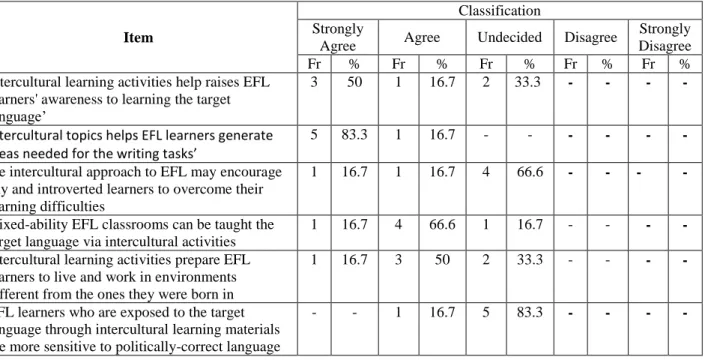
So, in this section deals with the presentation and the elaboration of data from questionnaires and interviews about the Implementation of Intercultural Approach in EFL Learning at SMAN 5 Makassar. The questionnaire was distributed to the all of English teachers at SMAN 5 Makassar. All of the questions were answered individually based on their opinion. All five options of the responses were given values differently. The scoring of the questionnaires was analyzed statistically based on the application of Likert Scale. The result shows the Implementation of Intercultural Approach in EFL Learning at SMAN 5 Makassar.
In this study, on the implementation of intercultural approach in language teaching, the researcher focused on 6 English teachers’ views on culture in both EFL learning and teaching. Findings revealed that teachers supported the role of culture in their EFL learning, but they suggested the need for a greater understanding of how to focus on culture in their own EFL classes.
Table 1 The Implementation of Intercultural Approach in EFL Learning at SMAN 5 Makassar
Item
Classification Strongly
Agree Agree Undecided Disagree
Strongly Disagree Fr % Fr % Fr % Fr % Fr % Intercultural learning activities help raises EFL
learners' awareness to learning the target language’
3 50 1 16.7 2 33.3 - - - -
intercultural topics helps EFL learners generate ideas needed for the writing tasks’
5 83.3 1 16.7 - - - - - -
the intercultural approach to EFL may encourage shy and introverted learners to overcome their learning difficulties
1 16.7 1 16.7 4 66.6 - - - -
mixed-ability EFL classrooms can be taught the target language via intercultural activities
1 16.7 4 66.6 1 16.7 - - - -
intercultural learning activities prepare EFL learners to live and work in environments different from the ones they were born in
1 16.7 3 50 2 33.3 - - - -
EFL learners who are exposed to the target language through intercultural learning materials are more sensitive to politically-correct language
- - 1 16.7 5 83.3 - - - -
The Benefits of Intercultural Approach in EFL Learning at SMAN 5 Makassar
Nowadays, it is a widely known fact that teaching and learning a foreign language cannot be reduced to the direct teaching of linguistic skills like phonology, morphology, vocabulary, and syntax. learn a language well usually requires knowing something about the culture of that language. Communication that lacks appropriate cultural content often results in humorous incidents, or worse, is the source of serious miscommunication and misunderstanding. According to Kramsch (1993, 1), culture “is always in the background, right from day one, ready to unsettle the good language learners when they expect it least, making evident the limitations of their hard-won communicative competence, challenging their ability to make sense of the world around them.”—
Corbett (2003) mentions the benefits of the Intercultural Approach: as learners come to a deeper understanding of how the target language is used to achieve the explicit and implicit cultural goals of the foreign language community, they should be prompted to reflect on the ways in which
their own language and community functions. The intercultural learner ultimately serves as a mediator between different social groups that use different languages and language varieties.
Chlopek (2008) presents the advantages of adhering to an Intercultural Approach. She states that, since English is the language used for international communication, students need to develop Inter Cultural Communication in order to communicate successfully in culturally diverse contexts. She believes that EFL training should encourage students to “compare their native culture to other cultures, to evaluate critically and interpret the results of such comparisons, and to apply this knowledge successfully in both verbal and non-verbal communication, for both transactional and interactional purposes”.
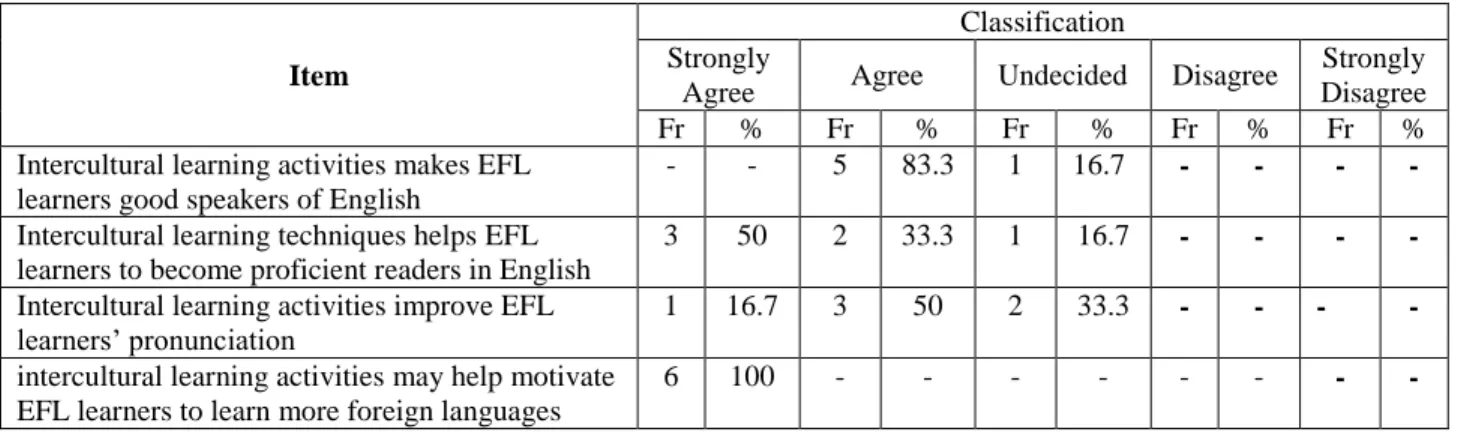
In this section deals with the presentation and the elaboration of data from questionnaires and interviews about the benefits of Implementation Intercultural Approach in EFL Foreign Learning at SMAN 5 Makassar. The questionnaire was distributed to the all of English teachers at SMAN 5 Makassar. All of the questions were answered individually based on their opinion. All five options of the responses were given values differently. The scoring of the questionnaires was analyzed statistically based on the application of Likert Scale. The result shows the benefit of Intercultural Approach in EFL Foreign Learning at SMAN 5 Makassar.
Table 2 The Benefits of Intercultural Approach in EFL Learning at SMAN 5 Makassar
Item
Classification Strongly
Agree Agree Undecided Disagree
Strongly Disagree Fr % Fr % Fr % Fr % Fr % Intercultural learning activities makes EFL
learners good speakers of English
- - 5 83.3 1 16.7 - - - -
Intercultural learning techniques helps EFL learners to become proficient readers in English
3 50 2 33.3 1 16.7 - - - -
Intercultural learning activities improve EFL learners’ pronunciation
1 16.7 3 50 2 33.3 - - - -
intercultural learning activities may help motivate EFL learners to learn more foreign languages
6 100 - - - - - - - -
Discussion
In the research finding, the researcher discusses some research findings concerning with the implementation of intercultural approach in EFL Learning at SMAN 5 Makassar. In order to justify the research finding, the researcher discussed it with the other relevant references.
Learning a foreign language is not just studying aspects of language and the development of the four language skills (listening, speaking, reading and writing), but it also needs cultural understanding. The introduction of this culture especially in recommended for language learning should have a greater emphasis on developing the ability to communicate with the target language. The introduction of culture in the process of learning a foreign language can reduce the potential misunderstanding occurred during the ongoing communication process.
Marijala (2008) further explained a communication between communicators of two different cultural backgrounds is considered successful as it is not only determined by understanding other participants’ linguistic aspects but also his/her culture during the process. Hence, cultural
background of the target language needs to be introduced primarily before moving to the next step. It will then be easier for both communicators to understand the entire meaning. For this reason, teacher should be able to compare cultures of two languages used during the lesson, for not only it will ease the students during learning process but it will also increase their motivation.
Implementing the intercultural approach is a challenging, demanding task for the language teacher, who must possess at least some intercultural knowledge and very often keep developing it alongside his or her students. What must not be overlooked is that intercultural education leads, to a certain extent, to the acceptance of values, beliefs, and behavior that may conflict with one’s own. “The language teacher, in guiding the learner to new perspectives and new identities, is tampering with fundamentals of human identity” (Gee 1988, 220). Therefore, the EFL teacher must implement the intercultural approach in a tactful, skillful, and conscious way. —Systematic intercultural training is a pre-condition for educating a new generation of young people who will not only tolerate, but also understand, accept, and respect people from different world cultures, will communicate with them successfully, and will learn from them through that communication. a. The Benefits of Intercultural Approach in EFL Learning at SMAN 5 Makassar
An intercultural approach to teaching is most often discussed in the context of learning languages, namely, English. It is often a discussion for ESL teachers, and in fact, ESL teachers are some of the few who employ it. But I believe that opening the doors for a multi-cultural perspective in any classroom has more advantages than simply allowing students to absorb a language easier. The intercultural approach to teaching English is similar to the balance of phonics and whole language learning that is done in early childhood reading classes. But let's imagine what could happen if all classrooms started to lean toward a more intercultural approach to teaching.
one of the biggest problems in schools today (my experience is in high school, but I suspect this is all over) is that many students feel threatened by the environment, especially as schools grow less and less homogenous. I believe that as the number of discipline problems in schools is on the rise, it points directly to a perception of a lack of safety and security, physically (certainly), but emotionally as well.
As a classroom teacher, I am not ready to tackle a pervasive feeling of threat that may hang in the hallways of my school, but certainly I am doing all I can to eliminate that emotional barrier in my classroom. This means I will do absolutely anything I can do to create an atmosphere of acceptance, tolerance, and open-minded discussion on any subjects where students’ beliefs and feelings differ.
An intercultural approach to teaching (easily done in literature and history classes) tells students that you, the teacher, are open to teaching and therefore understanding differences and diversity. This is a way to provide emotional security in your classroom and to approach difficult subjects, often the roots of conflict, in a safe and healthy way.
The number of ESL students in NC (and many other states as well) has been growing exponentially, and as different student populations increase in numbers, one of two things is going to happen. Either one, they are going to stick together for security and always feel alienated, or two, they are going to accept the culture of the school because the school is accepting their culture. Students need to learn about different cultures, because they need to learn how to understand people who are not like them. Besides the fact that they will encounter these cultures again, the process of recognizing difference is soimportant.
Based on the findings and discussions, the researcher concludes that implementing the intercultural approach is a challenging, demanding task for the language teacher, who must possess at least some intercultural knowledge and very often keep developing it alongside his or her students. The EFL teacher must implement the intercultural approach in a tactful, skillful, and conscious way. —Systematic intercultural training is a pre-condition for educating a new generation of young people who will not only tolerate, but also understand, accept, and respect people from different world cultures, will communicate with them successfully, and will learn from them through that communication. An intercultural approach to teaching (easily done in literature and history classes) tells students that you, the teacher, are open to teaching and therefore understanding differences and diversity. This is a way to provide emotional security in your classroom and to approach difficult subjects, often the roots of conflict, in a safe and healthy way.
Reference
Alptekin, C. (2002). Towards intercultural communicative competence in ELT. ELT Journal 56 (1): 57–64.
Amir H. Abdalla. 2017. An Investigation into the Benefits of the Intercultural Approach to EFL Learning and Teaching: A Case Study of Taif University, KSA. Journal of Language Teaching and Research, Vol. 8, No. 1, pp. 52-63
Atay, Derin. (2009). Turkish EFL Teachers’ Opinions on Intercultural Approach in Foreign Language Education. Procedia Social and Behavioral Sciences 1 (2009) 1611–1616 Baker, W. (2012). "From Cultural Awareness to Intercultural Awareness: Culture in ELT", ELT
Journal, Vol. 66/1: 62-70.
Byram, M. and Morgan, C. (1994). Teaching and learning language and culture. Clevedon: Multilingual Matters.
Byram, M., Zarate, G. (1997). The sociocultural and intercultural dimension of language learning and teaching. Strasbourg: Council of Europe.
Byram, M. (2006). Language teaching for intercultural citizenship: the European situation. Paper presented at the NZALT conference, University of Auckland.
Canale, M. & Swain, M. (1980). Theoretical bases of communicative approaches to second language teaching and testing. Applied Linguistics. 1, 1-47.
Castro, P. (1999). La dimensio´n europea en la ensen˜ anza/aprendizaje de lenguas extranjeras: la competencia intercultural, Lenguaje y Textos, 13, 41–53.
Castro, P., Sercu, L. & Garcia, M. C. M. (2004). Integrating language-and-culture teaching: an investigation of Spanish teachers' perceptions of the objectives of foreign language education. Intercultural Education, 15(1), 91-104.
Coleman, H. (Ed.) (1996). Society and the language classroom. Cambridge: CUP.
Colson, J.P. (2008). “Cross-linguistic Phraseological studies” in S. Granger, S. and F. Meunier, F. (eds) Phraseology: An Interdisciplinary perspective (pp.191-206). Amsterdam &Philadelphia:John Benjamin Publishing Company.
Corbett, J. (2003). An Intercultural Approach to English Language Teaching, Multilingual Matters Ltd, Clevedon.
Cortazzi, M., & Jin, L. (1999). Cultural mirrors: Materials and methods in the EFL classroom. In E. Hinkel (Ed.), Culture in second language teaching and learning (pp. 196–219). Cambridge: Cambridge University Press.
Council of Europe. (2001). Common European framework of reference for languages: Learning, teaching, assessment. Cambridge: Cambridge University Press. Retrieved April 28, 2015 from: www.coe.int/t/dg4/linguistic/Source/ Framework_EN.pdf.
Dobrovol‘skij, D. and E. Piirainen. (2006). Cultural knowledge and idioms. International Journal of English Studies, 6 (1), 27-41.
Fantini, A.E. (2000). ‘A Central Concern: Developing Intercultural Competence’. SIT Occasional Paper Series, Issue No., 1. 2000. PP 25-42.
___________. (2006). ‘Exploring and Assessing Intercultural Competent. Federation EIL, Brattleboro
Gee, J. P. (1988). Dracula, the vampire Lestat, and TESOL. TESOL Quarterly 22 (2): 201–25.— Holliday, A. (1999). Small cultures. Applied Linguistics, 20(2), 237–264.
Ho, S. T. K. (2009). "Addressing Culture in EFL Classrooms: The Challenge of Shifting from a Traditional to an Intercultural Stance", Electronic Journal of Foreign Language Teaching, No. 1: pp. 63-76, Centre for Language Studies, National University of Singapore, Retrieved March 22,2015, from: http://e-flt.nus.edu.sg/.
Jokikokko, J. (2005). Interculturally trained Finnish teachers’ conceptions of diversity and intercultural competence. Intercultural Education, 16, 69-93.
Kramsch, C. (1993). Context and Culture in Language Teaching. Oxford: Oxford University press. __________. (1998): Language and Culture. Oxford: Oxford University Press.
Krieger, D. 2005. Teaching ESL versus EFL: Principles and practices. English Teaching Forum 43 (2): 8–17.
Kumaravadivelu, B. (2008). Cultural Globalization and Language Education. New Haven: Yale University Press.
Kuo and Lai, C. (2006). Linguistic Across Cultures: The Impact of Culture on Second Language Learning. ERIC Document No. ED496079
Levine, G. (2003). Student and instructor beliefs and attitudes about target language use, first language use, and anxiety: Report on a questionnaire study. Modern Language Journal, 87, 343–364.
Liddicot A.J. (2003). Conceptualization of the cultural component of language teaching in Australian language in education policy. Journal of Multilingual and Multicultural Development, 25, 297-317.
Meyer, M. (1993). Developing transcultural competence: case studies of advanced foreign language learners. In D. Buttjes & M. Byram (Eds.), Mediating languages and cultures. Clevedon: Multilingual Matters.
Meyer, M. (2000). Developing transcultural competence: case studies of advanced foreign language learners. In D. Buttjes & M. Byram (Eds.), Mediating languages and cultures. Clevedon: Multilingual Matters.
Maijala, M. (2008). Between Worlds-a Reflection on Intercultural Aspects in Teaching of DAF and in DAF Text books. Intercultural Language Teaching Journal. (5).
McAllister, D. J. (1995). Affect- and Cognition-Based Trust as Foundations for Interpersonal Cooperation in Organizations,” Academy of Management Journal (38:1)
Méndez García, M. C. (2005). International and inter- cultural issues in English teaching textbooks: the case of Spain. Intercultural Education, 16, (1), 57-68.
Owen, J. (2013). Early career perspectives on psychotherapy research and practice: Psychotherapist effect, multicultural orientation and couple interventions. Psychotherapy, 50, 496–502.
Pennycook, A. (2007). Global English’s and transcultural flows. London: Routledge.
Peterson, R.A. (2004). Where the Two Cultures Meet: Popular Culture. The journal of popular culture.11 (2).385-400.
Richards, J. C. & Schmidt, R. (2012). Longman dictionary of language teaching and applied linguistics, 3rd Ed. Pearson Education. London.
Risager, K. (1998). Language Teaching and the Process of European Integration. In M. Byram and M. Fleming (eds.), Language learning in intercultural perspective. Approaches through drama and ethnography. Cambridge: Cambridge University Press.
Salo-Lee, L. (2006). Intercultural communication as intercultural dialogue: Revisiting intercultural competence. In P. Kistler & S. Konivuori (Eds.), From international exchanges to intercultural communication. Combining theory and practice (pp.121-128). Sen Gupta, A. (2002). Changing the focus. A discussion of the dynamics of the intercultural experience. In G. .Alfred, M. Byram and M. Fleming (eds.) Intercultural Experience and Education (pp.155-178). Clevedon: Multilingual Matters.
Starkey, H. (1991). World studies and foreign language teaching: Converging approaches in textbook writing. In D. Buttjes & M. Byram (Eds.), Mediating languages and cultures (pp. 209-227). Clevedon: Multilingual Matters.
Sysoyev, P. V. & Donelson, L. R. (2002). Teaching cultural identity through modern language:
Discourse as a marker of an individual’s cultural identity. Journal of Eurasian Research,
2(4). Retrieved from http://elibrary.ru/item.asp?id=13443750.
Tanaka, H. & Stapleton, P. (2006). Increasing reading input in Japanese high school EFL classrooms: An empirical study exploring the efficacy of extensive reading. The Reading Matrix, 7(1), 115-131.
Tomalin, B. & Stempleski, S. (1993). Cultural Awareness. Oxford: Oxford University press. Troike, M. 2006. Social Context of Second Language Acquisition. N Cambrige University Press Ur, Penny. (1996). A Course in English Teaching. New York: Cambridge University Press Wang, G. and Zhou, Z. (2006) Intercultural Language Education in China: Problems and
Prospect. The Second International Conference on Foreign Language Teaching Methodology in China. Shanghai, China.
Williams, G. (2010).”ESL Teaching: How Language and Culture are Interdependent”. Language Study. November 2010.
Wiseman, R. L. & Koester, J. (1993). Intercultural communication competence. Newbury Park, CA: Sage.
Wu, J. (2010). A Content Analysis of the Cultural Content in the EFL Textbooks. Canadian Social Science, 6(5), 137-144.