ARTICLE Pa ge
74
CASE STUDYMuzium padi kiosk: a case study in muzium padi
kedah
Aeni Zuhana Saidin
1, Asmidah Alwi
2, Nassiriah Shaari
31.Institute of Creative Humanities, Multimedia and Innovation, Universiti Utara Malaysia, Malaysia, [email protected] 2.Institute of Creative Humanities, Multimedia and Innovation, Universiti Utara Malaysia, Malaysia, [email protected] 3.Institute of Creative Humanities, Multimedia and Innovation, Universiti Utara Malaysia, Malaysia, [email protected]
Article History
Received: 10 February 2018 Accepted: 04 April 2018 Published: April 2018
Citation
Aeni Zuhana Saidin, Asmidah Alwi, Nassiriah Shaari. Muzium padi kiosk: a case study in muzium padi kedah. Indian journal of arts, 2018, 8, 74-78
Publication License
This work is licensed under a Creative Commons Attribution 4.0 International License.
General Note
Article is recommended to print as color digital version in recycled paper.
ABSTRACT
This paper describes the design and development of Muzium Padi Kiosk. The process was done according to the software development process. The phase started with the requirement analysis before it goes into the design and formative evaluation. Some amendment was also made at the end of the process to ensure that the kiosk will be effective and successful to deliver meaningful information to the museum visitors. As a result an interactive kiosk is ready to be used at Muzium Padi Kedah.
Keywords: Muzium Padi Kiosk, design and development, formative evaluation, museum visitor, user experience.
1. INTRODUCTION
Museum in Malaysia has been established as early as 1883, and after the independence, the institution has become a symbol of Malaysian identity and carries the role of nation-building. In most situation, museums use only real objects or artifacts as exhibits to convey information to their visitors. The artifacts are arranged to create a compelling storytelling for the museum visitors. However,
CASE STUDY
Vol.8, 2018
Indian Journal of Arts
ISSN 2320–6659
EISSN 2320–687X
Pa
ge
75
with the rapid growth of the ICT tools, the demands are pointing towards digital exhibits and looking forwards for more interactivity in the museum exhibitions (Awang, 2007). To fulfill this ongoing demand, a museum should explore the opportunity of using ICT tools to enhance the visitors’ experience by taking into account the need of information, prior, during and after the museum visits. However, many museums in Malaysia faces other challenges such as the need to maintain financial performance, and also the needs to address and change the public perception of the museum as a dull entity (Taha, 2008).
To comply and stand with other museums in the world, The Minister of Culture, Arts and Heritage have challenged the museums to be innovative and more creative. According to Taha (2008), lately, Malaysian museums environment has foreseen improvements in the physical space. Therefore, the museum in Malaysia has to consider drastic changes to find ways in ensuring its relevance in nowadays presence especially into integrating ICT into its exhibition and showcase.
Muzium Kedah as the context of investigation
Kedah Museum was established on 3 February 1957 and during its establishment, it was known as History Museum of Kedah. The museum was originally located on the ground floor of the Balai Besar but had to relocate due to growing collection of artifacts on December 30, 1961. The museum was later renamed as Kedah State Museum in July 1964. Now the Museum of Kedah is under the administration of Lembaga Muzium Kedah. Apart from the State Museum, there are other museums under the management of Lembaga Muzium Negeri Kedah, which are the Kedah Royal Museum, the Paddy Museum, Art Gallery and; Memorial and traditional houses. Each museum has its own building and situated in different locations.
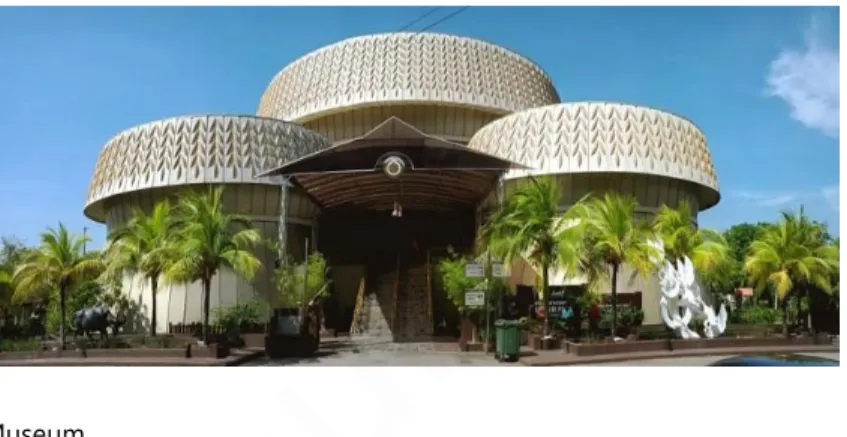
Figure 1 Paddy Museum
Museum with the highest visiting number is the Muzium Padi (as shown in Figure 1) and followed closely by the Royal Museum. Paddy museum is dedicated to exhibiting artifacts regarding paddy planting as well as the representation of the local culture. Interestingly, the exhibition not only houses the artifacts related to traditional paddy planting processes but also blended with the modern processing technique. On the other hand, the Royal Museum is devoted in exhibiting artifacts and information related to the Royal family of the Kedah sultanate of various generations. The museum is located in an old castle that was built in 1735 and has been Kedah administrative center of the 8th century during the ruling of Almarhum Sultan Muhammad Jiwa Zainal Adilin Mu'adzam
Shah II. As for the other museums; the exhibit values that lie within the building themselves such as the remains of the ancient and artistic value, the architectural knowledge as well as the historical information are the main attraction of these museums.
2. LITERATURE REVIEW
Museums have a well-known function in collecting, preserving, and sharing the historic artifacts belong to its specific society. Additionally, a museum has also well accepted as informal settings for learning (Black, 2005; Falk and Dierking, 1992). However, as museums grow, and with the advent of Information and Communication Technology (ICT) exhibiting tools, museums are taking advantage of utilizing these technological tools for more than recording their collections into electronic databases or embedding the exhibition itself as an ICT artifacts. Instead, museums can now play more important roles in enhancing and facilitating the museum visits through the use of the newest ICT media tools. The adoption of multimedia in museum exhibition is called as New Museum (Witcom, 2007).
As for interpretive opportunities, the ICT implemented on museum exhibition has offered gradual advancement and enhancement of the visitors' experience by providing various ways of supporting the process of meaning-making. However, it is quite a complex process because the interpretations of the objects on exhibit rely on the museum's curators and designers (Lester, 2006). Furthermore, it is essential for their designers to consider factors related to the understanding of the museum's visitors
Pa
ge
76
(Peacock and Brownbill, 2007), in order to fulfill their needs and requirements, while at the same time ensuring the essential quality of the knowledge from their interpretative (cognitive) processing.
Digitizing museum exhibits into electronic presentation could be categorized into two entities: the services and the content (Peacock and Brownbill 2007) with the utmost consideration should be given to the presentation of the content as it shapes the visitors’ experiences. Digitizing museum exhibit enables the use of various media such as images and diagrams, audio and video or even text can assist in achieving a richer explanation of a certain concept, which sometimes cannot be conveyed in the physical museum space. There are various advantages has been reported such as offer immediately accessible, globally, and at any time of day (Martenstyn, 2013), and able to engage more with their audiences and increase relationships with younger audiences (McLauchlan, 2014). Therefore, attention should be given to the use of ICT and new media to become part of museum new approach in exhibiting its artifacts to the society.
This paper discusses the design and development of Muzium Paddy Kiosk. At the moment, there is no kiosk or any digital presentation was available at Paddy Muzium. We were very keen in ensuring that this museum will also adopt this new approach in presenting information to the museum visitors. Being the most visited museum in Kedah, this opportunity to understand good digital artifacts as well as the visitors' preferences during the visit is an advantage. Compared to another museum that received a low number of visitors, the research opportunity here is good. To create a compelling kiosk in the museum we followed the design and development steps of software development. It stated with requirement analysis phase, followed with the storyboard and then produce the layout, interfaces and other multimedia elements. All these steps will be discussed in the following sections.
3. DESIGN AND DEVELOPMENT OF MUZIUM PADI KIOSK
Requirement and Analysis Phase
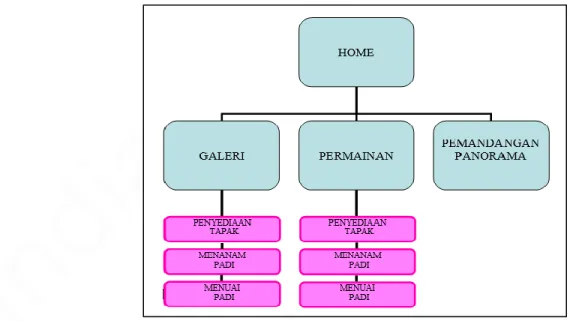
The work started with understanding the kiosk requirement and analyzing the data gathered. To do this, an interviewed session was held with the museum personnel. Additionally, several visits to the museum were conducted to do some observation of the museum situation, exhibition, and visitor behavior. Based on the data gathered, analysis was done and information architecture of the kiosk was created. Info architecture: Although the museum consists of three floors, the discussion between the development team decided to concentrate on the main reason of having the Muzium Padi which is to introduce processes of paddy until it turns to rice. Therefore, the kiosk galleries will only include on preparing, planting and harvesting of paddy both in information and games form. Refer to figure 2.
Figure 2 Part of Information Architecture Storyboard design
Design of the storyboard has taken around two month times. The first storyboard was presented however it was rejected by the development leader as it lacks in detailed of the paddy planting process. The second storyboard was then created which is the amendment from the first storyboard. The second storyboard was then accepted by all and guiding the development of the kiosk in the production phase. Refer figure 3.
Pa
ge
77
Figure 3 Parts of storyboard Production Phase
Development Phase: Adobe Photoshop and adobe illustrator were used to design the graphics and text to be used in the application. There are massive works in this phase as pictures were taken from the museum in the real situation. However, as the picture required the artifacts to be intact in its position to ensure that the visitor has the view of how the artifacts were exhibited. This situation requires the museum to be free from visitors in order to get the optimum view. All the taken pictures were edited using Adobe Photoshop. Explanation of the artifacts was then extracted from the museum's repository. The explanation of the artifacts in the kiosk was made using Adobe illustrator for its simple and extended explanation.
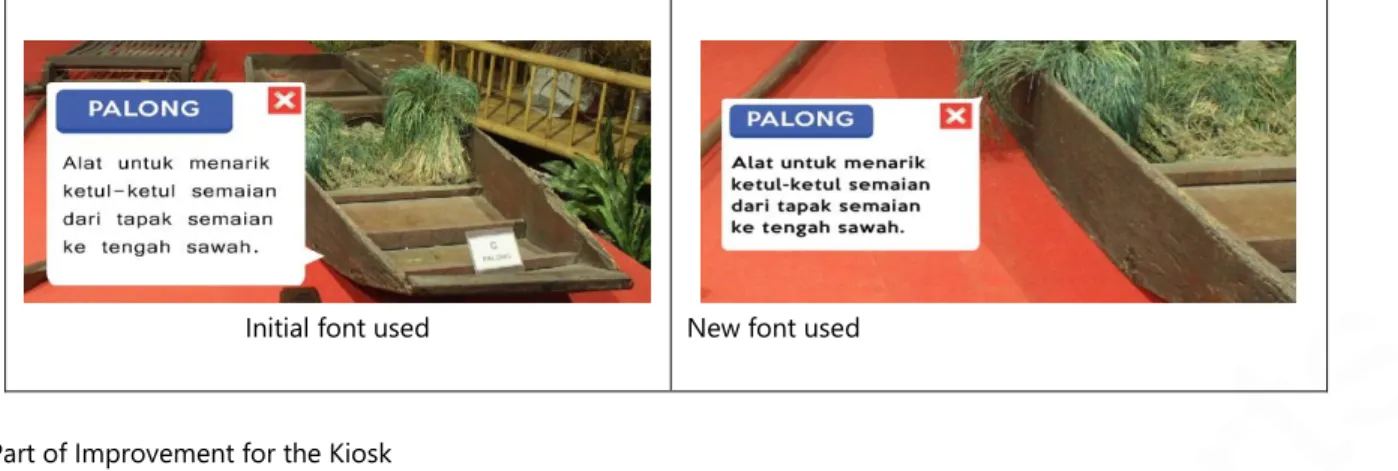
Testing Phase: Upon completion of the development process, the test process is executed. The testing covers the questions about the design of information kiosks, content of the information kiosk, the text used in the search kiosk, media element loaded in information kiosk and layout of information kiosk The answered will provide suggestions to improve the Kedah Paddy Information Kiosk. Based on the analysis made based on the stated criteria, there are a few amendments being made for the design based on the suggestion from the expert. Refer to Figure 4.
Initial design Amended design
Background and title
Navigation area
Title Content & Information area Navigate to next page Icons to drag Drag icon to this area Extended information, when i button is clicked.Pa
ge
78
Initial font used New font used
Figure 4 Part of Improvement for the Kiosk
4. CONCLUSION
The development of paddy museum kiosk is intended to be a new medium to deliver information more effectively and interactively to the museum visitors. The design and development of the Kedah paddy museum information kiosk are in line with the needs of today's community. This information kiosk is hoped to provide more interactive in which the visitors can interact with the kiosk for the desired information. Design and development of Kedah paddy museum kiosk have through few phases of important developmental processes. It started with the market research to understand the nature of museum before it moves further to analysis, design and testing the kiosk. This step by step process has helped in build a good information kiosk.
ACKNOWLEDGMENTS
The authors would like to thank dedicated student of BCIM in helped in the development of this Muzium Padi Kiosk. This study is also generously funded by Case Study Grant by IMBRE UUM.
R
R
E
E
F
F
E
E
R
R
E
E
N
N
C
C
E
E
1. Awang, N. (2007). Integrating virtual reality in ViSeum and end user acceptance. Master’s thesis, Faculty of Technology Management.
2. Billson, C. J. (1892). The Easter hare. Folklore, 3, 441-466. Retrieved from http://www.jstor.org.
3. Bower, B. (2008, Feb. 9). Dawn of the city: Excavations prompt a revolution in thinking about the earliest cities.
Science News, 173(6), 90-92. Retrieved from
http://www.sciencenewsmagazine.org/
4. Black, G. (2005). The engaging museum: Developing
museums for visitor involvement. London, New York: Routledge.
5. Falk, J. H. and L. D. Dierking (1992). The museum experience. Washington D. C.: Whalesback Books.
6. Lester, P. (2006). Is the virtual exhibition the natural successor to the physical? Journal of The Society of Archivists, 27(1): 85-101.
7. Martenstyn, L. (2013). Digital archives: Making museum
collections available to everyone. Retrieved
from https://www.theguardian.com/culture-professionals- network/culture-professionals-blog/2013/may/03/museum-archives-digital-online
8. McLauchlan, C. (2014). The benefits of digital museums. Retrieved from http://www.theleadsouthaustralia.com.au/ industries/education/the-benefits-of-digital-museums/ 9. Peacock, D. & J. Brownbill (2007). Audiences, Visitors, Users:
Reconceptualising Users of Museum On-line Content and Services. Museum and the Web, Toronto, Archives and Museum Informatics.
10.Taha, D. D. A. H. (2008). Museums in Malaysia: Challenges and development. Kuala Lumpur, Department of Museums, Malaysia.
11.Witcomb, A. (2007). The Materiality of Virtual Technologies: A New Approach to Thinking about the Impact of Multimedia in Museums. Theorizing Digital Cultural Heritage: A Critical Discourse. In F. Cameron & S. Kenderdine. Cambridge, Massachusetts, The MIT Press: 35-48.