A THESIS
In Partial Fulfillment of the Requirements For Master’s Program in Linguistics
Anin Eka Sulistyawati
A4C008003
POSTGRADUATE PROGRAM
DIPONEGORO UNIVERSITY
SEMARANG
DISCUSSIONS IN GENRE-BASED READING CLASS
(A CLASSROOM ACTION RESEARCH)
Submitted by: Anin Eka Sulistyawati
A4C008003
Approved by Advisor,
Dr. Sugeng Purwanto, M.A.
Master’s Program in Linguistics Head,
Submitted by: Anin Eka Sulistyawati
A4C008003
VALIDATION Approved by
Strata II Thesis Examination Committee Master’s Degree in Linguistics Postgraduate Program Diponegoro University
On 27th March 2012
Chairman
Dr. Sugeng Purwanto, M.A. _______________
First Member
J. Herudjati Purwoko, Ph. D. _______________
Second Member
Drs. Mualimin, M. Hum _______________
Third Member
I hereby declare that this thesis is definitely my own work. I am completely
responsible for the content of this thesis. To the best of my knowledge and belief,
this thesis contains no material previously published or written by another person
or material which to a substantial extent has been accepted for the award of any
other degree or diploma of a university or other institutes of higher learning,
except where due acknowledgment is made in the text of the thesis.
Semarang, 29th March 2012
Praise be to Allah SWT, the Almighty for His Blessing so that the writer
could finally finish this thesis on “The Use of Cooperative Learning in Small
Group Discussions in Genre-Based Reading Class.” The deepest gratitude and
appreciation are greatly extended to Dr. Sugeng Purwanto, M.A, who has given
her a lot of guidance, helpful correction, moral support, advice and suggestion,
without which it is doubtful that this thesis came into completion. The writer’s deepest thank also goes to the following:
1. J. Herudjati Purwoko, Ph.D., the Head of Master’ Program in Linguistics
of Diponegoro University Semarang.
2. Dr. Nurhayati, the Secretary of Master’ Program in Linguistics of Diponegoro
University Semarang.
3. Drs. Mualimin, M.Hum. and Drs. Hendarto Supatra, S.U., as the members of
thesis examination committee.
4. All lecturers of Master’ Program in Linguistics of Diponegoro University
Semarang who have enlarged the writer’s knowledge for several years.
5. The writer’s colleagues in Master’ Program in Linguistics of Diponegoro
University Semarang, especially for Pak Taufik, Ms. Arin, and Mas Yoga who
have shared the happiness and sadness together.
and Bang Ade for their supports and helps so she could finish this thesis.
9. The writer’s students at English Department, Faculty of Teacher Training and
Education, Pancasakti University Tegal who have given her many
contributions in the process of writing this thesis.
This thesis is still far from perfect. Several corrections, comments, and
criticism, are accepted for the improvements of it. Finally, the writer expects that
this thesis would be useful for the further study.
Semarang, 29th March 2012
“Pessimism never won any battle.”
(Dwight D. Eisenhower: 1953-1961)
“Do what you can, what you have, where you are”
(Theodore Roosevelt: 1901-1909)
This final project I dedicated to:
My beloved parents (Mr. and Mrs. Suraji), for their never ending support and attention,
My little brother, Sagrita
Wahyu Saputra as my „Ojek’
TITLE ... i
B. Underlying Concept and Theories of Small Group Discussions ... 11
C. Genres ……… 20
D. Small Group Discussions in Genre-Based Reading Class………. 24
2. The Subject of This Study………... 42
B. The Implementation of First Learning Cycle ... 52
1.Planning………... 52
2.Acting ………... 53
3. Observing ………... 55
4. Reflecting……… 55
C. The Implementation of Second Learning Cycle... 57
1. Planning………... 57
2. Acting ………... 57
3. Observing……… 58
4. Reflecting……….... 58
D. The Result and Analysis of Pre-Cycle……… 59
1. Pre-test (Reading Comprehension Test)………... 59
2. Questionnaire of the Initial Condition………. 61
3. Questionnaire of Students’ Interest and Awareness……… 66
4. Observation Sheet Analysis……… 67
F. The Result and Analysis of Second Learning Cycle……….…. 68
1. Post-test………... 68
2. Checklist Participation in Group Discussions………. 70
3. Questionnaire of Students’ Interest and Awareness……… 71
4. Observation Sheet Analysis II………. 72
G. Intercycle Analysis………. 73
1. Genre-Based Reading Tests………. 73
2. Checklist Participation in Group Discussions………. 74
3. Questionnaire of Students’ Interest and Awareness………...…. 76
4. Observation Sheet……… 77
CHAPTER V CONCLUSIONS AND SUGGESTIONS A. Conclusions ... 78
B. Suggestions ... 79
REFERENCES
ABBREVIATIONS
2. AR: Action Research
3. CAR: Classroom Action Research
4. CIRC: Cooperative Integrated Reading and Composition
5. GI: Group Investigation
6. KPA: Knowledge, Power, and Affection.
7. LT: Learning Together
8. SGD: Small Group Discussions
9. STAD: Student-Team-Achievement-Division
10.TAI: Teams-Assisted-Individualization
Appendix 1: A. List of Pre-Test Scores in Pre-Cycle (Genres)
B. List of Pre-test Scores in Pre-Cycle (Reading Purposes)
Appendix 2: A. List of Post-Test Scores in First Cycle (Genres)
B. List of Post-Test Scores in First Cycle (Reading Purposes)
Appendix 3: A. List of Post-Test Scores in Second Cycle (Genres)
B. List of Post-Test Scores in Second Cycle
Appendix 4: Survey Questionnaire of Initial Condition
Appendix 5: Survey Questionnaire of Reading Interest and Awareness in
Pre-Cycle
Appendix 6: Survey Questionnaire of Participation in Group
Appendix 7: Survey Questionnaire of Observation Sheet
Appendix 8: Lesson Plans
Research). Thesis. Linguistics Post Graduate Program. Diponegoro University Semarang. Advisor: Dr. Sugeng Purwanto, M.A.
This research employed the small group discussions as one of the techniques in cooperative learning to improve the students’ ability in Genre-Based Reading class. The subject of this research was 20 students. They were the second grade students of English Department, Teacher Training and Education Faculty at Pancasakti University Tegal. It was conducted in the even Semester of Academic year 2010/2011 starting from February until June 2011. This research belongs to the classroom action research (CAR) that purpose to improve the students’ ability in Genre-Based Reading class and also enhance their interest and awareness on reading genre-texts. Two cycles were conducted here through several stages in each, they were 1). Planning, 2). Acting, 3). Observing, and 4). Reflecting (based on Kemmis 1988). The first reflection was used to monitor the weaknesses gained in the cycle 1 that would be improved in cycle 2. The data were gathered from five kinds of instruments, namely the genre-based reading tests, the questionnaire at the initial condition before treatment, the survey of genre-based reading interest and awareness, the participation in group discussion checklist, and the observation sheet.
After completing the cycles, it showed that there were some significant improvements of the students’ ability in genre-based reading class as follows; the classical mean of the students’ score in pre-test was only 48, rose to 68,25 in the first cycle, and became 82,5 in the second cycle. Another finding is about the students’ interest and awareness that was enhanced from cycle 1 to cycle 2. It could be seen through the students’ interest and awareness checklist.
Teks (Sebuah Penelitian Tindakan Kelas). Tesis. Program Pasca Sarjana Linguistik. Universitas Diponegoro Semarang. Pembimbing: Dr. Sugeng Purwanto, M.A.
Penelitian ini menggunakan teknik diskusi-diskusi dalam kelompok kecil yang merupakan salah satu teknik dalam pendekatan cooperative learning sebagai cara untuk meningkatkan kemampuan siswa di kelas teks genre. Subyek yang diteliti dalam penelitian ini sebanyak 20 orang siswa. Mereka adalah mahasiswa semester dua Jurusan Bahasa Inggris, Fakultas Keguruan dan Ilmu Pendidikan di Universitas Pancasakti Tegal. Penelitian ini berlangsung di semester genap pada tahun ajaran 2010/2011 yang dimulai dari bulan Februari hingga Juni 2011. Penelitian ini termasuk dalam jenis penelitian tindakan kelas (PTK) yang bertujuan untuk menaikkan kemampuan siswa dalam kelas membaca khususnya pada bahasan membaca jenis-jenis teks (genre), serta untuk mempertinggi minat dan kesadaran siswa pada kelas membaca jenis-jenis teks. Terdapat dua siklus dan beberapa tahapan dalam penelitian ini, yakni 1). Merencanakan, 2). Bertindak, 3). Mengamati, dan 4). Refleksi (diambil dari Kemmis 1988). Refleksi yang pertama digunakan sebagai alat untuk memonitor kelemahan-kelemahan yang ada dalam siklus pertama yang kemudian akan diperbaiki pada siklus selanjutnya. Sedangkan pemerolehan data diambil dari beberapa instrumen, yaitu tes-tes membaca beberapa jenis teks, daftar pertanyaan pada tahap initial codition atau kondisi sebelum diberi tindakan, survey mengenai minat dan kesadaran siswa pada kelas membaca beragam jenis teks, daftar partisipasi siswa selama berdiskusi dalam grup masing-masing, serta lembar pengamatan.
Setelah menyelesaikan kedua siklus tersebut, dapat diketahui bahwa ada beberapa peningkatan siswa yang cukup signifikan dalam kelas membaca teks genre, diantaranya adalah nilai rata-rata siswa yang sebelumnya hanya memperoleh 48 di tahap awal, meningkat menjadi 68,25 pada siklus pertama, dan kemudian meningkat lagi menjadi 82,5 di siklus kedua. Hasil temuan berikutnya adalah minat dan kesadaran siswa yang meningkat pada tiap-tiap siklus. Hal ini dapat dilihat berdasarkan survey mengenai minat dan kesadaran siswa pada kelas membaca beragam jenis teks.
CHAPTER I
INTRODUCTION
This chapter deals with the background of the study, the purpose of the
study, the scope of the study, the underlying theories, definition of key terms and
the organization of writing.
A. Background of the Study
Teaching English can be classified into two cycles, spoken cycle and
written cycle. Spoken cycle consists of listening and speaking skill, whereas
written cycle consists of reading and writing skills. Reading itself has an
important role for language acquisition. The more students read; the better they
get new information from reading. By reading, students will get a positive effect
on their vocabulary knowledge, spelling, even their writing skill. Students need to
read as much as possible to gain their vocabularies, to make up their ideas when
they are asked to write something, and to upgrade their knowledge. It is not only
the students can get many benefits from reading activity, but the lecturer can also
use the reading materials to demonstrate the way to construct sentences,
paragraphs, and whole texts. It will make her much easier to convey her idea to the students. And for more advanced learners, they can learn some writer’s styles
and even rhetoric. However, teaching English, especially in reading class,
Teaching English in reading class is basically not as easy as people
imagine since there are some problems faced by the English lecturers. First, the
students are generally confused by what they read. They feel bored when they find
many new words because of their lack of the vocabulary items, moreover if it was
a very long passage. A long passage often makes students give up; hence they
prefer asking to their friends to trusting their own ability. Second, English is a
foreign language for the Indonesian students. They seldom hear and use it in their
daily communication. They just learn and practice it at school, not in their daily
life. That is why it will be so difficult for them to master grammatical rules and
idiomatic expressions taught. Besides, there are a lot of differences between
Bahasa Indonesia structure and English structure. Third, many students, even the
English Department students in Pancasakti University, have less motivation to
study this new language because most of them do not love it. Some of them, even,
were sent to this department by their parents. Being an English Department
student is not their own purpose. Therefore, they only focus on passing the exam
and graduate from their university in the right time.
In addition, the teaching Genre-Based reading in the English Education
Department of Pancasakti University is still teacher oriented. The students’
activity merely depends on the lecturer. When the reading lecturer is explaining
the material, the students are quite passive. They do not have a strong motivation
to ask the new vocabulary items, the grammatical rules, the way to pronoun some
over. This becomes a very serious problem both for lecturer and the students since
the lecturer has a lack of creativity to teach reading. She tends to use the teaching
method monotonously. The cycle of her teaching process is only giving the
explanation, asking the students to do some exercises and giving homework or
assignment, whereas the success of teaching reading basically should be supported
by qualified lecturers, good environments, facilities, media, methods and
techniques. At last, the students neither like attending to reading class nor
understand the materials until they graduate.
Since the students have less motivation in studying reading
comprehension, this study is an effort to overcome the students’ problems in
reading genres, especially descriptive, narrative, report and recount. The writer
implements the cooperative learning through the small group discussion technique
in teaching genre-based reading class. Cooperative learning or collaborative
learning, according to Freeman (2000: 164), essentially involves students learning
from each other in groups. It has benefits for students because they can learn how
to work cooperatively and share information to overcome some problems which
they get in reading class activities. And it exists when students work together to
accomplish shared learning goals.
Furthermore, Jacobs in Freeman (2000: 164) defined cooperative
learning as follows:
The most important thing in conducting cooperative learning is not only
about the group cooperation, but also the work together of the teacher and the
students in class. There are many kinds of techniques in cooperative learning,
such as small group discussions, jigsaw, STAD, group investigation, etc. Based on
(http://www.fp.education.tas.gov.au/english/smallgroup.htm), “small group
discussion is arrangement of students into small groups to participate in a range of
activities to develop thinking or to complete practical tasks”. This study focuses
on implementing the small group discussions as the technique in teaching-learning
process in genre-based reading class.
Considering the background of the study, there are three statements of
the problems arise as the followings:
1. How is cooperative learning in small group discussions implemented in
Genre-Based Reading class?
2. How is cooperative learning reflected in small group discussions in
Genre-Based reading class?
3. How do the students’ interests and awareness in Genre-Based Reading class
enhance their cooperative learning in small group discussions?
B. Purpose of the Study
Relating to the research problems, this study is aimed at finding out the
1. describe the implementation of small group discussions in Genre-Based
Reading class.
2. find out in what extent the cooperative learning is reflected in small
group discussions in Genre-Based Reading class.
3. find out whether small group discussion technique could enhance students’ interests and awareness in Genre-Based Reading class.
C. Scope of the Study
This study was applied in a classroom action research which used small
group discussion as one of the techniques of cooperative learning in teaching
genre-based reading class to the students. By using this technique, the students
would have a large autonomy to be active both in group and in the class
(individual). They did not only do the silent reading and answered the abundant
questions, but also practiced their speaking skills on discussing the materials.
Teaching reading class has two basic levels; intensive and extensive
reading. Intensive reading classes (I and II) for the second and third semester
students of English Department in Pancasakti University focus on discussing the
genre-based reading. This study implemented the small group discussions in
Intensive Reading I, the lecturer only intended to devote on Description,
D. Definitions of Key Terms
Several key terms used in this study such as cooperative learning, small
group discussions, genres, reading process, classroom action research (CAR) in
which they are defined specifically in the followings:
1. Cooperative Learning refers to an approach that makes the students work in
groups or pairs to maximize their own learning. This learning approach is also
known as collaborative learning. Cooperative learning could be conducted in
many ways, such as in small group discussions, jigsaw, learning together, etc.
It more focused on the way that teacher and students work together.
2. Small-Group Discussions means one of the techniques in cooperative learning
which intends some students in small groups to participate in a range of
activities to develop thinking or to complete practical tasks. By using this
technique, the students are expected to be more open, active and confident to
express their ideas.
3. Genres or type of texts is the basic theme taught in both Junior and Senior
high school. Since the subject of this study is the English Department
students from Teacher Training and Education Faculty (FKIP), they must
master in Genres. It is conducted in Intensive Reading I and II.
4. Reading Process in this study refers to a process to gather some information
from the text through small group discussions technique. There are three
reading purposes employed in this study, they are reading to search some
5. Classroom Action Research (CAR) is a research conducted to improve the
teaching and learning process which is caused by unsatisfied outcome such as the students’ low ability or achievement, students’ poor interest and
awareness in learning, and other problems concerning with the teaching and
learning process in the classroom.
E. The Organization of Writing
The subject of this thesis, small group discussions, has a broad
background which is introduced to improve students’ ability in genre-based
reading class.
Chapter I introduces background and the reasons for choosing the
subject matter, also presents purpose of the study, scope of the study, definition of
key terms and the organization of the thesis.
Chapter II discussess the literary review which consists of four main
subchapters: previous studies, underlying concept and theories of cooperative
learning and small group discussions, small group discussions in genre-based
reading class, genres, the reading process, and theories of action research. The
previous studies refers to some related researches about small group discussions.
The underlying theories deals with the concept and backgound theories of small
group discussions. Small group discussions in genre-based reading class refer to
the applying of small group discussions technique in genre-based reading class.
Genres discuss about this term in this research, including the definition, the
described in this chapter. The last part of this chapter talks about the theories
related to the action research.
Chapter III has a sub-chapter deals with the quantitative and the
qualitative data analysis. It contains the data presentation which describes the
research design done in this research, research procedure, research setting,
research subject, techniques of collecting data, instruments of collecting data, and
validity and reliability of the instruments.
Chapter IV is about the results of the study and discussions. It describes
the previous reflection, the implementation of the first learning cycle, the
implementation of the second learning cycle and the results and analysis of
pre-cycle, first cycle and second pre-cycle, and the last is the summary of research
findings.
Chapter V as the last chapter presents conclusions and suggestions. The
conclusions are obtained from the findings of this study. Several
CHAPTER II
LITERARY REVIEW
This chapter deals with some discussions; they are the previous studies, the
underlying concept and theories of small group discussions, genres, small group
discussions in genre-based reading class, and reading process.
A. Previous Studies
There were two researches used as the references for this study. The first
previous study and as the primary was a journal written by the three researchers
coming from University of Minnesota, they are David W. Johnson, Roger T.
Johnson, and Mary Beth Stanne (1997). The title of this study is “Cooperative Learning Methods: A Meta Analysis”. Here, the researchers compared several
techniques used in cooperative learning to gain the students’ ability on learning
language.
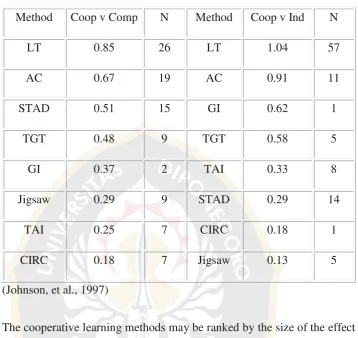
The goal of that research was to find out the most effective method in cooperative learning to develop the students’ achievement in class. After doing
some researches and comparing those methods, it had been found that Learning
Together promoted the greatest effect among the others, as shown in Table 1
Table 1: Ranking Of Cooperative Learning Methods
Method Coop v Comp N Method Coop v Ind N
LT 0.85 26 LT 1.04 57
AC 0.67 19 AC 0.91 11
STAD 0.51 15 GI 0.62 1
TGT 0.48 9 TGT 0.58 5
GI 0.37 2 TAI 0.33 8
Jigsaw 0.29 9 STAD 0.29 14
TAI 0.25 7 CIRC 0.18 1
CIRC 0.18 7 Jigsaw 0.13 5
(Johnson, et al., 1997)
The cooperative learning methods may be ranked by the size of the effect
they had on achievement and by the number of comparisons available. When the
impact of cooperative lessons was compared with competitive learning, Learning
Together (Small Group) promoted the greatest effect, followed by Constructive
Controversy, STAD, TGT, Group Investigation, Jigsaw, TAI, and finally CIRC
(See Abbreviation page). When the impact of cooperative lessons was compared
with individualistic learning, Learning Together promoted the greatest effect,
followed by Constructive Controversy, Group Investigation, TGT, TAI, STAD,
Jigsaw, and CIRC. The few numbers of studies conducted on several of the
The second previous study was a post-graduate final project entitled “The
Use of Cooperative Learning Small Group Discussions in Reading Class Activities”. This study was conducted in Semarang in 2009 by Luki Astria Sari.
The objective of this research was to find out to what extent the cooperative learning using a small group discussion can improve the students’ reading skill.
The population of this research was the tenth grade senior high school students.
After several treatments given to the students, there was a significant progression for the students’ achievement.
B. Underlying Concept and Theories of Small Group Discussions
Cooperative learning is the instructional use of small groups so that
students work together to maximize their own and each other's learning
(http://www.co-operation.org/pages/cl.html). However, it is not the group
configuration that makes cooperative learning distinctive; the most important
thing is the way that students and teacher work together. Richards cited Olsen and
Kagan (2001: 192) defined cooperative learning as follows:
Cooperative learning is group learning activity organized so that learning is dependent on the socially structured exchange of information between learners in groups and in which each learner is held accountable for his or her own learning and is motivated to increase the learning of others.
Thus, the cooperative learning or also known as collaborative learning
should work cooperatively among the learners in pairs or in small and large group.
This approach also believes that minority students will fall behind the high
achieving students in the traditional teaching learning class. In traditional
favored the high-achieving students. According to Johnson, Johnson, and Holubec
as cited by Richards (2001: 192), cooperative learning sought to:
a. Raise the achievement of all students, including those who are gifted or
academically handicapped.
Here, teacher might not only favor the high achieving students, but also the
lower ones. She combines the high and the low in the same group, not to
divide them into the high-achieving group and the low-achieving group since
the treatment should be conducted in the homogenous and neutral
circumstances.
b. Help the teacher build positive relationship among students.
Although there are some differences on the students’ characteristics and
achievements, teacher should help them to manage their group and avoid the
personal problems that may be encountered.
c. Give the students the experiences they need for healthy social, psychological,
and cognitive development.
By conducting the collaborative learning, it is expected that students will be
able to have good interaction and work together to solve the problems. They
also earn how to get communication, express their ideas, and even do
debating with other members politely.
d. Replace the competitive organizational structure of most classrooms and
schools with a team-based, high performance organizational structure. This
process on finding the result. Teacher should observe the students’ activity
during the collaborative learning to find out their performance.
In cooperative learning, several techniques are also well-known; they are
small group discussions, jigsaw, STAD, group investigation, etc. Based on
(http://en.wikipedia.org/wiki/Small-group_communication), small group
discussion refers to the nature of discussion that occurs in groups that are between
3 and 12 to 20 individuals.
In addition, small group discussion is arranged to encourage participation
in a non threatening environment, to maximize success, to develop collegial
practices, to arrive at shared understanding, to share knowledge, and also to allow
for focusing in teaching. Besides, by dividing class into small group discussions, teacher can gain information about students’ social skills, their ability to
contribute ideas, explanations of opinions and information, and speaking and listening skills. Students’ social skills here mean the daily life and surrounding of
students that can influence their behavior and habit in the classroom, such as why
some students feel so shy and afraid when teacher asks them to answer some
questions, whereas it is not their obstacle in learning something in the classroom. The second one is the students’ ability to contribute idea, explanations of opinions
and information. It is clearly enough that teacher can see those actions through
small group discussion. Students mostly feel insecure if they have to present their
mind individually in front of the class. Although they have prepared what they
actually will state to, they become speechless and afraid of making mistakes both
their own group. Probably, they feel more open and comfortable with this
situation. Related to the students’ speaking and listening skill, it also follows the
two conditions above. After having a long discussion, students will get more confident to present their group’s result in front of the class because they feel
secure that the rest members of their group will support and help them. If the
students are able to conduct the discussions and perform the result of their
discussions communicatively, it could be stated that they get success.
For measuring the success of applying small group discussion in class,
teachers can use the indicators, called Knowledge, Power, and Affection (KPA) as
guidance. Nagel (2001: 10) states that „all three attributes are very important, and each interacts with other two’. In the other words, although the three attributes
have the greatest impact when they work together, each one represents an idea
that also holds singular prominence. Actually, the ideas that comprise KPA are
not new, but still effective since it is related to group dynamics and personal
motivation. The KPA needs of individuals relate to their motivation for joining
and staying in group relationship, also stated in Nagel (2001: 29-32) that „teachers
may often keep goals at an explicit level, they missing the opportunity to inform
and motivate students through explicit explanation of the goals being sought or request for student input about goals’. Goals, here, are for sharing the students’
idea in group. There are four important goals which students achieve from
discussion in small group based on Nagel, namely behavioral goals, social
In behavioral goals, small group discussions help students to reach
sequenced, organized behavioral objectives. Here, students are expected to recall
key ideas, apply rules and master skills and demonstrate their acquisition through
independent performance. They also might have such a confidential condition in
performing their ideas in the end of the discussions.
Meanwhile, the social interaction goals intended to expand students’
ability to relate productively each other. They should rely on themselves and their
group members. Small group discussions also permit students to interact and help them adapt to one another’s personalities, ages, genders, characters, and culture.
That is why teacher in this technique should combine the groups with the
heterogeneous members, especially their ability.
Small group discussions in the information processing goals depend on
strategies of information processing. In other words, it focuses on how the group
members get the ideas, not about the result. It is also about how individuals speak
and listen to one another makes a difference in the quality of learning.
Well-handled conversations can become skilled discussion or true dialogues. There is a
difference. Discussion leads to decision, so the goals of discussion must be
clarified. Dialogues, on the other hand, lead to collective meaning making and
shared understanding.
The last is the personal goals. In this goal, small group discussions help
students to develop themselves as flexible and original through creative
expression. When the goal is personal, the emphasis is on promoting better
sensitive. They should held their views communicatively or debate the other
members politely.
It is also possible to encourage some form of discussion in both large and
small group teaching situations although this is often limited in large groups
because of the physical layout of lecture halls and the number of students
involved. Small group work on the other hand provides opportunities for
intellectual and personal growth which cannot be achieved so easily in the
standard lecture situation. Because the small group is a more personal situation, it
provides opportunities for interaction between tutor or lecturer and students and
among students. Such interaction can foster active learning and learning at a high
conceptual level, and can help students to achieve a sense of independence and
responsibility for their own learning. To optimize the work of the group, however,
teachers need to be conscious of their dual roles as subject matter experts and as group managers, and to plan the group’s work both in terms of the content to be
covered and the strategies which will be used to achieve the learning aims of the
group. Where the aim is to understand a body of knowledge and its associated
methods and skills, it is easy to ignore the fact that the human dynamics of the
group will invariably influence its work in achieving learning goals. The situation
is much clearer in groups whose learning aims are process-centered: for instance
in some aspects of professional studies such as management, law, medicine, social
work or teaching where the students need to focus on group processes such as
interpersonal relations, group dynamics and professional communication skills. It
and mathematics where the main focus is on learning the content and methods of
the discipline. Yet, even in disciplines where the content of a learning task is the
central focus of group work: understanding a text, solving academic problems,
writing essays, applying knowledge, and so on, basic ideas about the way in
which groups function need to be considered both to optimize the work of the
group and to avoid unnecessary disruption.
A central issue which runs through this discussion is that of the tutor or
lecturer as the authority figure and energy source in a c lass and ways in which
this can affect participation by group members. It is the aim of this booklet to
suggest strategies for discussion management in small groups which teachers can
incorporate into their work fairly easily. The first section deals with points to
consider when planning a series of sessions and the essentials of preparing for
specific sessions. Next we present some discussion group formats appropriate to
small groups and point out their advantages and disadvantages. This is followed
by an illustration of the effect of the physical environment on interaction within
small groups.
There are also some strategies which can be used to enhance the work of
the group by taking account of its dynamics, for example, methods for getting the
group started, ways of stimulating and regulating participation, and concluding the
session. Lastly we present a checklist which teachers or observers may use to monitor the group’s progress and assess whether there are factors which are
inhibiting the desired level of participation of students in the group. There are a
features and which allow for different degrees of teacher control and student
control. Several of these are described below (based on Kelly and Stafford: 1993).
Each has their advantages and disadvantages.
The first one is Controlled Discussion. This technique is often used to
check whether a topic is understood. It can be used in large group situations as
well as in small groups. Discussion is under the control of the teacher while
students ask questions or make comments or respond to questions from the
teacher. If practiced at the end of a mini-lecture or video presentation, for
example, the lecturer can obtain feedback quickly about how well the material has
been understood. It is a limited form of discussion and does not allow for full
participation.
Next is Step-by-Step Discussion. This format is appropriate for large and
small groups. A topic is broken down into several segments and the lecturer
alternates between presentation of subject matter and discussion periods in which
students can respond to questions of make comments or ask questions. The focus
of discussion may be notes, a text passage, video-tape and so on. While it makes
use of opportunities for discussion in large groups, the structure and content of the
discussion made not meet the needs of all group members.
While in Buzz Groups, during the course of a lecture or a discussion led
by the tutor students are asked to turn to their neighbors for a few minutes to
discuss problems in understanding, or to answer a prepared question, and so on.
Buzz groups enable students to test out their understanding and to discuss
groups also provide the opportunity to stimulate the group by changing the focus
of attention away from the lecturer. However, the timing is important since, rather
than providing a needed break in proceedings they may cause students to lose
concentration.
For Snowball Groups many people have ever implemented this method. Buzz groups can be extended by progressively doubling the group size so that
pairs join up to form fours, then fours to form eights. These larger groups finally
report back to the whole group in a plenary session. This technique allows ideas to
unfold gradually and allows students to think for them before bringing their ideas
back to the whole group. However as the groups increase in size the nature of the
discussion task may need to be changed to prevent boredom.
In Horseshoe Groups, the class can be organized so that attention can
alternately focus on the lecturer and group discussion. Rather than students sitting
in rows facing the front of the room, they sit around tables arranged in a horseshoe
formation with the open end facing the front. The lecturer can talk from the front
for a time before changing to a group task such as discussion or problem solving
or practical work. In science and engineering courses in particular this method can
be used effectively. Also the teacher can circulate easily to clear up any problems
that may arise.
C. Genres
The term „genre’ or genus or type, based on Hartono’s (2008:2), “is used
type or kind of text, defined in terms of its social purposes; also the level of
context dealing with social purpose. Related to the view above, Martin cited in Hyland (2004: 25), says that “genre in systemic functional linguistics emphasizes
the purposeful, interactive, and sequential character of different genres and the
ways to treat language as systematically linked to context”. Meanwhile, Gerot and
Wignell (1995: 190) said further in the followings:
The notions „genre’ and „grammar’ are closely linked. In the materials being produced about genres and their teaching, at least those written by systemic linguists, characteristics lexicogrammatical features of genres are provided. These are neither incidental nor accidental, nor optional extras. Lexicogrammatical features of various genres are integral to those genres, for it is through the lexicogrammatical choices that meaning is built up in a text.
Teaching genre in Indonesia is so popular since the government has
changed the curriculum into the latest one, KTSP (Kurikulum Tingkat Satuan
Pelajaran). According to this Curriculum, English subject for Junior and Senior
High is based on kinds of genre (genre-based). It is influenced by
systemic-functional linguistics that concerns with the use of language as a resource for
communication rather than with the rules for ordering grammatical forms. It
could be concluded that when someone writes something (a certain text), he also
keeps interacting to the readers (other people) to achieve a certain goal, based on
the genre he made. Therefore, he might express his whole idea based on the
generic structure in written text. There are several features found in the
a. Social function.
It is a purpose or goal or aim of a genre. Every genre has its own purpose to
make the readers easy to differentiate it. Some people said it is one of the
characteristics of a particular genre. For example, the social function of
Reports text is to describe the way things are, with reference to a range of
natural, man-made and social phenomena in our environment.
b. Schematic structure.
Schematic or generic structure is the distinctive beginning-middle-end
structure of a genre. A reader will be able to identify a certain genre through
its structure since different genre should have different schematic structure,
e.g.: in Narrative text, there are five points of generic structure, they are the
orientation, evaluation, complication, resolution, and re-orientation.
c. Participants
Participants are the people, places, or even things which can be related
experientially to a process without preposition. There are two kinds of
participants; the general and specific participants. General participant is a
participant constructed by the grammar as referring to all member of a class,
such as Kangaroos, Humans, etc. Meanwhile, specific participant is a
participant constructed by the grammar as having specific identifiable referent
d. Lexico-grammatical features.
Some features (especially in grammar) given in a certain text to make easier
to be analyzed, such as tenses, processes (material, relational, identifying,
etc), and conjunctions.
Different genres deploy the resources for meaning-making through the
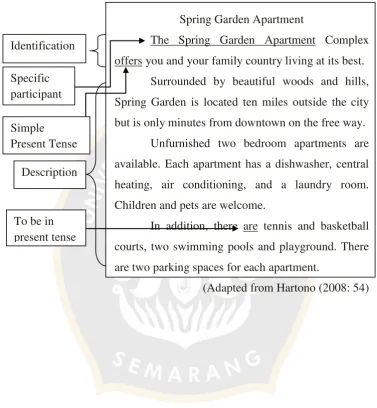
grammar in different ways. For example, the Description texts describe a
particular or certain person, place or thing. It tends to use the simple present tense
since it talks about a factual thing or a general truth. Description texts also use
attributive and identifying processes, focus on specific participant (e.g.: Bono My
Cat, Irfan Bachdim, Jakarta, etc.), and frequent use of classifiers in nominal
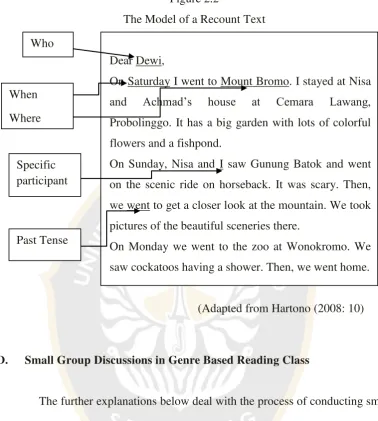
groups. On the other hand, the purpose of Recounts text is to retell events for the
purpose of informing or entertaining. Since the story or events happens in the
past, they use the past tense. They also focus on the specific participants and
temporal sequence, circumstances of time and place (across the road, at school,
before evening, etc.), and use material processes. These figures below are the
Figure 2.1
The Model of a Description Text
Spring Garden Apartment
The Spring Garden Apartment Complex offers you and your family country living at its best.
Surrounded by beautiful woods and hills, Spring Garden is located ten miles outside the city but is only minutes from downtown on the free way.
Unfurnished two bedroom apartments are available. Each apartment has a dishwasher, central heating, air conditioning, and a laundry room. Children and pets are welcome.
In addition, there are tennis and basketball courts, two swimming pools and playground. There are two parking spaces for each apartment.
(Adapted from Hartono (2008: 54) Identification
Description Specific participant
Simple Present Tense
Figure 2.2
The Model of a Recount Text
Dear Dewi,
On Saturday I went to Mount Bromo. I stayed at Nisa and Achmad’s house at Cemara Lawang, Probolinggo. It has a big garden with lots of colorful flowers and a fishpond.
On Sunday, Nisa and I saw Gunung Batok and went on the scenic ride on horseback. It was scary. Then, we went to get a closer look at the mountain. We took pictures of the beautiful sceneries there.
On Monday we went to the zoo at Wonokromo. We saw cockatoos having a shower. Then, we went home.
(Adapted from Hartono (2008: 10)
D. Small Group Discussions in Genre Based Reading Class
The further explanations below deal with the process of conducting small
group discussions in a classroom. It included the roles of group discussions and
the stages in group discussions.
1. Roles of Group Discussions
In group discussion, it should be explained to all members about the rules
and their roles in the beginning of the class, before the students conduct the
a. Group goals are clear; everyone knows what the group is supposed to
understand or accomplish. Thus, there is no misunderstanding about what
they should do in group, and also avoiding the roles distinction which
probably happens when some members are quite active to express their
ideas and the others are passive.
b. The tasks to be completed are understood and roles are delineated. That is
why teacher has to give such a clear instruction and make sure that all
members in every group have the same perception about the task. And if is
needed, teacher can remind them by repeating the instruction during the
group discussions.
c. The group membership is appropriate to the goals and tasks. There may no
special group or a certain group which has high-achieving members only,
but the members should be in heterogeneous one (achievement/high-low,
genders, etc.).
d. Norms for work habits and social habits are clear, with evaluation systems
that include rubrics for cooperation. It is better for teacher to distribute some
checklist of the students’ participation during the discussions to make her
easier to get the feedback and to monitor them.
In addition, Bennet and Dunne (1992: 147) as cited by Corden (2004:
145), suggest the following key roles in group of four, they are the coordinator,
data gatherer, secretary and evaluator.
Those students who take place as coordinator must keep the group on
problem arisen, he is the person in charge who has to manage the conflict or
report it to the teacher.
For data gatherer should take notes or summarizes ideas, to clarify ideas
and to read aloud from some materials when appropriate. The data gatherer may
decide which idea they will accept if there are two or more different ideas.
Secretary is not always girls. Recording group answer or materials to act
as spoke person when reporting to the class are the secretary’s jobs. She also
writes down the result of the discussions and the answers.
The last is evaluator. This position must keep notes on the group process
(how well individuals in the group are working together), to lead any evaluation at
the end of the session. Although this position should observe the discussions, she
also has an opportunity to express her idea.
However, if there is no motivation of the students, the discussions may
not work. Motivation, as Harmer said (2007: 20), is a desire to achieve some goal.
There are many factors that can create a students’ desire to learn some new thing.
The students, probably, love the subject they have attended, or maybe they are
simply interested in seeing what it is like. The second statement may happen when
the learners get curious of something new. It will lead them to learn direct or
indirectly. Some students have a practical reason for their study, for example they
want to study procedure text, especially in writing a recipe since they want to be a
good chef.
Furthermore, according to Harmer (2007: 20), there are two kinds of
get motivated from outside of the class. They might be influenced by several
factors, such as their family, friends, society, even their idols. Meanwhile, the
intrinsic motivation takes place when the students get interested in their learning
because of something happens inside the class. It could be many factors, like the teacher’s methods, the activities in the classroom, or even the students’ awareness.
However, all that the teacher can do to sustain the students’ motivation
is she can only encourage them by word, offer some helps and give some
guidance. Another problem might rise in conducting the group discussions when
some students are lack of motivation, whereas some others are quite active. Some
highly articulate students can present as many problems as those who refuse to
speak at all. Though at first teachers may be pleased to have a student who is keen
to interact, if the student cannot make room for others to participate the overall
effect on the group is a negative one. Other students may be discouraged in the presence of someone who appears to “know so much”. Although the numbers is
limited, or the minority ones, the passive students’ presence in the classroom is a
nuisance for the teacher. The following are some ways of dealing with the passive
students, based on Agoestyowati’s (2010: 313): First, the teacher should make a
careful preparation. It is better for him or her to make such a need analysis to find out the students’ need before she conducts the lesson. There are many factors that
make the minority ones being passive during the group discussions. Perhaps they
get problem at home or the topic is quite hard for them, so that they do not get
Next, the teacher asks these students to do something that does not
require speaking. She or he should not put the passive or uncooperative students
in the same group, otherwise the group discussions will not work properly. Those
inactive students can still support their group by doing something that does not
require speaking, such as making notes, writing down the answers, recording, or
holding up a picture.
The third way is that the teacher can give them the point system. He may
give those passive students some positive reinforcement. This reinforcement will
lead them to be afraid of being passive. It could be conducted by giving the
students some additional score if they are active, on the other hand, the passive
ones will lose their points.
Another way, the teacher tries to participate in activities with the
uncooperative students. She or he can give a hand to the passive members by
sitting down beside them and working together. Here, the uncooperative members
will not feel that they have been single out. They, even, feel more confident since
teacher gives attention to them.
Fifth, the teacher may give each student in the group a different job. It
has been mentioned in the previous discussion that each member should have
different jobs. For example, one as the coordinator, he must keep the group on
task, to ensure contributions from all, to guide discussion or activity.
The last way is teacher can leave the uncooperative students alone. If
those ways above did not work, she or he may pretend that she or he did not know
they may feel worried in the end of the lesson that they will not get any score or
point.
2. Stages in Group Discussions
Small group discussion consists of 4-5 students in each group to
participate in a range of activities to develop thinking or to complete practical tasks. According to Harmer (2007:43), „both pair work and group work give the
students chances for greater independence’. Since the students have autonomy to
keep working in group, make some cooperation with their friends in a group
without teacher controlling every action, they will be more secure to express their
idea and they can use their target language with no fear for making any mistakes
as they could not do it in front of the lecturer. The format and organization of
small group work need to be carefully conceived. Good preparation is necessary.
The choice of technique must be targeted to the intended goals and topics of the
meeting and whether the process is short- or long-term. The organization of the
process should aim to achieve limited goals within a specified deadline.
Policy-makers must be informed of the process and its goals to assist in its support.
Robertson (1990: 195-196) stated that there are four stages in group discussions
process:
a. The Orientation Stage.
In this stage, group members find out about one another and their place in
the group. They start to greet and introduce themselves to other members
b. The Norm Establishment Stage.
It is conducted where group members test one another and teacher. Test here
means they will start discussing the topic with their members, even they
might ask their teacher to give them some helps if it is needed. Conflict will
naturally happen and this stage is as an opportunity to learn problem solving
and interpersonal skill.
c. The productive stage.
This stage is generally the longest stage in the life of a group where group
members focus both on the task and interpersonal relations. They have to
decide which idea will be written as the best result. Debating some different
idea may not happen in this stage any longer. Here, they focus on producing
the answer in a pepper.
d. The termination stage.
This is a stage where group members look back at their experience together
and deal with the problems of parting. If they still had time, they can
re-check their answers together, but they might not do it when the time is over.
The figure 2.3 below describes the process of small group discussions.
The first stage is the orientation stage which is used as the introduction the
members in each group. Next is the norm establishment stage where the members
start their discussions. While in the productive stage, they share their ideas and
focus on what they read. And the last stage is the production stage where they
The Orientation Stage
The Norm Establishment Stage
The Productive Stage The Termination Stage
Despite the Robertson’s stages in conducting the small group discussions
technique, there are also another stage or cycle employed in teaching-learning
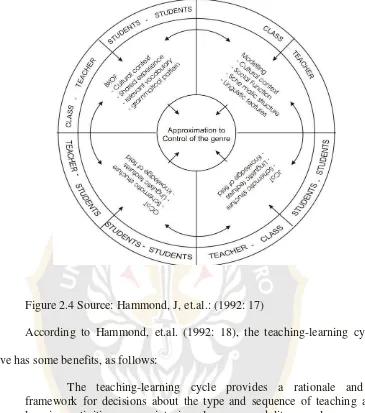
process in education. The cycle of teaching and learning activities, especially in
genre approach consists of a number of stages. Hammond et al. (1992: 17) states that “the classroom program is based on four stages in a teaching-learning cycle”.
It means that the stages in a teaching-learning cycle are also based on the
assumption that in order to learn how to get new information by reading, students
first need to have an understanding of a familiarity with the topic they read. They
also need models of the genre before they get the point of a certain genre. The
students need some support and guidance from the teacher in learning how to
identify and get the idea of a particular text.
Related to the view of the teaching-learning cycle, Feez and Joyce (2002:28) state that “there are four stages in teaching and learning activities”.
They are Building Knowledge of the Field (BKOF), Modeling of Text (MOT),
Joint Construction (JC), and Independent Construction of the Text (ICT). Figure
Figure 2.4 Source: Hammond, J, et.al.: (1992: 17)
According to Hammond, et.al. (1992: 18), the teaching-learning cycle
above has some benefits, as follows:
The teaching-learning cycle provides a rationale and a framework for decisions about the type and sequence of teaching and learning activities appropriate in a language and literacy classroom. It also incorporates tasks and activities that move learners from a focus on spoken language to a focus on the written language. Next, the teaching-learning cycle focuses on teaching-learning language and also teaching-learning about language, that is, learning how and why written texts are shaped and organized as they are. This focus on learning about language may involve reading published texts, reading texts that have been written by the teacher and/or reading texts written by learners.
In the beginning stage, Building Knowledge of the Field (BKOF), the teacher will make up the students’ perception about a certain topic. This stage is
knowledge of the cultural and social contexts of the topic is built, and, then,
developed.
The next stage is Modeling of Text (MOT) which introduces the students
to a model of genre they will read in the classroom. Here, they will learn about
how to analyze the genre through a model text related to the topic. If it is possible,
the teacher may ask and discuss the characteristic or schematic structure and also
grammatical patterns.
Meanwhile, in the third stage; Joint Construction of text has the objective
to construct a certain text. The construction analysis is held by the teacher
together with the students. The activities, for example, gathering relevant
information, or researching the topic through additional reading.
The last stage, Independent Construction of text should be done if the
teacher is quite sure that the students are ready to construct the text independently.
This stage may occur only after group or pair construction have shown that they
have gained control of the field.
In each stage, the teacher needs to select a number of different activities that provide a structure’s framework and support as the students increasingly gain
control over written language. The cycle itself, is intended to be used flexibly and
therefore it is possible to begin at different stages and to move from stage to stage according to the students’ needs. Normally, in some units of work, it may be
appropriate to omit some of the stages of the cycle. For example, in the first
independent construction. Thus, the teacher may decide to recycle some of the
activities introduced at the earlier stage.
E. Reading Process
Reading is both a process and a product. It is more than just receiving
meaning in a literal sense. It involves bringing an individual’s entire life
experience and thinking powers to bear to understand what the writer has encoded. According to Grabe and Stoller (2002: 9), „reading is the ability to draw
meaning from the printed page and interpret this information appropriately.’
Reading process in this study is a process to gather some information
from the text through small group discussions technique. Auckerman in
Agoestyowati (2010: 318) has divided the process of reading into four major
categories; they are the perceptual reading, associative learning, cognitive
learning, and affective learning.
Besides employing the group discussions, the lecturer also keeps
concerning on the reading principles. Reading principles here is any actions that
should be done in reading activities to reach the goals through students’
achievement. Harmer (2007:101) mentions six principles in reading class. They
are: to encourage students to read as often and as much as possible; students need
to be engaged with what they are reading; to encourage students to respond to the
content of the text, not just concentrate on its construction; prediction is a major
factor in reading; match the task to the topic when using intensive reading texts;
Whereas Grabe and Stoller (2002:13) state that there are several purposes
and skills of reading;
1. Reading to search some information means the students typically scan the text
for a specific piece of information or a specific word. For example, the
teacher asks the students to find info based on the text.
2. Reading to skim quickly involves a combination of strategies for guessing
where important information might be in the text, and then using basic
reading comprehension skills on those segments of the text until a general
idea is formed. This idea is almost same with the previous one. Students
should get the info from the passage by skimming the text.
3. Reading to learn from text is usually carried out at a reading rate somewhat
slower than general reading comprehension. Here, the students will get some
benefits from a text. This reading purpose should be applied in academic or
professional contexts.
4. Reading to integrate information needs to give some critical evaluation of the
information being read so that the readers can decide what information to
integrate and not. Actually, both reading to write and reading to critique texts
are the variants of reading to integrate information.
5. Reading for general comprehension as the last purpose on reading requires
some fluency on reading since this purpose is to get the idea from certain text.
This purpose also need much longer time constraints. For example, the
students are asked to find the best title, the main idea of the whole paragraph,
Since the subject research is the Intensive Reading I class, the researcher
only explores three purposes and skills of reading; they are reading to search some
information, reading to skim quickly, and reading for general information.
F. Classroom Action Research
According to Burns (2010: 2), action research is part of a broad
movement that has been going on in education generally for sometime. In this
case „teacher is as researcher’. He might give some treatments to the students and
design the research by himself. Action research is not simply problem solving. It
is systematic and collaborative. It involves problem posing, the search for the
questions beneath the questions that we typically ask about our practices. Action
research is not done 'to" other people. Action research is research by practitioners
on their 'own' work, and it is done with the help of other practitioners.
Furthermore, action research takes a self-reflective, critical and
systematic approach to exploring the teaching contexts. (Burns, 2010:2) stated
further that one of the main aims of action research is to identify a “problematic”
situation or issue that participants who may include teachers, students, managers,
administrators, or even parents-consider worth looking into more deeply and
systematically. The „problematic’ here means teachers often see gaps between
what is actually happening in our teaching situation and what we would ideally
like to see happening. Thus, teachers may find out the resolution to manage the
Another theory is coming from Kemmis and Mc. Taggart in Saleh (2008:
122), action research is a form of collective self-reflection done by the participants
in social situation to improve understanding and practical justice towards the
situation of places where the practices were done. Hardjodipuro in Wibawa, H.
Basuki (2004:5) also stated that CAR (Classroom Action Research) is an
approach to improve the education through changes by motivated teachers to think
their own teaching practices in order to criticize the practices and willing to
change it. In conducting CAR, the teacher should be helped by observer(s) to
observe her teaching-leaning process. The observation results, furthermore, is
used to get the reflection and solving her weaknesses.
1. Characteristics of Action Research
There are some characteristics on action research that could be
differentiated from other researches. The brief summary of the action research
characteristics from Kemmis and McTaggart (1992:22–5) as cited in Cohen
(2000:228-30) are as follows:
a. It is participatory. Action research is research through which people work
towards the improvement of their practices.
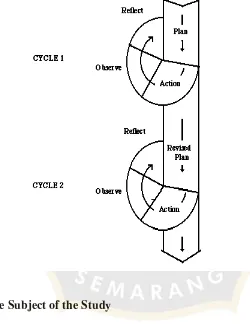
b. Action research develops through the self-reflective spiral cycle, they are
planning, acting (treatments), observing, reflecting and then replanning, further
implementation, observing and reflecting.
c. Action research is collaborative. It involves those responsible for action in
d. Action research is a systematic learning process in which people act
deliberately, though remaining open to surprises and responsive to
opportunities.
e. Action research involves people in theorizing about their practices, action and
consequences and coming to understand the relationships between
circumstances, actions and consequences in their own lives.
2. Steps in conducting Action Research
The followings are the steps of action research from Kemmis and
McTaggart, 1988:11-14) cited in Burns (2010:8).
a. Planning
In planning, the teacher might identify the problem or issue and produce
a plan of action in order to bring about improvements in a specific area of the
research context. This is a forward-looking phase where you consider: 1) what
kind of investigation is possible within the realities and constraints of your
teaching situations; 2) and what potential improvements you think are possible.
b. Acting
The plan is carefully considered one which involves some deliberate
interventions into your teaching situation that you put into action over an agreed
period of time. The interventions are critically informed as you question your
assumptions about the current situation and plan new and alternative ways of
doing things.