Parental Control Model for High School E-Learning
Sri Suning Kusumawardani, Ridi Ferdiana
Universitas Gadjah Mada, Electrical Engineering and Information Technology Department J1. Grafika No. 2 Yogyakarta, Indonesia
([email protected]; [email protected])
Abstract
Adopting e-Learning in high school is challenging. The main problem in this situation is the adoption of e-Learning as a self-paced learning. In universities, the problem rarely happens since the students in universities have an awareness to explore and to learn by themselves. In high school level, student awareness is limited.High school students more likely need a control mechanism to use e-Learning. In this research, an efort is made to create a model that collaborate parents to control e-Learning usages. The collaboration of parents in e-Learning strongly believed can provides additional value of effectiveness in student e-Learning usage.The result of this research is a model called PCM (Parental Control Model). PCM is an architectural model that contains of information and software architecture that will cover business process collaboration between parent and student.
Keywords: e-Learning, parental control model, software architecture, interaction model
1. Introduction
Nowadays, e-Learning becomes a part of the learning process and it is available at various e-Learning is adopted in university or institute. The successful implementation of e-Learning and ICT trends bring forward the e-Learning model into high school or elementary school society (Rosen, 2009). In university, the process of evaluating e-Learning can be more easily and independently. Students in general had the awareness and sensitivity towards the needs of knowledge. However, in high school the e-Learning should be evaluated further since the high school students is still infancy and growing. The use of e-Learning in high school and elementary needs a guidance and special control mechanism. It is suggested that a controlled edu-cation in adolescence would nature the maturity level when student live in college level. The mechanism control can be performed by various parties like teachers, communities, and parents However, the most significant party is the parents it self.
In this research, it will make an effort to evaluate the existing high school e-Learning and
combine it with parent factor. It shows that the parent engagements with the student through e-Learning system will improve the learning process. Parents as an active evaluator will control and manage how student will interact with the e- Learning.
The result of this research can be sed by any high school that wants to implement e-Learning and need to realign the usage of elearning with the proposed parental control model. In this re-search, it will cover several purposes of the research that are.
Analyze the interaction model between stu-dents and parents that can occur in a virtual environment through e-Learning channel
Designing a control model and the
interactions that involve parents
Propose a model of integration that can be done between e-Learning models that already exist with parental control model proposed in this study.
2.Previous Researches
A. Parents and E-Learning
Fredriksson, et al. (2008) found that the critical success factors for e-Learning in high school is depend on the support of national authorities, regional and local levels, as well as from school leaders and parents.In the process of learning, parents generally serve to provide education at home and also monitor the effectiveness of student learning at school or outside school such as through e-Learning and others learning programs. Telcm and Pinto aspects of LBA in the study implicitly suggest that parents have a major role of primary and secondary education 1evel. The addition of a technological dimension to the learning process led to a variety of related research.
Fang, et a1 (2007) makes an interaction model of e-Learning control through the mobile devices. In the study, the parents can get SMS notifications about the progress of student learning. Yarosh, et.al. (2009) refine a model of interaction between parents and students through the concept of media space that emphasizes the direct interaction between parents and students through technology Drake and Barton (2010) study the interaction between parents and teachers. In this study expressed a model of how
teachers give feedback to parents related to the education of their students. While Yarosh and Abowd (2011) focuses in a model of communication mechanism between children and parents that geographically separated.
Based on our analysis with the previous researches, it is found two facts as follows.
Synchronous technologies such as video chat can increase the effectiveness of communication between them.
Asynchronous technologies can help parents
to understand that
sometimes-directcornmunication cannot be expressed directly by their children.
Both of them are based on social interaction between parents and students. Frankly speaking, the technological aspect depends on the social aspect in the execution. Therefore, the research decides to evaluate the e-Learning interaction in social aspect.
B. E-Learning evaluation in social aspects
Camison, et al. (2008) shows that the e-Learning evaluation can be determined through two approaches to the training approaches and assessment approaches.It proposes a general model that allows an evaluation of e-Learning through several success factors. Table Iprovides researches that evaluate the e-Learning in social aspect.
Table Ishows that the training approach is more preferable. In simple terms, it can be concluded also that the success of e-Learning is more related to social aspects than on the
Tabele 1. Evaluation Model and successful metric
Success factors Evaluation model Success Vision
Appropriate process business
technological aspects. This is consistent with previous studies evaluating e-Learning in the social field as presented in Table 2 below.
This study distinguishes with previous research because it will evaluate e-Learning is socially on the user's e-Learning in high school and elementary school. In addition, this study also involves the role of parents towards the effective use of e-Learning.
3. Research Method
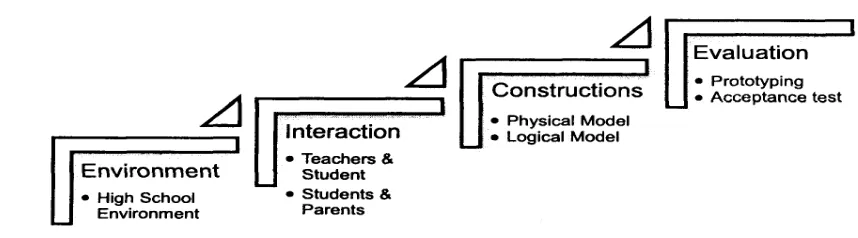
The study is divided into four main phases namely:
Analyzing e-Learning environment phase. This phase discusses how a high school environment can give an impact with the e-Learning.
Analyzing interaction in e-learning model. This phase covers the need of literate study
and field study that covers relation between student, teacher, and parents
Model constructions phase. This phase contructs the generic model of parental control mechanism in e-Learning, This model is called as Parental Control model (PCM)
Model evaluation phase. This phase evaluates and validates the result of model construction phase through prototyping the models and evaluated the model with the parents.
.
Figure 1 displays the components for each phase.
A. Analyzing Environment
This research is executed in a custom
e-Learning solution called Aquera. Aquera is a codename for e-Learning system that dedicated for primary and high school and made by private
company in Indonesia. Aquera system serves more
Table 2. E-learning Evaluation in social aspect
Authors Research Topic
Wang, dkk.(2010)
Adeyinka dan Mutula (2010)
Chen, dkk. (2009)
Wang dan Chiu (2011)
Wang, dkk (2007)
Quality e-Learning is significantly determined by the content of the e-Learning system
The study findings suggest that the quality of the content, quality systems, quality of service support, quality of teaching and learning, independent learning, the intention to use. / use, user satisfaction and net benefits is an important factor to evaluate the success of e-Learning
E-Learning success is determined by the perceptions of users, a good instructor filler, and the good web site
Empirical results show that the communication quality, information quality, and service quality is significantly and positively affect user satisfaction and loyalty intention to use the e-Learning system to share experiences, communicate with others, and get feedback
than 18000 students in 2010. Therefore, this system will sufficient as environment background for this research. Figure 2 describes the e-Learning features in Aquera
Figure 2. Aquera e-Learning features
In this research, it makes an effort to anayze the relation and use case scenarios each actor in
Aquera e-Learning. Figure 3 shows the use case diagram for Aquera E-learning.
Figure 3 implicitly shows that the existing system is not related directly with parents (orang tua), while teacher and student (guru and siswa) exposes the entire feature of Aquera. Several notes based on Figure 3 are.
Parents did not interact directly with e-Learning system. At this stage parents rely on information provided by teachers and students as well.
Aquerasystems that exist today don't have specific features that facilitate interaction between parents and students and parents with teacher
B. Constructing Interaction between Parents and Students
In this research, it makes and effort to construct how interaction between parents and students happens. It finds three characteristics what good enough e-Learning which are.
The purpose of interaction between students and parents is to improve communication between them so that parents can encourage students to learn
In this interaction model, parent will have sufficient information associated with their children.
Interaction model is also expected to provide parents understanding about what things are there on the e-Learning, Therefore, they knows the benefits of e-Learning for their children.
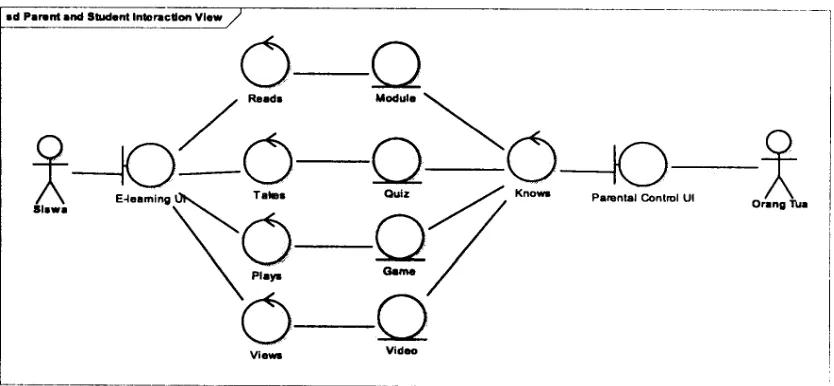
Figure 4 is a design that shows the interaction communication between students and parents. It is shown as UML communication diagram
Figure 4 shows that a parent will collaborate with the student through a single interface called dashboard. Dashboard is a united user interface that can be used to simplify the parent user interface. Dashboard model plays important roles since not all parents have ability to operate computer especially new system. In this research, it shows several facts which are.
Parents are technically only works as read only model which aims to understand what her son and daughter in e-Learning.
Parents need an interface which in this case is called a parental ontrol UI. Parental control UI is designed to be user interface for the parents.
In the interaction model, it is suggested that the act of communication between student and parents conducted outside the system.
Based on these facts, this research construct a general model for parents called as Parental Control Model (PCM). PCM is constructed in constructions phase.
C. Constructions Phase
PCM is a grand design that focuses on how ICT solutions can help parents evaluate their children. PCM is designed based on requirement derived from analysis of e-Learning environmen and also a model of interaction between student and parents.
Business process begins with knowing the status of parent registration. Parentwill get an account through a letter sent by the organizers of e-Learning. Organizers are generally tying the parent account with their children. A parent must have at least one child who uses the E-learning solutions. This account can be used by parents to access child and interpretation activities.
Student activities include the duration and activities conducted during the use of e-Learning Achievement is defined as achievement rank by the student through their activities such as.
Students received ratings of 10 best in local,
provincial, and national levels.
Students have been reading 10 modules in one month.
Students have watched 20 education
videos in a month
Students have been playing educational
games for 20 times in one week
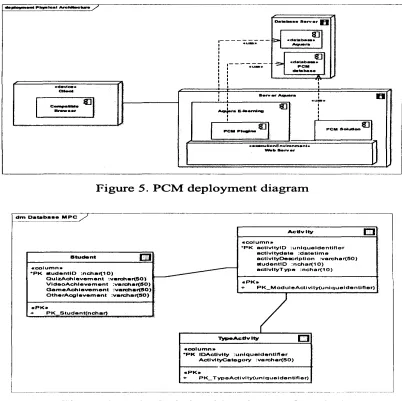
PCM uses client-server model based on web application model. This approach is done since a lot of e-Learning system such as Moodle, Share point and others use Web appications. Integration becomes main agenda for this research Therefore, PCM is developed using plugins model. Plugins modelis done by placing small compo- nents in existing e-Learning which acts as a middleware that communicates between e-Learning and the PCM solution. Figure 5
shows the deployment diagram that designed for PCM.
PCM solution contains two components which are PCM Solution and PCM Plugin. PCM Solution provides main business process as well as dashboard user interface for the parents. PCM Pluginis a small module that plugged in the existing e-Learning. It works by hooking the student activities in e-Learning and stores in its own database.
Student table stores student achievement information into the database. Activity table stores activity log and others. One of the interesting columns is Activity Description that contains the output of the activities carried out by students.One of the interesting columns is Activity Description that contains the output of the activities carried out by students.
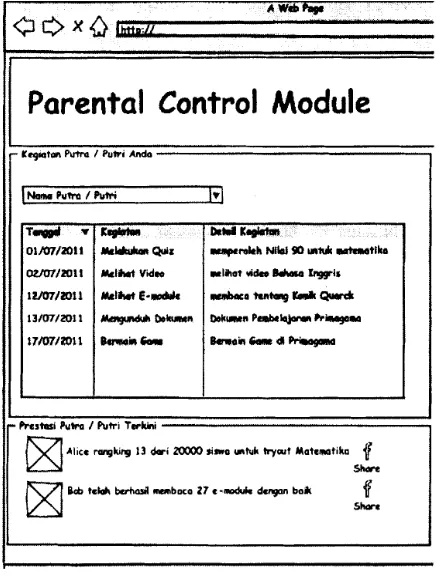
The dashboard model is the key how the information in the PCM database is displayed. The PCM dashboard follows executive information system and eliminates the complexity by providing single user interface for the entire actions. Figure 7 shows the dashboard design in PCM.
Figure 7. PCM user interface
Parents who are logged in can choose for their child through a dropdown list. At one of the sons is selected then the system will generate a report in the form of a table that contains the students' activities. As part of the solution, a panel contains the achievements of their children are shown. Parents can view a list of achievements of their children in an illustrative display that can be shared with peers through social media channels like Facebook or Twitter.
D. Evaluation phase
In this research, it focuses in creating an interaction model between parents and students through e-Learning. In addition, it also makes several steps in evaluation.
At this stage, evaluation is done by developing a model form of proof of concept (POC) applications. POC developed within a
period of two months. POC is evaluated architecturally based on proposed model and it will be integrated in Aquera e-Learning system.
After the development and integration, this research makes a short survey for the selected parents that use PCM POC. PCM POC is used by 20 parents and we randomly select 10 parents to fulfill the short survey that an be seen online at http://svy.mk/sxG7q6.
It is found that 2% of parent feel is no. writhed, 6% feels this feature is not effective yet 34% said useful, 36% said very helpful and 22% of parents say this feature is very useful and very important.
4. Conclusion and Future Works
The main problem of this research is about e-Learning implementation in high school. It is shown that the student in high school and elementary school need an additional support for not only the teacher but also the parents. The different characteristic between university student and high school student stimulate this research to create an interaction model between parents and students. The model is called as parental control model (PCM). PCM is developed as a prototype and is evaluated through an existing e-Learning system named Aquera. In the evaluation, it is shown that PCM features are somewhat importan
This research had limitation in terms of evaluation and Prototype development. Therefore, in the future research, the researchers will use this model to the common e-learning system like Moodle or Sharepoint
Acknowledgment
Networking Academy, and JTETI Universitas GadjahMada family.
References
Adeyinka, T, and S. Mutula. 2010. A proposed model for evaluating the success of WebCT course content management system. Distance Education Students' Perspective on Critical Success Factors of E-learning. In Proceedings of the 2009 Second International Conference on Education Technology and Training (ETT '09). IEEE Computer Society, Washington, DC, USA, 140- 143.
Drake, C. and Barton, A.C. 2010. Teacher learning about teacher-parent engagement: shifting narratives and a proposed trajectory. In Proceedings of the 9th International Conference of the Learning Sciences- Volume 1 (ICLS '10), Kimberly Gomez, Leilah Lyons, and Joshua Radinsky (Eds.), Vol. 1. International Society of the Learning Sciences 722-729.
Fang, R., Chiung W, Yang S., Tsai, H., Wu .K, and Juang, S. 2007. The effects and limits of teacher-parents communication by mobile device: the view of teachers. In Proceedings of the 6th Conference on WSEAS International Conference on Applied Computer Science
-
Volume 6 (ACOS’07),Fredriksson, U., Jedeskog G., and Plomp T. 2008. Innovative use of ICT in schools based on the findings in ELFE project. Education and Information Technologies 13, 2 (June 2008), 83-101.
Horton, W. 2002. Using E-learning. ASTD. New York.
Rosen, A. 2009. E-learning 2.0: Proven Practices and Emerging Technologies to Achieve Results. AMACOM.
Telem M., and Pinto S. 2006. Information technology's impact on school-parents and parents-student interrelations: a case study. Comput. Educ. 47, 3 (November 2006), 260- 279.
Wang Y., Wang, H., and Shee, D. 2007. Measuring E-learning systems success in an organizational context: Scale development and validation. Comput. Hum. Behav. 23, 4 (July 2007), 1792-1 808. Inf. Technol. 29, 3 (May 2010), 32 1-329.
Yarosh, S. and Abowd, G.D. 2011. Mediated parent-child contact in work-separated families. In Proceedings of the 201 1 annual conference on Human factors in computing systems (CHI '11). ACM, New York, NY, USA, 1 185- 1 194.
Yarosh, S., Cuzzort, S, Miller, H, and Abowd, G.D. 2009. Developing a media space for
remote synchronous parent-child