Gadjah Mada International Journal of Business May-August 2009, Vol. 11, No. 2, pp. 253–273
MANAGERIAL VIEWS OF SUPPLY CHAIN
COLLABORATION
An Empirical Study
Ramaswami Sridharan
University of Newcastle in Australia
Togar M. Simatupang
School of Business and Management, Bandung Institute of Technology, Bandung, Indonesia
This paper is carried out to empirically examine managerial perceptions on the relationship between supply chain collaboration practice and operational performance. The framework suggests that collaborative practice is characterised by three distinct factors: (1) decision synchronisation, (2) information sharing, and (3) incentive alignment, which enable the chain members to effectively match supply with customer demand. An important question is whether or not collaborative practice leads to better operational performance. A survey research was employed to assess the relationship between collaborative practice and operational performance of New Zealand companies. The survey results show significant positive impacts of key factors of collaborative practice on operational performance. The findings suggest that information sharing, decision synchronisation, and incentive alignment are important determi-nants of operational performance. This study demonstrates that the chain members need to understand the role of different key factors of collaborative practice that can be redesigned to leverage opera-tional performance.
Keywords: channel relationships; collaboration; incentive alignment; information
Introduction
Global competition has fundamen-tally changed the economic environ-ment of firms along the supply chain. End customers have greater control over the buying process and the finan-cial ability to make choices of product features. It is not surprising that the global market results in higher de-mand uncertainty with shorter product life cycles and greater variety (Fisher 1997). As interdependence increases between firms, they need to collabo-rate to effectively manage flows of products along the entire value-added supply chain to be available for end customers (Whipple and Russell 2007). Collaboration enables both parties to combine knowledge and capability better than acting in isolation (Dyer and Singh 1998). Retailers, for in-stance, know consumer preferences due to their direct access to end cus-tomers, but are lacking in knowledge of product design and delivery. Partnering suppliers, on the other hand, have better knowledge of product de-sign, production capability, and deliv-ery capability.
Supply chain collaboration brings advantages to participating members, and enables them to experience in-creases in their common market shares and profitability (Parks 1999). These advantages can be realised only if both parties work together to speed up the decision-making process in delivering the right product to the right place at the right time in the right condition for the right cost (Fisher 1997). As an
illustration, the cooperation between K-Mart and Lee Apparel shows that both parties reap the advantages of collaboration to match supply and de-mand. K-Mart shares points-of-sale (POS) data with Lee. Lee uses this data to monitor the exact products sold, including color, size, and style, in each K-Mart store. With this information in hand, Lee knows which products need to be restocked at each K-Mart loca-tion, and is thus able to coordinate its production and distribution plans to accommodate its major customers’ needs. Lee can also identify early warn-ing signs of merchandiswarn-ing problems for Lee’s products at particular K-Mart locations. Early warning signs help both parties to devise quick re-sponses that lead to reductions in stock outs and markdowns, thereby improv-ing customer service and sales.
con-cept of integrated supply chain man-agement is a collaborative-based strat-egy to link cross-enterprise business operations to achieve a shared vision of market opportunity. In a similar vein, Ballou et al. (2000) argue that supply chain management includes interfirm cooperation that coordinates product movements across the legal boundaries of independent firms. Stank et al. (2001) also emphasize the fact that supply chain management involves some levels of coordination of activi-ties and processes both intra- and in-terfirm.
Given the significance of supply chain collaboration, this research con-tributes to the literature of supply chain collaboration through characterizing collaborative practice into three inter-related enabling factors: (1) decision synchronization, (2) information shar-ing, and (3) incentive alignment. The research also tests hypotheses on whether or not the three factors of collaborative practice positively con-tribute to operational performance. Sur-vey research was carried out to assess the relationship between collaborative practice and performance.
The study is organized as follows.
First, related research as the
founda-tion for this paper is presented. The next section proposes an operating definition for collaborative practice that consists of three enabling factors, namely decision synchronization, in-formation sharing, and incentive align-ment. Research hypotheses are also developed in this section to describe the influence of collaborative practice
on operational performance. After-wards, the research method, compris-ing data collection, development of measures, and analysis is given. Find-ings and discussion are subsequently presented. Finally, the paper provides concluding remarks and recommenda-tions for further research.
Related Research
A review of related research re-veals an increased interest in supply chain collaboration. The literature can be classified into the development of the concept of supply chain collabora-tion and empirical research. The con-ceptual study on supply chain collabo-ration deals with the definitions and components or success factors of sup-ply chain collaboration. The empirical research provides evidence obtained from the survey and case studies that describe the extent to which firms have adopted the concept of collaboration and discussions of factors that facili-tate or hamper the implementation of supply chain collaboration. This sec-tion presents the previous work that relates to the conceptualization, suc-cess factors, and empirical evidence of supply chain collaboration.
the flow of goods and services along the entire value-added chain. Simi-larly, Buzzell and Ortmeyer (1995) propose partnership as the coopera-tion between suppliers and retailers in which the parties agree on objectives, policies, and procedures for ordering and physical distribution of suppliers’ products to end customers. Narus and Anderson (1996) use partnership to describe the cooperations amongst in-dependent but related firms to share resources and capabilities to meet their customers’ most extraordinary needs. Bowersox (1990) uses logistics alli-ance to characterize the cooperations amongst independent firms along a supply chain that share resources in delivering products to ultimate cus-tomers. Although previous research-ers have used different terms for col-laboration, it is important to note that collaboration is an evolving process rather than a static process that lies between adversarial relationships and joint ventures (Lambert et al. 1999). Therefore, a useful definition of sup-ply chain collaboration is the process of independent firms working together to deliver products and services to end customers for the basic purpose of optimizing higher long-range profit for all chain members than can be achieved by acting alone (Simatupang and Sridharan 2002).
Besides definitions, the success factors of supply chain collaboration also vary amongst previous research-ers. Buzzell and Ortmeyer (1995) pro-pose key elements of improvement opportunities from collaboration,
namely better assortment planning, faster new product development, more effective replenishment, faster order processing, better inventory control, more effective receipt and distribu-tion, and better store selling tasks. According to Spekman et al. (1998), supply chain collaboration occurs when participating members share informa-tion freely, work together to solve com-mon problems, devise joint planning, and make their success interdepen-dent. Ballou et al. (2000) emphasize three components of inter-organiza-tional coordination: (1) performance metrics, (2) information sharing, and (3) benefits allocation. Lee (2000) pro-poses the concept of supply chain inte-gration that incorporates information sharing, logistics coordination, and or-ganizational relationship linkages. Mentzer et al. (2000) argue that supply chain collaboration is characterized by the sharing of information, knowl-edge, risk, and profit. In addition, Simatupang and Sridharan (2005) as-sert that information sharing, decision synchronization, incentive alignment, collaborative performance systems, and process improvements are instru-ments used to enable supply chain collaboration.
and Spekman (1994), the success of collaboration depends on commitment and trust, effective communications to specify roles, responsibilities, and ex-pectations, and the conflict resolution techniques of joint problem solving. Stank et al. (2001) find that internal collaboration mediates the relation-ship between external collaboration and logistical service performance. Spekman et al. (1998) discover that information sharing is a key ingredient to reducing costs and improving cus-tomer satisfaction. Stank et al. (1999) also find the positive effect of the collaborative practice with key cus-tomers on logistics cost and customer service. Furthermore, Sheu et al. (2006) recently find from a case study that supply chain architecture in informa-tion sharing, inventory systems, coor-dination, and IT capabilities affects the level of collaboration.
Another stream of empirical re-search relies on the use of a collabora-tive management process to facilitate supply chain collaboration (Ireland and Bruce 2000). Kurt Salmon Associates promotes efficient-consumer-response (ECR) that facilitates planning and execution for efficient promotion, re-plenishment, store assortment, and product introduction (Barratt and Oliveira 2001; Frankel et al. 2002). Another initiative called vendor-man-aged inventory (VMI) delegates stock-ing decisions to main suppliers in such a way the suppliers are responsible for monitoring stock levels and replenish-ing products sold at the retailer stores (Lee et al. 1997; Whipple et al. 2007).
Sherman (1998) reports a recent move-ment in Collaborative Planning, Fore-casting, and Replenishment (CPFR). CPFR is proposed to enable participat-ing members across the supply chain to remain competitive by taking a ho-listic approach to delivering products to ultimate customers. This approach has the potential to deliver increased sales, interorganizational streamlining and alignment, administrative and op-erational efficiency, improved cash flows, and improved return on assets.
Conceptual Model
As the nature of collaboration is to optimise profitability, the chain members need to plan, execute, and control key decisions at the interface boundaries related to defining and de-livering products to ultimate custom-ers that lead to mutual advantage. The collaborative supply chain assumes that the chain members synchronize deci-sion making across a supply chain, share information to make effective decisions that improve performance, and employ incentive schemes for specifying reward and punishment mechanisms (Lee et al. 1997; Simatupang and Sridharan 2002). As a consequence, the structure of ongoing collaboration can be characterized by three enabling factors of collaborative practice: (1) information sharing, (2) decision synchronization, and (3) in-centive alignment (Simatupang and Sridharan 2005).
chain members into cross-organiza-tional cooperation in realizing collabo-rative benefits. To operationalize this concept, a hypothetical framework is developed to link the three factors of collaborative practice to operational performance. The framework consists of two variables: (1) collaborative prac-tice and (2) consequences of collabo-rative practice. Briefly, it suggests that collaborative practice positively af-fects operational performance. Hypoth-eses are developed based on this conceptualization and previous work in supply chain collaboration. The re-maining part of this section presents these hypotheses.
Information sharing can be de-fined as a process that facilitates the chain members to capture and dis-seminate timely, relevant, and accu-rate information such that the recipi-ent is able to plan, execute, and control supply chain operations. Effective in-formation sharing provides a shared basis for concerted actions by differ-ent functions across interdependdiffer-ent firms (Whipple et al. 2002). Examples of shared information include points-of-sale (POS) data, updated forecasts, production and delivery schedules, inventory levels, delivery lead-times, and inventory carrying costs. Informa-tion sharing also facilitates clarity about demand, the fulfillments process, and common performance for all partici-pating members (Zhao et al. 2001). Collaborative initiatives, such as Effi-cient Consumer Response (ECR), Quick Response (QR), and Vendor-Managed Inventory (VMI), are based
on the concept of information sharing amongst the chain members to match supply and demand (Simchi-Levi et al. 2007; Sherman 1998). Fisher (1997) finds that information sharing can yield significant performance improvements in all chain members, such as cohesive market focus, better coordination of sales and demand fulfillment, and mini-mum risks associated with demand uncertainty. Information sharing pro-vides a unifying visibility for the ef-forts of chain members to improve operational performance, thereby en-abling the chain members to forecast accurately, reduce order variability, shorten delivery lead time, and reduce inventory levels (Fisher 1997; Lee et al. 1997). Companies like Ford and its vendors, Dell and its suppliers, Wal-Mart and Procter and Gamble (P&G) are widely known to practice informa-tion sharing to reduce working capital and inventories (Simchi-Levi et al. 2007). Therefore, there is a direct link between the availability and the qual-ity of timely information and the per-formance of a supply chain. Relevant to this conceptualization as well as on the basis of this discussion, the follow-ing hypothesis is proposed.
Hypothesis 1. Information sharing is positively related to op-erational performance.
and solving problems (Bowersox et al. 2003; Mohr and Spekman 1994). The planning context integrates decisions on long-term planning and measures, such as selecting target markets, prod-uct assortments, customer service level, delivery schedule, promotion, and fore-casting. The operational context inte-grates order generation and delivery process that can ship schedules and replenish products to the stores. Deci-sion synchronization encourages the chain members to have a sense of belonging in which all decisions work toward a common goal of serving end customers (Lee et al. 1997; Morash and Clinton 1998). This reduces the gap between delivery requirements and actual delivery, thereby improving customers’ perceptions of fulfillment performance (Ramdas and Spekman 2000). Customers are satisfied as they find products suited to their prefer-ences and tastes at the right time and right price. Many improvements are made possible by employing decision synchronization and the associated dynamic control amongst autonomous members of the supply chain to align different decision sharing options with varying flexibility requirements (Lee et al. 1997). Decision synchronization facilitates the chain members to reas-sign decision rights in order to be able to identify exceptions and make effec-tive decisions like stocking, distribu-tion, outsourcing, and shipping, thereby providing responsibilities for improv-ing the performance of the supply chain (Holweg et al. 2005; Simatupang and Sridharan 2005). Bowersox et al.
(2000) report that decision synchroni-zation contributes to a reputation of on-time delivery and consistent prod-uct availability. This discussion sug-gests the following hypothesis.
Hypothesis 2. Decision synchroniza-tion is positively related to operational perfor-mance.
on-time delivery and responsiveness in the presence of incentive alignment tied to customer service at a just-in-time level (Narayanan and Raman 2004). It can be stated that incentive alignment facilitates the chain mem-bers to act consistently with improv-ing the performance of the supply chain (Lee and Whang 1999). This observa-tion suggests the following hypoth-esis.
Hypothesis 3. Incentive alignment is positively related to op-erational performance.
Research Method
A survey method is utilized to gain responses from sample that re-flects various degrees of collaboration between suppliers and retailers. In this setting, survey research is useful to accommodate diverse respondents and thereby has a high level of gene-ralizability (Pinsonneault and Kraemer 1993). In addition, linking interface coordination and key performance outcomes provides additional insights into current practice of collaboration that affects performance. Empirical findings, which confirm this relation-ship, extend the validity of collabora-tive practice.
The development of research in-struments follows three steps: (1) lit-erature review, (2) conceptualization, and (3) pre-test. The first phase con-sists of reviewing literature on supply chain collaboration. The literature in-dicates that the issue of supply chain collaboration is of substantial interest
to many firms, and serves as an active research arena with the advent of in-formation technology. Second, a pre-liminary conceptual framework is de-veloped to link the collaborative prac-tice and operational performance. There are three interface dimensions based on the interface processes be-tween the chain members: (1) decision synchronization, (2) information shar-ing, and (3) incentive alignment. A set of questionnaires was developed to capture and represent the concept of supply chain collaboration. Scales for the study comprised newly generated items and items that have been used previously in the literature. To de-velop a scale, the domain of a variable was itemized into a set of activities (Cavana et al. 2001). Five items were developed to measure each dimension of supply chain collaboration. A panel consisting of practitioners and aca-demics was asked to review and modify initial items. These experts clarified and suggested useful terms and were confident that the items posed in the questionnaires accurately reflected the concept of collaboration.
Finally, a pre-test was carried out
other survey procedures. Additional evaluation was also made to ensure the consistency of the measures used in prior research. Several items were modified slightly after this evaluation. The final set of questionnaires reflects the changes.
The final set of questionnaires contains general characteristics of re-spondent, items related to the mea-surement of the three dimensions of collaboration, and items intertwined with the measurement of performance variables. The measures of scale are described as follows. The information sharing (IS) scale describes the extent to which the chain members share pri-vate information required for plan-ning, executing, and controlling sup-ply chain operations. Items of the IS scale include data exchange about pro-motional events, demand forecasts, inventory holding costs, on-hand in-ventory levels, and order tracking. These measurement items are adapted from Zhao et al. (2001) and Whipple et al. (2002). A five-point format (1 =
strongly disagree, 5 = strongly agree)
is used for each item.
The decision synchronization (DS) scale describes the extent to which the parties make decisions jointly rather than independently. The chain member’s perception on DS is mea-sured using five parallel items. These items capture joint decisions on reduc-ing demand fluctuations, developreduc-ing joint forecasts, co-managing inventory requirements, ensuring on-time deliv-ery, and improving product availabil-ity. The five items are adapted from
previous researchers (Morash and Clinton 1998; Ramdas and Spekman 2000). Each item is assessed on a five-point format ranging from 1 (strongly
disagree) to 5 (strongly agree), with a
defined neutral point at 3.
The incentive alignment (IA) scale describes the extent to which the chain members share costs, risks, and ben-efits to encourage continuous improve-ment. The IA scale is adapted from Giunipero et al. (2001) and Morash and Clinton (1998), and measured by a five-item scale assessing risks sharing associated with demand uncertainties, shared savings of lowering inventory costs, investment sharing of collabo-rative efforts, joint effort for increas-ing sales, and benefit sharincreas-ing. Each item is assessed with the range from 1
(strongly disagree) to 5 (strongly agree), with a defined neutral point at
3.
prac-tice affects inventory and its associ-ated costs. This includes merchandise inventory turnaround, a decrease in inventory days-of-supply, and a de-crease in inventory carrying cost (Ramdas and Spekman 2000). Respon-siveness measures the extent to which the collaborative practice affects lead-time and flexibility to accommodate demand changes, and this measure is adapted from Wisner (2003). A five-point format ranging from 1 (strongly
disagree) to 5 (strongly agree) is used
for each item.
The unit of analysis in this re-search is a specific retailer-supplier relationship. This unit of analysis is chosen for several reasons. First, the retailer is an agent who ultimately meets the end customer demands of the entire supply chain (Whipple and Russell 2007). The retailer’s position is crucial to improving supply chain performance in terms of customer ser-vice for end customers. The retailer also has intimate knowledge of de-mand condition because of direct con-tact with end customers. Sharing cur-rent and advanced demand informa-tion with the supplier may mitigate the propagation of demand variation faced by the supplier (Lee et al. 1997). If the retailer shares private information about advanced customer demand with the supplier, the supplier might be able to anticipate this demand by placing a material order in advance or maintain-ing an inventory buffer to avoid prod-uct stockouts. At the same time, the supplier can use points-of-sale (POS) data to create a quick response to the
retailer’s store shelves at predeter-mined levels (Parks 1999).
Second, the geographical
proxim-ity of New Zealand companies tends to force the domestic manufacturers to ship products to their retailers directly rather than through distributors (Sankaran 2000). This direct link makes the retailer’s position signifi-cant for the swift flow of the supplier’s products to end customers. The sample also represents a specific relation of a distributor and a retailer. Distributor companies in New Zealand mainly accommodate products from overseas manufacturers to be delivered to their retailers.
Third, the retailer-supplier link as
the unit of analysis is consistent with previous research on advanced initia-tives –such as efficient consumer re-sponse (ECR), vendor-managed inven-tory (VMI), and collaborative plan-ning, forecasting, and replenishment (CPFR)– that employ a similar unit of analysis (Barratt and Oliveira 2001).
Data Collection
compa-nies operate with consumer products. This sample restriction reduces the extraneous sources of variation that might lower consistency of responses. Retail industry in New Zealand consists of retailers of various sizes, ranging from small owner operators, general merchandise chains, special-ized chains, traditional departments stores, to big multinational retailers such as Foodstuffs, Progressive Enter-prises, Arthur Barnett, Briscoes, Farm-ers, K-Mart, The Warehouse, Baby Factory, Hannahs, and Ezibuy (Albertson 2009). There are more than 30,000 retail outlets spread through-out New Zealand, including supermar-kets, department stores, clothing re-tailing, footwear rere-tailing, furniture retailing, houseware retailing, toy and game retailing, stationery goods re-tailing, domestic appliances, and softgoods. New Zealand has more than 150 national and regional chains oper-ating about 7,500 stores. New Zealanders spend more than $12,000 in shops every year, for every adult, child, and baby. That adds up to annual retail sales of more than $65 billion. The industry employs 325,000 people, about 17 percent of the national workforce.
The traditional relationship be-tween retailers and suppliers is de-scribed as a transactional basis, as each party is most concerned with its own interests. However, some retailers and suppliers have made great efforts to develop strategic partnerships since foreign retailers brought in the con-cept of supply chain collaboration in
the last few years. The drive to deploy this kind of system often comes from business pressure to take the cost out of transactions. The suppliers have to improve the documentation and sub-sequent delivery of goods. Progres-sive Enterprise, which operates Foodtown, Woolworths, and Count-down chains, for example, works closely with its suppliers to improve its service level to at least 97 percent by involving suppliers in an ongoing co-managed inventory process. Its sup-pliers send their representatives to work with Progressive to ensure that fore-casts and data are accurate, so they can see both sets of data and how they work to create an electronic order, an advance shipping notice to advise Pro-gressive as to what the stores will receive, and a purchase order adjust-ment (POA) docuadjust-ment for the suppli-ers to agree to order adjustments be-fore shipment. With the variety of re-lationships between retailers and sup-pliers, the selected companies offer a good mixture of scenarios for the pur-pose of this study.
The sample was selected from the
New Zealand Business Who’s Who, the New Zealand Business Directory,
complete the entire questionnaires in reference to their relationship with a specific trading partner.
Several techniques were used to motivate respondents to participate in this research (Dillman 1978). First, the survey was accompanied by a cover letter that described the objectives of the study and the contributions it made to supplier-retailer collaboration.
Sec-ond, the cover letter also stated that the
Massey University Human Ethics Committee (MUHEC) had approved the survey with PN Protocol 02/107, which increased the legitimacy of the survey. Third, all respondents were guaranteed anonymity and offered a summary report of the results in ex-change for their participation. Fourth, a pre-addressed stamped envelope was provided to make it easy for the re-spondents to return the completed ques-tionnaires. Finally, respondents who did not reply in four weeks were mailed a reminder letter and another copy of the questionnaires.
After the second round of sending questionnaires to the non-responding firms, the survey produced 140 re-sponses. 28 respondents chose to de-cline to participate in the study on the basis of company policy. 21 were re-turned due to missing addressees. 12 respondents stated that their firms had inappropriate supply chain structures, which were irrelevant to this study. There were three questionnaires with excessive missing data. After elimi-nating these questionnaires, the valid responses were 76 out of 367 represen-tative sample firms, resulting in a
sponse rate of 21 percent. This re-sponse rate is comparable to the previ-ous study on supply chain manage-ment in New Zealand (Basnet et al. 2003), and provides adequate data for further analysis (Malhotra and Grover 1998).
The non-response bias was tested by comparing early and late respon-dents (Armstrong and Overton 1977). The data set was divided into three according to the number of days from initial mailing until receipt of the re-turned questionnaires. The basic ratio-nale is that late respondents are more similar to non-respondents than are early respondents. There is no signifi-cant difference (p > .10) in the means responses between early and late re-spondents for all included variables. This finding provides reasonable evi-dence that non-response bias is not a problem in the data.
prod-ucts 7.89 percent of the sample. The resulting sample reflects the diversity of the retailer-supplier link inherent in the marketplace. Since the size of the sample is considered small, there is no attempt to classify and contrast the practice of collaboration across differ-ent sizes of companies since the inten-tion is to explore the relainten-tionship be-tween collaborative practice and op-erational performance.
Data Analysis
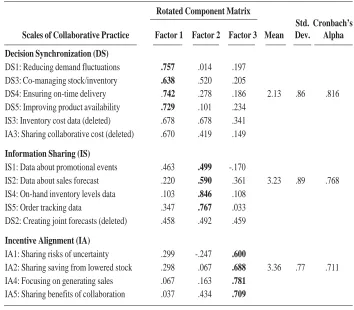
The collected data provide a basis for measurement validation and statis-tical analysis. For measurement vali-dation, conventional methods are used, including coefficient alpha, item-to-total correlations, and exploratory fac-tor analysis (Bienstock et al. 1997; Churchill 1979). The threshold value of the criteria for assessing adequate measurement properties is greater than 0.7, above the minimum level sug-gested by Nunnally (1978). Factor analysis is used to assess the measure-ment quality of the conceptual model because it allows a stringent test of the convergent and discriminant validity of the constructs in this study (Guinan et al. 1998). Consistent with the conceptualization, DS, IA, and IS are specified as three factors. Construct validity is supported by the fact that the loading of each item on its respec-tive scale is greater than 0.49. Low correlation between a factor and its non-associated items indicates a sup-port for discriminant validity. Table 1 lists the scale items, factor loadings,
reliabil-ity coefficients show a high degree of internal consistency amongst these variables.
For each variable, scale scores are computed as the average of the indi-vidual items. The profiles of the scores for predicted variables then serve as inputs for regression analysis. Several tests for the assumptions of linearity, independence, and normality are car-ried out to ensure that the data could be used to apply a valid regression model.
First, scatter plots of the individual
independent variables do not indicate nonlinear relationships between Infor-mation Sharing (IS), Decision
Syn-chronization (DS), and Incentive Alignment (IA). Second, tests for heteroscedascity do not find any vari-able violating the assumption of con-stant variance. Finally, the tests of normality using the Kolmogorov D-Statistics, skewness, and kurtosis do not find any variable violating the as-sumption of normality. The predicator variables are found to be not corre-lated amongst themselves (IS and DS is .58, IS and IA is .32, and DS and IA is .47). The regression analysis is used in this research to test the effect of the three factors of collaborative practice on performance. This procedure deter-Table 1. Measurement Statistics for Predictor Variables
Rotated Component Matrix
Std. Cronbach’s Scales of Collaborative Practice Factor 1 Factor 2 Factor 3 Mean Dev. Alpha Decision Synchronization (DS)
DS1: Reducing demand fluctuations .757 .014 .197 DS3: Co-managing stock/inventory .638 .520 .205
DS4: Ensuring on-time delivery .742 .278 .186 2.13 .86 .816 DS5: Improving product availability .729 .101 .234
IS3: Inventory cost data (deleted) .678 .678 .341 IA3: Sharing collaborative cost (deleted) .670 .419 .149
Information Sharing (IS)
IS1: Data about promotional events .463 .499 -.170
IS2: Data about sales forecast .220 .590 .361 3.23 .89 .768 IS4: On-hand inventory levels data .103 .846 .108
IS5: Order tracking data .347 .767 .033 DS2: Creating joint forecasts (deleted) .458 .492 .459
Incentive Alignment (IA)
IA1: Sharing risks of uncertainty .299 -.247 .600
IA2: Sharing saving from lowered stock .298 .067 .688 3.36 .77 .711 IA4: Focusing on generating sales .067 .163 .781
mines whether there is a significant effect of the independent variables as specified in the hypotheses (Cohen and Cohen 1983).
Discussion
The main purpose of this study is to provide a new insight into the con-ceptual link between the interface fac-tors of collaborative practice and op-erational performance. The hypoth-eses are tested through data analysis. Major findings are discussed as fol-lows.
All hypotheses stated in the mod-elling section are tested by estimating the regression equation for each per-formance criterion. The estimation results for the first three hypotheses are summarized in Table 2. The F-tests for the three regression equations indicate the linear relationship between predictor variables and realized per-formance with alphas less than 0.001. The regression equations vary in val-ues of adjusted coefficients of deter-mination. The first regression
equa-tion accounts for about 60 percent of
the variation in fulfillment perfor-mance. The second regression
equa-tion accounts for about 54 percent of
the variation in inventory performance.
The third regression equation accounts
for about 33 percent of the variation in responsiveness performance. The re-sults substantiate the three hypotheses. All being equal, realized performance is greater when information sharing, decision synchronization, and incen-tive alignment are higher.
Testing Hypothesis 1:
Hypoth-esis 1 relates to the relationship be-tween information sharing and opera-tional performance. As expected, in-formation sharing significantly helps the chain members achieve better ful-fillment (β = 0.225), lowered inven-tory (β = 0.489), and higher respon-siveness (β = 0.199). This finding is consistent with previous research on the impact of information sharing on the performance of supply chain (Fawcett et al. 2009; Fisher 1997). Through information sharing, the chain members are able to take into account factors affecting the future require-ments of fulfillment, inventory, and
Table 2. Standardized Beta Coefficients for Realized Operational Performance
Performance Criteria
Hypotheses Fulfillment Inventory Responsiveness
H1. Information Sharing (IS) .225 ** .489 *** .199 * H2. Decision Synchronization (DS) .496 *** .380 *** .423 *** H3. Incentive Alignment (IA) .226 *** -.077 .066
Adjusted R square .602 .537 .329
Note: * p < .10, one-tailed test; ** p < .05, one-tailed test, *** p < .01, one-tailed test,
responsiveness. Shared information can be used to better coordinate order and replenishments in reducing inven-tory costs and improving customer service levels.
Testing Hypothesis 2:
Hypoth-esis 2 states that decision synchroniza-tion influences better performance. It is found that decision synchronization significantly contributes to fulfillment (b = 0.496), inventory (b = 0.380), and responsiveness performance (b = 0.423). This finding is consistent with previous research on the effect of col-laborative decision making on supply chain performance (Holweg et al. 2005; Stank et al. 2001). The chain members are able to attain better view of plan-ning, monitoring, and coordination of the overall supply chain processes (Morash and Clinton 1998). They can synchronize their decisions on prod-uct planning, ordering, and replenish-ment that enable them to fulfil current and future demand with minimum in-ventory. Collaborative decision mak-ing also helps them carry out improve-ments such as shortening cycle time that affects their ability to respond more quickly to demand changes (Simchi-Levi et al. 2007).
Testing Hypothesis 3:
Hypoth-esis 3 states that incentive alignment has a positive relationship to opera-tional performance. It is found that incentive alignment contributes only to fulfillment performance (β = 0.226). There is no significant impact of in-centive alignment on lowered inven-tory and higher responsiveness. This finding indicates that the chain
mem-bers consider fulfillment to be the ba-sic criterion to satisfy customer needs and a means of incentive alignment (Giunipero et al. 2001). This is be-cause fulfillment performance speci-fies clearly an agreement between two parties where the supplier delivers or-ders by a predetermined due date in-cluding the payment arrangement. For instance, a large retailer in New Zealand often requires their suppliers to send orders within pre-specified delivery time windows. The suppliers will be charged for sending orders earlier or tardier than this time win-dow. Furthermore, as both parties en-joy inventory and responsiveness from collaboration, the benefits of inven-tory and responsiveness serve as self-imposed incentives. In other words, incentive alignment is often embed-ded in this collaborative effort. This means both parties would reap the benefits of lowered inventory and fast responsiveness if they are to cooperate closely in information sharing and de-cision synchronization without devis-ing incentive alignment (Fisher 1997; Stank et al. 1999).
is found to only affect fulfillment per-formance. This is not unusual for the chain members that prioritize fulfill-ment as a key performance indicator of customer service level (Croxton 2003). It appears that the chain members should put together information shar-ing, decision synchronization and in-centive alignment if they want to im-prove their fulfillment performance. Furthermore, information sharing and decision synchronization are both im-portant to attaining better inventory and responsiveness. This finding also suggests that the chain members should identify alternative incentive schemes if they prioritize inventory reduction and better responsiveness as key per-formance indicators of the relation-ships (Corbett et al. 1999; Narayanan and Raman 2004).
Further research should firstly concentrate on developing alternative measures of operational performance. This study employs operational mea-sures of performance. An important area for future research is to include financial measures of performance because it would be useful for the participating members to confirm the relationship between collaborative practice and financial performance (Corbett et al. 1999; Wisner 2003).
Next, this research can be extended to
examine the antecedents of collabora-tive practice such as interdependence, top management support, trust, com-mitment, power disparity, and organi-zational capability (Mentzer et al. 2000; Mohr and Spekman 1994; Sheu et al. 2006). Third, the focus of this research
is on the retailer-supplier link. The conceptual model can be modified to examine other links along the supply chain such as the manufacturer-dis-tributor, the manufacturer-logistics, and the retailer-logistic service pro-viders. Finally, there is also an oppor-tunity to study the complicated inter-action of antecedents, collaborative practice, and performance using struc-tural equation model with a larger sample size (Wisner 2003).
Conclusions
Research questions addressed in this study is the strength of relation-ship between collaborative practice and operational performance. A concep-tual model and an empirical study are undertaken to answer this research question.
all members through sharing costs, benefits, and risks. The study’s second contribution lies in its demonstration of the empirical examination of the impact of collaborative practice on operational performance.
The study statistically describes some important findings on collabora-tive practice. Results show that infor-mation sharing, decision synchroniza-tion, and incentive alignment signifi-cantly contribute to fulfillment perfor-mance. Information sharing and deci-sion synchronization consistently af-fect fulfillment, inventory, and respon-siveness performance.
Although this research confirms that collaborative practice provides benefits to participating members in terms of improved operational perfor-mance, there are a number of opportu-nities for further research. Several important ideas are to include finan-cial performance as a key success measure of collaboration and to use structural equation model to capture more interaction between key factors of collaborative practice and perfor-mance. Moreover, it would be useful to explore antecedent variables of collaborative practice and expand the study across other industries.
References
Albertson, J. 2009. The Retail Market in New Zealand: An Analysis – 2009. Auckland: NZ Retailers Association.
Armstrong, J. S., and T. S. Overton. 1977. Estimating non-response bias in mail surveys. Journal of Marketing Research 14 (3): 396-402.
Ballou, R. H., S. M. Gilbert and A. Mukherjee. 2000. New managerial challenges from supply chain opportunities. Industrial Marketing Management 29 (1): 7-18. Barratt, M., and A. Oliveira. 2001. Exploring the experiences of collaborative planning
initiatives. International Journal of Physical Distribution and Logistics Manage-ment 31 (4): 266-89.
Basnet, C., J. Corner, J. Wisner and K.-C. Tan. 2003. Benchmarking supply chain management practice in New Zealand. Supply Chain Management: An International Journal 8 (1): 57-64.
Bienstock, C. C., J. T. Mentzer and M. M. Bird. 1997. Measuring physical distribution service quality. Journal of the Academy of Marketing Science 25 (1): 31-44. Churchill, G.A. 1979. A paradigm for developing better measures of marketing constructs.
Journal of Marketing Research 16 (1): 64-73.
Bowersox, D.J. 1990. The strategic benefits of logistics alliances. Harvard Business Review 68 (4): 36-43.
Bowersox, D. J., D. J. Closs, and T. P. Stank. 2000. Ten mega-trends that will revolutionize supply chain logistics. Journal of Business Logistics 21 (2): 1-16.
Buzzell, R. D., and G. Ortmeyer. 1995. Channel partnerships streamline distribution. Sloan Management Review 36 (3): 85-96.
Cavana, R. Y., B. L. Delayahe, and U. Sekaran. 2001. Applied Business Research: Qualitative and Quantitative Methods. Milton, Qld: Wiley.
Cohen, J., and P. Cohen. 1983. Applied Multiple Regression/Correlation Analysis for the Behavioral Sciences (2nd ed.). Hillsdale, NJ: Erlbaum Associates.
Corbett, C. J., J. D. Blackburn, and L. N. van Wassenhove. 1999. Partnerships to improve supply chains. Sloan Management Review 40 (4): 71-82.
Croxton, K. L. 2003. The order fulfillment process. The International Journal of Logistics Management 14 (1): 19-32.
Dillman, D. 1978. Mail and Telephone Surveys. New York, NY: Wiley.
Dyer, J. H., and H. Singh. 1998. The relational view: cooperative strategy and sources of interorganizational competitive advantage. Academy of Management Review 23 (4): 660-679.
Fawcett, S. E., C. Wallin, C. Allred, and G. Magnan. 2009. Supply chain information-sharing: benchmarking a proven path. Benchmarking: An International Journal 16 (2): 222-246.
Fisher, M. L. 1997. What is the right supply chain for your product? Harvard Business Review 75 (2): 105-116.
Frankel, R., T. J. Goldsby, and J. M. Whipple. 2002. Grocery industry collaboration in the wake of ECR. The International Journal of Logistics Management 13 (1): 57-72. Giunipero, L. C., S. S. Fiorito, D. H. Pearcy, and L. Dandeo. 2001. The impact of vendor
incentives on quick response. The International Review of Retail, Distribution and Consumer Research 11 (4): 359-76.
Guinan, P. J., J. G. Cooprider, and S. Faraj. 1998. Enabling software development team performance during requirements definition: A behavioural versus technical ap-proach. Information Systems Research 9 (2): 101-125.
Hair, J.F., B. Black, B. Babin, R. E. Anderson, and R. L. Tatham. 2005. Multivariate Data Analysis (6th ed.). Upper Saddle River, NJ: Prentice Hall.
Holweg, M., S. Disney, J. Holmström, J. Småros. 2005. Supply chain collaboration: making sense of the strategy continuum. European Management Journal 23 (2): 170–181.
Ireland, R., and R. Bruce. 2000. CPFR only the beginning of collaboration. Supply Chain Management Review 4 (4): 80-8.
Johnston, R., and P. R. Lawrence. 1988. Beyond vertical integration – the rise of the value-adding partnership. Harvard Business Review 66 (4): 94-101.
Lambert, D. M., M. A. Emmelhainz, and J. T. Gardner. 1999. Building successful partnerships. Journal of Business Logistics 21 (1): 165-181.
Lee, H. L., V. Padmanabhan, and S. Whang. 1997. The bullwhip effect in supply chains. Sloan Management Review 38 (3): 93-102.
Lee, H. L., and S. Whang. 1999. Decentralized multi-echelon supply chains: Incentives and information. Management Science 45 (5): 633-640.
Malhotra, M. J., and V. Grover. 1998. An assessment of survey research in POM: From construct to theory. Journal of Operations Management 16 (4): 407-425.
Mentzer, J. M., S. Min and Z. G. Zacharia. 2000. The nature of interfirm partnering in supply chain management. Journal of Retailing 76 (4): 549-568.
Mohr, J., and R. Spekman. 1994. Characteristics of partnership success: partnership attributes, communication behaviour, and conflict resolution techniques. Strategic Management Journal 15 (2) 135-152.
Morash, E. A., and S. R. Clinton. 1998 Supply chain integration: Customer value through collaborative closeness versus operational excellence. Journal of Marketing Theory and Practice 6 (4): 104-120.
Narayanan, V. G., and A. Raman. 2004. Aligning incentives in supply chains. Harvard Business Review 82 (11): 94-102.
Narus, J. A., and J. C. Anderson. 1996. Rethinking distribution: adaptive channels. Harvard Business Review 74 (4): 112-120.
Nunnally, J. C. 1978. Psychometric Theory. New York, NY: McGraw-Hill.
Parks, L. 1999. CRP investment pays off in many ways. Drug Store News 21 (2): 26. Pinsonneault, A., and K. L. Kraemer. 1993. Survey research methodology in management
information systems: An assessment. Journal of Management Information System 10 (2): 75-105.
Ramdas, K., and R. E. Spekman. 2000. Chain or shackles: understanding what drives supply-chain performance. Interfaces 30 (4): 3-21.
Sankaran, J. K. 2000. Freight logistics in the New Zealand context. International Journal of Physical Distribution and Logistics Management 30 (2): 145-164.
Sherman, R. J. 1998. Collaborative planning, forecasting and replenishment (CPFR). Journal of Marketing Theory and Practice 6 (4): 6-9.
Sheu, C., H. R. Yen, and B. Chae. 2006. Determinants of supplier-retailer collaboration: Evidence from an international study. International Journal of Operations and Production Management 26 (1): 24-49.
Simchi-Levi, D, P. Kaminsky, and E. Simchi-Levi. 2007. Designing and Managing the Supply Chain (3rd ed.). New York: McGraw-Hill Irwin.
Simatupang, T. M., and R. Sridharan. 2002. The collaborative supply chain. The Interna-tional Journal of Logistics Management 13 (1): 15-30.
Simatupang, T. M., and R. Sridharan. 2005. Supply chain discontent. Business Process Management Journal 11 (4): 349-369.
Stank, T. P., M. R. Crum, and M. Arango. 1999. Benefits of interfirm coordination in food industry supply chains. Journal of Business Logistics 20 (2): 21-42.
Stank, T. P., S. B. Keller, and P. J. Daugherty. 2001. Supply chain collaboration and logistical service performance. Journal of Business Logistics 22 (1): 29-47. Whipple, J. M., R. Frankel, and P. J. Daugherty. 2002. Information support for alliances:
performance implications. Journal of Business Logistics 23 (2): 67-81.
Whipple, J. M., and D. Russell. 2007. Building supply chain collaboration: A typology of collaborative approaches. The International Journal of Logistics Management 18 (2): 174-196.
Wisner, J. 2003. A structural equation model of supply chain strategies and firm performance. Journal of Business Logistics 24 (1): 1-26.