CONFERENCE
PROCEEDINGS
CONFERENCE
PROCEEDINGS
Published by
IATED Academy
www.iated.org
ICERI2014 Proceedings
7th International Conference of Education, Research and Innovation
November 17th-19th, 2014 — Seville, Spain
Edited by
L. Gómez Chova, A. López Martínez, I. Candel Torres
IATED Academy
ISBN: 978-84-617-2484-0
ISSN: 2340-1095
Depósito Legal: V-2632-2014
Book cover designed by
J.L. Bernat
All rights reserved. Copyright
© 2014, IATED
WELCOME INTRODUCTION
Dear ICERI2014 participants,
In this 7th edition of ICERI2014, we are honoured to welcome you all to this
international conference that brings together experts from all over the world.
ICERI2014 is a key annual networking platform to discuss the latest trends about
education and research in a varied atmosphere. This is an excellent opportunity to
acquire new skills and get inspired by listening to innovative approaches in education.
We hope you get the best of ICERI2014 thematic sessions, discussions and debates, as
well as the poster presentations and exhibition.
This year, it is a pleasure to welcome 600 professionals and experts from all disciplines,
representing more than 75 countries.
Academics, researchers, educational scientists and technologists will present and share
the most up-to-date information on education and pedagogical innovations.
We hope you take ICERI2014 as an opportunity to exchange ideas and results, to
discover different ways of applying new educational technologies and broaden your
vision about new ways of teaching and learning.
In addition to your professional experience, Seville will provide you a large offer of
cultural and leisure activities to do during your stay here. We really wish you an
unforgettable stay in this unique city.
Thank you very much for coming to ICERI2014 and for being part of the education
change. We wish you a fruitful conference!
ICERI2014 7th International Conference of Education, Research and Innovation
ICERI2014 COMMITTEE AND ADVISORY BOARD
Aaron Doering UNITED STATES Javier Martí SPAIN Abdulrahman Mirza SAUDI ARABIA Joanna Lees FRANCE Abdurrahman Guelbeyaz JAPAN Johanna Lindström FINLAND
Agustín López SPAIN Johanna Ollila FINLAND
Ahmed Alwan UNITED ARAB EMIRATES Jörg Kammermann GERMANY Alexander Sobolev RUSSIAN FEDERATION Jose F. Cabeza SPAIN Amirah Abdulrazzaq BAHRAIN José Hernández-Morales MEXICO
Amparo Girós SPAIN Jose Luis Bernat SPAIN
Ana Tomás SPAIN Kristi Julian UNITED STATES Andrew Amayo UNITED KINGDOM Liliana Milevicich ARGENTINA
Anne Omori NIGERIA Lorena López SPAIN
Antonio García SPAIN Luis Gómez Chova SPAIN Antonio Maffei SWEDEN Mª Jesús Suesta SPAIN Arturo Serrano-Santoyo MEXICO Madiha Abdelrazik EGYPT Balamuralithara Balakrishnan MALAYSIA Mamello Thinyane SOUTH AFRICA Barbara Good UNITED STATES Margus Pedaste ESTONIA Belmiro Gil Cabrito PORTUGAL Maria Porcel SPAIN Bryan Eldridge UNITED STATES Megan Lawton UNITED KINGDOM Cagla Atmaca TURKEY Metaxia Pavlakou UNITED KINGDOM
Carol Ing CANADA Miguel Varela PORTUGAL
Chelo González SPAIN Mónica Fernández SPAIN
Cristina Lozano SPAIN Moses Duruji NIGERIA
David Martí SPAIN Naseer Ahmed UNITED ARAB EMIRATES Donald Gabard UNITED STATES Natalie Mikhaylov FINLAND Donata Puntil UNITED KINGDOM Norma Barrachina SPAIN Eduardo Simões PORTUGAL Nuraihan Mat Daud MALAYSIA
Eladio Duque SPAIN Odette Gabaudan IRELAND
Elena Ors SPAIN Olga Smolyaninova RUSSIAN FEDERATION
Ellen te Pas NETHERLANDS Olga Teruel SPAIN
Eric Jiang UNITED STATES Petch Sajjacholapunt UNITED KINGDOM
Fabrizio Maggi ITALY Peter Haber AUSTRIA
Gabriele Hoeborn GERMANY Pochun Li UNITED KINGDOM Gary Collins SOUTH AFRICA Rajesh Majumdar INDIA Gbolagade Adekanmbi BOTSWANA Randy Serrett UNITED STATES Hanne Wacher Kjaergaard DENMARK Rebekka Eckhaus JAPAN Harvey Oueijan LEBANON Roberta Gentry UNITED STATES Hélder Guerreiro PORTUGAL Saed Salhieh SAUDI ARABIA
Ignacio Ballester SPAIN Sergio Pérez SPAIN
Ignacio Candel SPAIN Valerie Priscilla Goby UNITED ARAB EMIRATES
Ina Blau ISRAEL Vanja Bevanda CROATIA
Ismael Serrano SPAIN Vasilia Kourtis-Kazoullis GREECE Iván Martínez SPAIN Veronika Winter AUSTRIA
Ivan Mota BRAZIL William Muirhead CANADA
Jana Mazancova CZECH REPUBLIC Xavier Lefranc FRANCE
CONFERENCE SESSIONS
ORAL SESSIONS, 17th November 2014.
Blended & Flipped Learning
International Projects
Technology in Teaching and Training (1)
Experiences in Research
Meet the Keynote
Language Learning Innovations
Collaborative and Problem Based Learning
Emerging Technologies in Education
University-Industry Cooperation (1)
Online Assessment
Links between Education and Research
m-learning
Language Learning Experiences
New Technologies in Architecture & Urban Planning
Learning and Teaching Technologies and Innovations (1)
University-Industry Cooperation (2)
Evaluation and Assessment of Student Learning
STEM Education Experiences (1)
MOOCs: Massive Open Online Courses
Technology in Foreign Language Education
Experiences in Engineering Education
Blended Learning
Cultural Diversity and Inclusive Learning (1)
Education Management and Leadership in Schools
STEM Education Experiences (2)
Web 2.0 and Social Networking
Technology in Language Learning
Experiences in Engineering and Industrial Design Education
POSTER SESSIONS, 17th November 2014.
Training, Quality and Design in Education
ICERI2014 7th International Conference of Education, Research and Innovation
ORAL SESSIONS, 18th November 2014.
Technology in Teaching and Training (2)
Work Employability (1)
Curriculum Design (1)
Barriers to Learning
New Trends, Challenges and Experiences in Education
Teacher Training in Primary & Secondary Education
Experiences in Business Administration Education
Learning and Teaching Technologies and Innovations (2)
Work Employability (2)
Curriculum Design (2)
Cultural Diversity and Inclusive Learning (2)
The Skill Match Challenge. Evidences from SMART and other successful European
projects
Technology in Primary & Secondary Education
Technology in Health Sciences Education
Educational/Serious Games
Entrepreneurship Education
Teacher Training and ICT Skills
Special Education
New Challenges for the Higher Education Area
Experiences in Primary and Secondary Education
Health Sciences Education Experiences (1)
e-learning Experiences
University-Industry Cooperation (3)
Teacher Training
Life-Long Learning
Accreditation and Quality in Education
Pedagogical Methods and Innovations
Health Sciences Education Experiences (2)
Advanced Classroom Applications and Technologies
Labour Market Skill Needs and Challenges for Higher Education Institutions
Pre-service and In-service Teacher Experiences
Adult and Vocational Education
Student Support in Education
Experiences in Undergraduate Education
Global, Social and Legal Issues in Education
POSTER SESSIONS, 18th November 2014.
Challenges in Education and Research
VIRTUAL SESSIONS
Academic Research Projects
Accreditation and Quality in Education
Adult education
Advanced classroom applications and technologies
Assessment of student learning
Blended Learning and Flipped Classroom
Collaborative and Problem-based Learning
Curriculum Design
E-content Management and Development
e-learning experiences
ECTS experiences
Education practice trends and issues
Education, Research and Globalization
Emerging Technologies in Education
Experiences in Post-graduate education
Experiences in Primary and Secondary education
Experiences in Undergraduate education
Global Issues in Education and Research
International Projects
Language Learning Innovations
Learning and Teaching Innovations
Life-long learning
Life-long learning experiences
Links between Education and Research
m-Learning: mobile applications and technologies
Massive Open Online Courses (MOOCs)
New challenges for the Higher Education Area
Pedagogical Methods and Innovations
Research Methodologies
Special education
Student Support in Education
Teacher Training
ICERI2014 7th International Conference of Education, Research and Innovation
ABOUT ICERI2014 Proceedings CD
HTML Interface: Navigating with the Web browser
This CD includes all presented papers at ICERI2014 conference. It has been formatted
similarly to the conference Web site in order to keep a familiar environment and to
provide access to the papers trough your default Web browser (open the file named "
ICERI2014.html").
An Author Index, a Session Index, and the Technical Program are included in HTML
format on this disk to aid you in finding conference papers. Using these HTML files as
a starting point, you can access other useful information related to the conference.
The links in the Session List jump to the corresponding location in the Technical
Program. The links in the Technical Program and the Author Index open the selected
paper in a new window. These links are located on the titles of the papers and the
Technical Program or Author Index window remains open.
Full Text Search: Searching ICERI2014 index file of cataloged PDFs
If you have Adobe Acrobat Reader version 6 or later (www.adobe.com), you can
perform a full-text search for terms found in ICERI2014 proceedings papers.
Important:
To search the PDF index, you must open Acrobat as a stand-alone
application, not within your web browser, i.e. you should open directly the file
"ICERI2014.pdf" in the CD with your Adobe Acrobat or Acrobat Reader application.
This PDF file is attached to an Adobe PDF index that allows text search in all PDF
papers by using the Acrobat search tool (not the same as the find tool). The full-text
index is an alphabetized list of all the words used in the collection of conference
papers. Searching an index is much faster than searching all the text in the documents.
To search the ICERI2014 Proceedings index:
1. Open the Search PDF pane through the menu "Edit > Advanced Search" or click in the PDF bookmark titled "SEARCH PAPERS CONTENT".
2. The "ICERI2014_index.pdx" should be the currently selected index in the Search window (if the index is not listed, click Add, locate the index file .pdx on the CD, and then click Open).
3. Type the search text, click Search button, and then proceed with your query.
For Acrobat 9 and later:
1. In the “Edit” menu, choose “Search”. You may receive a message from Acrobat asking if it is safe to load the Catalog Index. Click “Load”.
2. A new window will appear with search options. Enter your search terms and proceed with your search as usual.
For Acrobat 8:
1. Open the Search window, type the words you want to find, and then click Use Advanced Search Options (near the bottom of the window).
2. For Look In, choose Select Index.
3. In the Index Selection dialog box, select an index, if the one you want to search is available, or click Add and then locate and select the index to be searched, and click Open. Repeat as needed until all the indexes you want to search are selected.
4. Click OK to close the Index Selection dialog box, and then choose Currently Selected Indexes on the Look In pop-up menu.
5. Proceed with your search as usual, selecting other options you want to apply, and click Search.
For Acrobat 7 and earlier:
1. In the “Edit” menu, choose “Full Text Search”.
ANALYSIS DURING YEAR OF 2011
Mochamad Alip, Handaru Jati
Universitas Negeri Yogyakarta (INDONESIA)
Abstract
The work presented aims to analyze the efficiency of Indonesia Teacher Training Institutions in Indonesia in 2011. The study is based on field research and documents executed in four (4) phases: data collection, choice of variables under study, calculations and analysis of results. Data Envelopment Analysis (DEA), which estimates the optimal production frontier is used. The data are processed using the tool OSDEA. As a result the Indonesia Teacher Training Institutions efficiency ranking is obtained. It is concluded that there are four (4) Teacher Training Institutions efficient and the least efficient of all the analyzed institutions should increase its output to improve its performance.
Keywords: Efficiency, Data Envelopment Analysis, Teacher Training Institutions.
1
INTRODUCTION
In the field of Teacher Training Institutions is important to conduct ongoing assessments to measure how efficient are the processes that take place there. Comparisons between Teacher Training Institutions in terms of their institutional process helps determine how efficient actors are relative to each other, which serves for academic managers to make decisions based on quantitative data. The
Teacher Training Institution is an institution of higher education in Indonesia that has been established in twelve cities: Jakarta, Yogyakarta, Semarang, Surabaya, Malang, Bandung, Padang, Medan, Manado, Gorontalo, Makassar, and Singaraja. Institutions of higher education, and nonprofit organizations need to make changes in their organizational structures that lend their decision centers of modern and innovative management techniques that improve resource allocation and effectively contribute to the process of making decisions; able to provide profitability measures with which resources are invested, considering that in those entities, the objectives are not merely economic and profitability concept differs from that used in the business world [1]. Efficiency is one of the important aspects that need to be considered when assessing the management processes university. In this regard academic managers require indicators that allow them to establish relationships or comparisons between the various actors that make up each of the academic units. For this process to be effective, it is important to have a system of evaluation to measure the efficiency of the units. Efficiency is the capacity to produce maximum results with minimum resources [2]. Data Envelopment Analysis (DEA) is also used to assess the efficiency of the 25 best U.S. universities [3] and showed that DEA is the correct method for measuring the efficiency of higher education. DEA method is also used in the calculation of the efficiency of several universities in Norway in 1994, 1995 and 1996 [4]. As such, it is a relative term: to be established by comparing dependencies or a pattern. A method to quantify the efficiency is data envelopment analysis (Data Envelopment Analysis or DEA). This technique has its origins in the article Charnes, Cooper and Rhodes in 1978 [5] and is based on the notion of relative efficiency introduced by Farrell [6]. By virtue of the above, in this work the efficiency of Indonesia Teacher Training Institutions year 2011 is analyzed, using the DEA.
2
OBJECTIVE
Analyze the efficiency of Indonesia Teacher Training Institutions in 2011, using the Data Envelopment Analysis.
3
METHODOLOGY
The methodology consists of four phases: In Phase I field research and documentation is performed to obtain the input data and concepts, theories, and background relating to the measurement of efficiency through Data Envelopment Analysis. In phase-II are chosen in response to the data
Proceedings of ICERI2014 Conference
obtained-the objects of study variables. In phase III the OSDEA computational software tool is used for processing the data. Subsequently, in step IV, the analysis of the results is performed. The input data for the software used in this work are: (1) undergraduate student body, (2) the number of academic staff, (3) the number of administrative staff, (4) university budget, and the output for this work are (5) the number of research funded by university (6) the number of book and journal published by academic staff, (7) the number of publication cited in scopus database journal, (8) the number of granted patent, and (9) the number of social services conducted by academic staff in 2011. All of the data were taken from the Indonesian Accreditation Institutional report prepared by the each university. Efficiency values are calculated using the CCR model developed by oriented Input.
4
ANALYSIS OF RESULT
[image:11.595.73.524.280.442.2]Table 1 below are the data that were obtained from official sources about the input and output variables needed in the assessment of the efficiency of a university.
Table 1. Data from University Accreditation conducted by National Board Accreditation in the year of 2011
Universitas (1) (2) (3) (4) (5) (6) (7) (8) (9)
Universitas Pendidikan GANESHA 10318 434 247 4342540000 144 30 0 1 81
universitas Negeri YOGYAKARTA 29908 1038 454 13511960000 428 43 89 8 228
Universitas Negeri Semarang 26800 1003 767 14912360000 592 105 4 1 378
Universitas NEGERI makassar 22064 891 548 11087330000 271 73 9 1 236
Universitas Negeri Surabaya 23965 860 456 10870540000 306 22 16 12 25
Universitas Negeri Gorontalo 16201 634 414 3371540000 41 85 6 25 264
Universitas Negeri Medan 15473 965 398 4558480000 206 69 18 4 29
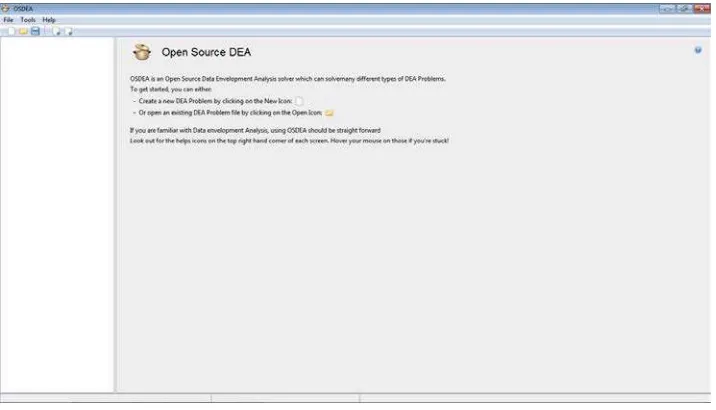
[image:11.595.120.478.518.723.2]Table 1 shows an example of the information obtained in field research and documentary data entry software OS DEA in the columns headed -Variables of input and Variables of output. Calculation to obtain the level of efficiency of the University Education in Indonesia performed using OSDEA software and this software capables in calculating several types of DEA method. Fig 1. is the initial view of the OSDEA software.
Figure 1 . Open Source DEA ( OSDEA )
number of social services conducted by academic staff in 2011. Fig 2 displays the process of DEA calculation by using OSDEA.
Figure 2 . Process with the DEA calculation OSDEA
All university that do not have the level 1 of efficiency should strive to be efficient in a way : reducing inputs while maintaining a constant output (this is an input-oriented approach), increase output while maintaining a constant input. This is an output-oriented approach, or a third model which seeks to reduce input and increase output.
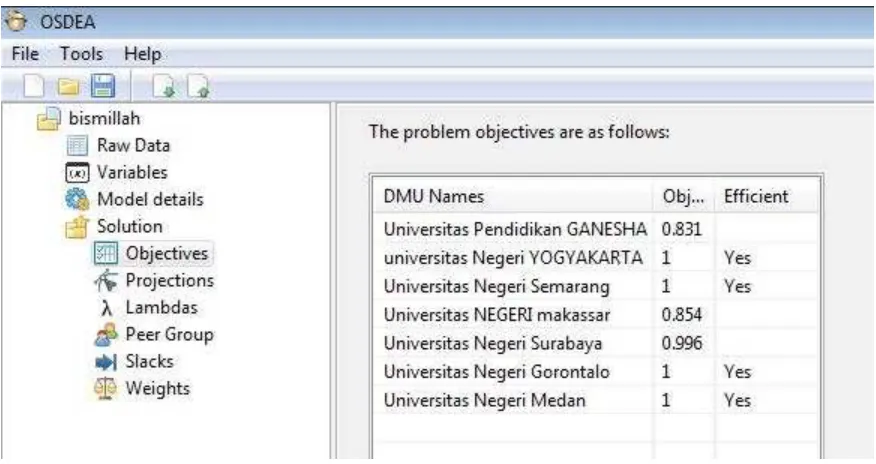
Figure 3 . Results of efficiency calculation Process with the DEA
From the calculation results in fig 3. shows that Universitas Negerri Yogyakarta, Universitas Negeri Semarang, Universitas Negeri Gorontalo, and Universitas Negeri Medan are the universities with the highest efficiency rating in Indonesia, by consecutive followed by Universitas Negeri Surabaya, Universitas Negeri Makassar, and Universitas Pendidikan Ganesha.
[image:12.595.79.517.443.675.2]5
CONCLUSIONS
This paper presents an analysis of efficiency in Indonesia Teacher Training Institutions or universities in the year of 2011, using the Data Envelopment Analysis. The database used contains input variables (undergraduate student body, the number of academic staff, the number of administrative staff, and university budget as an input, and the output for this work) and output variables (the number of research funded by university, the number of book and journal published by academic staff, the number of publication cited in scopus database journal, the number of granted patent, and the number of social services conducted by academic staff) viewed as an output. Using the computational tool OSDEA, a ranking of departments based on efficiency is obtained. In this article the data entered to the software and the results it yields for 2011 are illustrated Five departments are efficient independently of the model used DEA. The most inefficient department with CCR model should increase the level of its output variables to improve its efficiency, since the input variables considered can hardly be controlled in practice. It is concluded that majority of teacher training institutions in Indonesia are already in efficient academic process. It is suggested that further research to quantify the effect of these variables influence the output in increased efficiency.
REFERENCES
[1] García, J., López, F. y Ruiz, M.(2003).Un análisis de la eficiencia de los Departamentos de la Universidad Politécnica de Cartagena. Estudios de Economía Aplicada. Vol. 1, pp.1-20, 2010
[2] Sander, B. (1990). Educación, administración y calidad de vida. Santillana: Buenos Aires. Universidad Nacional Experimental Politécnica, Oficina Central de Planificación
[3] Breu, T.M. & Raab, R.L. (1994). Efficiency and perceived quality of the nation's “top 25†National Universities and National Liberal Arts Colleges: An application of data envelopment analysis to higher education. Socio-Economic Planning Sciences, Vol. 28, No. 1, pp. 33-45.
[4] Førsund, F.R. & Kalhagen, K.O. (1999). Efficiency and productivity of Norwegian colleges. Memorandum, Department of Economics, University of Oslo.
[5] Charnes, A., Cooper, W. W. y Rhodes, E. (1978). Measuring the efficiency of decision making units. European Journal of Operational Research 2, 2(6), 429–444.
[6] Farrell, M. J. (1957). The measurement of productive efficiency. J. Roy. Statit. Soc. Ser. A, III (1957), 253-290.