Full Terms & Conditions of access and use can be found at
http://www.tandfonline.com/action/journalInformation?journalCode=vjeb20
Download by: [Universitas Maritim Raja Ali Haji] Date: 11 January 2016, At: 19:40
Journal of Education for Business
ISSN: 0883-2323 (Print) 1940-3356 (Online) Journal homepage: http://www.tandfonline.com/loi/vjeb20
Student Perceptions in Teaching Principles of
Management Information Systems
Mohammad A. Rob & Vance Etnyre
To cite this article: Mohammad A. Rob & Vance Etnyre (2015) Student Perceptions in Teaching Principles of Management Information Systems, Journal of Education for Business, 90:7, 379-384, DOI: 10.1080/08832323.2015.1074151
To link to this article: http://dx.doi.org/10.1080/08832323.2015.1074151
Published online: 20 Aug 2015.
Submit your article to this journal
Article views: 31
View related articles
Student Perceptions in Teaching Principles
of Management Information Systems
Mohammad A. Rob and Vance Etnyre
University of Houston–Clear Lake, Houston, Texas, USATeaching concepts of information systems to general business students through a course such as management information systems (MIS) can be challenging in today’s fast-changing environment of information technology (IT). Such a course must provide not only an understanding of the development, applications, and management of information systems, but also some experience on these concepts taught in the classroom. The latter requires innovative ideas and changing modes of instruction, which may include activities for students such as hands-on practice with common IT tools and technologies, case studies, group projects, and group presentations. Engagement of students through various course activities is the key factor in creating a suitable learning environment for students. The authors focus on finding a suitable mode of instruction for a graduate-level MIS course that would provide necessary knowledge to future managers in a changing IT environment. Their results, based on the statistical analysis of an in-class survey, show strong preference toward learning MIS concepts, integrated case studies, and teamwork; and low preference toward Microsoft Office productivity tools and presentations. However, there is a strong preference toward learning database and spreadsheet applications that are part of Office productivity tools.
Keywords: assessment, case studies, information systems, teaching, teamwork
Management information systems (MIS) is a course that is commonly taught in a business school, to provide an under-standing of general concepts of information systems (IS), both to undergraduate and graduate students. The course provides an overview of IS hardware and software as well as important concepts and issues related to the development and management of business information systems. In most cases, the contents taught from a typical textbook do not stimulate students’ interests, and typically students are required to engage in activities that supplement the con-cepts outlined in the textbooks. However, what should be included in the supplemental activities is still a debatable issue and requires constant innovation from semester to semester.
The mode of instruction used in an undergraduate MIS course may not be suitable to that of a graduate course. Graduate students are more likely to have experience
working in work groups within organizations and are more likely to have some experience participating in system development activities than undergraduates. Graduate stu-dents are likely to participate in system development activi-ties sooner after graduation than undergraduates. Graduate students have a more immediate need to learn about system development activities and a less immediate need to learn about information processing tools that are covered at the undergraduate and precollege level. Typically in an under-graduate course, the text is supplemented with two Micro-soft Office (Redmond, WA) productivity tools such as Excel and Access. However, simply using these tools in the graduate level may not be appropriate, as most graduate students probably have significant experience in using these tools.
We have tried several different approaches of teaching the graduate-level MIS course using supplements such as case projects, Office tools, group projects, and group presenta-tions. This paper provides an understanding of what begin-ning graduate-level MIS students feel important in their learning while going through the experience of completing various topics and supplemental activities in the course.
Correspondence should be addressed to Mohammad A. Rob, University of Houston–Clear Lake, Department of Management Informa-tion Systems, 2700 Bay Area Boulevard, Houston, TX 77058, USA. E-mail: [email protected]
ISSN: 0883-2323 print / 1940-3356 online DOI: 10.1080/08832323.2015.1074151
LITERATURE REVIEW
The contents and methods of teaching a fundamental course on MIS has been an issue of research for many years. Ben-basat, Dexter, and Mantha (1980) outlined the results of a study that analyzed skills perceived as useful by IS manag-ers and systems analysts in IS organizations of different levels of maturity. These IS skills were examined under two major subgroups of generalist–managerial and special-ist–technical skills as well as under more detailed catego-ries of organizations, people, society, systems, computers, and models skills. Based on their findings, they made rec-ommendations concerning graduate IS curriculum. Leidner and Jarvenpaa (1995) contended that fundamental changes to the teaching and learning process such as mapping of technologies to learning models is necessary to transform the educational environment and processes of management programs.
Alavi, Yoo, and Vogel (1997) described the design and delivery of a graduate-level course in management at two universities via advanced information technology, which was used to enable collaborative learning, teaching with transcontinental student teams and multiple instructors, and integration of external expertise. This partnership enriched student learning and expedited faculty and institutional development.
Chan, Wolfe, and Fang (2009) suggested that due to increasing importance of Web-based solutions, pedagogical challenges exist in MIS programs regarding the develop-ment of student knowledge and skills in human–computer interaction as well as tools and technologies needed for the development of information systems. Sankar, Ford, and Terase (1997) used videoconferencing technology in a large MIS class where, traditionally, lecture had been used. Even though 85% of the students who participated in the classes were non-MIS majors, students in the videoconferencing section perceived it to be more useful, challenging, attrac-tive, and clear compared to where it was not used. Money (1996) argued that people learn from a variety of experien-ces and from the observation of the actions of others. He used social cognitive learning theory to explain what should be the structure of an MIS educational experience, and applied a group support system (GSS) in an MIS classroom to experience the methods of systems analysis and design.
Hackney, McMaster, and Harris (2003) suggested the use of cases as a teaching tool in IS education. Cases can allow students to develop high-order reasoning skills, bring real world examples into the classroom, allow students to learn by doing, bring organizational impacts, social values, and ethical issues to the forefront of discussion, and include realistic content, objectives, and knowledge transfer. Foltz, O’Hara, and Wise (2004) even proposed to have a uniform guideline for the objectives and the topics to be included in a MIS course, which is commonly taught in a business school.
THE MODE OF TEACHING OF OUR MIS COURSE
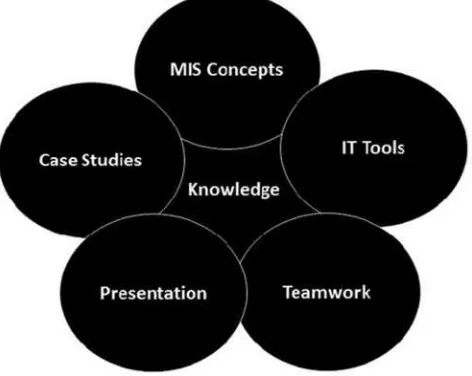
In our graduate MIS course, we use various teaching meth-ods, tools, and techniques to impart theoretical as well as practical knowledge to our students. As such we focus on teaching the key concepts of MIS provided in a typical text book and supplement it with various office productivity tools, case projects, group activities, and presentations. Figure 1 illustrates our teaching–learning framework. As shown, knowledge imparted to students comes from various teacher-student activities. Engagement of students through various activities is the key factor in creating a learning environment for our students. We have been teaching this course for many years in several different modes, and our goal was to find out how students perceive our course orga-nization and teaching methodology. Specifically, we wanted to know how important they feel about various activities or components that comprise the course. We also wanted to know how they want to see the semester hours to be distributed among various content areas of the course that impart knowledge to them.
STUDENT SURVEY
To gain an understanding of which approach is most suit-able for developing appropriate knowledge for the graduate students, we performed a six-question survey toward the completion of such a course. In the survey, students were asked to rate their experience on various modes of teaching that were used in the course. They were also asked to pro-vide optimum number of hours that should be spent in each mode or topic. Five different groups of topics were consid-ered in the survey: MIS concepts, integrated case,
FIGURE 1. A teaching–learning framework of imparting knowledge to students through various teacher–student activities.
380 M. A. ROB AND V. ETNYRE
teamwork, presentations, and Office tools. The survey, which is included in the Appendix, was given to 36 gradu-ate students in a gradugradu-ate MIS principles course. Students were asked to rate different learning modes using a 11-point Likert-type scale ranging from 0 (totally unimportant) to 10 (essential), as shown in the Appendix. The interpretations of the different ratings are provided subsequently.
RESULTS
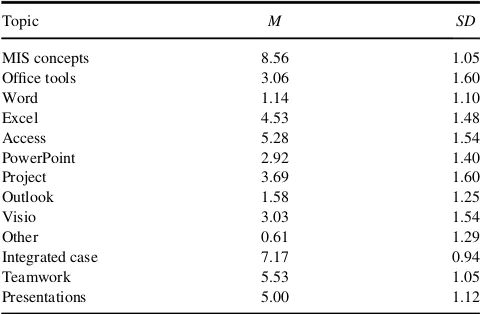
The summary results of the survey reflecting student per-ception in various modes or topics of instruction are given in Table 1. The overall average rating for all learning meth-ods was 5.84. Specific interpretations in five general topics or areas covered in the course are given in Table 2.
The two categories receiving the highest ratings (learn-ing MIS concepts and use of integrated case) were superior to other methods by statistically significant margins. When compared to the overall rating of all categories, learning MIS concepts had a margin of C2.7 rating points, which represented atofC7.16. When compared to the overall rat-ing of all categories, use of integrated case had a margin of C1.3 rating points, which represented at of C3.51. Since the criticaltfor a two-tailed test (assuming equal variances)
was 1.97, both of these learning methods are statistically superior to the other methods (see Table 3).
The two categories receiving the lowest ratings (student presentations and learning Office tools) were rated as infe-rior to other methods by statistically significant margins. When compared to the overall rating of all categories, stu-dent presentations had a margin of ¡0.84 rating points, which represented a t of ¡2.22. When compared to the overall rating of all categories, learning Office tools had a margin of ¡2.79 rating points, which represented a t of ¡7.17. Because the criticaltfor a two-tailed test (assuming equal variances) was 1.97, both of these learning methods are statistically less effective than the other methods (see Table 4).
Ratings Among the Office Tools
Although graduate students give low ratings for learning Office tools as an aggregate category, the disdain for Office tools is not uniform. Certain Office tools receive signifi-cantly higher rankings than other Office tools. Listed in Table 5 are the rankings for individual Office tool packages.
The two tools receiving the highest ratings (Access and Excel) were ranked higher than other methods by TABLE 1
Summary Response on Various Topics Covered in the Course
Topic M SD
Overall Rating in Five General Topics Covered
Topic M
t-Tests for MIS Concepts and Integrated Case
Two-sample assuming equal variances
MIS concepts All topics Integrated case All topics
M 8.56 5.84 7.17 5.84
Variance 1.11 4.93 0.89 4.93 Observations 36 180 36 180
Hypoth. diff. 0 0
df 214 214
t 7.16 3.51
P(Tt) two-tailed — .001
tCritical two-tailed 1.971 1.971
TABLE 4
t-Tests for Presentations and Office Tools
Two-sample assuming equal variances
Presentations All topics Office tools All topics
M 5 5.84 3.06 5.84
Variance 1.26 4.93 2.57 4.93 Observations 36 180 36 180
Hypoth. diff. 0 0
df 214 214
t ¡2.22 ¡7.17
P(Tt) two-tailed .027 —
tCritical two-tailed 1.971 1.971
statistically significant margins. When compared to the overall Office rating of 3.06, Access had a margin ofC2.22 rating points, which represented a t of C6.0. Excel had a margin ofC1.47 rating points, which represented a t score ofC4.0. Because the criticaltfor a two-tailed test (assum-ing equal variances) was 1.994, both of these Office tools were judged to be statistically superior to the other Office tools.
The two tools receiving the lowest ratings (Outlook and Word) were ranked lower than other methods by statisti-cally significant margins. When compared to the overall Office rating of 3.06, Outlook had a margin of¡1.47 rating points, which represented atof¡4.35. Word had a margin of ¡1.92 rating points, which represented a t score of ¡5.92. Since the criticalt for a two-tailed test (assuming equal variances) was 1.994, both of these Office tools were judged to be statistically inferior to the other Office tools.
Student Recommendation of Hours in Various Topics
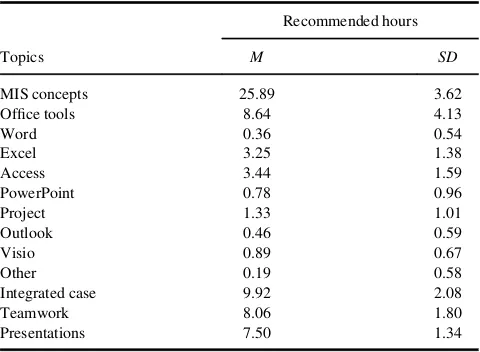
The results of the survey reflecting student expectation or recommend hours to be spent in various topics or activities of the course are given in Table 6. It is clear that students
would like to spend about one-third of the semester hours on MIS concepts, and the rest almost equally divided into case projects, teamwork, presentations, and Office tools. Contrary to our general experience of teaching undergradu-ate MIS course, we find that graduundergradu-ate students would like to focus more on the theory and concepts of MIS than other modes of instruction.
CONCLUSION
We have discussed the challenges of teaching the basic MIS course to the graduate students. Such a course must provide not only an understanding of the development, applications, and management of information systems, but also some experience on these concepts taught in the classroom. The latter requires innovative ideas and changing modes of instruction. We were focused on finding a suitable mode of instruction for a graduate-level basic MIS course that would provide necessary knowledge to future managers in a changing IT environment.
In addition to teaching general MIS concepts, we included activities for students such as hands-on practice with common IT tools and technologies, integrated case studies, teamwork through group projects, and group pre-sentations. Our results, based on the statistical analysis of an in-class survey of students toward completing such a course, show strong preferences toward learning MIS con-cepts, integrated case studies, and teamwork; and low pref-erence toward basic Office productivity tools and presentations. However, among the Office tools, there is a strong preference toward learning database and spreadsheet applications (Access and Excel), preferably these tools are found to be more productive in the working environment of the graduate students. This is in contrast to our general per-ception that graduate students already have significant experience in using these tools and they may not be inter-ested in them.
In the survey, students were also asked to provide opti-mum number of hours that should be spent in each of the learning modes or topics. Results show similar kind of pref-erences. Students would like to spend about one third of the semester hours on MIS concepts, and the rest they wish to be equally divided into case projects, teamwork, presenta-tions, and Office tools. Contrary to our general experience of teaching undergraduate MIS course, we find that gradu-ate students would like to focus more on the theory and concepts of MIS than other modes on instruction—prefera-bly majority of our graduate students have experience with tools, technologies, and teamwork in their working environment.
However, in today’s fast-changing technological world, we need to be innovative in teaching and involve students in hands-on learning to impart knowledge through doing TABLE 5
Ratings Among the Office Tools
Tool M
Recommended Hours in Various Topics and Tools
Recommended hours
than just teaching. Instructors of MIS can use our findings to design their courses in the future.
REFERENCES
Alavi, M., Yoo, Y., & Vogel, D. R. (1997). Using information technology to add value to management education.The Academy of Management Journal,40, 1310–1333.
Benbasat, I., Dexter, A. S., & Mantha, R. W. (1980). Impact of organizational maturity on information system skill needs.MIS Quarterly,4, 21–34. Chan, S. S., Wolfe, R. J., & Fang, X. (2009). Issues and strategies for
inte-grating HCI in masters level MIS and e-commerce programs. Interna-tional Journal of Human-Computer Studies,59, 497–520.
Foltz, C. B., O’Hara, M. T., & Wise, H. (2004). Standardizing the MIS course: Benefits and pitfalls. (2004).Campus-Wide Information Systems,
21, 163–169.
Hackney, R. A., McMaster, T., & Harris, A. L. (2003). Using cases as a teaching tool in IS education.Journal of Information Systems Education,
14, 229–234
Leidner, D. E., & Jarvenpaa, S. L. (1995). The use of information technol-ogy to enhance management school education: A theoretical view.MIS Quarterly,19, 265–291.
Money, W. H. (1996). Applying group support systems to classroom set-tings: A social cognitive learning theory explanation.Journal of Man-agement Information Systems,12, 65–80.
Sankar, C. S., Ford, F. N., & Terase, N. (1997). Impact of videoconferenc-ing in teachvideoconferenc-ing an introductory MIS course. Journal of Educational Technology Systems,26, 67–85.
APPENDIX: SURVEY OF TOPIC PREFERENCES IN GRADUATE MIS COURSE
1. Rate the importance of learning MIS Concepts using a scale from 0 to 10 (see scale below) and state number of classroom hours that should be spent on learning MIS Concepts.
Rating Hours
MIS Concepts _______ _______
2. Rate the overall importance of learning Office tools (Excel, Access, Project, etc.) using a scale from 0 to 10 (see scale below) and state number of classroom hours that should be spent on office tools.
Rating Hours
Office tools _______ _______
3. Rate the importance of each Office tool from 0 to 10 (see scale at end) and state number of classroom hours should be spent on each.
Rating Hours
Word _______ _______
Excel _______ _______
Access _______ _______
PowerPoint _______ _______
Project _______ _______
Outlook _______ _______
Visio _______ _______
Other (_________) _______ _______
4. Rate the importance of the integrated case (Pacific Consulting) using a scale from 0 to 10 (see scale at end) and state number of class-room hours that should be spent on working on an integrated case.
Rating Hours
Integrated Case _______ _______
5. Rate the importance of working in an analysis and development team (using a scale from 0 to 10 – see scale at the end) and state number of classroom hours that should be spent on working on teamwork concepts and techniques.
Rating Hours
Team Participation _______ _______
6. Rate the importance of the student presentations to the class using a scale from 0 to 10 (see scale at end) and state number of classroom hours that should be spent on student presentations to the class.
Rating Hours
Student Presentations _______ _______
RATING SCALE
0 Totally Unimportant – should be completely ignored 1 Extremely Unimportant – a definite waste of time 2 Very Unimportant – probably a waste of time 3 Unimportant – perhaps a waste of time
4 Of Little Importance – contributes very little or not at all 5 Neutral – doesn’t matter if included or not
6 Of Some Importance – might contribute to class 7 Important – contributes to success of class 8 Very Important – should be included in class
9 Extremely Important – one of the most important success factors 10 Essential – can not succeed without it
384 M. A. ROB AND V. ETNYRE