PHARMACEUTICAL
PREFORMULATION
AND
FORMULATION
A Practical Guide from
Candidate Drug Selection to
Commercial Dosage Form
Mark Gibson
Editor
Your Enterprise Solution to Global Healthcare Knowledge
IHS
®Health Group
This book contains information obtained from authentic and highly regarded sources. Reprinted material is quoted with permission, and sources are indicated. A wide variety of references are listed. Reasonable efforts have been made to publish reliable data and information, but the authors and the publisher cannot assume responsibility for the validity of all materials or for the consequences of their use.
Neither this book nor any part may be reproduced or transmitted in any form or by any means, electronic or mechanical, including photocopying, microfilming, and recording, or by any information storage or retrieval system, without prior permission in writing from the publisher.
The consent of CRC Press LLC does not extend to copying for general distribution, for promotion, for creating new works, or for resale. Specific permission must be obtained in writing from CRC Press LLC for such copying.
Direct all inquiries to CRC Press LLC, 2000 N.W. Corporate Blvd., Boca Raton, Florida 33431.
Trademark Notice: Product or corporate names may be trademarks or registered trademarks, and are used only for identification and explanation, without intent to infringe.
Visit the CRC Press Web site at www.crcpress.com
© 2004 by Interpharm/ CRC
No claim to original U.S. Government works Library of Congress Card Number 1-57491-120-1 Printed in the United States of America 1 2 3 4 5 6 7 8 9 0
Printed on acid-free paper
CONTENTS
Preface vii
Contributors ix
1. Introduction and Perspective 1
Mark Gibson
Drug Development Drivers, Challenges, Risks and Rewards 2
Current Trends in the Pharmaceutical Industry 6
Lessons Learnt and the Way Forward 8
Scope of the Book 10
References 11
PART I: Aiding Candidate Drug Selection
2. Aiding Candidate Drug Selection:
Introduction and Objectives 15
Mark Gibson
Stages of the Drug Discovery and Development Process 15
Summary 20
References 20
3. Preformulation Predictions from Small Amounts of Compound
as an Aid to Candidate Drug Selection 21
Gerry Steele
Initial Physicochemical Characterization 22
Initial Solubility 28
Initial Stability Investigations 34
Crystallinity 41
Crystal Morphology 46
Hygroscopicity 48
Salt Selection 49
Methods for Evaluating Physicochemical Properties 58
Concluding Remarks 87
Acknowledgements 88
References 88
4. Biopharmaceutical Support in Candidate Drug Selection 97 Anna-Lena Ungell andBertil Abrahamsson
Drug Dissolution and Solubility 100
Luminal Interactions 111
Absorption/Uptake over the GI Membranes 117
Models for Studying the Absorption Potential of Drugs 118
Permeability Coefficients versus Fa 134
In VivoTechniques for Studies in Man 135
Vehicles for Absorption Studies 139
Functional Use of Absorption Models 141
References 143
PART I I: Early Drug Development
5. Early Drug Development: Product Design 157
Mark Gibson
The Importance of Product Design 157
Product Design Considerations 158
Concluding Remarks 173
References 173
6. Preformulation as an Aid to Product Design in Early Drug Development 175 Gerry Steele
Solid Dosage Forms 175
Solution Formulations 196
Freeze-Dried Formulations 210
Suspensions 214
Topical/Transdermal Formulations 215
Inhalation Dosage Forms 217
Compatibility 223
References 228
7. Biopharmaceutical Support in Formulation Development 239 Bertil Abrahamsson andAnna-Lena Ungell
In VitroDissolution 241
Bioavailability Studies 257
In Vitro/In VivoCorrelations 269
Animal Models 276
Imaging Studies 279
References 289
PART I I I: From Product Design to Commercial Dosage Form
8. Product Optimisation 295
Mark Gibson
Product Optimisation Purpose and Scope 295
Sources of Information 304
Expert Systems 305
Experimental Design 309
Stability Testing 313
Developing Specifications 316
Process Design, Process Optimisation and Scale-Up 319
Validation and Launch 323
Acknowledgements 327
References 327
9. Parenteral Dosage Forms 331
Joanne Broadhead
Guiding Principles for Simple Parenteral Solutions 332
Choice of Excipients 334
Sterility Considerations 336
Strategies for Formulating Poorly Soluble Drugs 336
Strategies for Formulating Unstable Molecules 340
Strategies for the Formulation of Macromolecules 342
Liposomal Delivery Systems 343
Sustained-Release Parenteral Formulations 343
In Vitroand In VivoTesting Methods 346
Packaging of Parenteral Products 347
Manufacturing of Parenteral Products 348
Administration of Parenteral Products 350
Parenteral Products and the Regulatory Environment 351
References 353
10. Inhalation Dosage Forms 355
Paul Wright
Lung Deposition 356
Particle Sizing 357
Dry Powder Inhalers 361
Metered Dose Inhalers 364
Nebulisers 372
Standards 374
Future 375
References 376
Bibliography 378
11. Oral Solid Dosage Forms 379
Peter Davies
Powder Technology 381
Powder Flow 382
Mixing 388
Compaction 390
Solid Dosage Forms 403
Tablets 403
Soft Gelatin Capsules 453
Summary 455
References 456
12. Ophthalmic Dosage Forms 459
Mark Gibson
Ocular Topical Drug Delivery Issues and Challenges 460
Drug Candidate Selection 464
Product Design Considerations 465
Product Optimisation Considerations 473
Processing Considerations 482
Concluding Remarks 486
References 488
13. Aqueous Nasal Dosage Forms 491
Nigel Day
Nasal Anatomy and Physiology 494
Formulation Selection Considerations 496
Device Selection Considerations 499
Regulatory Aspects 506
Special Considerations for Peptide Nasal Delivery 508
References 511
Additional Reading 513
14. Topical and Transdermal Delivery 515
Kenneth A. Walters andKeith R. Brain
The Skin and Percutaneous Absorption 516
Drug Candidate Selection and Preformulation 534
Formulation 543
Concluding Remarks 567
Bibliography 567
References 569
PREFACE
In my industrial career, I have gained broad experience working on many different pharma-ceutical development projects and dosage forms, spanning candidate drug selection through technology transfer to production and subsequent launch. With this background and with Gerry Steele’s encouragement and rich experience in preformulation studies, I planned a book that would emphasize what practical studies need to be undertaken, for what reasons and during what key stages of the drug development process. In addition to preformulation, I considered it essential to include biopharmaceutics (an area of emerging importance) as well as formulation aspects. I soon realized I could not commit the time to writing all the chapters in such a book, and, indeed, I considered the book would be more comprehensive by involving other contributors and adding their special knowledge and experiences.
I am extremely grateful to all the contributors in this book, who have given up so much of their time to create their specialised chapters. I would specially like to thank Anna-Lena Ungell and Bertil Abrahammson for the two biopharmaceutics chapters, and also Jo Broad-head for stepping in at the final hour and writing the chapter on parenterals. Without these chapters, the book would have been incomplete.
In the past few years, I have written internal company guidelines and given seminars ex-ternally on a logical approach to product development and technology transfer. This ap-proach emphasises the importance of starting development of an NCE with product design prior to commencing product and process optimisation, scale-up and technology transfer. Two people I would particularly like to thank for their input and support for these concepts are Gordon France and Mike Dey. This logical approach to ensure that products are devel-oped efficiently and moved speedily to market is part of my own contribution to the chapters in this book.
Preparing this book took longer than anticipated, and it contains more pages than ex-pected. I have many vivid memories of one-finger typing on my laptop in airport lounges and hotel rooms and at home late in the evenings or on weekends. While my typing has become considerably faster, I hasten to add that I have progressed only to two-finger typing! I am in-debted to my secretarial support, particularly Hayley Pruden, who has much better typing skills than I, to complete the figures and tables for this book.
This book should prove to be a useful guide to practitioners working in the pharmaceu-tical industry, including R&D scientists, technicians and managers. In the words of Francis Bacon (1561–1626):
Some books are to be tasted, others to be swallowed, and some few to be chewed and digested: that is, some books are to be read only in parts; oth-ers to be read but not curiously; and some few to be read wholly, and with diligence and attention.
I would like to think that this book might fit any of the above descriptions, depending on the reader’s need.
Finally, I would like to thank my wife Alison for her love, understanding and support over the time I have spent preparing this book. Now that the book is finished, I should have more time to spend with her and my three children, Laura, Joanna and David.
Contributors
MARK GIBSON
Mark Gibson, BPharm, PhD, CChem, MRSC, MRPharmS, is currently responsible for par-enteral and oral solid dosage form development at AstraZeneca R&D Charnwood, which is a division of AstraZeneca. His experience includes formulation and preformulation develop-ment, both as a bench scientist and a manger, at Cyanamid (Lederle) for six years, Fisons Par-maceuticals for six years, Astra PharPar-maceuticals for four years and AstraZeneca for two years. He has worked on a variety of dosage forms and routes of delivery, including inhalation, oral, nasal, ophthalmic, parenteral and transdermal, resulting in some patents or marketable prod-ucts. Dr. Gibson is a member of the UK Academy of Pharmaceutical Sciences, the Parenteral Society and the Aerosol Society.
BERTIL ABRAHAMSSON
Bertil Abrahamsson, PhD, leads pharmaceutical and analytical research and development at AstraZeneca R&D Mölndal. His experience is in in vitro/in vivocorrelations,in vitro dissolu-tion,in vivoimaging of dosage forms and drug absorption. Dr. Abrahamsson has published more than 20 articles in clinical pharmacology.
KEITH R. BRAIN
Keith Brain, BPharm, PhD, is head of the drug delivery research group at Cardiff Univer-sity. His major responsibilities are in molecular recognition research and skin research. He is also CEO of An-eX, a university-based spinoff company formed in 1988, which specialises in confidential contract research and development for international clients. He has organized several international conferences on skin research and workshops on molec-ular imprinting.
JOANNE BROADHEAD
Joanne Broadhead, PhD, MRPharmS, manages a small team of formulation scientists at As-traZeneca R&D Charnwood in the development of solid and parenteral products. Her expe-rience includes two years as a formulation scientist for creative BioMolecules (Hopkinton, Mass., USA) prior to joining AstraZeneca in 1996. Dr. Broadhead is a member of the Ameri-can Association of Pharmaceutical Scientists, the Parenteral Drug Association and the Par-enteral Society.
PETER DAVIES
Peter Davies, BPharm, MRPharmS, PhD, is currently the formulation team leader in drug de-livery sciences at Roche Discovery Welwyn. At Roche for 18 years, his principal areas of in-terest are preformulation and formulation of solid dosage forms.
NIGEL DAY
Nigel H. Day, BSc, MSc, PhD, is a team manager in product development at AstraZeneca R&D Charnwood (formerly Fisons R&D and Astra Charnwood). He has wide experience in the de-velopment of solid, liquid and inhalation formulations. His professional experience includes a postdoctoral research fellowship at the University of Bradford and seven years in the Hoff-man-La Roche UK R&D Laboratories. Dr. Day is a member of the UK Academy of Pharma-ceutical Sciences.
GERRY STEELE
Gerry Steele, BSc, MSc, PhD, CChem, MRSC, is a team manager at AstraZeneca R&D Charn-wood. His research experience includes preformulation work and characterization and the surface rheology of phospholipid monolayers using photon correlation spectroscopy. Prior to joining AstraZeneca R&D Charnwood, he spent seven years with Fisons plc and a year at In-versesk Research International. Dr. Steele is a member of the Royal Society of Chemistry and the Academy of Pharmaceutical Scientists (of the Royal Pharmaceutical Society of Great Britain).
ANNA-LENA UNGELL
KENNETH A. WALTERS
Kenneth A. Walters, PhD, is director of An-eX Analytical Services Ltd and an honorary lec-turer in pharmaceutical chemistry at the Welsh School of Pharmacy. His research interests are biological membrane penetration enhancement and retardation, particularly with respect to skin. He has experience at Fisons Pharmaceuticals, Eastman Pharmaceuticals (a division of Eastman Kodak Company) and Controlled Therapeutics Ltd. (Scotland). Dr. Walters has published many articles and reviews and has co-edited two volumes on skin penetration en-hancement and dermal toxicity. He is a charter member of the American Association of Phar-maceutical Scientists and also a member of the Society of Investigative Dermatology, the Controlled Release Society, the Society of Toxicology and the Society of Cosmetic Scientists.
PAUL WRIGHT
1
Introduction and Perspective
Mark Gibson
AstraZeneca R&D Charnwood
Loughborough, United Kingdom
This book is intended to be a practical guide to pharmaceutical preformulation and formula-tion. It can be used as a reference source and a guidance tool for those working in the pharmaceutical industry or related industries, for example, medical devices and biophar-maceuticals, or anyone wanting an insight into this subject area. The information presented is essentially based on the extensive experiences of the editor and various other contributors who are all actively working in the industry and have learned “best practice” from their expe-riences.
There are various excellent books already available which cover the theoretical aspects of different types of pharmaceutical dosage forms and processes. A variety of books are also available that focus on the drug development process, business, regulatory and project man-agement aspects. In my opinion, there has been a long-standing need for a pragmatic guide to pharmaceutical preformulation and formulation with an emphasis on what practical studies need to be undertaken, for what reasons and during what key stages of the drug development process. The important stages where preformulation, biopharmaceutics and formulation play a key role are candidate drug selection through the various stages of product development. This book has been written to try and address this need.
A logical approach to product development is described in the book, with the key stages identified and the preformulation, biopharmaceutics and formulation activities and typical is-sues at each stage discussed. Wherever possible, the book is illustrated with real or worked
examples from contributors who have considerable relevant experience of preformulation, biopharmaceutics and formulation development.
Jim Wells’ book on preformulation (Wells 1988) made a strong impact on trainees and pharmaceutical scientists (including myself) working in this field of the pharmaceutical in-dustry when it was introduced over 10 years ago. It describes the important concepts and methods used in preformulation with the underlying theory. To his credit, Wells’ book is still useful today, but sadly, the book is now out of print, and existing copies are hard to obtain. It also requires updating to include modern preformulation instrumental techniques which have emerged over the last decade, such as thermo gravimetric analysis (TGA), hot stage mi-croscopy (HSM), X-ray powder diffraction (XRPD), raman and infra-red spectroscopy and solid-state nuclear magnetic resonance (NMR), to name a few. These techniques can be used to provide valuable information to characterise the drug substance and aid formulation de-velopment using the minimal amounts of compound.
Pharmaceutical Preformulation and Formulation: A Practical Guide from Candidate Drug
Selection to Commercial Formulation covers a wider subject area than just preformulation.
Topics include biopharmaceutics, drug delivery, formulation and process development aspects of product development. The book also describes a logical and structured approach to the product development process, recommending at what stages appropriate preformulation, bio-pharmaceutics and formulation work is best undertaken.
DRUG DEVELOPMENT DRIVERS,
CHALLENGES, RISKS AND REWARDS
It is important that the reader is aware of the nature of pharmaceutical research and develop-ment (R&D) in order to appreciate the importance of preformulation and formulation in the overall process.
In simple terms, the objective ofpharmaceutical R&Dcan be defined as “converting ideas into candidate drugs for development”, and the objective ofproduct developmentdefined as “converting candidate drugs into products for registration and sale”. In reality, these goals are extremely challenging and difficult to achieve because of the many significant hurdles a phar-maceutical company has to overcome during the course of drug development. Some of the major hurdles are listed in Table 1.1.
Table 1.1
Major hurdles to successful product registration and sale.
Activity Requirements
Research Novel compound (patentable?)
Novel biological mechanism (patentable?) Unmet medical needs
Potent and selective
Safety High margin of safety
Non-toxic (not carcinogenic, tetratogenic, mutagenic, etc.)
Clinical Tolerable side-effects profile
Efficacious
Acceptable duration of action
Drug process Bulk drug can be synthesised/scaled up
Pharmaceutical Acceptable formulation/pack (meets customer needs)
Drug delivery/product performance acceptable Stable/acceptable shelf-life
Clinical trial process robust and can be scaled up
Regulatory Quality of data/documentation
Manufacturing Manufacturable
Able to pass pre-approval inspection
Marketing/commercial Competitive
Meets customer needs Value for money Commercial return
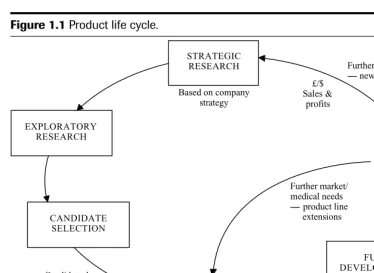
To be successful and competitive, research-based pharmaceutical companies must ensure that new discoveries are frequently brought to the market to generate cash flow. This is re-quired to fund the next generation of compounds to meet the therapeutic needs of patients, and of course, to benefit the shareholders. This cycle of events is sometimes referred to as the “product life cycle” and is further illustrated in Figure 1.1.
Launch STRATEGIC RESEARCH MARKETING & COMMERCIAL EXPLORATORY DEVELOPMENT EXPLORATORY DEVELOPMENT EXPLORATORY DEVELOPMENT FULL DEVELOPMENT EXPLORATORY RESEARCH CANDIDATE SELECTION Further market/ medical needs product line extensions Regulatory submissions
Safety and efficacy demonstrated Candidate drug
selected
Based on company strategy
Further market/medical needs new indications £/$ Sales & profits EXPLORATORY DEVELOPMENT
Proof of concept demonstrated
Figure 1.1Product life cycle.
some companies selectively screen and eliminate compounds earlier in the drug development process based on results from small-scale, less expensive studies in man and progress fewer, more certain compounds to later clinical phases.
In spite of the high risks and high costs involved, there is still a huge incentive for phar-maceutical companies to seek the financial rewards from successful marketed products, and especially from the phenomenal success of the rare “blockbuster” (reaching sales of⬎1 billion U.S.$ per year). This can earn the company significant profits to reinvest in research and fund the product development pipeline.
The average time from drug discovery to product launch is currently estimated to take 10 to 12 years. Several factors may have contributed to lengthening development times over the years, including an increase in the preclinical phase to select the candidate drug, and also an increase in the duration of the clinical and regulatory period required for marketing ap-proval. Benchmarking studies show wide gaps between industry average or worst performance compared to what is achievable as best practice performance (Spence 1997). On average, the preclinical phase currently takes 4 to 6 years to complete, whereas the time from candidate drug nomination to regulatory submission takes on average 6 to 8 years, longer for treatments of chronic conditions. Most forward-looking pharmaceutical companies are aiming to reduce these times by re-evaluation and subsequently streamlining the development process, for ex-ample, by introducing more effective clinical programmes and more efficient data reporting systems, forward planning and conducting multiple activities in parallel. However, this, in turn, may put formulation development and clinical supplies on the critical path, with pres-sures to complete these activities in condensed time scales. Suggestions are offered through-out this book on how preformulation, biopharmaceutics and formulation can be conducted in the most efficient way to avoid delays in development times.
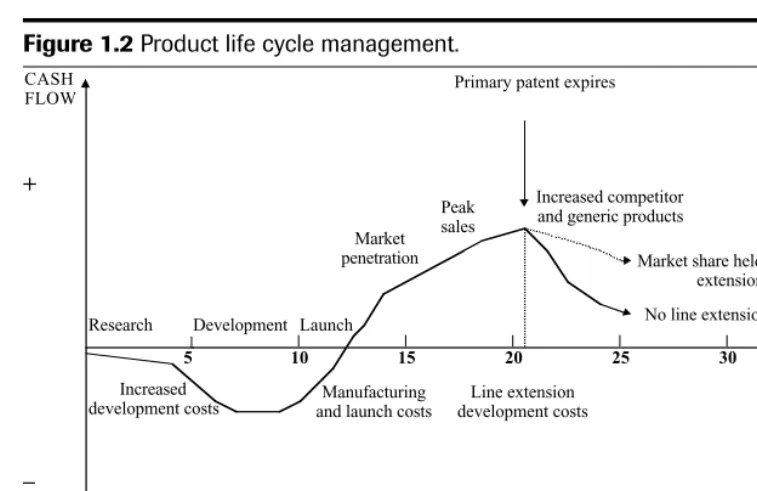
Any reduction in the total time-frame of drug discovery to market should improve the company’s profitability. In a highly competitive market, product lifetimes are being eroded due to the pace of introduction of competitor products, the rapid introduction of generic products when patents expire and moves to “over-the-counter” (OTC) status. Successful phar-maceutical companies are focusing on strategies for optimum “product life cycle manage-ment” to maximise the early growth of the product on the market, sustain peak sales for as long as the product is in patent and delay the post-patent expiry decline for as long as possi-ble. This should maximise the return on investment during a product life cycle to enable the company to recover development costs and make further investments in R&D. Figure 1.2 shows a classic cash flow profile for a new drug product developed and marketed. During de-velopment there is a negative cash flow, and it may be some time after launch before sales rev-enue crosses from loss to profit because of manufacturing, distribution and advertising costs. Profits continue to increase as the market is established to reach peak sales, after which sales decrease, especially after the primary patent expires and generic competition is introduced.
Throughout the life span of a product, it is in a company’s interest to ensure the best patent protection in order to achieve the longest possible market exclusivity. Prior to the pri-mary patent expiring (normally for the chemical drug substance), it is imperative to introduce new indications, formulations, manufacturing processes, devices and general technology, which are patent protected, to extend the life of the product and maintain revenue. A patent generally has a term of about 20 years, but as development times are getting longer, there will be a limited duration of protection remaining once the product is marketed (the effective patent life). A comparison of effective patent life for pharmaceutical new chemical entities in various countries around the world shows the same downward trend between the 1960s and the 1980s (Karia et al. 1992; Lis and Walker 1988).
Primary patent expires
+
–
TIME (YEARS)
5 10 15 20 25 30
Research Development Launch Market penetration
Peak sales
Increased competitor and generic products
Market share held with line extensions
No line extensions CASH
FLOW
Increased
development costs and launch costsManufacturing
Line extension development costs
Figure 1.2Product life cycle management.
For example, if a simple, non-optimised formulation with a relatively short shelf life is accept-able for Phase I clinical studies, any further optimisation or stability testing might be consid-ered wasteful, unless the data generated can be used later in the development programme.
There can be a significant risk associated with doing a minimum development pro-gramme and cutting corners to fast track to market. Post-launch, the cost of a retrospective fix due to poor product/process design and/or development can be extremely high. The addi-tional financial cost from work in product/process redevelopment, manufacturing and vali-dation, technical support, regulatory and sales and marketing (due to a product recall) can easily wipe out the profit from an early launch. This can have several unpleasant knock-on ef-fects; it may affect the market share and the company’s relationship with the regulatory au-thorities, and its credibility with customers (both externally and internally within the company) may be threatened. These factors need to be taken in to account when planning pre-formulation/formulation studies which can directly influence the progress of a product to market and final product quality.
CURRENT TRENDS IN THE PHARMACEUTICAL INDUSTRY
and the cost of goods sold is increasing. There have been several mergers and acquisitions of research-based pharmaceutical companies, and increased collaborations and inward licensing of products and technologies, in attempts to acquire new leads, to share costs, to reduce the time to licence and to maintain growth. Unfortunately, mergers and acquisitions also result in streamlining and job losses which improve efficiency and decrease overhead costs at the same time.
There is a changing trend in the nature of the candidate drug emerging from pharma-ceutical R&D, from a low molecular weight chemical to a more complex macromolecule (bi-ologicals), which can be a peptide, protein, enzyme, antibody, nucleic acid, genetic material or a multicomponent vaccine. Some of these compounds have been derived from biotechnolog-ical processes to produce biotechnologbiotechnolog-ical medicinal products that fight infection and disease. The U.S. Food and Drug Administration (FDA) and European Agency for the Evaluation of Medicinal Products (EMEA) have already approved biotechnological medicinal products for anaemia, cystic fibrosis, growth deficiency, hepatitis and transplant rejection. Many more are being developed to treat cancer, human immunodeficiency virus (HIV) infections and ac-quired immunodeficiency syndrome (AIDS), multiple sclerosis and stroke. A major challenge to the formulator is to develop self-administered formulations to deliver macromolecules such as proteins and polypeptides into the body, for example, by the oral or inhalation route. More sophisticated drug delivery systems are being developed to overcome the limita-tions of conventional forms of drug delivery systems (e.g., tablets and intravenous [IV] solu-tions), to overcome problems of poor drug absorption, the non-compliance of patients and inaccurate targeting of therapeutic agents. One example of an emerging drug delivery tech-nology is the use of low-level electrical energy to assist the transport of drugs across the skin in a process known as electrophoresis. This method could be particularly useful for the deliv-ery of peptides and proteins which are not adequately transported by passive transdermal therapy. The drug absorption rate is very rapid and more controlled compared with passive diffusion across the skin. Another example is the improvement in inhaler technology to en-sure a more efficient delivery to the lungs, with minimal drug deposition in the mouth and trachea. The use of a breath-actuated aerosol is designed to co-ordinate drug delivery with the patient’s inhalation to achieve this. A third example is the use of bioerodable polymers that can be implanted or injected within the body to administer drugs from a matrix which can be formulated to degrade over a long duration from one day to six months, and do not require retrieval. Some of these specific delivery systems are explained in more detail in later chapters of this book on the various dosage forms.
Futuristic drug delivery systems are being developed which hope to facilitate the trans-port of a drug with a carrier to its intended destination in the body and then release it there. Liposomes, monoclonal antibodies and modified viruses are being considered to deliver “re-pair genes” by IV injection to target the respiratory epithelium in the treatment of cystic fi-brosis. These novel drug delivery systems not only offer clear medical benefits to the patient but can also be opportunities for commercial exploitation, especially useful if a drug is ap-proaching the end of its patent life.
In spite of efforts to harmonise tests, standards and pharmacopoeias, there is still diver-sity between the major global markets—Europe, the United States and Japan—which have to be taken in to account in the design of preformulation and formulation programmes (Anony-mous 1993). This is discussed further in Chapter 5 on product design.
Other pressures facing the pharmaceutical industry are of a political/economical or envi-ronmental nature. Some governments are trying to contain healthcare costs by introducing healthcare reforms, which may lead to reduced prices and profit margins for companies, or re-stricted markets where only certain drugs can be prescribed. Although the beneficial effect of drugs is not questioned in general, the pressure to contain the healthcare costs is acute. Healthcare costs are increasing partly because people are living longer and more treatments are available. This may influence the commercial price that can be obtained for a new prod-uct entering the market and, in turn, the “cost of goods (CoG) target”. The industry average for the CoG target is 5 to 10 percent of the commercial price with pressure to keep it as low as possible. This may impact on the choice and cost of raw materials, components and packag-ing for the product and the design and cost of manufacturpackag-ing the drug and product.
Environmental pressures are to use environmentally friendly materials in products and processes and to accomplish the reduction of waste emissions from manufacturing processes. A good example is the replacement of chlorofluorocarbons (CFCs) propellants in pressurised metered dose inhalers (pMDIs) with hydrofluorocarbons (HFAs). The production of CFCs in developed countries was banned by the Montreal Protocol (an international treaty) apart from “essential uses”, such as propellants in pMDIs, to reduce the damage to the earth’s ozone layer. However, there is increasing pressure to phase out CFCs altogether. The transition from CFC to HFA products involves a massive reformulation exercise with significant technical challenges and costs for pharmaceutical companies involved in developing pMDIs, as de-scribed in Chapter 10 “Inhalation Dosage Forms”. However, this can be turned into a com-mercial opportunity for some companies which have developed patent-protected delivery systems to extend the product life cycle of their CFC pMDI products.
LESSONS LEARNT AND THE WAY FORWARD
To achieve the best chance of a fast and efficient development programme to bring a candi-date drug to market, several important messages can be gleaned from projects which have gone well and from companies with consistently good track records.
There are benefits for pharmaceutical development to get involved early with preclinical research during the candidate drug selection phase. This is to move away from an “over-the-wall” hand-over approach of the candidate drug to be developed from “research” to “develop-ment”. The drug selection criteria will be primarily based on pharmacological properties such as potency, selectivity, duration of action and safety/toxicology assessments. However, if all these factors are satisfactory and similar, there may be an important difference between the pharmaceutical properties of candidate drugs. A candidate drug with preferred pharmaceuti-cal properties, for example, good aqueous solubility, crystalline, nonhygroscopic and good stability, should be selected to minimise the challenges involved in developing a suitable for-mulation. This is discussed further in Chapter 2.
with a vested interest in the project. Needless to say, the plan should contain details of activi-ties, timings, responsibiliactivi-ties, milestones, reviews and decision points. Reviews and decision points are required at the end of a distinct activity to ensure that the project is still meeting its objectives and should progress to the next stage of development. However, these reviews should not cause any delays to the programme, rather, they should ratify what is already pro-gressing. The traditional sequential phases of product development (see Chapter 2) must be overlapped to accelerate the product to market. In reality, plans will inevitably change with time; they should be “living” documents which are reviewed and updated at regular intervals and then communicated to all parties. There may be several more detailed, lower-level plans focusing on departmental activities, e.g., for pharmaceutical development, but these plans must be linked to the top level central project plan.
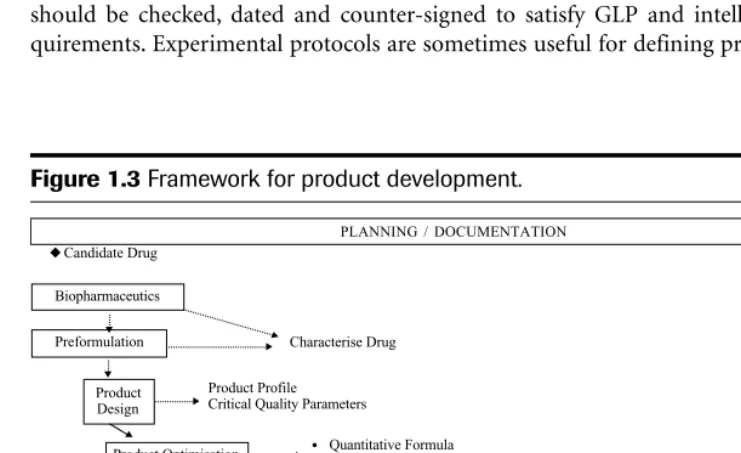
Forward planning should provide the opportunity for a well thought out and efficient ap-proach to product development, identifying requirements up front so as to avoid too much de-liberation and backtracking along the way. It also should provide a visible communication tool. Good planning is supported by adopting a systematic and structured approach to prod-uct development. The development process can be broken down into several key defined stages—product design, process design, product optimisation, process optimisation, scale-up and so on. Each stage will have inputs and outputs as shown in Figure 1.3, a simplified frame-work for product development. The appropriate definition and requirements at each stage are described in Chapters 5 and 8 of this text.
As product development can take several years to complete, it is important to have an ef-fective document management system in place to record the work. The primary reference source for recording experimental work will usually be a laboratory notebook. The work should be checked, dated and counter-signed to satisfy GLP and intellectual property re-quirements. Experimental protocols are sometimes useful for defining programmes of work,
PLANNING / DOCUMENTATION Candidate Drug Preformulation Product Design Product Optimisation Process Design Process Optimisation
Scale-Up for Clinical Trials
Characterise Drug
Product Profile Critical Quality Parameters
Quantitative Formula
Raw Material / Component Specifications Process Outline
Equipment / Facility Definition In-Process Controls Product Specification Scale-Up for Commercial
Production Process Validation
Manufacture Launch Stock NDA
Submission
Phase I Phase II Phase III Regulatory Review Launch Biopharmaceutics Phase IV • • • •
explaining the rationale for the studies and defining the acceptance criteria. When the studies are completed, the results can be reported with reference to the protocol and acceptance cri-teria. Laboratory notebooks are referenced in the protocols and reports so that the raw data can be retrieved in the event of an audit.
At the completion of key stages of the work, summary reports can be written, referencing all other protocols and reports relevant to that stage and highlighting the major recommen-dations and conclusions. In this way, a product development document file can be built up for transfer of information and technology, including the development history and rationale for progression. The file will also be vital for data retrieval in the event of a regulatory inspection. Finally, successful product development is often associated with good teamwork. The process is multidisciplinary, relying on people with different specialist skills working together to make it happen. This is particularly important at the key interfaces such as preclinical re-search with pharmaceutical development and pharmaceutical development with manufactur-ing operations at the final production site. It is therefore useful to have representation on the project teams from all the key specialist functions to ensure buy-in to the plans, strategies and decisions and to have a good project management system in place.
SCOPE OF THE BOOK
This book is structured in a logical order to cover the various stages of drug development from candidate drug selection to development of the intended commercial dosage form.
In Chapter 2, the key stages of the R&D process are explained in some detail, with the out-puts expected from each stage, to afford an appreciation of the entire process. The remainder of the book concentrates on candidate drug selection for development and development of the commercial dosage form where preformulation, biopharmaceutics and formulation play a vital role. Initial emphasis is on candidate drug selection and the importance of preformula-tion, formulation and biopharmaceutics input at this stage. Traditionally, not all pharmaceu-tical companies operate in this way, and the result from experience is often that pharmaceupharmaceu-tical development has to accept whatever candidate drug comes out of research and address any un-foreseen difficulties during development. The disadvantages of this approach, and the oppor-tunities and benefits of pharmaceutical input to the candidate selection process, are clearly explained in the early chapters.
Available drug substance for preformulation and biopharmaceutics studies at the candi-date drug selection stage can be a major challenge. Chapter 3 describes the preformulation studies that can be undertaken to maximise the information gained from small amounts of drug substance in order to select the preferred candidate drug for development. Various mod-ern preformulation techniques which use minimal amounts of drug are described to evaluate the physicochemical properties of compounds, salts and polymorphs.
Chapter 4 describes the importance of drug delivery and biopharmaceutical factors in the candidate drug selection phase. Consideration is given to the intended route of administra-tion and what predicadministra-tions can be made and useful informaadministra-tion gained from biopharmaceuti-cal assessment of the candidate drug.
Chapters 6 and 7 focus on preformulation and biopharmaceutics, respectively, as an aid to product design. The emphasis is on generating the appropriate data to characterise the can-didate drug and aid product design and development. The objective at this stage is to deter-mine the physicochemical properties of the candidate drug which are considered important in the development of a stable, effective and safe formulation. Limited availability of drug sub-stance, speed and careful consideration of the programme of work depending on the intended dosage form and route are all considered here and illustrated with the aid of worked exam-ples. Modern instrumental techniques and personal computer (PC)–based “expert systems” are discussed as useful tools.
To develop a product from inception to market, the product and process have to be opti-mised and the process scaled up and transferred to commercial production. Definitions and descriptions of the requirements for all these stages of development are discussed in Chapter 8, although the major discussion is on the preformulation/formulation input to product op-timisation. The many factors which a formulator should consider in the selection of pharma-ceutical excipients and packaging are discussed. Useful sources of information and techniques for selection such as expert systems and experimental design tools are included.
Drugs are generally administered via the mouth, eyes, nose, skin, or by inhalation or in-jection, and so these routes are covered in more detail in separate chapters of this book. Special considerations and issues for the formulation development of each route and type of dosage form are discussed, based on the considerable relevant experience of the various contributors.
REFERENCES
Anonymous. (1993). Global differences in registration requirements.Pharmaceut. J.251:610–611. Karia, R., Y. Lis, and S. R. Walker. 1992. The erosion of effective patent life—An international
compari-son. In Medicines, regulation, research and risk2nd ed., edited by J. P. Griffin. Belfast: Queen’s Uni-versity Press, pp. 287–301.
Lis. Y., and S. R. Walker. 1988. Pharmaceutical patent term erosion—A comparison of the UK, USA and Federal Republic of Germany (FRG).Pharmaceut. J.240:176–180.
McKinsey & Co. 1991. In Managing product creation, a management overview, edited by P. Burall. Lon-don: The Design Council for the UK Department of Trade and Industry.
Spence, C., ed. 1997.The pharmaceutical R & D compendium: CMR International/SCRIP’s guide to trends
in R & D. Richmond, Survey, UK: CMR International/SCRIP Publication.
Tucker, D. 1984.The world health market, the future of the pharmaceutical industry. Bücher, Germany: Eu-romonitor Publications Ltd.
Part I
15
2
Aiding Candidate Drug Selection:
Introduction and Objectives
Mark Gibson
AstraZeneca R&D Charnwood
Loughborough, United Kingdom
STAGES OF THE DRUG DISCOVERY AND
DEVELOPMENT PROCESS
The development of a new medicinal product from a novel synthesised chemical compound, a chemical extracted from a natural source or a compound produced by biotechnological processes, is a long and complex process and involves many different disciplines working to-gether. The drug discovery and development process for a typical research-based pharmaceu-tical company can be broken down into five distinct stages as described briefly below. At each stage, there will be several activities running in parallel, with the overall objective of discov-ering a candidate drug and developing it to market as efficiently as possible. It should be noted that different companies may use slightly different terminology and perform some ac-tivities sooner or later, but the overall process is essentially the same.
Strategic Research
The strategic research of a particular company is usually guided by factors such as its in-herent research competence and expertise, therapeutic areas of unmet medical need and mar-ket potential/commercial viability. Companies often wish to develop a portfolio of products within a specific therapeutic area to capture a segment of the market. By focusing on a par-ticular therapeutic area, a company can build on its existing expertise and competence in all of its functions with the aim of becoming a leading company in that field.
Exploratory Research
Investigation of the biological mechanism and identification of a “chemical lead” that inter-feres with it.
During the exploratory research stage, diverse compounds are screened for the desired bi-ological activity. The aim is to find a chemical or molecular entity that interferes with the process and to provide a valuable probe of the underlying therapeutic problem. Traditionally, this has been achieved by the organic chemist synthesising compounds one at a time for the biologist to test in a linear fashion. Over the last decade, there has been a rapid development in the technologies for creating very large and diverse quantities of synthetic and biosynthetic molecules and for testing large numbers for activity in less time. These technologies have been labelled “combinatorial chemistry” and automated “high-throughput screening” (HTS), re-spectively. The key impact has been to accelerate the synthesis of new compounds from, say, 50 compounds per chemist year to many tens of thousands and to be able to test these against many biological targets (e.g., biological receptors or biochemical pathways) very quickly (Doyle et al. 1998).
The rate of technology development specifically associated with HTS for pharmaceutical drug discovery has increased markedly over recent years with automated techniques involving miniaturisation, to allow assays on very small samples (e.g., 1L volume), and the ability to
analyse thousands of samples a day using well microplates (Burbaum 1998). In addition to the use of HTS for pharmacological activity, HTS tests have been developed for assessing metab-olism and pharmacokinetic and toxicity factors to speed up the drug discovery process.
In simple terms, a biologically active compound can be considered to consist of a sup-portive framework with biofunctional groups attached that bind to a target to induce a bio-logical response. Each compound is, in effect, a unique combination of numerous possible groups. Combinatorial techniques have replaced traditional synthetic approaches to generate many possible combinations rapidly for biological testing.
Approaches to lead generation during exploratory research often depend on how much is already known about the therapeutic target under consideration. For example, if the three-dimensional structure of the target (such as an enzyme-inhibitor complex) is known, chemical leads could be found and optimised through combinatorial chemistry and HTS. Alternatively, in some cases, the only available biochemical knowledge might be the structure of a ligand for the enzyme. If there were no information at all, then the only approach might be limited to HTS of batches of compounds from combinatorial libraries.
Even with combinatorial chemistry and HTS, lead generation can be extremely laborious because of the vast number of different molecules possible (framework and biofunctional group combinations). To ease this burden, some rational drug design and quantitative struc-ture activity relationships (QSARs) are often introduced to direct the programme and utilise a company’s finite screening resource as efficiently as possible.
Together with combinatorial chemistry and rational drug design, genomics is rapidly emerging as a useful technique to enable companies to significantly increase the number of drug targets and improve on candidate selection success. A number of companies have seen the potential in defining patient groups based on their genotypes and are now investing lots of money to gain a clearer understanding of the genes that are important to drug action.
Candidate Drug Selection
The chemical lead is used to generate specific chemical compounds with the optimal desired characteristics, for example, potency, specificity, duration, safety and pharmaceutical aspects. One or more candidate drugs are nominated for development.
During the candidate drug selection stage, the chemical lead is optimised by testing a range of selected compounds in in vitroand in vivo(animal) studies. The objective is to select one or more candidate drugs for development with the most desired characteristics. Pharma-cological characteristics might include acceptable absorption, potency, duration of action and selectivity for the receptor or enzyme. Safety characteristics will normally include non-carcinogenicity, non-teratogenicity, non-mutagenicity, and general non-toxicity. The potential for these characteristics can be predicted from relatively short-term preclinical toxipharmaco-logical animal studies and in vitrotests.
In the interests of rapid drug development, it is also important to select a compound with preferred pharmaceutical and chemical synthesis properties at this stage. A list of preferred characteristics for a compound intended for oral solid dosage form development is given in Table 2.1.
Higher priority in the selection process will, in most cases, be given to a compound’s op-timal pharmacological and safety characteristics. However, in the event of having a choice from a range of compounds all possessing similar pharmacological and safety properties, there may be a significant advantage for formulation development in selecting a compound with the most preferred pharmaceutical properties. It is useful to conduct preformulation studies and biopharmaceutics studies at the candidate drug selection stage to determine the
Table 2.1
Preferred drug synthesis and pharmaceutical properties for compounds intended for oral solid dosage form development.
Drug Synthesis Factors Formulation/Drug Delivery Factors
• Least complex structure (none/few chiral centres) • Exists as a stable polymorphic form • Few synthesis steps as possible • Non-hygroscopic
• High yields as possible • Crystalline
• Non-explosive route or safety issues • Acceptable solid-state stability of candidate drug • Commercial availability of building blocks and • Acceptable oral bioavailability
contract manufacturers
• Low cost of goods compared to overall cost of • Not highly coloured or strong odour (to ensure product on market batch reproducibility and reduce problems with
most relevant physicochemical and biopharmaceutical properties of potential candidate drugs to aid candidate selection.
Biopharmaceutics is the study of how the physicochemical properties of the candidate drugs, the formulation/delivery system and the route of administration affect the rate and ex-tent of drug absorption. Appropriate biopharmaceutical information generated at this stage can also be very important in directing the candidate selection process and for future dosage form design during development.
The benefits of providing preformulation and biopharmaceutics input during the candi-date drug selection stage, to characterise the candicandi-date drug and provide useful information to support the selection of the optimal compound for pharmaceutical development, are em-phasised in Chapters 3 and 4. Generally, any pharmaceutical issues can be discovered earlier, before the candidate drug reaches development, and any implications for product design and development considered in advance. Pharmaceutical development’s involvement in the selec-tion process and “buy-in” to the nominaselec-tion decision can often enhance the team’s working relationship with their research colleagues. The objective is to achieve a seamless transition from research to development, as opposed to the traditional “over-the-wall” approach that many pharmaceutical companies experience to their costs. Earlier involvement by the Phar-maceutical Development group at the preclinical stage should also result in better planning for full development.
In spite of all these potential advantages of early pharmaceutical involvement to candi-date drug selection, there may be several barriers within a company which can hinder this way of working. Distance between the Research group and the Development group should not re-ally be considered a barrier, although this can be the case for groups on different continents with different cultures and languages. The important factor for success seems to be the devel-opment of a formal mechanism for interaction, supported by senior management in the com-pany. This often takes the form of a joint project team with regular meetings to review progress. However, there may still be a lack of appreciation of what input or expertise phar-maceutical development can offer at the candidate drug selection stage. Opportunities to demonstrate what can be done and to educate Research colleagues should be sought to try and overcome this attitude.
Another potential barrier is any overlapping expertise there may be in Research and De-velopment groups. For example, overlap may occur between Preformulation in Pharmaceuti-cal Development and PhysiPharmaceuti-cal Chemistry in Research, or between Biopharmaceutics in Development and Drug Metabolism in Research. In these cases, it is important to clarify and agree which group does what activity.
A common perceived barrier to providing early preformulation and biopharmaceutics input can be the quantity of compound required for evaluation at this stage. The Research group may believe that significantly more compound is required; with modern instrumental techniques, however, this is often not the case.
this stage, and rank order information is often acceptable, rather than definitive quantitative information. Analytical methods should not require rigorous validation at this stage to pro-vide these data. Excessive documentation and rigid standard operating procedures that can slow down the work are not usually necessary and should be avoided.
Exploratory Development
The aim of exploratory development is to gauge how the candidate drug is absorbed and metabolised in healthy human volunteers before studying its effect on those actually suffering from the disease for which it is intended. Occasionally, it is necessary to conduct further small-scale studies in patients in order to make a decision whether to progress the candidate drug into full development. This stage is often referred to as Phase I clinical studies or Concept Test-ing (Proof of Concept). Usually a small number of healthy volunteers (who do not have the condition under investigation or any other illness) receives the drug candidate provided as a simple formulation, which can be different from the intended commercial formulation. For example, a simple aqueous oral solution or suspension may be used, rather than a capsule or tablet, to minimise the formulation development work at this early stage.
If the candidate drug does not produce the expected effects in human studies, or produces unexpected and unwanted effects, the development programme is likely to be stopped at this stage. In the United Kingdom, there is no requirement, at the time of this writing, to make a submission to the local regulatory authorities for permission to conduct the trials in human volunteers. However, this is likely to change in the future to bring the United Kingdom in line with the rest of the world.
Full Development
SUMMARY
Pharmaceutical companies with the best track records for drug discovery and rapid devel-opment to market tend to have a seamless transfer from Research to Develdevel-opment. There are many opportunities and benefits to be gained by the involvement of Pharmaceutical Devel-opment groups, such as Preformulation and Biopharmaceutics, during the candidate drug selection stage: It may be surprising what valuable information can be obtained using mod-ern preformulation instrumental techniques and biopharmaceutical techniques from rela-tively small quantities of compound. These topics are discussed further in Chapters 3 and 4 of this text.
REFERENCES
Burbaum, J. 1998. Engines of discovery.Chemistry in Britain(June): 38–41.
3
Preformulation Predictions from
Small Amounts of Compound
as an Aid to Candidate
Drug Selection
Gerry Steele
AstraZeneca R&D Charnwood
Loughborough, United Kingdom
Prior to nomination into full development, a candidate drug should undergo a phase tradi-tionally called preformulation. Preformulation is the physicochemical characterization of the solid and solution properties of compounds and although now relatively old, the definition of preformulation proposed by Akers (1976) is particularly apt:
Preformulation testing encompasses all studies enacted on a new drug com-pound in order to produce useful information for subsequent formulation of a stable and biopharmaceutically suitable drug dosage form.
Furthermore, Wells’ book on the subject (1988) closes by exhorting pharmaceutical scientists:
Do not neglect these foundations. Good preformulation will inevitably lead to simple and elegant formulations and successful commercial products.
The scope of preformulation studies to be carried out will depend not only on the ex-pertise, equipment and drug substance available but also on any organizational preferences or restrictions. Some companies like to conduct detailed characterization studies, whilst others
prefer to do the minimum amount of work required to progress compounds as quickly as pos-sible into development. Both of these approaches have pros and cons. However, for the smooth progression of compounds through the preformulation phase, a close interaction be-tween departments of Medicinal Chemistry in Research, Pharmaceutical Sciences, Analytical Chemistry and Drug Substance Process Development is essential.
Although preformulation typically begins in earnest during the lead optimization (LO) phase, there may be some involvement during lead identification (LI). In LI, support may be given to Medicinal Chemistry for solid-state screening to ensure that, e.g., batches of a com-pound are the same polymorph. LO normally takes around two years; during the last three to six months, the number of compounds being seriously considered for nomination will have been narrowed to around three. This phase is known as prenomination. During this period, there may be a number of compounds with sufficient activity to merit consideration, and so studies must be designed to select which compound to proceed with into development. Clear differences in in vivo activity may be sufficient to determine which of the candidates is selected. However, other factors that may be important from a pharmaceutical and drug syn-thesis point of view should also be considered if there is a choice. For example, physicochem-ical characteristics of the compound(s), ease of scale-up for compound supply, availability of analytical procedures and the nature of the anticipated dosage form should also be taken into consideration in the decision process.
Ideally, for an oral solid dosage form, a water-soluble, non-hygroscopic, stable and easily processed crystalline compound is preferred for development purposes; however, other for-mulation types will have their own specific requirements.
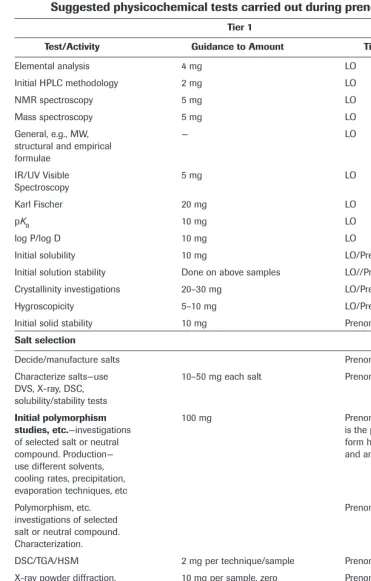
Table 3.1 summarizes the prenomination studies that could be carried out on a candi-date drug. These are considered to be the minimum tests that should be undertaken, recog-nizing that during the prenomination phase only a limited quantity of compound, e.g., 50 mg, is typically available for characterization. However, it should be emphasized that this is a critical decision period that can profoundly affect the subsequent development of a can-didate drug. Thus, the tests shown are considered to be those important for making a rational decision as to which compound, salt or polymorph to proceed with into development. A poor decision at this point could mean a substantial amount of revisionary work, such as a change of salt or polymorph being necessary, and a possible delay to the development of the drug to the market.
After nomination to full development, the increased quantity of candidate drug available will allow a more complete physicochemical characterization of the chosen compound(s) to be carried out, with particular emphasis on the dosage form. These tests should allow a ra-tional, stable and bioavailable formulation to be progressed, which will be discussed in more detail in Chapter 6.
INITIAL PHYSICOCHEMICAL CHARACTERIZATION
Suggested physicochemical tests carried out during prenomination.
Tier 1
Test/Activity Guidance to Amount Timing/Comments
Elemental analysis 4 mg LO
Initial HPLC methodology 2 mg LO
NMR spectroscopy 5 mg LO
Mass spectroscopy 5 mg LO
General, e.g., MW, — LO
structural and empirical formulae
IR/UV Visible 5 mg LO
Spectroscopy
Karl Fischer 20 mg LO
pKa 10 mg LO
log P/log D 10 mg LO
Initial solubility 10 mg LO/Prenomination
Initial solution stability Done on above samples LO//Prenomination Crystallinity investigations 20–30 mg LO/Prenomination
Hygroscopicity 5–10 mg LO/Prenomination
Initial solid stability 10 mg Prenomination
Salt selection
Decide/manufacture salts Prenomination
Characterize salts—use 10–50 mg each salt Prenomination DVS, X-ray, DSC,
solubility/stability tests
Initial polymorphism 100 mg Prenomination (also included
studies, etc.—investigations is the propensity of the CD to
of selected salt or neutral form hydrates, solvates
compound. Production— and amorphs)
use different solvents, cooling rates, precipitation, evaporation techniques, etc
Polymorphism, etc. Prenomination
investigations of selected salt or neutral compound. Characterization.
DSC/TGA/HSM 2 mg per technique/sample Prenomination X-ray powder diffraction, 10 mg per sample, zero Prenomination including temp and RH background holder
FTIR/Raman 2 mg per sample Prenomination
Crystal habit—microscopy, 10 mg Prenomination
light and SEM
Stability-stress wrt, 100 mg Prenomination
temp/humidity
Choose polymorph, Prenomination
amorph or hydrate
pK
aDeterminations
Many potential candidate drugs are weak acids or bases, therefore, one of the most pertinent determinations carried out prior to development is the pKa or ionization constant. Strong acids, e.g., HCl, are ionized at all pH values, whereas the ionization of weak acids is depend-ent on pH. It is useful to know the extdepend-ent to which the molecule is ionized at a certain pH, since properties such as solubility, stability, drug absorption and activity are affected by this parameter. The basic theory of the ionization constant is covered by most physical chemistry textbooks, and a most useful text is that by Albert and Sargeant (1984). Fundamental to our appreciation of the determination of this parameter, however, is the Brønstead and Lowry the-ory of acids and bases. This states that an acid is a substance that can donate a hydrogen ion, and a base is one that can accept a proton.
For a weak acid, the following equilibrium holds:
HA TH++ A–
For the sake of brevity, a detailed discussion and derivation of equations will be avoided; how-ever, it is important that the well-known Henderson–Hasselbach equation is understood (equation 1). This equation relates the pKato the pH of the solution and the relative concen-trations of the dissociated and undissociated parts of a weak acid:
(1)
where [A–] is the concentration of the dissociated species, and [HA] is the concentration of
the undissociated species. This equation can be manipulated into the form given by equation 2 to yield the percentage of a compound that will be ionized at any particular pH.
(2)
One simple point to note about equation 1 is that at 50 percent dissociation (or ionization), pKa= pH. It should also be noted that, usually, pKavalues are preferred for bases instead of pKbvalues (pKw= pKa+ pKb).
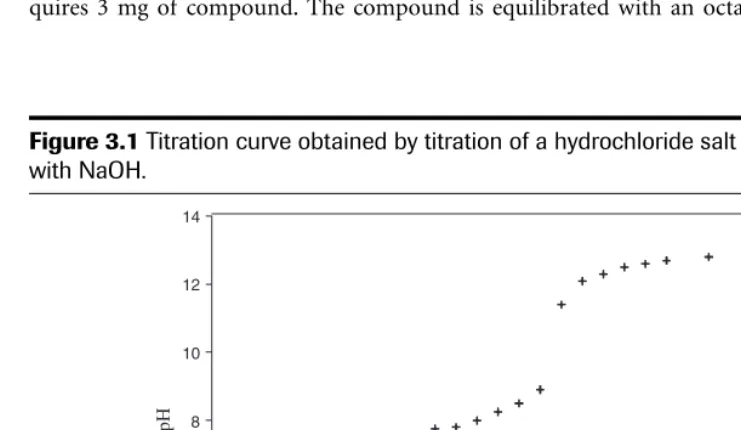
Some methods used in the determination of ionization constants are shown in Table 3.2. Figure 3.1 shows the curve obtained from the titration of a hydrochloride salt with sodium hy-droxide. The pKaobtained from this experiment was 7.9.
If a compound is poorly soluble in water, the pKamay be difficult to measure. One way around this problem is to measure the apparent pKaof the compound in solvent and water mixtures and then extrapolate the data back to a purely aqueous medium using a Yasuda-Shedlovsky plot. The organic solvents most frequently used are methanol, ethanol, propanol, dimethylsulphoxide (DMSO), dimethyl formamide (DMFA), acetone and tetrahydrofuran (THF). However, methanol is by far the most popular because its properties are closest to water. A validation study in water-methanol mixtures has been reported by Takács-Novák et al. (1997) and the determination of the pKas of ibuprofen and quinine in a range of organic solvent–water mixtures has been reported by Avdeef et al. (1999).
If the compound contains an ultraviolet (UV) chromophore that changes with the extent of ionization, then a method involving UV spectroscopy can be used. This method involves measuring the UV spectrum of the compound as a function of pH. Mathematical analysis of
%ionization
pH p a
=
+
(
-)
100
1 K
pH p log[A
[HA]
a
–
Table 3.2
Some reported methods for the determination of pK as.
Method Reference
Potentiometric titration Rosenberg and Wagenknecht (1986)
UV spectotroscopy Asuero et al. (1986)
Solubility measurements Zimmerman (1986a, 1986b)
HPLC techniques Gustavo González (1993)
Capillary zone electrophoresis Chauret et al. (1995)
Foaming activity Alverez Núñez and Yalkowsky (1997)
the spectral shifts can then be used to determine the pKa(s) of the compound. This method is most suitable for compounds in which the ionizing group is close to or actually within an aro-matic ring, which usually results in large UV shifts upon ionization.
The pKaof a compound may be estimated using ACDpKa software, which also contains a large database of measured pKadata. The use of the computer program SPARC (scalable processor architecture) for estimating the pKaof pharmaceuticals has been described by Hilal et al. (1996).
The UV method requires only 1 mg of compound, and the potentiometric method re-quires 3 mg of compound. The compound is equilibrated with an octanol/aqueous buffer
0 20 40 60 80 100 120
pH
2 4 6 8 10 12 14
Volume of NaOH Added (mL)
mixture for 30 min, and the resulting emulsion is centrifuged to separate the two constituent phases. Once separated, the concentration of each layer is determined by high performance liquid chromatography (HPLC) and log D/log Pis calculated. Bearing in mind the drive to de-termine the maximum amount of information from the minimum quantity of compound, Morgan et al. (1998) have developed microscale titrimetric and spectrophotometric methods for determination of the pKaand log Ps of candidate drugs (see next section).
The Partition and Distribution Coefficients
The relationship between chemical structure, lipophilicity and its disposition in vivohas been reviewed by a number of authors (e.g., Koehler et al. 1988). It has been shown that many bi-ological phenomena can be correlated with this parameter, such that “quantitative structure activity relationships” (QSARs) may be deduced. These include solubility, absorption poten-tial, membrane permeability, plasma protein binding, volume of distribution and renal and hepatic clearance.
The lipophilicity of an organic compound is usually described in terms of a partition co-efficient, log P, which can be defined as the ratio of the concentration of the unionized com-pound, at equilibrium, between organic and aqueous phases:
(3)
It is worth noting that this is a logarithmic scale, therefore, a log P = 0 means that the compound is equally soluble in water and in the partitioning solvent. If the compound has a log P= 5, then the compound is 100,000 times more soluble in the partitioning solvent. A log P = –2 means that the compound is 100 times more soluble in water, i.e., it is quite hydrophilic.
LogPvalues have been studied in approximately 100 organic liquid–water systems. Since it is virtually impossible to determine log Pin a realistic biological medium, the octanol-water system has been widely adopted as a model of the lipid phase (Leo et al. 1971). Whilst there has been much debate about the suitability of this system (see, e.g., Dearden and Bres-nen 1988), it is the most widely used in pharmaceutical studies. Octanol and water are im-miscible, but some water does dissolve in octanol in a hydrated state. This hydrated state contains 16 octanol aggregates, with the hydroxyl head groups surrounded by trapped aque-ous solution. Lipophilic (unionized) species dissolve in the aliphatic regions of the octanol, whilst ionized species (see below) are drawn to the polar regions (Franks et al. 1993). The partitioning of solutes in different solvent systems has been reported by El-Tayar et al. (1991).
The most common method for determining partition and distribution coefficients is the shake flask method. In this technique, the candidate drug is shaken between octanol (previ-ously shaken together to presaturate each phase with the other) and water layers, from which an aliquot is taken and analyzed using UV absorption, HPLC or titration. In terms of experi-mental conditions, the value of the partition coefficient obtained from this type of experiment is affected by such factors as temperature, insufficient mutual phase saturation, pH and buffer ions and their concentration, as well as the nature of the solvents used and solute examined (Dearden and Bresnen 1988).
The role of log Pin absorption processes occurring after oral administration has been dis-cussed by Navia and Chaturvedi (1996). Generally, compounds with log P values between
log [unionized compound] [unionized compound]
P org
aq
1 and 3 show good absorption, whereas those with log Ps greater than 6 or less than 3 often have poor transport characteristics. Highly non-polar molecules have a preference to reside in the lipophilic regions of membranes, and very polar compounds show poor bioavailability be-cause of their inability to penetrate membrane barriers. Thus, there is a parabolic relationship between log Pand transport, i.e., candidate drugs that exhibit a balance between these two properties will probably show the best oral bioavailability.
The partition coefficient refers to the intrinsic lipophilicity of the drug, in the context of the equilibrium of unionized drug between the aqueous and organic phases. As we noted in the last section, if the drug has more than one ionization centre, the distribution of species present will depend on the pH. The concentration of the ionized drug in the aqueous phase will therefore have an effect on the overall observed partition coefficient. This leads to the def-inition of the distribution coefficient (log D) of a compound, which takes into account the dissociation of weak acids and bases. For a weak acid this is defined by
(4)
It can be seen that combining this equation with equation 1 gives an equation relating the dis-tribution to the intrinsic lipophilicity (log P), the pKaof the molecule and the pH of the aque-ous phase:
(5)
Figure 3.2 shows the effect of ionization on the partitioning of a proton pump inhibitor compound. This compound has a log Pof 3.82 and three pKas, i.e.,ⱕ1, 5.26 and 8.63. At low pH, both the benzimidazole and diethylamine nitrogens are protonated, and hence the ten-dency of the compound is to reside in the aqueous phase. As the pH increases, deprotonation of the protonated nitrogen of the benzimidazole takes place; as the compound is less ionized, the compound resides more in the octanol phase. At neutral pH, deprotonation of the di-ethylamine nitrogen renders the molecule neutral, and hence its lipophilicity is at a maximum. A further increase in the pH results in deprotonation of the second nitrogen to form an anion which, being ionized, is more hydrophilic, resulting in a decrease in log D.
HPLC techniques have also been used in the determination of log Pvalues. Lambert et al. (1990), for example, have described the development of a preformulation lipophilicity screen utilizing a C18derivatized HPLC column. They appeared to prefer this column to the tradi-tional reverse-phase HPLC columns, which may yield a poor correlation between log Pand the capacity factor (k⬘). A potential problem with the use of HPLC retention data is that i