PREFORMULATION STUDIES:
PHYSICOCHEMICAL CHARACTERIZATION OF NEW DRUG MOLECULES
Ms. Pratiksha Jayaswal Assistant Professor
CONTENTS
1
Introduction
2
Major area of preformulation research
a)
Organoleptic characters
b)
Bulk characterization
c)
Solubility characters
d)
Stability characters
3
Conclusion
PREFORMULATION
It is defined as the phase of research and development in
which preformulation studies characterize physical and
chemical properties of a drug molecule in order to
develop safe, effective and stable dosage form.
OBJECTIVES
To establish the physico-chemical parameters of a new drug entity To determine its kinetics and stability
To establish its compatibility with common excipients
It provides insights into how drug products should be processed and stored to ensure their quality
Major Area of Preformulation Research
➢ ORGANOLEPTIC CHARACTERS
➢ BULK CHARACTERS
❑ Crystallinty and polymorphism
❑ Hygroscopicity
❑ Fine particle characterization
❑ Powder flow properties
➢ SOLUBILITYANALYSIS
❑ ionization constant-PKa
❑ pH solubility profile
❑ Common ion effect-Ksp
❑ Thermal effects
❑
Solubilization
❑
Partition co-efficient
❑
Dissolution
➢
STABILITYANALYSIS
❑
Stability in toxicology formulations
❑
Solution stability
❑
pH rate profile
❑
Solid state stability
❑
Bulk stability
❑
Compatibility
ORGANOLEPTIC CHARACTERS
❖ Colour,odour, taste of the new drug must be recorded
COLOUR ODOUR TASTE
❑Off-white ❑pungent ❑Acidic
❑Cream yellow ❑sulphurous ❑Bitter
❑tan ❑Fruity ❑Bland
❑shiny ❑Aromatic ❑Intense
❑Odourless ❑Sweet
❑Tasteless
BULK CHARACTERIZATION Crystallinity
affect bulk &
Crystal habit & internal structure of drug can physicochemical property of molecule.
Crystal habit is description of outer appearance of crystal.
Internal structure is molecular arrangement within the solid.
Change with internal structure usually alters crystal habit.
Eg. Conversion of sodium salt to its free acid form produce both change in internal structure & crystal habit.
Different shapes of crystals
Different shapes of crystals
Depending on internal structure compounds is classified as 1. Crystalline
2. Amorphous
Crystalline compounds are characterized by repetitious spacing of constituent atom or molecule in three dimensional array.
In amorphous form atom or molecule are randomly placed.
Solubility & dissolution rate are greater for amorphous form than crystalline, as amorphous form has higher thermodynamic energy.
Eg. Amorphous form of Novobiocin is well absorbed whereas
Polymorphism
It is the ability of the compound to crystallize as more than one distinct crystalline species with different internal lattice.
Different crystalline forms are called polymorphs.
Polymorphs are of 2 types 1. Enatiotropic
2. Monotropic
The polymorph which can be changed from one form into another by varying temp or pressure is called as Enantiotropic polymorph.
Eg. Sulphur.
One polymorph which is unstable at all temp. & pressure is called as Monotropic polymorph.
Polymorphs differ from each other with respect to their physical property such as
• Solubility
• Melting point
• Density
• Hardness
• Compression characteristic
Eg. 1)Chloromphenicol exist in A,B & C forms, of these B form is more stable & most preferable.
Polymorphism
ANALYTICAL METHODS FOR THE
CHARACTERIZATION OF SOLID FORMS
Microscopy
Hot stage microscopy Thermal analysis
X-ray diffraction
Infrared (IR) spectroscopy
Proton magnetic resonance (PMR)
Nuclear magnetic resonance (NMR)
Scanning electron microscopy (SEM)
Microscopy
Material with more than one refractive index are anisotropic & appear bright with brilliant colors against black polarized background.
The color intensity depends upon crystal thickness.
Isotropic material have single refractive index and this substance do not transmit light with crossed polarizing filter and appears black.
Advantage :
By this method, we can study crystal morphology & difference between polymorphic form.
Disadvantage :
This require a well trained optical crystallographer, as there are many possible crystal habit & their appearance at different orientation.
Hot stage microscopy
The polarizing microscope fitted with hot stage is useful for investigating polymorphism, melting point & transition temp.
Disadvantage :
In this technique, the molecules can degrade during the melting process.
Thermal analysis
Differential scanning calorimetry (DSC) & Differential thermal analysis are (DTA) are particularly useful in the investigation of polymorphism.
It measures the heat loss or gain resulting from physical or chemical changes within a sample as a function of temp.
For characterizing crystal forms , the heat of fusion can be obtained from the area under DSC- curve for melting endotherms.
Similarly, heat of transition from one polymorph to another may be calculated.
A sharp symmetric melting endotherm can indicate relative purity of molecule.
X-ray diffraction
Working :
When beam of nonhomogenous X-ray is allow to pass through the crystal, X-ray beam is diffracted & it is recorded by means of photographic plate.
Diffraction is due to crystal which acts as 3 dimensional diffraction grating toward X-ray.
Random orientation of crystal lattice in the powder causes the X-ray to scatter in a reproducible pattern of peak intensities.
The diffraction pattern is characteristic of a specific crystalline lattice for a given compound.
An amorphous form does not produce a pattern mixture of different crystalline forms.
Single – Crystal x-ray provide the most complete information
about the solid state.
HYGROSCOPICITY
Many drug substances, particularly water –soluble salt forms, have a tendency to adsorb atmospheric moisture.
Adsorption and moisture content depend upon the atmospheric humidity, temperature, surface area, exposure and the mechanism of moisture uptake.
The degree of Hygroscopicity is classified into four classes:
✓ Slightly hygroscopic: increase in weight is ≥ 0.2% w/w and < 2% w/w
✓ Hygroscopic : increase in weight is ≥ 0.2 % w/w and < 15 % w/w
✓ Very hygroscopic : increase in weight is ≥ 15% w/w
✓
Hygroscopicity is tested by:
Samples are exposed to the moisture
exposed to controlled relative humidity environments moisture uptake is monitored at different time points Analytical methods which is used are :
✓ Gravimetry
✓ Karl Fischer Titration
✓ Gas chromatography
PARTICLE SIZE
Particle size is characterized using these terms :
Very coarse, Coarse, Moderately coarse, Fine ,Very fine .
Particle size can influence variety of important factors : - Dissolution rate
- Suspendability
- Uniform distribution
- Penetrability
Methods to Determine Particle Size
Sieving (5µ-150µ)
Microscopy(0.2µ-100µ)
Sedimentation rate method(1µ-200µ)
Light energy diffraction(0.5µ-500µ)
Laser holography(1.4µ-100µ)
POWDER FLOW PROPERTIES
➢
Powder flow properties can be affected by change in particle size, shape & density.
➢
The flow properties depends upon following-
1.
Force of friction.
2.
Cohesion between one particle to another.
➢
Fine particle posses poor flow by filling void spaces between larger particles causing packing & densification of particles.
➢
By using glident we can alter the flow properties.
Determination of Powder Flow Properties
➢ By determining Angle of Repose.
➢ A greater angle of repose indicate poor flow.
➢ It should be less than 30°. & can be determined by following equation.
tan θ = h/r.
where, θ = angle of repose.
h=height of pile.
r= radius.
Angle of Repose ( In degree)
Type of Flow
<25 Excellent
25-30 Good
30-40 Passable
>40 Very poor
Methods to determine angle of repose
➢ Static angle of repose
Fixed-funnel method
Fixed-cone method
➢ Kinetic or dynamic method
Rotating cylinder
method
flowing powder by
➢ Measurement of free compressibility.
➢ Also known as Carr's index.
X 100 CARR’S INDEX(%) =(TAPPED DENSITY – POURED DENSITY)
TAPPED DENSITY
➢ It is simple, fast & popular method of predicting powder flow characteristics.
Determination of Powder Flow Properties
Carr’s Index Type of flow
5-15 Excellent
12-16 Good
18-21 Fair To Passable
23-35 Poor
33-38 Very Poor
>40 Extremely Poor
Determination of Powder Flow Properties
SOLUBILITY STUDIES
❖ Table: Solubility based classificati n of drug
1. Solution phase equilibrium with solid phase at a stated temperature and pressure .
2. Determines amount of drug dissolved , amount of drug available for absorption.
3. Solubility reduction is carried out in certain conditions:
❖ Enhancement of chemical stability.
❖ taste masking products.
❖ Production of sustained release products.
Descriptive term Parts of solvent required for 1 part of o solute
Very soluble Freely soluble Soluble
Sparingly soluble Slightly soluble
Less than 1 From 1 to 10 From 10 to 30 From 30 to 100 From 100 to 1000
The equilibrium solubility is based on the phase-solubility technique proposed by Higuchi-Connors .
Method
Drug dispersed in solvent in a closed container
agitated at a constant temperature using shakers
samples of the slurry are withdrawn as a function of time
clarified by centrifugation and assayed by HPLC, UV, GC etc
pKa determination
pKa is the dissociation constant of a drug
The un-ionized drug is lipid soluble thus permeates through lipid membrane.
The ionized substance is lipid insoluble therefore permeation is slow Degree of ionization depends on pH
Henderson-Hasselbalch equation For basic compounds:
For acidic compounds:
[ionized]
[un−ionized]
pH = pKa +
pH = pKa+[un−ionized]
[ionized]
1 0
(p H − p K a)%i o n i z e d =
1
+1 0
( p H − p K a)Determined by uv spectroscopy, potentiometric titration, titrimetric
SOLUBILIZATION
“Solubilization is defined as the spontaneous passage of poorly water soluble solute molecules into an aqueous solution of a
soap or detergent in which a solution is thermodynamically stable
formed ”.
➢It is the process by which apparent solubility of an otherwise sparingly soluble substance is increased by the presence of surfactant micelles .
❑ MICELLES: -
➢ The mechanism involves the property of surface active agents to form colloidal aggregates known as micelles .
➢ When surfactants are added to the liquid at low concentration they tend to orient at the air-liquid interface .
➢ On further addition of surfactant the interface becomes completely occupied and excess molecules are forced into the bulk of liquid.
➢At very high concentration surfactant molecules in the bulk of liquid begin to form micelles and this concentration is know as CRITICAL MICELLE CONCENTRATION (CMC)
➢ Addition of co-solvent
➢ pH change method
➢ Reduction of particle size
➢ Temperature change method
➢ Hydotrophy
➢ Addition of Surfactant
➢ Dielectrical Constant
➢ Complexation
General Method of Increasing
the Solubility
Partition Coefficient
A measurement of drug lipophilicity i,e the ability to cross the cell membrane
Distribution coefficient
For acids:
For bases :
The octanol-water system is widely accepted to explain these phenomenon.
Buccal membrane : butanol-pentanol system Blood-Brain barrier: chloroform-cyclohexane
p
=c
o rg a n icc
a q u e o u s o/a(pH−pKa)
(1+10 )
log D = log P − log
10 10 10
p K a−p H
(1 +1 0 )
l o g D = l o g P − l o g
1 0 1 0 1 0
SHAKE FLASK METHOD
Drug is shaken between octanol and water.
Aliquot is taken and analyzed for drug content
RULE OF FIVE : for drug permeates through passive diffusion
1. Log P is greater than 5
2. Molecular weight >500
3. There are more than 5 hydrogen bond donors (number of NH + OH)
4. There are more than 10 hydrogen bond acceptors (number of hydrogen + oxygen )
5. Molar refractivity should be between 40-130
DISSOLUTION
When Kd << Ka ,dissolution is significantly slower and the absorption is described as dissolution-rate limited.
Solid drug in the G.I Fluid
Drug in solution in the G.I fluid
Drug systemic circulation
K
dK
aRate constant of
dissolution
Rate constant of
absorption
dt hV
SdC DA
= ( C − C )
The dissolution rate of drug substance in which surface area is constant during dissolution is described by Noyes-Whitney equation.
dC/dt=dissolution rate
h=diffusion layer thickness
C=solute concentration in bulk solution V=volume of the dissolution medium D=diffusion coefficient
A=surface area of the dissolving solid
Cs=solute concentration in the diffusion
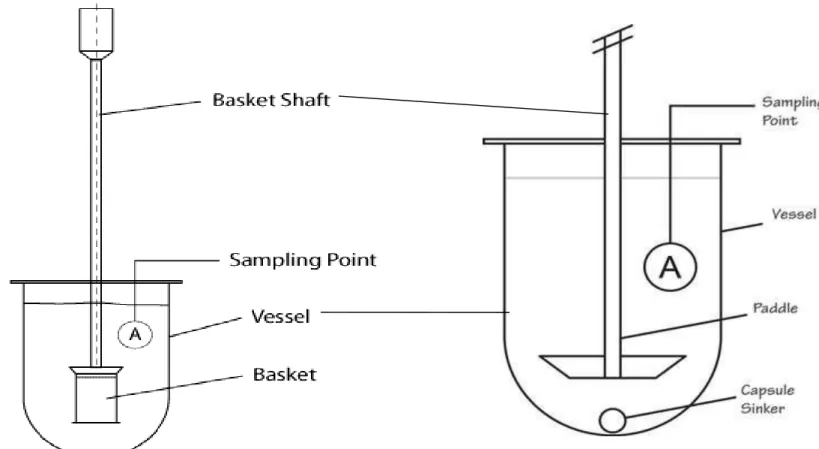
Constant surface area is obtained by compressing powder into a disc of known area with a die and punch apparatus.
Hydrodynamic conditions are maintained with Static-disc dissolution apparatus and Rotating disc apparatus
fig : static dissolution apparatus and rotating disc apparatus
STABILITY ANALYSIS
1. Solution stability
2. Solid state stability
SOLUTION STABILITY
▪ The decomposition of drug occurs through hydrolysis, oxidation, photolysis.
➢ Hydrolysis (anaesthetics, vitamins etc )
a) Ester hydrolysis
RCOOH + ROH acid alcohol R’-COOR + H+ + OH-
ester
b) Amide hydrolysis
RCONHR’ + H+ + OH- amide
RCOOH + H2N-R’
acid amine
➢ Oxidation
used to evaluate the stability of pharmaceutical preparations Eg : steroids, vitamins, antibiotics, epinephrine
Autoxidation
Materials + molecular oxygen homolytic fission Free radicals are produced.
Oxygen sensitivity is measured by bubbling air through the compound or adding hydrogen peroxide.
➢ Photolysis
pharmaceutical compounds
exposure to uv light
absorbs the radiant energy undergoes degradative reactions
SOLID-STATE STABILITY
1o objective: identification of stable storage conditions.
identification of compatible excipients.
Solid-State Stability profile of a new compound
Samples are placed in open vials and are exposed directly to a variety of temperatures, humidities, and light intensities for up to 12 weeks.
Vials exposed to oxygen and nitrogen to study the surface oxidation and chemical stability , polymorphic changes and discolouration.
Stability data obtained at various humidities may be linearized with respect to moisture using the following apparent decay rate constant (KH )
k
H= [ gpl]. k
0gpl= concentration of water in atmosphere in units of grams of water per liter of dry air .
Mole fraction of the solid that has liquefied (F
m) is directly proportional to its decay rate.
T T
mm
app R
−
H
fus 1 1=
[
−]
ln k
ln F
H
fus-molar heat of fusion
T
m- absolute melting point
T - absolute temperature
R - gas constant
Drug- excipient compatibility
Compatibility test play a very important role in the preformulation studies of oral dosage forms
An incompatibility in the dosage form can result in any of the following changes:
➢ Changes in organoleptic properties
➢ Changes in dissolution performance
➢ Physical form conversion
➢ An decrease in potency
METHOD
Drug + Excipients (1:1)
Powder samples dispersed into glass ampoules
1 ampoule 1 ampoule (sample + water)
stored at a particular temperature (500 C) andanalysed In emulsions the studies include measuring the critical micelle concentration of the formulations
For oral use preparations compatibility of the ingredients (ethanol, glycerine, syrup, sucrose, buffers and preservatives)
CONCLUSION
Preformulation studies on a new drug molecule provide useful information for subsequent formulation of a physicochemically stable and biopharmaceutically suitable dosage form.
Preformulation work is the foundation of developing
efficacious and economical formulations.
REFERENCE
Leon Lachman, Liberman. The theory and practice of Industrial pharmacy, Edn 4. CBS publishing house, New Delhi.2013 p:217-307.
Banker GS, Rhodes CT. Modern pharmaceutics, Edn 4.
Marcel Dekker, New York. 2002 p:167-184.
Loyd V. Allen, Nicholas G.popovich, Howard C. Ansel.
Ansel’s pharmaceutical Dosage forms & Drug delivery systems, Edn 8. B.I.Publication pvt. Ltd, p:187-193,42
& 43,126-133.
Brahmankar D.M, Jaiswal BS. Biopharmaceutics
and pharmacokinetics a Treatise, Edn 2. Vallabh