1 st ASI AN PH Y SI CS OLY M PI AD
K ARAWACI , I N DON ESI A
T H EORET I CAL COM PET I T I ON
APRI L 2 5 , 2 0 0 0
T im e a va ila ble : 5 hours
T his se t of proble m s c onsist s of …. pa ge s
READ THIS FIRST :
1. Use only the pen provided.
2. Use only the marked side of the paper
3. Each problem should be answered on separate sheets 4. In your answers please user primarily symbols, equations,
numbers, graphs, tables and as little text as possible. 5. Write at the top of every sheet in your report:
• Your candidate number (APhO identification number).
• The problem number and section identification, e.g.2/a.
• Number each sheet consecutively.
1
Proble m 1
Ec lipse s of t he J upit e r’s Sa t e llit e
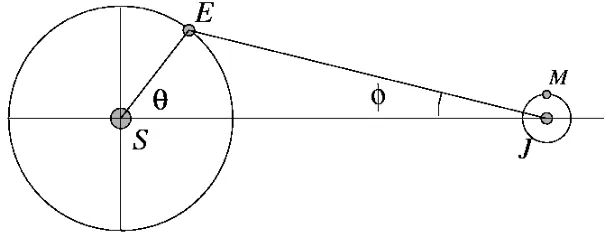
A long time ago before scientists could measure the speed of light accurately, O Römer, a Danish astronomer studied the time eclipses of the Jupiter’s satellite. He was able to determine the speed of light from observed periods of a satellite around the planet Jupiter. Figure 1 shows the orbit of the earth E around the sun S and one of the satellites M around the planet Jupiter. (He observed the time spent between two successive emergences of the satellite M from behind Jupiter).
A long series of observations of the eclipses permitted an accurate evaluation of the period of M. The observed period T depends on the relative position of the earth with respect to the frame of reference SJ as one of the coordinate axes. The average time of revolution is T0 = 42h 28 m 16s and maximum observed period is ( T0 + 15)s.
Figure 1 : The orbits of the earth E around the sun and a satellite M around Jupiter J. The average distance of the earth E to the Sun is RE = 149.6 x 10⁶ . The maximum distance is
RE,max = 1.015 RE. The period of revolution of the earth is 365 days and of Jupiter is 11.9
years. The distance of the satellite M to the planet Jupiter RM= 422 x 103 km.
a. Use Newton’s law of gravitation to estimate the distance of Jupiter to the Sun. Determine the relative angular velocity ω of the earth with respect to the frame of reference Sun-Jupiter (SJ). Calculate the speed of the earth with respect to SJ.
b. Take a new frame which Jupiter is at rest with respect to the Sun. Determine the relative angular velocity ω of the earth with respect to the frame of reference Sun-Jupiter ( SJ). Calculate the speed of the earth with respect to SJ.
c. Suppose an observed saw M begin to emerge from the shadow when his position was at
2
d. Derive the relation between d ( t k ) and T ( t k ). Plot period T ( t k ) as a function of time of observation t k. Find the positions of the earth when he observed maximum period, minimum period and true period of the satellite M.
e. Estimate the speed of light from the above result. Pont out sources of errors of your estimation and calculate the order of magnitude of the error.
3
Proble m 2
De t e c t ion of Alpha Pa rt ic le s
We are constantly being exposed to radiation, either natural or artificial. With tha advance of nuclear power reactors and utilization of radioisotopes in agriculture, industry, biology and medicine, the number of man made prepared (artificial) radioactive sources is also increasing every year. One type of the radiation emitted by radioactive materials is alpha (α) particles (doubly ionized helium atom having two units of positive charge and four units of nuclear mass).
The detection of α particles by electrical means is based on their ability to produce ionization when passing through gas and other substance. For α particle in air at normal (atmospheric) pressure, there is an empirical relation between the mean range Rα and its energy E
Rα = 0.318 Ε 3/2 ( 1 )
Where Rα is measured in cm and E in MeV.
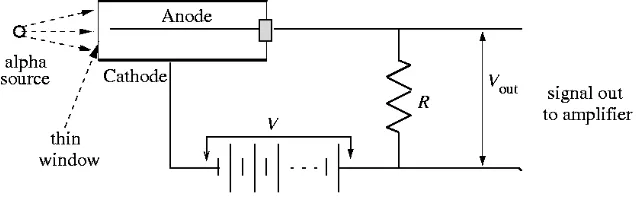
For monitoring α radiation, one can use an ionization chamber, which is a gas-filled detector that operates on the principle of separation of positive and negative charges created during the ionization of gas atoms by the α particle. The collection of charges yields a pulse that can be detected, amplified and then recorded. The voltage difference between anode and cathode is kept sufficiently high so that there is a negligible amount of recombination of charges during their passage to the anodes.
4
a. An ionization chamber electrometer system with a capacitance of 45 picofarad is used to detect α particles having a range Rα of 5.50 cm. Assume the energy required to produce an ion-pair (consisting of a light negative electron and a heavier positive ion, each carrying one electronic charges of magnitude e = 1.60 x 10⁻¹⁹ Coulomb) in air is 35 eV. What will be the magnitude of the voltage produced by each α particle?
b. The voltage pulses due to the α particle of the above problem occur across a resistance R. The smallest detectable saturation current (a condition where the current is more or less constant, indicating that the charge is collected at the same rate at which it is being produced by the incident α particle) with this instrument is 10-12 ampere. Calculate the lowest activity A (disintegration rate of the emitter radioisotope) of the α source that could be detected by this instrument if the range Rα is 5.50 cm assuming a 10 % efficiency for the detector geometry.
c. The above ionization chamber is to be used for pulse counting with a time constant τ = 10-3 seconds. Calculate the resistance and also the necessary voltage pulse amplification required to produce 0.25 V signal.
d. Ionization chamber has geometry such as cylindrical counter, the central metal wire (anode) and outer thin metal sheath (cathode) have diameter d and D, respectively. Derive the expression for the electric field E(τ ) and potential V (τ ) at a radial distance
2 2
d D
with
τ ≤ ≤τ
from the central axis when the wire carries a charge per unit length λ. Then deduce the capacitance per unit length of the tube. The breakdown field strength of air E b is 3 MV m-1 (breakdown field
strengths greater than E b , maximum electric field in the substance ). If d=1 mm
and D = 1 cm , calculate the potential difference between wire and sheat at which breakdown occurs.
Data : 1 MeV = 106 eV ; 1 picoFarad = 10-12 F ; 1 Ci = 3.7 x 10¹⁰ disintegration/second = 106 µ Ci ( Curie, the fundamental SI unit of activity A );
ln
dr
r = τ +C
5
Proble m 3
St e w a rt -T olm a n Effe c t
In 1917, Stewart and Tolman discovered a flow of current through a coil wound around a cylinder rotated axially with certain angular acceleration.
Consider a great number of rings, with the radius τ each, made of a thin metallic wire with resistance R. The rings have been put in a uniform way on very long glass cylinder, which is vacuum inside. Their positions on the cylinder are fixed by gluing the rings to the cylinder. The number of rings per unit of length along the symmetry axis is n. The planes containing the rings are perpendicular to the symmetry axis of the cylinder.