CIRCLE
A circle is a simple shape of Euclidean geometry that is the set of all points in a plane that are at a given distance from a given point, the centre. The distance between any of the points and the centre is called the radius. It can also be defined as the locus of a point equidistant from a fixed
point.
A circle is a simple closed curve which divides the plane into two regions: an interior and an exterior. In everyday use, the term "circle" may be used interchangeably to refer to either the boundary of the figure, or to the whole figure including its interior; in strict technical
usage, the circle is the former and the latter is called a disk.
A circle can be defined as the curve traced out by a point that moves so that its distance from a given point is constant.
A. Terminology
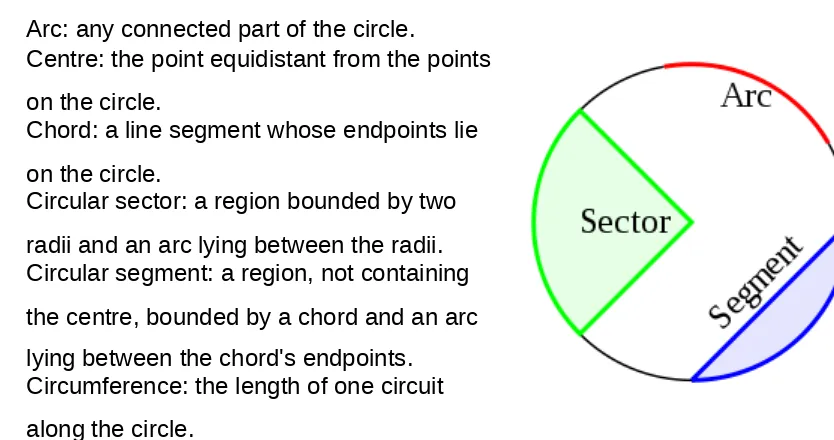
Arc: any connected part of the circle.
Centre: the point equidistant from the points
on the circle.
Chord: a line segment whose endpoints lie
on the circle.
Circular sector: a region bounded by two
radii and an arc lying between the radii. Circular segment: a region, not containing
the centre, bounded by a chord and an arc lying between the chord's endpoints. Circumference: the length of one circuit
along the circle.
Diameter: a line segment whose endpoints lie on the circle and which passes
distance between any two points on the circle. It is a special case of a chord, namely the longest chord, and it is twice the radius.
Passant: a coplanar straight line that does not touch the circle.
Radius: a line segment joining the centre of the circle to any point on the circle
itself; or the length of such a segment, which is half a diameter.
Secant: an extended chord, a coplanar
straight line cutting the circle at two points. Semicircle: a region bounded by a
diameter and an arc lying between the diameter's endpoints. It is a special case of a circular segment, namely the largest one.
Tangent: a coplanar straight line that touches the circle at a single point.
B. Analytic results
Arc Length
By the same reasoning, the arc length (of a Sector or Segment) is:
L = θ × r (when θ is in radians)
L = (θ × π/180) × r (when θ is in degrees)
Length of circumference Further information: Circumference
Area enclosed
As proved by Archimedes, the area enclosed by a circle is equal to that of a triangle whose base has the length of the circle's circumference and whose height equals the circle's radius,[7] which comes to π multiplied by the radius squared:
Equivalently, denoting diameter by d,
that is, approximately 79 percent of the circumscribing square (whose side is of length d).
The circle is the plane curve enclosing the maximum area for a given arc length. This relates the circle to a problem in the calculus of variations, namely the isoperimetric inequality.
Sector of a Circle (fractional part of the area)
2. where CS is the arc length of the sector.
Segment of a Circle Area of Segment
The Area of a Segment is the area of a sector minus the triangular piece (shown in light blue here)
There is a lengthy reason, but the result is a slight modification of the Sector formula:
Area of Segment = ½ × ( (θ × π/180) - sin θ) × r2 (when θ is in degrees).
C. Equation
Cartesian coordinates
This equation, also known as Equation of the Circle, follows from the Pythagorean theorem applied to any point on the circle: as shown in the diagram to the right, the radius is the hypotenuse of a right-angled triangle whose other sides are of length x − a and y − b. If the circle is centred at the origin (0, 0), then the equation simplifies to
The equation can be written in parametric form using the trigonometric functions sine and cosine as
where t is a parametric variable in the range 0 to 2
π
, interpreted geometrically as the angle that the ray from (a, b) to (x, y) makes with thex-axis.An alternative parametrisation of the circle is:
In this parametrisation, the ratio of t to r can be interpreted geometrically as
the stereographic projection of the line passing through the centre parallel to the x-axis: (see Tangent half-angle substitution).
In homogeneous coordinates each conic section with equation of a circle is of the form
Polar coordinates
In polar coordinates the equation of a circle is:
where a is the radius of the circle, is the polar coordinate of a generic point on
the circle, and is the polar coordinate of the centre of the circle (i.e., r0 is the
distance from the origin to the centre of the circle, and φ is the anticlockwise angle from the positive x-axis to the line connecting the origin to the centre of the circle).
For a circle centred at the origin, i.e. r0 = 0, this reduces to simply r = a. When r0 = a,
or when the origin lies on the circle, the equation becomes
In the general case, the equation can be solved for r, giving
the solution with a minus sign in front of the square root giving the same curve.
Complex plane
In the complex plane, a circle with a centre at c and radius (r) has the equation . In parametric form this can be written .
The slightly generalised equation for real p, q and complex g is sometimes called a generalised circle. This becomes the above
equation for a circle with ,
since . Not all generalised circles are actually circles: a generalised circle is either a (true) circle or aline.
Tangent lines
The tangent line through a point P on the circle is perpendicular to the diameter passing through P. If P = (x1, y1) and the circle has centre (a, b) and radius r, then the
tangent line is perpendicular to the line from (a, b) to (x1, y1), so it has the
form (x1 − a)x + (y1 – b)y = c. Evaluating at (x1, y1) determines the value of c and the
or
If y1 ≠ b then the slope of this line is
This can also be found using implicit differentiation.
When the centre of the circle is at the origin then the equation of the tangent line becomes
and its slope is