URBAN DESIGN:
URBAN DESIGN:
STREET AND SQUARE
Third Edition
Cliff Moughtin
AMSTERDAM BOSTON HEIDELBERG LONDON NEW YORK OXFORD PARIS
An imprint of Elsevier Science
Linacre House, Jordan Hill, Oxford OX2 8DP 200 Wheeler Road, Burlington, MA 01803
First published 1992 Reprinted 1995 Second Edition 1999 Reprinted 2001 Third edition 2003
Copyright © 2003, Cliff Moughtin. All rights reserved
The right of Cliff Moughtin to be identified as the author of this work has been asserted in accordance with the Copyright, Designs and Patents Act 1988
No part of this publication may be reproduced in any material form (including photocopying or storing in any medium by electronic means and whether or not transiently or incidentally to some other use of this publication) without the written permission of the copyright holder except in accordance with the provisions of the Copyright, Designs and Patents Act 1988 or under the terms of a licence issued by the Copyright Licensing Agency Ltd, 90 Tottenham Court Road, London, England W1T 4LP. Applications for the copyright holder’s written permission to reproduce any part of this publication should be addressed to the publisher.
Permissions may be sought directly from Elsevier’s Science and Technology Rights Department in Oxford, UK: phone: (+44) (0) 1865 843830; fax (+44) (0) 1865 853333; e-mail: [email protected]. You may also complete your request on-line via the Elsevier homepage (www.elsevier.com), by selecting ‘Customer Support’ and then ‘Obtaining Permission’.
British Library Cataloguing in Publication Data
A catalogue record for this book is available from the British Library
Library of Congress Cataloguing in Publication Data
A catalogue record for this book is available from the Library of Congress
ISBN 0 7506 57170
For information on all Architectural Press publications visit our website at www.architecturalpress.com
v
CONTENTS
Preface to the First Edition ...
vii
Preface to the Second Edition ...
ix
Preface to the Third Edition ...
xi
Acknowledgements ...
xiii
Introduction ...
1
1 Urban Design and People ...
11
2 Basic Design Concepts ...
25
3 Towns and Buildings ...
63
4 The Square or Plaza ...
87
5 Streets ... 127
6 Seafront, River and Canal ... 171
7 Sustainable Urban Form ... 189
8 Visual Analysis ... 209
10 Conclusion ... 277
Bibliography ... 283
Figure Sources ... 293
My interest in urban design began in the mid 1950s with Professor McCaughan’s history of planning lectures given in the then Department of Civic Design, University of Liverpool. At those lectures ‘Mac’ made it quite clear that he was a follower of Camillo Sitte, a Viennese architect whose main work dated from the last decade of the nineteenth century. After a five-year education in architecture where the heroic dimension of modern architecture was stressed, it came as a refreshing tonic to read the works of a scholar, Sitte, who analysed urban form to distil from it the principles of good design. After Sitte, the writings of Le Corbusier and those of like mind could be seen for what they were – polemical manifestos. This is not meant to denigrate the work of Le Corbusier, he is one of the great architects of this century, nothing can destroy that reputation. However, as a planner and urbanist Le Corbusier, and more particularly followers of lesser stature, are responsible for much environmental damage through-out European cities – vandalism would not be too strong a word for such developments.
The early years of my professional career were spent in developing countries, Singapore, Ghana, Nigeria and the Sudan. Those years living and working with people of diverse life-styles gave a
valuable insight into the relationship of built form and culture. Again under the influence of ‘Mac’ I read works in social anthropology and made studies of traditional settlement form and architecture. Walking in Singapore’s China Town or exploring the wonderful mud cities of the Hausa, Nigeria together with readings in anthropology convinced me of the aridity of much contemporary urban design.
From the mid 1960s onwards I worked closely with ‘Mac’, first at Liverpool University, then at the Queen’s University of Belfast and latterly at Notting-ham University. During 25 years ‘Mac’ and I collabo-rated on many European student field trips exploring a rich urban heritage with our students. This book is an introduction to our common European urban design heritage and the reader is advised to visit the places mentioned in the text as the printed word, drawings and photographs are no substitute for the excitement of personal discovery. The following text is a starting point which may help the development of the reader’s own critical faculties and so lead to a greater appreciation of the European street and square.
The need for a book of this type was made apparent to me on my recent visits to universities in the developing world. For example, during a two-month visit to Nairobi University, where I was
teaching the urban studio, I undertook to develop the workshop lectures and seminars into some form of useful publication. Eight years later that task is now complete. Three further volumes on urban
design have now been published entitled Urban Design: Ornament and Decoration, Urban Design: Green Dimensions, Urban Design: Method and Techniques.
This is the preface to the second edition of Urban Design: Street and Square, in which a new chapter, ‘Seafront, River and Canal,’ is incorpor-ated. An additional case study of riverside regenera-tion has been added to the last chapter of the book to illustrate the role of water in urban design. The chapter and its case study are intended to fill a gap in the original text; they are concerned with the design of public space close to urban water-ways.
Urban design is closely linked to both architec-ture and planning, yet is a quite distinct subject area. The main concern of urban design is the design and structuring of public space in cities, towns and also in the smaller settlements that comprise urban regions. In the Introduction to Urban Design: Street and Squareit is maintained that the main component of urban design is the city quarter: ‘Certainly, it could be, and has been, argued that clearly defined city quarters about 1.5 kilo-metres (1 mile) across will be a major preoccupa-tion of urban designers in the coming decade.’ The Introduction does go on to suggest that the urban designer may, nevertheless, be involved in smaller scale developments in street and square. This preface to the second edition reaffirms this defini-tion of the core activity of urban design.
Urban design, however, is a large subject area which this book deals with in part only: it does not pretend to be a manual of good practice in urban design, nor is it prescriptive. The aim of the book is much more modest: it is to examine precedent to see if general principles can be deduced which may at some future date form the basis for a more defini-tive theory of urban design. Until such time the content of this book is presented as part of the ongoing discussion about the nature of this most absorbing art form.
Since the first edition of this book was published there have been, in this country, a number of far reaching developments in the practice of urban design. The Government has prepared or is preparing Planning Policy Guidance and other documents which have elevated urban design to a central position in the process of planning and regeneration. The importance of urban design is also confirmed by the report of Rogers and his Urban Task Force. An alliance of professional bodies with an interest in urban design has been formed which includes The Urban Design Group, the Royal Institute of British Architects, the Royal Town Planning Institute, the Landscape Institute, the Royal Institution of Chartered Surveyors, the Institution of Civil Engineers together with The Civic Trust: the
formation of such a group provides a vehicle to promote and lobby for the recognition and develop-ment of the subject. While much developdevelop-ment in this country still fails to achieve high standards of
urban design there are, nevertheless, notable excep-tions many of which are being documented in Urban Design, the quarterly journal of the Urban Design Group.
Since the publication in 1992 of the first edition of this book there has been considerable development in the understanding and practice of urban design. These developments have been gathering momen-tum since the publication of the second edition in 1999. Many of the ideas in the Report of Lord Rogers and his Urban Task Force Towards an Urban Renaissance, also published in 1999, have been absorbed into Government thinking and may in part be responsible for the recent Planning Green Paper. Ideas in the Green Paper could, if imple-mented, lead to an innovative planning system where urban design is elevated to a central role.
In 2001, Lomberg’s book The Skeptical Environmentalistwas translated into English and published by Cambridge University Press. The optimistic, almost complacent, view of the state of the global environment presented in his book has been rebutted by most of the reputable scientists in the field. Nevertheless, this thought-provoking book and its assessment that conditions on earth are generally improving for human welfare, has encour-aged those advocating an ‘environmental free for all’, particularly those to the right of American politics. Fortunately, here in Britain and indeed in Europe, sustainable development still seems to be a goal of urban planning. In his response to some of
the criticisms of the Green Paper, Lord Faulkner promised to give more weight to sustainability as a goal of development in a future planning agenda. This book, and the others in the series, will continue to advocate ‘the precautionary principle’ as a guide for environmental design; this principle is fundamental to the theory of sustainable develop-ment. Until the Scientific Community decides other-wise it is sensible to propose development strategies, which reduce, as far as possible, the pressures on a fragile global environment.
The types of development and planning tasks that have involved urban design skills have increased over the past decade. For example, they now include tasks of urban restructuring over large sub-regional areas. If the ideas encompassed by the Green Paper on planning are implemented, then it is likely that the workload of the urban designer will increase; he or she will also be engaged in a wide variety of tasks, once thought to be the province of other disciplines. To some extent urban design can quite simply be defined as the work carried out by urban designers. However, throughout this series of books on urban design the core of the subject is considered to be the planning and design of the city quarter, district or neighbourhood. The nature of urban design is discussed elsewhere in this book.
Here, I wish to reaffirm that the main concern of urban design is the creation of sustainable quarters of environmental quality. This book deals with only part of this subject area: its theme is the design of street and square, that is, the design of the major components of the urban realm.
There are four main additions to this third edition. A chapter has been included which examines in outline, the theories of sustainable development in order to bring the contents of the book into line with current thinking: it deals specifi-cally with the relationship of these theories to the design of street and square, taking into considera-tion the probable changes to transportaconsidera-tion systems in the city. A chapter, Visual Analysis, has also been
introduced to explain the practical significance of the theoretical contents of the book, and to clarify how the techniques of visual analysis can be used to achieve greater understanding of the form, function and meaning of the streets and squares that make up the major part of the urban realm. A new case study on regeneration of the seafront in Barcelona has been included in Chapter 9. This case study illustrates a major urban design achievement, emphasising the importance of the waterfront and its relationship to the cities network of streets and squares. Finally, there is a short concluding chapter, which brings together the main themes of the book, asking the question – why were so few great streets or squares developed in the twentieth century?
My greatest debt is to my friend and teacher the late Reginald Ellersley Manifold McCaughan, ‘Mac’ or ‘Mek’ to his colleagues, friends and students. ‘Mac’ was Senior Lecturer in Civic Design at Liverpool University for many years. Later, after his retirement, he became Special Professor in the History of Planning and the History of Architecture at The University of Nottingham. ‘Mac’ taught many genera-tions of architectural and planning students in Liverpool, Nottingham and also in his native city of Belfast. I was fortunate to be one of his students from 1953 when I first heard him lecture until 1989 when he died. It was ‘Mac’ who introduced me to the delights and mysteries of urban design and it is to his teaching and his ideas that this book owes its origins; while the mistakes are my own, the inspira-tion is ‘Mac’s’.
This book would not have been completed if my wife Kate McMahon had not given great support and put pressure on me when other academic matters appeared to occupy both my mind and time. Kate read the manuscript and being an English graduate, she ensured that it both made sense and could be read easily. I also wish to acknowledge the help given by Dr Taner Oc and Dr Peter Tregenza: both read early versions of the text and gave valuable criti-cism. The students in my department at Nottingham
and those at other universities where I have taught, particularly in Third World countries, have provided most useful feedback on the material for urban design as it has developed over the years. One partic-ular student group gave great moral and intellectual support during a critical stage in the development of the text: Dave Armiger, Rafael Cuesta, Alison Gee, June Greenway, Persephone Ingram and Christine Sarris accompanied me on visits to Italian hill towns, indeed their work appears in the text. It was the enthusiasm of this student group which gave final impetus to the completion of this manuscript.
The drawings in the text were prepared by Peter Whitehouse. Peter is both a student and technician in the Institute of Planning Studies, University of Nottingham. Though performing both these roles, he found time to complete the lovely drawings which illustrate the text and without which it would lose so much meaning. I am also indebted to Glyn Halls, the senior technician in the School of Architecture, University of Nottingham. Glyn took my negatives and turned them into the photographs which also illustrate the text. This was a mammoth undertaking – the illustrations used here are the ‘tip of the iceberg’, representing barely a quarter of those produced and less than ten per cent of the negatives.
Last but by no means least, I wish to thank the secretarial staff in my department – Linda Francis, Liz Millward and Jenny Chambers. They prepared the final manuscript for publication, which as it turned out was the sixth draft. Linda Francis, in
addition to organizing work on the manuscript, typing much of it herself, also managed my professional work (no mean feat!) so that as much time as possible remained for work on this book.
The subject matter of this book is urban design or City Planning According to Artistic Principlesas Camillo Sitte entitled his seminal work in 1889.1It is
intended to begin after the manner of the theorist Sebastiano Serlio who in The Five Books of Architecturewrote:
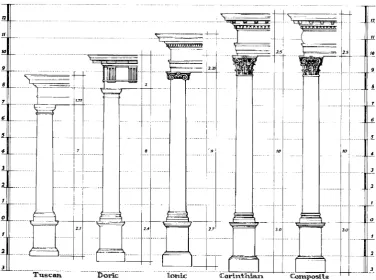
In the beginning of this book, I observed the comedians order, who (when they intend to play any comedy) first send out a Prologue, who in a few words giveth the audience to understand what they intend to entreat of, in their comedie. So I, meaning in this Booke, to entreat of the manner of buildings, viz Thuscan, Dorica, Ionica, Corinthia and Composita, have thought good, that in the begin-ning thereof, men should see figures of all the several kinds where I propose to entreat of.2
In the case of urban design the main actors in the play presented here are the square, the street and the buildings that make up the public face of towns and cities. The meaning and role these elements play in urban design, the ways in which they are arranged, designed and detailed is the subject matter of the remaining chapters.
Urban design is an important though often neglected aspect of planning and a topic which has
not always received due recognition in architectural education. Urban design is at the interface between architecture and planning but is quite distinct from both disciplines.
There are a number of definitions of planning, in fact, almost as many as there are planners. At its broadest planning can be defined as the process by which resources are distributed.3Indeed some
planners would see the planners’ role as one which is deeply committed to redistribution of resources in favour of those less well-off sections of society.4
These definitions elevate planning to the political arena, that is, deciding who gets what, where and when. Other more technical definitions of planning restrict the subject to the organization of land uses, transportation and infrastructural networks both for efficient functioning and the creation of a pleasant and well-ordered environment. This narrow defini-tion of planning does not free the discussion entirely from politics, for land itself is a resource and all developments bring benefits to some and incur costs for others. It is, therefore, concerned with the distribution and allocation of resources, as such it is an activity of government. Planning periods are often long, possibly twenty years and may cover large urban and rural regions. On the
other hand action plans requiring entrepreneurial skills from the planners may have a timescale of five to ten years and cover only small parts of a town.
Architecture is concerned with the design and construction of individual buildings. Usually the archi-tect designs for clearly identifiable clients. The designs are made for particular sites. The construc-tion period, for the most part, covers short term projects of one to five years’ duration. However, an architect involved in hospital design or other large scale developments would be working on a building complex covering many acres of ground which would take ten or more years to build. The know-ledge and expertise of the planner are as necessary as the professional skills of the architect for the success-ful execution of such a project. Hence, in practice, there is no precise differentiation between the domain of the architect and that of the planner. Since the boundary between these subject areas is blurred there can be no clear and precise subject definitions.
Urban design is allied to architecture and planning. For its practice it requires some of the skills and knowledge of both disciplines. The subject matter of urban design is the arrangement of many buildings so that they form a single composi-tion. The designs may cover more than one site and involve many owners, users and government agencies. Since more than one owner is usually involved the time horizon is longer than that of a single building and usually varies between five and twenty years, though many of the finest urban designs such as the Piazza Annunziata, Florence, have taken centuries to complete. For the purpose of this book urban design is the study of the design of the urban realm as opposed to the private domain. By public realm is meant the streets, boule-vards, squares and public parks together with the building façades that define them. Clearly, the design of the private domain, both as a study and as a professional activity, is the proper function of the architect. The planner and the urban designer are concerned with the private domain of individual properties only so far as it affects the public realm.
For example, developments exceeding certain densi-ties or volumes may put excessive strain upon roads and services, or indeed, may destroy the visual quality of the environment. The internal subdivision of a building is a problem for the owner and his designer. Such internal planning may have to satisfy by-laws, health and safety regulations, but it is not a matter for the planner and nor does it fall within the normal province of urban design. Nevertheless, the relationship between internal and external space, as depicted on Nolli’s map of Rome, is a facet of design which should be an important consideration of all those working in the field of city construction and reconstruction.
It has been suggested by some writers that the city quarter is the main component of urban design.5Certainly the scale of development since
the Second World War has increased significantly, first in the public then latterly in the private sector. It is now possible to consider whole urban quarters as single design problems undertaken by a single group of developers and a single design team. In the case of urban development corporations concerned with inner-city regeneration, major components of the city such as the Isle of Dogs, London, are managed and developed by specially constituted authorities. Certainly, it could be, and has been, argued that clearly defined city quarters about 1.5 kilometres (1 mile) across will be a major preoccu-pation of urban designers in the coming decade. Other smaller-scale groupings of urban design elements forming the urban realm, such as the area comprising the precinct around St Paul’s, London, will, nevertheless, remain central to the professional interests of the urban designer. Indeed, the consid-eration of the design of small-scale developments in conservation areas is very much within the field of urban design.
Over the last decade there has been considerable development in the understanding and practice of urban design. The types of development and planning tasks in this country that have involved urban design skills have increased – for example,
urban design now includes tasks of restructuring large subregional areas. Ideas in the Planning Green Paper, produced in 2002 by the former Department of Transport, Local Government and the Regions for Her Majesty’s Government, could lead to an innova-tive system of planning where urban design is elevated to a central role. If these ideas are imple-mented then it is likely that the workload of the urban designer will increase: he or she will be engaged in a wide variety of tasks once thought to be the province of other disciplines. The complex nature, however, of most urban development requires the skills of, amongst others, the planner, architect, urban designer, landscape architect and traffic planner.6The successful completion of these
complex tasks requires that the urban designer exhibits ability and skill to work with these profes-sionals from other disciplines.
City builders, architects, town planners and trans-portation engineers are in disarray, attacked, seemingly, from all sides. The gulf between the design professions and client group, those who live in or use the cities, is witnessed by critical press coverage and unsympathetic television programmes. Community destruction, demolition of pleasant, nineteenth-century terrace housing, inner-city blight, memories of new-town blues, high-rise development, all appear on the long menu of violations thought to be caused by the planner, a term used to cover a multitude of participants in the development process. The successes of the development profes-sions are not given the same publicity. City conser-vation schemes, the protection of the green belt, the creation of national parks and the movement towards public participation in planning do not make headlines. Environmental success is not news, but planning and design disasters appear frequently on television and are fully documented. These negative views on the state of the city design professions are best articulated by Prince Charles. His pithy remarks about the ‘monstrous carbuncle’ or the ‘giant glass stump’ whether given in a lecture to the RIBA or made on a television programme
have the immediacy and quality of the eye-catching headline.7These views do, however, appear to be
closely in tune with those of the lay person. This general discontent with city planning closely parallels conditions a century ago as Sitte, a Viennese architect saw them. Sitte, in the preface to the first edition of his book, Der Stadte-Bau, after noting the general approval at the time, in 1889, with the technical aspects of city planning, wrote:
In contrast there is almost as prevalent a condemna-tion of the artistic shortcomings of modem city planning, even scorn and contempt. This is quite justified; it is a fact that much has been accom-plished in technical matters, while artistically we have achieved almost nothing, modem majestic and monumental buildings being usually seen against the most awkward public squares and the most badly divided lots.8
Sitte’s great seminal work is the starting point and the inspiration for this present study. He studied in detail magnificent civic design achievements of the past so that he could glean from them the prin-ciples that contributed to the quality of their composition. Sitte has been described, quite erroneously, as the founder of modern city planning. Even a cursory reading of his book City Planning According to Artistic Principlesreveals quite clearly that the subject matter is not planning as it is defined and practised in Britain today.
Sitte’s main preoccupation was the artistic design and decoration of streets and squares and, as such, he would more accurately be described as the founder of urban design. This present study follows Sitte’s method using historical precedent to establish the ground rules for composition in the field of urban design. Though drawing heavily on historical examples, this is not a history of urban form and should not be confused with work in that field. The examples of streets and squares chosen for the text are ones that are generally accepted as fine city building and, indeed, are well-known tourist attrac-tions, places thought worthy of visiting by many
I N T R O D U C T I O N
people. It is argued here that if we can analyse the properties that made fine city streets and squares in the past it may be possible to reproduce some of those qualities in future development, not by outright copying, but by employing the underlying principles of composition.
The theoretical literature of western architecture starts with Vitruvius, the Augustan architect, and his treatiseDe Architectura. It was with Vitruvius that this present search for a theoretical understanding of urban design appropriately began. More impor-tant for urban design however, are the works of the Renaissance scholars, Leone Battista Alberti, Filarete, Serlio and Andrea Palladio. De re aedificatoria begun by Alberti in the 1430s was presented to Pope Nicholas V in 1452. With this great work Alberti established architecture as a learned discip-line based upon principles articulated and structured by reason. In his text Alberti dealt also with elements of city design, streets, roads and piazze. Antonio Averlino, known as Filarete, was the first author to write a treatise on architecture, Libro architettonico, in a modern language. The book is of interest to the urban design student mainly for its description of a capital city, Sforzinda, and a port city, Plousiapolis: explanations are given not only for planning, design and construction of the city but also for its institutional organization. Tutte l’opere d’architectura, by Serlio, is probably best known for its exhaustive treatment of the five orders of archi-tecture and the splendid illustration of their propor-tions and use.
It was, however, Palladio who wrote the most influential architectural treatise of the sixteenth century,I Quattro Libri dell’Architettura. It was frequently republished in Italy and other European countries and had an unprecedented impact on architects and architecture in the centuries follow-ing its publication. The book covers the general principles of architectural design, the Classical orders, the design of palaces, villas, bridges, civic buildings, temples and churches. Like Alberti a century before him, Palladio discussed the design of
streets and piazze. There is little abstract theory in Palladio, most of the text discusses actual buildings and the problems of design they raise. The drawings of Palladio’s own buildings with their great
economy of form, simple symmetry and propor-tional regularity were probably the main reasons for the book’s influence, an influence that can still fire the imagination of the young architect.9
Sitte reacted against a debased Classical tradition as it had been incorporated into design dogma at the large scale of the city. His counter proposals to the poor and mechanical imitations of Hausmann’s axial planning of Paris were based largely on an exhaustive study of medieval towns. The opposing view of city design, the Beaux Arts, is represented by writers such as Julien Guadet and his Elements et Théorie de l’Architecture.10More important for this
study, however, is the school of urban design stemming directly from Sitte and those he influ-enced through the many translations of his book into other European languages. In Britain, Raymond Unwin, a key figure in the Garden City movement, was an early convert to Sitte’s influence. His own bookTown Planning in Practice, an immense work on the design aspects of city planning, was of profound influence on the planning profession during the early part of the twentieth century.11
Meanwhile, in the United States, there were Werner Hegemann and Elbert Peets, who, early in the last century, wrote The American Vitruvius, An Architect’s Handbook of Civic Art. It was an impor-tant contribution to the development of urban design, and is still a delight to read.12
The writers associated with the Modern Movement in architecture, represented particularly by Le Corbusier or the manifestos of ClAM, were following dictates other than the concerns of Sitte. One of the foremost apologists of the Modern Movement, Sigfried Giedion, dismissed Sitte’s ideas as palliatives and, instead, advocated mass housing, vast engineering roadworks and comprehensive city-centre development – now the subject of popular criticism. It may, however, be too soon to write an
objective critique of the pre-Post-Modern architec-tural styles current during the first part of the last century. Time and distance from those events may be necessary for them to be seen with any clarity. Giedions’Space, Time and Architecturehowever, is still a book well worth the attention of the student of architecture and urban design; of particular inter-est is the section dealing with the planning of Rome by Pope Sixtus V.13
The interest in urban design continued after the Second World War. As a result of this a number of important books were published in the 1950s. Frederick Gibberd’s Town Designis still a standard text book on the design of elements that form the town.14He is clearly indebted for many of his ideas
to Sitte, particularly in his analysis of the town square. Paul Zucker in Town and Square, like Gibberd, builds on the work of Sitte, but introduces a much broader typology of public squares. These two books are complemented by Towns and Buildings, by Steen Eiler Rasmussen, which, like Zucker, relies heavily on the analysis of urban groupings set in an historical setting.15
Three important works on the perception of cities appeared in the late 1950s and early 1960s. They were, Experiencing Architecture, by Rasmussen,Townscapeby Gordon Cullen and The Image of the City by Kevin Lynch.16Rasmussen’s
main concern in his book is to try to show how we react to internal and external architectural space and the ways in which we appreciate forms, colours and textures. Cullen, by contrast, takes up the idea of serial vision which is also a feature of Sitte’s work. With the aid of fine perspective sketches, Cullen dissects in great detail the form of the urban realm as the viewer moves through it. Clearly many of the towns and cities most admired are picturesque, in the sense that they are capable of analysis using Cullen’s techniques for expressing serial vision. Lynch, too, was interested in the way in which the city is perceived. For his evidence Lynch conducted a survey among city residents analysing the drawings and mental maps made for him. From this
analysis Lynch formulated the theory of
‘Imageability’, that is, the elements of urban struc-ture which need to be present to create a strong visual image in the eye or mind of the beholder. Lynch’s theories of urban form are probably the single most important contribution in the field of urban design in the twentieth century.
Christopher Alexander is among the most prolific writers on architecture and urban design. An early essay, ‘The city is not a tree’ is a well-argued critique of current planning concepts for the hierarchical distribution of facilities and services.17In support of
his case, he pointed out the complexities and diver-sity of connections in the real world. Two other of Alexander’s works will be mentioned here: A Pattern Language andA New Theory of Urban Design. In both works Alexander seeks to establish a natural or organic way of designing and building.18
First he established a set of 253 patterns, such as the organization of an entrance or a window place: the criteria arrived at to define and describe these patterns, Alexander argued, applied to all similar cases. The designer, armed with this set of patterns from sleeping area to outdoor meeting place, is able to reproduce universally acceptable solutions forming part of an all-pervasive organic unity. In his theory of urban design, Alexander goes one step further by attempting to establish a natural or organic design process by which means the unity of the traditional town can be recreated. Alexander’s work is challeng-ing and it is a body of theory with which the urban design student must come to terms.
Two works which considerably affected architec-tural thinking both appeared in 1966. They are Aldo Rossi’sL’Architettura della Citta, and Robert Venturi’sComplexity and Contradiction in Architecture.19Rossi set the intellectual agenda for
neo-Rationalism, while Venturi, with a preference for richness of meaning rather than clarity of meaning, gave further support to an empirical and flexible approach to city design.
Colin Rowe and Fred Koetter, in their enigmatic mid-1970’s work Collage City, aimed to illuminate
I N T R O D U C T I O N
the complex process of city building using a language often as obscure as poetry.20The book is a
warning against the Utopian vision, whether populist or elitist. Instead, they put forward a plural-ist view of city form, a collage city that accommo-dates a range of ideas and visions. In similar fashion, Christian Norberg-Schulz lays stress upon the unique qualities of place and the importance of symbolism in all that man creates.21Symbolism, like so many
aspects of a rich and stimulating environment, was completely overlooked or considered unimportant by architects of the so-called ‘heroic age’ of modern architecture. Amos Rapoport with his seminal work House Form and Culture, and his later book Human Aspects of Urban Form, brought the close relationship between built form and culture to the attention of architects and planners.22The idea that
architecture is applied social anthropology broadens the scope of urban design from ‘architecture writ large’ to a subject that now includes the social sciences. Urban form is clearly seen as resulting from the interplay of a number of factors such as location, transportation networks, land value and topography. A discussion of settlement form as the physical manifestation of culture is not a major theme in this present study, it has been explained elsewhere in, for example, Hausa Architecture.23
The other major theme to be found in the Post-Modern reaction to the hegemony associated with modern architecture is ‘new rationalism’ given, as we saw, its intellectual stimulus from Rossi. The creed of the new rationalists is The Third Typology.24The new
rationalists, turning their attention to urbanism, reacted against the anti-historicism of the Modern Movement as encapsulated in the Charter of Athens. Architects such as Leon and Rob Krier turned instead to the city for typological components. Said Leon Krier: ‘The history of architectural and urban culture is seen as the history of types. Types of settlements, types of spaces (public and private), types of build-ings, types of construction. The bourgeois concept of architectural history – basically concerned with the monument – is extended to include the typological
complexity of the urban fabric, of the anonymous buildings forming the flesh of the city, the skin of the public space.’25The prime concern of urbanism for
the new rationalist is the design of the urban realm. Leon Krier again: ‘In these new projects the form of the public realm is the prime concern. The public realm as a finite, unitarian, rational space.’26For those
in the planning profession who have followed people like Sitte rather than worshipping at the feet of the false gods of the architectural profession this all sounds rather old fashioned producing a feeling of déjà vu.
The tension between the rational and empirical wings of the Post-Modern era is captured by the debateReconstruction Deconstruction, My Ideology is better than Yours, in which Peter Eisenman and Leon Krier discuss architecture and city building in terms of ‘presentness’ and ‘tradition’.27
The cudgels for rationalism are taken up by Alexander Tzonis and Liane Lefaivre who, using Classical architecture as a model, articulate a growing concern in some quarters for the poetics of order in architecture.28Reading once again about
the canon of Classical design, emphasizing, as it does, order analysis and composition, is a refreshing return to sanity after some of the more whimsical excursions or architectural fashions in the 1980s. Tzonis and Lefaivre do not advocate a return to the glories of a past style, the dead hand of ‘copyism’ is not the message of this scholarly work. It is, however, a timely reminder of a systematic thought process that has produced many fine buildings in the past.
Deconstructionists following the writings of Jacques Derrida aim to deconstruct aesthetics. Derrida attempts to free philosophy from in-built constraints: centuries of thinking have, according to him, stultified the thought processes. In his literary and philosophical criticism, Derrida aims to decon-struct, among other things, the belief that logic and rational argument will provide the key to under-standing – all things will become clear from rational explanation. Derrida, therefore, hopes to show that
by applying rational methods rationalism cannot work.29
Geoffrey Broadbent, in Emerging Concepts in Urban Space Design, presents an exhaustive account of the main contributors in the field of urban design.30This useful and extensive annotated
bibliography deals in greater detail with the Post-Modern philosophical debate and is complementary to the foregoing, more selective, range of authorities chosen for their relevance to, and importance for, the thesis presented in the following chapters. For the moment, the last word will he left with Broadbent and his attempt to connect Venturi, Derrida and Rationalism:
Venturi likes walls to be good and solid; obvious containers, protectors of internal space with trans-parent holes for windows. He cannot abide the Modem Movement idea of ‘flowing space’; of outside and inside opening into each other through glass walls which ‘can be discounted by the eye’. Inside and the outside are and must be different. Which is exactly what Derrida says of words. Spoken words, he says, are too transparent’ – like Venturi’s glass walls – which is why he, Derrida, gives such priority to writing.
Broadbent goes on to say that Derrida demonstrates:
the impossibility of conceiving the inside prior to the outside. Only an outside can define an inside! So whilst Derrida may have ‘stunned’ rationalism, he gives even more authority to Venturi’s kind of Empiricism!31
So has Rationalism been dealt the coup de grâce? While agreeing the primacy of the outside (which followers of Sitte wouldn’t) this writer will cling irrationally to the rational process of testing ideas in the world of empirical fact: the idea or concept comes first, the test later. Those ideas are generated by theory, even Derrida’s! The present text is firmly in the tradition of Sitte and that tradition’s latest manifestations, the New Rationalism. There is, here, however, no attempt like that of David Gosling in
‘Definitions of Urban Design’, ‘to discover whether there is indeed a shift away from The Third Typology towards new directions.’32The new
ration-alists publicized and brought back onto the urban design agenda the need to design using the main formal elements found in the city.
Three interconnected themes seemed to inform the discussion about ‘urbanism’ or urban design during the last decade of the twentieth century: they were participation, context, and sustainable development. With the growing awareness of the importance of urban design amongst the develop-ment professions, environdevelop-mental quality became an important goal of city planning, a quality ultimately judged by the user. Participation was therefore thought to be a key component in the delivery of fine city development, which was both accepted and owned by its citizens. The impetus for this movement to politicize the planning and design process was generated by a number of books appearing in the 1960s, which were critical of the development process. Books such as Jacobs’ seminal work,The Death and Life of Great American Cities published in 1965 and Gans series of essays in People and Planspublished in 1968, were highly influential in changing the attitudes of architects and planners. Goodman’s After the Plannerspublished in 1972, with its suggestions for ‘guerrilla architec-ture’ and ‘squatter environments in which the community as a body lays down what it requires’, gave a positive architectural dimension to the critique of the then formal process of city develop-ment.33
The pursuit of environmental excellence is now equated with ‘contextualism’ or the design of devel-opment, which is suited to the local context as defined by environment and culture. As Tibbalds wrote in Making People Friendly Towns,1992 ‘Places need to offer variety to their users. They need to be unique and different from one another – each rooted in their own particular historical, geographical, physical or cultural context’.34Context
as a generator of environmental excellence in the
I N T R O D U C T I O N
public realm has its roots in ‘critical regionalism.’ According to Frampton, who is also associated with the development of the concept, Alexander Tzonis and Liane Lefaivre first coined ‘Critical Regionalism’ in 1981.35The first International Seminar on the
topic, however, was not until 1989, the University of Pomona – the proceedings were published later in 1991. According to Amourgis who edited the proceedings ‘the intentions behind the use of the word “regionalism” are to express natural and social context, essential factors in the shaping and evolu-tion of life and civilizaevolu-tion.’36
The rest of this book is composed of ten chapters. Chapter one deals with the method of urban design and programme formulation, a funda-mental study for establishing discipline. It poses the question: ‘Where do design ideas origlnate?’ concen-trating on creative thinking as outlined by Edward de Bono, and Bryan Lawson.37The urban design
programme, or the social and economic needs of society, is shown to be the generator or foundation of city building activities. Urban form is defined as a physical expression of culture and, as such, it is related directly to user satisfaction and, ultimately, to public participation in the design process.
Chapter two examines the laws of composition in architecture in order to determine how and in what ways they apply at the larger scale of urban design. Composition at the scale of urban design is used in a similar way to its use for music or litera-ture; a musical composition has a beginning, an end, theme, movements, chords and notes; similarly, a novel has a beginning, an end, theme, chapters and words. This chapter examines the grammar and syntax of urban design.
Chapters three to nine form the core of the text. Chapter three examines the ways in which buildings can be arranged, both within space and to form space. It develops an idea for a general typology of built form. Chapter four discusses the design of the square or plaza. It starts with an outline of the role and function of the square in the built environment and goes on to analyse, through examples, its form.
Chapter five discusses the design of the street – the other main element in urban design. It follows the structure of chapter four starting by outlining the role and function of the street in the built environ-ment, then going on to analyse its form using examples. Chapter six specifically examines the role of water in the design of public spaces: it discusses the form and function of the river, canal and seafront with a particular concern for the spaces formed along the edge of such water courses.
Chapter seven introduces the principles of sustainable development as they affect the design of street and square. The second part of the chapter concentrates on public transport in street and square and pays particular attention to the architec-tural settings for the tram or light train. Chapter eight concentrates on the use of visual analysis as a tool for understanding the role of street and square in the urban quarter. The chapter starts with an outline of the principles of visual analysis, which is followed by a study of Tavira, a small town in the Algarve, Portugal: it concludes with a summary of the ways in which the technique of visual analysis can inform the urban design process for the better understanding and design of streets and squares. Chapter nine has five case studies, bringing together the main ideas in the previous chapters, namely the design of the public realm and, in particular, its streets and squares.
Chapter ten, a short concluding chapter, examines why it proved so difficult in the twentieth century to design and develop lively streets and squares of real quality. The chapter returns to the issues raised in previous chapters in order to learn both from past mistakes and also from the great achievements of earlier generations.
NOTES
1 Sitte, Camillo. Der Stadte-Bau, Verlag Von Carl Graeser and Co. Wien, 1889
2 Serlio, Sebastiano. The Five Books of Architecture, an unabridged reprint of the English edition of 1611, Book 4, Folio 3, Dover Publications, New York, 1982
3 Eversley, David. The Planner in Society, Faber & Faber, London, 1973
4 Davidoff, Paul. Working towards redistributive justice. In Journal of the American Institute of Planners, Vol 41, No 5, September 1975, pp.317–318
5 Gosling, D. and Maitland, B. Concepts of Urban Design, Academy Editions, London, 1984, p.7
6 Department for Transport, Local Government and the Regions,Planning Green Paper, Planning: Delivering a Fundamental Change,DTLR, London, 2002.
7 HRH, The Prince of Wales. A Vision of Britain, Doubleday, London. 1989
8 Collins, G.R. and Collins, C.C. Camillo Sitte: The Birth of Modern City Planning, Rizzoli, New York, 1986, p.138
9 Wiebenson, Dora. Architectural Theory and Practice from Alberti to Ledoux, University of Chicago Press, Chicago, 1982
The following are the English translations used in this text:
Vitruvius.The Ten Books of Architecture, Dover Publications, New York, 1960
Alberti, Leone Battista. Ten Books on Architecture(trns Cosimo Bartoli (into Italian) and James Leoni (into English) Tiranti, London, 1955
Filarete (Antonio di Peiro Averlino). Treatise on Architecture(trns J.R. Spencer) Yale University Press, New Haven, 1965
Serlio, Sebastiano. The Five Books of Architecture(an unabridged reprint of the English edn of 1611), Dover Publications, New York, 1982
Palladio, Andrea. The Four Books of Architecture, Dover Publications, New York, 1965
10 Guadet, J. Elements et Théorie De L’Architecture,Vols I to IV, 16th edn, Librarie de Ia Construction Moderne, 1929 and 1930
11 Unwin, Raymond.Town Planning in Practice, Benjamin Blom Inc. New York, 1971 (first published 1909)
12 Hegemann, Werner and Peets, Elbert, The American Vitruvius, An Architect’s Handbook of Civic Art, Benjamin Blom, New York, 1922
13 Giedion, Sigfried. Space, Time and Architecture, Harvard University Press, Cambridge. Mass., 3rd edn, 1956 14 Gibberd, Frederick. Town Design, Architectural Press,
London, 2nd edn, 1955
15 Rasmussen, S.E. Towns and Buildings, Liverpool University Press, Liverpool, 1951
16 Rasmussen, S.E. Experiencing Architecture, MIT Press, Cambridge, Mass., 1959
Lynch, Kevin. The Image of the City, MIT Press, Cambridge, Mass., 1960
Cullen, Gordon. The Concise Townscape, Architectural Press, London, 1986 (first publishcd 1961)
17 Alexander, Christopher. A city is not a tree. In Architectural Forum, New York, April 1965, pp.58–62 and May 1965, pp.58–61
18 Alexander, C., et al. A Pattern Language. Oxford University Press, Oxford, 1977
Alexander, C., et al. A New Theory of Urban Design, Oxford University Press, Oxford, 1987
19 Rossi, A. L’Architettura della cilta(ed. Macsilio), Padua, 1966
Venturi, R. Complexity and Contradiction in Architecture, Museum of Modern Art, New York, 1966
20 Rowe, C. and Koefler, F. Collage City, MIT Press, Cambridge, Mass., l978
21 Norberg-Schulz, Christian. Existence, Space and Architecture, Studio Vista, London, 1971, and Genius Loci, Towards a Phenomenology of Architecture, Rizzoli, New York, 1980
22 Rapoport, A. House Form and Culture, Prentice-Hall, Englewood Cliffs, New Jersey, 1962, and Human Aspects of Urban Form, Pergamon Press, Oxford, 1977
23 Moughtin, J.C. Hausa Architecture, Ethnographica, London, 1985
24 Vidler, A. The third typology. In Rational Architecture, Archives d’Architecture Moderne, Bruxelles, 1978
I N T R O D U C T I O N
25 Krier, L. The reconstruction of the city. In Rational Architecture, Archives d’Architecture Moderne, Bruxelles, 1978, p.41
26 Ibid, p.42
27 Eisenman, P. and Krier, L. Reconstruction deconstruction, my ideology is better than yours. In Architectural Design, vol 59, No 9–10, 1989 pp.7–18
28 Tzonis, A. and Lefaivre, L. Classical Architecture, The Poetics of Order, MIT Press, Cambridge, Mass., 1986
29 Derrida, J. Of Grammatologie(trns G.C. Spivak) Johns Hopkins University Press, Baltimore, 1976; L’Ecriture et la Difference(trns A. Bass) Chicago University Press, Chicago, l978;Speech and Phenomena, Northwestern University Press, Evanston, 1973 and Derrida and Deconstruction(ed. H.J. Silverman) Routledge, London, 1989
30 Broadbent, G. Emerging Concepts in Urban Space Design, Van Nostrand Reinhold, London, 1990
31 Ibid, p.320
32 Gosling, D. Definitions of urban design. In Architectural Design, Urbanism(ed. David Gosling) Vol 54, No 1/2, 1984, pp.16–25
33 Jacobs, J. The Death and Life of Great American Cities, Penguin, Harmonsdworth, 1965. Gans, H. People and Plans, Basic Books, New York, 1968. Goodman, R. After the Planners,Penguin, Harmondsworth, 1972
34 Tibbalds, F. Making People-friendly Towns, Longman, Harlow, 1992
35 Tzonis, A. and Lefaivre, L. Critical regionalism. In Critical Regionalism: The Pomona Meeting Proceedings(ed. A. Amourgis) California State Polytechnic University, California, 1991
36 Amourgis. S. ‘ Introduction’, in Critical Regionalism,ibid 37 de Bono, E. Lateral Thinking, Penguin Books.
Harmondsworth, 1977, and Lawson, B. How Designers Think, Architectural Press, London, 1980
INTRODUCTION
The title of this chapter presents a dilemma. This dilemma is caused by the tension between the desire to practise an art form based upon method and principle, while, at the same time, involving people actively in the design process. The tension can be summed up in the phrase ‘professionalism versus populism’. HRH Prince Charles is engaged with this dilemma by supporting public participation in planning and architecture while advocating, at the same time, a form of Classical design: ‘Buildings should reflect these harmonies, for architecture is like a language. You cannot construct pleasing sentences in English unless you have a thorough knowledge of the grammatical ground rules. If you abandon these basic principles of grammar the result is discordant and inharmonious. Good archi-tecture should be like good manners and follow a recognized code. Civilized life is made more pleasur-able by a shared understanding of simple rules of conduct.’1Later he writes: ‘People should be
involved willingly from the beginning in the improvement of their surroundings. . .but participa-tion cannot be imposed: it has to start from the bottom up.’2
In any dispute between the views of the ‘people’ and the ‘professionals’ which takes precedence? In Bath this dilemma was made manifest when an individual occupying a property in The Crescent wished to paint her door yellow. The professional view considered that all doors in John Wood junior’s great piece of Classical urban architecture should be white. The law in this case upheld the individual’s right to express her own taste.
The aim of this chapter is not to solve this dilemma but, more simply, to make it apparent and to set theoretical ground rules for incorporating public participation into the urban design process. The dilemma will not disappear, but it may be that the resolution of the tensions will stimulate creative design.
AN ANALYTICAL FRAMEWORK FOR PUBLIC PARTICIPATION
Urban design, or the art of building cities, is the method by which man creates a built environment that fulfils his aspirations and represents his values.3
This he does in his own likeness, The sixteenth-century theorist and architect John Shute likens the
1 1
1
city to the human figure: ‘A city ought to be like the human body and for this reason it should be full of all that gives life to man.’4Urban design, like its
sister art architecture, is a people’s use of an accumulated technological knowledge to control and adapt the environment for social, economic, political and religious requirements. It is the method learned and used by a people to solve the total programme of requirements for city building. The city is an element of a people’s spiritual and physi-cal culture and, indeed, it is one of the highest expressions of that culture.
Central to the study of urban design is man, his values, aspirations and power or ability to achieve them. The task of the city builder is to understand and express, in built form, the needs and aspirations of the client group. How does the city builder design to best serve the community’s needs? How can the designer ensure that the end product is culturally acceptable? These and other similar questions are important issues for those in the city designing professions.
Experience from the recent past, in this and many other countries, is littered with well-inten-tioned, but totally unsuitable, developments. Developments that range from the faceless mass housing of the 1960s to the large-scale office blocks or commercial areas which totally destroy the intimate fabric of the city. As a reaction the conser-vation movement grows apace. Timidity, the fear of further mistakes, prevents even the replacement of mediocre buildings from the past. Yet Shute, one of the country’s earliest theorists and author of the first English architectural book, recognized that all build-ings have a natural lifespan then they need to be replaced, sometimes with reluctance: ‘You can say one eats, and even so dies. The building must also decline through time just as one person dies sooner than another or has better or poorer health.’5
Copying features from past architectural styles is once again in vogue among city builders around the world, as if the planting of an onion dome, a minaret or horseshoe arch will, of themselves,
convert a barren design into culturally acceptable development.
The anarchy of the Post-Modern movement in architecture, with its dependence upon cliché and eclectic use of symbols from the past, must, if progress is to he made, give way to a more rational approach to architectural design steeped in discip-line and method. Urban design, too, requires a return to its roots in method. Central to such a return to method is the relationship between designer and client.
It is evident that the architect has lost touch with his client. In traditional practice the architect worked for an individual or a small group represent-ing a landed proprietor, the Church Commissioners, a company or government department. The individ-ual client is a vestige of the past: a time when archi-tect and client shared the same culture, values and may even have been on the same ‘grande tour’. Growth of democracy and mass culture now requires the architect and city builder to recognise a wider client group. This wider client group includes the church congregation, the ordinary voter and the general user of the buildings. Many in this expanded client group do not share the values of the designer group. It is frequently possible that a wide cultural gap separates the city builder and the new client – the man and woman in the street.
The chasm between city designer and client can be bridged when the problem is recognized as exist-ing and its nature defined: when the complexity and heterogeneity of the client group is admitted and when the designer realizes that culture is never static: it is in a constant state of change and to some extent, he or she – the designer – is an agent for those changes. Finally, it is necessary to develop methods and techniques for use when working with community groups.
For evidence of the gulf between the design professions and lay people one need only turn to the outpourings of the press or the many critical programmes appearing on television where planners and architects alike receive rough treatment. These
views are best summarized by Prince Charles’s remarks at the Festival of Architecture held at Hampton Court in early 1984. In his blistering attack on architectural practice in Britain he compared the Ahrends, Burton and Koralek design for the National Gallery extension to ‘a monstrous carbuncle on the face of a much loved and elegant friend’ and he called the Mies van der Rohe design for Mansion House Square ‘a giant glass stump better suited to Chicago’.6These views are
impor-tant not only because they were expressed by a member of the Royal family but because they appear to be closely in tune with those of the lay person.
The reasons for the present public antipathy to much recent urban development lie squarely with the training of architects and planners. To a large extent architects, urban designers and planners have been trained in a rarefied atmosphere where the subject is taught with little or no reference to the public for whom the product is intended. Education in city building in the recent past has been dominated by the posturings of the avant-garde, a break with sound tradition and the pursuit of novel, but empirically untested, theory. The result is that we have a very special subculture designing with its own peer group in mind. The internal validating process in our subject area of urban design has produced a class of people out of touch with the general mass of users. There are notable exceptions to this general rule. There are also movements within the professions which espouse a more populist approach, but, generally speaking, the gap between designer and client is wide and goes unnoticed or disregarded by many.
The communities inhabiting towns and cities, and therefore the focus of our subject, are complex heterogeneous groups made up of diverse subcul-tures with differing values and aspirations. The understanding of an alien culture or subculture poses great difficulties. In our understanding of the world around us, we all start from our own cultural framework modified by a personal frame of
refer-ence. Such an analytical framework so deeply embedded in culture, while necessary for structuring thought can, in the process, limit understanding. Culture can be viewed as a filter, acting between the outside environment and the receiver. Understanding others requires, primarily, an under-standing of the limitations of one’s own cultural and personal frame of reference.7The modest approach
to design advocated here is somewhat at variance with the egocentric attitudes inculcated in the great designer. I suggest that a change in attitude on the part of the design professions is essential for under-standing a community’s needs and aspirations and for working with people.
Culture is never entirely static, it is in a constant state of change. The world is getting smaller and there is increasing contact between peoples. As a result, cultures are changing. What is more, they appear to be changing at an increasing rate. Urban designers are forward looking; we plan and design, not only for the here and now, but also for the future. A backward looking or even static view is, therefore, a highly mischievous occupation. It is the dynamic of cultural change that must be the urban designer’s primary concern. As anthropologists would say, it is the process of acculturation – the way in which new ideas and mores are grafted onto existing cultures – that should be the prime concern of those engaged in designing for the future.8It is
the agents of change, those actors or processes that drive the engines of change, which have to be discerned and harnessed. The situation is further complicated when the architect, urban designer or planner realizes that he or she is an important agent of change. The designer even when working with people is not a neutered, objective observer, but a significant actor in the process of culture change.
An important aspect of the designer’s skill is the development of a menu of techniques for incorpora-tion into the design process. These techniques range from anthropological studies establishing essential cultural data, user studies, and planning surveys, through informative techniques, the exhibition and
U R B A N D E S I G N A N D P E O P L E
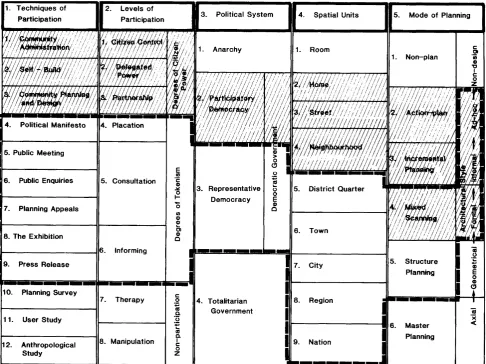
press notices, to administrative procedures such as public enquiries and planning appeals. People’s views can also be elicited at public meetings or sought through the electoral process by including planning matters in political manifestos. Finally, there is the group of more active forms of participa-tion such as community design exercises, self-build operations and community administration and control. The menu of techniques, Figure 1.1, has limited utility without the ability to predict the type of technique most useful in any given situation or, conversely, the changes in context necessary to facilitate the use of a technique.
Participation can have different meanings for different people. Fortunately for those working in this field Sherry Arnstein has described the shades of meaning attached to this term.9Her ladder of
participation, Figure 1.2, though now 30 years old, is still a good tool for a preliminary analysis of participation. Her typology ranges from illusory forms of participation, which she terms manipula-tion and therapy, through degrees of tokenism such as informing, consulting and placating. The top rungs of the hierarchy are partnership, delegated power and citizen control, all of which infer a degree of citizen power, that is, they require some redistribution of power if they are to be realized.
The Arnstein typology makes it easy to under-stand the communication gap between the ‘planned’ on the one hand, the planner, urban designer and politician, on the other. The former, having had his or her expectation of participation raised, often thinks in terms of having the final word in the decision-making process while, to the professional and politician it usually means publicity and consul-tation. A phrase such as ‘more participation’ can mean to the public a more intensive form of partici-pation, that is, moving up the ladder, while to the professional and politician it may mean greater consultation in the form of more publicity.
From Figures 1.1 and 1.2 it can be seen that in Arnstein’s terms, the more intense forms of partici-pation, that is participation of a type close to the
top of the ladder, requires techniques which actively involve the individual in plan making, design, constructional work, and responsibility for estate administration including participation in any economic gains from development. The mid-range levels of participation, the more usual conditions found in western democracies, suggest the use of bureaucratic techniques usually advocated and organized by the professionals in any administration. Towards the lower end of the scale, which Arnstein defines as non-participation, are the more objective and scientific methods of information gathering which can inform the planning and design process but, at best, result only in a more sympathetic and human form of administration, still in all its essential features paternalistic.
The higher levels of participation require a redis-tribution of power, that is, power has to be removed from some sectors of society and placed in the hands of others. The higher one moves in Arnstein’s ladder the greater is the degree in the shift in power. For example, the professional planner, urban designer and architect in a participa-tory situation lose much of their ability to decide the outcome of the development process. This line of argument brings the planning, design and devel-opment process directly into the political arena.10
American scholars in their writings have made it abundantly clear that planning decisions by their very nature are political and cannot be considered simply technical. For example, Paul Davidoff states:
‘The essence of politics is who gets what. Or call it distributive justice. The public planning process as a part of the political system is inextricably related to the distributional question facing communities in which planners work.’11This point has also been
made by writers such as David Eversley in Britain, who says:
But it must be made clear that since the planner, as defined here, is the person who determines where people shall build, and where they shall not build, where there shall be new or expanded towns, or
1 4
Figure 1.1 Techniques of participation
growth areas, and where national parks or Areas of Outstanding Natural Beauty shall prevent building, where power stations shall be sited and canals reopened, motorways built and railways shut down, he is in fact responsible for the allocation of this very large part of the national product and the benefits it confers.12
It can be argued that urban design is akin to planning in many respects and, since it deals with large parts of towns and cities, it too is concerned with distribution of resources and wealth. It would be advisable, for the urban designer wishing to remain within the safety of a technical design process, not to dabble with participation that confronts the designer directly with the issue of the distribution of power and wealth and, hence, takes the subject right to the centre of politics.
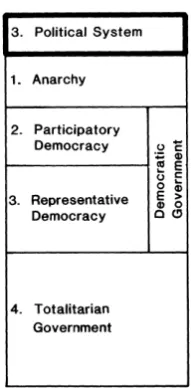
Figure 1.3 shows in simplistic form a scale of political structures, ranging from anarchy through various forms of democracies to the varieties of dictatorship which exist in the world. From the viewpoint of participation in development it is convenient to concentrate on the middle portion of the range. A state of anarchy, though an ideal among some thinkers and activists, in its more extreme forms does not last long before being replaced by a more disciplined regime. Totalitarian government, by definition, does not permit general and widespread participation.
Democracy according to Carole Pateman has three main definitions.13These are: first,
representa-tive or modern democracy; second, classical democ-racy associated with the writings of the
eighteenth-century political philosophers and, finally, participatory democracy based upon a reinterpreta-tion of the writings of Jean Jacques Rousseau to take regard of an industrialized society.
The theoretical basis of representative democracy has been developed by Joseph Schumpeter and others. Schumpeter states that: ‘The democratic method is that institutional arrangement for arriving at political decisions in which individuals acquire
the power to decide by means of a competitive struggle for the people’s vote.’14Competition for
votes is similar to the operation of the economic market. Voters choose between the policies offered by competing political entrepreneurs. Political parties are analogous to trade associations in the economic sphere and regulate competition. ‘Participation’ for the majority in a representative democracy is, therefore, only participation in the choice of decision makers.
Representative democracy does not require high levels of participation and interest in political affairs except from a small minority. Pateman points out that ‘the apathy and disinterest of the majority play a valuable role in maintaining the stability of the system.’15Planners and urban designers should be
aware of the shortcomings of this rather cynical view of the political process whereby plans are legitimized and development is implemented. Dealing with problems such as where and how people live, work and educate their children, should lead us to question the necessity and desir-ability of decisions in these fields being handed over to ‘representatives of the people’. To remove people’s right to make these decisions removes also their self respect and lessens their dignity as human beings.
For the followers of Rousseau and participatory democracy, ‘participation’ is an essential element of the decision-making process and is also a method of protecting private interest. This theory is also concerned with the psychological effect of social and political institutions. The central function of Rousseau’s theory is educative and his chief concern is that the political system should develop respon-sible individuals. In effect, he is saying that as one can only learn to swim by swimming so too one can only learn to be democratic by being involved in democratic processes. These democratic processes, according to Rousseau and his twentieth-century followers, should permeate all aspects of society, and that, of course, includes planning and develop-mental decisions.
U R B A N D E S I G N A N D P E O P L E
1 5