647
The Anxiety of Learning English by Senior High
School Students in Medan
*
Susi Ekalestari and Azmir Pasaribu
Faculty of Literature, Islamic University of North Sumatra, Medan 20217, Indonesia;
*
Corresponding author: [email protected]
Abstract
This study is a result of a research on the anxiety of learning English by students of Senior High School in Medan, North Sumatra. Anxiety is “one form of emotional problem that could highly affect the academic
performance of EFL” (Sadiq, 2017). This study is aimed to know the
anxiety level of the students of Senior High School in Medan, North Sumatra in learning English as a foreign language, which, then, there will be further research to respond the findings in this study. The further research might be in the form of solution, improvement, modification, and module invention in relation to teaching English as foreign language. The method used in the study is qualitative descriptive method, in which the finding is presented in the form of description of the simple calculation of the data obtained from the questionnaire. This study takes the students of Senior High School in two schools for its respondents. They are the fresh students in 2017. Questionnaires are shared to collect the data related to learning anxiety of English language. The questions in the questionnaire are created to get not only the anxiety level of the students in learning English, but also their obstacles, suggestion and hope to successfully learn English as a foreign language. It is found that the anxiety of learning English experienced by the students of Senior High School is at the moderate level. It reaches 44 respondents (55%) of the whole respondents. The whole respondents are 80 fresh students of Senior High School.
Keywords: anxiety, learning, students, EFL.
Introduction
648 Foreign Language (EFL). Therefore, it is necessary to be made in Indonesia. At least, it will contribute good initiation for further research on better offer to overcome the problem. The research problems of this study are:
1. What is the level of anxiety of learning English by the students of Senior High School in Medan?
2. What are the causes of the students’ anxiety in learning English?
Then, the objective of this study is to analyze the level of anxiety of the students of
Senior High School in Medan and to analyze the causes of the students’ anxiety in
learning English as foreign language. The finding is, hopefully, useful for further research on teaching English as a foreign language in Indonesia, especially in Medan North Sumatra.
Literature Review
Foreign language anxiety is a feeling of apprehension and tension felt by the learners related to foreign language learning (Horwitz, 2001). This feeling is mostly dominantly felt by the learners of English as a foreign language in speaking because the spelling and the way how to pronounce the words are quite different. However, it effects negatively to their achievement in language learning of English as a foreign language. A research in Japan found that “Most students felt frustrated and helpless, although students who perceived themselves as having higher ability indicated a greater sense of resilience (Williams & Andrade, 2008, p. 188). Other research
exposed that the learners “did not feel anxious in English class, fearful of being
negatively evaluated, or apprehensive about both speaking and tests. Meanwhile, the majority of the participants were moderately or even strongly motivated to learn English (Liu, 2011, p. 5). These two researches show contradictory findings on the anxiety of the learners when they are learning language. However, there might be
some factors that cause its existence in the learners’ mind. The main cause might
come from the learners themselves. It is their unrealistic or erroneous beliefs about language learning (Zhang & Zhong, 2012). Young (1991) proposed six causes of foreign language anxiety which are related to the learners themselves, the instructor, and the instructional practice. They are 1) personal and interpersonal anxiety, 2) learner beliefs about language learning, 3) instructor beliefs about language teaching, 4) instructor-learner interactions, 5) classroom procedures, and 6) language testing.
Anxiety is classified into three components by Horwitz et al. (1986). They are: 1) Communication apprehension, 2) Anxiety of negative social evaluation, and 3) Test anxiety. Communication apprehension refers to communicative competence. The
learners’ anxiety appears when they should perform speaking practice in the target
language. Anxiety of negative social evaluation refers to the learners’ anxiety about
their performance among their friends. They feel anxiety of having negative impression from their friends, while they want to obtain positive impression. Test anxiety refers to academic evaluation. This anxiety is also triggered by the previous two components of anxiety. It is also believed that there are four instructor factors that might be related to language anxiety. They are: 1) language teaching, 2) the manner of error correction, 3) the level of perceived support, and 4) teaching style (Young, 1991). Furthermore, he also said that language anxiety in the learners is
probably caused by the teacher’s role. Many teachers do not play their role as a
facilitator, but as a sergeant, a constant error-corrector which trigger the
appearance of the learners’ language anxiety. This will make the learners
apprehensive under inconvenience condition which may, initially, trigger the appearance of language anxiety of the learners.
To settle the anxiety of the learners, teacher has an important role and should take
649
”
research found that there are some factors that might be associated with language anxiety of the learners. They are comparison with peers, learning strategies, and language learning, and finally motivation (Yan & Horwitz 2008). In language learning, speaking or communicative competence is the foundational target that will be achieved. It is recommended that language anxiety does not need special treatment, but what is needed to ovoid this phenomenon. Teachers should have careful attitude to effectively diagnose anxiety among the learners. Therefore, the application of new approaches is needed to enhance learning opportunities in conducive environment to learn.
Research Method
The research method applied in this study is descriptive qualitative method. The data are collected from questionnaire and the findings are obtained from simple calculation from the data obtained. The respondents of this study are fresh students of Senior High School in Medan. They are from SMA UISU Medan and SMK UISU Medan. There are 62 students from SMA UISU Medan, and 18 students are from SMK UISU, Medan. The questionnaires are shared on 3 August 2017 and 5 August 2017. The questionnaire includes questions relating to anxiety of language learning and causes of the anxiety (see Appendix 2). However, the questions are written in Bahasa Indonesia for the respondents (see Appendix 1). It is to get proper answer from the respondents because if the questions are written in English, there might be some misunderstanding which leads to wrong answer.
Results and Discussion
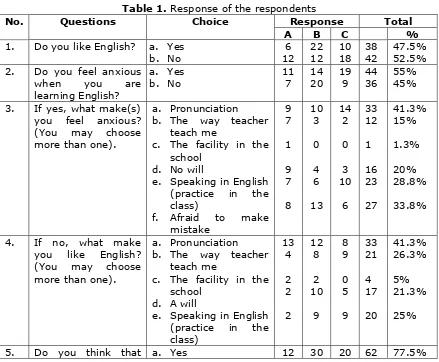
Table 1. Response of the respondents
No. Questions Choice Response Total
A B C %
e. Speaking in English (practice in the
650 confidence in speaking English.
Note:
A : Vocational School
B : Senior High School (Physic) C : Senior High School (Social)
The data obtained from the questionnaire show that 47.5% of the respondents like English and 52.5% of the respondents do not like English. It seems that there is no significant difference between the respondents who like and dislike English. However, this affects the feeling of the respondents when they are learning English. The data show that 55% of the respondents feel anxious and 45% do not feel anxious in learning English. The two next questions contribute to the previous questions. They give the reason why the respondents like or dislike English and why they feel anxious in learning English. The data show that the respondents have the same percentage on pronunciation. It is 41.3%. It implies that pronunciation has great impact to the learners when they are learning English because it is potential to make them comfortable and uncomfortable in learning English.
Related to the way of teaching of the teacher, the data show that 15% of the respondents feel uncomfortable with the way of teaching of the teacher, and 26.3% of the respondents like the way of teaching of the teacher. It implies that there is no problem with the way of teaching of the teacher. It can be assumed that the way of teaching of the teacher is good. The facility of the school does not give significant
effect on the respondents’ anxiety because it is only 1.3% of the respondents regard
it as the factor of their anxiety. Still, the respondents who regard it as the factor that make them like learning English are greater. It is 5%.
In addition, other two elements make the respondents anxious. They are practicing or speaking in front of the class (28.8%) and feeling afraid of making mistake (33.8%). Furthermore, among 80 respondents, 20% have no eagerness to be able to communicate in English and 21.3% have eagerness. Although more than half of them do not like English, apparently they have willingness to have competence in speaking English. It is proved by their respond achieving 77.5%, and it is only 20% of the respondent who do not have willingness. The final question is directed to get
the respondents’ opinion about who should be responsible to their failure and
success in learning English. The data show that the highest percentage of the
respondents’ respond is they themselves (83.8%) and the second highest is teacher
651 Conclusion
It is concluded that the anxiety of the students of Senior High School in Medan is at the moderate level of anxiety. It is in line with a finding of a research that “… students studying English language and literature at Cumhuriyet University, city of
Sivas, Turkey experienced moderate level of anxiety” (Elaldi, 2016, p. 225). Other
researchers also found the similar finding related to the level of anxiety. It revealed
“moderate anxiety among the participant” (Merzin, 2015, p. 37). This research is
conducted to the 6th graders from elementary school in the Southern region of Saudi Arabia. Furthermore, in general, it can be concluded that the factors of the
respondents’ anxiety are feeling shameful to their friends of making mistake and
being afraid of making mistake. In other words, they feel anxiety because of negative social evaluation.
References
Asif, F. (2017). The anxiety factors among Saudi EFL learners: A study from English
language teachers’ perspective. English Language Teaching 10(6), 160-173.
Elaldi, S. (2016). Foreign language anxiety of students studying English language and literature: A sample from Turkey. Educational Research and Reviews, 11(6), 219-228.
Ewald, J. D. (2007). Foreign language learning anxiety in upper-level classes: Involving students as researchers. Foreign Language Annals, 40(1), 122-142. Horwitz, E. K., Horwitz, M. B., Cope, J. (1986). Foreign language classroom anxiety. Modern Language Journal, 70(2), 125-132.
Horwitz, E. K. (2001). Language anxiety and achievement. Annual Review of Applied Linguistics, 21, 112-126.
Liu, M, & Huang, W. (2011). An exploration of foreign language anxiety and English learning motivation. Education Research International, 12, 1-8.
Merzin, A., & Awad, A. (2015). An investigation of anxiety among elementary school students towards foreign language learning. Studies in Literature and Language 11(1), 29-40.
Sadiq, J. M. (2017). Anxiety in English language learning: A case study of English language learners in Saudi Arabia. English Language Teaching, 10(7), 1-7. Williams, K. E., & Andrade, M. R. (2008). Foreign language learning anxiety in
Japanese EFL university classes: Cause, coping, and locus of control. Electric Journal of Foreign Language Teaching, 5(2), 181-191.
Yan, J. X., & Horwitz, E. K. (2008). Learners’ perceptions of how anxiety interacts
with personal and instructional factors to influence their achievement in English: A qualitative analysis of EFL learners in China. Language learning, 58(1), 151-183.
Young, D. J. (1991). Creating a low-anxiety classroom environment: What does language anxiety research suggest? The Modern Language Journal, 75(4), 426-439.
Zhang, R., & Zhong, J. (2012). The hindrance of doubt: Causes of language anxiety.
652 Appendix 1
KUESIONER
Pertanyaan:
1. Apakah anda menyukai pelajaran Bahasa Inggris? a. Ya
b. Tidak
2. Apakah anda merasa was-was/gelisah ketika mengikuti pelajaran Bahasa Inggris?
a. Ya b. Tidak
3. Jika iya, apa yang membuat anda merasa gelisah? (Anda boleh memilih lebih dari satu pilihan)
a. Pengucapannya b. Cara guru mengajar c. Fasilitas disekolah d. Memang tidak suka
e. Berbicara Bahasa Inggris (praktek di kelas) f. Takut buat salah
4. Jika tidak, apa yang membuat anda menyukai Bahasa Inggris? (Anda boleh memilih lebih dari satu pilihan).
a. Pegucapannya b. Cara guru mengajar c. Fasilitas di sekolah d. Memang suka
e. Berbicara Bahasa Inggris (praktek di kelas)
5. Menurut anda apakah seharusnya anda bisa menguasai dan berkomunikasi Bahasa Inggris?
a. Ya b. Tidak
6. Menurut anda, siapa seharusnya yang bertanggungjawab untuk kemampuan Bahasa Inggris anda? (Anda boleh memilih lebih dari satu pilihan)
a. Guru b. Sekolah c. Teman d. Keluarga e. Kesempatan f. Diri anda sendiri
7. Coba anda tuliskan pengalaman buruk anda saat mengikuti pelajaran Bahasa Inggris.
________________________________________________________________ ________________________________________________________________ ________________________________________________________________
653 Appendix 2
QUESTIONAIRE Questions:
1. Do you like English? c. Yes
d. No
2. Do you feel anxious when you are learning English? c. Yes
d. No
3. If yes, what make(s) you feel anxious? (You may choose more than one). a. Pronunciation
b. The way teacher teach me c. The facility in the school d. No will
e. Speaking in English (practice in the class) f. Afraid to make mistake.
4. If no, what make you like English? (You may choose more than one). a. Pronunciation
b. The way teacher teach me c. The facility in the school d. A will
e. Speaking in English (practice in the class)
5. Do you think that you must be able to communicate in English? a. Yes
b. No
6. Who/what do you think that should be responsible to your competence in English? (You may choose more than one).
a. Teacher b. School c. Friends d. Family e. Chance f. Yourself
7. Write your bad experience in English:
_________________________________________________________ _________________________________________________________ 8. Write your expectation to make you confident in learning English:
_________________________________________________________ _________________________________________________________