Full Terms & Conditions of access and use can be found at
http://www.tandfonline.com/action/journalInformation?journalCode=tjas20
Italian Journal of Animal Science
ISSN: (Print) 1828-051X (Online) Journal homepage: http://www.tandfonline.com/loi/tjas20
Genetic characterization of indigenous anatolian
water buffalo breed using microsatellite dna
markers
M.I. Soysal, E. Ozkan, S. Kok, M. Occidente, Y.T. Tuna, E.K. Gurcan & D.
Matassino
To cite this article: M.I. Soysal, E. Ozkan, S. Kok, M. Occidente, Y.T. Tuna, E.K. Gurcan & D. Matassino (2007) Genetic characterization of indigenous anatolian water buffalo breed using microsatellite dna markers, Italian Journal of Animal Science, 6:sup2, 409-412
To link to this article: http://dx.doi.org/10.4081/ijas.2007.s2.409
Copyright 2007 Taylor and Francis Group LLC
Published online: 15 Mar 2016.
Submit your article to this journal
Article views: 1
anatolian water buffalo breed using
microsatellite dna markers
m.
I. Soysal
·
1, E. ozkan
1, S. Kok
1, m. occidente
2, Y.t. tuna
1,
E.K. Gurcan
1, D. matassino
2,31 Trakya University, Agriculture Faculty, Department of Animal Science, 59030 Tekirda˘g, Turkey 2 conSDaBI - nFp.I – Fao - centro di Scienza omica per la Qualità e per l’Eccellenza nutrizionali,
Benevento, Italy
3 Dipartimento di Scienze biologiche e ambientali- università degli Studi del Sannio, Benevento,
Italy
Corresponding author: M.˙I.. Soysal. Trakya University, Agriculture Faculty, Department of Animal Scien-ce, 59030 Tekirda ˘g , Turkey Tel. +90 2822931292 - Fax: +90 2822931479 - Email: [email protected]
ABSTRACT: One indigenous water buffalo population to Anatolia was characterised with 11 cattle autosomal microsatellite loci. A set of 4 cattle microsatellite loci was found to be polymorphic in the Anatolian buffalo genome. Genotyping of these polymorphic micros-atellite loci revealed alleles ranging from 3 to 9. The observed heterozygosity ranged from 0.550 to 0.775 and the expected heterozygosity ranged from 0.494 to 0.815. The FIS value within each locus, changed from –0.101 to 0.205. Total FIS was 0.043 indicating that Anato-lian water buffalo population samples seemed to be in Hardy- Weinberg expectation.
Key words: Microsatellite, Anatolian water buffalo, Genetic diversity, DNA polymor-phism.
INTRODUCTION - The number of water buffaloes in the world has decreased rapidly over the past three decades (Georgoudis et al., 1998). Most of world buffaloes live in Asia, Egypt, Southern and South-Eastern Europe. Also buffaloes have played an important role in the rural economy of developing Asian country from ancient times.
According to FAO (2000) data, there were about 166 million domesticated buffaloes raised in the five world continents. However, there are about 158 million buffaloes left in the world (FAO statistics, 2003).Roughly 97 percent of them or 153 million of heads are water buffa-loes essentially found in the Asian region.
Also, in Turkey the buffalo population declined dramatically over the last decades. The total population according to FAO statistics (2003) is 164.000 heads. The largest number of buffa-lo population existed in Black sea region. Eastern Anatolian buffabuffa-lo population has second biggest number of population. Third biggest number of population in the Marmara region existed in Istanbul and surroundings this city. Feeding is based on grazing, straw and con-centrates. Their purpose of raising is firstly milk and secondly meat production.
The aim of this study was to estimate the intra-population genetic diversity using microsa-tellite markers.
MATERIAL AND METHODS -Sampling and analysis methods.The number of ani-mals sampled from the Anatolian water buffalo was 40. Blood samples of unrelated aniani-mals were collected in slaughterhouse in Silivri of Marmara region. Blood was collected in 10 ml tubes containing K2EDTA and stored at –20°C until the DNA was extracted by the standard
Phenol – Chloroform technique (Sambrook et al. 1989). The microsatellite loci used in the study and their characteristics are given in Table 1.
The PCR analyses were carried out using an Applied Biosystems GeneAmp® PCR System 2700 thermal cycler. The reaction mixture was composed of genomic DNA (100 ng), 200µm dNTPs, 2.0 mM MgCl2, 1X PCR buffer, 5 pmol forward and reversed primers and Taq DNA
polymerase (0.5 u/sample) in a total volume of 20 µl.
The PCR reactions were carried at following conditions: 1 cycle of initial denaturation for 5 minutes at 94 0C, 30 cycles of 45 seconds at 94 0C, 45 seconds at annealing temperature, 1
minute at 72 0C and 1 cycle of final extension for 10 minutes at 72 0C. In order to minimize
the artifacts caused during the amplification leading to false size estimations, one or more positive controls were used in each PCR reaction together with a negative control. The PCR products were checked on 2% agarose gel together with DNA size markers standards. For all microsatellites, allele size was determined on all samples with a Perkin Elmer ABI Pri-sm 310 Genetic Analyzer using the GeneScan Software (Perkin Elmer).
For the population and for each locus number of alleles (nA), observed heterozygosity (H0)
and unbiased expected heterozygosity (He) were calculated using Genetix 4.0 Programs.
The averages of nA, H0, He based on four loci were also computed. The population FIS value
of Wright’s F statistics based on four loci were estimated and used to test the deviation from the Hardy Weinberg equilibrium. All of the above computations were performed by using Genetix 4.0 statistical programs.
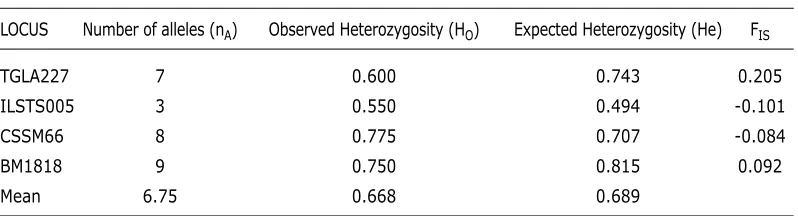
RESULTS AND CONCLUSIONS -Heterologous cattle microsatellite markers have been tested on Anatolian buffalo genome. A set of 11 (TGLA227, ILSTS005, CSSM66, BM1818, ETH10, ETH225, ETH3, HAUT24, HEL5, TGLA122, TGLA126) cattle microsatellite loci was analysed in Anatolian buffalo samples. Four cattle microsatellite loci were found to be poly-morphic in the Anatolian water buffalo genome. The number of alleles per locus varied from 3 (ILSTS005) to 9 (BM1818). The mean number of alleles per locus was about 6.75. Allele number distribution at the four analysed loci is given in Table 2. The observed heterozygosity ranged from 0.550 to 0.775, and the expected heterozygosity ranged from 0.494 to 0.815. Arora et al. (2003) studied microsatellite characterization of Tarai Buffalo of India. The Tarai buffalo is riverine with 50 chromosomes, which is similar to Anatolian water buf-falo population which is called as subgroup of Mediterrenean water bufbuf-faloes. Arora et al. (2003) examined heterologous cattle microsatellite loci and used them for molecular genetic characterization of Tarai genome. A set of 22 cattle microsatellite loci was found to be polymorphic in the Tarai genome. Genotyping of these polymorphic microsatellite loci
revealed alleles ranging from two to seven. Observed heterozygosity changed from 0.1316 to 0.9231. The value of mean observed heterozygosity was 0.60 in the Tarai buffalo popu-lation and expected heterozygosity changed from 0.1246 to 0.8149. BM1818, CSSM66 and ILSTS005 microsatellite loci were found be polymorphic in the Tarai buffalo population and also Anatolian water buffalo population. Anatolian water buffalo population heretozygosity was found to be similar in Tarai buffalo population.
vIII WorlD BuFFalo conGrESS
Moioli et al. (2001) compared genetic diversity between Greek, Italian and Egyptian buffalo po-pulations using 13 polymorphic microsatellite loci. The number of alleles per locus varied from two (ILSTS005) to 19 (ETH03). Only for two loci (CSSM33 and ILSTS005), all detected alleles were found in all three populations (Italian, Greek and Egyptian). ILSTS005 locus showed 3 al-leles in Anatolian water buffalo population. Observed average heterozygosity was 0.135, 0.151 and 0.158 in the Italian, Greek and Egyptian populations, respectively. It was lower, although not significantly different from the expected heterozygosity (0.173, 0.176 and 0.190 respectively for the Italian, Greek and Egyptian). Compared with the above values, in Anatolian water buf-falo population observed and expected heterozygosity were very high.
The Anatolian water buffalo population FIS value within locus ranged from –0.101 to 0.205 and the total FIS was 0.043. This result shows that, Anatolian water buffalo
po-pulation samples seemed to be in Hardy Weinberg expectation. Ultimately, the present study revealed the presence of high degree of genetic diversity within the water buffalo populations of Turkey.
table 1. nomenclature of the microsatellite loci used in the study, their primer sequences, polymorphism information contents (pIc), annealing tempera-ture, chromosome localization and references.
locus name primer pIc annealing chromosome reference
Sequence temp. (0c) number
tGla227 cGaattccaaatctGttaatttGct
acaGacaGaaactcaatGaaaGca 0,87 55 18 Steigleder et al. (2004) IlStS005 GGaaGcaatGaaatctataGcc
tGttctGtGaGtttGtaaGc 0.42 55 10 arora et al. (2003) cSSm66 acacaaatcctttctGccaGctGa
aatttaatGcactGaGGaGcttGG 0.49 58 14 arora et al. (2003) Bm1818 aGctGGGaatataaccaaaGG
aGtGctttcaaGGtccatGc 0.40 58 23 arora et al. (2003)
table 2. characteristics of bovine microsatellite markers tested on anatolian Water Buffalo population.
locuS number of alleles (na) observed Heterozygosity (Ho) Expected Heterozygosity (He) FIS
tGla227 7 0.600 0.743 0.205
IlStS005 3 0.550 0.494 -0.101
cSSm66 8 0.775 0.707 -0.084
Bm1818 9 0.750 0.815 0.092
mean 6.75 0.668 0.689
REFERENCES -Arora, R., Lakhchaura B.D., Prosad R.B., Chauhan, A., Bais R.K.S., Tantia M.S., Vijh R.K.,2003.Physical and Microsatellite Based Characterization of Tarai Buffalo of India. Buffalo Newsletter. 19 (June 2003). FAO, 2003. Food and Agricultural
Or-ganization of The United Nation (FAO). Rome (http://www.fao.org).Georgoudis, A.G., Pa-panastasis, V.P. Boyazo ˘glu, J.G.,1998.Use of Water Buffalo for Environmental Conservation of Waterland. In: Proc. of the 8th World Conference, Seoul, June 28-July 4, 1998, Symposium
Series 1, Seoul National University, Korea, 341-350. Moioli, B.,Georgoudis, A., Napolitano, F., Catillo, G., Giubilei, E., Ligda, Ch., Hassonane, M, 2001.Genetic Diversity Between Italian, Greek and Egyptian Buffalo Populations. Livestock Production Science. 7: 203-211.
Sambrook, J., Fritsch E. F. and Manıatıs T., 1989.Molecular Cloning: A laboratory Manual (2nd ed.) 3 vol., Cold-Spring Harbor Laboratory press, New York. Steigleder, C.S., Almeida,
E.A. Weimer, T.A., 2004.Genetic Diversity od a Brazilian Crerole cattle Based on Fourteen Microsatellite Loci. Arch. Zootec. 53:3-11.
vIII WorlD BuFFalo conGrESS