Full Terms & Conditions of access and use can be found at
http://www.tandfonline.com/action/journalInformation?journalCode=vjeb20
Download by: [Universitas Maritim Raja Ali Haji] Date: 11 January 2016, At: 22:14
Journal of Education for Business
ISSN: 0883-2323 (Print) 1940-3356 (Online) Journal homepage: http://www.tandfonline.com/loi/vjeb20
Increasing Student-Learning Team Effectiveness
With Team Charters
Phillip Hunsaker , Cynthia Pavett & Johanna Hunsaker
To cite this article: Phillip Hunsaker , Cynthia Pavett & Johanna Hunsaker (2011) Increasing Student-Learning Team Effectiveness With Team Charters, Journal of Education for Business, 86:3, 127-139, DOI: 10.1080/08832323.2010.489588
To link to this article: http://dx.doi.org/10.1080/08832323.2010.489588
Published online: 24 Feb 2011.
Submit your article to this journal
Article views: 389
View related articles
ISSN: 0894-1920
DOI: 10.1080/08832323.2010.489588
Increasing Student-Learning Team Effectiveness
With Team Charters
Phillip Hunsaker, Cynthia Pavett, and Johanna Hunsaker
University of San Diego, San Diego, California, USA
Because teams are a ubiquitous part of most organizations today, it is common for business educators to use team assignments to help students experientially learn about course concepts and team process. Unfortunately, students frequently experience a number of problems during team assignments. The authors describe the results of their research and efforts to enhance student team effectiveness by providing a team charter assignment and coaching students about its implementation. Descriptions of the team charter assignment, its components, theoretical foundations, effectiveness, and ideas for future developments are provided.
Keywords: charter, class, group, learning, performance, projects, team
Teams have the potential to increase productivity, morale, and innovation (Dumaine, 1994; Thompson, 2008). Conse-quently, they have become ubiquitous in modern organiza-tions (Cox, Bobrowski, & Spector, 2004; Devine, Clayton, Philips, Dunford, & Melner, 1999; Halfhill & Neilsen, 2007; Mumford, Van Iddekinge, Morgeson, & Campion, 2008). In response to the need for organizational members to possess team skills it has become common for business educators to utilize student learning teams in their classes (Cox & Bobrowski, 2004; Kalliath & Laiken, 2006). We have uti-lized team projects to enhance learning of course subject matter and team process skills in a wide variety of graduate and undergraduate courses. Existing research (Baily, Sass, Swiercz, Seal, & Kayes, 2005; Holtham, Melville, & Sodhi, 2006; Kalliath & Laiken) and feedback from our students over the years, confirm the efficacy of student teams as an experiential learning tool.
The use of student learning teams as a vehicle for expe-riential learning, however, is no guarantee that participants emerge from a management classes with the skills required to be an effective team leader or team member. Some students thrive on team assignments, but others rank working with teams as their worst college experience (Bacon, Stewart, & Silver, 1999). One reason many student project teams have unpleasant and dysfunctional outcomes (Kalliath & Laiken, 2006) is that, although many educators use teams to
facili-Correspondence should be addressed to Johanna Hunsaker, University of San Diego, School of Business Administration, 5998 Alcala Park, San Diego, CA 92110, USA. E-mail: [email protected]
tate learning, few provide the skills training for students to interact effectively as a team (Navarro, 2008). Even when training in team skills is offered, it has been found that stu-dents often resist investing the necessary time to become pro-ficient in them, preferring to get right to work on assigned projects. When teams start working without proper skills training, problems often result, including ambiguous expec-tations, conflicting team and individual goals, free-riding, inadequate communication, poor performance, dissatisfac-tion, and even having members be fired from the team (Cox & Bobrowski, 2000).
Numerous studies and books offer strategies to enhance team performance, evaluation, and leadership in the work-place (e.g. Baily, Sass, Swiercz, Seal & Kayes, 2005; Behfar, Peterson, Mannix & Trochim, 2008; Fowler & Zigarmi, 1997; Mishra & Sahgal, 2005; Thompson, 2008; Willcoxson, 2006). It is challenging, however, to develop classroom training strategies that can expediently mold di-verse sets of students into cohesive, high-performing learning teams in a single semester. Some of the most useful ideas for increasing classroom learning team effectiveness can be de-rived from the literature on psychological contracts and team charters (e.g., Aranda, Aranda, & Conlon, 1998; Fowler & Zigarmi, 1997; Holtham et al., 2006; McDermott, Brawley, & Waite, 1998; Thompson, 2008; Willcoxson, 2006).
The purpose of this artile is to share the results of our research and efforts to enhance student learning team effec-tiveness by introducing a team charter assignment early in the semester, before teams start to work on class projects. Following are descriptions of the team charter, why it is im-portant, and guidelines to help students develop each charter
component. The Pinch Model for managing member adher-ence to the charter is discussed, followed by examples of recommended processes for giving feedback, differentially allocating grades to avoid social loafing, and terminating non-compliant members. The final section of the article presents results of a student survey that illustrates the effectiveness of the team charter and provides suggestions for enhancing its usefulness in learning about and managing team.
The Need to Prepare Students for the Team Experience
We have observed a tendency for most students working on team projects to rush into the task without first examin-ing member strengths, sharexamin-ing personal expectations, settexamin-ing common goals, ascertaining levels of commitment, agree-ing on processes for communicatagree-ing and decision makagree-ing, and deciding how to measure and control contributions from members. Each member brings unique experience, expertise, information, and personal objectives to the team (Larson, Foster-Fishman, & Keys, 1994). When members have pri-vate data not possessed by others on the team, information asymmetry exists. When team members have divergent per-sonal goals, interest asymmetry exists (Edmondson, Roberto, & Watkins, 2003). Members usually have one or more shared objectives, including optimization of the overall performance of the team, but they also have unique personal goals that can conflict with overall team goals and other members’ personal goals.
When individuals pool their knowledge and expertise, synergy may occur where the collective output of the team is greater than the sum of individual outputs (Dumaine, 1994; Surowiecki, 2004). Many teams, however, often fail to achieve their potential (Hackman, 1990, 2002). Quite of-ten this is due to process losses (I. D. Steiner, 1972) that occur for a number of reasons, including groupthink (Janis, 1982), failure to handle information and interest asymme-tries effectively (Edmondson et al., 2003), and unproductive conflict (Edmondson & Smith, 2006). The usual result of process loss is confusion, anxiety, conflict, and disappoint-ing performance.
When members begin their team experience with infor-mation and interest asymmetries, ambiguity about how the team will operate, confusion about the rules, differing expec-tations about individual contributions, and varying assump-tions about objectives, there is a high probability for process losses. These losses can be minimized, and synergy can be created and maintained, by developing a psychological con-tract through the creation of a team charter at the beginning of the team’s existence (Hunsaker & Hunsaker, 2010).
Learning teams that are successful in a one-semester course are able to work through the difficult forming and storming stages of team development and proceed to norm-ing and performnorm-ing stages relatively quickly (Tuckman & Jensen, 1977). Often this occurs because of a lucky
assign-ment of compatible individuals that include a skilled leader with previous experience on an effective team. Other suc-cesses can be attributed to student team members having prior courses focused on team process and leadership. Unfor-tunately, these soft-skill courses, with titles such asWorking in Teams,Groups in Organizations,Leading High Perform-ing Teams, orInterpersonal and Group Dynamics, are few in number and usually are only offered as advanced electives too late in the curriculum to aid students in earlier team-based courses.
Students without previous team experience or skills need guidelines to help them uncover information and interest asymmetries, and develop a set of common expectations about how they will interact with each other (i.e., a psy-chological contract). They also need training in how to im-plement these guidelines as they strive to complete assigned tasks and learn from the team experience. Our observations, and student feedback over the years, confirm the conclusions of earlier research that a team charter is an efficacious tool for establishing team objectives, structure, norms, and oper-ating procedures to facilitate effective team performance and learning (Cox & Bobrowski, 2000). Our experience has also taught us that completing a team charter assignment in and of itself is not sufficient to assure effective team functioning. Students do not always utilize the team charter effectively for managing their team process and often regard it as just another assignment (Hunsaker & Hunsaker, 2010). Conse-quently, team members also need to develop and commit to a psychological contract, and, learn how to apply tech-niques for implementing and assuring compliance to their team charters.
What Is a Team Charter and Why Is It Important?
According to social exchange theory, people enter into re-lationships that are most satisfactory when the exchange of economic and social obligations is balanced (Wayne, Short, & Liden, 1997). A psychological contract is an implicit, un-written agreement between two or more individuals consist-ing of mutually accepted expectations about what each party will give and receive in the relationship. It includes social obligations and emotional commitments not usually speci-fied in performance agreements (Atkinson, 2007; Guest & Conway, 2002; Nadin & Cassell, 2007; Rousseau, 1995). A team charter expands and formalizes a psychological contract by obtaining explicit agreement among a team of individuals in a written document that specifies the team’s mission, goals, performance agreement, evaluation standards, and methods of discipline, in addition to making explicit previously im-plicit reciprocal social obligations and emotional commit-ments.
One desirable outcome of a psychological contract is the establishment of trust among the parties (Atkinson, 2007). Team charters are built on elements of psychological con-tracts, such as sharing information, agreeing on expectations,
devising norms, and establishing operating procedures that contribute to enhancing trust, building camaraderie, and max-imizing team performance potential. The maintenance of trust is critical in student teams because a breach can cre-ate perceptions of inequity leading to conflicts and reduced feelings of obligation to the team and its tasks (Atkinson; Bosch-Sijtsema, 2007; McFarlane Shore & Tetrick, 1994; Robinson & Rousseau, 1994). When trust is maintained con-flict is more likely to result in creative problem solving and positive outcomes (Behfar, Peterson, Mannix, & Trochim, 2008; Simons & Peterson, 2000).
The team charter assignment is designed to help student learning teams (a) clarify and create commitments to team purpose and goals; (b) bring information and interest asym-metries into the open; (c) establish guidelines and norms to govern team and individual behavior; (d) provide perfor-mance standards against which individual contributions and team outcomes can be measured; (e) provide feedback and self-correction measures; (f) maximize individual learning; and (g) define the boundaries and limitations within which the team will operate (Fowler & Zigarmi, 1997; McDermott et al., 1998). The process of creating and committing to a team charter at the beginning of the semester clarifies ex-pectations and creates a collaborative psychological contract that can ameliorate the chaos teams often experience dur-ing the early stages of their existence (Holtham et al., 2006). The resulting win-win climate and commonly understood ex-pectations, operating procedures, feedback mechanisms, and consequences can help prevent process losses and contribute to team synergy and learning throughout the life of the team (Cox & Bobrowski, 2000; Hunsaker & Hunsaker, 2010).
ELEMENTS OF A TEAM CHARTER
Successful organizations have mission statements to explain their reason for existing and keep member decisions and behaviors focused on this purpose. To be effective, teams members also need to agree about why they were formed, what they are expected to accomplish, and how they are sup-posed to interact (Ericksen & Dyer, 2004; Hackman, 2002). If individuals cannot agree on these things it may be very difficult for them to work effectively as a team to get the desired results (McDermott et al., 1998). A team charter is a mechanism for codifying a common understanding of why the team exists, what its goals are, and how members are to behave in order to achieve its goals (Fowler & Zigarmi,
1997). Charters also establish norms that govern individ-ual behavior, provide criteria for measuring team outcomes, develop guidelines for assessing member behavior, provide self-correction procedures, and define the boundaries within which the team must operate (Fowler & Zigarmi; McDermott et al.). A review of the literature on the best practices for cre-ating and implementing team charters revealed six essential components illustrated in Figure 1. These should be adapted
to the needs of each specific team and agreed upon by the leader, members, and the team sponsor (Fowler & Zigarmi).
Mission Statement
A mission statement explains a team’s purpose and goals. Team members begin by asking themselves why they are on the team and what they want to accomplish. Most teams do not spend enough time on these initial activities, which can cause negative consequences as team members strive to achieve unclear and conflicting goals (Aranda et al., 1998). It is often difficult for teams in task-oriented cultures, such as the United States or Germany, to take the time to share their feelings about team purposes and goals before they begin working. This is less of a problem in more relationship-oriented cultures, such as most Asian, Latin American, Mid-dle Eastern, and Southern European cultures, where building rapport among team members is more valued (Adler, 2008). Newly formed teams also often lack the skills of empathy and supportiveness to clarify members’ interests and degrees of commitment. Without these skills, attempts at purposing may be reduced to arguments over the inclusion of certain goals or even the use of a given word (Aranda et al.).
The purpose of the first charter question, “Why do you exist as a team?” is to clarify the team’s purpose and the reason for existence. It is not necessary for all team members to have exactly the same goals and motivations for being on the team, but it is important that these differences in assumptions, perceptions, and commitments are expressed and understood (Aranda et al., 1998).
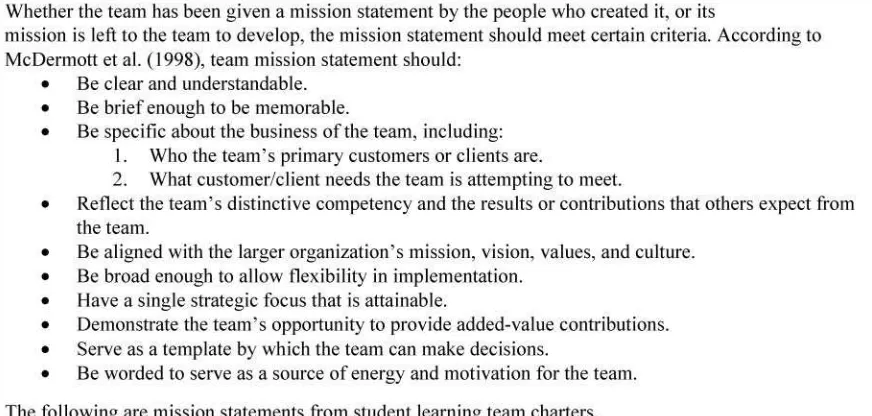
The result this discussion should be a clear purpose that every member understands and is committed to. After the team has agreed on its purpose, it should be written up as a mission statement to guide the rest of the chartering process (McDermott et al., 1998). Guidelines for writing mission statements and three examples are presented in Figure 2.
Vision
The next chartering step is to create a vision: a clear concise statement of the ideal end state the team desires to achieve. The vision should address outcomes for all stakeholders af-fected by the team’s actions. For example,
By the end of this semester this team will have helped un-derprivileged elementary school students perform better aca-demically through its service project, learned about why un-ethical business practices occur and what leaders can do to prevent them from its research project, and learned how to effectively function as a task team by studying our own pro-cess.
Boundaries
Teams need to develop a structure and operating guidelines that are congruent with their mission and vision (Behfar et al., 2008). Boundaries are the limits within which a
FIGURE 1 Components of a team charter.
team can conduct its business and accomplish its objectives. Boundary setting consists of generating clear, concise state-ments concerning policies, procedures, or values that cannot be violated (Fowler & Zigarmi, 1997). Boundaries define the team’s roles and responsibilities, its level of empower-ment or authority, and areas that are off limits. Figure 3 describes and gives examples of authority, task, identity, and political boundaries that need to be specifically addressed (McDermott et al., 1998).
By identifying the constraints within which they must work and how they will manage these boundaries in advance of project decisions, teams can factor these limits into plans and avoid more serious problems later on. Time, for example, is often a constraint for students with other responsibilities. To manage time boundaries, a team may set up a Gnatt chart with time lines for individual contributions. Financial re-sources may be another constraint that can be managed by setting limits for total and individual monetary contributions to team projects. Checking the class syllabus and confer-ring with the professor before initiating a project could help manage decisions that have to be approved by the professor. After boundaries are identified, members need to decide if they can make a commitment to work under these conditions or terminate their membership on the team. For example, if only one of six team members holds a weekend job, and the team cannot work around this limitation to find a suit-able meeting time, then the weekend worker may not be able to stay on the team. This is a planned termination
be-cause this member could not commit to the common team expectations. If members decide to leave a team, they are usually responsible for finding another team to join whose boundaries accommodate their personal situation.
Operating Guidelines, Norms, and Expectations
Not everyone on a team has the same level of commitment and members may make different kinds of contributions. It is important that members share and understand these dif-ferences so the team can design activities and rewards ac-cordingly (Osland, Kolb, Rubin, & Turner, 2007). To avoid misunderstandings and hurt feelings, team members need to share and agree on their expectations regarding how mem-bers should behave in order to achieve team goals and what the consequences for compliance and non-compliance will be (Atkinson, 2007). Examples are expectations about the degree of preparation for team meetings, work quality, and timeliness of individual inputs (Willcoxson, 2006).
Teams also need to discuss leadership and communica-tions expectacommunica-tions. Autonomous student learning teams don’t have an appointed leader, so they need to discuss the issue of leadership and decide to appoint a leader, rotate leadership, let a leader emerge naturally, or function without a leader (Cohen & Ledford, 1994). Face-to-face contact is often min-imal on student teams that typically only meet in a class-room once or twice a week. Consequently, communication processes quite often resemble those of virtual teams whose
FIGURE 2 Team mission statements: Criteria and examples.
members are geographically dispersed and communicate via a combination of telecommunications and information tech-nologies to accomplish an organizational task (Townsend, DeMarie, & Hendrickson, 1998). Virtual student teams rely on e-mail, text messages, and groupware. While these are efficient tools, they lack the richness found in face-to-face contact (Bosch-Sijtsema, 2007; Lipnack & Stamps, 2000; Robey, Koo, & Powers, 2000) making it difficult to commu-nicate effectively. A team charter provides guidelines to help team members insure that all relevant information is shared in a timely fashion through agreed upon channels that assure that all members are in the communication loop. One of the team leader’s responsibilities outlined in the previous step of the team charter, is to act as a linker of members by monitor-ing electronic communications to insure that all are included and meeting their responsibilities.
Evaluation and Discipline
How to evaluate the contributions of individual members to team projects has been the focus of much theorizing and research. (e.g., Halfhill & Neilsen, 2007; Holtham et al.,
2006; Stark, Shaw, & Duffy, 2007; Willcoxson, 2006). The prevailing conclusion is that teams should identify individual contributions and reward them accordingly (Stark et al.). If team members know that their individual contributions will be visible to all, the free-rider problem is often eliminated (Kerr & Bruun, 1983; Stark et al.).
The team charter assignment includes a member eval-uation component. Members generate a rubric for grading overall individual contributions and a method for allocating individual grades on the team projects. Additionally, mem-bers delineate consequences for violating team rules, norms and expectations.
Charter Endorsement
A charter endorsement is an acknowledgment between mem-bers and the instructor that the team charter is appropriate and that the team has permission to function accordingly. Having team members formally sign their charter signifies agreement and encourages commitment to uphold the char-ter. The instructor’s signature indicates acceptance of the student-imposed norms and guidelines.
FIGURE 3 Boundary statement essentials and examples.
TEAM CHARTER ASSIGNMENT INSTRUCTIONS AND PROCEDURE
Student learning teams are usually formed during the first or second class meeting. At that time, the Team Charter Assignment, found in Appendix A, should be distributed and discussed. Teams should be given class time to meet so they can get to know each other and get organized. During the first meeting, members share personal information including their goals and expectations, and develop a plan to complete the team charter assignment. The instructor’s job at this stage is to act as a coach who is available to clarify, elaborate, and make suggestions.
Managing Adherence to the Team Charter
A team charter can provide a structured vehicle for estab-lishing objectives, structure, norms, and operating proce-dures to facilitate team performance and learning, but its
creation alone is not adequate to assure effective team func-tioning. The student survey discussed subsequently revealed that charters are sometimes regarded as only a required as-signment and are not always implemented effectively to man-age a team’s process. The data imply that five mechanisms are necessary for effective implementation of a team char-ter. They include continuous management through the Pinch Model, fairly rewarding individual contributions, team pro-cess reviews, utilizing due propro-cess for firing noncompliant team members, and charter review and revisions after project completions.
Pinch Model for Managing Changes in Team Member Expectations
The psychological contract of a team charter is broken when members fail to fulfill commonly agreed upon obligations or when they interpret the contract differently (Simons, 2002). These breeches change the nature of relationships and can
create anger and resentment, which can decrease trust, sat-isfaction, performance, commitment, attendance, and desire to continue with the team (Johnson & O’Leary-Kelly, 2003; Robinson & Rousseau, 1994). One example is a free-rider that refuses to meet a group’s work norms becoming a stum-bling block to team productivity and morale (Osland et al., 2007). Another is ambiguous role assignments that create confusion that detracts from member contributions (McDer-mott et al., 1998).
To avoid these dysfunctional outcomes, team members need to continually share and process changing expectations. Broken psychological contracts brought about by asymmetric information and interests can be avoided by making goals and expectations explicit at the beginning of the group (Rousseau & Schalk, 2000). For unfulfilled expectations that occur later in the life of the team, mechanisms for continual discussion and renegotiations of the psychological contract are nec-essary (Osland et al., 2007). When team members apply the Pinch Model to manage shifting expectations, there is a higher probability that all expectations will be shared, under-stood, and fulfilled, which minimizes possible dysfunctional consequences (Sherwood & Glidewell, 1972).
The Pinch Model diagrammed in Figure 4 includes four sequential team actions necessary for the continuous man-agement of a psychological contract (Osland et al., 2007): sharing information and clarifying expectations, deciding to commit or terminate team membership, deciding how to deal with pinches (minor disruptions of shared expectations), and deciding how to deal with crunches (unbearable disruptions of shared expectations).
Step 1. Share information and clarify expectations.
Frequently it is assumed that all new team members are com-mitted to the same things, in the same way, and at the same level. In actuality, various members bring different goals, values, skills, role preferences, information, and levels of commitment to the team, and they do not always share these differences. Asymmetries in the distribution of situation-specific information and interests can give rise to process losses that undermine team effectiveness (Edmondson et al., 2003).
If both interest and information asymmetries occur si-multaneously, the likelihood of team effectiveness decreases further. In these instances, individuals may withhold infor-mation in order to create a personal advantage over other group members, or an individual may hold back information to prevent others from determining goals or preferences. The team needs to find out each member’s true goals, preferences, commitment to contribute, and other relevant information to determine if it needs different membership and if the current membership can achieve results (Aranda et al., 1998).
This information should be shared during the formation of the team. Team members need to accept that they have mutual accountability for team accomplishments. Each team
member has a specific role to play, but these roles come together to achieve a common result (Aranda et al., 1998).
Step 2. Decide to commit or terminate membership on the team. If the sharing process uncovers differences in expectations that cannot be resolved, a potential member should not join the team. Because there is an irresolvable mismatch of expectations that prevents the establishment of a mutually agreeable psychological contract there is a planned termination. On the other hand, if members share all relevant information and establish mutually acceptable expectations regarding contributions and rewards, a joint commitment to a psychological contract can be made and the team moves into a period of stability and productivity.
Step 3. Decide how to deal with pinches: Minor dis-ruptions of shared expectations. Changes occur over time, causing disruptions in shared expectations. Examples are norm violations regarding team meeting attendance or the quality of work input. External intrusions may also oc-cur, such as adding a new person to the team or changes in competing commitments when a team member begins a new job.
Initial awareness of such changes results in a pinch: the anxiety brought about by changes in behavior from previous expectations. This acts as a warning signal and a discussion should be initiated. The result may be a renegotiation of new acceptable expectations and a return to stability, or if the dif-ferences cannot be resolved, a member’s planned departure from the team.
Step 4. Decide how to deal with crunches: Unbear-able disruptions of shared expectations. Team mem-bers sometimes respond to pinches by suppressing their feel-ings. This behavior can result in heightened ambiguity and uncertainty that can lead to more anxiety and resentment toward the member violating team expectations. This often cumulates in a crunch.
Crunches are usually resolved by one of four solutions. Premature reconciliation occurs when the outlying member renews commitment to the team and returns to complying with the expectations of the original psychological contract. Stalemates occur when neither the outlier nor team members try to solve the problem resulting with the outlier remaining on the team, continuing the unsatisfactory behavior, and all suffering. The best alternative at a crunch point is for the outlying member to share the reasons for his or her viola-tions followed by renegotiating revised mutually agreeable expectations. An all too common outcome, however, is a re-sentful termination, when the offending member is forced to leave the team. An even more destructive outcome may occur if the resentful termination is only psychological and the chastised member stays on the team, pretending to accept the team expectations, but in reality reducing contributions to a minimum.
FIGURE 4 Pinch Model for managing expectations (Sherwood & Glidewell, 1972).
The key to avoiding negative crunch points is intervening at pinch points. This is a form of damage control aimed at finding and fixing small problems before they grow into bigger problems. When the authors have explained the Pinch Model and encouraged members to utilize it to manage their team process, student feedback indicates that the majority of crunches can be avoided. Figure 5 provides examples of student survey responses demonstrating how they used the Pinch Model to manage team psychological contracts.
Individual Member Grade Allocation Process
Free-riding occurs when teams are rewarded as a whole for their results. Social loafing does not usually occur when indi-vidual efforts are measured and awarded accordingly (Kerr & Bruun, 1981; Stark, Shaw & Duffy, 2007). If a team wants to discourage free riders and build trust among its members, it is important to measure and reward individual contributions to team projects in ways that are perceived as fair by team members.
FIGURE 5 Student evaluations of Pinch Model.
One method of encouraging compliance with the charter is to provide teams with an opportunity to evaluate the quantity and quality of individual contributions and distribute rewards accordingly. If all team members know that they will get their just deserts, the incidents of social loafing decrease dramatically, and when they do occur the team’s allocation of different grades to different members is usually accepted as fair (Hunsaker & Hunsaker, 2010).
Continuous Process Reviews
We recommend that teams review their process, progress, and each member’s level of contribution on an ongoing ba-sis. The goal is to provide feedback about potential or actual pinches and to review the team process in hope of finding ideas for improvement. Teams that complete ongoing pro-cess analyses have fewer crunches because they are able to address pinches as they occur (Hunsaker & Hunsaker, 2010).
Due Process in Firing Noncompliant Team Members
Teams sometimes have problems with lack of contribution and/or participation of team members. Because of groupthink that occurs when members do not want to rock the boat (Ja-nis, 1972) and pluralistic ignorance where members think they are lone dissenters (Miller, 1987), pinches are often not acted on until late in the project when they become crunches. Crunches typically are not managed well. At crunch points, noncompliant members are often blindsided by harsh criti-cism and penalties that cause defensive reactions. We insist that teams follow a due process for firing offending members from the team if renegotiation under duress is not successful and no other resolution is possible.
Due process consists of a written warning to the offending member after a serious pinch, with specific reasonable objec-tives for future contributions spelled out. If these objecobjec-tives are not met, a written notice of termination explaining the shortcomings is provided to the offending member who is terminated from the team with no credit for the team project. The terminated member has no appeal possible unless ap-proved by the instructor prior to the final notice of termina-tion. Teams are advised not to wait until the last two weeks of the semester to take action regarding offending members of the team because this does not provide sufficient feedback and time for due process (Morris, 2008).
Revisiting and Revising the Team Charter After Project Completions
After each team project members are required to review and report on their productivity, process, satisfaction, and each member’s level of contribution. Teams are also required to offer suggestions for improvement in each of these areas for forthcoming team projects.
TEAM CHARTER ASSIGNMENT EVALUATION
Student perceptions about the usefulness of the team char-ter assignment and implementation tools were gathered via an anonymous e-mail survey sent to three business man-agement classes that utilized team projects and required the development of a team charter as their first assignment. Re-spondents were asked to evaluate how well the assignment facilitated their team process on class projects. Suggestions about how the team charter assignment’s effectiveness might be improved were also solicited. The survey was sent to 93 students and 67 useable responses were received.
The survey consisted of two sections. The first section contained a 9-item Likert-type survey with responses rang-ing from 1 (strongly agree) to 7 (strongly disagree). The sec-ond section contained a 5-item open-ended response survey. Summaries of the numerical ratings and a content analysis of the open-ended questions are presented in Appendix B.
SUMMARY AND CONCLUSIONS
The team charter assignment and implementation tools were developed because of the dysfunctional experiences reported by learning teams in our own classes, reports from colleagues, and the literature of similar problems in other classes. After implementing the team charter assignment three years ago, student feedback, course evaluations, and a survey of the most recent classes indicate that there has been a significant im-provement in team dynamics, satisfaction, and productivity. When teams do experience problems, the team charter ap-pears to provide an explicit agreement and structure by which members self-manage and resolve difficulties without medi-ation from the instructor. Because we introduced the Team Charter Assignment no members have been fired from their teams and the quality of team projects and other team-based activities, such as in-class exercises and case discussions, all have improved.
There are several things we have learned from our ex-periences and student feedback that can enhance the team charter’s effectiveness. The first is that the team charter as-signment should be completed early in the semester in order to facilitate the forming and norming phases of team devel-opment, and provide a set of guidelines for performing later team assignments. Second, all members should participate in developing all portions of the charter (i.e., parts of the charter should not be delegated to individual members). Third, all members should sign the charter endorsement to signify their agreement and commitment. Fourth, the charter should be re-viewed before each project begins, and it should be utilized during work on the project to assure compliance. Finally, teams should be encouraged to revise any component at any time to enhance its relevance.
The Team Charter Assignment is undergoing continual refinement. Based on student suggestions for improving the
team charter assignment, we are planning to revise it in the following ways: (a) providing a required components check-list to insure all necessary features are included; (b) combin-ing sections of the charter to eliminate redundant informa-tion, (c) asking teams to revisit their charters before begin-ning each team project, (d) adding a section to the assignment specifically addressing meeting times and assignment sched-ules, (e) asking teams to introduce their members, share their team names and team logos, and provide executive sum-maries of the highlights of their charters to the rest of the class to enhance team identity and share learning with other teams.
Congruent with the trends in business education, many educators are utilizing student learning teams in their classes (Cox & Bobrowski, 2004; Kalliath & Laiken, 2006). Expe-rience and existing research (Baily et al., 2005; Holtham et al., 2006; Kalliath & Laiken), verify the efficacy of student teams as an experiential learning tool. To avoid the problems student learning teams frequently experience, our university now requires that all incoming graduate business students participate in a team building orientation that includes training in how to develop a team charter, and, in each subsequent class utilizing student learning teams, the development of a team charter is the first order of business.
REFERENCES
Adler, N. J. (2008).International dimensions of organizational behavior (5th ed.). Mason, OH: Thomson South-Western.
Aranda, E. K., Aranda, L., & Conlon, K. (1998).Teams: Structure, process, culture, and politics. Upper Saddle River, NJ: Prentice Hall.
Atkinson, C. (2007). Trust and the psychological contract.Employee Rela-tions,29, 227–246.
Bacon, D., Stewart, K., & Silver, W. (1999). Lessons from the best and worst student team experiences: How a teacher can make the difference. Journal of Management Education,23, 467–488.
Baily, J., Sass, M., Swiercz, P., Seal, C., & Kayes, D. C. (2005). Teaching with and through teams: Student-written instructor-facilitated case writing and signatory code.Journal of Management Education,29, 39–59. Behfar, K., Peterson, R. S., Mannix, E. A., & Trochim, W. M. K. (2008).
The critical role of conflict resolution in teams: A close look at the links between conflict type, conflict management strategies, and team outcomes.Journal of Applied Psychology,93, 170–188.
Bosch-Sijtsema, P. (2007). The impact of individual expectations and ex-pectation conflicts on virtual teams.Group & Organization Management, 32, 358–388.
Cohen, S., & Ledford, G. (1994). The effectiveness of self-managed teams: A quasi-experiment.Human Relations,47, 13–43.
Cox, P. L., & Bobrowski, P. E. (2000). The team charter assignment: Im-proving the effectiveness of classroom teams.The Journal of Behavioral and Applied Management.1(1), 92–103.
Cox, P. L., & Bobrowski, P. E. (2004). Power tools for teams: A model for improving the teamwork skills of first-year business students.The Journal of Behavioral and Applied Management,5, 204–227.
Cox, P. L., Bobrowski, P. E., & Spector, M. (2004). Gateway to business: An innovative approach to integrating writing into the first-year business curriculum.Journal of Management Education,28, 62–87.
Devine, D. J. Clayton, L. D, Philips, J. L., Dunford, B. B., & Melner, S. B. (1999). Teams in organizations: Prevalence, characteristics, and effectiveness.Small Group Research,30, 678–711.
Dumaine, B. (1994). The trouble with teams.Fortune,5, 86–92.
Edmondson, A., Roberto, M., & Watkins, M. (2003). A dynamic model of top management team effectiveness: Managing unstructured task streams. Leadership Quarterly,14, 297–325.
Edmondson, A. C., & Smith, D. M. (2006). Too hot to handle? How to manage relationship conflict,California Management Review,49(1), 6– 31.
Ericksen, J., & Dyer, L. (2004). Source right from the start: Exploring the effects of early team events on subsequent project team development and performance.Administrative Science Quarterly,49, 438–471.
Fowler, S., & Zigarmi, D. (1997).The team leader’s idea-a-day guide. Chicago, IL: Dartnell.
Guest, D., & Conway, N. (2002). Communicating the psychological con-tract: An employer perspective.Human Resource Management Journal, 12, 23–38.
Hackman, J. R. (1990).Groups that work (and those that don’t). San Fran-cisco, CA: Jossey-Bass.
Hackman, J. R. (2002).Leading teams. Boston, MA: Harvard Business School Press.
Halfhill, T. R., & Nielsen, T. M. (2007). Quantifying the “softer side” of management education: An example using team competencies.Journal of Management Education,31, 64–80.
Holtham, C. W., Melville, R. R., & Sodhi, M. S. (2006). Designing student group work in management education: Widening the palette of options. Journal of Management Education,30, 809–817.
Hunsaker, P. L., & Hunsaker, J. S. (2010, March).Can team charters in-crease learning team performance and satisfaction? Results of a survey of management students. Paper presented at the Western Academy of Management, Kona, Hawaii.
Janis, I. (1972).Victims of groupthink. Boston, MA: Houghton Mifflin. Johnson, J. L., & O’Leary-Kelly, M. (2003). The effects of psychological
contract breach and organizational cynicism: Not all social exchange violations are created equal.Journal of Organizational Behavior,24, 627–647.
Kalliath, T., & Laiken, M. (2006). Use of teams in management education. Journal of Management Education,30, 747–750.
Kerr, N. L., & Bruun, S. E. (1983). Dispensability of member effort and group motivation losses: Free-rider effects.Journal of Personality and Social Psychology,44, 78–94.
Larson, J. R., Foster-Fishman, P. G., & Keys, C. B. (1994). Discussion of shared and unshared information in decision-making groups.Journal of Personality and Social Psychology,67, 446–461.
Lipnack, J., & Stamps, J. (2000).Virtual teams: People working across boundaries with technology(2nd ed.). New York, NY: Wiley.
McDermott, L. C., Brawley, N., & Waite, W. W. (1998).World class teams. New York, NY: Wiley.
McFarlane Shore, L., & Tetrick, L. E. (1994). The psychological contract an explanatory framework in the employment relationship. In C. Cooper (Ed.),Trends in organizational behavior(Vol. 1, pp. 91–109). New York, NY: Wiley.
Miller, D. T. (1987). Pluralistic ignorance: When similarity is interpreted as dissimilarity.Journal of Personality and Social Psychology,53, 298–305. Mishra, S., & Sahgal, P. (2005). The efficacy of group method in man-agement education: A case study on social conformity.Decision,32, 113–123.
Morris, T. (2008).How to fire a member from your team. Unpublished manuscript, University of San Diego, Master of Global Leadership pro-gram.
Mumford, T. V., Van Iddekinge, C. H., Morgeson, F. P., & Campion, M. A. (2008). The team role test: Development and validation of a team role knowledge situational judgment test.Journal of Applied Psychology,93, 250–267.
Nadin, S. Y., & Cassell, C. (2007). New deal or old? Exploring the psycho-logical contract in a small firm environment.International Small Business Journal,25, 417–443.
Navarro, P. (2008). The MBA core curricula of top-ranked U.S. business schools: A study in failure?Academy of Management Learning & educa-tion,7, 108–123.
Osland, J. S., Kolb, D. A., Rubin, I. M., & Turner, M. E. (2007). Organiza-tional behavior: An experiential approach(8th ed.). Upper Saddle River, NJ: Prentice Hall.
Robey, D., Koo, H. M., & Powers, C. (2000). Situational learning in cross-functional virtual teams.Technical Communication,47, 51–66. Robinson, S. L., & Rousseau, D. M. (1994). Violating the psychological
con-tract: Not the exception, the norm.Journal of Organizational Behavior, 15, 245–259.
Rousseau, D. M. (1995). Psychological contracts in organizations: un-derstanding written and unwritten agreements. Newbury Park, CA: Sage.
Rousseau, D. M., & Schalk, R. (2000).Psychological contracts in employ-ment: Cross-national perspectives. Thousand Oaks, CA: Sage. Sherwood, J. J., & Glidewell, J. C. (1972). Planned renegotiation: A
norm-setting OD intervention. In W. W. Burke (Ed.),Contemporary organiza-tion development: Orientaorganiza-tions and intervenorganiza-tions(pp. 35–46). Washing-ton, DC: NTL Institute.
Simons, T. L. (2002). Behavioral integrity: The perceived alignment between managers’ words and deeds as a research focus.Organizational Science, 13(1), 18–35.
Simons, T. L., & Peterson, R. S. (2000). Task conflict and relationship conflict in top management teams: The pivotal role of intra-group trust. Journal of Applied Psychology,85, 102–111.
Stark, E. M., Shaw, J. D., & Duffy, M. K. (2007). Preference for group work, winning orientation, and social loafing behavior in groups.Group & Organization Management,32, 699–723.
Steiner, I. D. (1972).Group process and productivity. New York, NY: Aca-demic Press.
Surowiecki, J. (2004).The wisdom of crowds: Why the many are smarter than the few and how collective wisdom shapes business, economies, societies and nations. New York, NY: Anchor Books.
Thompson, L. L. (2008).Making the team: A guide for managers. Upper Saddle River, NJ: Pearson, Prentice-Hall.
Townsend, A. M., DeMarie, S. M., & Hendrickson, A. R. (1998). Virtual teams: Technology and the workplace of the future.Academy of Manage-ment Executive,12, 17–29.
Tuckman, B. W., & Jensen, M. A. (1977). Stages of small group de-velopment: Revisited. Group and Organizational Studies, 2, 419– 427.
Wayne, S. J., Short, L. M., and Liden, R. C. (1997). Perceived organiza-tional support and leader-member exchange: a social exchange perspec-tive.Academy of Management Journal,40, 82–111.
Willcoxson, L. E. (2006). It’s not fair!: Assessing the dynamics and re-sourcing of teamwork. Journal of Management Education, 30, 798– 808.
APPENDIX A—Team Charter Assignment
Purpose: The purpose of developing a team charter is to jump-start your work together as a learning team, to help you avoid common problems, and to facilitate continual improve-ment of your team throughout the course. By addressing the following issues, you should be able to enhance your team performance, member satisfaction, and learning.
Instructions:Download and read the Team Charter Hand-book from WebCT. Develop your team charter through mu-tual sharing and consensus. Include the following compo-nents in your written team charter.
I. Mission statement
• Team purpose (This is your mission statement)
– Why do you exist as a team?
– What do you want to accomplish?
• Team goals (These are means to your mission)
– What team goals do you need to accomplish to attain your mission?
• Member goals (These help align individuals to the overall
team goals)
– Clarify what each member expects to achieve by being a part of this team.
– What do you have in common?
– How do individual goals differ? (Clarify grade expec-tations, learning goals, and social expecexpec-tations, etc.)
II. Team vision
• Develop a clear and concise statement of the ideal end state your team desires to achieve in terms of the entities that will be affected by the team’s outcomes. Describe what it will be like for all stakeholders if your team is successful?
III. Team identity
• Develop a team name that represents your member com-position and goals.
• Develop a team logo: an image of who you are and what you will accomplish.
• Develop a team roster that includes: Each team mem-bers’ name, phone number, e-mail address and an as-sessment of his/her team strengths and improvement goals.
IV. Boundaries
• What policies, procedures and values do you subscribe to that cannot be violated?
• What are the limitations on the teams’ performance (e.g., time and resources)?
• What decisions can you make on our own versus needing permission from others?
• What activities are and are not legitimate for the team to engage in?
• Who are the stakeholders affected by your team’s activi-ties?
V. Operating guidelines: Team structure and processes
• Do you need a leader? What is expected of your leader? Will you rotate leadership?
• How will you make decisions: most vocal wins, voting, consensus (100% agree)?
• How will you perform the work that needs to be done on the various projects?
• How will you communicate with each other?
• How will you encourage positive/creative conflict and dis-courage dysfunctional conflict?
• How will you facilitate member growth and development?
VI. Performance norms and consequences (Perfor-mance Agreement)
What norms (behavioral rules) do you need to facilitate goal attainment and member satisfaction? What are your standards of performance?
• How will you evaluate and rewardoverall teamand mem-ber performance?
– How you will treat each other in general?
– How will you deal with dysfunctional behaviors, e.g., dominating, withdrawing, wasting time, free riding, etc.?
– How will you evaluate member contribution to the team process
– How will team members be disciplined for not adhering to team norms?
– What is your due process for terminating a member from the team?
– How will the team reward itself for a job well done?
• What expectations do you have forteam meetings?
– What consequences for missing or being late to a meet-ing?
– What are valid excuses for missing or being late to a meeting?
• What expectations do you have forteam project
contribu-tions?
– What is expected for delivery and quality of assigned work?
– What are your criteria for evaluating project contribu-tions?
– What are the consequences for work that is late or is of poor quality?
– How will grades for your team projects be allocated to individual team members? (See Appendix C for an example grade allocation method)
– How will the team reward individual members for out-standing contributions?
VII. Charter endorsement
• All team members sign the team charter agreement.
• Those not agreeing to all terms should leave the team for reassignment.
Note.The Team Charter Handbook and examples of stu-dent learning team charters are available from the senior author.
APPENDIX B—Team Charter Survey
Part I: Numerical ratings results
Students were asked to respond to each of the following nine statements by circling responses on a 7-item Likert-type scale ranging from 1 (strongly agree) to 7 (strongly disagree).
1. The team charter contributed to the success of our team functioning.
This statement received an average score of 2.72, which suggests that the majority of respondents fairly strongly agreed that the team charter was a contributing factor to the success of their team functioning.
2. The team charter helped to clarify team goals and objectives.
The average response was 2.3, suggesting that the majority of respondents fairly strongly agreed that the team charter helped with the clarification of team goals and objectives.
3. The team charter helped to increase attendance at team meetings.
This statement received an average of 3.28, which suggests that the majority of respondents somewhat agreed that the team charter helped to increase attendance at meetings.
4. The team charter helped to decrease lateness at team meetings.
The average response was 3.50, suggesting that the majority of respondents somewhat agree that the team charter helped to decrease lateness at meetings. 5. The team charter helped to increase member participation.
The statement received an average of 2.54, which suggests that the majority of respondents agreed that the team charter helped to increase member participation.
6. The team charter helped to decrease social loafing.
The average response was 2.96, suggesting that the majority of respondents somewhat agreed that the team charter helped to decrease social loafing. 7. The team charter helped the team manage conflict effectively.
This statement received an average of 2.86, suggesting that the majority of respondents agreed or somewhat agreed that the team charter helped to manage team conflict more effectively.
8. Creating a team name enhanced team identity and cohesiveness.
This statement received an average score of 2.75, suggesting that the majority of respondents agreed that the team name enhanced identity and cohesiveness. 9. Creating a team logo kept our team focused and motivated.
This statement received an average score of 3.19, which suggests that the majority of respondents somewhat agreed that the logo helped to maintain focus and motivation of the team.
Part II: Written responses results
Below are content analyses summaries of student answers to five open-ended questions about various aspects of the team charter.
1. If you think the team charter contributed to the success of your team functioning, please explain how it did so.
The team charter contributed to the success of the team’s functioning in that it forced conversation about, and agreement on, members’ goals and expectations for the assignment. It caused the team to establish ground rules to which every member agreed. The team charter brought team cohesion and shared commitment to the assignments, as well as setting a tone of accountability among the team members. The charter assisted members in organizing their schedules and finding mutually agreeable times to meet throughout the semester. Many students mentioned that establishing and team charter helped form interpersonal bonds among team members.
2. If you do not think the team charter contributed to the success of your team functioning, please explain why it didn’t.
Most comments were in support of the team charter as a contributing factor to a team’s success. Some said that although the process of creating it helped the team get to know each other, the charter document itself did not have much influence because they never revisited or consulted the charter after it was created. Others speculated that a more efficient team, or a team made up of organized and efficient students, may not need a charter to be successful.
3. If you created a team name, explain how it was, or was not, useful and helpful.
Most of the students’ responses were positive and suggested that the team name was useful, fun and helpful in that it created a sense of unity and pride among the team members. Those students who said they did not create a team name also said they wished they had created one because it might have created more of a sense of unity among team members
4. If you created a team logo, explain how it was, or was not, useful and helpful.
Overall, students found the team logo helpful, but not as significant as the team name and charter. In general, creating a logo was fun and creative and many students thought it created more cohesion among the group members, especially if it related to their team name.
5. What ideas do you have for improving the usefulness of the Team Charter assignment?
The majority of the students suggested a more clear explanation of the requirements of the charter as they felt they were marked down for not having included some necessary elements—a requirements or checklist was suggested. The majority of the students also suggested that some of the sections were redundant in that they required information similar to that required in other sections. Some students suggested that future teams be asked to revisit their charters throughout the semester to be sure all members are adhering to the guidelines set out in the beginning. Several students suggested that a meeting and assignment schedule should be a required section of the charter as it was difficult to find times when all group members were able to meet and discuss the team assignments. There were a few students who suggested that a signature page should be included at the end of the charter to ensure that all members have read and agree to the contents of the charter. Others suggested having a small amount of class time to introduce their members, team name and logo to the rest of the class.