GENES IN FOUR ACACIA SPECIES
Anthonius Y.P.B.C. Widyatmoko1,2 and Susumu Shiraishi3
ABSTRACT
Sequence polymorphisms among and within four Acacia species, A. aulacocarpa, A. auriculiformis, A. crassicarpa, and A. mangium, were investigated using four chloroplast DNA genes (atpA, petA, rbcL, and rpoA). he phylogenetic relationship among these species is discussed in light of the results of the sequence information. No intraspeciic sequence variation was found in the four genes of the four species, and a conservative rate of mutation of the chloroplast DNA genes was also conirmed in the Acacia species. In the atpA and petA of the four genes, all four species possessed identical sequences, and no sequence variation was found among the four Acacia species. In the rbcL and rpoA genes, however, sequence polymorphisms were revealed among these species. Acacia aulacocarpa and A. crassicarpa shared an identical sequence, and A. auriculiformis and A. mangium also showed no sequence variation. he fact that A. mangium and A. auriculiformis shared identical sequences as did A. aulacocarpa and A. crassicarpa indicated that the two respective species were extremely closely related. Although a putative natural hybrid of A. aulacocarpa and A. auriculiformis has been reported, our results suggested that natural hybridization should be further veriied using molecular markers.
Keywords: Acacia, sequencing, chloroplast DNA, phylogeny
I. INRODUCTION
here are more than one thousand documented species of Acacia, of which about 650 species occur in Australia. Acacia auriculiformis, A. mangium, A. aulacocarpa, and A. crassicarpa are four of only nine Australian Acacia species, whose distributions extend northward into Papua New Guinea and Indonesia (Moran et al., 1989). he four species are multiple-purpose plantation species, and in the last decade, they have become a major plantation species used for pulp production in Southeast Asia. Acacia species have been introduced in commercial plantations in Southeast Asia. he total area of tree plantations is now approaching two million ha and the largest of these plantations (about 1.2 million ha) is located in Indonesia, where the major planted species is fast-growing Acacia mangium Wild. (Arisman and Hardiyanto, 2006; Potter et al., 2006). In industrial pulpwood plantations, these four Acacia species are newcomers compared
1 Center for Forest Biotechnology and Tree Improvement Research, Jl. Palagan Tentara Pelajar Km. 15, Purwobinangun, Pakem, Sleman, Yogyakarta, Indonesia.
2 Corresponding Author. E-mail: [email protected]
to Eucalyptus. However, these species are suitable for krat pulp production based on criteria such as basic density, bleaching properties, and pulp quality.
he genetic relationship among the four species is important for evolutionary study. In breeding programs, this information is useful for predicting hybridization activities. Until now there has been little discussion of the relationship among these species (Pettigrew and Watson, 1975; Boland et al., 1990; Brain and Maslin, 1996). Moreover, the classiication of the four species is not well elucidated. Some studies have been conducted in order to investigate the relationship among the four species (Widyatmoko et al., 2010); however, no phylogenetic analysis among the four species has been reported using the sequence information of chloroplast DNA (cpDNA) genes. Phylogenetic relationship among Acacia species have been reported by Clarke et al. (2000), Byrne et al. (2001; 2002) and Brown et al. (2008). Both of the research were using chloroplast DNA. Acacia species which have been used for phylogenetic relationship study revealed the signiicant association between phylogenetic position of many haplotypes and their geographical distribution. Hamrick et al. (1992) reported the efect of pollination to genetic diversity of species. Long-lived, outcrossing and wind-pollinated species has higher levels of allozyme diversity within population and less among population.
DNA sequences of cpDNA genes have been utilized for estimating the phylogeny of many taxa of plants. In particular, the chloroplast gene (rbcL) that encodes a large subunit of the enzyme ribulose-1,5-biphosphate carboxilase has been used to elucidate the relationships of Betulaceae (Chen et al., 1999), Rutaceae (Chase et al., 1999), Salix (Azuma et al., 2000) and Solanum (Bohs, 2004). Intraspeciic sequence polymorphism of cpDNA has also been investigated (Fujii et al., 1999; Amane et al., 2000; Zimmer et al., 2002).
In this study, sequence polymorphisms among the four Acacia species were investigated using four cpDNA genes (atpA, petA, rbcL, and rpoA). Furthermore, a phylogenetic relationship among these species was discovered and is discussed with the results of the sequence polymorphism.
II. MATERIALS AND METHODS
Plant materials for the study were obtained from the Australian Tree Seed Centre of CSIRO (Commonwealth Scientiic and Industrial Research Organization), Australia, and from the Forest Tree Improvement Research and Development Institute, Indonesia. For each species, four seedlots (represented by one seed) were used for sequencing. Details of each sample are shown in Table 1.
acetate was added. he solution was kept on ice for 30 min, and was then centrifuged at 0oC at 15,000 rpm for 40 min. he sample in the aqueous phase (400 µl), was transferred to a new tube, and the DNA was precipitated by the addition of 400 µl isopropanol. Ater circa 10 min, the precipitate was collected by centrifugation at 15,000 rpm for 10 min. he supernatant was completely removed, and the pellet was washed twice with 1.0 ml of 70% Ethanol. Ater the pellet was washed using a vacuum evaporator for 2 min, it was resuspended in 100 µl puriied H2O. Finally, the crude solution was puriied using a GeneClean III Kit (BIO 101), and the puriied DNA was utilized as a template for PCR.
Table 1. List of sample materials for the four cpDNA genes
Species Seed source
Seedlot No. Location*
A. aulacocarpa 16946-AK 000012** Balimo District, PNG 13866-BH 012313** Garioch, QLD
17905-TREE** 10K NW Mt. Molloy, QLD 17739-BG 000022** 3K S Mt. Larcom, QLD
A. auriculiformis 16606-BVG 01220** Morehead R Rouku WP, PNG 18359-MHL 20** Lower Poscoe River, QLD 16756-BG 004936** E Normamby River, QLD 18601-6** (R) Orchard Melville Is., NT
A. crassicarpa AC-1107** Kuel, Irian Jaya, IND
13680-JC 001503** Wemenever Prov., PNG 17944-MHL 04** Claudie River, QLD 16775-BH 013582** Parish of Annan, QLD
A. mangium 570*** Piru, Seram, IND
16971-BVG 01626** Wipim District WP, PNG 17946-GJM 1110** Claudie River, QLD 17703-GLM 00920** Tully-Mission Beach, QLD
Notes: * PNG, Papua New Guinea; QLD, Queensland, Australia; NT, Northern Territory, Australia; IND, Indonesia
** Seedlot No. of CSIRO, Australia *** Seedlot No. of FTIRDI, Indonesia
mM MgCl2, 200 mM of each dNTP, and 0.25 unit/10µl Ex Taq DNA polymerase. DNA ampliication was performed with a Gene Amp PCR System Model 9600 (Perkin-Elmer) programmed as follows: 95oC for 90 s, 30 cycles of 30 s at 94oC, 30 s at 55 oC, and 90 s at 72oC, followed by 60 s at 72oC. he PCR product was separated by electrophoresis in 1.5% agarose gel and the target fractions were excised from the gel. DNA was recovered from the gel particles and was puriied using QIAEX II Gel Extraction (QUIAGEN). he sequence reaction was carried out using a hermo Sequenase luorescent labeled primer cycle sequencing kit (Amersham Pharmacia Biotech), the template DNA, and -21M13 (TGTAAAACGACGGCCAGT) / M13Rev (CAGGAAACAGCTATGA-CC) sequence primer 5’-labeled with Texas Red luorescent dye (Amersham Pharmacia Biotech). he sequence was analyzed with a Hitachi SQ5500 DNA Sequencer.
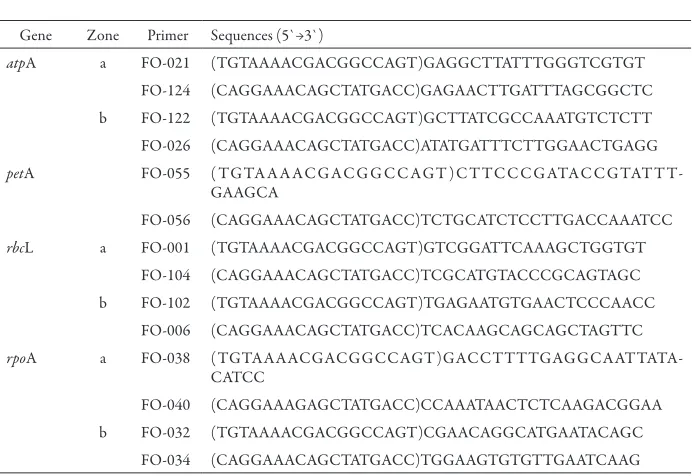
Table 2. Primer sequences for amplifying the four cpDNA genes
Gene Zone Primer Sequences (5`→3`)
atpA a FO-021 (TGTAAAACGACGGCCAGT)GAGGCTTATTTGGGTCGTGT FO-124 (CAGGAAACAGCTATGACC)GAGAACTTGATTTAGCGGCTC b FO-122 (TGTAAAACGACGGCCAGT)GCTTATCGCCAAATGTCTCTT FO-026 (CAGGAAACAGCTATGACC)ATATGATTTCTTGGAACTGAGG
petA FO-055 ( TGTA A A ACG ACG G CC AGT )C T TCCCG ATACCGTAT T T-GAAGCA
FO-056 (CAGGAAACAGCTATGACC)TCTGCATCTCCTTGACCAAATCC
rbcL a FO-001 (TGTAAAACGACGGCCAGT)GTCGGATTCAAAGCTGGTGT FO-104 (CAGGAAACAGCTATGACC)TCGCATGTACCCGCAGTAGC b FO-102 (TGTAAAACGACGGCCAGT)TGAGAATGTGAACTCCCAACC
FO-006 (CAGGAAACAGCTATGACC)TCACAAGCAGCAGCTAGTTC
rpoA a FO-038 (TGTAAAACGACGGCCAGT
)GACCTTTTGAGGCAATTATA-CATCC
FO-040 (CAGGAAAGAGCTATGACC)CCAAATAACTCTCAAGACGGAA b FO-032 (TGTAAAACGACGGCCAGT)CGAACAGGCATGAATACAGC
FO-034 (CAGGAAACAGCTATGACC)TGGAAGTGTGTTGAATCAAG Remarks: - upper primer was forward primers, below primers was reverse primers
- he sequence in parentheses represents the M13/M13Rev universal primer
III. RESULTS AND DISCUSSION
A. Intraspeciic Variation of the Four Chloroplast Genes
In order to investigate sequence variations within species, four samples from four separate populations were used in each species (Table 1). Of the four Acacia species, A. aulacocarpa was thought to have the largest genetic diversity (Widyatmoko et al., 2010). he samples of this species from New Guinea Island, North Queensland, and South Queensland corresponding to the diferent subspecies were separated morphologically by homson (1994). he length of atpA, petA, rbcL, and rpoA were 1084 bp, 561 bp, 1309 bp, and 782 bp, respectively, and no sequence variation was found in the four genes among the four samples. Eventhough McDonald and Maslin (2000) divided A. aulacocarpa into 6 species, no sequence variation was found among those species. In the remaining three species, exactly the same results were shown. A low rate of cpDNA mutation has been reported in Acacia acuminata complex in Western Australia (Byrne et al., 2002). the time of divergence between the two main lineages within A. acuminata is in the order of 800,000 years ago, in the middle of the Pleistocene. Paritt and Badeness (1997) and Provan et al. (1999) reported a low cpDNA mutation rate for the genus Pistacia and Pinus torreyana respectively. Restriction site mapping of chloroplast DNA was chosen for phylogenetic analysis because of its ability to provide many information characters, even in comparison to DNA sequence from any particular gene ( Jansen et al., 1998)
B. Interspeciic Variation Among the Four Acacia species
In the atpA and petA genes, no sequence variation was found among the four Acacia
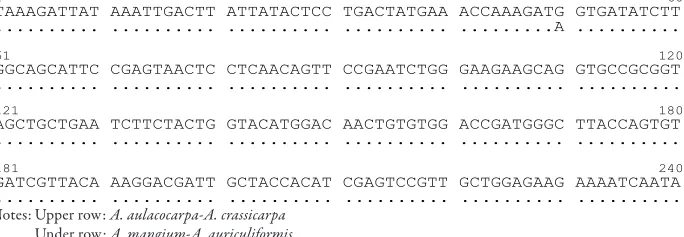
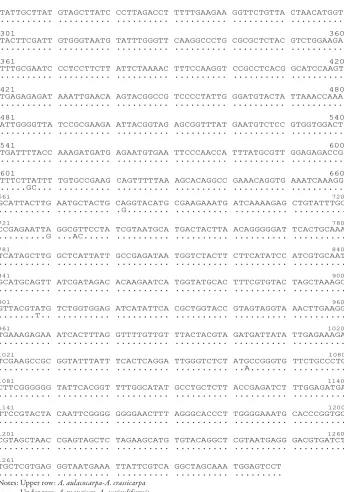
species. All four species possessed identical sequences. Sequences of the rbcL and rpoA genes are shown in Figures 1 and 2. Although no length variation among species was observed in either gene, sequence polymorphisms were revealed among these species. Within the four species, A. aulacocarpa and A. crassicarpa shared an identical sequence, and A. auriculiformis and A. mangium also showed no sequence variation.
Number of base substitutions and amino acid changes among species are shown in Table 3. In the rbcL sequence, six transitions and three transversions were found between the two groups mentioned above. In rpoA, two transitions between the two groups were identiied. Five amino acid changes were caused by these substitutions between the groups. he amino acid changes were observed only in the rbcL gene.
An inference concerning the genetic relationship among the four Acacia species using RAPD analysis has been reported (Widyatmoko et al., 2010). We indicated that the four species were separated into two clades: A. auriculiformis and A. mangium were grouped into one clade, and the other clade contained A. aulacocarpa and A. crassicarpa
relationship among closely related species. A. auriculiformis and A. mangium, which were grouped into the same clade, were separated into diferent respective subclades. In the latter clade, however, which contained A. aulacocarpa and A. crassicarpa, each species could not clearly form a clade. As a result, A. crassicarpa is considered a subspecies of A. aulacocarpa. McDonald and Maslin (2000) also mentioned closed relationship between those species. A result similar to this has also been reported by homson (1994) whose study was based on morphological observations.
he present study clariied a phylogenetic relationship among the four species. he four Acacia species were classiied into two groups. One group contained A. auriculiformis
and A. mangium, and the other consisted of the remaining two species. Within each group, two species had exactly the same sequences in the four cpDNA genes. Between the two groups, 11 substitutions were found in the rbcL and rpoA genes. Putative natural hybrids of A. aulacocarpa and A. auriculiformis have been found (homson, 1994). However, our results suggested that A. aulacocarpa and A. auriculiformis were distantly related. herefore, natural hybridization between these two species might be further veriied using molecular markers.
Interspeciic variation among Acacia species have been reported by and Clarke et al. (2000) and Byrne et al. (2002). Byrne et al. (2002) reported a signiicant association between phylogenetic position of many haplotypes and their geographical distribution. he cpDNA analysis clearly identiied A. oldieldii as distinct from the rest of the A. acuminata complex. Clarke et al. (2000) reported the phylogenetic relationship between 4 Acacia sub genus Acacia in Caribbean, Africa, South America and North America. A group of Carribean species was found to be ancestral in Acacia subgenus Acacia, and African and South American species were found to relatively derive with respect to North American species.
1 60
TAAAGATTAT AAATTGACTT ATTATACTCC TGACTATGAA ACCAAAGATG GTGATATCTT ... ... ... ... ...A ...
61 120
GGCAGCATTC CGAGTAACTC CTCAACAGTT CCGAATCTGG GAAGAAGCAG GTGCCGCGGT ... ... ... ... ... ...
121 180
AGCTGCTGAA TCTTCTACTG GTACATGGAC AACTGTGTGG ACCGATGGGC TTACCAGTGT ... ... ... ... ... ...
181 240
GATCGTTACA AAGGACGATT GCTACCACAT CGAGTCCGTT GCTGGAGAAG AAAATCAATA ... ... ... ... ... ...
241 300
Notes: Upper row: A. aulacocarpa-A. crassicarpa
Under row: A. mangium-A. auriculiformis
241 300 TATTGCTTAT GTAGCTTATC CCTTAGACCT TTTTGAAGAA GGTTCTGTTA CTAACATGGT
... ... ... ... ... ...
301 360
TACTTCGATT GTGGGTAATG TATTTGGGTT CAAGGCCCTG CGCGCTCTAC GTCTGGAAGA
... ... ... ... ... ...
361 420
TTTGCGAATC CCTCCTTCTT ATTCTAAAAC TTTCCAAGGT CCGCCTCACG GCATCCAAGT
... ... ... ... ... ...
421 480
TGAGAGAGAT AAATTGAACA AGTACGGCCG TCCCCTATTG GGATGTACTA TTAAACCAAA
... ... ... ... ... ...
481 540
ATTGGGGTTA TCCGCGAAGA ATTACGGTAG AGCGGTTTAT GAATGTCTCC GTGGTGGACT
... ... ... ... ... ...
541 600
TGATTTTACC AAAGATGATG AGAATGTGAA TTCCCAACCA TTTATGCGTT GGAGAGACCG
... ... ... ... ... ...
601 660
TTTCTTATTT TGTGCCGAAG CAGTTTTTAA AGCACAGGCC GAAACAGGTG AAATCAAAGG
...GC... ... ... ... ... ...
661 720
GCATTACTTG AATGCTACTG CAGGTACATG CGAAGAAATG ATCAAAAGAG CTGTATTTGC
... ... .G... ... ... ...
721 780
CCGAGAATTA GGCGTTCCTA TCGTAATGCA TGACTACTTA ACAGGGGGAT TCACTGCAAA
...G ...AC... ... ... ... ...
781 840
TCATAGCTTG GCTCATTATT GCCGAGATAA TGGTCTACTT CTTCATATCC ATCGTGCAAT
... ... ... ... ... ...
841 900
GCATGCAGTT ATCGATAGAC ACAAGAATCA TGGTATGCAC TTTCGTGTAC TAGCTAAAGC
... ... ... ... ... ...
901 960
GTTACGTATG TCTGGTGGAG ATCATATTCA CGCTGGTACC GTAGTAGGTA AACTTGAAGG
...T.. ... ... ... ... ...
961 1020
TGAAAGAGAA ATCACTTTAG GTTTTGTTGT TTACTACGTA GATGATTATA TTGAGAAAGA
... ... ... ... ... ...
1021 1080
TCGAAGCCGC GGTATTTATT TCACTCAGGA TTGGGTCTCT ATGCCGGGTG TTCTGCCCTG
... ... ... ... ..A... ...
1081 1140
CTTCGGGGGG TATTCACGGT TTTGGCATAT GCCTGCTCTT ACCGAGATCT TTGGAGATGA
... ... ... ... ... ...
1141 1200
TTCCGTACTA CAATTCGGGG GGGGAACTTT AGGGCACCCT TGGGGAAATG CACCCGGTGC
... ... ... ... ... ...
1201 1260
CGTAGCTAAC CGAGTAGCTC TAGAAGCATG TGTACAGGCT CGTAATGAGG GACGTGATCT
... ... ... ... ... ...
1261
TGCTCGTGAG GGTAATGAAA TTATTCGTCA GGCTAGCAAA TGGAGTCCT
... ... ... ... ...
Notes: Upper row: A. aulacocarpa-A. crassicarpa
Under row: A. mangium-A. auriculiformis
661 720 GCATTACTTG AATGCTACTG CAGGTACATG CGAAGAAATG ATCAAAAGAG CTGTATTTGC ... ... .G... ... ... ...
721 780
CCGAGAATTA GGCGTTCCTA TCGTAATGCA TGACTACTTA ACAGGGGGAT TCACTGCAAA ...G ...AC... ... ... ... ...
781 840
TCATAGCTTG GCTCATTATT GCCGAGATAA TGGTCTACTT CTTCATATCC ATCGTGCAAT ... ... ... ... ... ...
841 900
GCATGCAGTT ATCGATAGAC ACAAGAATCA TGGTATGCAC TTTCGTGTAC TAGCTAAAGC ... ... ... ... ... ...
901 960
GTTACGTATG TCTGGTGGAG ATCATATTCA CGCTGGTACC GTAGTAGGTA AACTTGAAGG ...T.. ... ... ... ... ...
961 1020
TGAAAGAGAA ATCACTTTAG GTTTTGTTGT TTACTACGTA GATGATTATA TTGAGAAAGA ... ... ... ... ... ...
1021 1080
TCGAAGCCGC GGTATTTATT TCACTCAGGA TTGGGTCTCT ATGCCGGGTG TTCTGCCCTG ... ... ... ... ..A... ...
1081 1140
CTTCGGGGGG TATTCACGGT TTTGGCATAT GCCTGCTCTT ACCGAGATCT TTGGAGATGA ... ... ... ... ... ...
1141 1200
TTCCGTACTA CAATTCGGGG GGGGAACTTT AGGGCACCCT TGGGGAAATG CACCCGGTGC ... ... ... ... ... ...
1201 1260
CGTAGCTAAC CGAGTAGCTC TAGAAGCATG TGTACAGGCT CGTAATGAGG GACGTGATCT ... ... ... ... ... ...
1261
TGCTCGTGAG GGTAATGAAA TTATTCGTCA GGCTAGCAAA TGGAGTCCT ... ... ... ... ... Notes: Upper row: A. aulacocarpa-A. crassicarpa
Under row: A. mangium-A. auriculiformis
Figure 2. Sequences of rpoA of the four Acacia species
Table 3. Number of substitutions and amino acid changes in the four cpDNA genes of A. aulacocarpa-A. crassicarpa and A. auriculiformis-A. mangium
Figure 3. he relationships between four Acacia species (Widyatmoko et al., 2010)
IV. CONCLUSION
Sequence polymorphisms were revealed among these species for rbcL and rpoA genes. No sequence variation was found for Acacia aulacocarpa and A. crassicarpa, and also for A. auriculiformis and A. mangium. Both groups were diferentiated by 11 bases.
he phylogenic results of this and previous studies may be useful in planning, especially in breeding programs. For A. mangium and A. auriculiformis, which are extremely closely related, it might be necessary that interspeciic hybridization breeding be carried out on a larger scale in the breeding programs. A similar breeding strategy is also worth discussing for A. aulacocarpa and A. crassicarpa.
REFERENCES
Arisman, H. and E.B. Hardiyanto 2006. Acacia mangium: a historical perspective on its cultivation. In: Potter, K., A. Rimbawanto and C. Beadle (Eds.), Heart Rot and Root Rot in Tropical Acacia Plantations (ACAIR Proceedings No. 124) ACAIR, Canberra, pp. 11–15.
Azuma, T., T. Kajita, J. Yokoyama and H. Ohashi 2000. Phylogenetic relationships of Salix (Salicaceae) based on rbcL sequence data. American Journal of Botany 87: 67-75.
Bohs, L. 2004. A Chloroplast DNA Phylogeny of Solanum Section Lasiocarpa.
Systematic Botany 29:177-187.
Boland, D.J., K. Pinyopusarerk, M.W. McDonald, T. Jovanovic and T.H. Booth 1990. he habitat of Acacia auriculiformis and probable factors associated with its distribution. Journal of Tropical Forest Science 3: 159-180.
Brain, P. and B.R. Maslin 1996. A serological investigation of the classiication of Acacia
subgenus Phyllodineae (Leguminosae: Mimosoideae). Biochemical Systematics and Ecology 24: 379-392.
Brown, G. K., D.J. Murphy, J.T. Miller and P.Y. Ladiges 2008. Acacia s.s. and its Relationship Among Tropical Legumes, Tribe Ingeae (Leguminosae: Mimosoideae). Systematic Botany 33:739-751.
Byrne, M., B. MacDonald and D. Coates 2002. Phylogeographical patterns in chloroplast DNA variation within the Acacia acuminata (Leguminosae: Mimosoideae) complex in Western Australia. Journal of Evolutionary Biology 15 : 576-587. Byrne, M., G. Tischler, B. Macdonald, D.J. Coates and J. McComb, J. 2001. Phylogenetic
relationships between two rare acacias and their common, widespread relatives in south-western Australia. Conservation Genetics 2: 157-166.
Chase, M.W., C.M. Morton and J.A. Kallunki 1999. Phylogenetic relationship of Rutaceae: a cladistic analysis of the subfamilies using evidence from rbcL and atpB sequence variation. American Journal of Botany. 86: 1191-1199.
Chen, Z-D., S.R. Manchester and H-Y. Sun 1999. Phylogeny and evolution of the Betulaceae as inferred from DNA sequences, morphology and paleobotany. American Journal of Botany. 86: 1168-1181.
Clarke, H.D., S.R. Downie, and D.S. Seigler 2000. Implications of chloroplast DNA restriction site variation for systematics of Acacia (Fabaceae: Mimosoideae). Systemactic Botany 25: 618-632.
Hamrick, J. L., M.J.W. Godr, and S.L.S. Broyles 1992. Factors inluencing levels of genetic diversity in woody plant Species. New Forests 6: 95-124.
Jansen, R. K., J.L. Wee and D. Millie 1998. Comparative utility of chloroplast DNA restriction site and DNA sequence data for phylogenetic studies in plants. Pp. 87 – 100 in Molecular systematic of Plants II: DNA sequencing, eds. D. E. Soltis, P. S. Soltis and J. J. Doyle. Norwell, Massachusetts: Kluwer Academic Publicher. McDonald, M. W. and B.R. Maslin 2000. Taxonomy revision of the Salwood: Acacia
aulacocarpa Cunn. Ex Benth. And its allies (Leguminosae: Mimosoideae: secion Julilorae). Australian Systematic Botany 13:21-78.
Moran, G. F., O. Muona and J.C. Bell 1989. Breeding systems and genetic diversity in Acacia auriculiformis and A. crassicarpa. Biotropica 21: 250-256.
Paritt D. E. and M.L. Badeness 1997. Phylogeny of the genus Pistacia as determined from analysis of the chloroplast genome. Proceeding of the National Academy of Science. 94: 7987-7992.
Pettigrew, C. J. and L. Watson 1975. On the classiication of Australian Acacias. Australian Journal of Botany 23: 833-847.
Potter, K., A. Rimbawanto, and C. Beadle 2006. Preface. In: K. Potter, A. Rimbawanto, C. Beadle (Eds.), Heart Rot and Root Rot in Tropical Acacia Plantations ACIAR Proceedings No. 124, Canberra, p.7.
Provan, J., N. Soranzo, N.J. Wilson, D.B. Goldstein and W. Powell, W. 1999. A low mutation rate for chloroplast microsatellites. Genetics 153: 943-947.
Thomson, L.A.J. 1994. Acacia aulacocarpa, A. cincinnata, A. crassicarpa and A. wetarensis: an annotated bibliography. Division of Forestry, Australian Tree Seed Centre, Canberra. 131p.
Widyatmoko, A.Y.P.B.C., A. Watanabe, A. Rimbawanto and S. Shiraishi 2010. Genetic variations and relationship in four species of section Julilorae, genus Acacia using DNA molecular markers. Journal of Forestry Research 7 (2): 125-143.