Accredited by DGHE No: 66b/DIKTI/Kep/2011 DOI: 10.5398/medpet.2013.36.3.159
*Corresponding author:
E-mail: [email protected]
Intensiication of Wild Silkworm Atacus atlas Rearing
(Lepidoptera: Saturniidae)
B. K. Desmawitaa,*, A. M. Fuahb, & D. R. Ekastutic
aMajor Program of Animal Science Production and Technology, Graduate School, Bogor Agricultural University bDepartment of Animal Production and Technology, Faculty of Animal Science, Bogor Agricultural University
cDepartment of Anatomy, Physiology, and Pharmacology, Faculty of Veterinary Science, Bogor Agricultural University
Jln. Agatis, Kampus IPB Darmaga, Bogor 16680, Indonesia
(Received 04-07-2013; Reviewed 24-09-2013; Accepted 09-12-2013)
ABSTRACT
Study on intensiication program through reproduction and feeding management was conducted for six months to evaluate the growth and reproductive performance of wild silkworm, Atacus atlas. The experiment was divided into two phases: 1) the irst phase was conducted on mating management, by applying diferent times of mating duration of 3, 6, 12, and 24 h as treatments to assess eggs produc
-tion. In this phase, a completely randomized design was used, with 4 treatments and 5 replications; 2) the second phase was on feeding management, a completely randomized design method (2 x 2) was used, including feed (guava and walnut leaves) as irst factor, and the second factor was feeding times (3 and 4 times/day) with 5 replications. The results obtained from the irst experiment showed that dif
-ferent duration of mating signiicantly (P<0.05) afected the number of eggs produced. Based on time eiciency 6 hours mating duration produced higher egg production (226 egg/cycle), as well as hatch
-ability (95%) than those of other mating duration. In the second experiment, it was found that there was interaction between feed types and feeding frequencies which signiicantly (P<0.05) afected feed consumption, feed digestibility, body weight gain, diameter of larvae and mortality rate. In conclusion, the optimum and eicient duration sugested for mating is six hours resulting high egg production. The walnut leaves feed has beter efect on the irst and second instar of larvae, while the guava leaves af
-fect the following instars. In terms of production, four times of feeding frequency per day has higher productivity and is recommended in the cultivation management of A. atlas.
Key words: Atacus atlas, feeding management, intensiication, mating management
ABSTRAK
Penelitian ini bertujuan untuk mengevaluasi penerapan program intensiikasi pemeliharaan Atacus atlas. Penelitian dibagi dalam dua tahap: 1) tahap pertama adalah manajemen perkawinan yang dilakukan berdasarkan lama perkawinan yang berbeda yaitu 3, 6, 12, dan 24 jam dan dinilai pengaruh
-nya terhadap produktivitas dan performa telur. Penelitian ini menggunakan rancangan acak lengkap dengan lama perkawinan sebagai perlakuan dan lima ulangan; 2) tahap kedua adalah manajemen pakan yang menggunakan rancangan acak lengkap pola faktorial 2 x 2, yang terdiri atas faktor pertama, yaitu jenis pakan (daun jambu dan kenari); faktor kedua, adalah waktu pemberian pakan per hari (3 dan 4 kali). Hasil penelitian fase pertama menunjukkan bahwa perbedaan lama kawin mempengaruhi (P<0.05) jumlah telur dan daya tetas telur. Hasil penelitian fase kedua mengindikasikan adanya inter
-aksi antara jenis pakan dan frequensi pemberiannya terhadap parameter produksi A. atlas. Terdapat perbedaan nyata (P<0.05) konsumsi pakan segar, kecernaan pakan, pakan tercerna, pertambahan bobot badan, pertambahan diameter badan larva, dan mortalitas pada waktu dan frekuensi pemberian pakan yang berbeda. Disimpulkan bahwa lama perkawinan 6 jam menghasilkan jumlah dan daya tetas telur yang lebih tinggi (226 butir/induk/siklus dan 95%) dibandingkan perlakuan lainnya. Daun kenari memberikan hasil yang lebih baik pada instar I dan II, sementara daun jambu memberi hasil yang baik pada instar ke III dan sampai ke V. Frekuensi pemberian pakan 4 kali per hari meningkatkan produkti
-vitas ulat sutera A. atlas.
INTRODUCTION
Atacus atlas was a wild silkworm species which was found in almost in all parts of Indonesia (Wolfgang et al., 2010), still considered as wild animals, and very much depending on the available feeds around their habitat. This insect was categorised as polivoltin and polifagus, potentially could be cultivated because of their capability to consume a large varieties and types of feeds. Several feeds which were common to A. atlas, including tea leaves, soursop, avocado, cinnamon, bit-terness, ylang-ylang, dadap, cloves, sengugu, turmeric, mango, kaliki, jatropha (Indrawan, 2007; Adria, 2010). A. atlas can produce cocoons (Faatih, 2005), that could be processed for good quality silk, however, the insect has not been intensively cultivated yet. Due to environ-mental changes and efects, mortality rate of A. atlas was very high, which may reach 90% (Situmorang, 1996). The main natural problems related to environmental factors that can not be controlled such as temperature, humid-ity, rainfall, light, types of feed available and diseases caused by parasites and predators were suggested as factors associated with such high mortality (Indrawan, 2007). Therefore, one of the alternative solutions to im-prove productivity is to apply an intensive management by keeping the insect in appropriate housing system, feeds and suitable environmental conditions.
In terms of reproductive performance, cultivation of A. atlas often encountered some natural problems including the unbalanced number of males and females imago in the population for fair matings, the shorter life cycle of males than females, and some of eggs produced are infertile. Therefore, optimum use of imago in mating systems, appropriate feed and feeding through intensive management may improve reproductive performance of A. atlas. Information on feeding and reproduction management of A. atlas were still rare, therefore, study on this aspect was necessarily of importance.
MATERIALS AND METHODS
The study was devided into 2 phases, includ-ing matinclud-ing management and feedinclud-ing management. The experiments were conducted for six months from September 2012 to February 2013, located in the Laboratory of Metabolism, Faculty of Veterinary Medicine, Bogor Agricultural University. Materials used were wild silkworm A. atlas, guava, and walnut leaves as feed sources.
A completely randomized design was used in the irst experiment, by applying 4 diferent mating times (3, 6, 12, and 24 h) as treatments with ive replications. Twenty moths (10 males and 10 females) were used. In the second experiment, a completely randomized design with 2 factors (types of feeds and feeding frequency) with 5 replications was applied. Guava and walnut leaves were given to animals in the frequency of feeding of 3 and 4 times per day. The total numbers of larvae used were 300 larva’s, of which put in 20 experimental units with 15 larva’s per unit.
Procedures and Data Analysis
This study was commenced with the collection of cocoons from tea plantation in Purwakarta. Cocoons were placed in a gauze cage 50 x 50 x 50 cm2, and the moths were caged in pairs. The observed variables during the irst phase included: 1) laying period, is the time required by female moth to oviposite her eggs; 2) eggs production counted as the total eggs produced by a female moth during her production cycles; 3) incubation time or time needed for incubation (in days), egg hatch-ability is the percentage of eggs hatched relative to the total eggs produced; and egg weight.
The variables measured in the second phase of ex-periment were done in each cycle of instar, included: 1) Feed intake= Ʃdaily feed intake
Daily feed intake= {weight of given fresh leaves – [weight of residual leaves x correction factor]}/ number of larvas;
2) Feed digestibility= ([dry mater consumption – faeces dry mater]/ dry mater consumption) x 100%; 3) Digested feed= feed digestibility x fresh feed
consumption;
4) Body weight gain= body weight at the start of instar – body weight at the end of instar;
5) Average diameter gain at anterior, middle, and pos-terior part of body, and mortality= ([number of larva at the start of instar – number of larva at the end of instar]/ number of larva at the start of instar) x 100%. Data obtained from this study were analyzed using analysis of varianced (ANOVA). Duncan least signiicant mean test at α= 0.05 was used to assess the diference be-tween treatments in order to determine the best mating and feeding management for application.
RESULTS AND DISCUSSION
Environmental Conditions
Temperature, humidity, and light intensity were measured to present the environmental condition dur-ing the study. The results showed that the average room temperature was 27.44±0.38 oC in the morning, 28.21±0.45 oC in the afternoon, and 27.52±0.52 oC in the evening, and the minimum and maximum temperature was 26.2 oC and 28.9 oC, respectively. Humidity in the morning, afternoon, and evening was 83.93±3.37%, 75.33±6.57%, and 82.42±5.14% respectively, with a minimum humid-ity of 56.9% during the day time and 91.7% in the eve-ning. The morning light intensity was 0.009±0.004 Klux, 0.015±0.008 Klux during day time, and 0.008±0.017 Klux in the evening. Minimum light intensity occured in the evening (0.001 Klux) and the maximum occured in the afternoon (0.029 Klux). These overall conditions were still favorable for A. atlas to express good performance.
Mating Management
times did not signiicantly afect the average of laying period of 5.00±0.65 d. The laying period with mating time longer than: 3 h was 4.60±0.55 d, 6 h was 5.20±0.84 d, 12 h was 5.20±0.45, and 24 h was 5.00±0.63 d, which was relatively similar amongst treatments. According to Singh et al. (2003), the similar results indicates a good prospect required for cultivation process. The moth of A. atlas used chemical compounds such as pheromones to do their sexual communication with each others (Goswami & Singh, 2012). The antenna of males have an important function to detect the pheromones released by females as a signal and chemical cues to atract the males for copulation. The sexual activities was performed by nature, and then, the female moths will produce eggs (Jurgen et al., 2005; Triplehorn & Johnson, 2005; Grater et
al., 2006; Syed et al., 2006).
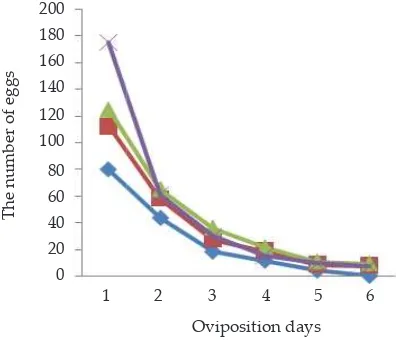
The trend of laying paterns in Figure 1 showed that egg laying at diferent mating duration indicated a declining patern along with the longer mating duration during the days of mating activities. These igures may be associated with the decreasing of moth energy for mating within the period of 4-6 d (Goswami & Singh, 2012). After matings and egg producing, the females would do the oviposition, and then the last activity was laying eggs. The number of eggs produced was
signii-cantly afected (P<0.05) by mating duration. The results showed that the increase of egg number produced was in line with the increase of mating duration (3, 6, 12, and 24 h). Female moths mated for 24 h produced the highest number of eggs (288.40±77.63 eggs/cycle), followed by 245.00±50.70 eggs of 12 h; 225.80±24.30 eggs of 6 h; and the lowest was 155.60±48.75 eggs of 3 h mating duration. Egg production between 6, 12, and 24 h mating time was similar but the diference was found between the 3 treat-ments with those of 3 h mating time. The number of eggs produced were between the range of 155-288 eggs/cycle. In average, this result was not signiicantly diferent from the previous study (Nazar, 1990), of which female moths produced 286 eggs/cycle.
The results from this study indicated that incuba-tion time was not afected by the length of mating time; for each mating duration of 3, 6, 12, and 24 h, time spent by females for hatching eggs was 9.91±0.93, 9.57±0.99, 9.94±1.14, and 9.77±0.59 d respectively, with the average of 9.80±0.87 days/cycle. The igures were varied between treatments and was relatively diferent from the results of Adria & Idris (1997) of 7-13 days/cycle. Egg hatching period was naturally inluenced by temperatures during the incubation process, the ecdysis and juvenile hor-mones (Triplehorn & Johnson, 2005; Woods, 2010) and also afected by the diferences of individual embryo formation process which needed 7-8 d.
The length of mating duration signiicantly (P<0.001) afected hatchability. There was no diferences in hatchability between mating times of 6, 12, and 24 h, however, a signiicance diferent was found between the three treatments with that of 3 h. The highest percent-age of hatchability(96.41±2.08%) was found on insects mated for 24 h as compared to the insects mated for 3 h (82.06±5.18%). Adria & Idris (1997) reported that the egg hatchability of A. atlas in nature was 72.06%. Those dif-ferences may be due to environmental conditions dur-ing hatchdur-ing process includdur-ing egg storage, ecdysis and juvenile hormone (Triplehorn & Johnson, 2005). Long period of matings may inluence the numbers of sperms stored by females which would increase eggs fertility. The similar result of egg weight among treatments may be associated with feed and feeding management, since the weight of eggs is basically more inluenced by the quality of feed consumed by female moths during larvae phases.
Variables Mating period (h) Average
3 6 12 24
LP (days) 4.60 ± 0.55 5.20 ± 0.84 5.20 ± 0.45 5.00 ± 0.63 5.00 ± 0.65 NE (eggs) 155.60 ± 48.75b 225.80 ± 24.30ab 245.00 ± 50.70a 288.40 ± 77.63a 228.70 ± 71.89 IT (days) 9.91 ± 0.93 9.57 ± 0.99 9.94 ± 1.14 9.77 ± 0.59 9.80 ± 0.87 EH (%) 82.06 ± 5.18B 94.89 ± 1.23A 95.28 ± 0.82A 96.41 ± 2.08A 92.16 ± 6.57 EW (mg) 6.90 ± 0.20 7.00 ± 0.70 6.80 ± 0.20 6.90 ± 0.60 6.90 ± 0.43 Note: Mean in the same rows with diferent small superscript difers signiicantly (P<0.05); mean in the same rows with diferent capital superscript
difers signiicantly (P<0.01).
Table 1. Laying period (LP), eggs number (NE), egg incubation time (IT), egg hatchability (EH), and egg weight (EW) of A. atlas with diferent mating duration
Figure 1. The reproduction patern of A. atlas at diferent length of mating times. -♦- : 3 times, -■- : 6 times, -▲- : 12 times, -x- : 24 times.
!
'
% (
' $ ( &
1 2 3 4 5 6
Oviposition days 200
180 160 140 120 100
80 60 40 20 0
The num
ber o
f eg
Feeding Management
The results indicated that types of feeds and feeding frequencies signiicantly (P<0.05) afected the feed consumption of A. atlas larvae (Table 2). The large amount of daily feed consumption was found at the irst instar (I1) (0.317±0.015 g/d) and the second instar (I2) (0.459±0.015 g/d) on larvae given fresh walnut leaves for 4 times daily. Whereas, at instar 3 (I3), and instar 4 (I4), feed consumption was gradually increased (1.000±0.010 g/d) (1.291±0.132 g/d), on larvae given guava leaves for 4 times. Larvae of A. atlas preferred fresh feeds. According to Hamamura (2001), good quality of moistures, protein, fat and iber content leaves would increase feeding activity and feed consumption of A. atlas. Guava leaves have rough structure, and is preferred by insects than walnut leaves. Young larvae (instar 1-4) of A. atlas preferred walnut leaves with soft structure. This results is supported by Vonny & Nugroho (2005), suggesting that the condition of epidermis surface and leaf structure afected feed preferences of larvae. The larvae of A. atlas used in this study had been well adapted to feed and tea leaves available in plantation for tens of generations.
Diference types and structure of leaves used as feed treatment during the study would probably afect
feed consumption, as well as feed digestibility. Data presented in Table 3 showed that feed digestibility was signiicantly inluenced (P<0.05) by the types of feed and feeding frequency. The highest feed digestibility was found at the irst instar (I1) (27.6±0.012%) and sec-ond instar (I2) (28.1±0.027%). The digestibility of guava leaves with the daily feeding of 4 times to larvae of in-star 3 (I3) and inin-star 4 (I4) was similar (31.7±0.007%, and 35.5±0.008% respectively). In average, the digestibility of feed at the irst instar (I1) was 0.071±0.006 g/larvae and second instar (I2) was 0.133±0.012 g/larvae (Table 4). Those revealed that the undigested feed by larvae given walnut leaves 4 times a day was quite high. The feed intake, digestibility, and the amount of undigested feed of larvae fed guava leaves increased along with the changing of growth to instar III and IV. Whereas, the digestibility of walnut leaves was low as the times of feeding lesser than 4 times per day.
Data presented in Table 5 suggested that weight gain of A. atlas was afected by feeding treatments. The weight gain of larvae at the irst instar of larvae given walnut and guava leaves for 4 times was signiicantly (P<0.05) higher than those of 3 times per day. Similar results were found at the second instar of larvae fed walnut leaves 4 times a day showed higher weight
Table 4. Feed digested by A. atlas given guava and walnuts leaves based on instar with diferent frequency
Note: Mean in the same rows and columns with diferent superscript for the same instar difers signiicantly (P<0.05).
Instar Frequencies n leaves (g)Walnut n leaves (g)Guava Instar I 3 times 75 0.067 ± 0.004b 60 0.048 ± 0.003c
4 times 75 0.071 ± 0.006a 65 0.050 ± 0.002c
Instar II 3 times 67 0.111 ± 0.012b 52 0.093 ± 0.014c
4 times 63 0.133 ± 0.012a 60 0.095 ± 0.005c
Instar III 3 times 40 0.229 ± 0.008c 47 0.290 ± 0.037b
4 times 50 0.287 ± 0.023b 55 0.331 ± 0.009a
Instar IV 3 times 7 0.283 ± 0.042c 10 0.378 ± 0.070a
4 times 10 0.323 ± 0.051b 17 0.432 ± 0.044a
Instar Frequencies n leaves (g)Walnut n leaves (g)Guava Instar I 3 times 75 0.304 ± 0.010b 60 0.274 ± 0.012c
4 times 75 0.317 ± 0.015a 65 0.284 ± 0.003c
Instar II 3 times 67 0.425 ± 0.039b 52 0.392 ± 0.012c
4 times 63 0.459 ± 0.015a 60 0.392 ± 0.012c
Instar III 3 times 40 0.815 ± 0.038c 47 0.935 ± 0.040b
4 times 50 0.924 ± 0.050b 55 1.000 ± 0.010a
Instar IV 3 times 7 0.918 ± 0.125b 10 1.132 ± 0.217b
4 times 10 1.025 ± 0.162b 17 1.291 ± 0.132a
Table 2. Feed consumption of A. atlas givenfresh guava and wal -nuts leaves based on instar with diferent frequencies
Note: Mean in the same rows and columns with diferent superscript for the same instar difers signiicantly (P<0.05).
Instar Frequencies n leaves (%)Walnut n leaves (%)Guava Instar I 3 times 75 25.90 ± 0.010b 60 21.70 ± 0.003c
4 times 75 27.60 ± 0.012a 65 22.60 ± 0.004c
Instar II 3 times 67 26.10 ± 0.027b 52 22.90 ± 0.009c
4 times 63 28.10 ± 0.027a 60 23.40 ± 0.005c
Instar III 3 times 40 27.50 ± 0.006c 47 29.70 ± 0.007b
4 times 50 29.70 ± 0.005b 55 31.70 ± 0.004a
Instar IV 3 times 7 30.70 ± 0.006b 10 32.50 ± 0.008a
4 times 10 31.50 ± 0.007b 17 35.50 ± 0.008a
Table 3. Feed digestibility of A. atlas given guava and walnuts leaves based on instar with diferent frequency
Note: Mean in the same rows and columns with diferent superscript for the same instar difers signiicantly (P<0.05).
Table 5. Body weight gain of A. atlas given guava and walnuts leaves based on instar with diferent frequencies
Note: Mean in the same rows and columns with diferent superscript for the same instar difers signiicantly (P<0.05).
Instar Frequencies n leaves (g)Walnut n leaves (g)Guava Instar I 3 times 75 0.033 ± 0.001b 60 0.017 ± 0.001d
4 times 75 0.037 ± 0.001a 65 0.019 ± 0.002c
Instar II 3 times 67 0.102 ± 0.005a 52 0.023 ± 0.001b
4 times 63 0.121 ± 0.004a 60 0.033 ± 0.002b
Instar III 3 times 40 0.209 ± 0.015c 47 0.354 ± 0.060b
4 times 50 0.221 ± 0.019c 55 0.527 ± 0.016a
Instar IV 3 times 7 0.380 ± 0.035b 10 0.428 ± 0.062b
gains. Whereas, the average weight gain of larger larvae (I3 and I4) with feeding frequencies of 4 times was sig-niicantly higher than those of 3 times a day, and varied between types of feeds. Elzinga (2004) stated that more frequent of feedings may help to maintain the freshness and water content of feed leaves. In this regard, the growth of Lepidoptera larvae was highly depended on feed water content.
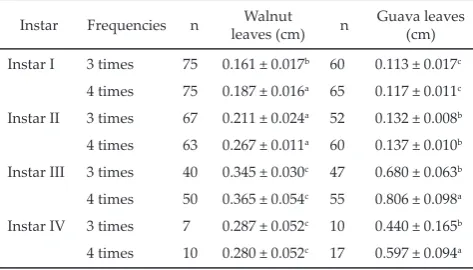
The size of A. atlas larvae based on their diameters (Table 5) was generally afected by types of feeds and feeding frequencies, especially at the irst instar (I1) of which larvae fed both feed types for 4 times was sig-niicantly (P<0.05) higher than those of 3 feeding times (0.187 vs 0.033 cm). Diference results was found at the average diameter of larvae at the second (I2) instar which was similar at all treatments (Table 6). Along with growth development of larvae, the results become more varied; the larger the larvae size, the higher the feeding frequency resulted in higher size of body di-ameters, especially larva I3, given walnut leaves gave high result (0.806 cm). The adequate intake of good quality feed will improve growth and also the diameter of larvae size. According to Elzinga (2004), the growth of A. atlas larvae was much depended on some important aspects including feed availability and environmental conditions such as temperature, photoperiod and popu-lation density. Shortage of feed will certainly reduce the productivity of larvae. The overall results showed that 4 times feeding frequency per day could maintain the freshness of feed leaves given to larvaes, associated with short interval times between feedings. Intensiication with good feeding management will increase feed con-sumption. Ahmad et al. (2006), stated that suitable feed for larvae should contain complete nutrition to produce good quality of silkworm, A. atlas.
Mortality rate of larvae as seen in Figure 2 was signiicantly high, especially at the late instars of I3 and I4. Diference leaves and feeding frequency signiicantly afected the survivals of larvaes, less frequency of feedings resulted in such high mortality. Despite the similar mortality rate found at the second instar (I2), the high mortality rate was also found at the I3 (approximately 40%). However, as the growth progressing, the extreme mortality rate was experienced
with I4 and I5 larva’s that achieved 100%, especially of those fed guava leaves with lesser feeding frequency. Less feed intake and hence feed digestibility of small larvae at early stage, might be responsible for the high percentage of mortality. Indrawan (2007) suggested that at early stage of growth development, small larvae required quality feeds with balanced nutrients and apropriate management to reduce mortality because young insect was more susceptible to death.
Regarding the environmental factors, temperature and humidity play important roles in the intensiication process of A. atlas. During the study, the average tem-perature recorded in the morning was 27.44 oC, 28.21 oC in the afternoon and 27.52 oC in the evening. Relative humidity in the morning, afternoon and evening was 83.93%, 75.33% and 82.42% respectively and was con-sidered high. Wulandari & Situmorang (2002), reported that temperature and humidity might cause stress to larvae, decreasing immunity, increasing susceptibility to diseases, and under extreme conditions may resulted in death. According to Nation (2008), the availability of suicient waters, speciically in the fresh leaf feed, was extremely important. Keeping A. atlas in experimental rooms with such warm humidity and temperature, larvae will require adequate waters. Regarded as poiki-loterm insect, luctuations in temperature and humidity between times of days during rearing would have great efect on the survival rate of A. atlas larvae. Therefore, water becoming essential for larvae to adapt to the sur-rounding environment.
CONCLUSION
The optimum and eicient time sugested for mating is six hours resulting high egg production. The walnut leaves feed has beter efect on the irst and second instar of larvae, while the guava leaves afect the following instars. In terms of production, four times of feeding frequency per day has higher productivity and is recom-mended in the cultivation management of A. atlas. Table 6. Body diameter of A. atlas given guava and walnuts
leaves based on instar with diferent frequencies
Note: Mean in the same rows and columns with diferent superscript for the same instar difers signiicantly (P<0.05).
REFERENCES
Ahmad, I., M. H. Ar-Rasyid, S. Salim, M. J. Hosen, & B. Elora. 2006. Efect of feeding on the larval growth and develop -ment of silkworm, Bombyx mori L. Race: Nistari (M). Int. J.
Sustain. Agril. Tech. 2: 66-68.
Adria & H. Idris. 1997. Aspek biologis hama daun Atacus atlas
pada tanaman ylang-ylang. Jurnal Penelitian Tanaman In -dustri. Vol. III (2).
Adria. 2010. Populasi dan intensitas serangan hama Atacus atlas (Lepidoptera: Saturniidae) dan Aspidomorphamiliaris
(Coleoptera: Chrysomelidae pada Tanaman Ylang-ylang). Jurnal Litri 16:77–82.
Elzinga, R. J. 2004. Fundamentals of Entomology. Sixth Edition. Department of Entomology, Kansas State University. Pear -son Pretince Hall, New Jersey.
Faatih, M. 2005. Aktivitas anti-mikroba kokon Atacus atlas, L. Jurnal Penelitian Sains dan Teknologi 6: 35-48.
Goswami D. & H. I. Singh. 2012. Bioecological studies of Indian golden silk moth, Antheraea assamensis Helfer (Lepidoptera:
Saturniidae). Munis Entomology & Zoology 7: 274-283. Grater, F., W. Xu, W. Leal, & H. Grubmuller. 2006. Pheromone
discrimination by the pheromon-binding protein of Bom-byx mori. Structure 14:1577-1586. htp://dx.doi.org/10.1016/
j.str.2006.08.013
Hamamura, Y. 2001. Silkworm Rearing on Artiicial Diet. Sci -ence Publisher, New Hampshire.
Indrawan, M. 2007. Karakter sutra ulat jedung (Atacus atlas L.) yang dipelihara pada tanaman pakan senggugu ( Cleroden-dronserratum Spreng). J. Biodiversitas. 8: 215-217.
Jurgen, K, G. W. Ewald, G. Thomas, & B. Heinz. 2005. Candi-date pheromone receptor of the silkmoth Bombyx mori. J. Neuroscience 21: 2167–2176. htp://dx.doi.org/10.1111/ j.1460-9568.2005.04058.x
Nation, J. L. 2008. Insect Physiology and Biochemistry Second Edition. CRC Press, London.
Nazar A. 1990. Beberapa aspek biologi ulat perusak daun ( At-tacus atlas Linn) pada tanaman cengkeh. Jurnal Penelitian Tanaman Indusrti XVI: 35-37.
Singh, T., B. Saratchandra, & H. S. P. Raj. 2003. Physiological and biochemical modulations during oviposition and egg laying in the silkworm, Bombyxmori L. J. Indust. Entomol.
6:115-123.
Situmorang, J. 1996. An atemp to produce Atacus atlas L. using baringtonia leaves as plant fooder. Int. J. Wild Silkmoth Silk 1: 25-29.
Syed, Z., Y. Ishida, K. Taylor, D. A. Kimbrell, & W. S. Leal. 2006. Pheromone reception fruit lies expressing a moth odorant receptor. The National Academy of Sciences of the USA 103:16538-16543.
Triplehorn, C. A. & N. F. Johnson. 2005. Borror and Delong’s Introduction to the Study of Insects.7th Edition. Thomson Brooks/Cole, Australia
Vonny & L. H. Nugroho. 2005. Perbandingan struktur ultra permukaan epidermis dan struktur anatomi daun muda keben, gempol, sirsak dan mahoni sebagai tanaman pakan ulat sutera liar Atacus atlas (L.). Sigma 8: 171-177. Woods, H. A. 2010. Water loss and gas exchange by eggs of
Man-duca sexta: Trading of costs and beneits. J. Insect Physiol. 56: 480-487.
Wolfgang, A. N., S. Naumann, & R. Rodolphe. 2010. Evidence for the existence of three species in the genus Archaeoat-tacus (Lepidoptera: Saturniidae). J. Reaserch on the Lepti -doptera 43:37-47.