All sources 4 74 7 Internet sources 3 23 2 Own documents 33 Organization archive 33 Plagiarism Prevention Pool 11
[11] "Jestec_Manurung similarity.doc" dated 2017-10-05 1
[18] https://www.science.gov/topicpages/j/jecorina trichoderma reesei.html 0
[22] "Renita Manurung.docx" dated 2017-10-05 0
0.77% 3 matches
[23] www.thaiscience.info/journals/Article/KLST/10970467.pdf 0
0.66% 4 matches
[24] "The effects of the addition of alk...ot; dated 2017-12-05 0
0.55% 4 matches
[25] from a PlagScan document dated 2017-07-26 04:53 0
[30] "CR-CFD Analysis of Evaporation-Con...ot; dated 2017-10-10 0 Results of plagiarism analysis from 2017-12-07 09:02 UTC
2
2. JEST EC JEST EC.pdfpdf
[34] https://www.researchgate.net/profile/Ani...citationCount&page=1 0
0.00% 1 matches
[35] core.ac.uk/display/32246332 0
0.33% 2 matches
[36] https://bioresources.cnr.ncsu.edu/resour...iation-pretreatment/ 0
0.44% 3 matches
[37]
"Optimalisasi_Komposit_Hibrid_S.pdf.pdf" dated 2017-09-18 0
0.44% 2 matches
2 documents with identical matches
[40] https://www.sciencedirect.com/science/article/pii/S1878535214000562 0
0.33% 1 matches
[41] https://patents.google.com/patent/EP2546203A1/en 0
0.22% 2 matches
[42] https://www.sciencedirect.com/science/article/pii/S0167732216304251 0
0.22% 1 matches
[43] https://www.sciencedirect.com/science/article/pii/S0168165614008670 0
0.33% 1 matches
[44] repository.usu.ac.id/bitstream/handle/123456789/42448/Cover.pdf;sequence=7 0
0.22% 1 matches
[45] "ICCAI2017-Syaliman.pdf" dated 2017-10-14 0
0.22% 1 matches
[46] https://link.springer.com/article/10.1007/s11270-008-9708-x 0
0.22% 1 matches
[47] https://www.researchgate.net/publication...colonization_on_rice 0
0.11% 1 matches
[48] https://www.science.gov/topicpages/n/nanophase metallic iron 0
0.11% 1 matches
11 pages, 4001 11 pages, 4001 wor dsor ds
PlagLevellagLevel: selected / selected / over allover all
154 matches from 49 sources, of which 40 are online sources.
Settings Settings
Data policy: Compare with web sources, Check against my documents, Check against my documents in the organization repository, Check
against organization repository, Check against the PlagiarismPrevention Pool Sensitivity: Medium
--Journal of Engineering Science and Technology
[11]
Special Issue on SOMCHE 2014 & RSCE 2014 Conference, January (2015) 29 - 39 © School of Engineering, Taylor's University
29
PROCESS SELECTION ON BIOETHANOL PRODUCTION FROM WATER HYACINTH (EICHHORNIA CRASSIPES)
OKTA BANI, TASLIM*, IRVAN, IRIANY
Faculty of Engineering, University of Sumatera Utara
No. 9 Jalan Dr. T. Mansur, 20155, Medan, Sumatera Utara, Indonesia [11]
*Corresponding Author: [email protected]
Abstract
In many water bodies, water hyacinth has been a nuisance towards the ecosystem.
Utilization of water hyacinth seems to be a promising way of controlling this weed. However, despite the amount of research on this particular matter, it is still not cost effective. Correct choice of process parameters and on-site enzyme production are believed to be able to cut the cost effectively. Therefore, this research aimed to evaluate and select the critical process parameters. In this research, pre-blended and filtrated water hyacinth was subjected to pretreatment. Afterwards, water hyacinth was hydrolysed and subsequently fermented and
fermented. Magnesium sulfate was added to enhance the process. Result favors the use of DAP as pretreatment, addition of C. utilis inoculums for 24 h fermentation, and addition of magnesium sulfate in fermentation broth at 25 mM.
Fermentation duration beyond 24 h led to decrease in sugar and ethanol, while addition of magnesium sulfate to level of 100 mM did not interrupt fermentation but caused underestimation in sugar analysis (DNS assay).
Keywords: Water hyacinth, Bioethanol, On-site enzyme, Pretreatment, Duration, Magnesium sulfate.
1. Introduction
Water hyacinth has long been associated with negative socioeconomic and environmental impacts [1-4]. Despite its water purifying ability [5-7], it still poses significant hazard towards an ecosystem. Direct control of its growth has been ineffective [1-4]. Hence, current research is driven towards converting the weed to bio fuel as a mean of control [8, 9].
[16]
Journal of Engineering Science and Technology Special Issue 5 1/2015
Abbreviations
AN Aspergillus niger
CMC Carboxymethyl Cellulose
CU DAP DNS FPU GB LHW PDA SC TR
Candida utilis
Dilute Acid Pretreatment Dinitrosalicylic acid Filter Paper Unit Ganoderma boninense Liquid Hot Water Saccharomyces cerevisiae Trichoderma reesei Potato Dextrose Agar
of enzymes; methods of hydrolysis; processing scheme; microbial choices;
and others [10-25]. However, due to costly processing, the technologies have yet to be applied. Correct choices of process parameters and on-site enzyme production are considered important to realize the implementation of the technology.
Therefore, this paper aimed to evaluate and select the critical process parameters on bioethanol production from water hyacinth.
2.[11Materials and Methods ]
2.1.[24 Material collection ]
Water hyacinth was collected from local ponds in University of Sumatera Utara,
Medan, Indonesia. Saccharomyces cerevisiae (SC) and Ganoderma boninense
(GB) were purchased from University of Sumatera Utara, Medan, Indonesia. Trichoderma reesei (TR), Aspergillus niger (AN) and Candida utilis (CU) were purchased from Bandung Institute of Technology, Bandung, Indonesia. All chemicals used were of analytical grade.
2.2. Preparation and storage of water hyacinth
Water hyacinth was chopped into pieces and the roots were removed then, it was blended to slurry and filter-pressed to reduce water content. A portion of the filtered water hyacinth was dried further for analytical and experimental purpose. Afterwards, both filtered and dried water hyacinth was analysed (procedure in 2.7) and stored in closed, separated container at 4-6 °C.
2.3. Storage and inoculation of microorganisms
All microorganisms except SC, which was kept in granular form in closed container at 8 °C, were grown in potato dextrose agar (PDA) at 20 oC. Prior to usage, SC was warmed to 20 oC for 30 min, whilst TR, AN, and CU were inoculated at 20 oC for 2 days (1 day for CU) in liquid media containing
22% sucrose, 1% KH2PO4, and 1% (NH4)2SO4 [26]. All procedures were
Process Selection on Bioethanol Production From Water Hyacinth . . . . [1631]
Journal of Engineering Science and Technology Special Issue 5 1/2015
2.4.[18 Enzyme production ]
Enzyme production was carried out in a 100-ml vial in which 10 g of water
hyacinth (moisture adjusted to 70%) was mixed with Mendel Weber solution at a
ratio of 3 ml to 1 g biomass. The mixture was autoclaved (121 °C, 15 lb) for 15
minutes, and subsequently cooled down to 20 °C. Inoculums of TR and AN (1.5 ml per 10 g biomass) were grown separately in prepared mixture and incubated at 20 °C for 1 week. Enzymes were extracted by distilled water at a ratio of 4-5 ml per g biomass. The liquor was separated by centrifugation at 2.500 rpm and 4 °C for 15 minutes. Supernatant from both cultures were then mixed at a ratio of 1:1 and stored in dark glass bottle at 4 °C.
2.5.[35 Pretreatment of water hyacinth ]
Water hyacinth was subjected to 4 types of pretreatments: simple sterilization, [35]
dilute acid pretreatment (DAP), liquid hot water (LHW), and biological
pretreatment. In simple sterilization, 18 g of water hyacinth (94.4% moisture) was
mixed with 5 ml of distilled water, and autoclaved (121 °C, 15 lb) for 15 min.[23] In
DAP, 1 g dried water hyacinth was mixed with 20 ml of 2% (v/v) sulfuric acid,
and autoclaved (121 °C, 15 lb) for 1 hour, followed by neutralization with
concentrated NaOH (5-10 M) to pH of 4-5. In LHW, 18 g of water hyacinth
(94.4% moisture) was mixed with 5 ml of distilled water, and heated at 140 °C for 2 hours. In biological pretreatment, 0.5 g of the white rot fungus (GB with PDA
included) was added to 18 g of water hyacinth (94.4% moisture) and incubated
for 7 days at 20 °C. After incubation, 5 ml of distilled water was added. After each pretreatment, all samples were cooled down to 20 °C. All the types and conditions of pretreatments were adjusted from results reported on various journals [13, 16-20, 22-25].
2.6.[13 Hydrolysis ] and fermentation of water hyacinth
The hydrolysis and fermentation were carried out simultaneously. After
pretreatment, 30 ml enzymes, 0-1.23 g (0-0.1 M) MgSO4, and 0.5 g (1% w/v) SC
were added, and whole mixture was incubated at 20 °C for 24-96 h. As
alternative, 1 ml (2% v/v) CU inoculums were added at the beginning of fermentation or after 24 h fermentation. After incubation, fermentation broth was filtered and the filtrate was analysed. A high enzyme volume was required due to low enzyme activity but was kept at low enough volume to avoid excessive dilution. Concentration of MgSO4 was kept in range of 0-100 mM to observe the
effects on fermentation at higher concentration as studies on this subject suggest that MgSO4 has positive effect at concentration of 3.5 mM but becomes inhibitory
at higher concentration [27-28]. Influence of various parameters on hydrolysis and fermentation was optimized by step-wise experiments where specified parameter was changed by keeping all other parameters constant.[18] Most effective
parameter was selected for further optimization of process parameters.
2.7. Characterization of biomass and enzyme
[16]
Journal of Engineering Science and Technology Special Issue 5 1/2015
analysed by Chesson-Datta method [29]. Crude enzyme was analysed for its
cellulase activity by CMC assay and the activity was expressed as FPU/ml [30].
2.8. Analysis of fermentation broth
Concentration of reducing sugar was analysed by spectrophotometer UV-Visible (SHIMADZU 1800) using DNS method [31] and was expressed as equivalent glucose concentration against calibration curve. Ethanol concentration was analysed by GC using static head space analysis [32] at adjusted salt concentration of 0.1 mM MgSO4 against calibration curve. Iso-propanol was used
[48]
as an internal standard. Density, viscosity, and pH were measured by using
pycnometer, Oswald viscometer, and pH meter.
3.[11Results and Discussion ]
3.1. Initial analysis
Moisture content analysis on chopped water hyacinth showed that the stems
contain 92.1 0.3 % of water, while the leaves contain 87.0 0.7 % of water. ± ± Mixed, blended and filtered water hyacinth contains 94.4 ± 0.1 % water. Results of chemical content analysis, along with results from other studies, are shown in Table 1.[47] Crude enzyme was found to have cellulase activity of 0.12 FPU/ml.
Table 1. Chemical Composition of Water Hyacinth.
Component
3.2. Effect of pretreatments
Pretreatment affects hydrolysis of cellulose by modifying lignocellulose structure to allow for better enzyme access [33-35]. Effectiveness of pretreatments depends on type of biomass because of differences in structure and composition. Results on effect of pretreatments are shown on Fig. 1.
Out of all pretreatments performed in this study, DAP yielded the highest
Process Selection on Bioethanol Production From Water Hyacinth . . . . 33
Journal of Engineering Science and Technology Special Issue 5 1/2015 Fig. 1. Comparison of Pretreatments on Ethanol Production.
Fermentation was Carried Out by 1% (w/v) SC for 24 h at 20 °C without Addition of MgSO 4.
3.3. Effect of magnesium sulfate
Magnesium sulfate increases yeast tolerance on alcohol by decreasing cell membrane permeability [27]. Salts in general also induce salting out effect on water – organic system, in which most salts alter equilibrium dynamic of both phases and drive ethanol out of water [36, 37]. In this study, effect of magnesium sulfate was studied by varying the magnesium concentration in the range of 0-100 mM (0-1.23 g).[41] Magnesium sulfate was added after DAP and neutralization, and the
salt concentration was adjusted to 100 mM before sugar and ethanol analysis. [36]
As shown in Fig. 2, magnesium concentration did not have detrimental effect [36]
on fermentation, although at 25 mM, sugar and ethanol concentration were
slightly higher than those at other magnesium concentration.
[11]
Journal of Engineering Science and Technology Special Issue 5 1/2015 A higher MgSO4 concentration could not be tested because the salt disturbs
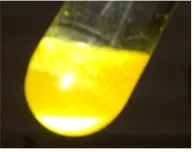
sugar analysis by DNS method as shown in Fig. 3. The existence of Mg2+ ions are
also reported to interfere with the activity of cellulase, although further verification is required to determine whether the cause of the decline in enzyme activity is due to direct inhibition of the ions on cellulase, or disturbance on the enzyme assay [38].
Fig. 3. Precipitate Observed in Prepared Sample during Sugar Analysis.
3.4. Effect of fermentation duration
Duration affects the composition and microenvironment of the broth. In ethanol
fermentation, an overlong duration may result in ethanol loss by decomposition, evaporation, and conversion to other products [39][15], while insufficient duration
will lead to lots of unconverted sugar and lower ethanol yield. [15]In order to
optimize the duration, a duration range of 24-96 h was tested[33]. The results are
shown in Fig. 4.
Fig. 4. Effect of Fermentation Duration on Ethanol Production. After DAP, Fermentation was Carried Out by 1% (w/v) SC at 20 °C with Addition of
MgSO4 (25 mM and 50 mM).
Results agree well with the literature in which longer fermentation did not
[13]
lead to more ethanol even though sugar was consumed. [13]In some literatures,
ethanol fermentations with quite similar conditions required less than one day
fermentation [11, 24].
0.0 0.3 0.6 0.9 1.2
0 1 2 3 4
C
o
n
ce
n
tr
at
io
n
(
g
/L
)
Duration (day)
Process Selection on Bioethanol Production From Water Hyacinth . . . . 35
Journal of Engineering Science and Technology Special Issue 5 1/2015 3.5. Effect of microbial choice
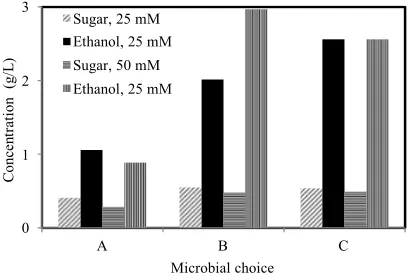
Microorganism affects the ethanol yield. Microorganisms of same species could give different yield depends on the strain. If the microorganisms are of different species, they will require different fermentation conditions. In this study, SC was chosen for hexose fermentation and CU for pentose fermentation. Results are shown in Fig. 5.
Fig. 5. Effect of Microbial Choice on Ethanol Production. A: Monoculture of SC for 24 h, B: SC for 24 h Followed by CU for 24 h,
C: Co-culture SC and CU for 24 h.
Results indicate that CU contributed positively on ethanol production. Sornvoraweat and Kongkiattikajorn (2010) acquired similar results by using co-culture of Saccharomyces cerevisiae and Candida tropicalis.
The increase on ethanol concentration could be attributed to different substrate utilization by both yeasts. However, it is also possible that extra sucrose from inoculums increased the ethanol yield as well. Due to the many factors which influence the performance of both yeasts, such as differences in magnesium absorption and accumulation in both yeasts which change dynamically [40], glucose limited competition between both yeasts which depends on the aerobic or anaerobic state [41][17], complicated ethanol generating system of Candida utilis which requires auto anaerobic setting along with ethanol repressing system which activates on
stationer phase [42], a more focused and thorough research is required to understand
the real cause of the increase of ethanol yield in this system.
4. Conclusions
Effects of pretreatment, magnesium sulphate, fermentation duration, and microbial choices on bioethanol production from water hyacinth were investigated. Some conclusions are given below.
•For bioethanol production from the cellulose portion of water hyacinth, DAP is still the best pretreatment despite reported inhibitor generation.
0 1 2 3
A B C
C
o
n
ce
n
tr
at
io
n
(g
/L
)
Microbial choice Sugar, 25 mM
Ethanol, 25 mM
Sugar, 50 mM
[11]
Journal of Engineering Science and Technology Special Issue 5 1/2015
•In the range tested, magnesium salt does not havesignificant effect on sugar
and ethanol yield.
•Fermentation duration of one day was sufficient for maximum yield. •Adding CU also yielded positive result for 1 day fermentation.
•In all the experiments, ethanol and sugar concentration were not high. This might be due to the low enzyme loading. Further addition of enzyme mixture is possible but not initiated because extra cost for ethanol purification quickly override the advantage of cost cutting effect given by on-site enzyme production.
•Although enzyme production from merely dried-blended water hyacinth is possible, it could not achieve the goal to cut the cost of bioethanol production in this research. Thus, another approach has to be taken. Some possible approaches may include altering water hyacinth composition to better suit cellulase production, or eliminating extraction step by direct mixing of incubated biomass. The latter choice suffers from possibility of competitive substrate utilization and product assimilation. Composition alteration can be achieved by treating water hyacinth by DAP and taking the solid portion, as pretreated water hyacinth will contain higher cellulose and reflects substrate composition in ethanol production better.
•Further research on bioethanol from water hyacinth should investigate other strategies to cut production cost. The strategies may include study on purification step as it is considered one of the most cost and energy consuming steps in general, utilization of fermentation waste for further economic value, and increasing ethanol yield either by improved yeast strain or better processing strategy.
[24]
Acknowledgement
The authors would like to thank Indonesia Endowment Fund for Education (LPDP)
under Ministry of Finance, Republic of Indonesia for funding the research.
References
1. Patel, S. (2012). Threats, management and envisaged utilizations of aquatic weed Eichhornia crassipes: an overview. Reviews in Environmental Science and Biotechnology, 11, 249-259.
2. Abdel-sabour, M.F. (2010). Water hyacinth: Available and renewable resource.
Electronic Journal of Environmental, Agricultural and Food Chemistry, 9(11),
[33]
1746-1759.
3. Jafari, N. (2010).[12]Ecological and socio-economic utilization of water hyacinth
(Eichhornia crassipes Mart Solms). Journal of Applied Science and
Environmental Management, 14(2), 43-49.
4. Malik, A. (2007).[12]Environmental challenge vis a vis opportunity: [12]The case of
water hyacinth. Environment International, 33(1), 122-138.
Process Selection on Bioethanol Production From Water Hyacinth . . . . 37
Journal of Engineering Science and Technology Special Issue 5 1/2015 6. Jianbo, L.U.; Zhihui, F.U.; and Zhaozheng, Y.I.N. (2008).[12]Performance of a
water hyacinth (Eichhornia crassipes) system in the treatment of wastewater
from a duck farm and the effects of using water hyacinth as duck feed. Journal
of Environmental Sciences, 20(5), 513-519.
7. Hasan, S.H.; Talat, M.; and Rai, S. (2007).[8]Sorption of cadmium and zinc from
aqueous solutions by water hyacinth (Eichchornia crassipes). Bioresource
Technology, 98(4), 918-928.
8. Bhattacharya, A.; and Kumar, P. (2010).[33]Water hyacinth as a potential biofuel crop. Electronic Journal of Environmental Agricultural, and Food Chemistry , 9(11), 112-122.
9. Hronich, J.E.; Martin, L.; Plawsky, J.; and Bungay, H.R. (2008).[14]Potential of
Eichhornia crassipes for biomass refining. [14]Journal of Industrial Microbiology
and Biotechnology, 35, 393-402.
10. Abdel-Fattah, A.F.; and Abdel-Naby, M.A. (2012).[8]Pretreatment and enzymic
saccharification of water hyacinth cellulose. Carbohydrate Polymers, 87(3),
2109-2113.
11. Ahn, D.J.; Kim, S.K.; and Yun, H.S. (2012). Optimization of pretreatment and saccharification for the production of bioethanol from water hyacinth by Saccharomyces cerevisiae. Bioprocess and Biosystems Engineering, 35, 35-41. 12. Artati, E.K.; Effendi, A.; and Haryanto, T. (2009). Pengaruh konsentrasi larutan pemasak pada proses delignifikasi eceng gondok dengan proses organosolv. Ekuilibrium, 8(1), 25-28.
13. Eshtiaghi, M.N.; Yoswathana, N.; Kuldiloke, J.; and Ebadi, A.G. (2012).[8]
Preliminary study for bioconversion of water hyacinth (Eichhornia crassipes)
to bioethanol. [21]African Journal of Biotechnology, 11(21), 4921-4928.
14. Guragain, Y.N.; Coninck, J.D.; Hussonb, F.; Durand, A.; and Rakshit, S.K. (2011).[18] Comparison of some new pretreatment methods for second generation
bioethanol production from wheat straw and water hyacinth. Bioresource
Technology, 102(6), 4416-4424.
15. Harun, M.Y.; Radiah, A.B.D.; Abidin, Z.Z.; and Yunus, R. (2011). Effect of physical pretreatment on dilute acid hydrolysis of water hyacinth (Eichhornia crassipes)”. Bioresource Technology, 102(8), 5193-5199.
16. Isarankura-Na-Ayudhya, C.; Tantimongcolwat, T.; Kongpanpee, T.; Prabkate, P.; and Prachayasittikul, V. (2007).[14]Appropriate technology for the bioconversion of water hyacinth (Eichhornia crassipes) to liquid ethanol: [14]
Future prospects for community strengthening and sustainable development.
Experimental and Clinical Science, 6, 167-176.
17. Kurniati, A.; Darmokoesoemo, H.; and Puspaningsih, N.N.T. (2011).[34] Modification of surface structure and crystallinity of water hyacinth (Eichhornia crassipes) following recombinant α-L-arabinofuranosidase (abfa) treatment”[10]. Journal of Agricultural Biotechnology and Sustainable
Development, 3(9), 182-188.
18. Ma, F.; Yang, N.; Xu, C.; Yu, H.; Wu, J.; and Zhang, X. (2010).[31]Combination of biological pretreatment with mild acid pretreatment for enzymatic hydrolysis
and ethanol production from water hyacinth. Bioresource Technology, 101(24),
Journal of Engineering Science and Technology Special Issue 5 1/2015 19. Masami, G.O.O.; Usui, I.Y.; and Urano, N. (2008).[9]Ethanol production from
the water hyacinth Eichhornia crassipes by yeast isolated from various
hydrospheres”. African Journal of Microbiology Research , 2, 110-113.
20. Merina F, and Trihadiningrum Y. 2011. Produksi bioetanol dari eceng gondok (Eichhornia crassipes) dengan Zymomonas mobilis dan Saccharomyces cerevisiae. Prosiding Seminar Nasional Manajemen Teknologi XIII. ITS. 21. Mishima, D.; Kuniki, M.; Sei, K.; Soda, S.; Ike, M.; and Fujita, M. (2008).[9]
Ethanol production from candidate energy crops: [9]Water hyacinth (Eichhornia
crassipes) and water lettuce (Pistia stratiotes L.). Bioresource Technology,
99(7), 2495-2500.
22. Mukhopadhyay, S.; and Chatterjee, N.C. (2010).[23] Bioconversion of water
hyacinth hydrolysate into ethanol. BioResources, 5(2), 1301-1310.
23. Sari, E.; Syamsiah, S.; Sulistyo, H.; and Muslikin. (2011).[19] The Kinetic of
biodegradation lignin in water hyacinth (Eichhornia crassipes) by
Phanerochaete chrysosporiumusing solid state fermentation (SSF) method for
bioethanol production, Indonesia. [19]World Academy of Science, Engineering and
Technology, 54, 249-252.
24. Sornvoraweat, B.; and Kongkiattikajorn, J. (2010).[13]Separated hydrolysis and
fermentation of water hyacinth leaves for ethanol production. Khon Kaen
University Research Journal, 15(9), 794-802.
25. Takagi, T.; Uchida, M.; Matsushima, R.; Ishida, M.; and Urano, N. (2012).[8]
Efficient bioethanol production from water hyacinth Eichhornia crassipes by
both preparation of the saccharified solution and selection of fermenting yeasts.
Fisheries Science, 78, 905-910.
26. Junior, M.M.; Batistote, M.; Cilli, E.M.; and Ernandes, J.R. (2009). Sucrose fermentation by Brazilian ethanol production yeast in media containing structurally complex nitrogen sources. Journal of the Institute of Brewing, 115, 191-197.
27. Hu, C.K.; Bai, F.W.; and An, L.J. (2003).[10]Enhancing ethanol tolerance of a self-flocculating fusant of Schizosaccharomyces pombe and Saccharomyces
cerevisiae by Mg2+ via reduction in plasma membrane permeability.
Biotechnology letters, 25, 1191-1194.
28. Jonsson, L.J.; Alriksson, B.; and Nilvebrant, N-O. (2013). Bioconversion of lignocellulose: inhibitors and detoxification. Biotechnology for biofuels, 6(16). 29. Datta, R. (1981).[21] Acidogenic fermentation of lignocellulose-acid yield and
conversion of components. Biotechnology and Bioengineering, 23, 2167-2170.
30. Ghose, T.K. (1987). Measurement of cellulase activities. Pure and Applied Chemistry, 59(2), 257 -268.
31. Miller, G.L. (1959).[43] Use of dinitrosaiicyiic acid reagent for determination of
reducing sugar. Analytical Chemistry , 31(3), 426-428.
32. Shih, C. (2010). Determination of Saccharides and Ethanol from Biomass Conversion Using Raman Spectroscopy: Effects of Pretreatment and Enzyme Composition. Graduate Thesis and Dissertations. Iowa State University, Iowa, USA.
Process Selection on Bioethanol Production From Water Hyacinth . . . . 39
Journal of Engineering Science and Technology Special Issue 5 1/2015 34. Zhu, J. (2011). The role of cellulose accessibility on enzymatic saccharification
of lignocelluloses. AIChE Annual Meeting, International Congress on Energy 2011.
35. Neves, M.Ad.; Kimura, T.; Shimizu, N.; and Nakajima, M. (2007). State of the art and future trends of bioethanol production. Dynamic Biochemistry, Process Biotechnology and Molecular Biology, 1(1), 1-14.
36. Ghalami-Choobar, B.; Ghanadzadeh, A.; and Kousarimehr, S. (2011).[42] Salt
effect on the liquid-liquid equilibrium of (Water + Propionic acid +
Cyclohexanol) system at T = (298.2, 303.2, and 308.2) K. Chinese Journal of
Chemical Engineering, 19(4), 565-569.
37. Palei, S. (2010). Salt Effect on Liquid Liquid Equilibrium of the System Water + 1-Butanol + Acetone at 298 K: Experimental Determination. Thesis.[30]
National Institute of Technology Rourkela, Odisha, India.
38. Sinegani, A.A.S.; and Emtiazi, G. (2006). The relative effects of some elements on the DNS method in cellulase assay. Journal of Applied Science and Environmental Management, 10(3), 93-96.
39. Raamsdonk, L.M.; Diderich, J.A.; Kuiper, A.; van Gaalen, M.; Kruckberg, A.L.; Berden, J.A.; and Dam, K.V. (2001).[15] Co-consumption of sugars or ethanol and glucose in a Saccharomyces cerevisiae strain deleted in the HXK2 gene. Yeast, 18, 1023-1033.
40. Małgorzata, G.; Stanisław, B.; Joanna, R.; and Wanda, D-R. (2006).[17]A study on
Saccharomyces cerevisiae and Candida utilis cell wall capacity for binding
magnesium. European Food Research and Technology, 224, 49-54.
41. Postma, E.; Kuiper, A.; Tomasouw, W.F.; Scheffers, W.A.; and van Dijken, J.P. (1989). Competition for glucose between the yeasts Saccharomyces cerevisiae and Candida utilis”. Applied and Environmental Microbiology, 55(12), 3214-3220.