Characteristics and socioeconomic factors on Perinatal Depression among
mothers and infants in three Primary Health Centers in Jakarta and Bogor
DOI: 10.22435/hsji.v8i2.7371.88-94
Sri Idaiani, Nunik Kusumawardani, Rofingatul Mubasyiroh, Olwin Nainggolan, Enung Nurchotimah
National Institute of Health Research and Development, Ministry of Health, Jakarta, Indonesia
Corresponding address: Dr. dr. Sri Idaiani, SpKJ Email: [email protected]
Received: August 8, 2017; Revised: November 13, 2017; Accepted: November 27, 2017
Abstrak
Latar belakang: Masa kehamilan dan persalinan merupakan waktu yang sangat penting bagi wanita. Pada masa tersebut wanita lebih mudah mengalami gangguan emosional seperti depresi. Tujuan penelitian untuk mendapatkan proporsi depresi perinatal, karakteristik dan determinan sosial ekonomi pada ibu baru melahirkan.
Metode: Rancangan penelitian potong lintang, dilaksanakan bulan Juli-Agustus 2016. Populasinya adalah ibu yang baru melahirkan. Subjek sebanyak 347 orang yang tinggal di wilayah Puskesmas Tebet Jakarta, Puskesmas Merdeka dan Sindangbarang di Kota Bogor. Kriteria inklusi berumur ≥ 18 tahun, melahirkan bayi dalam periode 4-16 minggu sebelum interview. Kriteria eksklusi apabila ibu belum pernah melahirkan dan tidak tinggal di wilayah tersebut. Wawancara terstruktur dilakukan oleh enumerator yang dilakukan di rumah responden. Depresi dinilai dengan kuesioner Edinburgh postnatal depression (EPDS). Data dianalisis dengan analisis univariat dan uji beda rerata dan proporsi 2 dan lebih 2 variabel bebas. Software yang digunakan STATA versi 10.
Hasil: Secara umum proporsi depresi perinatal 15,3%, dengan rincian: proporsi di wilayah Puskesmas Merdeka 23,6%, Puskesmas Tebet 16,4%, sedangkan di wilayah Puskesmas Sindangbarang 6,1%, (p=0,002). Perbedaan karakteristik ibu dan bayi antara lain pendidikan (p=0,001), pekerjaan suami (p=0,001), status perkawinan (p=0,001), tingkat ekonomi (p=0,001) dan panjang bayi (p=0,0122)
Kesimpulan: Proporsi dan karakteristik berbeda diantara 3 wilayah. Proporsi terendah di Sindangbarang dengan karakteristik pendidikan rendah, suami bekerja tidak tetap, tingkat ekonomi rendah dan panjang bayi yang lebih pendek. (Health Science Journal of Indonesia 2017;8(2):88-94)
Kata kunci: depresi perinatal, EPDS, karakteristik.
Abstract
Background: The period of pregnancy and childbirth is a very important time for women. During that time, women are more likely to experience emotional disorders such as depression. The objective of this study was to obtain the proportion of perinatal depression (PND), characteristics and socioeconomic determinants of mothers who had just delivered and their babies.
Method: The study design was cross sectional which was conducted in July – August 2016. The subjects were 347 mothers living in territory of Primary Health Center (PHC) of Tebet, Jakarta; and PHC of Merdeka and Sindangbarang in Bogor. The inclusion criteria were mother aged ≥ 18 years, after labour within 4-16 weeks before the interview. The exclusion criteria were had not ever delivered baby and not living in the study areas. The depression was assessed with an Edinburgh postnatal depression (EPDS) questionnaire. Data were analyzed by univariate analysis and mean difference test for two or more variables using STATA version 10. Results: In general, the proportion of PND was 15.3%, in which this proportion comprised of 23.6% in PHC of Merdeka, 16.4% in PHC of Tebet, and 6.1% in PHC of Sindangbarang, (p=0.002). Differences in maternal and infant characteristics include education (p=0.001), husband occupation (p=0.001), marital status (p=0.001), economic level (p=0.001) and infants length (p=0.0122).
Conclusion: The proportion and characteristics differs in the three areas. The lowest proportion was in Sindangbarang with low education, informal husband occupation , low socioeconomic and shorter infants length characteristics. (Health Science Journal of Indonesia 2017;8(2):88-94)
The period of pregnancy and childbirth is crucial period for women. During that period, women are easily affected by emotional disorders due to changes from internal and external factors. The most common emotional disorders that affect mothers and babies within the womb are depression. Depression’s symptoms are the feeling of sadness and the decrease of interest and activities.1
Depression among mothers often occurs in the perinatal period, five months before delivery and one month after giving birth.2 The depression may affect both the baby and the mother. The impact on babies occur in terms of fetus growth disorder including low body weight at birth, unstable growth in infant and toddler period, cognitive impairment, malnutrition, diarrhea, as well as incomplete immunization because depressive mother tends to ignore her baby. Meanwhile on pregnant women, they will experience health issues during perinatal period, obstetric complication when delivering the babies, and even psychiatric disorder. All of those things will cause the mother’s ability to care for the baby becomes less.3 Depression during pregnancy and childbirth can occur in women worldwide, but the prevalence is higher in lower middle income country (LMIC) rather than high income country (HIC). In LMIC, the prevalence is about 10-41%, whereas in HIC about 10-15%, but research on maternal depressions is more common in HIC.4 The proportion of ante natal depression in a study at Persahabatan Hospital in 2001 was 18% using the same instrument with this study.5 After delivery, the proportion of maternal blues (the postpartum depression variant) on those subjects were 25%.5,
6 A study focused on PND in LMIC mentioned the
estimation prevalence in Malaysia 11.5%, Thailand 13.3%, Vietnam 33.3% and Indonesia 16.3%.7
The economic loss due to depressive disorders is about 3.3% according to the global burden of disease (GBD) for women aged 14-44 or in reproduction years. In general, today, depression is currently at number five of the GBD regardless of gender. For women, depression is number four, and is expected to be number two in
2020.8 The risk factors of PND are family history of depression, old age, single mother, poor relationship with their mother, poor social support, psychosocial stress, history of previous mental diseases, etc.9 Based on the situation, the proportion of PND is important to be assessed to understand the actual problem. The purpose of this study was to obtain the proportion of PND and its characteristics in mothers who had just delivered babies living in Jakarta and Bogor.
METHODS
The study was a cross sectional, conducted from July to August 2016. The population was the mothers who live in the surrounding area of three PHCs namely Tebet PHC in Jakarta municipality, Merdeka PHC in Bogor municipality and Sindangbarang in suburb of Bogor municipality. These areas were chosen based on the consideration that one area is within the capital city and two areas are in non-capital city. The minimum population was obtained using the formula of Z2 1-α/2 P (1-P) /d2, P = 30%, d=0.05 which amounted to 323 people. The inclusion criteria were aged ≥ 18 years old; just gave birth within 4-16 weeks before the interview, and agreed to participate in the study. The exclusion criteria were the mothers who have never delivered a baby before and do not live in those areas.
has never attended schools. Mothers’ occupation was also categorized into working and not working. The husbands’ occupation was categorized as employees if they have stable income as civil servants, soldiers/ police or working in non-government enterprises. Unstable occupation is working in the informal sector and do not have a stable income such as farmers, labors or traders. A husband does not work if they do not have a job that makes money.
Marital status was divided into marriage and divorce. Divorced and widower were categorized into one category namely divorce. In this study, unmarried mothers were not found. The economic rate was calculated from monthly family expenditure; after that it was divided into 5 quintiles.Thenquintile 1, 2, and 3 are categorized into low socioeconomic level, while quintile 4 and 5 are categorized into high socioeconomic levels. The baby’s body length is the baby’s body length in centimeter when the baby was born. Baby’s weight is the baby’s body weight in grams when the baby was born. The length and weight of the baby is obtained from the Maternal and Child Health Book (Buku KIA) or from the mothers’ recall. Pregnancy complications are diseases that affect mother during pregnancy. Labor complications are diseases or conditions that affect mother as they give birth or after giving birth. The completed and collected questionnaire will then be edited and inserted into the entry using CS Pro program. After cleaning, the data was analyzed with statistical program STATA 10. Analysis was done by using univariate analysis and independent T test samples. For numerical variables that have no normal distribution, and homogeneity, Anova is used with Bonferroni test. For category and numerical variables that do not meet the criteria of normality and homogeneity, non-parametric tests are used for more than two variables. The statistical test used was Anova, Wilcoxon and Kruskal Wallis with significance p < 0.05.
Ethical Approval
The Ethical Approval was obtained from the Ethics Commission of National Institute of Health Research and Development number LB 02.01/5.2/ KE 464/2016. Respondents were explained about the objectives of this study and signed the informed consent form before interview.
Permission to conduct the research was obtained from the Ministry of Home Affairs DKI Jakarta, and West Java which then forwarded to the Local Government and also local Health Office.
RESULTS
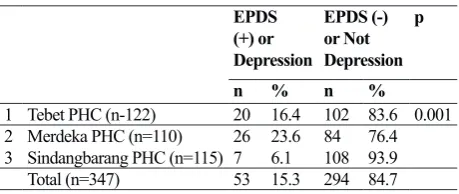
There were 350 questionnaires which had been entered into the database . Three respondents were excluded from the analysis because after the editing and cleaning process, they were under the age of 18. Thus, the total number of respondents analyzed was 347 people with the proportion of depression as described in the following table.
1 Tebet PHC (n-122) 20 16.4 102 83.6 0.001
2 Merdeka PHC (n=110) 26 23.6 84 76.4
3 Sindangbarang PHC (n=115) 7 6.1 108 93.9
Total (n=347) 53 15.3 294 84.7
Tebet vs Merdeka p= 0.1680. Tebet vs Sindangbarang p=0.0128.
Merdeka vs Sidangbarang p=0.001
Table 2. The Characteristics of mothers after labour in Tebet, Merdeka, Sindangbarang areas in 2016
Characteristics Tebet PHC n= 122
Merdeka PHC n= 110
Sindangbarang PHC
n=115 p
mean (95% CI) mean (95% CI) mean (95% CI)
1 Age (year) 29.6 (29.6-30.7) 30.0 (28.8-31.2) 28.9 (28.0-29.7) 0.312
n % n % n %
2 Education
- High 11 9.02 17 15.45 6 5.22 0.001
- Moderate 73 59.84 59 53.64 52 45.55
- Low 38 31.15 34 30.91 57 49.57
3 Mother’s occupation
- Working 23 18.85 14 12.73 10 8.70 0.071
- Not Working 99 81.15 96 87.27 105 91.30
4 Husband’s occupation
- Employee 72 59.02 43 39.09 37 32.17 0.001
- Non-Employee 47 38.52 66 60.00 77 66.96
- Not Working 3 2.46 1 0.91 1 0.87
5 Marital Status
- Married 121 99.18 26 69.09 115 100 0.001
- Divorce 1 0.82 34 30.91 0 0
6 Economy status
- High 68 55.74 46 41.82 25 21.74 0.001
- Low 54 44.26 64 58.18 90 78.26
education Tebet vs Merdeka p=0.490. Tebet vs Sindangbarang p=0.004. Merdeka vs Sindangbarang p=0.001.
− Mothers’ occupations Tebet vs Merdeka p=0.204. Tebet vs Sindangbarang p=0.0243. Merdeka vs Sindangbarang p=0.328.
− Husbands’ occupations Tebet vs Merdeka p=0.005. Tebet vs Sindangbarang p=0.0001. Merdeka vs Sindangbarang p=0.290
− Marital status Tebet vs Merdeka p=0.001. Tebet vs Sindangbarang p=0.3316. Merdeka vs Sindangbarang p=0.001
− Economy level Tebet vs Merdeka p=0.035. Tebet vs Sindangbarang p=0.0000. Merdeka vs Sindangbarang p=0.001
Tabel 3. Characteristics of the Newborn Baby in Tebet, Merdeka, Sindangbarang areas in 2016
Tebet PHC n= 122
Merdeka PHC n= 110
Sindangbarang PHC
n=115 p
mean (95% CI) mean (95% CI) mean (95% CI)
1 Babies Length (centimeter) 48.9 (48.2 - 49.7) 48.7 (48.1- 49.2) 48.5 (47.7- 49.3) 0.012
2 Babies Weight (gram) 3207(3085- 3329) 3147(3044 - 3250) 3233 (3127 – 3338) 0.274
n % n % n %
3 Sex
- Boy 69 56.56 52 47.27 71 61.74 0.088
- Girl 53 43.44 58 52.73 44 38.26
4 Pregnancy complication
- No complication 100 81.97 85 77.27 84 73.04 0.303
- 1 disease 15 12.30 17 15.45 23 20.00
- 2 diseases 3 2.46 2 1.82 7 6.09
- >2 diseases 4 3.28 6 5.45 1 0.87
5 Complication during delivery
- No complication 102 83.61 95 86.36 104 90.43 0.273
- 1 disease 15 12.30 10 9.09 10 8.70
- 2 diseases 2 1.64 2 1.82 1 0.87
- >2 diseases 3 2.46 3 2.73 0 0.00
Age of pregnancy
- ≥ 36 weeks 109 89.34 97 88.18 105 91.30 0.739
- < 36 weeks 13 10.66 13 11.82 10 8.70
Based on the characteristics of newborns, almost everyone has no difference. The difference is only in the baby’s body length that is between infants around Tebet PHC area with Sindangbarang. Baby’s body length in Tebet and Merdeka is higher than Sindangbarang.
DISCUSSION
Of the 374 respondents who had just given birth, the proportion of PND was 15.3%. This number is in the right range with the amount of depressions in the mother in South East Asia countries such Malaysia, Thailand and Vietnam.
The proportion of PND in the area of PHC of Merdeka was the highest and the lowest one was in the area of Sidangbarang. This difference is statistically significant between Tebet located in the center of the capital city of Jakarta and Sindangbarang located on the suburb of Bogor city. The proportion between PHC of Merdeka and Sindangbarang both located in Bogor are also different. In some characteristics, there are many differences between Tebet and Sindangbarang, for example in terms of education, husband’s occupations and family economy. Between Merdeka and Sindangbarang, there are also differences in education, marital status and economic level. The literature suggests that in rural areas the number of perinatal or post-partum depression is higher than in cities.10 However, in this study, even though the characteristics of mothers and infants in Sindangbarang were worse than in other areas, but the proportion of PNDs was lower.
The level of education is always associated with depression. The higher education is better for a person in dealing with stress in his life. A highly educated mother tends to seek for effective treatments such as counseling, taking medications, or a combination of both.11 In Sindangbarang, highly educated respondents only 5.2%, moderate and high education were 45% and 50%, respectively.
Most of husbands in Sindangbarang were unemployee. unemployees can be assumed that they have unstable incomes or work in informal sector. From economic level, in Sindangbarang, almost 80% of them have low economic level. The husband’s occupation and the economic level are closely related to maternal depressions in childbirth.12-14 The economic factors mainly affect pregnant women in the first and second trimester.13 In this study, the mother is assessed
within 4-16 weeks after delivery and there was no influence of the economic factor.
In the characteristics of the infant, the difference was only the body length. Regardless of the statistical value, the average length of the newborns is 48 centimeters. The 48 centimeter is usually defined as the minimum body length during birth.15The length of the body is unrelated to depression in the mother who gives birth, but is generally associated with the baby’s weight at birth. Mothers with depression tend to have babies with low birth weight (LBW).16-18
In this study, the lowest proportion of PNDs was in Sindangbarang with the lack of socioeconomic and education. This is contrary to other studies. The difference may be due to other factors not reported in this study such as social support other than mother and infants variables. Limitation of this study that have not included stressor variables of life events, negative thinking, discrimination, violence (sexual, psychological and physical), interpersonal relationship with husband and family, substance abuse and alcohol and several other aspects of reproduction, for example the number of children, age during marriage, pregnancy history, etc.10-11,14,19
Stresor due to actual event in life should be assessed since it related to maternal depression. Previous research found that if mothers have negative thoughts they tend to get greater impact on depression than those who are stressed due to life events.19-20
Coercion committed by a partner (intimate partner of violence) is often associated with maternal depression. In extreme circumstances, things could be fatal such as suicide attempts.21-22 Basically, the
questionnaire in this study questioned the behavior of domestic violence and husbands behavior but less than 10 respondents claimed it. Some literatures correlate maternal nutrition with depression, but some literatures suggest that diet is not related to depression in the perinatal period.23
Statistically, the proportion of PND differs between PHC areas and is supported by data that some of the characteristics of mother and baby are also different. This difference is more affecting between mothers who live in Jakarta (Tebet) and those who live in the suburbs of Bogor. In Bogor, there are also distinctive characteristics of the mothers in the area of Merdeka and Sindangbarang PHC.
three months of pregnancy to postpartum. Early detection is required so as not to continue to be a worsening condition. In developed countries, one way to overcome perinatal depression is to provide psychotherapy, counselling and taking medicine. Psychotherapy cognitive behaviour therapy is largely mentioned as effective in dealing with this disorder.12 Ministry of Health through the Directorate of Mental Health Service (currently Directorate of Prevention and Control of Mental Health and Narcotic, Psychotropic, Substance Problem.) has basically trained PHC officers and prepared a mental health pocket book for mothers in pregnancy, childbirth and breastfeeding. The book can be used by the family and health cadre. Information about maternal stress symptoms is presented in this book and there are some simple guideline on how to deal with them through simple counselling. Pregnant women are also advised to do relaxation exercise during pregnancy as well as techniques for dealing with anxiety. In certain circumstances, the mothers are suggested to consult doctor at PHC because of their stress.24 Based on this results of this study, it is suggested to add more variable questions about stressors of life and/or negative thoughts on the mother for further research to find more determinants of PND. 19-20 In conclusion, the PND was lower in the Sindangbarang PHC area with the characteristics of Sindangbarang located on the suburbs of Bogor city, the education level of the respondents was mostly low, most of the respondents husbands work as non-employees (informal jobs), mostly from low economic classes. The length of infants in Sindangbarang is relatively shorter than infants in other areas even though they are still above 48 centimeters.
Acknowledgments
The researcher team would like say thank you to the Head of Primary Health Center of Tebet, South Jakarta, Merdeka and Sindangbarang in Bogor that provided an opportunity for the researcher team to conduct an activity in their territorial as well as providing technical assistance in the field.
REFERENCES
1. Sadock BJ, Sadock VA. Psychiatry and reproductive medicine. In: Grebb JA, Pataki CS, Sussman N, et al., editors. Kaplan & Sadock’s Synopsis of Psychiatry: Behavioral Sciences/Clinical Psychiatry. 10th ed. Philadelphia: Lippincott Williams & Wilkins; 2007.
2. Gavin NI, Gaynes BN, Lohr KN, Meltzer-Brody S, Gartlehner G, Swinson T. Perinatal depression: a systematic review of prevalence and incidence. Obstet Gynecol 2005;106:1071–83.
3. American College of Obstetricians and Gynecologists ACoOa. FAQ091: Labor, delivery, and postpartum care. [cited 2017 June 23]. Available from: https://www.acog. org/-/media/For-Patients/faq091.pdf?dmc=1&ts=20170 623T1533073502
4. World Health Organization. Maternal mental health and child health and development in low and middle income countries. Report of the WHO meeting. Geneva: World Health Organization; 2008.
5. Ismail RI. Stress before and during pregnancy increased risk antepartum depression. Med J Indones. 2003;12:81-6. 6. Ismail I. Antepartum depression and husband’s mental
problem increased risk maternity blues. Med J Indones. 2006;15:74-80.
7. Parsons CE, Young KS, Rochat TJ, Kringelbach ML, Stein A. Postnatal depression and its effects on child development: a review of evidence from low- and middle-income countries. Br Med Bull. 2012;101:57-79. 8. World Health Organization. The world health report 2001:
Mental health: new understanding, new hope. 2001. 9. Semple D, Smyth R. Reproductive psychiatry, sexual
dysfunction, and sexuality. Oxford handbook of psychiatry. Oxford: Oxford University Press; 2013. p. 470-1
10. Fisher J, Tran T, LaBT, KriitmaaK, Rosenthal D, Tran T. Common perinatal mental disorders in northern Vietnam: Community prevalence and health care use. World Health Organization.Bull World Health Organ, 2010; 88(10), 737-45.
11. Ride J, Lancsar E. Women’s preferences for treatment of perinatal depression and anxiety: A discrete choice experiment 2016; 11(6). Available from: https://doi. org/10.1371/journal.pone.0156629.
12. Tandon SD, Leis JA, Mandelson T, Perry DF, Kemp K. Six-month outcomes from a randomized controlled trial to prevent perinatal depression in low-income home visiting clients. Matern Child Health J. 2014;18(4):873-81. 13. ParkJ, Karmaus W,Zhang H. Prevalence of and risk
factors for depressive symptoms in Korean women throughout pregnancy and in postpartum period. Asian Nurs Res. 2015; 9(3), 219-25.
14. Ley CE, Copeland VC, Flint C, White JS, Wexler S. Community-based perinatal depression services for African American women: the healthy start model. Soc Work Public Health. 2009;24(6):568-83.
15. Badan Litbang Kesehatan Kementerian Kesehatan RI. Laporan Riskesdas 2013. Jakarta: Badan Litbangkes; 2013. Indonesian.
16. Rahman A, Bunn J, Lovel H, et al. Association between antenatal depression and low birthweight in a developing country. Acta Psychiatr Scand 2007;115:481–6.
weight, and intrauterine growth restriction. Arch Gen Psychiatry. 2010;67(10):1012-24
18. Idaiani S, Basuki B.Postpartum depression in Indonesian women. Health Science Indones. 2012;1:3-8.
19. Wang Y, Wang X, Liu F, Jiang X, Xiao Y, Dong X, et al. Negative life events and antenatal depression among pregnant women in rural china: The role of negative automatic thoughts.2016. doi:http://dx.doi.org/10.1371/ journal.pone.0167597.
20. Price SK, Masho SW. What does it mean when we screen? A closer examination of perinatal depression and psychosocial risk screening within one MCH home visiting program. Matern Child Health J. 2014;18(4):765-71.doi:http://dx.doi.org/10.1007/ s10995-013-1317-7.
21. Garcia-Moreno C, Jansen HA, Ellsberg M, Heise L, Watts CH. Prevalence of intimate partner violence: Findings from the WHO multi-country study on women’s health and domestic violence. The Lancet. 2006;368(9543):1260-9. 22. Lindahl V, Pearson JL, Colpe L. Prevalence of suicidality
during pregnancy and the postpartum. Arch Womens Ment Health. 2005;8(2):77-87.
23. OkuboH, MiyakeY, Sasaki S, Tanaka K, Murakami K, HirotaY. Dietarypatterns during pregnancy and the risk of postpartum depression in Japan: The Osaka maternal and child health study. Br J Nutr. 2011;105(8): 1251-7. doi:http://dx.doi.org/10.1017/S0007114510004782.