18
Simulation Study of Natural Ventilation in Traditional and Contemporary
Javanese Houses in Yogyakarta
Tri Yuni Iswati1
1 Architecture Department/Engeneering Faculty, Sebelas Maret University, Indonesia
ABSTRACT
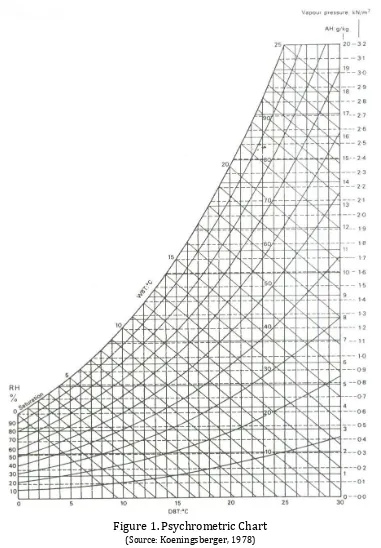
19 Figure 1. Psychrometric Chart
(Source: Koeningsberger, 1978)
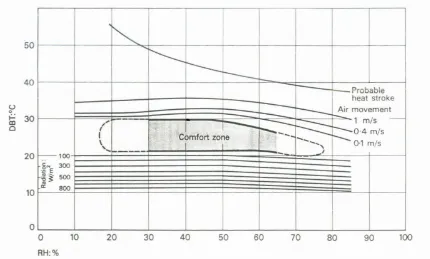
20 Figure 2. Bioclimatic Chart
(Source: Satwiko, 2008)
Thick walls have a greater time lag. The wall thickness is suitable for humid tropical climate. Because it can maintain the coolness of the room on a hot day. At night is not quite effective because the temperature difference between day and night not too far away. So at night when the temperature of the heat off the wall in the room is still quite high. For the tropical climate is very suitable supported with high ceilings, tile-roofed. In addition the use of multiple windows. That window glass inside and outside blinds are very suitable for humid tropical climate. At Kotagede’s house material used is wood windows, wooden bars on the inside, one brick wall, clay roof tiles, floor tiles, without a ceiling with a large yard.
2.2. Methodology
The methodology used in this study is the simulation of a simulation study using CFD (Computational Fluids Dynamics) with data from measurements made on the assumption BMKG (Meteorology Climatology Geophysics Board) height of 10 m from ground level. Objects being compared are the traditional houses in the area Kotagede and contemporary homes in residential areas Gowok, Sleman, Yogyakarta. Extents compared to approximately 150m2. Assuming the same direction toward the building. Building materials for the aspect that distinguishes the measurement. Simulation by taking data at the hottest temperature (October) and coldest (July).
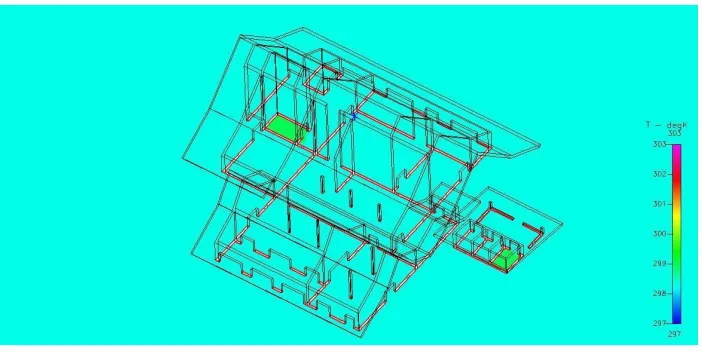
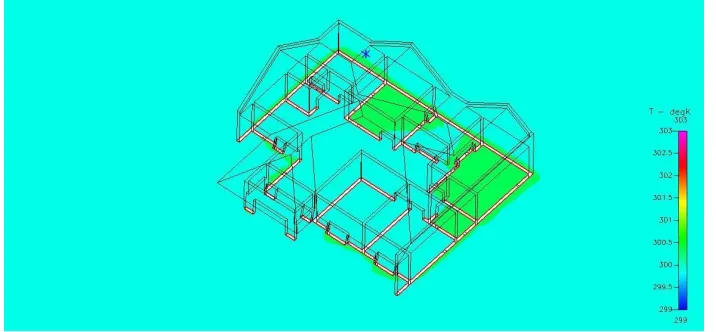
21 In Traditional house on the coldest temperature of more 298.5 ˚K = 25.35 ˚C some were 299.5 ˚K = 26.35 ˚C (Fig.4). In Contemporary house on the coldest temperature of all the same inside and outside buildings 299.5 ˚K = 26.35 ˚C (Fig.3). Contemporary on the hottest temperature of more 299.8 ˚K = 26.65 ˚C in some parts of 300.5 ˚K = 27.35 ˚C (Fig.3). Traditional hottest temperature more 299.8 ˚K = 26.65 ˚C in some parts of 300.5 ˚K = 27.35
˚C (Fig.6).
So at the hottest temperature in both houses contemporary and traditional homes do not have a significant difference because both dominant temperature is 26.65 ˚C and some parts of 27.35 ˚C. but the difference is the coldest month temperature at which the temperature of contemporary home inside and outside the same room is 26.35 ˚C, while the traditional home has a temperature of dominant sections 25.35˚C and the other part is 26.35 ˚C .
Note: Green 300.5 ˚K = 27.35 ˚C, Young Greens 299.8 ˚K = 26.65 ˚C
Figure 3. simulation of temperature on the contemporary home on the coldest month
(Source: Author, 2011)
Figure 4. simulation of temperature on the traditional houses on the coldest month
22 Figure 5. simulated temperature in contemporary homes in the hottest month
(Source: Author, 2011)
Figure 6. simulated temperatures in the traditional home at the hottest temperature
(Source: Author, 2011)
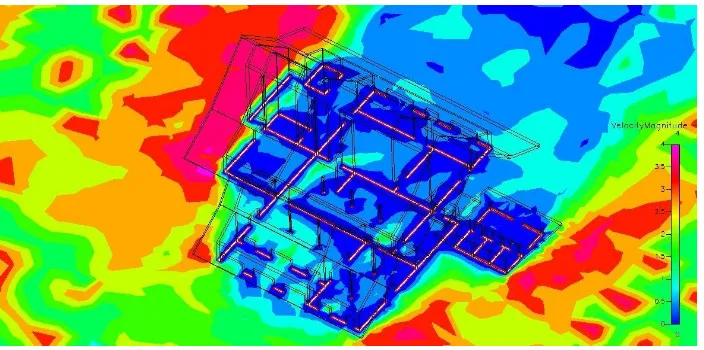
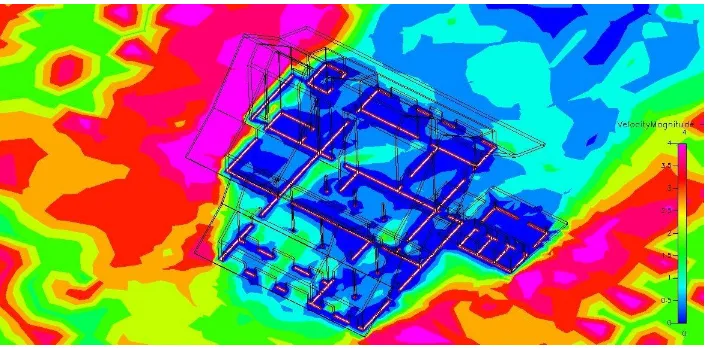
Navy 0-0.5 m / s Blue 0.5-1m / s
Light green 1-1.5m / s Green 1.5-2 m / s
23
Figure 7. Wind speed simulation in contemporary home on the hottest temperature
(Source: Author, 2011)
Figure 8. Wind speed simulation in contemporary home on the coldest temperature
(Source: Author, 2011)
Figure 9. Wind speed simulation at the traditional houses on the coldest temperature
24 Figure 10. Wind speed simulation at the traditional houses on the coldest temperature
(Source: Author, 2011) sufficient to carry heat by convection and make the temperature more comfortable
4. Conclusion
Simulation is conducted with due respect to material that is half brick and one wall brick, floor tile all, the window glass and wood, all solid wood doors, clay tile roofs all. So it can be concluded That the use of materials on the wall and floor, window and door materials, roofing materials in traditional house proved to result in temperature and wind speed are comfort.
References
Koenigsberger, Ingersoll, Mayhew, Szokolay. 1978. Manual Of Tropical Housing And
Building. America: Longman Inc.
PO Fanger. 1982. Thermal Comfort, Analisys And Applications In Environmetal Engineering. New York: Mc Graw Hill Company.
Szokolay, SV. 1987. Thermal Design of Buildings. Canberra RAIA: Education Devision. Evans, M. 1980. Housing, Climate and Comfort. New York: John Wiley and Sons. Egan, D. 1975. Concepts in Thermal Comfort. New Jersey: Prentice Hall Inc.
Idham, C., Aksugur, E. 2006. The Natural Acclimation of Javanese Vernacular House
Typology. in Harmony in Culture and Nature, Inta Conference, Yogyakarta.
Iswati, T.Y. 2009. Kampung Dalem di Balik Kemegahan Kotagede. Surakarta: UNS Press. Iswati, T.Y. 2011. Simulation Of Thermal Performance Of Traditional Javanese House
Compared With Contemporary House In Tropics Region In Yogyakarta. International