MICROMORPHOLOGICAL CHARACTERISTICS OF
ANDISOLS IN WEST JAVA, INDONESIA
Mahfud Arifin*, Rina Devnita
Dept. of Soil Science, Faculty of Agriculture, Padjadjaran University, Bandung, Indonesia [email protected]
Tel. ++62-22/779.63.16 Fax. ++62-22/779.63.16; ++62-22/779.72.00
Abstract
Micromorphological characteristics have been studied for six pedons of Andisols developed in volcanic materials in West java, Indonesia. The pedons represent deposits of different volcanoes (Mt.Tangkuban Perahu A and C, Mt. Patuha, Mt. Kendeng, Mt. Papandayan, Mt. Guntur), with different ages (Pleistocene, Holocene) and different types of volcanism (andesitic, basaltic), in three agroclimatic zones (A, B1, B2). Undisturbed soil samples for thin section preparation were taken from every identifiable horizon (49 samples in total). Observations were made with a magnifying lens, binocular stereomicroscope, polarization microscope, and scanning electron microscope. The results demonstrate that the study of micromorphological characteristics is very useful to identify pedogenetic processes in Andisols.
INTRODUCTION
Soil micromorphology is a method to study undisturbed soil samples using microscopic and submicroscopic techniques to identify soil components and establish their spatial, temporal, genetic and functional relationships [3, 13].
Historically, micromorphological investigations have mainly been used for soil genesis studies, but they also have wider applications, e.g. in soil physics, biology and chemistry [3]. Two basic principles of micropedology are the use of undisturbed (oriented) samples and the concept of functional research whereby all observations are directed towards reaching as an understanding of the function of soil components and the relationship between one another.
Micropedology covers all microscopic analyses of undisturbed soil samples [14], including the study of soil thin sections, microchemical and microphysical methods, and submicroscopic techniques. The most advanced analysis is the study of the entire soil fabric (soil micromorphology) and its quantitative aspects (soil micromorphometry).
Many soil micromorphology studies have been conducted and published, especially on Ultisols, Oxisols, Spodosols and Paleosols [3]. However, research on Andisols is still rare, especially in Indonesia. Therefore, there is a few information concerning micromorphological features of Andisols in Indonesia, particularly the Andisols developing on different parent materials and in different agroclimatic zones.
For this study, research has been done on the micromorphological characteristics of Andisols in six pedons in the tea plantation area of West Java, Indonesia. The studied soils represent six different volcanic eruptions, ages, and parent materials, in three agroclimatic zones [11].
MATERIALS AND METHODS
District, Pleistocene, andesitic, agroclimatic zone B1), pedon SNR-B5 (Lithic Hapludand) at Mt. Patuha (Sinumbra District, Holocene, basaltic, B1), pedon SDP-A3 (Typic Hapludand) at Mt. Guntur Cs (Sedep District, Pleistocene, basaltic, agroclimatic zone B2), and pedon SDP-B5 (Hydric Thaptic Hapludand) at Mt. Papandayan (Sedep District, Holocene, basaltic, agroclimatic zone B2) are all located in Bandung Regency.
Undisturbed soil samples for the preparation of soil thin sections were obtained for every identifiable horizon in all profiles. The total number of samples was 49.
Preparation of the soil thin sections involved hardening of the samples by impregnation. Observations of the undisturbed samples were made with the naked eye, a magnifier lens, binocular stereomicroscope, polarization microscope and scanning electron microscope. The terminology and concepts of the Handbook for Soil Thin Section Description [3] were used, with a few modifications.
RESULTS AND DISCUSSION
Micromass Colour
The colour of the micromass as observed in thin sections partly depends on thickness, light source properties and magnification.
In this study, only small variations in colour were observed. Horizon A/Bw has a brown to dark brown colour. Horizon BC generally has a lighter colour compared to the other genetic horizons. Surface horizons and buried A horizons have the darkest colour. In general, the horizons of pedons CTR-A2, SNR-A2, SNR-B5 and SDP-A3 have a brown colour, except pedon SDP-A3, which was lighter. Pedon CTR-B4 and SDP-B5 have a dark brown colour.
The micromass colour in the thin sections was generally more brownish than the field soil capacity colour. Rainfall, age and parent material appear to have no significant effect on micromass colour. However, in Ciater District pedon CTR-A2 generally has a lighter colour than CTR-B4, in Sinumbra District pedon SNR-A2 has a lighter colour than SNR-B5, and in Sedep District SDP-A3 is lighter than SDP-B5. This indicates that
the older parent materials have a lighter colour than the younger parent materials.
Microstructure
Microstructure refers to the shape, size and arrangement of soil aggregates and pores, generally observed at rather low magnification.
Pedality
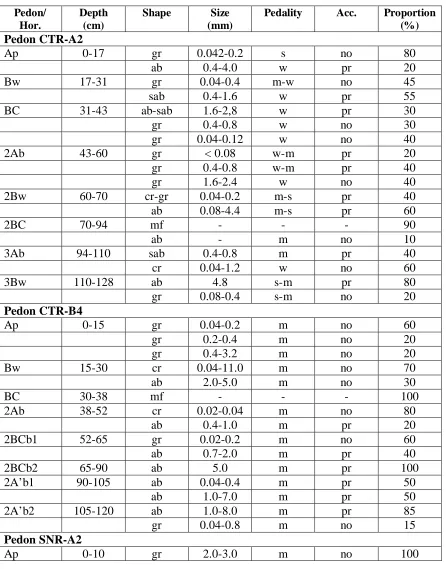
The complete results of observation of the microstructure are presented in Table 1. Some examples of soil microstructure features are presented in Figure 1. The microstructure of the Andisols ranges from granular to massive. The surface horizon generally has crumb and granular microstructures (Fig. 1.a and 1.b), whereas the subsurface horizon has a blocky to subangular blocky microstructure.
In all horizons, the size of the peds shows a rather wide range (0.02-11.00 mm). The degree of accommodation ranges from well accommodated to unaccommodated, and is generally partly accommodated (Fig. 1.f).
Types of voids
In surface horizons, compound packing voids are observed (Fig. 1.a and 1.b). The voids are equant to elongate, interconnected, occurring between granular, crumb and angular blocky peds, which are unaccommodated. Other void types that are recognized are planar voids, chambers and vughs (Fig. 1.a, 1.b, 1.f)
Subsurface horizons, which show crumb, granular or angular blocky microstructures, with or without pores, generally have planar voids, or planar voids with compound packing voids (Fig. 1.f). In a subsurface horizon (A’’, Bw) developed on old parent material (e.g. pedon SNR-A2 and SDP-A3), planar voids, vughs, channels, chambers and vesicles are recognized.
a b
c d
g h
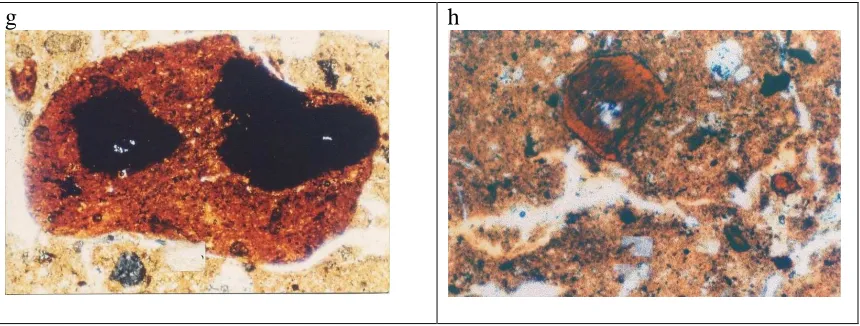
Figure 1. Photomicrograph of thin section with plane polarized light. Hor. Ap, CTR-A2 (a); Hor. Ap, SNR-B5 (b); Hor B’wb, SDP-A3 (c); Hor. 2Ab SNR-A2 (d); Hor. 3Ab, CTR-A2 (e); Hor. Ap, SNR-A2 (f); Hor.
A’b2, SDP-A3 (g); Hor. Bw SDP-A3 (h)
Planar voids in the surface horizon (Ap) generally developed along roots
residues or microfauna remain. In the subsurface horizon, planar void mainly formed
by development of cracks in dense groundmass material.
Abundance of voids
The abundance of voids in the thin sections was determined, expressed as percentage of the total area of the thin section [5]. The results show that surface horizons have a higher porosity than the subsurface horizons. Hence, the percentage of voids decreases with depth. This can be clearly seen in old pedons such as SNR-A2 and SDP-A3. This was predicted referring to processes of infilling of voids by illuvial material derived from the groundmass by percolation of water, gravity, and biological activity, taking place during a long period. Therefore several pores have been closed by material derived from upper horizons.
Related Distribution Patterns
Horizons in Andisols have porphyric and enaulic c/f related distribution patterns, i.e. they are composed of coarse material embedded in finer material (porphyric) or they have a skeleton of larger fabric units with aggregates of fine material in the interstitial spaces (enaulic) [1,8]. In the latter, the aggregates do not completely fill the interstitial spaces, and the larger units support each other.
Surface horizon generally have enaulic c/f related distribution patterns (Fig. 1.a and 1.b), especially in Andisols developed on young parent materials. Andisols developed from old parent material have porphyric c/f related distribution patterns in their surface horizon. The granular or crumb structure in the surface horizon could be related to high biological activity (e.g. termites, ants), and the intensive growth of roots. The allophane content in the surface horizon is generally lower than in subsurface horizons due to the strong accumulation of organic matter in the surface horizon, preventing the formation of allophanes because of the formation of Al-humus complexes [9].
The subsurface horizons have porphyric c/f related distribution patterns. These horizons have a high total density, with porous and non porous parts. Pores in the porous parts can be filled with material derived from upper horizons. With time, they can develop into non-porous materials in this way.
and gibbsite. The change in mineral composition was predicted to be accompanied by a change in c/f related distribution pattern from enaulic to porphyric.
The subsurface horizons of pedon CTR-B4 still have enaulic c/f related distribution patterns, although the age of this pedon is older than that of CTR-A2, which shows porphyric c/f related distribution patterns. This indicates that the accumulation process in the subsurface horizons (pedon CTR-A2) was intensive due to the presence of impervious layers that prevent transportation of material to the lower horizons.
Bw1 10-23 ab 2.0-5.0 s no 50 cryptocrystalline, fabric and excrement pedofeatures [3,4]. Weathering of primary mineral grains is also considered in this chapter. Table 2 gives a detailed overview of the pedofeatures observed in every studied horizon.
The other features generally found were the strong alteration of primary mineral, e.g. minerals susceptible to physical and chemical weathering in A, B, and BC horizons. Physical weathering can be in the form of fragmentation. Chemical weathering can be recognized by the change of form or colour of the mineral grains.
Mineral grains in pedons originated from old parent material generally have anhedral shapes (and low c/f2µ ratios), whereas grains in younger pedons usually have subhedral to euhedral shape (and higher c/f2µ ratios). Iron nodules are found in old
pedon like SDP-A3 in Sedep (Fig. 1.g). The nodules were formed by residual accumulation of iron compounds, related to weathering of primary minerals. Gibbsite coatings (Fig. 2.a) are found in Acrudoxic Hapludand.
Weak indications for clay illuviation are only recognized for the B’wb horizon in pedon SDP-A3, originated from old parent material, and in horizon 2BCb of pedon SNR-A2 (Fig. 2.b). These horizons do not fulfill the prerequisite of an argillic horizon in Soil
Taxonomy [12] due to the small total volume of illuvial clay (< 1 %) and the low degree
of orientation within the clay coatings. Maeda et al [10] also reported a few coatings in Andisols. Mohr et al [11] proposed that Andisols often include a horizon with clay accumulation.
Table 2. Pedofeatures of every identifiable horizon in the studied soils.
Pedon/horizon Pedofeatures and weathering features (and plant remains) CTR-A2
Ap Partly weathered primary minerals
Bw Voids of root residue filled by granular groundmass material Fragment of altered root, coloured brown-black at the edge BC Planar voids filled by isotropic clay mixed with very fine sand 2 Ab Fragment of yellowish weathered rock
2Bw -
2BC Plagioclase covered by opaque material
3Ab Planar void filled by a mixture of clay and very fine sand 3Bw Planar voids filled by clay
Root residue, with black soil material at the edge
CTR-B4
Ap Voids of root residue, brownish, 20 % Bw Voids of root residue, 15 %
BC Planar voids filled by a mixture of clay and very fine sand Brownish red organic fragments, 10 %
2Ab -
2BCb1 Voids of root residue and organic fragments, 10 %
2BCb2 Planar void filled by granular clay aggregates and very fine sand Fragment of reddish weathered rocks with volcanic glass
2A’b1 Tuff with volcanic glass and yellowish brown clay minerals 2A’b2 Voids filled by very fine sand
2B’wb Voids filled by very fine sand and groundmass material
SNR-A2
Ap Voids of tea plant’s root residue, reddish brown wall Bw1 Voids filled by gibbsite
Bw2 Partly altered root fragments Bw3 -
2BCb Planar void filled by clay Root fragments, 7 %
2A”B Void of weathered mineral residue Planar void filled by clay and gibbsite
2BC’b Planar voids and vughs filled by granular groundmass material
SNR-B5
Ap Opaque root fragments Bw Opaque root fragments A’b Opaque root fragments
BC’b Voids of root residue, partly filled with groundmass material Typic nodules
SDP-A3
Ap Opaque and reddish brown root fragments
Voids of root residue, partly filled with granular groundmass material A2 Typic and nucleic nodules
Root fragments
Bw Typic and nucleic nodules
BC Planar voids filled by groundmass material and very fine sand A’b1 Hypocoating in the planar voids
Typic nodules
Planar voids filled by groundmass material and very fine sand A’b2 Typic nodules
Voids of root residue, reddish brown wall, partly coated by groundmass material
B’wb Typic nodules
Voids of root residue , filled with groundmass material Typic clay coatings in planar voids
Planar voids filled by groundmass material and very fine sand A”b Planar voids coated by groundmass material and very fine sand B”wb Typic oating in planar voids
Planar voids filled by groundmass material BC”b Typic coating in planar voids
Planar voids filled by groundmass material and very fine sand
Typic nodules SDP-B5
Ap Planar voids filled by groundmass material and very fine sand
Bw -
A’b Planar voids filled by groundmass material and very fine sand Voids of weathered root residue, rounded, reddish brown wall
B’wb Planar voids and compound packing voids filled by groundmass material and very fine sand
a b
c d
e
Fig.2 . Scanning electron microscope images (a and e) and thin section photographs. Gibbsite coating in hor. 2BCb, SNR-A2 (a); clay coating in hor. B’wb-SDP-A3, XPL (b); coatings of organic material in hor. B’wb, SDP-A3, PPL (c); pores with infilling in hor. 2BCb, SNR-A2, XPL (d); clay coating on sand grains,
hor. Bw, SNR-B5 (e)
CONCLUSION
coatings and nodules. The pedon developed at Mt. Kendeng has gibbsite coatings, and pedons developed at Mt. Papandayan and Mt. Tangkuban Perahu (eruption A and C) had coatings of organic material.
(2) Micromorphological characteristics of Andisols developed from old parent material were different from those of soils developed from young parent material. The former have porphyric c/f related distribution patterns, low c/f2µ ratios, poor sorting, common infillings and coatings of voids, a few clay and gibbsite coatings, anhedral primary mineral grains, planar voids, a blocky to angular blocky microstructure, well-developed pedality and good accommodation. The soils on young parent materials have enaulic c/f related distribution patterns, high c/f2µ ratios, poor sorting, infillings composed of groundmass material, silt and organic material, subhedral to euhedral primary mineral grains, a granular microstructure, a crumb to blocky microstructure with medium pedality, partly accommodated peds and compound packing voids.
REFERENCES
[1] Brewer, R. “Fabric and Mineral Analysis Soils”, John Wiley & Sons, Inc., New York, (1964). [2] Brewer, R. “Fabric and Mineral Analysis Soils”, Robert E. Krieger Publ. Co., New York, (1976). [3] Bullock, P. L., Federoff, N., Jongerius, A., Stoops, G. and T. Tursina, “Handbook for Soil Thin Section
Description”, Waine Research Publ, 152 p (1985).
[4] Bullock, P. L. “The Role of Micromorphology in the Study of Quaternary Soil Process. Soil and Quaternary Landscape Evolution”, J. Boardman (ed), John Wiley & Sons Lt, (1985).
[5] FitzPatrick, E. A. “Micromorphology of Soils”, Chapman and Hall, London, (1984).
[6] Goenadi, D. H. and Tan, K. H. “Mineralogy and micromorphology of soils from volcanic tuffs in the humid tropics”, SSSAJR, 53(6):1907-1911 (1989).
[7] Goenadi, D. H. and Tan, K. H. “Relationship of soil fabric and particle-size distribution in Davidson soil”, Soil Sci. 147:264-269 (1989).
[8] Goenadi, D.H and Tan, K. H. “Micromorphology and x-ray microanalysis of an Ultisols in the tropic”,
Indon. J. Trop. Agric, 1:12-16 (1989).
[9] Maeda, T., H. Takenaka and B.P Warkentin. “Physical properties of allophane soils”, Advances
Agronomy, 29:229-264 (1977).
[10] Mohr, E.J.C., F.A van Baren and I. van Schuylenborg. ”Tropical Soils, A Comprehensive Study of Their Genesis”, The Hague-Paris-Djakarta, (1972).
[11] Oldeman, L. R. “An Agroclimatic Map of Java Central Research”, Institute of Agricultur, Bogor, (1975).
[12] Soil Survey Staff. “Keys to Soil Taxonomy, SMSS, Technical Monograph No.19, Fifth Edition”,
Pocahontas Press. Inc, Blacksburg. Virginia, (1992).
[13] Stoops, G and A. Jongerius. “Proposal for micromorphological classification in soil materials, I. A classification of the related distribution of coarse and fine particles”, Geoderma, 13: 189-200 (1975).