Building Blocks Incorporating Waste Materials Bound with
Bitumen
Thanaya, I.N.A.1)
Abstract: This paper described an investigation and evaluation which was carried out in the United Kingdom-UK, on the properties of masonry building block materials that incorporate waste materials, namely: steel slag, crushed glass, coal fly ash, rice husk ash (RHA), incinerator sewage sludge ash (ISSA), municipal solid waste incinerator bottom ash (MSWIBA) or shortened as IBA, bound with bitumen or asphalt, named as Bitublock. The binder used was 50 pen bitumen. The properties of the blocks evaluated were: compressive strength, density, porosity, initial rate of suction (IRS), creep, and volume stability. It was found that the Bitublock performance can be improved by optimizing porosity and curing regime. Compaction level of 2 MPa and curing regime of 200°C for 24 hours gave satisfactory bitublock performances that at least comparable to concrete block found in the United Kingdom (UK). The Volume stability (expansion) of the unit is affected by environment relative humidity.
Keywords: Building block, bitublock, waste, materials, bitumen.
Introduction
Demands on building materials have increased from time to time in most part of the world in line with the increasing number of population. Among materials demanded is masonry material for constructing housings. In phase with sustainability in building construction, utilization of waste materials had been encouraged.
The incorporation of those waste materials (the case in the UK), supports the UK government target to reduce the amount of commercial and industrial waste going to landfill to 85% of 1998 levels by 2005 [1].
The Landfill Directive represents a step change in the way waste materials are disposed in the UK and will help to drive waste up the hierarchy through waste minimization and increased levels of recycling and recovery. The Directive’s overall aim is to prevent or reduce as far as possible negative effects on the environment, in particular the pollution of surface water, groundwater, soil and air, and on the global environment, including the greenhouse effect, as well as any resulting risk to human health, from the land filling of waste, during the whole lifecycle of the landfill [1].
1) Civil Engineering Department, Faculty of Engineering, Udayana
University, Denpasar-Bali. Email: [email protected]
Note: Discussion is expected before June, 1st 2010, and will be published in the “Civil Engineering Dimension” volume 12, number 2, September 2010.
Received 4 May 2009; revised 26 July 2009; accepted 18 September 2009
As costs of waste disposal at landfill rise and operators pass on the costs of meeting the requirement to producers, then there will be an increased incentive for those producers to reduce those costs by minimizing the amount of waste they produce or recycle or re-use. Until now the widespread availability of landfill area has offered a cheap disposal route; this has acted as a disincentive to both serious waste minimization and recycling and recovery efforts [1].
Researches in utilizing waste materials in civil engineering fields had been done in some parts of the world, such as rice husk ash had been used for soil improvement [2] and limited coal bottom ash can be incorporated into hot asphalt mixtures with satisfactory results [3].
Investigation of masonry building block described in this paper was carried out at Civil Engineering Department, Leeds University UK. This research certainly supports the UK government efforts in reducing wastes material to landfill. The materials incorporated namely: steel slag, crushed glass, coal fly ash, rice husk ash (RHA), incinerator sewage sludge ash (ISSA), municipal solid waste incinerator bottom ash (MSWIBA) or shortened as IBA. The binder used was 50 pen bitumen. There is a huge availability of bitumen in some oil producing countries. The properties of the blocks evaluated were: compressive strength, density, porosity, initial rate of suction (IRS), creep, and volume stability.
masonry building material. Efforts were made to produce the Bitublocks with low compaction level (low energy) for ease of production, but should meet the performance criteria targeted which is described in the following section.
Experimental Details
Performance Criteria
Referring to the currently available specification for building block in the UK, the Bitublock unit should achieve the following level of performance:
- Compressive strength: ≥ 2.8 MPa at room temperature. This is in line with the compressive strength of concrete blocks commonly found in the UK (2.8–10 MPa) [4].
- Initial rate of suction (IRS) values shall be equal to IRS values of clay brick found in the UK (0.25-2.0 kg/m2/min). The IRS is a parameter that can provide an indication of the effect of the unit on the cement mortar. Units with high IRS require very plastic mortar (high water/cement ratio), while units with lower IRS need stiffer mortar [5,6].
- Possess specific creep (static creep strain per unit stress in MPa) of ≤ 100 microstrain, tested at 20 °C. This target is in line with the specific creep level of concrete blocks currently used in the UK (approximately 100 microstrain). The level of stress of 1 MPa shall be used for the creep test as this is considered representative in masonry experiments [7,8].
Materials
Bitumen Type and Content
In principal, all types of bitumen (hard, penetration grade or bitumen emulsion) can be used as the binder, depends on availability. In the UK, most widely available bitumen was 50 pen bitumen. Therefore the type of bitumen used for this investigation was 50 penetration grade (50 pen or 40/60 pen grade bitumen) with a specific gravity of 1.03 and a softening point of 47°C. A range of
bitumen contents between 5 and 6.5% was considered.
From environment and energy saving consideration, using bitumen emulsion is an attractive option. However, historically in the UK the use of bitumen emulsion (for road construction) has not been very popular as the weather is generally wet and cold, which is not helpful for curing process. There is also a sense of conservativeness (a sense of reluctant), as hot bituminous mixtures have been widely available and successfully used. Additionally, when ordering a small amount of bitumen emulsion requires a special order and can take longer time. This matter added the reason of using 50 pen grade bitumen as the binder for the investigation.
Aggregate Type and Grading and Sample size
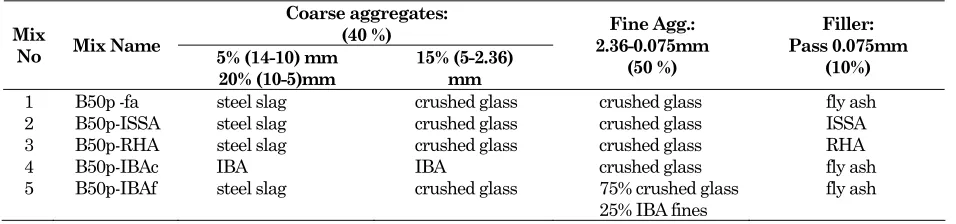
In order to reduce the amount of bitumen needed, (hence enhance the economics of the mix) and yet still ensure satisfactory bitumen coating, the incorporation of a combination of sufficient amount waste aggregates with lower absorption properties (e.g. crushed glass) have been considered for this investigation (e.g. Mix No. 5, in Table 1). This mix incorporated limited amount of fine IBA (IBA with particle sizes < 2.36 mm) as it has high absorption properties. Coarser IBA (≥ 2.36 mm) has lower absorption properties than the fine IBA, as shown in Table 2.
During the initial investigation Mix No. 1 was selected for optimization of curing regime effectiveness (suitable curing temperature and duration) and bitumen content. This matter is described further in the next section. The aggregate proportion of the materials used for all mixtures are shown in Table 1.
The choice of aggregate grading (composition) is largely affected by the performance criteria previously specified. After series of trials, it was found that a gap graded distribution of aggregates consisting of about 40% coarse aggregates (max nominal size of 14 mm; minimum retained 2.36 mm)
Table 1. Type of mix and aggregate materials used.
Coarse aggregates:
2 B50p-ISSA steel slag crushed glass crushed glass ISSA
3 B50p-RHA steel slag crushed glass crushed glass RHA
4 B50p-IBAc IBA IBA crushed glass fly ash
5 B50p-IBAf steel slag crushed glass 75% crushed glass
25% IBA fines
and 60% fines: 50% fine aggregates (2.36-0.075 mm) and 10% filler (passing 0.075 mm) was preferred. This grading contains high fine fraction, hence enables the application of low compaction level to satisfy the Bitublock performances. This grading was also found to give satisfactory texture, i.e. neither too rough nor too smooth. The properties of the materials used are shown in Table 2. Figure 1 shows further details of the aggregate particle size distribution compared with the hot rolled asphalt on the British Standard for a general appreciation of aggregate composition [9].
The size of the samples used in the investigation was 100×100×65 mm. This size was chosen for efficient use of material and for ease of laboratory scale production. The thickness of the samples was meant to closely following the thickness of clay brick commonly used in the UK.
As the samples require heat curing to harden the bitumen binder, thickness of samples would affect the heat penetration effectiveness, therefore the results of this investigation was based on the above samples size. Sample production for industrial size masonry block was not covered within this investigation.
Table 2. The properties of the aggregate materials.
Materials Density
Fine Aggregates (FA): < 2.36 mm
Crushed glass 2.51 < 1.00
0.01 0.10 1.00 10.00 100.00
Sieve Size (m m )
Figure 1. Bitublock grading used in comparison to hot
rolled asphalt [9], an example case
Preliminary Test (Optimisation)
During the initial experiment, Mix No. 1 (Table 1) was produced. The manufacture of Bitublock has been reported previously [8]. Briefly, to facilitate mixing the aggregate materials and the 50 pen bitumen were pre-heated at 160-180°C [10] for 3 hours. The loose mix was then placed in a mould and compacted.
Following compaction, the Bitublock samples were cured in an oven in order to stiffen the bitumen. Curing regime had previously been found to play a very significant role. When using a 50 pen bitumen and cured at 160°C, the curing duration required to satisfy creep performance was 72 hours. In order to reduce curing duration, the samples were cured at 200°C, but for 24 hours only. After some trials this was found to give satisfactory results [11].
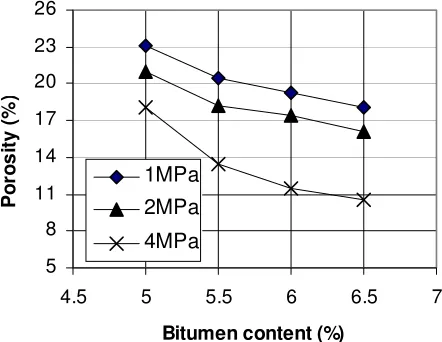
As described above, in this optimization stage the curing regime was fixed at 24 hours and the compaction level applied was 1, 2 and 4 MPa. The bitumen contents were varied from 5 to 6.5% with 0.5% increment. Figures 2 to 4 illustrate the optimisation of Mixture No. 1 as in Table1.
Referring to the aggregate grading shown in Figure 1, the minimum bitumen content for road bituminous mixtures recommended by BS594 is 6.5% by weight of total mixture, to ensure adequate coating and durability. With this in mind, the bitumen content was optimised taking the figure of 6.5% as a maximum. Lower bitumen content was targeted for efficiency.
It can be seen in Figures 2 and 3 that a decrease in bitumen content from 6.5% to 5%, corresponds to a decrease in density and an increase in porosity. This is a common trend in bituminous mixtures as the mixture becomes less workable at lower bitumen contents. As expected, a reduction in compaction level also corresponds to a decrease in density and an increase in porosity.
1.85
5
Figure 3. Bitumen content vs. porosity (Mix 1: B50p-fa).
0
Figure 4. Bitumen content vs. compressive strength (Mix
1: B50p-fa).
The compressive strength trends shown in Figure 4 are in line with the trend for density. For units compacted at 2 and 4 MPa, compared to the result at 6% bitumen content, there is little improvement in compressive strength at 6.5% bitumen content. Further increase in bitumen content (higher than 6.5%) may enhance density and hence compressive strength.
As the degree of bitumen coating, stability during handling, and compressive strength were satisfactory, for efficiency, bitumen content of 6% and compaction level of 2 MPa were chosen for further works (lower compaction level was preferred for ease of compaction).
As shown in Figure 4, the compressive strength of the samples at 6% bitumen content and 2 MPa compaction level, had exceeded the compressive strength of concrete blocks commonly used in the UK, i.e. 2.8–10 MPa [4].
Test Results and Analysis
As had been mentioned in the last sentence on the Introduction Section, low compaction level was applied when producing the Bitublocks. Test results: i.e. density, porosity, IRS, water absorption and compressive strength, based on 1 and 2 MPa compaction level are given in Table 3.
The Density, Porosity, Water Absorption, and the Compressive Strength
Referring to Table 3, the density, porosity, and the water absorption of the samples slightly vary depending of the compaction level and the type of materials used. There were no particular targets aimed at for these properties as they are not part of the performance criteria.
Table 3 also shows that when cured at curing regime of 200°C for 24 hours, at compaction level of 1-2 MPa, the samples gave satisfactory compressive strength (2.8–10 MPa). This compaction level gave porosities of the samples between 17.0% to 18.2% and compressive strength > 2.8 MPa. Reduction in compressive strength occurred on Mix no. 2 to 5. This was because of a slight reduction in degree of coating due to higher absorption of the material used that causes lower workability during compaction hence gave higher porosity. Differences in porosities are due to the nature of the materials used (difference in surface texture, shape, and particle porousness). Mix 2: B50p-ISSA that incorporated ISSA gave highest porosity as the ISSA it self contains some porous components.
The Initial Rate of Suction (IRS)
Volume Stability of the Bitublock Units
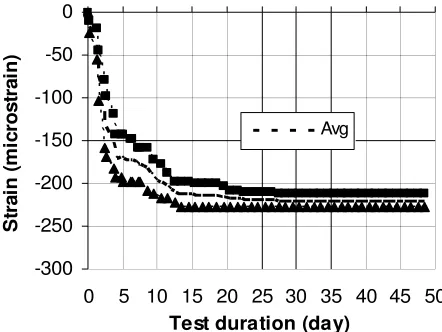
For volume stability test four samples of the Bitublock (Mix No.1 as in Table 1: Mix 1b, B50p-fa) with size of 100x100x65 mm were tested at room environment of: 21. 0 ± 0.5°C and the environment relative humidity (RH) was 62±1%. It had previously been found that volume stability of the samples is affected by water absorption from the environment. Higher relative humidity can cause higher expansion [8].
The expansion on the four side faces of the samples was monitored by means of a 50 mm Demec gauge. The averaged result was 215 microstrain, and the samples were stable after 20 days as shown in Figure 5. This result gave further confirmation that the stability of the samples was affected by moisture absorption from the testing environment (due to relative humidity).
This situation needs to be anticipated when utilizing Bitublock units for building construction. The Bitublocks are suggested to be used after achieving stable volume in line with the environment condition.
Figure 5. Expansion of Bitublock (Mix 1b, B50p-fa) at
21.0 ± 0.5°C, and relative humidity (RH) of 62±1%.
The application of Bitublocks in Indonesia, should consider the local environment condition (humidity and temperature). In order to obtain data on the magnitude of expansion and the time required to achieve volume stability, this matter need to be investigated.
Creep Test
Referring to results in Figure 5, the samples stabilized after 20 days. For this reason before the samples were tested for creep, they were conditioned at room environment for 3 weeks, as at this age the samples had been found stable.
Creep test was initially carried out on Mix No.1a and 1b as shown in Table 3 (Mix B50p-fa) with two compaction level: 1MPa and 2MPa. The samples were loaded using static dead-weight lever arm (cantilever) machine (mechanical advantage of 4) as shown in Figure 6.
This stress was applied onto the samples through the cantilever beam (Figure 6) which was loaded with cylindrical steel load on its one end. The other end of the beam was held by a hinge joint construction. From the cantilever beam the load was transferred onto the samples by means of a steel ball completed with its steel plate holder. The 1 MPa stress applied was separately calibrated by means of a load cell before the test was started. The machine can be used to test up to three samples at the same time. Every sample should be separated with a metal plate.
The strain was monitored on four side faces of each samples and measured by means of a 50 mm Demec gauge (Figure 7), and then averaged. The samples were loaded in a controlled environment (62% ± 1% relative humidity and 21.5°C ± 0.5°C).
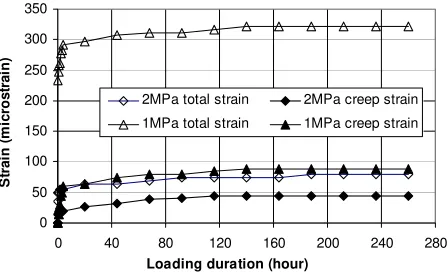
Figure 8 shows the total and creep strain of the samples initially tested (Mix 1a and 1b: B50p-fa) as shown in Table 3. The creep strain is the total strain minus the elastic strain (the strain soon after loading).
Table 3. The properties of the Bitublocks at 6% bitumen content, cured at 200˚ C for 24 hours
Mix
1 MPa compaction level
1a B50p-fa 2.000 19.2 0.41 6.1 6.8
2 MPa compaction level
1b B50p-fa 2.044 17.4 0.35 5.5 14.2
2 B50p-ISSA 2.057 18.2 0.44 6.1 8.6
3 B50p-RHA 2.013 17.8 0.37 5.4 12.7
4 B50p-IBAc 2.253 17.0 0.38 5.8 11.6
Figure 7. A 50 mm Demec gauge with its supporting equipment.
Referring to Figure 8, the creep strain of the units compacted at both 1 and 2 MPa were acceptable, i.e. in line with creep strain targeted, i.e. ≤ 100 microstrain). Compaction level of 2 MPa was then chosen for producing other type of mixtures as given in Tables 1 and 3, to ensure satisfactory performance, as it gave lowest creep strain (better resistance to creep deformation). The creep test results of all mixtures compacted at 2 MPa are shown in Figures 9 and 10, and all results are summarized in Table 4.
0
2MPa total strain 2MPa creep strain 1MPa total strain 1MPa creep strain
Figure 8. Creep test results of Bitublock units (B50p-fa),
Mix1a and 1b with 1 and 2 MPa compaction level, respectively, cured for 24 hours at 200°C.
0
Figure 9. Total strains of Bitublock mixes using 50 pen
bitumen compacted at 2 MPa, cured for 24 hours at 200°C.
0
Figure 10. Creep strains of Bitublock mixes using 50pen
bitumen compacted at 2 MPa, cured for 24 hours at 200°C.
Referring to Figures 8, 9, 10 and Table 4, the creep strains of most mixes (compacted at 1 and 2 MPa) were generally satisfactory, i.e. meet creep strain target <100 µε, except for Mix No.2 that incorporated ISSA which gave creep strain of 113.85 µε (at 2 MPa
Lever arm (cantilever beam)
Application of
creep stress). This was only marginally higher than the target and indicating a flatting off trend.
Compared to others, Mix No. 2 which used ISSA as the filler gave significantly higher elastic strains. This is due to the relatively high ISSA filler content (10%) which weakens the samples. Additionally this mix has higher porosity due to the nature of the ISSA as shown in Table 3.
Referring to Table 4, Mix No. 1a which was compacted at 1 MPa, reasonably gave higher elastic strain hence lower elastic modulus, but could meet the creep strain targeted. At 2 MPa compaction level, the performance of most samples was far better. In general the creep strains under 1 MPa stress (specific creep) of the Bitublock are comparable to those of concrete blocks currently used in the UK [7].
Considering the creep performances of the samples, although there were slight differences in porosities, the curing regime applied (200°C for 24 hours) could give sufficient hardening effect to bitumen film which bond the aggregates. The samples could resist the 1 MPa creep stress applied, hence gave satisfactory creep strain. In addition to aggregate grading, curing regime has been showing to play a very significant role.
Utilization of Bitublock
Utilization of Bitublock is suitable for non structural wall (free standing wall), e.g. as partition wall. As bitumen was used as the binder, and it had been widely known that bitumen-aggregate mixtures would suffer deterioration under water attack, therefore the Bitublocks should be used un-exposed to water (indoor).
Leachate Consideration
When incorporating waste material, one aspect i.e .leachate is an important aspect to be considered. However, during the Bitublock investigation, as it was limited by budget and time, no leaching test was carried out. It is therefore suggested that the use of Bitublock or any other product that incorporates waste materials, preferably to be used un-exposed to water (indoor situation), until leachate test result is available.
Conclusions
The results described above and the analysis, lead to the following conclusions:
- Bitublock is a sustainable masonry material that can incorporate various types of waste aggregate materials.
- The performance of the Bitublock can be improved by optimising porosity (hence compaction level) and curing regime.
- The performance of the Bitublocks in term of compressive strength and creep are comparable to concrete blocks currently used in the UK.
- Bitublock can be produced with lower compaction level provided the aggregate grading is suitable (sufficient fine fraction).
- The volume stability (expansion) of the Bitublocks is affected by environment relative humidity (RH).
- Bitublocks is suitable to be used as non structural walls, and in an indoor environment.
Acknowledgment
The author would like to express his gratitude and appreciation to the Engineering and Physical Sciences Research Council (EPSRC)-United King-dom for providing funds, and to his research supervisors Dr. S.E. Zoorob and Dr. J.P. Forth who had given guidance during the author’s post doctoral research at The School of Civil Engineering Leeds, University-United Kingdom, in the year of 2004-2007.
References
1. Department for Environment, Food and Rural Affairs (Defra) UK, Strategy & Legislation:
Legislation/Directives - EU Landfill Directive, Landfill Directive Briefing Papers, 2007. http://www.defra.gov.uk/environment/waste/topi cs/landfill-dir/, Visited 13-8-2007.
2. Muntohar, A.S., Utilization of Uncontrolled Burnt Rice Husk Ash in Soil Improvement, Civil Engineering Dimension (Dimensi Teknik Sipil), Vol. 4, No. 2, September 2002, ISSN 1410-9530 2002, pp. 100–105.
3. Indriani, S., et. al., Pengaruh Penggunaan Bottom AshTerhadap Karakteristik Campuran Aspal Beton, Civil Engineering Dimension (Dimensi Teknik Sipil), Vol 5, No. 2, September 2003, pp. 75–81.
4. British Standard (BS) 6073-1, Precast Concrete Masonry Units, 1981.
5. British Standard (BS) 3921, Specification For Clay Bricks, 1985.
6. Vekey de, R.C., Brickwork and Blockwork, in Construction Materials, Their Nature and Beahviour, Third Edition, Edited by J.M. Illston and P.L.J. Domone, Page 288, Spon Press, London and New York, 2001.
PhD Thesis, Civil Engineering Department, University of Leeds, UK, 1985.
8. Forth, J.P., Zoorob, S.E., Thanaya, I.N.A : Development of Bitumen-bound Waste Aggregate Building Blocks, Proceedings of the Institution of Civil Engineers, Construction Materials, Volume 159, Issue1, February 2006, ISSN 1747-650X, Thomas Telford-London, 2006, pp, 23-32.
9. British Standard (BS) 594-1, Hot Rolled Asphalt and Other Pave Areas, Part 1, 2003.
10. Whiteoak, D., The Shell Bitumen Hand Book,
Shell Bitumen, UK, 1991.
![Figure 1. Bitublock grading used in comparison to hot rolled asphalt [9], an example case](https://thumb-ap.123doks.com/thumbv2/123dok/3672609.1469753/3.595.57.279.438.756/figure-bitublock-grading-used-comparison-rolled-asphalt-example.webp)