* Email address : [email protected]
SORPTION-DESORPTION CHARACTERISTICS OF HEAVY METALS
AND THEIR AVAILABILITY FROM THE SEDIMENT OF
SEGARA ANAKAN ESTUARY
Sri Noegrohati
Faculty of Pharmacy, Gadjah Mada University Jogyakarta, Indonesia, 55281
Received 8 August 2005; Accepted 18 August 2005
ABSTRACT
Estuarine sediments are increasingly recognized as both a carrier and a possible source of heavy metals in pollution of aquatic ecosystems. The bioavailability of heavy metal from sediments, however, is a long-standing impediment of questions in determining the metal effects in ecosystems. The fraction considered as available heavy metal are both the dissolved heavy metal and the exchangable cations. The main objective of this study is to understand the extent of heavy metal availability from sediments in estuarine ecosystem. It was found that the availability of heavy metals, i.e. copper, zinc, cadmium, and mercury in the estuarine ecosystem investigated, are governed by the relative strength of the electrostatic attraction of their complexation to the ligands present both in the sediment and the overlaying waters. Under simulated estuarine ecosystem, it was observed that Cu and Zn prefer to form organo-complex through ligand exchange, while Cd and Hg tend to form chloro-complex through electrostatic interaction. Therefore, the availability of Hg and Cd is higher in more saline overlaying water. On the contrary, the availability of Cu and Zn is lower in more saline overlaying waters, as indicated by their respective water-sediment distribution coefficient, KD. Similar behaviour of heavy metal was observed in natural field conditions of Segara Anakan estuary. Due to the higher salinity of the overlaying water, the availability of Cd and Hg in dry season was higher than in wet season, while Zn was more available in wet season due to the higher input of organic matters from the inland. The patterns of heavy metal release from the sediment are consistent to that obtained in experiments of the undisturbed simulation, where highest release was obtained for Cd. Surprisingly, it was found that even though Cd was not detected in the sediment, higher level of Cd in water medium was observed in dry season, and Cu seems to retain in the sediment in both dry and wet seasons. Compared to the unextractable fraction, the extractable was very low, therefore Geloina sp. was used as biomonitor for dissolved Cd and Hg, and Zn in sediment. Generally, the heavy metal concentration in Geloina sp. was higher in dry season than in wet season, but no Cu uptake was detected. Therefore, the establishment of limit values of heavy metals in sediment is highly recommended.
Keywords:heavy metal, sorption-desorption, estuary, availability.
INTRODUCTION
Heavy metals are of special interest in environmental pollution. In aquatic environments, two different sources are usually considered, i.e.: natural weathering product of volcanic materials (soils and minerals), and waste of anthropogenic activities as industrial and domestic effluents. After entering aquatic environments, dynamic transformations may occur due to the presence of many different types of macromolecular substances, such as humic materials, consisting of humin, humic acid and fulvic acid, amorphous metaloxy-hydroxides and aluminosilicate clays, bacterial surfaces and associated exo-copolymers settled in the sediments as well as suspended
Estuary ecosystem, where fresh water and seawater are mixed, is unique and quite complicated. Under high salt content in seawater, water-suspended particles of clay and organic matters tend to aggregate forming such flocs, resulting in a more rapidly sedimentation in estuary than that in fresh water environment. Many authors [1,2] observed that heavy metals are among the most common contaminants bound to estuarine sediments. Since biogeochemical processes could solubilize heavy metals bound in estuarine sediments, causing water pollution or contamination of the food chain, estuarine sediments are increasingly recognized as both carrier and possible sources of heavy metals pollution in aquatic ecosystems [1,2]. The heavy metal bioavailability from sediments is a long-standing impediment of questions in determining the metal effects in ecosystems, and proper assessment of heavy metal contaminations in estuarine sediments and their effects on biological lifes is required in such pollution studies.
It is well documented that factors influencing the extent of heavy metals solubilization depend largely on the interaction involved [3,4]. The mechanism of the interaction between the negative charges on the adsorption sites of the sediment surfaces and the positive charges on the heavy metal cationic species in the solution may determine the extent the heavy metal solubilization.
Heavy metals present as precipitates with metaloxides, fixed within the silicate matrix, or associated with hydrous oxides through occlusion, and chemisorption with either minerals and/or organic matter, are associated with permanently negative charged due to isomorphic substitution of ions, and considered to be unavailable [5]. Fractions of exchangeable heavy metals are those associated with the pH-dependent complex-forming ligands. Together with the water soluble fractions, which is trapped in the sediment, they are considered as available heavy metal [6]. Heavy metal associated to the solid surface in this pH dependent charge complex-forming ligands, are more available in lower pH [6,7].
Even though the content of organic matters in sediments are much lower (1-10 % w/w) than that of clays (80 % w/w), due to its high capacity in cation exchange, organic matters present in the sediments play important role in the availability of the existing adsorbed heavy metal in estuarine aquatic environments.
Complexation reactions are important regulators of heavy metal speciation in water. Heavy metals that have a tendency to form strong complexes in solution have similar tendency to the same ligands on solid particles. In estuarine
ecosystem, salinity of the water phase determines the presence of soluble ligands which affected heavy metal sorption-desorption between sediment and the overlying water. Moreover, due to the high salinity, the ionic strength of the overlying water phase in estuarine ecosystem is typically high, resulting in a more favourable condition for flocculation and sedimentation of suspended matters.
The main objective of this study is to understand the extent of the heavy metal availability in estuarine ecosystem. The influence of salinity of the water medium to the sorption-desorption characteristics, and to the extent of the solubilization of the adsorbed heavy metal species were studied in a simulated estuarine ecosystem consisting of freshly collected field estuarine sediments in water medium of different salinities. The study includes copper(II) and zinc(II) cations representing relatively hard species, and cadmium(II) and mercury(II) cations representing soft species. The data obtained, which are critically important for assessing the availability of heavy metals, were then used in evaluating field monitoring heavy metals data of Segara Anakan estuarine ecosystem.
EXPERIMENTAL SECTION Material
All chemicals used in the present were of analytical grade. The estuarine sediment was collected from Gombol, Segara Anakan estuary, Cilacap, Cental Java, kept in wet condition and processed as soon as possible. The texture and organic matter content were determined in soil laboratory, Faculty of Agriculture, Gadjah Mada University. The seawater was collected from Parangtritis, South coast of Special Province of Jogyakarta, mixed and let stand for one week. To make water medium with different salinities, the seawater was mixed with Aqua.
Instrumentation
to an electrically heated quartz tube atomizer, at absorbance resonance line of 253.7 nm, with a limit of detection, LOD of 1.18g/L.
Procedures
Analysis of Heavy Metal
Water samples taken from Segara Anakan estuary were acidified with concentrated HNO3 up to pH = 2, and then transported to the analytical laboratory. Since the expected concentration of cations were very low compared to the other cations seawater, an additional pretreatment (clean-up) was employed. After filtration, the heavy metals were complexed with ammonium pyrolydine dithiocarbamate, APDC, (at pH =4), and extracted into CHCl3. The heavy metals in CHCl3extract were then acidified with aqueous HNO3solution (to pH = 2) to reextract the heavy metals into H2O, and were subjected into the appropriate AAS for quantitative determination of the heavy metals. An experiments for method validation showed that recoveries of 80 %, 112 %, 139 % and 77 % for Cu, Zn, Cd and Hg were obtained respectively.
Sediment samples were digested with wet technique (3:2 mixture of HNO3:HCl) at 80C, the obtained clear solution, was then subjected into the appropriate AAS for quantitative determination of the heavy metals. Recoveries of 68 %, 69 %, 122 %, and 119 % were respectively obtained for Cu, Zn, Cd and Hg.
The edible part of Geloina sp were dissected and kept frozen until analysis. Similar sample pre-treatment was applied to the edible part of Geloina
sp. The respective recoveries for Cu, Zn, Cd and Hg were 133 %, 93 %, 123 % and 74 %.
Experimental Design
A. Laboratory scale of heavy metal sorption-desorption in simulated estuarine ecosystem
(1). The influence of salinity on heavy metal adsorption in sediment
About one gram of wet estuarine sediment was carefully weight in sixteen series of 4-capped plastic bottles. Two series of bottles were added with 25.0 mL solution, containing Cu2+ 8.0, 19.9, 39.9 and 79.6 g/mL in seawater medium and the other two series were added similar solution in a mixture of seawater: Aqua (1:1). Similar treatments were done to the other bottles with solution of Zn2+ 4.5, 11.4, 22.7, and 45.5 g/mL, Cd2+ 0.7, 1.8, 3.7 and 7.3 g/mL, Hg2+ 11.7, 23.4, and 46.8 ng/mL. Then they were shaken overnight,
centrifuged, and the supernatant was subjected into the appropriate AAS to determine its heavy metal concentrations.
To evaluate the effect of salinity to the partitioning of heavy metal between the sediment and the overlaying water medium, the data of heavy metal in every medium were expressed as adsorption equilibrium coefficients, KD, which is defined as the ratio of the concentration of heavy metal bound to sediment (dry weight basis) to the total dissolved heavy metal concentration at equilibrium: KD = [S-M]/[M]. An increase in KD indicates higher heavy metal concentration in the sediment, while a decrease in KD indicates higher heavy metal concentration in the water medium. Increasing or decreasing soluble species of heavy metals in water medium could be confirmed by the decrease and the increase of activity coefficient of the soluble species in water medium of the same system, which can be expressed as lower or higher Freundlich adsorption coefficients, KF, since KFact = [S-M]/(fM[M])1/n, or KF= KFact(fM)1/n
(2). Heavy metal desorption from sediment with clean water medium
About one gram of wet estuarine sediment was carefully weight in eight series of 4-capped plastic bottles. Two series of sediment were enriched with 0.50 mL solution containing inorganic Cu2+ 796.4, 19901, and 3982 g. Similarly, enrichment was applied to the other series with solution of Zn2+ 113.7, 227.4, 454.9 and 1137 g, Cd2+ 18.4, 36.7, 73.5, and 183.7 g, and Hg2+ 585.6, 1171 and 2342, then leave it over night. A 25 mL mixture of Seawater:Aqua (1:1) was added into each bottle, shaken overnight, centrifuged, and the supernatant was subjected into the appropriate AAS to determine its heavy metal concentrations. To evaluate the extent of the adsorbed heavy metal transferred into the clean water medium, the obtained desorption isotherm was compared to the adsorption isotherm in Seawater:Aqua (1:1) medium
(3). Effect of acidification on heavy metal solubilization from sediment
value indicates lower solubilization, and the consequent transfer to the overlying water. The unit of 1/KD is kg L–1and the values are multiplied by a factor of 1000. The obtained desorption equilibrium coefficient was compared to those of non-acidic medium obtained in ad (2).
(4). Heavy metal solubilization from sediment under undisturbed condition
About 60 g of wet estuarine sediment was carefully weight in eight series of 2 open plastic bottles. Two series of sediment were enriched with 5 mL solution containing inorganic Cu2+ 116.3 and 232.6 mg. Similarly, enrichment was applied to the other series with solution of Zn2+13.6 and 27.2 mg, Cd2+ 4.9 and 9.8 mg, Hg2+ 0.9 and 1.7 mg then leave it over night. A 900 mL mixture of Seawater:Aqua (1:1) was added into each bottle. Water samples and sediment samples were taken at 1st, 7th, 14th and 28th days after the addition of water medium.
Water samples were centrifuged, and the supernatant was subjected into the appropriate AAS to determine its heavy metal concentrations. The obtained data expressed as desorption equilibrium coefficient, 1/KD, and compared to desorption equilibrium coefficient obtained from those shaken over night in non-acidic medium.
The sediment samples were soxhlet extracted with Acetone:Hexane (1:1) up to 7 circulations. The extract was evaporated in rotary evaporator, and reextract into acidifed water at pH 2. The obtained solution was subjected into the appropriate AAS to determine its heavy metal concentrations.
The obtained data was presented as extracted fractions of hydrophylic heavy metal species that is soluble in Seawater:Aqua (1:1), and hydrophobic heavy metal species that is soluble in acetone:hexane (1:1). The cumulative extracted fractions were considered as the available heavy metal, and unextracted fractions was considered as unavailable.
B. Evaluation of Heavy metal Monitoring Data in Segara Anakan (2003-2004)
(1) Heavy metal monitoring in Segara Anakan
Monitoring of heavy metal in Segara Anakan estuary was carried out at dry season 2003 and wet season 2004. Top 5 cm sediment layer and water samples were taken from Palindukan, Karanganyar, Muaradua, Motean, Klaces, Gombol, Majingklak, and Citanduy River. Local infauna bivalve, Geloina sp, collected from Gombol, was used as biomonitor
of the availability of the existing adsorbed heavy metal in sediment.
The water samples were preserved by acidification, the Geloina were kept alive in its wet sediment. All the samples were tranported as soon as possible to the laboratory, processed and determined its heavy metal concentrations with the appropriate procedures.
(2). Data evaluation
The obtained monitoring data of heavy metal in Segara Anakan (2003-2004) was evaluated for its agreement with the obtained sorption-desorption equilibrium of the laboratory scale simulated estuarine ecosystem.
RESULT AND DISCUSSION
Fate and distribution of heavy metal in estuarine ecosystem are complex problems. Many different interacting processes are taking place, such as sorption-desorption, co-precipitation, sedimentation and microbial activity, making the whole process difficult to elucidate. Many authors [6,7] experienced, however, that in term of availability of heavy metal bound to estuarine sediment, sorption desorption seems to be the most important process. To understand the heavy metal behaviour in estuarine ecosystem, a study of heavy metal sorption-desorption was carried out in a laboratory scale simulated estuarine ecosystem.
Heavy Metal Sorption-desorption in Simulated Estuarine Ecosystem
In sediments, heavy metals are chemically adsorbed to clays and organic matters by electrostatic attraction to their heterogeneous complexation sites [8]. The extent of heavy metal cations adsorbed into sediment depend largely on the composition of the sediment, especially the amounts and types of clays, minerals, hydrous oxides, organic matter, and the nature of the heavy metals.
mixture of seawater: aqua 1:1 at salinity level of 12‰, representing a low salinity medium. The pH of water medium was 7.
The influence of salinity on heavy metal adsorption in sediment
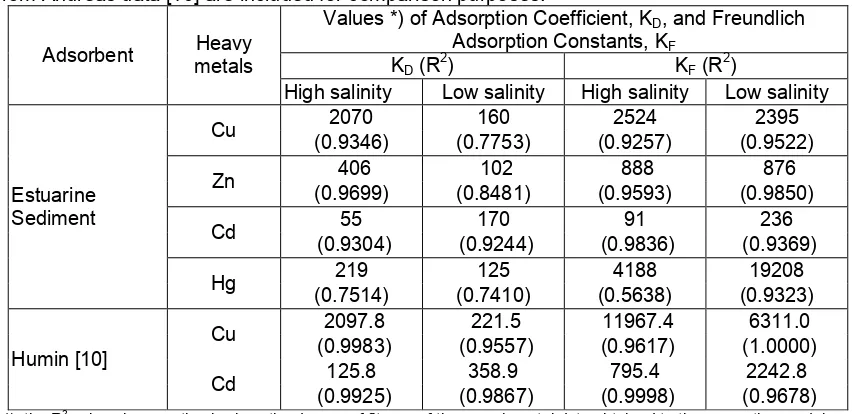
Table 2 presents the KD’s values obtained in this experiments, showing that except for Cd, the KD‘s values for Cu, Zn, and Hg increase as the water medium salinity increases. Similar results have also been reported for highly contaminated and organic-rich sediments of Gulf of Cádiz, Spain [7], and of Mersey Estuary, United Kingdom [9]
The heavy metal species present in the system are dominated by species of relatively high stability constants for their complex formation. Due to their small in size, Cu and Zn are often classified as hard acceptors, which are electronically difficult to be polarized. Consequently, they prefer to form
complexes with hard donors, such as donors containing oxygen, hydroxides, OH-, hydroxyls, -OH, and carboxyls, -COOH. On the other hand, Cd and Hg, which are categorized as soft acceptors (electronically easily polarized), tend to form stable complexes with soft donors, such as chlorides, Cl -and iodides, I-[10].
As shown in table 1, the stability constant of Cu and Zn for complex formation with fulvic acid (4 < log < 10 and 2 < log < 5, respectively) are much higher than that for chlorocomplex species of CuCl+ (log = 0.5) and ZnCl+ (log = 0.4). Therefore, in estuarine ecosystem, most of Cu and Zn species are found as complex with organic matters. Considering the positively charged species of CuCl+ and of ZnCl+, are adsorbed onto the negatively charged adsorption sites of the sediments, increases the Cu and Zn bonded to the sediments.
Table 1 Values of stability (formation) constant for the formation of chloro (Cl) and fulvic acid (FA) complexes [10] and of solubility of the dichloride salts of the heavy metals studied in water and in other solvents [17].
Formation constant (log) Solubility of MCl2(g/100 mL) Heavy Metal
Cations MCl+ MCl2 MCl3- MCl42- M-FA Water Other Solvents
Cu2+ 0.5 - - - 4 - 10 70 Soluble in acetone
Zn2+ 0.4 0.2 - - 2 - 5 432 Very soluble in ether
Cd2+ 2.0 2.6 2.4 1.7 3 - 6 140 Insoluble in acetone
Hg2+ 7.2 14 15.1 15.4 5 - 20 7 4 (in ether)
Table 2 Values of adsorption coefficient, KD, and Freundlich adsorption constants, KF, of heavy metals on estuarine sediment in waters of different salinities. Similar values for humin calculated from Andreas data [10] are included for comparison purposes.
Values *) of Adsorption Coefficient, KD, and Freundlich Adsorption Constants, KF
KD(R 2
) KF(R
2 ) Adsorbent Heavy
metals
High salinity Low salinity High salinity Low salinity
2070 160 2524 2395
Cu
(0.9346) (0.7753) (0.9257) (0.9522)
406 102 888 876
Zn
(0.9699) (0.8481) (0.9593) (0.9850)
55 170 91 236
Cd
(0.9304) (0.9244) (0.9836) (0.9369)
219 125 4188 19208
Estuarine Sediment
Hg
(0.7514) (0.7410) (0.5638) (0.9323)
2097.8 221.5 11967.4 6311.0
Cu
(0.9983) (0.9557) (0.9617) (1.0000)
125.8 358.9 795.4 2242.8
Humin [10]
Cd
(0.9925) (0.9867) (0.9998) (0.9678) *): the R2values in parenthesis show the degree of fitness of the experimental data obtained to the respective models
It should be noted that increasing the salinity of the water medium would decreased the net negative charge of the macromolecular suspended particles, causing co-precipitation of the dissolved CuCl+and ZnCl+. These phenomena probably explain the increase of KD‘s values for Cu and Cd observed in Table 2. It seems justified to state that the decrease in concentration of the water-soluble Cu and Zn chlorocomplexes in medium of higher salinity, are due to the increase of activity coefficient in water phase. This is also confirmed by the increase in the values the Freundlich adsorption coefficients, KF, in systems with higher salinity.
A completely different phenomenon was observed for soft species of Cd and Hg. Considering the stability constants for CdCl2 and CdCl+ (with the respective log of 2.6 and 2.0), which are quite similar to that of fulvic acid (3 < log
< 6), chloro-complex species tend to dominate of Cd species in medium of high salinity, since Cl- is one of the major constituent of seawater. Moreover, due to the higher water solubility of CdCl2(140 g/100 mL), increases Cd cation in water medium of higher salinity, and a decrease in KD’s values were observed. This is also confirmed by the decrease in the values the Freundlich adsorption coefficients, KF, in systems with higher salinity.
Similarly, HgCl2 and HgCl+ dominate the chlorocomplex spesies of Hg as suggested by their respective stability constant of log = 14.0 and of log = 7.2, which are not much different from Hg-fulvic acid stability constant (5 < log < 20). The higher Hg-chlorocomplexes in water medium with higher salinity, confirmed by the decrease in Freundlich adsorption coefficients, KF, in system with higher salinity (Table 2) due to the decrease in activity coefficient. The relatively low water solubility of HgCl2, i.e. 7g/100 mL (Table 1) seems responsible for the increase in KDfor Hg in medium with higher salinity.
The trend of the influence of salinity toward KD of Cu and Cd observed in these studies are very similar to that obtained by Andreas [11], who studied the influence of salinity on adsorption of Cu and Cd in humin isolated from peat soils. A recalculation based on the Cu and Cd adsorption data for humin-seawater and humin-freshwater systems reported by Andreas [11], showed that the KD’s values of Cu-humin increases with increasing the medium salinity in, while KD’s values of Cd-humin decreases as the salinity of the medium increases.
Moreover, experiments on sequential extraction of Cu adsorbed on humin in a humin-seawater system revealed that the increase of Cu was due to the significant increase in the Cu adsorbed on humin through co-precipitation, cation exchange, and hydrogen bonding mechanisms. Similar experiments also confirm that the decrease of Cd adsorbed on humin was due to the significant decrease in the contribution of complexation and cation exchange mechanisms during the Cd adsorption.
Since nearly all of the adsorbed Cu and Cd were recovered completely by sequential extraction, the heavy metals adsorbed on humin are responsible for the exchangable cation in the sediments. It seems justified to conclude that the exchangable heavy metal in sediment is mostly associated with organic matters. This conclusion was supported by the FTIR data [11], suggesting the negatively charged adsorption sites of -COO- and
-O-were involved in Cu and Cd adsorption.
Heavy metal desorption from enriched sediment with clean water medium
Desorption of heavy metal from sediments to the overlaying waters depend on the relative importance of the two counter-active processes [12]: (i) desorption due to complexation with ligands in water medium and/or competition for adsorption sites with other cations, and (ii) coagulation, precipitation and flocculation.
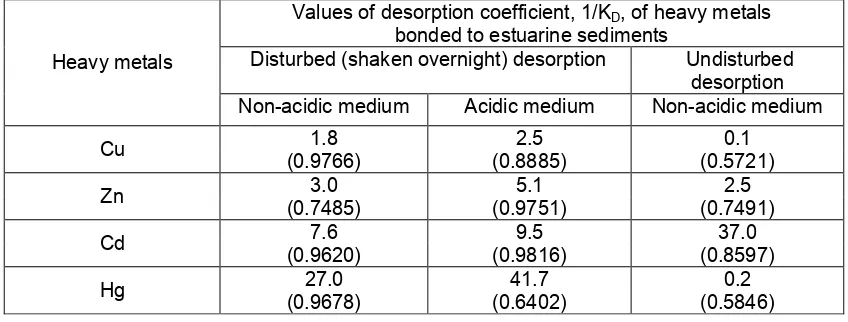
In this study, although relatively high concentration of chloride ions, Cl-, as ligands present in seawater medium, only part of the enriched Cu and Zn are transferred into the overlaying water, resulting in smaller 1/KD. Under the same condition, more Cd and Hg are transferred into the overlaying water were observed, resulting in higher equilibrium coefficient for desorption, 1/KD. These differences indicate that sediment bonded Cd and Hg are more electrostatically attracted to seawater ions in the water medium than Cu and Zn.
the exchangable heavy metal cations in sediment are associated with the pH-dependent charge complex-forming ligands of the organic matters.
The effect of acidification on the solubilization of sorbed heavy metal from enriched sediment
It was observed in the previous experiments of the present study and other work reported earlier [7,11], the exchangable heavy metal cations are associated with the pH-dependent charge complex-forming ligands of the organic matter in the sediment. For that reason, acidification increases the solubilization of these cations [7]. Data in Table 3 confirm that acidification of the system increases the equilibrium coefficient for desorption, 1/KD for all of the heavy metals studied. From environmental point of view, it is important to be realized that sediment is functioning not only as scavenger for dissolved heavy metals, but also serves as an important source for heavy metal in aquatic ecosystems.
In this work, it was observed that Cu was the strongest bond to the sediment (expressed by the lowest 1/KDvalue) in both neutral (pH 7) and acidic medium, followed by Zn, Cd and Hg (Table 3). This order of the strength of heavy metal-sediment bonding indicated that interaction of heavy metal with estuarine sediment was due to electrostatic interaction as suggested by McBride [cited from13], who believes that if metal sorption is governed only by electrostatic interaction, then the strongest bond should be formed by the metal cations having the greatest charge to radius, Z/r, ratio, giving an order of bonding preferences of Cu > Zn > Cd > Hg.
Heavy metal solubilization from enriched sediment under undisturbed condition
In the previous experiments, in order to obtain a maximum solubilization of heavy metal from the sediment, the vessels were shaken overnight. Certainly, this practice would accelerate desorption, partitioning, bacterial degradation, and oxidation of organic matter due to the changes in the chemical properties of the sediment. In natural field condition, it is not realistic, since only top layer sediment would interact with the overlying water. For that reason, a long term (28 days) desorption experiments were carried out for undisturbed system. As expected, except for Cd (Table 3), the desorption equilibrium coefficients, 1/KD values obtained were generally lower than that found previously. At present, the cause of this discrepancy still can not be elucidated.
There is a possibility that 28 days incubation of freshly collected sediment may promote the microbial transformations, such as transformation of Hg2+ into the hydrophobic species of CH3HgCl and/or (CH3)2Hg, which are accumulated in lipophylic tissues of aquatic organisms. Therefore, the bioavailabilities of the heavy metals are not only related to the hydrophylic species extractable with seawater-aqua (1:1), but also to the hydrophobic species, which could be extracted with low polarity organic solvents. Although, a mixture of acetone-hexane (1:1) was selected to cover a wide range of solvent polarity listed in Table 1. From the obtained result, it was observed that hardly any significant increase of the hydrophobic species concentration during the 28 days of incubation.
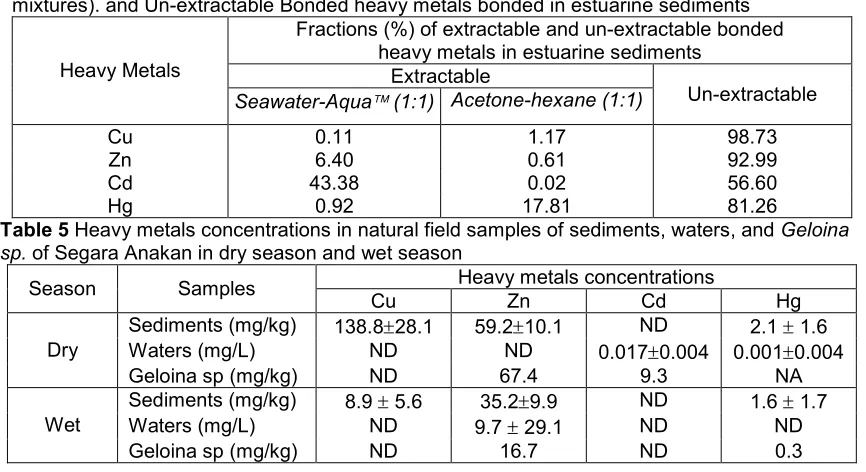
The percentages of the extracted and the unextracted fractions of heavy metals obtained are presented in Table 4.
Table 3Values of desorption coefficient, 1/KD, of heavy metals bonded to estuarine sediments into medium of seawater-aqua (1:1) mixture at two different desorption (disturbed and undisturbed) conditions.
Values of desorption coefficient, 1/KD, of heavy metals bonded to estuarine sediments
Disturbed (shaken overnight) desorption Undisturbed desorption Heavy metals
Non-acidic medium Acidic medium Non-acidic medium
1.8 2.5 0.1
Cu
(0.9766) (0.8885) (0.5721)
3.0 5.1 2.5
Zn
(0.7485) (0.9751) (0.7491)
7.6 9.5 37.0
Cd
(0.9620) (0.9816) (0.8597)
27.0 41.7 0.2
Hg
Table 4 Fractions of Extractable (into seawater-Aqua and the subsequent acetone-hexane mixtures). and Un-extractable Bonded heavy metals bonded in estuarine sediments
Fractions (%) of extractable and un-extractable bonded heavy metals in estuarine sediments
Extractable Heavy Metals
Seawater-Aqua(1:1) Acetone-hexane (1:1) Un-extractable
Cu 0.11 1.17 98.73
Zn 6.40 0.61 92.99
Cd 43.38 0.02 56.60
Hg 0.92 17.81 81.26
Table 5Heavy metals concentrations in natural field samples of sediments, waters, andGeloina sp.of Segara Anakan in dry season and wet season
Heavy metals concentrations
Season Samples
Cu Zn Cd Hg
Sediments (mg/kg) 138.828.1 59.210.1 ND 2.11.6
Waters (mg/L) ND ND 0.0170.004 0.0010.004
Dry
Geloina sp (mg/kg) ND 67.4 9.3 NA
Sediments (mg/kg) 8.95.6 35.29.9 ND 1.61.7
Waters (mg/L) ND 9.729.1 ND ND
Wet
Geloina sp (mg/kg) ND 16.7 ND 0.3
The cumulative extracted fraction (both hydrophylic and hydrophobic species) is considered as the available heavy metals, and the unextracted fraction is considered as the unavailable heavy metals. The data show that except for Cd, the available (extracted) heavy metals are very low (less than 1%). Similar results were also reported Surija and Branica [14] and Jones and Turki [15], who found that in estuarine ecosystems, except for Cd, which is dominated by hydrophylic species, the hydrophobic species of heavy metals are generally higher than the hydrophylic species. In the present study it was observed that the hydrophobic species of Hg was 200 times higher than that of the hydrophylic species. Even though if it is compared to the total heavy metal presents in sediment, the hydrophobic species were very low, their presence in aquatic environment raised the awareness to the risk posted by toxic heavy metal contamination, due to the possible bioaccumulation in aquatic organisms, which in the long term affected the local consumer communities [16].
Evaluation of Heavy Metal Monitoring Data in Segara Anakan (2003-2004)
Table 5 present monitoring data of heavy metals in Segara Anakan estuary, carried out in the dry season period of 2003 and the wet season of 2004. During the work, the salinity levels of the water medium were 25‰ and 3‰ in dry season and wet season, respectively. The data show a consistent trend in the heavy metal concentrations. The concentrations, decrease in the sediment, and
increase in the overlaying water from the dry season to the wet season. This trend follows exactly the trend of the adsorption equilibrium coefficient obtained previously presented in Table 2.
In the dry season, except for Cd, which was not detected, the concentrations of Cu, Zn, and Hg found in the sediment were higher than that in the wet season. During the dry season, only Cd and Hg were detected in water medium, due to the relatively high availability of chloride ions in seawater, responsible for the formation of their chlorocomplexes. In the wet season, only Zn was detected in water medium due to the high content of organic matters (as shown by the high BOD values), responsible for the formation of its organocomplex.
The trend of heavy metal concentrations in the overlaying waters followed directly the coefficients of the desorption equilibrium of the heavy metals obtained in experiments of undisturbed condition (Table 4). The highest desorption was observed for Cd followed by Zn, Hg and Cu. In the dry season, even though no Cd was detected in sediment, due to the high concentration of Cl- ligand present in the overlaying water, Cd was detected in water medium. Consistently, in the wet season, no Cd was detected in sediment and water medium, due to the lack of Cl -ligand present in water.
The bioavailability of heavy metals in Segara Anakan estuarine ecosystem was monitored utilizing
uptake was observed, even though Cu concentration in sediment was relatively high. It is interesting to recognize that Zn concentration in
Geloina sp. is a good measure of Zn concentration in the sediments, while Cd and Hg concentrations are reflected the Cd and Hg concentration in water medium.
From this study, it is clear that, limit values for heavy metal concentrations should be based on exposure-effect assessment. Since the exposure of heavy metals are not solely from dissolved heavy metal, it is recommended that the assessment should include both the surface waters and the newly formed related sediment (top 5-10 cm layers). Consequently, limit values of heavy metal should be established not only for surface water, but also established for the sediment.
CONCLUSION
1. In estuarine ecosystems, sediments are not only functioning as heavy metal scavenger, but also as one of potential sources for heavy metals to the system. Therefore assessment of limit values for heavy metals should include both the surface waters and the newly formed related sediments.
2. Heavy metal sorption-desorption study in simulated estuarine ecosystem revealed that Cu and Zn cations prefer in forming organocomplex, while Cd and Hg cations prefer in forming chlorocomplex. Therefore Hg and Cd concentration in water increases with the salinity of the medium, but Cu and Zn are more retained in the sediment. These exchangeable heavy metal are cations associated to the pH dependent charge complex-forming ligands in the solid surfaces, therefore acidification of the system releases more heavy metal from the sediment. Together with the dissolves heavy metal, the exchangeable heavy metal are considered as available heavy metal.
3. The behaviour of heavy metals in natural field condition of Segara Anakan estuary are in excellent agreement with the obtained result from simulated estuarine ecosystem, i.e., Cd and Hg concentration in water were higher in dry season, while higher Zn concentration in water was obtained in wet season. Even though Cu concentration in sediment was high, Cu was not detected in water, neither in dry season nor in wet season.
4. Due to heavy metal accumulation in its edible part,Geloinasp. can be used as biomonitor for dissolved Cd and Hg, and Zn in sediment. Generally, the heavy metal concentration in
Geloina sp. were higher in dry season than in wet season.
ACKNOWLEDGEMENT
Thanks are due to Dr. Narsito, professor in inorganic chemistry, Department of Chemistry, Gadjah Mada University for his constant encouragement and valuable scientific discussions, Dr. Jurgen Saeger, expert of BCEOM French Consulting Group, for his valuable support, to Setyana W. Lestari, and Sanjayadi for their assisstance in carrying out these works.
REFFERENCES
1. Förstner, U. and Salomons, W. 1991. Mobilization of metals from sediments. In: Merian, E (ed.),Metals and Their Compounds in the Environment, pp. 379–398. VCH, Weinheim.
2. Gümgüm, B. and Öztürk, G.en, 2001,Chemical Speciation and Bioavailability 13(1)
3. Padmala,l D., Maya, K., and Seralathan, P., 1995,Environ Geol31:85–93
4. Simpson, S.L., Rochford, L., and Birch, G.F., 2002,Mar Freshwater Res53:9–17
5. Matagi, S. V., Swai, D., and Mugabe, R., 1998,
Afr. J. Trop. Hydrobiol. Fish. 8: 23-35
6. Zhang, M.K., He, Z.L., Stoffella, P.J., Calvert, D.V., Yang, X., and Sime, P.L. 2003,
Environmental Geology44:1–7,
7. Riba, I., García-Luquea, E., Blascob, J., and DelVallsa, T.A., 2003, Chemical Speciation and Bioavailability, 15(4) 101-114
8. Patrick, W. H., Gambrell, R. P. and Khalid, R. A., 1990, Utrecht Plant Ecology News Report 11,
44-51.
9. Turner A., Martino M., and Le Roux S.M., 2002,
Environ Sci Technol. 36 (21): 4578-84.
10. Schnoor, J.L., 1996, Environmental Modelling, Fate and transport of Pollutans in Water, Air and Soil,John Willey & Sons, Singapore, p 381-424 11. Andreas, R., 2005,Adsorption Characteristics of
Copper (II) and Cadmium (II) on Humin in fresh water medium and seawater medium, Thesis, Graduate Program, GMU
12. Chapman, P.M. and Wang, F., 2001 Environ. Toxicol. Chem., 20, 3–22.
13. Gomes, P.C., Fontes, M.P.F., da Silva, A.G., Mendonca, E de S.,and Netto, A.R., 2001, Soil Sci. Soc. Am. J.65,1115–1121
14. Surija, B., and Branica, M., 1995, Sci Total Environ170:101–118
15. Jones, B., and Turki, A., 1997, Mar Pollut Bull
34:768–779
16. Noegrohati, S., 2005, Indo.J.Chem. 5,. 2, 135-142