J. Biol. Indon. Vol 7, No.1 (2011)
Vol. 7, No. 1 Juni 2011 Akreditasi: No 816/D/08/2009 BOGOR, INDONESIA
JURNAL
BIOLOGI
INDONESIA
ISSN 0854-4425
JURNAL
BIOLOGI
INDONESIA
ISSN 0854-4425
Phylogenetic relationships within Cockatoos (Aves: Psittaciformes) Based on DNA Sequences of The Seventh intron of Nuclear β-fibrinogen gene
Dwi Astuti
1
Forest Condition Analysis Based on Forest Canopy ClosureWith Remote Sensing Approach
Mahendra Primajati, Agung Budi Harto & Endah Sulistyawati
13
Genetic Variation of Agathis loranthifolia Salisb. in West Jawa Assessed by RAPD
Tedi Yunanto, Edje Djamhuri, Iskandar Z. Siregar, & Mariyana Ulfah
25
Bird Community Structure in Karimunjawa Islands, Central Jawa
Niarsi Merry Hemelda, Ummi Syifa Khusnuzon, & Putri Sandy Pangestu
35
Morfologi Larva dan Pola Infeksi Falcaustra kutcheri Bursey et.al., 2000 (Nematoda : Cosmocercoidea: Kathalaniidae) Pada Leucocephalon yuwonoi (McCord et.al., 1995) Di Sulawesi Tengah, Indonesia
Endang Purwaningsih & Awal Riyanto
45
Tingkat Eksploitasi Ikan Endemik Bonti-bonti (Paratherina striata) di Danau Towuti
Syahroma Husni Nasution
53
Bentuk Sel Epidermis, Tipe dan Indeks Stomata 5 Genotipe Kedelai pada Tingkat Naungan Berbeda
Titik Sundari & Rahmat Priya Atmaja
67
Sintesis Alkil N-asetilglukosamina (Alkil-GlcNAc) dengan Enzim N-asetilheksosaminidase yang diisolasi dari Aspergillus sp. 501
Iwan Saskiawan & Rini Handayani
J. Biol. Indon. Vol 7, No. 1 (2011)
Jurnal Biologi Indonesia diterbitkan oleh Perhimpunan Biologi Indonesia.
Jurnal ini memuat hasil penelitian ataupun kajian yang berkaitan dengan masalah biologi yang diterbitkan secara berkala dua kali setahun (Juni dan Desember).
Editor Pengelola
Dr. Ibnu Maryanto Dr. I Made Sudiana Deby Arifiani, S.P., M.Sc
Dr. Izu Andry Fijridiyanto
Dewan Editor Ilmiah
Dr. Abinawanto, F MIPA UI Dr. Achmad Farajalah, FMIPA IPB
Dr. Ambariyanto, F. Perikanan dan Kelautan UNDIP Dr. Aswin Usup F. Pertanian Universitas Palangkaraya Dr. Didik Widiyatmoko, PK Tumbuhan, Kebun Raya Cibodas-LIPI
Dr. Dwi Nugroho Wibowo, F. Biologi UNSOED Dr. Parikesit, F. MIPA UNPAD
Prof. Dr. Mohd.Tajuddin Abdullah, Universiti Malaysia Sarawak Malaysia Assoc. Prof. Monica Suleiman, Universiti Malaysia Sabah, Malaysia
Dr. Srihadi Agungpriyono, PAVet(K), F. Kedokteran Hewan IPB Y. Surjadi MSc, Pusat Penelitian ICABIOGRAD
Drs. Suharjono, Pusat Penelitian Biologi-LIPI Dr. Tri Widianto, Pusat Penelitian Limnologi-LIPI
Dr. Witjaksono Pusat Penelitian Biologi-LIPI
Alamat Redaksi
Sekretariat
d/a Pusat Penelitian Biologi - LIPI
Jl. Ir. H. Juanda No. 18, Bogor 16002 , Telp. (021) 8765056 Fax. (021) 8765068
Email : [email protected]; [email protected] Website : http://biologi.or.id
Jurnal ini telah diakreditasi ulang dengan nilai A berdasarkan SK Kepala LIPI 816/ D/2009 tanggal 28 Agustus 2009.
J. Biol. Indon. Vol 7, No.1 (2011)
KATA PENGANTAR
Jurnal Biologi Indonesia yang diterbitkan oleh PERHIMPUNAN BIOLOGI INDONESIA edisi volume 7 nomer 1 tahun 2011 memuat 15 artikel lengkap dan 1artikel tulisan pendek, empat artikeldiantaranya telah dipresentasi pada seminar ATCBC di bali 2010. Penulis pada edisi ini sangat beragam yaitu dari Departemen Kementerian Pertanian Balai Penelitian Tanaman Kacang-kacangan dan Umbi-umbian, Fak. MIPA-Biologi Universitas Negeri Malang, Universitas Cenderawasih Jayapura, Universitas Islam Negeri Hidayatulah Jakarta, Jurusan Biologi FMIPA IPB, Program Studi Sarjana Biologi, Sekolah Ilmu dan Teknologi Hayati (SITH), ITB, Jurusan Konservasi Fakultas Kehutanan IPB, Puslit Biologi LIPI, Departmen Biologi FMIPA, University Indonesia, Puslit Limnologi LIPI-LIPI, Puslit Biologi-LIPI dan UPT Loka Konservasi Biota Laut Biak-LIPI. Topik yang dibahas pada edisi ini meliputi bidang Botani, mikrobiologi, zoologi, remote sensing.
J. Biol. Indon. Vol 7, No. 1 (2011)
UCAPAN TERIMA KASIH
Jurnal Biologi Indonesia mengucapkan terima kasih dan penghargaan kepada
para pakar yang telah turut sebagai penelaah dalam Volume 7, No 1, Juni 2011: Dr. Niken T. M. Pratiwi, Fakultas Perikanan dan Ilmu Kelautan IPB
Dr. Tike Sartika, Balitnak, Departemen Pertanian, Ciawi Sigit Wiantoro SSi, MSc, Puslit Biologi-LIPI
Drs. Awal Riyanto, Puslit Biologi-LIPI Drs. Roemantyo, Puslit Biologi-LIPI Dr. Andria Agusta, Puslit Biologi LIPI Ir. Titi Juhaeti MSi, Puslit Biologi-LIPI Dr. Nuril Hidayati, Puslit Biologi-LIPI Ir. Heryanto MSc, Puslit Biologi-LIPI
Drh. Taufik Purna Nugraha MSi, Puslit Biologi-LIPI
J. Biol. Indon. Vol 7, No.1 (2011)
DAFTAR ISI
Phylogenetic relationships within Cockatoos (Aves: Psittaciformes) Based on DNA Sequences of The Seventh intron of Nuclear β-fibrinogen gene
Dwi Astuti
1
Forest Condition Analysis Based on Forest Canopy ClosureWith Remote Sensing Approach
Mahendra Primajati, Agung Budi Harto & Endah Sulistyawati
13
Genetic Variation of Agathis loranthifolia Salisb. in West Jawa Assessed by RAPD
Tedi Yunanto, Edje Djamhuri, Iskandar Z. Siregar, & Mariyana Ulfah
25
Bird Community Structure in Karimunjawa Islands, Central Jawa
Niarsi Merry Hemelda, Ummi Syifa Khusnuzon, & Putri Sandy Pangestu
35
Morfologi Larva dan Pola Infeksi Falcaustra kutcheri Bursey et.al., 2000 (Nematoda : Cosmocercoidea: Kathalaniidae) Pada Leucocephalon yuwonoi (McCord et.al., 1995) Di Sulawesi Tengah, Indonesia
Endang Purwaningsih & Awal Riyanto
45
Tingkat Eksploitasi Ikan Endemik Bonti-bonti (Paratherina striata) di Danau Towuti
Syahroma Husni Nasution
53
Bentuk Sel Epidermis, Tipe dan Indeks Stomata 5 Genotipe Kedelai pada Tingkat Naungan Berbeda
Titik Sundari & Rahmat Priya Atmaja
67
Sintesis Alkil N-asetilglukosamina (Alkil-GlcNAc) dengan Enzim N-asetilheksosaminidase yang diisolasi dari Aspergillus sp. 501
Iwan Saskiawan & Rini Handayani
81
Eritrosit dan Hemoglobin pada Kelelawar Gua di Kawasan Karst Gombong, Kebumen,Jawa Tengah
Fahma Wijayanti, Dedy Duryadi Solihin, Hadi Sukadi Alikodra, & Ibnu Maryanto
89
Kajian Hubungan Antara Fitoplankton dengan Kecepatan Arus Air Akibat Operasi Waduk Jatiluhur
Eko Harsono
99
Dimorfisme Seksual, Reproduksi dan Mangsa Kadal Ekor Panjang Takydromus sexlineatus Daudin, 1802 (Lacertilia :Lacertidae)
Mumpuni
121
Serapan Karbondioksida (CO2) Jenis-Jenis Pohon di Taman Buah "Mekar Sari" Bogor, Kaitannya dengan Potensi Mitigasi Gas Rumah Kaca
N. Hidayati, M. Reza, T. Juhaeti & M. Mansur
J. Biol. Indon. Vol 7, No. 1 (2011)
Analisis Fekunditas dan Diameter Telur Kerang Darah (Anadara antiquata) di Perairan Pulau Auki, Kepulauan Padaido, Biak, Papua
Andriani Widyastuti
147
Giving Formulated Pellet on Javan Porcupine (Hystrix javanica F. Cuvier, 1823): Effects on Feed Intake, Feed Conversion, and Digestibility in Pre-Domestication Condition
Wartika Rosa Farida & Roni Ridwan
157
Profil Mamalia Kecil Gunung Slamet Jawa Tengah
Maharadatunkamsi
171
TULISAN PENDEK
Kondisi Parameter Biologi Plankton dan Ikan di Perairan Danau Sentani
Auldry F. Walukow
35 Jurnal Biologi Indonesia 7(1): 35-43 (2011)
Bird Community Structure in Karimunjawa Islands, Central Jawa
Niarsi Merry Hemelda, Ummi Syifa Khusnuzon, & Putri Sandy PangestuCOMATA Wildlife Study Group, Department of Biology University of Indonesia, Depok 16424, Email: [email protected]
ABSTRAK
Struktur Komunitas Burung di Kepulauan Karimunjawa Jawa Tengah. Karimunjawa sebagai
salah satu taman nasional yang memiliki berbagai macam tipe habitat dengan tingginya keragaman jenis burung yang ada. Penelitian kesamaan keragaman jenis burung telah dilakukan di area di hutan Legon Lele, Nyamplungan,kawasan pemukiman pedesaan Karimunjawa dan Legon Lele, kawasan kolam Cikemas dan Jatikerep, dan kawasan pantai Terusan, semua pendataan tersebut di lakukan di bulan Agustus 2009. Menggunakan metode titik telah terdata ada39 jenis burung ditemukan dikawasan tersebut. Indeks keragaman jens Shanon
untuk masing-masing lokasi seperti pemukiman Legon Lele (H’=2.33), pantai Terusan (H’=2.31), kolam Jatikerep (H’=2.28), kolam Cikemas (H’=2.07), hutan Legon Lele (H’=1.81), pemukiman Karimunjawa (H’=1.75), dan hutan Nyamplungan (H’=1.65).
Kata kunci: Habitat, burung, Karimunjawa.
INTRODUCTION
Karimunjawa island is one of con-servation areas in Karimunjawa National Park with high diversity of bird species. According to the previous researches, there are about 115 bird species in Karimunjawa Archipelago National Park area (Department of Forestry 2007). Karimunjawa island has many types of habitat such as settlements, forests, fish-ponds, and coastal area. Each habitat has unique characteristics and high diversity of bird species.
Research in bird community structure of a habitat is important to do because birds have important role as bioindicator in environmental changes. In addition, the presence of bird species is
determined by the presence of particular plant species as food resource, nesting area, and refuge area (Ewusie 1990). Therefore, the community structure of bird species in an area can describe the whole condition of that community. The purpose of this study was to analyze the bird community structure including the composition, abundance, and species di-versity. By analyzing the bird community structure, the indicator species from an area can be identified. Hence, the result of this study can be an evaluation data for sustainability management of Karimunjawa National Park.
MATERIALS AND METHODS
36
Hemelda et.al.
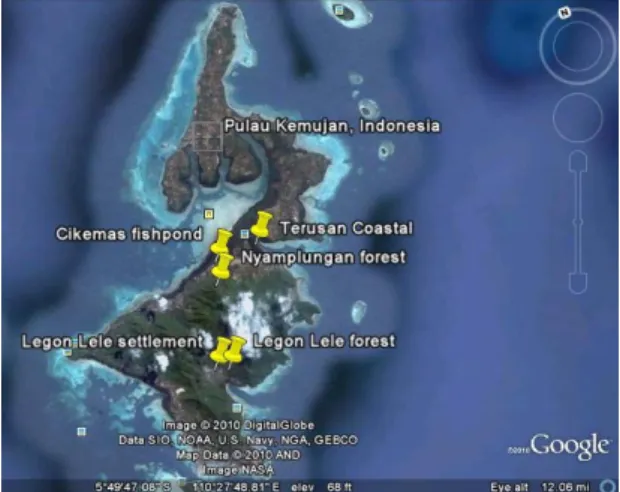
Karimunjawa island, West Java (Figure 1). Karimunjawa Archipelago National Park has 5 different ecosystems, includ-ing tropical forest ecosystem and man-grove ecosystem (Department of For-estry 2007). The research site was di-vided into seven locations from four types of habitat. Legon lele forest and Nyamplungan forest were categorized as forest habitat, Karimunjawa village settle-ment and Legon Lele settlesettle-ment were categorized as settlement habitat, Cikemas fishpond and Jatikerep fishpond were categorized as fishpond habitat, and Terusan coastal was categorized as coastal habitat.
Canopy covering the location is caused by the presence of trees with wide diameter. In addition, many shrubs found between the trees in the location. There are also many plants that produce fruits and seeds found in that location. A stream with slow water flow supports the water supply for trees and shrubs.
Nyamplungan forest has less den-sity of vegetation compared with Legon Lele forest. The forest floor is covered by shrubs and canopy from the wide-di-ameter trees. There is also farming ac-tivity near the forest.
Legon Lele settlement is a settle-ment which located near the Legon Lele forest. Most of the villagers in that loca-tion occupy as rice farmers and work in rice fields near the settlement. Palm tree, Cocos nucifera, often found near the rice fields and Legon Lele forest. In con-trast, far from the rice fields Anacardium occidentale, as first commodity of Karimunjawa island, found within the settlement. Beside Cocos nucifera and
Anacardium occidentale, many species of plant that produce fruits and seeds also found along the settlement.
Karimunjawa village settlement is a more crowded settlement compared with Legon Lele settlement. Karimunjawa vil-lage settlement is located near the beach. Most of villagers plant some productive plants in their yards, such as Mangifera indica, Psidium guajava, and Schizi-gium aquea.
Cikemas fishpond is a fishpond area that had been abandoned. Sedimentation process occurred in that fishpond so that the fishpond became narrower. Many shrubs that produce small seeds like Penicetum sp. grow surrounding the fishpond.Many Anacardium occidentale trees were also foundnear the fish pond. Jatikerep fishpond is an active and well-managed fishpond. Near the fish-pond, many fruit-producing trees can be easily found. In contrast, just a small clus-ter of shrubs can be found because the fishpond owner cut it.
Terusan coastal is located between Karimunjawa island and Kemujan island. Mangrove ecosystem with high density of mangrove vegetation is found in that area. The mangrove trees produce fruits and their root system supply refuge ar-eas for small crustacean, fish, and gas-tropods.
Point count method is used for col-lecting data. The observer is standing and observe during certain time and identify the bird species both visually and vocally (Bibby et. al.1992). According to Bibby et.al. 1992, point count method can be used to explain bird community condition based on the habitat type. Point samples
37 Bird Community Structure in Karimunjawa
were determined by route in the seven locations. From one point to the nearest point took 150 m distance for closed habi-tat (forest, settlement, and fishpond area), but 250 m distance for opened habitat (coastal area). Each point took 10 min-utes duration for collecting the data. Data collections was carried out for 3 days from 07.00 WIB until 10.00 WIB and contin-ued at 16.30 WIB until 18.00 WIB. Fol-lowing Aynalem & Bekele (2008), in that time, the activities of birds were promi-nent. Data collections included species and total individuals of birds that could be identified visually and vocally. Field guide books were used to identify birds visually (MacKinnon et. al., 1992). Other equipments that used for collecting data were Bushnell 10 x 50 binoculars, Kowa TSH-601 20x zoom monocular, and Nikon Coolpix L14 digital camera.
The data that had been collected was analyzed for determining species rich-ness, species diversity, and habitat simi-larity. Species richness is defined as total bird species that had been met in a
habi-tat. Shannon-Wiener Index (H') was used to evaluate bird species diversity in each habitat. Evenness Index was used to ex-plain evenness of total individual of each bird species in one habitat and according to Balen (1986), Evenness Index of un-disturbed habitat is about 0.80-0.87.
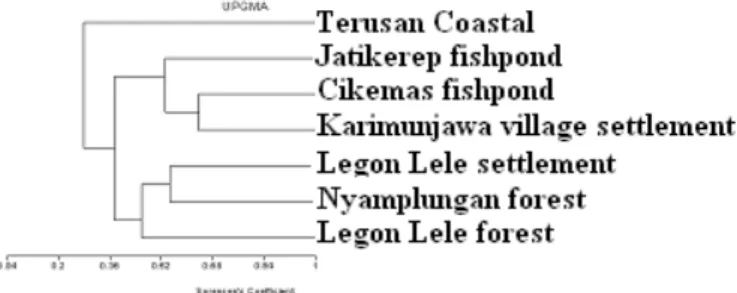
Similarity between locations was analyzed using Sorensen Similarity Index. The result was described in a dendrogram using MVSP (Multivariate Variable Sta-tistical Package) Version 3.13n. The in-dex then was analyzed using UPGMA (Unweighted Pair Group Multivariate Analysis) cluster for measuring the habi-tat similarity.
RESULTS
A total of 39 bird species from 19 families was observed in seven locations during the 3 days observation, 2 species of them are endemic in Java Island (Table 1). They are Dicaeum trochilleum (Sparrman, 1789) dan Lonchura leucogastroides (Horsfield &
38
Hemelda et.al.
Moore, 1858). According to UU No. 5/ 1990 about Natural Resources Conser-vation, several of 39 bird species are pro-tected by government, namely: Egretta sacra (J. F. Gmelin, 1789); Numenius arquata (Linnaeus, 1758); Halcyon chloris Boddaert, 1783; Cinnyris jugularis (Linnaeus, 1766); Pernis ptilorhynchus (Temminck, 1821); Haliaeetus leucogaster (Gmelin, 1788); Numenius minutus Gould, 1841; dan Numenius madagascariensis (Linnaeus, 1766). According to IUCN Redlist (2009), Numenius arquata and Ducula rosacea are listed as Near Threatened species.
Species diversity of birds in seven habitats successively from the highest are Terusan coastal (17 species), Legon Lele settlement (15 species), Cikemas fish-pond (14 species), Jatikerep fishfish-pond (12 species), Legon Lele forest (9 species), Karimunjawa village settlement (8 cies), and Nyamplungan forest (7 spe-cies). Jatikerep fishpond has the highest value of Evenness Index (J), 0.92, whereas Cikemas fishpond has the
low-est one, 0.78.
Species of bird which has the high-est values of relative species abundance (Pi) in Legon Lele forest, Legon Lele settlement, Cikemas fishpond, Nyam-plungan forest, Karimunjawa village settlement, and Terusan coastal succes-sively Orthotomus ruficeps (Lesson, 1830) (Pi=0.2766); Lonchura leucogas-troides (Pi=0.2381); Lonchura punctu-lata (Linnaeus, 1758) (Pi=0.3443); Pycnonotus goiavier (Scopoli, 1786) (Pi=0.4211); Pycnonotus goiavier (Pi=0.3281), and Numenius arquata (Linnaeus, 1758). In Jatikerep fishpond, there are 3 species that have high value of relative species abundance (Pi=0.1667), namely Halcyon chloris Boddaert, 1783; Zosterops palpebrosus (Temminck, 1821); and Lonchura leucogastroides.
Diversity of bird species in each lo-cation was analyzed using Shannon-Wiener diversity index. The locations that have the highest values of bird species diversity index (H') successively are Legon Lele settlement (H'=2.33),
39 Bird Community Structure in Karimunjawa
Table 1. Species relative Abundance in Karimunjawa Island.
HLL HN PDK PLL TC TJ PT Scolopidae Actitis hypoleucos 0 0 0 0 0 0.033 0.032 Heteroscelus brevipes 0 0 0 0 0 0 0.016 Numenius madagascariensis 0 0 0 0 0 0 0.048 Numenius minutes 0 0 0 0 0 0 0.016 Numenius arquata 0 0 0 0 0 0 0.242 Tringa tetanus 0 0 0 0 0 0 0.016 Anatidae Anas gibberifrons 0 0 0 0 0 0 0.032 Sturnidae Acridotheres javanicus 0.021 0 0 0 0 0 0 Acanthizidae Gerygone sulphurea 0 0 0 0 0 0.033 0.016 Ploceidae Passer montanus 0 0 0.047 0 0 0 0 Estrildidae Lonchura punctulata 0 0 0 0 0.344 0 0 Lonchura leucogastroides 0.105 0.238 0.167 Artamidae Artamus leucorynchus 0 0 0 0.048 0 0 0.032 Pycnonotidae Pycnonotus goiavier 0.255 0.421 0.328 0.214 0.066 0.1 0 Pycnonotus aurigaster 0 0 0 0.024 0 0 0 Dicaeidae Dicaeum trochilleum 0 0 0.219 0 0.033 0.067 0 Sylviidae Orthotomus ruficeps 0.277 0.158 0 0.048 0.033 0 0 Orthotomus sutorius 0.064 0 0 0 0.016 0 0 Muscicapidae Muscicapa dauurica 0 0.053 0 0 0 0 0 Muscicapa sibirica 0 0 0 0 0 0.1 0 Nectariniidae Anthreptes malacensis 0 0 0.024 0 0 0 Cinnyris jugularis 0 0 0.141 0 0.033 0.067 0 Zosteropidae Zosterops palpebrosus 0.106 0.158 0.156 0.071 0.213 0.167 0.016 Zosterops chloris 0 0 0 0.095 0 0 0 Rallidae Amaurornis phoenicurus 0.043 0 0 0.048 0 0 0
Families and Species
40
Hemelda et.al.
Terusan coastal (H'=2.31), Jatikerep fish-pond (H'=2.28), Cikemas fishfish-pond (H'=2.07), Legon Lele forest (H'=1.81), Karimunjawa village settlement (H'=1.75), and Nyamplungan forest (H'=1.65). Based on observation, Legon Lele settlement is a not-so-crowded settlement with wide area of rice fields.
DISCUSSION
The research site was divided into four type of habitat, namely forest, fish-pond, settlement, and coastal area. We Table 1 (continued)
Notes: HLL: Legon Lele forest; HN: Nyamplungan forest; PDK: Karimunjawa island village
settle-ment; PLL: Legon Lele settlesettle-ment; TC: Cikemas fishpond; TJ: Jatikerep fishpond; Pes: Terusan Coastal.
divided 3 types of habitat (forest, fish-pond, and settlement) into two locations each habitat, but only one location for coastal habitat. Based on the result from Sorensen Similarity Index, the seven lo-cations are grouped into 3 main groups. Group A consists of Legon Lele settle-ment, Nyamplungan forest, and Legon Lele forest. Group B consists of Jatikerep fishpond, Cikemas fishpond, and Karimunjawa village settlement. Group C only consists of Terusan coastal. Lo-cations which are in same group share many similarities and might be have
simi-HLL HN PDK PLL TC TJ PT Apodidae Apus pacificus 0.021 0 0 0 0 0 0 Collocalia linchi 0 0 0.031 0.024 0.016 0.033 0.048 Alcedinidae Halcyon chloris 0 0 0.063 0.024 0.082 0.167 0.145 Ardeidae Egretta sacra 0 0 0 0.024 0 0.033 0.226 Ardea cinerea 0 0 0 0 0.016 0 0 Butorides striatus 0 0 0 0 0.016 0 0.048 Ixobrychus cinnamomeus 0 0 0 0 0 0.033 0 Columbidae Ptilinopus melanospila 0.021 0 0 0 0 0 0 Ducula aenea 0.191 0.053 0.016 0.071 0.082 0 0 Ducula rosacea 0 0 0 0.024 0 0 0.032 Ducula bicolor 0 0 0 0 0.033 0 0 Chalcophaps indica 0 0 0 0 0.016 0 0 Accipitridae Haliaeetus leucogaster 0 0.053 0 0.024 0 0 0.016 Pernis ptilorhynchus 0 0 0 0.016
Families and Species
41 Bird Community Structure in Karimunjawa
also different from other locations. Most of birds that found in there were shore-birds and some of them were migrant birds. Terusan coastal is also the richest area of bird species diversity.
Cikemas fishpond has the lowest value of Evenness Index (J) because the location is rich of species diversity but the abundance of each bird species is uneven. According to Waite (2000), if a habitat or community has less species diversity and each species is distributed unevenly, the value of H' will be low, con-versely.
Cikemas fishpond and Legon Lele settlement share the highest value of Sorensen Similarity Index (Ss=0.636) (Fig. 3). It may be caused the two loca-tions have similar vegetaloca-tions such as palm trees and other fruit-producing trees so that it is possible for same species of birds which have same food resources found in both locations. Terusan coastal and Legon Lele forest share the lowest value of Sorensen Similarity Index (Ss=0.154) because they have different ecosystems and vegetations so the spe-cies of birds found in both locations are different too.
Based on the result, species of bird
Figure 3. Dendrogram of Sorensen Similarity Index lar environmental condition. In addition,
the state of the locations where is near each other, so there is no barrier that ham-per the bird movement from one location to another (Cox & Moore 2005).
In group A, Legon Lele settlement, Nyamplungan forest, and Legon Lele forest are in same group because they share same food resources for birds. Legon Lele settlement and Nyamplungan forest has the highest value of Sorensen Similarity Index (Ss=0.545) in this group. That may be caused both locations are located near the rice fields whereas no rice field in Legon Lele forest.
In group B, Jatikerep fishpond, Cikemas fishpond, and Karimunjawa vil-lage settlement are in same group be-cause they are relatively opened habitat with less density of vegetations compared with group A. In addition, they also share same vegetation of fruit-producing plants. Cikemas fishpond and Karimunjawa vil-lage settlement have the highest value of Sorensen Similarity Index (Ss=0.636).
Group C, Terusan coastal, is signifi-cantly different from other groups. Terusan coastal has unique ecosystem, namely mangrove ecosystem. Species of birds that found in Terusan coastal are
42
Hemelda et.al.
that has the highest value of relative spe-cies abundance is different in each loca-tion. There are several factors that influ-ence the relative abundance of bird spe-cies, such as historical process of that area (speciation and dispersal), climate and climate changes, topography, biotic components (primary productivity), and competition (Huggert 1995).
The highest value of relative abun-dance in Legon Lele settlement might be caused of the diversity of food resources in that location compared with other lo-cations. Rice fields supply microhabitats and food resources for several species of birds, such as Amaurornis phoenicurus (Pennant 1769). Rice field areas, shrubs, and trees near the settlement provide food resources, such as fruits, seeds, nectars, insects, small crustaceans, and fish. Therefore, guilds of bird that were found such as nectarinivores, piscivores, insec-tivores, frugivore, and graminivores.
Result from Evenness Index shows that the values of Evenness Index in seven locations are above 0.8. Value of Even-ness Index of Undisturbed habitat accord-ing to Balen (1986) is about 0.80-0.87. Based on that theory, it can be concluded that the seven locations are relatively undisturbed.
Two of 39 bird species that observed in seven locations were new record spe-cies that have not recorded in Karimunjawa 2007. They are Numenius arquata and Pycnonotus aurigaster. N. arquata is a migrant bird, migrating in winter from North Erasia to the south, Indonesia and Australia (MacKinnon 2000). The category of migrant birds re-fers to bird species that migrate from the
North of Earth to the South in the winter (Sukmantoro et.al. 2007). Winter in Erasia is supposed to be in August until October and the data collection time, August 2009, coincided perfectly with the migration of N. arguata. Pycnonotus aurigaster is a common bird that can be found everywhere, but it is new record in Karimunjawa and it may be an intro-duction species that released by the vil-lagers.
CONCLUSION
Result of this research in Karimunjawa island shows that a total of 39 bird species was observed in seven locations. Legon Lele settlement has the highest value of Shannon-Wiener Diver-sity Index (H'=2.33). Cikemas fishpond and Legon Lele settlement has the high-est value of Sorensen Similarity Index (Ss=0.636). The activities of villager in those locations do not disturb the diver-sity of bird species significantly.
REFERENCES
Aynalem, S. & A. Bekele. 2008. Species composition, relative abundance and distribution of bird fauna of riverine and wetland habitats of Infranz and Yiganda at southern tip of Lake Tana, Ethiopia. Tropical Ecology 49 (2): 199--209.
Balen, B.Van. 1986. Birds of the Botani-cal gardens of Indonesia at Bogor. Berita Biologi 3:167--172.
Bibby, C.J., ND. Burgess & DA. Hill. 1992. Bird census technique. Aca-demic Press, London: xvii + 257
43 Bird Community Structure in Karimunjawa
hlm.
Cox, CB. & PD. Moore. 1993. Bioge-ography: an ecological and evo-lutionary a p p r o a c h . 5 t h e d . Blackwell Science Ltd, London: x + 326 hlm.
Department of Forestry. 2007. Jenis Burung Karimunjawa. Balai Taman Nasional Karimunjawa, Semarang: i + 65 hlm.
Ewusie, JY. 1990. Pengantar ekologi tropika. Bandung: Penerbit ITB Bandung.
Huggett, R.J. 1995. Geoecology: An evo-lutionary approach. Routledge, New York: vii + 320 hlm.
MacKinnon, J., K. Philips & B. Van Balen. 2000. Seri panduan lapangan burung-burung di Sumatera, Jawa, Bali, dan Kalimantan. Puslitbang Biologi-LIPI, Bogor: xviii + 510 hlm. Sukmantoro, W., M. Irham, W. Novarino, F. Hasudungan, N. Kemp & M. Muchtar. 2007. Daftar burung In-donesia no. 2. InIn-donesian Orni-thologists' Union, Bogor: x + 157 hlm.
Waite, S. 2000. Statistical ecology in practice: a guide to analysing envi-ronmental and ecological field data. Prentice Hall, London: xx + 414 hlm.
Memasukkan: Juli 2010 Diterima: Desember 2010
J. Biol. Indon. Vol 7, No.1 (2011)
PANDUAN PENULIS
Naskah dapat ditulis dalam bahasa Indonesia atau bahasa Inggris. Naskah disusun dengan urutan: JUDUL (bahasa Indonesia dan Inggris), NAMA PENULIS (yang disertai dengan alamat Lembaga/ Instansi), ABSTRAK (bahasa Inggris, maksimal 250 kata), KATA KUNCI (maksimal 6 kata), PENDAHULUAN, BAHAN DAN CARA KERJA, HASIL, PEMBAHASAN, UCAPAN TERIMA KASIH (jika diperlukan) dan DAFTAR PUSTAKA.
Naskah diketik dengan spasi ganda pada kertas HVS A4 maksimum 15 halaman termasuk gambar, foto, dan tabel disertai CD. Batas dari tepi kiri 3 cm, kanan, atas, dan bawah masing-masing 2,5 cm dengan program pengolah kata Microsoft Word dan tipe huruf Times New Roman berukuran 12 point. Setiap halaman diberi nomor halaman secara berurutan. Gambar dalam bentuk grafik/diagram harus asli (bukan fotokopi) dan foto (dicetak di kertas licin atau di scan). Gambar dan Tabel di tulis dan ditempatkan di halam terpisah di akhir naskah. Penulisan simbol α, β, χ, dan lain-lain dimasukkan melalui fasilitas insert, tanpa mengubah jenis huruf. Kata dalam bahasa asing dicetak miring. Naskah dikirimkan ke alamat Redaksi sebanyak 3 eksemplar (2 eksemplar tanpa nama dan lembaga penulis).
Penggunaan nama suatu tumbuhan atau hewan dalam bahasa Indonesia/Daerah harus diikuti nama ilmiahnya (cetak miring) beserta Authornya pada pengungkapan pertama kali.
Daftar pustaka ditulis secara abjad menggunakan sistem nama-tahun. Contoh penulisan pustaka acuan sebagai berikut :
Jurnal :
Hara, T., JR. Zhang, & S. Ueda. 1983. Identification of plasmids linked with polyglutamate production in B. subtilis. J. Gen. Apll. Microbiol. 29: 345-354.
Buku :
Chaplin, MF. & C. Bucke. 1990. Enzyme Technology. Cambridge University Press. Cambridge.
Bab dalam Buku :
Gerhart, P. & SW. Drew. 1994. Liquid culture. Dalam : Gerhart, P., R.G.E. Murray, W.A. Wood, & N.R. Krieg (eds.). Methods for General and Molecular Bacteriology. ASM., Washington. 248-277.
Abstrak :
Suryajaya, D. 1982. Perkembangan tanaman polong-polongan utama di Indonesia. Abstrak Pertemuan Ilmiah Mikrobiologi. Jakarta . 15 –18 Oktober 1982. 42.
Prosiding :
Mubarik, NR., A. Suwanto, & MT. Suhartono. 2000. Isolasi dan karakterisasi protease ekstrasellular dari bakteri isolat termofilik ekstrim. Prosiding Seminar nasional Industri Enzim dan Bioteknologi II. Jakarta, 15-16 Februari 2000. 151-158.
Skripsi, Tesis, Disertasi :
Kemala, S. 1987. Pola Pertanian, Industri Perdagangan Kelapa dan Kelapa Sawit di Indonesia.[Disertasi]. Bogor : Institut Pertanian Bogor.
Informasi dari Internet :
Schulze, H. 1999. Detection and Identification of Lories and Pottos in The Wild; Information for surveys/Estimated of population density. http//www.species.net/primates/loris/ lorCp.1.html.
J. Biol. Indon. Vol 7, No. 1 (2011)
Eritrosit dan Hemoglobin pada Kelelawar Gua di Kawasan Karst Gombong, Kebumen,Jawa Tengah
Fahma Wijayanti, Dedy Duryadi Solihin, Hadi Sukadi Alikodra, & Ibnu Maryanto
89
Kajian Hubungan Antara Fitoplankton dengan Kecepatan Arus Air Akibat Operasi Waduk Jatiluhur
Eko Harsono
99
Dimorfisme Seksual, Reproduksi dan Mangsa Kadal Ekor Panjang Takydromus sexlineatus Daudin, 1802 (Lacertilia :Lacertidae)
Mumpuni
121
Serapan Karbondioksida (CO2) Jenis-Jenis Pohon di Taman Buah "Mekar Sari" Bogor, Kaitannya dengan Potensi Mitigasi Gas Rumah Kaca
N. Hidayati, M. Reza, T. Juhaeti & M. Mansur
133
Analisis Fekunditas dan Diameter Telur Kerang Darah (Anadara antiquata) di Perairan Pulau Auki, Kepulauan Padaido, Biak, Papua
Andriani Widyastuti
147
Giving Formulated Pellet on Javan Porcupine (Hystrix javanica F. Cuvier, 1823): Effects on Feed Intake, Feed Conversion, and Digestibility in Pre-Domestication Condition
Wartika Rosa Farida & Roni Ridwan
157
Profil Mamalia Kecil Gunung Slamet Jawa Tengah
Maharadatunkamsi
171
TULISAN PENDEK
Kondisi Parameter Biologi Plankton dan Ikan di Perairan Danau Sentani
Auldry F. Walukow