A Model Checking Approach
to Protocol Conversion
Technical Report
No.0000482
Roopak Sinha, Partha Roop
Department of Electrical and Computer Engineering University of Auckland
and Samik Basu
Department of Computer Science Iowa State University
Iowa State University
Department of Computer Science
November, 2006
c
Abstract
Protocol conversion for mismatched protocols has been addressed in a number of formal and informal settings. However, existing solutions address this problem only partially. This paper develops the first on-the-fly local approach to protocol conversion based on temporal logic model checking. The tableau-based approach verifies the existence of a converter, and if a converter exists, it is automatically synthesized. Our approach handles control and data mismatches under a single unifying framework. A NuSMV-based implementation has been developed and we provide results for some non-trivial protocol mismatch examples.
1
Introduction
A system-on-a-chip (SoC) is built by reusing components connected using a central bus such as AMBA [3]. A major problem with this reuse is the inher-ent mismatch between protocols of components, an active area of research for about two decades [7]. Mismatches occur because components are developed independently without any intention of eventual integration, and can result from control signal mismatches [6], inconsistent naming conventions [11], differ-ent clock speeds and difference in data-widths [3]. Mismatches are corrected, if possible, by synthesizing extra glue-logic, called a converter[10] to control communication between given protocols in order to satisfy given specifications. A number of techniques address the problem of protocol conversion in a wide range of formal and informal settings with varying degrees of automation— projection approach [7], conversion seeds [9] and synchronization [11]. Some approaches, like conversion seeds [9] and protocol projections [7], require signif-icant user expertise and guidance. While this problem has been studied in a number of formal settings [6, 7, 9, 11], only recently have some formal verifica-tion based soluverifica-tions been proposed [3, 5, 10].
In [5], a hybrid simulation/verification approach to protocol conversion in SoC designs is proposed. [10] proposes an approach towards protocol conversion employing a game-theoretic framework to generate a converter. This solution is restricted only to protocols with half-duplex communication between them, with specifications represented as finite state machines. D’Silva et al [3] present syn-chronous protocol automata to allow formal protocol specification and matching, as well as converter synthesis. The technique addresses the problem of limited communication medium capacity, but data-communication between protocols cannot be constrained any further.
Specifications
Converter
P
1P
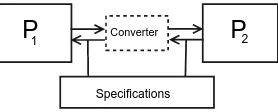
2In contrast to the above techniques, we present a technique using model checking for automatic converter synthesis. Protocols, in our setting, are rep-resented usingKripke Structures (KS) and specifications (and their negations) are expressed in the temporal logicACTL.ACTL, a branching time temporal logic
with universal path quantifiers, is particularly relevant for protocol conversion as mismatches in protocols must be addressed for every path of their KS de-scriptions. Given two KSsP1 and P2 and a set Ψ of desiredACTL properties,
the protocol conversion via converter synthesis problem (illustrated in Fig. 1) may be stated as:
Can a converter C be synthesized for P1 and P2 such that all
for-mulas in Ψcan be satisfied?
The proposed approach involves the local and on-the-fly construction of a tableau [2] where satisfaction of ACTLformulas in Ψ is defined in terms of the
satisfaction of their subformulas by the states of the protocols. The tableau construction results in the automatic synthesis of the converter, if one exists. If no converter is found, failures can be identified without exploring states irrel-evant for failure inference. Not only are temporal logic specifications succinct and more intuitive to write, additional constraints such as fairness can also be specified. Fairness constraints ensure that converters allow meaningful commu-nication to take place between protocols. We use invariants to specify bounds on data-widths [1] so that data-width mismatches are addressed.
The main contributions of this paper are:
• We propose the first model checking based solution to protocol match-ing guaranteed to produce a converter if one exists—no further proof of correctness is required, unlike some other approaches [3].
• We present a novel tableau-based algorithm to address data and control mismatches in a unifying manner, unlike earlier solutions that deal with them separately or in an ad hoc manner.
• We present an on-the-fly algorithm for converter synthesis, one where pro-tocol states are explored only when needed. The algorithm is polynomial in the size of the protocols and specifications.
The rest of this paper is organized as follows. Section 2 presents the au-tomatic converter synthesis approach based on tableau generation. Section 3 provides some implementation results with concluding remarks in section 4.
2
Methodology
T
Figure 2: Producer-consumer protocol pair
2.1
Input description
The conversion algorithm takes as input two protocols represented as Kripke structures:
Definition 1: A Kripke structure (KS) is afinite state machinerepresented as
a sextupleAP, S, s0, Σ, R, L,where AP is a set of atomic propositions;S
is a finite set of states;s0∈S is the initial state; Σ is a finite set of input and
output events;R⊆S×Σ×S is the transition relation; andL:S→2AP is the state labelling function.
States in a protocol are labelled by unique identifiers. Transitions between states, each labelled with a priority, trigger with respect to a clock. At each clock cycle, the KS checks for the presence of input/output events that can trigger a transition from the current state. If multiple input/output triggers are present, the transition using the highest priority is taken. An eventarepresents an input whereasarepresents an output. The relations (s, a, s′)∈R are represented as
s→a s′.
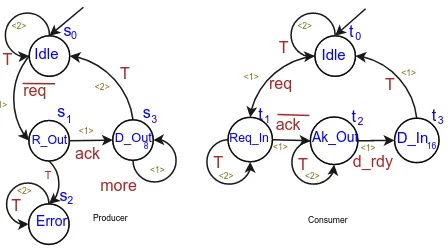
Fig. 2 shows the protocols of two devices, a producer and a consumer rep-resented as Kripke structures. The producer protocolP1, sends sends a request
before producing any data and in the next cycle awaits the input signalack. If ack is absent, the protocol enters an error state (s2). Else, it goes on to write
8-bits on to the data channel D out8 and is capable of writing multiple 8-bit
data if the signal more is present in subsequent cycles. The 16-bit consumer, P2, reads the request from the producer and then emits an acknowledgement
(ack). It then waits for the inputd rdy to readone 16-bit data from the data channel.
The protocols have a number of incompatibilities. Although P1 and P2
can share the input/output channels req and ack, but there are no outputs corresponding to the control inputsd rdy and more (control incompatibility). Furthermore, there is also adata incompatibility asP1writes 8-bit data whereas
P2 can only read 16-bit data.
addi-tionalACTLformulas. ACTLis a fragment of the branching time temporal logic CTLand only allows universal path quantifiers. Semantics of anACTLformula,ϕ
denoted by [[ϕ]]M are given in terms of set of states in a KS,M, which satisfies the formula. A state s ∈ S is said to satisfy a ACTL formula ϕ, denoted by
s|=ϕ, ifs∈[[ϕ]]M. We also say thatM |=ϕto indicate that the initial states0
of the modelM satisfies ϕ. We restrict ourselves to formulas where negations are applied to propositions only. For the producer-consumer example in Fig. 2, the following properties are needed:
1. A(¬Req InUR Out) (S1): A request cannot be read before one is made.
2. A(¬D Out8 UReq In) (S2): No data is written data before a request has
been received.
3. AG(¬Error) (S3): The communication never enters a state labelled by
Error.
2.1.1 Describing data-width mismatches
The producer-consumer protocol pair has a data-width mismatch asP1 writes
8-bit numbers to the data channel whereas P2 reads 16-bit numbers. We
for-mally describe the desired data-communication behaviour as follows. Given the data-widthsN andM of the outputs and inputs respectively, we first compute the minimum width needed for the communication medium between the two protocols. If N < M, then the minimum capacity must beN ×f such that f is the smallest integer for which N ×f > M; otherwise the minimum ca-pacity is N. This ensures that there are enough preceding outputs before any one input. While the minimum bound of communication medium buffer can be computed as above, the maximum bound is be any value greater than the minimum bound. In our setting, we assume that the maximum bound of the communication medium buffer isLCM(N, M). Given a capacity K of the
com-munication medium between these bounds, the maximum number of outputs possible when the medium is empty isx=⌊K/N⌋; while the maximum number of inputs possible when the medium is full isy=⌊K/M⌋. We use an auxiliary counter for every input/output pair such that the counter isincremented byy for every output,decremented byxfor every input, and verify that the counter always remains between 0 andx×y using theinvariant 0≤counter≤(x×y). In addition, we can also force that maximum number of outputs are done before inputs start and vice versa—expressed by the followingACTLformulas:
AG(counter= 0 ⇒ A(¬input Ucounter=x×y) ) AG(counter=x×y ⇒ A(¬output Ucounter= 0) )
For the producer-consumer example in Fig. 2, we use the invariant 0 ≤
s (state)
labels (set of formulas) type (either OR or AX) counters
Node
Node
s (state)
labels (set of formulas) type (either AND or OR) counters
Leaf
s (state) F (set of formulas) counters
Figure 3: The structure of nodes and leaves
2.1.2 Fairness
In order to ensure that converters always allow meaningful communication be-tween protocols, it may be desirable that additional fairness conditions are sat-isfied, which can be again defined usingACTLformulas. For converter synthesis,
the goal is to ignore as well asdisable all unfair behaviours of the protocols. For the producer-consumer example, we use the following fairness conditions:
• AGAF(D Out8) (F1): The producer can always eventually write data.
• AG(D Out8⇒AXA(¬Req OutUData In16) (F2): Once some data is
writ-ten, no further requests are allowed before a read operation is performed.
• AGAF(R Out) (F3): The producer can always eventually emit requests.
2.2
Tableau Construction Algorithm
The proposed technique is based on model checking and involves on-the-fly tableau construction, similar to [2]. Given the inputs P1 and P2 describing
participating protocols, some invariants over data counters, and the set Ψ of desired properties (including fairness properties), the tableau construction algo-rithm proceeds as follows. We illustrate the working of the tableau construction algorithm using the producer-consumer example given in Fig. 2.
The first step is the computation of the unrestricted combined behaviour P1||P2 of P1 and P2, also called the parallel composition (similar to the
syn-chronous parallel in Argos [8]), defined as follows.
Definition 2: Parallel Composition.
0,0 R_Out), AXA(tt U D_Out8)}
Node 1
Figure 4: Tableau construction procedure. (a) states of P1||P2, (b) tableau
nodes, (c) synthesized converter.
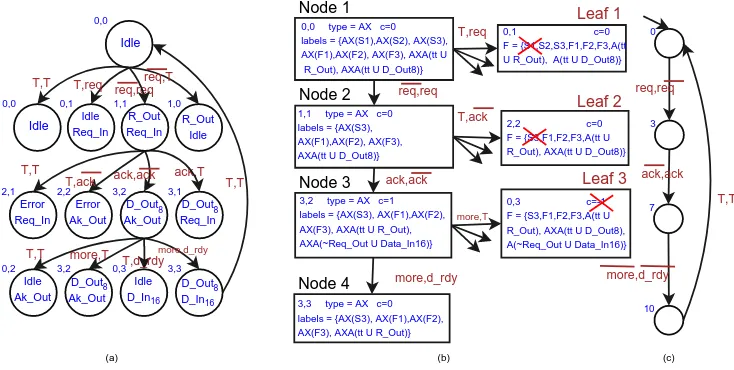
Some states of the parallel composition of the producer-consumer example are shown in Fig. 4(a).
Algorithm 1check(s0,Ψ)
1: Initialize counters, create a setAof leaves. 2: callcreate leaf(s, counter vals,Ψ,Nil)
3: whileAis non-emptydo
4: remove one leaftfromA 5: result =solve leaf(t)
6: ifresult =SUCCESSorFAILUREthen
7: result =notif y parent(t, result) 8: ifglobalresult =SUCCESSthen
9: returnSUCCESS
10: end if
11: end if
12: end while
13: returnFAILURE
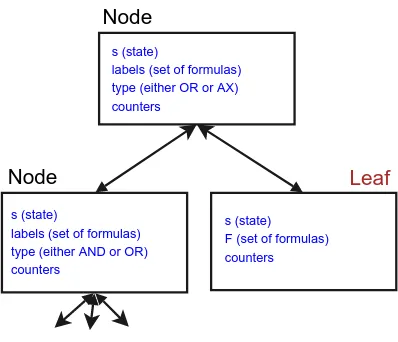
The proposed algorithm constructs a tableau which has nodes and leaves
(Fig. 3). Nodes are parents that have one or more children. Each node cor-responds to a state inP1||P2 and a specific valuation of all data counters, and
have children, and have no labels. A leaf contains a set of formulasF that its corresponding state must satisfy. The tableau can be extended only when a leaf is expanded into a node.
Given the states ofP1||P2 for the producer-consumer example (Fig. 4(a)),
the algorithm proceeds as follows. The initial state (s0, s0) of P1||P2 and the
set Ψ ({S1, S2, S3, F1, F2, F3}) are passed to the top-level tableau construc-tion procedurecheck which initializes data counters and creates a setA, which contains all leaves created during tableau construction. checkthen contains the initial top-level tableau leaf corresponding to (s0, s0) and the set of properties
Ψ. This is theroot of the tableau which contains the initial state ofP1||P2and
the original set of properties Ψ. The methodcreate leaf is used to create new leaves. If the creation of a leaf results in the violation of any invariants, the leaf is deemed invalid. After creating the root leaf, check calls the procedure solve leaf for this newly created leaf.
Algorithm 2create leaf(s, prevcountervals,Ψ, parent) 1: Update counters based on labels ofs.
2: returnif counters violate invariants.
3: if there exists a leaf t with t.state = s and t.counter status = current counter statusthen
4: t.f ormulas=t.f ormulas
Ψ 5: else
6: createa new leaftwitht.state=s
7: t.f ormulas= Ψ,t.parent =parent, t.type=LEAF.
8: t.counter status= updated counter status.
9: end if
The solve leaf method receives a tableau leaf t as input and proceeds to
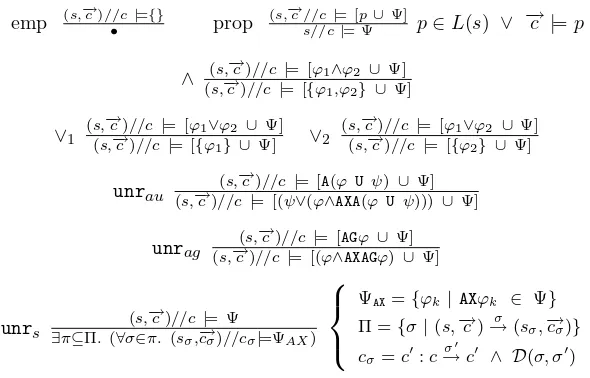
individually break down formulas contained int.F into current-state and future commitments (lines 4-18). This decomposition of formulas is based on a set of tableau rules (Fig. 5. For example, for root leaf of the producer-consumer example, the formula S3 (AG(¬Error)) is broken down into the subformulas
ErrorandAXAG(¬Error). The sub-formulaError, being a current-state
com-mitment (a proposition), is checked against the leaf state (s0, s0). The future
commitment AXAG(¬Error) is stored in the set label. Once all current-state
commitments have been checked, the root leaf is expanded to become a node (Node 1 in Fig. 4(b)) and a leaf is created for each successor of the state (s0, s0).
All future commitments (includingAXAG(¬Error)) are added to the setlabels
of the newly expanded node, and (after removingAXfrom the formulas) to the
emp (s,−→c)//c• |={} prop (s,−→c //cs//c|= [|= Ψp∪Ψ] p∈L(s) ∨ −→c |=p
Figure 5: Tableau Rules for converter generation
returned bysolve leaf.
For the producer-consumer example, root node 1 (Fig. 4(b)) has 4 children. checkiteratively callssolve leaf on all newly created leaves. When solve leaf operates on leaf 1 (a child of node 1), it returns a F AILU RE. This happens because the violation of the property S1. S1 is broken down to the current-state commitmentR Out∨(¬R In∧AXA(¬R InUR Out) which is not satisfied
by the state (s0, s1) (the state corresponding to leaf 1). Thecheck procedure
then passes the returned value to the methodnotif y parent, which effectively results in the transition from (s0, s0) to (s0, s1) to be disabled in the tableau.
Another child leaf of node 1 corresponding to (s1, s1) satisfies all its current-state
commitments and hence is further expanded into node 2 with 4 children. Its child leaf 2, corresponding to the state (s2, s2) inP1||P2 returns aF AILU RE
as it is labelled byError(violates S3).
The child leaf corresponding to the state (s3, s2) is expanded (node 3) with
only 3 children even though the state (s3, s2) has 4 successors. This is so because
the child leaf 3 corresponding to the state (s0, s3) is invalid as the data read
(D In16) in this state results in the counterctaking a value (-1) which is outside
the allowed invariant range (0≤c≤2).
One of the children of node 3, corresponding to the state (s3, s3) is further
expanded into node 4 with 2 child leaves (one for each successor (s3, s0) and
(s0, s0)). The leaf corresponding to (s3, s0) returns F AILU RE (counter out
of bounds), whereas (s0, s0) returns SU CCESS. This happens because all
formulas passed to this child leaf are contained in the labels of the ancestor node 1 (corresponding to the same state (s0, s0) and counter valuation (c= 0).
Algorithm 3solve leaf(t) 1: s= t.state, Ψ =t.F 2: Initialize ΨAX
3: whileΨ is non-emptydo
4: remove one formulaf from Ψ 5: iff =TRUEthen
6: continue
7: else if f=FALSEthen
8: returnFAILURE
9: else if f=p∈AP then
10: returnFAILUREif notf∈L(s)
11: else if f=¬p(p∈AP)then
12: returnFAILUREiff∈L(s)
13: else if f=AGP then
14: insertP∧AXAGP in Ψ
15: else if f=A(P UQ)then
16: insertQ∨(P∧AXA(P UQ)) in Ψ
17: else if f=P∧Qthen
18: insertP, Qin Ψ
19: else if f=P∨Qthen
20: t.type=OR N ODE
21: create leaf(s,ΨS
{P}S
ΨAX, t)
22: create leaf(s,ΨS
{Q}S
ΨAX, t)
23: returnEXPANDED
24: else if f=AXP then
25: ifP =A(QUR) andP occurs earlier in tableau atsthen
26: returnFAILURE
27: else
28: addf to the set ΨAX
29: end if
30: ifP =AGQand no ancestor oftcontainsP at statesthen
31: addf to the set ΨAX
32: end if
33: end if
34: end while
35: ifΨAX is non-emptythen
36: Ψ′
AX={p|AXp∈ΨAX},t.type=AX N ODE
37: t.labels=label
38: foreach successor s’ of sdo
39: create trace(s′,Ψ′
AX, t)
40: end for
41: returnEXPANDED
42: end if
SU CCESS. This results in the tableau being folded back with a reference to node 1. A similar leaf may returnF AILU RE if the future commitments are of the typeAU.
The return values SU CCESS or F AILU RE returned by solve leaf for a leaftis passed to thenotif y parentmethod which recursively passes the result to its parent (ancestors if needed). A node returnsSU CCESSif at least on of its children returnsSU CCESS. An OR N ODE does not disable any transitions (as only one child is needed to satisfy commitments), whereas anAX N ODE enables transitions to only those children that satisfy the future commitments passed to them. The algorithm finishes when the root leaf (corresponding to (s0, s0)) returns SU CCESS.
Algorithm 4notif y parent(t, result)
1: if tis a top-level tracethen 2: globalresult = result
3: return
4: end if
5: parent=t.parent
6: if parent.type=OR N ODE then
7: if result =FAILUREthen
8: callnotif y parent(parent,FAILURE) if no unchecked child remains.
9: else
10: callnotif y parent(parent,SUCCESS)
11: end if
12: else if parent.type=AX N ODE then
13: if result =FAILUREthen
14: remove the link fromparentto t. 15: if child-set ofparentis emptythen
16: call notif y parent(parent,FAILURE) if successor set of parent.state
is empty
17: else callnotif y parent(parent,SUCCESS)
18: end if
19: end if
20: end if
2.3
Converter Synthesis
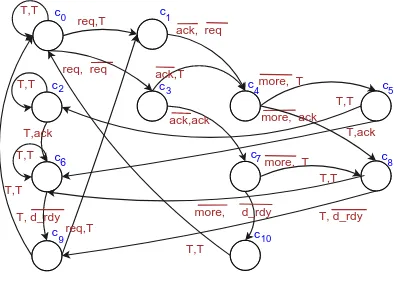
The converter is synthesized automatically during tableau construction if it completes successfully. We traverse the nodes (starting from the root node that returnedSU CCESS) in the tableau and select the AX nodes encountered to form states in the converter. The converter states synthesized for the states of P1||P2for the producer-consumer example shown in Fig. 4(a), are shown in Fig.
The converter resolves incompatibilities betweenP1and P2 as follows. The
input (output) events inP1||P2are output (input) events for the converter. The
converter can read an output generated by either protocol and may pass it to the other. Using this underlying control, the controller can performinhibition,
buffering and synthesis. The converterinhibits an event when the transition resulting from an event is disabled inCitself. In this case, the converter disallows (or absorbs) the input instead of passing it on. The converter may buffer an event, where it holds an input for a while before passing it on. Finally, in case a control input expected by one protocol is not provided by the other, the convertersynthesizesit as an output itself in order to avoid blocking states. The converterC(Fig. 7) for the producer-consumer example resolves the control incompatibility between the two protocols by synthesizing the signalsmoreand
d rdy artificially when required. The data incompatibility is resolved as all
paths leading to states where a mismatch happens (the counter variable in the tableau exceeds invariant range) are disabled using inhibition. Furthermore, buffering and inhibition are used such that only those paths that satisfy the givenACT Lspecifications and fairness properties are also satisfied.
Formally, the control of a converterCover given protocolsP1andP2, called
the lock-step compositionC//(P1||P2), is defined as follows
Definition 3: Lock-step Converter Composition. Given the KS P1||2 =
AP1||2, S1||2, s01||2, Σ1||2, R1||2, L1||2and a converterC=APC,SC, sC0, ΣC,
RC, LC, the lock-step compositionC//(P1||P2) = AP1||2, SC//(1||2), s0C//1||2,
Σ1||2, RC//(1||2), LC//(1||2)such that:
SC//(1||2)⊆SC ×S1||2; ands0C//1||2(s0C, s0(1||2)). RC//(1||2)is defined as:
sC σc
1,σc2
→ s′C∧s1||2 (σ1,σ2)
→ s′1||2∧ D(σ1c, σ1)∧ D(σc2, σ2)⇒sC//(1||2) (σ1,σ2)
→ s′C//(1||2)
Finally,LC//(1||2)(sP, sC) =L1||2(s1||2).
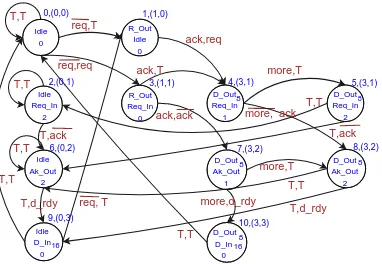
The transition relation of the protocols composed with a converter ensures that protocols move only when the converter allows that move. As such the lock-step composition // is different from unrestricted composition (Defini-tion 2). For the producer-consumer example, the corresponding controlled sys-temC//(P1||P2) is given in 6
The following theorem follows from the above:
Theorem 3: Sound and Complete. Two protocolsP1andP2, withndefined
data countersc1, c2, . . . cnwith the constraintsmini≤ci≤maxi, can be made compatiblewrt to a set Ψ ofACTLformulas by using an automatically generated
converterC iff checkreturnsSU CCESS.
Proof.
The first step in proving the above theorem is to realize the size of the state space to be traversed during tableau construction.
Given P1 with total number of states |S1|, and P2 with total number of
states|S2|, the input to the check method (P1||P2) would contain a maximum
of|S1| × |S2|states.
Observation 1. For each counterci (0≤i≤n) , the values of interest lie in
T,T
sets containing one element each from the rangemaxi to mini, one partition containing all data points in < mini and another containing all data points
> maxi. In other words, if the valuation of the counter goes beyond the limits
mini or maxi, it is not required to record the exact valuation. This stems from the fact that if ci takes values outside the allowed range, the invariant (mini≤ci≤maxi) is violated and leads to a failed path in the tableau.
It follows from the above observation that for each state sin P1||P2, there
may be several (exactlyKi+ 2) valuations for each counter variableci, resulting in multiple states corresponding to the same state inP1||P2(each with a different
valuation of counters). Therefore the total number of states |S| that can be traversed by the algorithm in the worst case is:
|S|=|S1×S2| ×(K1+ 2)×(K2+ 2)×. . .×(Kn+ 2)
We use −→c to denote a valuation of all counters and use S to denote the expanded state space.
Having defined the maximum size of the state-space to be traversed, we first note that for any state (s,−→c) in S, if −→c refers to a valuation of the counters where any one counter is outside its allowed range, the tableau leaf automatically results in a failed path (functioncreate leaf). solve leafis only called for leaves which are associated states inS that have valid valuations for all counters.
The proof then proceeds by realizing the soundness and completeness of each of the tableau rules. For brevity, we present here the proof-sketch forunrs,
proofs for the other rules are straightforward.
T,T
Figure 7: The converterC
As each transition is annotated by an event σ, we construct Π, the set of events of out-going transitions. In other words, σ ∈ Π ⇒ (sσ,−→cσ) is reach-able via the transition with eventσ. We are required to identify one possible subset of Π which represents the enabled transitions whose destinations con-form to the obligations in the consequent (see∃π⊆Π in the consequent). Let πs = {(sσ,→−cσ) | σ ∈ π} be the next states reachable via (selected) enabled transitions.
The consequent of the tableau rule has the following obligations. All ele-ments ofπsin parallel composition with the converter must satisfy the expres-sions in Ψax. This ensures that the converter constructed is consistent, i.e., c is constructed such that (s,−→c )|c satisfies all obligations (Ψax). Therefore, if we can generate an environment forscorresponding to ruleunrs, then s|=ψ
whereψ is the conjunction of the elements of the set{AXϕ| ϕ∈Ψax}. The other direction can be proved likewise.
3
Results
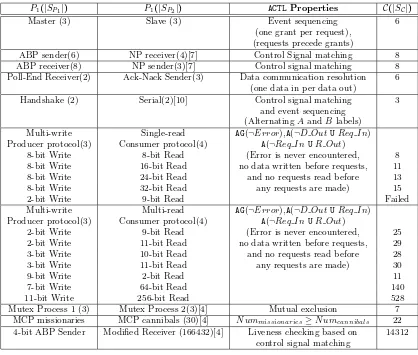
A protocol conversion tool employing the tableau construction approach has been implemented by extending the NuSMV model checker [4]. The results table (Table 1) contains four columns. The first two columns contain the description and size (number of states) of the participating protocols . TheACTLproperties
P1(|SP1|) P1(|SP2|) ACTL Properties C(|SC|)
Master (3) Slave (3) Event sequencing 6
(one grant per request), (requests precede grants)
ABP sender(6) NP receiver(4)[7] Control Signal matching 8 ABP receiver(8) NP sender(3)[7] Control signal matching 8 Poll-End Receiver(2) Ack-Nack Sender(3) Data communication resolution 6
(one data in per data out)
Handshake (2) Serial(2)[10] Control signal matching 3 and event sequencing
(AlternatingAandB labels) Multi-write Single-read AG(¬Error),A(¬D Out UReq In) Producer protocol(3) Consumer protocol(4) A(¬Req InUR Out)
8-bit Write 8-bit Read (Error is never encountered, 8 8-bit Write 16-bit Read no data written before requests, 11 8-bit Write 24-bit Read and no requests read before 13 8-bit Write 32-bit Read any requests are made) 15
2-bit Write 9-bit Read Failed
Multi-write Multi-read AG(¬Error),A(¬D Out UReq In) Producer protocol(3) Consumer protocol(4) A(¬Req InUR Out)
2-bit Write 9-bit Read (Error is never encountered, 25 2-bit Write 11-bit Read no data written before requests, 29 3-bit Write 10-bit Read and no requests read before 28 3-bit Write 11-bit Read any requests are made) 30
9-bit Write 2-bit Read 11
7-bit Write 64-bit Read 140
11-bit Write 256-bit Read 528
Mutex Process 1 (3) Mutex Process 2(3)[4] Mutual exclusion 7 MCP missionaries MCP cannibals (30)[4] N ummissionaries≥N umcannibals 22 4-bit ABP Sender Modified Receiver (166432)[4] Liveness checking based on 14312
control signal matching
Table 1: Implementation Results
receiver, which introduced many faulty paths in the combined system. Using the tableau construction algorithm, a converter that effectively disabled such faulty communication paths was realized. Note that size entry in the second column for the final two results is the combined size of the system (size ofP1||P2).
4
Conclusions
Protocol conversion to resolve protocol mismatches is an active research area and a number of solutions have been proposed. Some approaches require signifi-cant user effort, while some only partly address the protocol conversion problem. Most formal approaches work on protocols that have unidirectional communi-cation and use finite state machines to describe specificommuni-cations. In this paper we propose a formal approach to protocol conversion which alleviates the above problems. Specifications are described in temporal logic and bidirectional com-munication is allowed. A tableau-based approach using the model checking framework is used to generate converters in polynomial time. We use invari-ants to handle data-width issues. Fairness properties are used to generate fair converters. We prove that the approach is sound and complete and provide implementation results.
References
[1] Rajeev Alur and David L. Dill. A theory of timed automata. Theoretical Computer Science, 126(2):183–235, 1994.
[2] Girish Bhat, Rance Cleaveland, and Orna Grumberg. Efficient on-the-fly model checking for CTL*. InProceedings of the Tenth Annual Symposium on Logic in Computer Science, pages 388–397, June 1995.
[3] Vijay D’Silva, S Ramesh, and Arcot Sowmya. Synchronous protocol au-tomata : A framework for modelling and verification of soc communication architectures. In DATE, pages 390–395, 2004.
[4] R. Cavada et al. NuSMV 2.1 User Manual, June 2003.
[5] Saurav Gorai et al. Session 42: simulation assisted formal verifica-tion: Directed-simulation assisted formal verification of serial protocol and bridge. InProceedings of the 43rd annual conference on Design automation DAC ’06, pages 731 – 736, 2006.
[6] P. Green. Protocol conversion. IEEE Transactions on Communications, 34(3):257–268, March 1986.
[8] F. Maraninchi and Y. Remond. Argos: an automaton-based synchronous language. Computer Languages, 27:61–92, 2001.
[9] K. Okumura. A formal protocol conversion method. InACM SIGCOMM 86 Symposium, pages 30–37, 1986.
[10] R. Passerone, L. de Alfaro, T. A. Henzinger, and A. L. Sangiovanni-Vincentelli. Convertibility verification and converter synthesis: Two faces of the same coin. In International Conference on Computer Aided Design ICCAD, 2002.
[11] J. C. Shu and Ming T. Liu. A synchronization model for protocol con-version. Proceedings of the Eighth Annual Joint Conference of the IEEE Computer and Communications Societies. Technology: Emerging or Con-verging? INFOCOM ’89, pages 276–284, 1989.