Investigating accidents and
incidents
A workbook for employers, unions, safety representatives
and safety professionals
A workbook for employers, unions, safety representatives and safety professionals
Investigatingaccidents and incidents
Every year people are killed or injured at work. Over 40 million working days are lost annually through work-related accidents and illnesses.
This workbook gives organisations an opportunity to find out what went wrong. Learning the lessons and taking action may reduce, or even prevent, accidents in the future.
As a step-by-step guide, it will help all organisations, particularly smaller businesses, to carry out their own health and safety investigations. Investigating accidents and incidents explains why you need to carry out investigations and takes you through each step of the process:
Step one: Gathering the information Step two: Analysing the information
Step three: Identifying risk control measures Step four: The action plan and its implementation
Contents
Reducing risks and protecting people 3
Understanding the language of investigation 4 The causes of adverse events 6
Why investigate? 7
A step by step guide to health and safety investigations 12
Gathering the information 13
Analysing the information 19 Identifying risk control measures 23 The action plan and its implementation 24 References and further reading 26
Adverse event report and investigation form: Worked examples 28 Adverse event report and investigation form: Blank form 56 Adverse event analysis: Rooting out risk 66
Reducing risk and protecting
people
Recent figures show that an average of 250 employees and self-employed people are killed each year as a result of accidents in the workplace.1 A further 150 000 sustain major injuries or injuries that mean they are absent from work for more than three days. Over 2.3 million cases of ill health are caused or made worse by work.2
According to the Labour Force Survey,3 over 40 million working days are lost through work-related injuries and ill health, at a cost to business of £2.5 billion.4
“If you think safety is expensive, try an accident”Chairman of Easy Group Clearly, there are good financial reasons for reducing accidents and ill health. Costings show that for every £1 a business spends on insurance, it can be losing between £8 and £36 in uninsured costs.4
The same accidents happen again and again, causing suffering and distress to an ever-widening circle of workers and their families. The investigation and analysis of work-related accidents and incidents forms an essential part of managing health and safety. However, learning the lessons from what you uncover is at the heart of preventing accidents and incidents. Identify what is wrong and take positive steps to put it right. This guide will show you how.
Carrying out your own health and safety investigations will provide you with a deeper understanding of the risks associated with your work activities. Blaming individuals is ultimately fruitless and sustains the myth that accidents and cases of ill health are unavoidable when the opposite is true. Well thought-out risk control measures, combined with adequate supervision, monitoring and effective management (ie your risk management system) will ensure that your work activities are safe. Health and safety investigations are an important tool in developing and refining your risk management system.
An effective investigation requires a methodical, structured approach to information gathering, collation and analysis. The findings of the investigation will form the basis of an action plan to prevent the accident or incident from happening again and for improving your overall management of risk. Your findings will also point to areas of your risk assessments that need to be reviewed. This link with risk assessment(s) is a legal duty.5
Understanding the language of
investigation
Certain key words and phrases will be used regularly throughout this guide.
‘Adverse event’ includes:
n accident: an event that results in injury or ill health; n incident:
– near miss: an event that, while not causing harm, has the potential to cause injury or ill health. (In this guidance, the term near miss will be taken to include dangerous occurrences);
– undesired circumstance: a set of conditions or circumstances that have the potential to cause injury or ill health, eg untrained nurses handling heavy patients.
Dangerous occurrence: one of a number of specific, reportable adverse events, as defined in the Reporting of Injuries, Diseases and Dangerous Occurrences Regulations 1995 (RIDDOR).
Hazard: the potential to cause harm, including ill health and injury; damage to property, plant, products or the environment, production losses or increased liabilities.
Immediate cause: the most obvious reason why an adverse event happens, eg the guard is missing; the employee slips etc. There may be several immediate causes identified in any one adverse event.
Consequence:
fatal: work-related death;
major injury/ill health: (as defined in RIDDOR, Schedule 1), including fractures (other than fingers or toes), amputations, loss of sight, a burn or penetrating injury to the eye, any injury or acute illness resulting in unconsciousness, requiring resuscitation or requiring admittance to hospital for more than 24 hours;
serious injury/ill health: where the person affected is unfit to carry out his or her normal work for more than three consecutive days;
minor injury: all other injuries, where the injured person is unfit for his or her normal work for less than three days;
damage only: damage to property, equipment, the environment or production losses. (This guidance only deals with events that have the potential to cause harm to people.)
Likelihood that an adverse event will happen again:
certain: it will happen again and soon;
likely: it will reoccur, but not as an everyday event; possible: it may occur from time to time;
unlikely: it is not expected to happen again in the foreseeable future; rare: so unlikely that it is not expected to happen again.
Figure 1 Accident
Figure 2 Near miss
Risk: The level of risk is determined from a combination of the likelihood of a specific undesirable event occurring and the severity of the consequences (ie how often is it likely to happen, how many people could be affected and how bad would the likely injuries or ill health effects be?)
Risk control measures: are the workplace precautions put in place to reduce the risk to a tolerable level?
Root cause: an initiating event or failing from which all other causes or failings spring. Root causes are generally management, planning or organisational failings.
The causes of adverse events
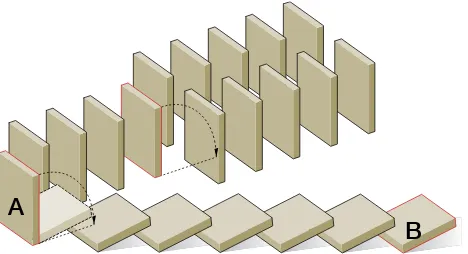
Adverse events have many causes. What may appear to be bad luck (being in the wrong place at the wrong time) can, on analysis, be seen as a chain of failures and errors that lead almost inevitably to the adverse event. (This is often known as the Domino effect.)
These causes can be classified as:
n immediate causes: the agent of injury or ill health (the blade, the substance, the dust etc);
n underlying causes: unsafe acts and unsafe conditions (the guard removed, the ventilation switched off etc);
n root causes: the failure from which all other failings grow, often remote in time and space from the adverse event (eg failure to identify training needs and assess competence, low priority given to risk assessment etc).
To prevent adverse events, you need to provide effective risk control measures which address the immediate, underlying and root causes.
Note: Each domino represents a failing or error which can combine with other failings and errors to cause an adverse event. Dealing with the immediate cause (B) will only prevent his sequence. Dealing with all causes, especially root causes (A) can prevent a whole series of adverse events.
Figure 4 Sequence of dominoes
Why investigate?
There are hazards in all workplaces; risk control measures are put in place to reduce the risks to an acceptable level to prevent accidents and cases of ill health.
The fact that an adverse event has occurred suggests that the existing risk control measures were inadequate.
Learning lessons from near misses can prevent costly accidents. (The Clapham Junction rail crash and the Herald of Free Enterprise ferry capsize were both examples of situations where management had failed to recognise, and act on, previous failings in the system.) You need to investigate adverse events for a number of reasons.
Legal reasons for investigating
n To ensure you are operating your organisation within the law.
n The Management of Health and Safety at Work Regulations 1999, regulation 5, requires employers to plan, organise, control, monitor and review their health and safety arrangements. Health and safety investigations form an essential part of this process.
n Following the Woolf Report6 on civil action, you are expected to make full disclosure of the circumstances of an accident to the injured parties
considering legal action. The fear of litigation may make you think it is better not to investigate, but you can’t make things better if you don’t know what went wrong! The fact that you thoroughly investigated an accident and took remedial action to prevent further accidents would demonstrate to a court that your company has a positive attitude to health and safety. Your investigation findings will also provide essential information for your insurers in the event of a claim.
Information and insights gained from an investigation
n An understanding of how and why things went wrong.
n An understanding of the ways people can be exposed to substances or conditions that may affect their health.
n A true snapshot of what really happens and how work is really done. (Workers may find short cuts to make their work easier or quicker and may ignore rules. You need to be aware of this.)
n Identifying deficiencies in your risk control management, which will enable you to improve your management of risk in the future and to learn lessons which will be applicable to other parts of your organisation.
Benefits arising from an investigation
n The prevention of further similar adverse events. If there is a serious accident, the regulatory authorities will take a firm line if you have ignored previous warnings.
n The prevention of business losses due to disruption, stoppage, lost orders and the costs of criminal and civil legal actions.
n The development of managerial skills which can be readily applied to other areas of the organisation.
While the argument for investigating accidents is fairly clear, the need to investigate near misses and undesired circumstances may not be so obvious. However, investigating near misses and undesired circumstances is as useful, and very much easier than investigating accidents.
Adverse events where no one has been harmed can be investigated without having to deal with injured people, their families and a demoralised workforce, and without the threat of criminal and civil action hanging over the whole proceedings. Witnesses will be more likely to be helpful and tell the truth. (Consider the following: ‘I mistakenly turned the wrong valve which released the boiling water because the valves all look the same’ or ‘I don’t know how John was scalded.’ Which is the likely response to a near miss and which to an accident? More importantly, which is the most useful?)
It is often pure luck that determines whether an undesired circumstance translates into a near miss or accident. The value of investigating each adverse event is the same.
An investigation is not an end in itself, but the first step in preventing future adverse events. A good investigation will enable you to learn general lessons, which can be applied across your organisation.
The investigation should identify why the existing risk control measures failed and what improvements or additional measures are needed. More general lessons on why the risk control measures were inadequate must also be learned.
Which events should be investigated?
Having been notified of an adverse event and been given basic information on what happened, you must decide whether it should be investigated and if so, in what depth.
It is the potential consequences and the likelihood of the adverse event recurring that should determine the level of investigation, not simply the injury or ill health suffered on this occasion. For example: Is the harm likely to be serious? Is this likely to happen often? Similarly, the causes of a near miss can have great potential for causing injury and ill health. When making your decision, you must also consider the potential for learning lessons. For example if you have had a number of similar adverse events, it may be worth investigating, even if each single event is not worth investigating in isolation. It is best practice to investigate all adverse events which may affect the public.
Who should carry out the investigation?
For an investigation to be worthwhile, it is essential that the management and the workforce are fully involved. Depending on the level of the investigation (and the size of the business), supervisors, line managers, health and safety professionals, union safety representatives, employee representatives and senior management/ directors may all be involved.
This joint approach will ensure that a wide range of practical knowledge and experience will be brought to bear and employees and their representatives will feel empowered and supportive of any remedial measures that are necessary. A joint approach also reinforces the message that the investigation is for the benefit of everyone.
In addition to detailed knowledge of the work activities involved, members of the team should be familiar with health and safety good practice, standards and legal requirements. The investigation team must include people who have the necessary investigative skills (eg information gathering, interviewing, evaluating and analysing). Provide the team with sufficient time and resources to enable them to carry out the investigation efficiently.
It is essential that the investigation team is either led by, or reports directly to someone with the authority to make decisions and act on their recommendations.
When should it start?
The urgency of an investigation will depend on the magnitude and immediacy of the risk involved (eg a major accident involving an everyday job will need to be investigated quickly).
In general, adverse events should be investigated and analysed as soon as possible. This is not simply good practice; it is common sense – memory is best and motivation greatest immediately after an adverse event.
What does it involve?
An investigation will involve an analysis of all the information available, physical (the scene of the incident), verbal (the accounts of witnesses) and written (risk assessments, procedures, instructions, job guides etc), to identify what went wrong and determine what steps must be taken to prevent the adverse event from happening again.
It is important to be open, honest and objective throughout the investigation process. Pre-conceived ideas about the process, the equipment or the people involved in an adverse event may blind you to the real causes. Question everything. Be wary of blaming individuals.
What makes a good investigation?
To get rid of weeds you must dig up the root. If you only cut off the foliage, the weed will grow again.
Similarly it is only by carrying out investigations which identify root causes that organisations can learn from their past failures and prevent future failures.
Simply dealing with the immediate causes of an adverse event may provide a short-term fix. But, in time, the underlying/root causes that were not addressed will allow conditions to develop where further adverse events are likely, possibly with more serious consequences. It is essential that the immediate, underlying causes and root causes are all identified and remedied.
counterproductive, because people become defensive and uncooperative. Only after the investigation has been completed is it appropriate to consider whether any individuals acted inappropriately.
Investigations that conclude that operator error was the sole cause are rarely acceptable. Underpinning the ‘human error’ there will be a number of underlying causes that created the environment in which human errors were inevitable. For example inadequate training and supervision, poor equipment design, lack of management commitment, poor attitude to health and safety.
The objective is to establish not only how the adverse event happened, but more importantly, what allowed it to happen.
The root causes of adverse events are almost inevitably management, organisational or planning failures.
Look carefully at your health and safety policy and how it is reflected in the workplace. Do staff understand the health and safety message in general and in particular those parts that relate to their work? Is something missing from the policy? Is it implemented, or is management failing to ensure that health and safety measures remain in place and are effective at all times? If not, your health and safety policy needs to be changed.
The investigation should be thorough and structured to avoid bias and leaping to conclusions. Don’t assume you know the answer and start finding solutions before you complete the investigation. A good investigation involves a systematic and structured approach.
Information gathering:
n explores all reasonable lines of enquiry; n is timely;
n is structured, setting out clearly what is known, what is not known and records the investigative process.
Analysis:
n is objective and unbiased;
n identifies the sequence of events and conditions that led up to the adverse event;
n identifies the immediate causes;
n identifies underlying causes, ie actions in the past that have allowed or caused undetected unsafe conditions/practices;
Risk control measures:
n identify the risk control measures which were missing, inadequate or unused; n compare conditions/practices as they were with that required by current legal
requirements, codes of practice and guidance;
n identify additional measures needed to address the immediate, underlying and root causes;
n provide meaningful recommendations which can be implemented. But woolly recommendations such as ‘operators must take care not to touch the cutters during run-down’ show that the investigation has not delved deep enough in search of the root causes.
Action plan and implementation:
n provide an action plan with SMART objectives (Specific, Measurable, Agreed, Realistic and Timescaled);
n ensure that the action plan deals effectively not only with the immediate and underlying causes but also the root causes;
n include lessons that may be applied to prevent other adverse events, eg assessments of skill and training in competencies may be needed for other areas of the organisation;
n provide feedback to all parties involved to ensure the findings and recommendations are correct, address the issues and are realistic; n should be fed back into a review of the risk assessment. The Approved
Code of Practice5 attached to the Management of Health and Safety at Work Regulations 1999 regulation 3 (paragraph 26), states that adverse events should be a trigger for reviewing risk assessments);
n communicate the results of the investigation and the action plan to everyone who needs to know;
n include arrangements to ensure the action plan is implemented and progress monitored.
The last three steps, though essential, are often overlooked. But, without them, the full benefits of the investigation will not be realised and in the long term nothing will change.
Techniques for analysing adverse events
There are many tools and techniques for structuring the investigation, analysing adverse events, and identifying root causes.8 HSE does not endorse any one method – it is for you to choose which techniques suit your company. These techniques are simply tools, not an end in themselves.
For large, complex or technically demanding investigations, these techniques may be essential in determining not only how the adverse event happened, but also what were the root causes.
A step by step guide to health
and safety investigations
Steps to take following an adverse event
Emergency response:
n take prompt emergency action (eg first aid);
n make the area safe (in some cases this may need to be done first).
Initial report:
n preserve the scene;
n note the names of the people, equipment involved and the names of the witnesses;
n report the adverse event to the person responsible for health and safety who will decide what further action (if any) is needed.
Initial assessment and investigation response:
n report the adverse event to the regulatory authority if appropriate.
RIDDOR
For those accidents and dangerous occurrences that are reportable under the provisions of RIDDOR (the Reporting of Injuries, Diseases and Dangerous Occurrences Regulations 1995), this information must be notified to the enforcing authority.
Whether you are HSE or LA-enforced, to make a report, go to
www.hse.gov.uk/riddor. A telephone service can be used to report fatal and major injuries only – call the Incident Contact Centre on 0845 300 9923 (opening hours Monday to Friday 8.30 am to 5 pm).
You must also keep a record of the reports you make that are required under RIDDOR. You can do this by:
n keeping a copy of the form;
n recording the incident in the accident book; n recording the incident electronically.
You also need to enter details of the accident in an accident book. And, you need to decide on the scale of the investigation. Where appropriate, decide who will carry out the investigation, the resources required and brief the investigation team.
The decision to investigate
The table below will assist you in determining the level of investigation which is appropriate for the adverse event. Remember you must consider the worst potential consequences of the adverse event (eg a scaffold collapse may not have caused any injuries, but had the potential to cause major or fatal injuries).
Likelihood of recurrence
Potential worst consequence of adverse event
Minor Serious Major Fatal
(The definitions of ‘consequence’ and ‘likelihood’ are set out in the section on ‘Understanding the language of investigation’)
Risk Minimal Low Medium High
Investigation level Minimal
n In a minimal level investigation, the relevant supervisor will look into the circumstances of the event and try to learn any lessons which will prevent future occurrences.
n A low level investigation will involve a short investigation by the relevant supervisor or line manager into the circumstances and immediate, underlying and root causes of the adverse event, to try to prevent a recurrence and to learn any general lessons.
n A medium level investigation will involve a more detailed investigation by the relevant supervisor or line manager, the health and safety adviser and employee representatives and will look for the immediate, underlying and root causes. n A high level investigation will involve a team-based investigation, involving
supervisors or line managers, health and safety advisers and employee representatives. It will be carried out under the supervision of senior
management or directors and will look for the immediate, underlying, and root causes.
The investigation
The four steps include a series of numbered questions. These set out in detail the information that should be entered onto the adverse event investigation form. The question numbers correspond to those on the form.
Step one Gathering the information
Find out what happened and what conditions and actions influenced the adverse event. Begin straight away, or as soon as practicable.
corrupted, eg items moved, guards replaced etc. If necessary, work must stop and unauthorised access be prevented.
Talk to everyone who was close by when the adverse event happened,
especially those who saw what happened or know anything about the conditions that led to it.
The amount of time and effort spent on information gathering should be proportionate to the level of investigation. Collect all available and relevant information. That includes opinions, experiences, observations, sketches, measurements, photographs, check sheets, permits-to-work and details of the environmental conditions at the time etc. This information can be recorded initially in note form, with a formal report being completed later. These notes should be kept at least until the investigation is complete.
Where, when and who?
1 Where and when did the adverse event happen?
2 Who was injured/suffered ill health or was otherwise involved with the adverse event?
Gathering detailed information: How and what?
Discovering what happened can involve quite a bit of detective work. Be precise and establish the facts as best you can. There may be a lack of information and many uncertainties, but you must keep an open mind and consider everything that might have contributed to the adverse event. Hard work now will pay off later in the investigation.
Many important things may emerge at this stage of the process, but not all of them will be directly related to the adverse event. Some of the information gathered may appear to have no direct bearing on the event under investigation. However, this information may provide you with a greater insight into the hazards and risks in your workplace. This may enable you to make your workplace safer in ways you may not have previously considered.
3 How did the adverse event happen? Note any equipment involved.
Describe the chain of events leading up to, and immediately after, the adverse event. Very often, a number of chance occurrences and coincidences combine to create the circumstances in which an adverse event can happen. All these factors should be recorded here in chronological order, if possible. Work out the chain of events by talking to the injured person, eye witnesses, line managers, health and safety representatives and fellow workers to find out what happened and who did what. In particular, note the position of those injured, both immediately before and after the adverse event. Be objective and, as far as possible, avoid apportioning guilt, assigning responsibility or making snap judgements on the probable causes.
precise. Shop floor process and layout changes are a regular occurrence. Unless you precisely identify plant and equipment, you will not detect, eg that a machine or particular piece of equipment has been moved around and caused injuries on separate occasions, in different locations.
4 What activities were being carried out at the time?
The work that was being done just before the adverse event happened can often cast light on the conditions and circumstances that caused something to go wrong. Provide a good description, including all the relevant details, eg the surroundings, the equipment/materials being used, the number of employees engaged in the various activities, the way they were positioned and any details about the way they were behaving etc.
5 Was there anything unusual or different about the working conditions?
Adverse events often happen when something is different. When faced with a new situation, employees may find it difficult to adapt, particularly if the sources of danger are unknown to them, or if they have not been adequately prepared to deal with the new situation. If working conditions or processes were significantly different to normal, why was this?
Describe what was new or different in the situation. Was there a safe working method in place for this situation, were operatives aware of it, and was it being followed? If not, why not? Learning how people deal with unfamiliar situations will enable similar situations to be better handled in the future.
Was the way the changes, temporary or otherwise, were introduced a factor? Were the workers and supervisors aware that things were different? Were workers and supervisors sufficiently trained/experienced to recognise and adapt to changing circumstances?
6 Were there adequate safe working procedures and were they followed?
Adverse events often happen when there are no safe working procedures or where procedures are inadequate or are not followed. Comments such as ‘…we’ve been doing it that way for years and nothing has ever gone wrong before…’ or ‘…he has been working on that machine for years and knows what to do…’ often lead to the injured person getting the blame, irrespective of what part procedures, training and supervision – or the lack of them – had to play in the adverse event. What was it about normal practice that proved inadequate? Was a safe working method in place and being followed? If not, why not? Was there adequate supervision and were the supervisors themselves sufficiently trained and experienced? Again, it is important to pose these questions without attempting to apportion blame, assign responsibility or stipulate cause.
7 What injuries or ill health effects, if any, were caused?
It is important to note which parts of the body have been injured and the nature of the injury - ie bruising, crushing, a burn, a cut, a broken bone etc. Be as precise as you are able. If the site of the injury is the right upper arm, midway between the elbow and the shoulder joint, say so. Precise descriptions will enable you to spot trends and take prompt remedial action. For example it could be that what appears to be a safe piece of equipment, due to the standard of its guarding, is actually causing a number of inadvertent cut injuries due to the sharp edges on the guards themselves.
ambulance, a colleague etc) should also be recorded here.
8 If there was an injury, how did it occur and what caused it?
Where an accident is relatively straightforward, it may seem artificial to differentiate between the accident itself (question 3) and the mode of injury, but when the accident is more complicated the differences between the two aspects become clearer and therefore precise descriptions are vital.
The mode of injury concerns two different aspects:
n the harmful object (known as the ‘agent’) that inflicted the injury; and n the way in which the injury was actually sustained.
The object that inflicted the injury may be a hand-held tool like a knife, or a chemical, a machine, or a vehicle etc. The way in which it happened might, eg, be that the employee cut themselves or spilt chemicals on their skin.
9 Was the risk known? If so, why wasn’t it controlled? If not, why not?
You need to find out whether the source of the danger and its potential consequences were known, and whether this information was communicated to those who needed to know. You should note what is said and who said it, so that potential gaps in the communication flow may be identified and remedied. The aim is to find out why the sources of danger may have been ignored, not fully appreciated or not understood. Remember you are investigating the processes and systems, not the person.
The existence of a written risk assessment for the process or task that led to the adverse event will help to reveal what was known of the associated risks. A judgement can be made as to whether the risk assessment was ’suitable and sufficient’, as required by law5 and whether the risk control measures identified as being necessary were ever adequately put in place.
10 Did the organisation and arrangement of the work influence the adverse event?
The organisational arrangement sets the framework within which the work is done. Here are some examples; there are many more:
n standards of supervision and on-site monitoring of working practices may be less than adequate;
n lack of skills or knowledge may mean that nobody intervenes in the event of procedural errors;
n inappropriate working procedures may mean certain steps in the procedures are omitted, because they are too difficult and time-consuming;
n lack of planning may mean that some tasks are not done, are done too late or are done in the wrong order;
n employees’ actions and priorities may be a consequence of the way in which they are paid or otherwise rewarded;
n high production targets and piecework may result in safety measures being degraded and employees working at too fast a pace.
11 Was maintenance and cleaning sufficient? If not, explain why not.
the brakes on the forklift truck in good working order? Were spills dealt with immediately? Was the site so cluttered and untidy that it created a slipping or tripping hazard? Was there a programme of preventative maintenance? What are the instructions concerning good housekeeping in the workplace? You should observe the location of the adverse event as soon as possible and judge whether the general condition or state of repair of the premises, plant or equipment was adequate. Those working in the area, together with witnesses, and any injured parties, should also be asked for their opinion. Working in the area, they will have a good idea of what is acceptable and whether conditions had deteriorated over time. Consider the role the following factors may play:
n a badly maintained machine or tool may mean an employee is exposed to excessive vibration or noise and has to use increased force, or tamper with the machine to get the work done;
n a noisy environment may prevent employees hearing instructions correctly as well as being a possible cause of noise-induced hearing loss;
n uneven floors may make movement around the workplace, especially vehicle movements, hazardous;
n badly maintained lighting may make carrying out the task more difficult; n poorly stored materials on the floor in and around the work area will increase
the risk of tripping;
n ice, dirt and other contaminants on stairs or walkways make it easier to slip and fall;
n tools not in immediate use should be stored appropriately and not left lying around the work area.
12 Were the people involved competent and suitable?
Training should provide workers with the necessary knowledge, skills and hands-on work experience to carry out their work efficiently and safely. The fact that someone has been doing the same job for a long time does not necessarily mean that they have the necessary skills or experience to do it safely. This is particularly the case when the normal routine is changed, when any lack of understanding can become apparent.There is no substitute for adequate health and safety training. Some of the problems that might arise follow:
n a lack of instruction and training may mean that tasks are not done properly; n misunderstandings, which arise more easily when employees lack
understanding of the usual routines and procedures in the organisation; n a lack of respect for the risks involved, due to ignorance of the potential
consequences;
n problems due to the immaturity, inexperience and lack of awareness of existing or potential risks among young people (under18).You must assess the risks to young people before they start work;
n poor handling of dangerous materials or tools, due to employees not being properly informed about how things should be done correctly.
People should also be matched to their work in terms of health, strength, mental ability and physical stature.
13 Did the workplace layout influence the adverse event?
Employees should be able to see the whole of their work area and see what their immediate colleagues are doing. The workplace should be organised in such a way that safe practices are encouraged. In other words, workplace arrangements should discourage employees from running risks, eg providing a clear walkway around machinery will discourage people from crawling under or climbing over it.
14 Did the nature or shape of the materials influence the adverse event?
As well as being intrinsically hazardous, materials can pose a hazard simply by their design, weight, quality or packaging, eg heavy and awkward materials, materials with sharp edges, splinters, poisonous chemicals etc.
The choice of materials also influences work processes, eg a particularly hazardous material may be required. Poor quality may also result in materials or equipment failing during normal processing, causing malfunctions and accidents.
15 Did difficulties using the plant and equipment influence the adverse event?
Plant and equipment includes all the machinery, plant and tools used to organise and carry out the work. All of these items should be designed to suit the people using them. This is referred to as ergonomic design, where the focus is on the individual as well as the work task the item is specifically designed to carry out. If the equipment meets the needs of the individual user, it is more likely to be used as it is intended - ie safely. Consider user instructions here. A machine that requires its operator to follow a complicated user manual is a source of risk in itself.
16 Was the safety equipment sufficient?
You should satisfy yourself that any safety equipment and safety procedures are both sufficient and current for all conditions in which work takes place, including the provision and use of any extra equipment needed for employees’ safety. For example:
n extra technical safety equipment at machines; n power supply isolation equipment and procedures; n personal protective equipment (PPE);
n building safety systems, eg an extract ventilation system.
Make a note of whether the safety equipment was used, whether it was used correctly, whether or not it was in good condition and was working properly etc.
17 Did other conditions influence the adverse event?
‘Other conditions’ is intended to cover everything else that has not been reported yet, but which might have influenced the adverse event. For example:
n disagreements or misunderstandings between people; n the weather;
n unauthorised interference in a process or job task; n defective supplies or equipment;
Step two Analysing the information
An analysis involves examining all the facts, determining what happened and why. All the detailed information gathered should be assembled and examined to identify what information is relevant and what information is missing. The information gathering and analysis are actually carried out side by side. As the analysis progresses, further lines of enquiry requiring additional information will develop.
To be thorough and free from bias, the analysis must be carried out in a systematic way, so all the possible causes and consequences of the adverse event are fully considered. A number of formal methods have been developed to aid this approach.8
One useful method for organising your information, identifying gaps and beginning the analysis is Events and Causal Factor Analysis (ECFA),9 which is beyond the scope of this guidance.
The analysis should be conducted with employee or trade union health and safety representatives and other experts or specialists, as appropriate. This team approach can often be highly productive in enabling all the relevant causal factors to emerge.
18 What were the immediate, underlying and root causes?
It is only by identifying all causes, and the root causes in particular, that you can learn from past failures and prevent future repetitions.
The causes of adverse events often relate to one another in a complex way, sometimes only influencing events and at other times having an overwhelming impact, due to their timing or the way they interact. The analysis must consider all possible causes. Keep an open mind. Do not reject a possible cause until you have given it serious consideration.The emphasis is on a thorough, systematic and objective look at the evidence.
Analysis
What happened and why?
The first step in understanding what happened and why is to organise the
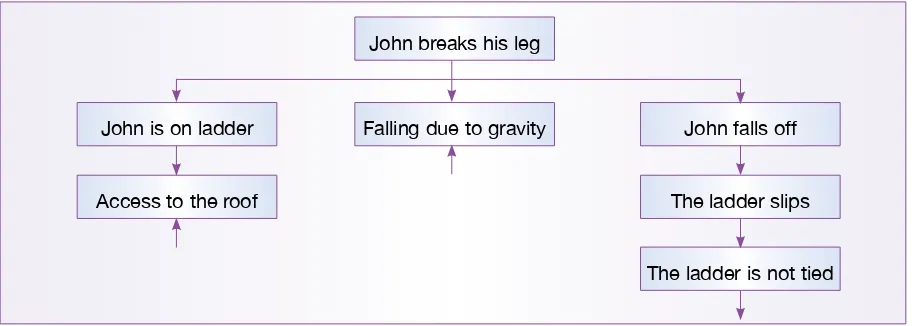
information you have gathered. This guidance uses the simple technique of asking ‘Why’ over and over, until the answer is no longer meaningful (see Figure 5). The starting point is the ‘event’, eg John has broken his leg. On the line below, set out the reasons why this happened. This first line should identify:
n the vulnerable person, eg John on a ladder; n the hazard, eg falling due to gravity;
n the circumstances that brought them together, eg John fell off the ladder. For each of the reasons identified ask ‘Why?’ and set down the answers. Continue down the page asking ‘Why’ until the answers are no longer meaningful.
Do not be concerned at the number of times you ask the question, ‘Why?’ because by doing so you will arrive at the real causes of the adverse event. Some lines of enquiry will quickly end, eg ‘Why was the hazard of falling present?’ Answer: ‘Gravity’.
Having collected the relevant information and determined what happened and why, you can now determine the causes of the adverse event systematically.
Checklist/question analysis of the causes
Using the adverse event analysis work sheets and checklist (in the Adverse Event and Investigation Form), work through the questions about the possible immediate causes of the adverse event (the place, the plant, the people and the process) and identify which are relevant.
Record all the immediate causes identified and the necessary risk control measures.
For each immediate cause, the analysis suggests underlying causes which may have allowed the immediate causes to exist.
Consider the underlying/root cause questions suggested by the immediate causes. Record those that are relevant and note the measures needed to remedy them. The final step of your analysis is to consider the environment in which the
John breaks his leg
Falling due to gravity John falls off
The ladder slips The ladder is not tied John is on ladder
Access to the roof
organisation and planning of health and safety was carried out.
This ‘Management’ section of the analysis must be carried out by people within the organisation who have both the overall responsibility for health and safety, and the authority to make changes to the management system. Record the underlying failings in the overall management system (ie the root causes of the adverse event) and the remedial action required at management level. The root causes of almost all adverse events are failings at managerial level.
Worked examples of the Adverse Event Report and Investigation Form are on page 29.
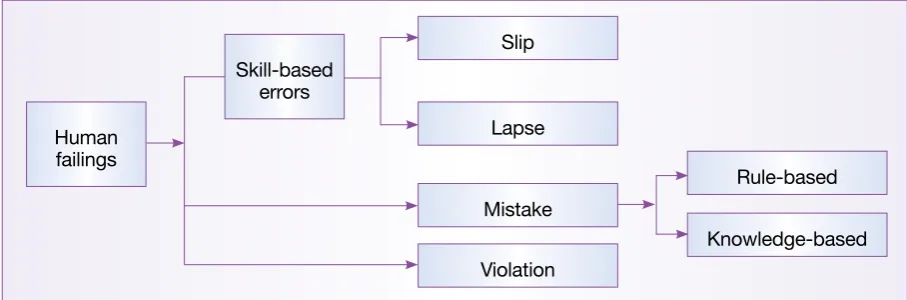
What if ‘human failings (errors and violations)’10 are identified as a
contributory factor?
If your investigation concludes that errors or violations contributed to the adverse event, consider carefully how to handle this information.
Not addressing the ‘human’ factors greatly reduces the value of the investigation. The objective of an investigation is to learn the lessons and to act to prevent recurrences, through suitable risk control measures. You will not be able to do that unless your workforce trusts you enough to co-operate with you.
Laying all the blame on one or more individuals is counter-productive and runs the risk of alienating the workforce and undermining the safety culture, crucial to creating and maintaining a safer working environment.
Speak to those involved and explain how you believe their action(s) contributed to the adverse event. Invite them to explain why they did what they did. This may not only help you better understand the reasons behind the immediate causes of the adverse event, but may offer more pointers to the underlying causes: perhaps the production deadline was short, and removing the guards saved valuable time; maybe the workload is too great for one person etc.
Unless you discover a deliberate and malicious violation or sabotage of workplace safety precautions, it may be counter-productive to take disciplinary action against those involved. Will anyone be open and honest with you the next time an adverse event occurs? What you should aim for is a fair and just system where people are held to account for their behaviour, without being unduly blamed. In any event, your regime of supervision and monitoring of performance should have detected and corrected these unsafe behaviours.
Skill-based errors: a slip or lapse of memory:
n slips happen when a person is carrying out familiar tasks automatically, without thinking, and that person’s action is not as planned, eg operating the wrong switch on a control panel;
n lapses happen when an action is performed out of sequence or a step in a sequence is missed, eg a road tanker driver had completed filling his tanker and was about to disconnect the hose when he was called away to answer the phone. On his return he forgot that he hadn’t disconnected the hose and drove off. These types of error can be foreseen and measures can be taken to prevent or reduce their likelihood, eg colour coding, a checklist, an interlock etc.
Mistakes: errors of judgement (rule-based or knowledge-based):
n rule-based mistakes happen when a person has a set of rules about what to do in certain situations and applies the wrong rule;
n knowledge-based mistakes happen when a person is faced with an
unfamiliar situation for which he or she has no rules, uses his or her knowledge and works from first principles, but comes to a wrong conclusion. For example when the warning light comes on indicating that the cooling system pump is overheating, is there a rule for what to do? If not, do you leave the pump on, turn it off, or shut down the whole unit?
Training, comprehensive safe working procedures and equipment design are most important in preventing mistakes.
Violation (rule breaking):
n deliberate failure to follow the rules, cutting corners to save time or effort, based on the belief that the rules are too restrictive and are not enforced anyway, eg operating a circular saw bench with the guard removed.
This type of behaviour can be foreseen. The provision of training, simple practical rules, and routine supervision and monitoring of performance will reduce this type of behaviour.
When considering how to avoid human failings, bear in mind the fact they do not happen in isolation. If human failings are identified as a cause of an adverse event, consider the following factors that can influence human behaviour.
Job factors:
n how much attention is needed for the task (both too little and too much can lead to higher error rates)?
n divided attention or distractions are present; n inadequate procedures;
n time available.
Human factors:
n physical ability (size and strength);
n competence (knowledge, skill and experience); n fatigue, stress, morale, alcohol or drugs.
Organisational factors:
n work pressure, long hours; n availability of sufficient resources; n quality of supervision;
n management beliefs in health and safety (the safety culture).
Plant and equipment factors:
n how clear and simple to read and understand are the controls?
n is the equipment designed to detect or prevent errors? (For example different-sized connectors are used for oxygen and acetylene bottles to prevent errors in connecting the hoses);
n is the workplace layout user-friendly?
Step three Identifying suitable risk control measures
The methodical approach adopted in the analysis stage will enable failings and possible solutions to be identified. These solutions need to be systematically evaluated and only the optimum solution(s) should be considered for
implementation. If several risk control measures are identified, they should be carefully prioritised as a risk control action plan, which sets out what needs to be done, when and by whom. Assign responsibility for this to ensure the timetable for implementation is monitored.
19 What risk control measures are needed/recommended?
Your analysis of the adverse event will have identified a number of risk control measures that either failed or that could have interrupted the chain of events leading to the adverse event, if they had been in place. You should now draw up a list of all the alternative measures to prevent this, or similar, adverse events.
Some of these measures will be more difficult to implement than others, but this must not influence their listing as possible risk control measures. The time to consider these limitations is later when choosing and prioritising which measures to implement.
Evaluate each of the possible risk control measures on the basis of their ability to prevent recurrences and whether or not they can be successfully implemented.
n measures which eliminate the risk, eg use ‘inherently safe’ products, such as a water-based product rather than a hydrocarbon-based solvent;
n measures which combat the risk at source, eg provision of guarding; n measures which minimise the risk by relying on human behaviour, eg safe
working procedures, the use of personal protective equipment.
In general terms, measures that rely on engineering risk control measures are more reliable than those that rely on people.
20 Do similar risks exist elsewhere? If so, what and where?
Having concluded your investigation of the adverse event, consider the wider implications: could the same thing happen elsewhere in the organisation, on this site or at another location? What steps can be taken to avoid this?
Adverse events might not have occurred at other locations yet, but make an evaluation as to whether the risks are the same and the same or similar risk control measures are appropriate.
21 Have similar adverse events happened before? Give details.
If there have been similar adverse events in the past why have they been allowed to happen again? The fact that such adverse events are still occurring should be a spur to ensure that action is taken quickly. You will be particularly open to criticism if you as an organisation ignore a series of similar accidents.
Remember that there is value in investigating near-misses and undesired
circumstances: it is often only a matter of luck that such incidents do not result in serious injuries or loss of life.
Step four The action plan and its implementation
22 Which risk control measures should be implemented in the short and long term?
The risk control action plan
At this stage in the investigation, senior management, who have the authority to make decisions and act on the recommendations of the investigation team, should be involved.
An action plan for the implementation of additional risk control measures is the desired outcome of a thorough investigation. The action plan should have SMART objectives, ie Specific, Measurable, Agreed, and Realistic, with Timescales.
Deciding where to intervene requires a good knowledge of the organisation and the way it carries out its work. For the risk control measures proposed to be SMART, management, safety professionals, employees and their representatives should all contribute to a constructive discussion on what should be in the action plan.
high, you should act immediately.
You will, no doubt, be subject to financial constraints, but failing to put in place measures to control serious and imminent risks is totally unacceptable. You must either reduce the risks to an acceptable level, or stop the work.
For those risks that are not high and immediate, the risk control measures should be put into your action plan in order of priority. Each risk control measure should be assigned a timescale and a person made responsible for its implementation.
It is crucial that a specific person, preferably a director, partner or senior manager, is made responsible for ensuring that the action plan as a whole is put into effect. This person doesn’t necessarily have to do the work him or herself but he or she should monitor the progress of the risk control action plan.
Progress on the action plan should be regularly reviewed. Any significant departures from the plan should be explained and risk control measure rescheduled, if
appropriate. Employees and their representatives should be kept fully informed of the contents of the risk control action plan and progress with its implementation.
23 Which risk assessments and safe working procedures need to be reviewed and updated?
All relevant risk assessments and safe working procedures should be reviewed after an adverse event. The findings of your investigation should indicate areas of your risk assessments that need improving. It is important that you take a step back and ask what the findings of the investigation tell you about your risk assessments in general. Are they really suitable and sufficient?
Failing to review relevant risk assessments after an adverse event could mean that you are contravening the Management of Health and Safety at Work Regulations 1999 regulation 3(3).5
24 Have the details of adverse event and the investigation findings been recorded and analysed? Are there any trends or common causes which suggest the need for further investigation? What did the adverse event cost?
In addition to the prompt notification of RIDDOR reportable events to the regulatory authorities you should ensure that you keep your own records of adverse events, their causes and the remedial measures taken. This will enable you to monitor your health and safety performance and detect trends, the common causes of adverse events and so improve your overall understanding and management of risk.
It is also useful to estimate the cost of adverse events to fully appreciate the true cost of accidents and ill health to your business.
References and further reading
References
1 Health and safety statistics 2000/01 Report HSE Books 2001 ISBN 978 0 7176 2110 1
2 Health and Safety Statistics Highlights 2002/03 Report MISC623 HSE Books 2003
3 European Social Statistics: Labour Force Survey Results 2001 ISBN 9289436050
4 The cost to Britain of workplace accidents and work-related ill health in 1995/96 HSG101 (Second edition) HSE Books 1999 ISBN 978 0 7176 1709 8 For the latest workplace health and safety statistics see
www.hse.gov.uk/statistics/index.htm.
5 Management of health and safety at work. Management of Health and Safety at Work Regulations 1999. Approved Code of Practice and guidance L21 (Second edition) HSE Books 2000 ISBN 978 0 7176 2488 1 (Regulations 3(3) and 5 refer) www.hse.gov.uk/pubns/books/L21.htm
6 Access to Justice: Final report by the Right Honourable Lord Woolf, Master of the Rolls July 1996 available on the Lord Chancellor’s Department website www.lcd.gov.uk/civil/finalfr.htm
7 Safety representatives and safety committees L87 (Third edition) HSE Books 1996 ISBN 0 7176 1220 1 (Out of print. Replaced by Consulting workers on health and safety: Safety Representatives and Safety Committees Regulations 1977 (as amended) and Health and Safety (Consultation with Employees) Regulations 1996 (as amended) L146 HSE Books 2008 ISBN 978 0 7176 6311 8
www.hse.gov.uk/pubns/books/l146.htm)
8 Root causes analysis: Literature review CRR325 HSE Books 2001 ISBN 978 0 7176 1966 5
9 Events and Casual Factors Analysis is a technique developed for the United States Department of Energy. A full description of the technique is available via their Environmental Health and Safety internet information portal at http://tis.eh.doe.gov/ analysis/trac/14/trac14.htm
10 Reducing error and influencing behaviour HSG48 (Second edition) HSE Books 1999 ISBN 978 0 7176 2452 2 www.hse.gov.uk/pubns/books/hsg48.htm
Further reading
Five steps to risk assessment Leaflet INDG163(rev3) HSE Books 2011 (priced packs of 10 ISBN 978 0 7176 6440 5) www.hse.gov.uk/pubns/books/indg163.pdf
Management of health and safety at work. Management of Health and Safety at Work Regulations 1999. Approved Code of Practice and guidance L21 (Second edition) HSE Books 2000 ISBN 978 0 7176 2488 1
www.hse.gov.uk/pubns/books/L21.htm
A guide to the Reporting of Injuries, Diseases and Dangerous Occurrences Regulations 1995 L73 (Third edition) HSE Books 2008 ISBN 978 0 7176 6290 6 www.hse.gov.uk/pubns/books/L73.htm
Successful health and safety management HSG65 (Second edition) HSE Books 1997 ISBN 978 0 7176 1276 5 www.hse.gov.uk/pubns/books/hsg65.htm
Reducing error and influencing behaviour HSG48 (Second edition) HSE Books 1999 ISBN 978 0 7176 2452 2 www.hse.gov.uk/pubns/books/hsg48.htm
Adverse event report and investigation form
Part 1 Overview
The purpose of this form is to record all adverse events. The term accident is used where injury or ill health occurs. The term incident includes near-misses and undesired circumstances, where there is the potential for injury. Part 1 should be filled out immediately by the manager or supervisor for the work activity involved. Part 2 should be completed by the person responsible for health and safety. Part 3 should be completed, where appropriate, by the investigation team. Part 4 should be completed by the investigating team, together with managers who have the authority to take decisions. When completing Parts 2, 3 and 4 refer to the guidance under ‘A step by step guide to health and safety investigations’.
Part 1 Overview
Reported by:
Brief details (What, where, when, who and emergency measures taken)
Forwarded to: Date
Time
Incident Ill health Minor injury Serious injury Major injury
Date/time of adverse event
Ref no
R Osmund 23.06.03 10.00am
Norman Brown was trying to fix a problem on the edge gluer when the machine operated. Norman cut his right hand quite badly. He was given first aid and taken to hospital.
The fuses have been taken out of the edge gluer and a sign hung on it. X
Richard Wills
23.06.03
Part 2 Initial assessment (to be carried out
by the person responsible for health and
safety)
Y/N
Type of event Actual/potential for harm
Accident
Initial assessment carried out by: Date
Priority
Peter Peterson (fitter), John Evans (foreman) and Richard Wills
23.06.03 15.03.03
Part 3 Investigation information gathering
1 Where and when did the adverse event happen?
6 Were there adequate safe working procedures and were they followed? 5 Was there anything unusual or different about the working conditions?
2 Who was injured/suffered ill health or was otherwise involved with the adverse event?
4 What activities were being carried out at the time?
3 How did the adverse event happen? (Note any equipment involved).
Woodmachine shop
Monday 23rd July 2003 at 11.00 am
Yes. This machine normally is used with mdf skirtings, not aluminium.
No. Machines should be isolated before carrying out repairs. Norman Brown – Injured person woodmachinist
No witnesses
Norman was working on the edge gluing machine on a batch of aluminium skirtings.
Norman discovered a defect in the edge gluing machine. He opened the interlocked lid where the skirting boards are sawn off and planed down. Norman put his pencil into the interlock switch, so he could operate the machine with the guard open, so he could see what was wrong. The cross cut saw operated and cut Norman’s hand.
Part 3 Investigation information gathering
7 What injuries or ill health effects, if any, were caused?
11 Was maintenance and cleaning sufficient? If not, explain why not. 8 If there was an injury, how did it occur and what caused it?
10 Did the organisation and arrangement of the work influence the adverse event? 9 Was the risk known? If so, why wasn’t it controlled? If not, why not?
Severe laceration to the top of the right hand at the knuckles resulting in severing of tendons.
The rotating blade of the cross cut saw.
Yes, but Norman thought he would be OK having a look inside the guard.
No, but Norman had been having trouble with the machine all morning. After the coffee break, he decided to get it fixed.
Part 3 Investigation information gathering
12 Were the people involved competent and suitable?
17 Did other conditions influence the adverse event? 16 Was the safety equipment sufficient?
13 Did the workplace layout influence the adverse event?
15 Did difficulties using the plant and equipment influence the adverse event? 14 Did the nature or shape of the materials influence the adverse event?
Norman was a qualified wood machinist with 9 years’ experience. He had worked on the edge gluing machine for 3 years.
Yes – access to the edger is difficult. Access to the viewing window in the guard is difficult.
Yes – the machine was being used with aluminium rather than the normal mdf skirtings.
Yes, in that the edge gluer was malfunctioning.
No – the interlock switch was of a type easily defeated.
Analysis and further action
18 What were the immediate, underlying and root causes?
Analysis (see ‘Analysis’ under ‘Step two’)
Norman’s hand was in the danger area Norman Brown lacerates
his hand on the edge gluing machine
Because
Why?
Why?
Why?
Because Norman was working on
the machine
The machine was ‘live’, under power Norman was investigating
a fault The guard was open
A
B
C
The saw blade made a stroke
A B C
Analysis and further action
18 What were the immediate, underlying and root causes?
Analysis (see ‘Analysis’ under ‘Step two’)
Norman was investigating a fault
There were no procedures for reporting/repairing
faults Because
Why?
Why?
Why?
Because Because
There was a fault on the machine
There were no arrangements for carrying
out maintenance The machine was being
used for aluminium
Analysis and further action
18 What were the immediate, underlying and root causes?
Analysis (see ‘Analysis’ under ‘Step two’)
Why?
Why?
Why?
The machine was live
The interlock had been defeated The machine was not
isolated Interlock of a type
Analysis and further action
18 What were the immediate, underlying and root causes?
Analysis (see ‘Analysis’ under ‘Step two’)
Norman wanted to see the machine operate
under power The guard was open
Access to the viewing port was obstructed Because
Why?
Because Norman was investigating
a fault
Analysis and further action
18 What were the immediate, underlying and root causes?
Analysis (see ‘Analysis’ under ‘Step two’)
How/Why
1 Edge gluer was used for aluminium without adjusting to suit 2 The saw blade was tearing the end of the sections
3 The operator decided to investigate the cause
4 The operator decides that to find the cause he has to run the machine 5 The operator is unable to see through the viewing port
6 The operator opens the guards and defeats the interlock 7 The machine makes a cutting stroke
8 The operator’s hand is cut by the saw blade
Immediate causes
1 Not enough room around the machine to do the job 2 The saw set up was not suitable for use on aluminium 3 The interlocks fitted were of a type easily defeated 4 There were no safe working procedures for the job 5 Operative not fully competent
Underlying causes
6 Poor workplace layout
7 No risk assessments for use/maintenance of machine 8 Risk assessments didn’t address use of other materials 9 Risk assessments didn’t address violations
10 SWPs were not prepared following risk assessments
11 Operators not trained on machine maintenance and safety devices 12 Level of supervision not adequate – should have detected violations 13 All staff to be reminded of their duties and essential health and safety measures
Root causes
Part 3 Investigation information gathering
19 What risk control measures are needed/recommended?
20 Do similar risks exist elsewhere? If so, what and where?
21 Have similar adverse events happened before? Give details.
1
2
3
4
5
6
Replace interlock switch with tongue type switch
Rearrange machine to allow access to window
Procedures for isolation of machine
Procedures for reporting/repairing defects
Clear allocation of duties
Review risk assessment
Yes – there are similar interlock switches on the multi-headed moulder/planer
Part 4 The risk control action plan
22 Which risk control measures should be implemented in the long and short term?
23 Which risk assessments and safe working procedures need to be reviewed and updated?
Control measure Completion
Prepare SWPs for isolation and reporting and repair/maintenance
Part 4 The risk control action plan
24 Have the details of the adverse event and the investigation findings been recorded and analysed? Are there any trends or common causes which suggest the need for further investigation? What did the adverse event cost?
25 Signed on behalf of the investigation team
26 Members of the investigation team
Name Position
Name Signature
Details have been recorded – no trends or common causes – need to check quality of risk assessments.
Estimated cost of accident £3,700
Richard Wills H&S Officer
John Evans Foreman
27 The findings of this investigation need to be communicated to the following managers, union and employee safety representatives
Person Signature Date
A. Director
W.K.S Manager
A. Rep
Adverse event report and investigation form
Part 1 Overview
The purpose of this form is to record all adverse events. The term accident is used where injury or ill health occurs. The term incident includes near-misses and undesired circumstances, where there is the potential for injury. Part 1 should be filled out immediately by the manager or supervisor for the work activity involved. Part 2 should be completed by the person responsible for health and safety. Part 3 should be completed, where appropriate, by the investigation team. Part 4 should be completed by the investigating team, together with managers who have the authority to take decisions. When completing Parts 2, 3 and 4 refer to the guidance under ‘A step by step guide to health and safety investigations’.
Part 1 Overview
Reported by:
Brief details (What, where, when, who and emergency measures taken)
Forwarded to: Date
Time
Incident Ill health Minor injury Serious injury Major injury
Date/time of adverse event
Ref no
Adam Jones (Wages Dept)
Paul Melish
09.11.03
10.30am Unknown
Sick paper received from John Smith together with a note from his GP which states that he is suffering from occupational asthma
Part 2 Initial assessment (to be carried out
by the person responsibile for health and
safety)
Y/N
Type of event Actual/potential for harm
Injury
Initial assessment carried out by: Date
Priority
P Melish, workshop manager and foreman
09.11.03 11.30 am
1 Where and when did the adverse event happen?
6 Were there adequate safe working procedures and were they followed? 5 Was there anything unusual or different about the working conditions?
2 Who was injured/suffered ill health or was otherwise involved with the adverse event?
4 What activities were being carried out at the time?
3 How did the adverse event happen? (Note any equipment involved).
Spray shop – sometime over last 6 months? John Smith was taken on 6 months ago as a paint sprayer
Nothing different
As normal
John Smith – paint sprayer
Also other sprayers Peter John and Roger Wilson
Duties carried out would have been limited to the mixing and spraying of isocyanate-based spray paint in the spray booth
John works in the paint spray booth.
Booth – Windflow Mark 3 serial no 12345/97 Spray guns – Paintspraymaster model 2
Gun wash – Cleanomax mark 4 serial no 247/99 Half mask – Wearmask model 12 with AXP3 filters
Part 3 Investigation information gathering
7 What injuries or ill health effects, if any, were caused?
11 Was maintenance and cleaning sufficient? If not, explain why not. 8 If there was an injury, how did it occur and what caused it?
10 Did the organisation and arrangement of the work influence the adverse event? 9 Was the risk known? If so, why wasn’t it controlled? If not, why not?
Reported Occupational Asthma
Exposure to isocyanate-based paint suspected Also possible poor quality of air fed to mask
Risks of paint known – existing controls assumed to be sufficient Poor air quality not known
No supervision or monitoring of paint spray shop – air-fed mask not always used – for small jobs half-masks were sometimes used (suitable for working with isocyanates but NOT suitable for spray painting)