Noni Agustina
Primary Teacher Education Department, Esa Unggul University, Arjuna Utara Street No.9 West Jakarta, Indonesia
Email: [email protected]
ABSTRACT
This study reports the students’ assessment through applying the project-based learning in science class for elementary school. The research methodology applied is case study with qualitative approach. The participants of this study are teacher and students of grade 1 and 5 at Budi Luhur elementary school. The instruments to collect data are classroom observation sheets, interviews and rubric of project-based assessment for science class. The result shows that project-based learning is conducted in semester 2 as the substitution of written mid-term test. It is non-test because project-based learning emphasizes on the authentic learning, therefore it is applicable and meaningful for the students. The steps undertaken in project-based learning consist of planning, implementation and evaluation. The project-based learning makes the students glad and enthusiastic. It also encourages the students to have higher cognitive thinking (synthesizing level in Bloom’s taxonomy) and build students’ character. The assessment of project-based learning uses analytical rubric comprising four scales, 4 (excellent), 3 (good), 2 (fair), dan 1 (poor).
ABSTRAK
Penelitian ini menguraikan secara mendalam mengenai penilaian pembelajaran berbasis proyek di SD Budi Luhur. Metode penelitian yang digunakan adalah studi kasus dengan pendekatan kualitatif. Penelitian ini dilaksanakan di SD Budi Luhur. Partisipan penelitian ini adalah guru dan siswa kelas 1 dan 5. Instrumen yang digunakan untuk mengumpulkan data adalah lembar observasi kelas, wawancara dan dokumen yang berupa rubrik penilaian berbasis proyek mata pelajaran sains/IPA. Hasil penelitian menunjukkan bahwa pembelajaran berbasis proyek di SD Budi Luhur dilakukan di semester 2 sebagai pengganti ujian tertulis tengah semester. Pembelajaran berbasis proyek bersifat non-tes karena menekankan pada pembelajaran autentik/ nyata sehingga bersifat aplikatif dan bermakna bagi siswa. Terdapat beberapa langkah-langkah dalam pembelajaran berbasis proyek yaitu tahap perencanaan, pelaksanaan, dan evaluasi. Siswa sangat senang dan antusias dengan pembelajaran berbasis proyek. Selain itu pembelajaran ini memberikan banyak manfaat bagi siswa seperti kemampuan kognitif tingkat yang lebih tinggi (tingkat menciptakan dalam taksonomi Bloom) dan dapat menumbuhkan karakter siswa. Penilaian pembelajaran berbasis proyek menggunakan rubrik penilaian yang terdiri dari beberapa kriteria dengan skala rentangan 4 (excellent), 3 (good), 2 (fair), dan 1 (poor).
Hard skills are not enough in twenty-first era. Those skills must be supported by soft skills in real life. How people can work in a team (cooperative way), socialize to other (interpersonal), solve the problems,
do something
creatively and
innovatively, has flexibility and confidence (Boss
and Krauss,
2007:11). The soft
skills have
important roles
especially in
workplace or
industrial place, therefore those skills must be
education.
In national education system, Law No.20 of 2003
reveals that
educational goal not only creates the intellectual students but also gives them the spirituality,
good moral,
character and skill to equip them in their life. In fact, mostly Indonesian
schools just
concern on the intellectual
development. It can be seen from the learning process in which the students are asked to
memorize the
lesson.
Sanjaya (2006:1) explains
Indonesia should
be reformed.
Memorizing the lesson should be changed because the students just understand the information
without connecting to their real life. This condition makes the students are expert in theory but are not able to
apply the
knowledge in their life. For instance, students are asked to memorize kinds of verbs in present and past context. They are very fluent to mention them; however, they are not able to retell their daily
using those
developed their critical, innovative
and creative
thinking as well
solved the
problems
sufficiently. The learning process emphasizes
memorizing route that is meaningless for the students (Gunawan,
2003:19).
Moreover, mostly teachers
evaluate the
learning process by using
standardized-test. The
tests measure the extent to which students understand and master the
lesson given
without concerning on whole students’ development. The standardized test does not embrace
the social
interaction and real-life context. At the end, the teachers just see the result of students’ achievement not
the learning
process (Sanjaya, 2006:268-269).
Sanjaya also uncovers that students are not successful if their progress is only seen from the result
of their
achievement. Their learning process
must be concerned by looking at the whole students’ development. Therefore, this study proposes the authentic
assessment in
learning process. Tommi (2014:62-64) argues that the authentic
assessment is
applied to measure students’ cognitive,
affective, and
psychomotor development. It shows that the authentic
assessment not only measures the intellectual aspects but also the
behavior or
attitude. One of the authentic
assessments is
project-based learning.
Project-based learning emphasizes on students as subject because students are given chances to explore and
discover the
knowledge.
Teachers do not require talking a lot to deliver the lesson all day long. They have roles as facilitator,
guidance and
motivator for their
students. The
paradigm change
influences the
project-based learning. It is not
teaching but
learning. Some results of research conducted by the
experts show that
assessment of
project-based learning gives the benefit in students’ learning process. Boss and Krauss (2007:11) conclude that project-based learning is a good strategy to increase students’
motivation, participation, problem solving, spirit of teamwork
and critical
thinking. The
learning process will be meaningful for the students. Moreover, project-based learning gains not only students’
Thomas (2000) in McGrath (2002:42) describes
that students’
performance is better when they have project-based
learning than
conventional way. Their
understanding is deeper and more focus to undertake the project.
Many countries
implement project-based learning such
as America,
Singapore,
Scotland, and so on. Singapore has slogan to insist its school to do more
learning less
teaching. Those countries conduct project-based learning because it
is beneficial for the students.
While in Indonesia, project-based learning has not fully been done and has still used standardized test to
measure the
cognitive aspect.
However, the
previous survey undertaken, Budi Luhur elementary school employs project-based learning as the substitution of written mid-term test in semester 2. Therefore, this study aims to
investigate by
digging up the implementation and
assessment of
project-based learning at Budi
Luhur elementary school.
2. Literature Review 2.1. Assessmen
t
Assessment
has close
relationship with
teaching and
learning. Those components cannot
be separated
(Eggen dan
Kauchak, 2007:476).
Teachers undertake
teaching and
learning process
then assess
students’ activities. Reynold, et al. (2009:2) argue that teachers spend a third of their professional time to assess students.
Assessment
is crucial
component in
teaching and
learning process. Hamzah and Koni (2012:2) explain that assessment is a measurement to collect the data on students’ learning process or learning program in order to make a decision. Through
assessment,
teachers can gather the information about students’ learning
characteristics to make a decision (Reynold et al., 2009:3). Further, Brown (2007:445)
reveals that
assessment
learning
performances. Reynold et.al (2009:248) and Brown (2007:462)
divide the
assessment into two, traditional and alternative
assessment. Traditional
assessment refers to the standardized test or paper-pencil
based test.
Alternative
assessment has various forms such as performance, portfolio,
conference, journal, project-based learning and so on.
Lombardi (2008:6) identifies the differences between traditional and alternative assessment. The
traditional assessment
emphasizes on cognitive
development and memorization route
and product
oriented. On the
other hand,
alternative
assessment focuses on interactive and various
performances, skill development related to the real life context and meaningful
learning and give the opportunity to the students to have critical thinking
and process
oriented.
2.2. Project-based learning
Project-based learning is a
learning
methodology that focuses on student-centered (Grant, 2002:1). Students make a project based on their interest and ability so they will be independent
learners. They do not listen to the teachers all day and memorize but they learn by doing.
Project-based learning involves students to design, solve the problem, make decision and work independently (Thomas, 2000:1). They will create a work by solving the
real problem
(McGrath,
2002:42). Project-based learning also can establish fun
and flexible
learning (Klein et
al., 2009:7;
Doppelt, 2003:255).
Project-based learning is also
beneficial for
teachers and
parents. Curtis (2002) in McGrath (2002:42) finds that they are happy to see their students or
children are
enthusiastic in doing the projects.
The aims of project-based
learning are
creating fun
activities,
facilitating the students to learn in
social context
discover the
knowledge by
themselves so the learning will be meaningful for them, encourage the students to solve the problem and use kinds of learning sources as well do the experiment, and developing
students’ reflection (Seidel and Aryeh, 2002:19-20). Klein et al. (2009:7-9) adds that students can grasp the lesson by
creating and
presenting the
project based on their interest. They will be creative, active, and critical. To conduct project-based learning, teachers
must determine some steps. Klein et al. (2009:11) explicate the steps are deciding the objective and the skills that will be
reached by
addressing the
project theme
referring to the curriculum,
determining the
format of
project(the final product of project),
informing the
timeline, designing
the learning
process, and
assessing the
project-based learning. Those steps are almost same as McGrath’s (2002:42-44). The steps in employing project-based
learning are
discussing the
topic, preparing and planning the project by making
groups and
informing what they will do,
guiding the
students in making project, evaluating and criticizing the project result, and
presenting the
students’ work in front of their parents.
2.3. Assessment of project-based learning
Assessment of project-based
learning is
important to
decide. Klein et al. (2009:17) address that students must
know the
assessment criteria
in making project at beginning. When they know the assessment criteria, they can assess themselves and do the best for their project.
Rubric is one of the instruments to assess project-based learning. It can be used for the teacher to assess
the students’
progress in making the project and give the feedback for the students.
Reynold et al. (2009:256-258) classify rubric into two, analytical scoring rubric and holistic scoring rubric. Analytical
scoring rubric
on students’
strength and
weakness. On the other hand, holistic scoring rubric is less detail. Rubric has rating scale to
indicate the
assessment quality
consisting of
outstanding, good, average, poor or frequency
comprising always, often, sometimes, seldom, never, and so on.
Klein et al. (2009:72) provides project-based learning rubric for science class. The rubric’s criteria consists of the project, conceptual understanding of science, scientific process, written
work, oral
presentation. Each criteria has its own description (the complete rubric can be seen in Klein et al.’s book). The rating scale comprises exceeds standards (4
points), meets
standard (3 points),
approaching
standard (2 points), and significantly below standard (1 point).
Carrol
(2005:99) has
different
assessment from Klein et al. He does
assessment of
project-based
learning at
Limerick
University. The criteria consist of presentation, the use of visual aid,
logical structure, handling objection, grabbing
audience’s
attention and
innovation. All those criteria are represented in A, B, C, and D. Each of them has different
description. A
refers to the excellent, B is good, C is fair, D is less satisfying, and
E is poor.
2.4 The previous studies on assessment of project-based learning
Some
relevant studies are conducted by some
researchers on
project-based learning. Doppelt investigates
(2003:255-271) 54
junior high students who have low achievement. But when they do project, they have
novelty and
meaningful
learning. Their responsibility, confidence, and learning
achievement
increase. Even though Dopplet’s
research has
positive impact but it has not shown the steps in conducting project-based learning and the assessment completely.
learning has some
strength and
weakness. The weakness is some teachers do not want to apply the project-based learning because they have lack experience doing it, even though it is
integrated in
curriculum. On the other hand, it gives the positive impact in increasing the
cognitive and
emotional
development for the students and developing
students’
confidence and learning quality. The research result of this study also has not disclosed the assessment of
project-based learning.
Baş (2011:2-10) undertakes the experimental research to ninth grade by applying the project-based learning. The result shows that students have good learning result and better attitude than those do not make the project. Musa et al. (2012:572) find similar result to Baş that project-based learning can develop students’
soft skills.
Moreover, project-based learning
contributes to
students’ cognitive,
affective, and
psychomotor development
(Kettanun, 2015:572-573).
Those researches focus on project-based learning and the results show that they have the
strength and
weakness. The researches have not
disclosed the
implementation and assessment with the criteria in detail.
3. Research Methodology
This study employs the case study methodology and qualitative as
its approach.
Cresswell (1998:36-61) argues that case study is used to explore a case which refers to a
program, event, activities or an individual. Burn (2000: 459-460) and Nunan (1992: 75-79) add that case study is also used to obtain a deep understanding or portray toward a detail investigated case. This study focuses on the deep investigation on project-based learning of fifth and first graders.
3.1.Setting and Participants
The study was conducted at
Budi Luhur
Elementary School located at Jombang Raya Street, South Tangerang. The data sources are
students of grade 1 and 5. The data
consists of
interview
transcripts and project-based learning rubrics as well classroom observation.
3.2 . Data
collection procedure
According to Cresswell
(2008:220),
collecting data meant gathering the
information to
address the
research questions. Some steps to collect the data are as follows:
1. Observation
sheets Classroom
observation is
conducted to
investigate project-based learning from planning,
implementing and evaluating phases. The observation is undertaken in class 1 and 5 at science class by recording those phases.
2. Document
analysis Project-based
learning is
assessed by using the rubrics. Those rubrics can be collected as data. The rubrics cover the planning, implementing and evaluating phases of project-based learning.
3. Interview
transcript
This study uses semi-structure interview. The
interview is
addressed to the
teachers and
students of grade 1 and 5.
This study employs more than one instrument to collect the data. This collection data
is called
triangulation. Triangulation is the process to collect the data by
applying the
multiple sources. It aims to build the
accurate and
credible data.
(Sugiyono, 2013:397-399; Cresswell, 2008:266).
3.3 Data analysis and
interpretation Procedure
After
collecting data, the
analysis and
interpretation data
are conducted
(Cresswell, 2008:244). Sugiyono (2013:405-412)
presents some
procedures in
analyzing the data consisting of data reduction, data display and draw the conclusion. Data reduction means taking the
important and
and interpretation data of this study were as follows:
1.
Project-based learning rubric, interview transcripts and observation sheets are used as analysis data.
2. The data
were reduced 3. Those data
were displayed in table and short description
4. The data are were interpreted and concluded
4. Research Finding and Discussion
4.1 The
implementatio n of project-based
learning in
Budi Luhur elementary school
The finding
from the
observation and interview shows that Budi Luhur elementary school implements
project-based
learning at
semester 2 for substituting written mid-term test. This school applies this learning because it
is applicable.
Students can
develop their
higher order
thinking such as analyzing and synthesizing skill. Moreover it also can enhance their presentation skill,
bravery in
expressing their
idea, creativity, and teamwok. Tommi (2014:62-64)
unveils that
project-based
learning is
authentic. On the other word, project-based learning can be used to assess students’
performance with interactive and innovative way as well focus on process. Written test is not suitable to measure the students’
performance
(Brown, 2007:462). The other finding reveals that some steps of project-based
learning are
undertaken by the
students and
teachers as follows:
1. Making the
rubric as the guidelines to measure
students’
learning process. The rubrics can be used to measure
students’ performance from beginning (planning) until ending
(presentation) of the learning process.
2. Dividing
students into some groups. Each group has three or four students. The division is based on the students’ characteristics. 3. Explaining
content for the project.
The materials or content refer to the competency standard and based
competency
(goal and
objective) in curriculum (KTSP).
4. Leting the
students to
prepare the
project stuff. Students prepare the stuff or equipment for
making the
project. They write what they bring to school on their diary book. The diary book is a means
of the
communication book between
teachers and parents.
5. Conducting
the project-based learning for two weeks including the presentation.
Two weeks
embrace the planning,
implementing, and evaluating process.
6. Allowing
the students to do the project based on their creativity and letting them to
solve the
problem in
group.
Students are not
forced to
memorize the lesson but they are encouraged to express their
idea to solve the problem with their team by linking it to their life.
7. Giving the model how to present their final project. Even though they are given the example to present their project, they have a freedom to present with their own style referring to the the guidelines given to them.
8. Providing
chances for the students to have the presentation exercise.
The students have time to practice with their team in
presenting their final project.
9. Assesing
presentation for their project Although the project is made in group, they present their final project individually. This assessment emphasizes on the content and procedure when they make the project.
10. Assesing
the students’
behavior or
attitude while
making the
project.
There are some behaviour or attitude
ability,
independence, confidence, tolerance, and leadership.
Those steps are almost similar to Klein et al.
(2009:11) and
McGrath (2002:42-44). The steps are deciding the goal, topic, theme or format; preparing and planning the project as well the
schedule and
learning activities;
guiding the
students; presenting the final projects; and assessing the process and final project.
The other finding indicates that project-based learning makes the students
enthusiastic and busy to accomplish their project. They share their thought, idea, and work to make their project. They prefer to make the project than do the written test because they can express their idea and help each other to finish their project. Doppelt (2003:255-271), Efstratia, Douladeli (2014:1258-1259), Baş (2011:2-10) and Musa et al. (2012:572) find that project-based
learning has
positive impact for
the students.
Doppelt
demonstrates that project-based learning develops students’
achievement, responsibility and confidence than conventional
learning. Efstratia (2014:1258-1259) points out that project-based
learning can
enhance students’ cognitive, emotion and confidence. Baş and Musa et al. prove that project-based learning can change students’ attitude to be better such as team work or participation.
4.2 Assessment of project-based learning in Budi Luhur elementary school
The findings of project-based learning rubrics
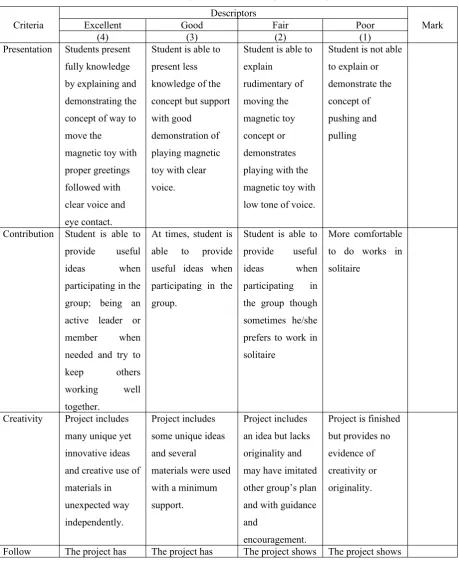
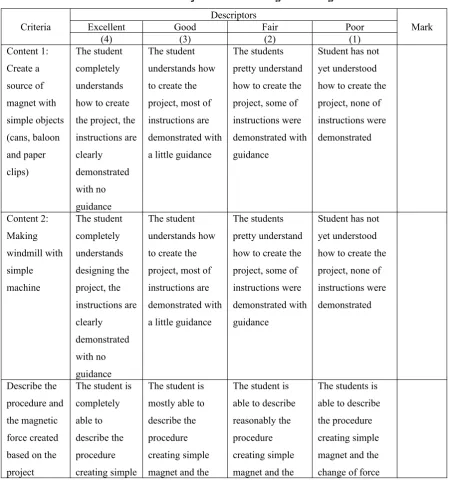
between grade 1 and 5 are different in format, even though those have same goal to assess students’ learning progress. It can be seen that the format has not been standardized for each class in that school. Those rubrics can be seen in table 1 and 2.
Project-based learning rubric of grade 1 has four criteria:
presentation, contribution,
creativity, dan follow instruction. Presentation refers to students’ ability in presenting their
final poject.
Contribution
group, help each other, or share the idea or opinion in making the project. Creativity
emphasizes on students’ skill in
creating their
project with their
original and
creative thought. Follow instruction means students’ skill to understand the instruction and internalize it into
their project.
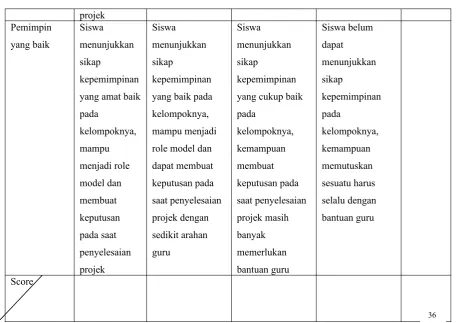
Meanwhile, the rubric of grade 5 consists of three criteria as follows: content,
presentation, and character building
aspects. The
character building aspects are divided into some criteria
such as
independence (kemandirian), confidence
(percaya diri), creativity( kreatif), tolerance (saling menghormati), and leadership
(kepemimpinan). The fifth graders must make two science projects: Create a source of magnet with simple objects and make
windmill with
simple machine, therefore they have two criteria for the
content and
presentation. The rating scale of those rubric comprises excellent (4 points), good (3 points), fair (2 points) and poor (1 points). Total score for
project-based learning for grade 1 is 16. It is the sum of presentation (4
points) +
contribution (4 points) + creativity
(4 points) + follow instruction (4 points). On the other hand, the total score for grade 5 is 36. It is the sum of content 1 (4 points) + content 2 (4 points) + presentation 1 (4
points) +
presentation 2 (4
points) +
independence (4
points) +
confidence (4
points) + creativity (4 points) + tolerance (4 points) + leadership (4 points). Those total score will be
converted into 0-100 range. For instance, if a student of grade 1 gets 14 points, she/ he will get 88 (14 points is divided by 16 then multiplied by 100).
The analysis of project-based learning rubric of grade 1 shows that the presentation skill, contribution in group, creativity and ability to
follow the
instruction are in good level. The average of those is 3.65, 3.2, 3.6, and 3.65. The data can be seen from table 3.
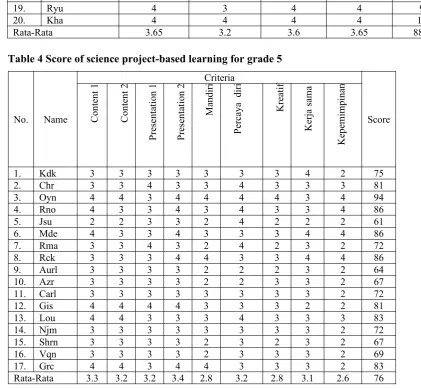
ability. The average is 3.2 and 3.25. They have fair independence,
creativity and
leadership in
making the project with the average 2.8, 2.8, and 2.6.
Students are
confident and able to work in team. It can be seen from the average 3.2 and 3.1. Look at table 4
for detail
information.
5. Conclusion
Applying project-based learning as the replacement of written mid-term test of semester 2
gives positive
impact to the
students. The
students are happy
and enthusiastic in doing the project-based learning. They can share their idea, help each other and work together in team to solve the
problem. The
project-based
learning can
develop the
students’ character building such as their interpersonal skill, leadership, teamwork, and bravery.
Project-based learning conducted consists of some steps such as planning,
implementing, and evaluating. The process of project-based learning from beginning until ending is
assessed by using the rubric. The rubric of grade 1 and 5 has slightly difference from the criteria. It occurs because the criteria in grade 5 have two projects and detail character building. Therefore, this study recommends Budi Luhur School to make the standard criteria for all classes.
A further research is also required to conduct because this study only investigates the project-based learning for science class. It will be better to securitize the other subjects.
References
Aksel, Aynur and Fatma
Gurman-Kahraman. 2014. Video project assignment and their effectiveness on foreign language learning. www.science direct.com
Brown, H.Douglas. 2007.
Teaching by principles. An
interactive approach to language pedagogy. Third
Edition. NY: Pearson Longman
Boss, Suzie and Jane Krauss. 2007.
Reinventing project-based learning. Your field guide to real-world
projects in the digital age. USA: ISTE
Introduction to research method. Fourt edition. Australia: Pearson Education Australia Limited
Cresswell, John W. 1998.
Qualitative inquiry and research design. USA: Sage
Publication.
Cresswell, John W. 2008. Educational research. Planning, conducting, and evaluating quantitative and qualitative research. Third edition. New Jersey: Pearson
Doppelt, Yaron. 2003.
Implementati
on and
Assessment of Project-Based
Learning in a
Flexible Environment.
International Journal of Technology and Design Education 13, 255–272. Efstratia, Douladeli. 2014. Experiential education through project based learning.
Procedia -Social and Behavioral Sciences 152 ( 2014 ) 1256
– 1260.
www.science direct.com
Eggen, Paul and Don
Kauchak. 2007.
Educational psychology. Windows on classrooms. Seventh edition. New Jersey:
Pearson Merril Precentice Hall.
Grant, Michael M. 2002.
Getting a grip on project-based
learning: theory, cases and
recommendat ions.
Meridian: A Middle School Computer Technologies Journal
Volume 5,
Issue 1. Retrieved from http://www.n csu.edu/meri dian/win2002 /514/3.html
Gunawan, Adi W. 2003. Genius learning strategy. Jakarta: Gramedia pustaka utama
Hamzah dan Koni. 2012.
Assessment pembelajara n. Jakarta: Bumi Aksara
Klein et al. 2009.
School
students to engage in deep and active
learning. NY: NYC
Department
Laur, Dayna. 2013.
Authentic Learning Experiences. A real-world approach to project-based learning. USA: Routledge
Lombardi, Marylin M. 2008.
Making the Grade: The
Role of
Assessment in Authentic Learning.
ELI Paper 1: 2008 January 2008.
net.educause. edu/ir/library/ pdf/eli3019.p df
McGrath, Diane. 2002. Getting started with project-based learning.
ISTE
Technology in Education)
Volume 30 Number 3
Musa, Faridah et.al. 2012.
Project-based learning (PjBL): inculcating soft skills in 21stcenturyw ork place.
Procedia -Social and Behavioral Sciences 59 (2012 ) 565 – 573.
Retrieved from
www.science direct.com
Nunan, David. 1992.
Reseach methods in language learning. New York: Cambridge University Press
Reynold, Cecil et.al. 2009.
Measurement and
assessment in education.
New Jersey: Pearson
Sanjaya, Wina. 2007.
Strategi pembelajara n
berorientasi standard proses pendidikan. Jakarta: Kencana Prenada Media Group
Seidel,Steve dan Laura Aryeh. 2002.
Learning in After-School Programmin g. Boston’s after-school
for all
partnership learning goal research
Sugiyono. 2013.
Metode penelitian manajemen. Bandung:Alf abeta
Thomas, John W.
2000. A
review of research on project-based learning.
http://www.a utodesk.com/found ation
Yuniawan, Tommi. 2014. “Model penilaian kinerja dalam pembelajaran membaca berbasis teks narasi
bermuatan pendidikan karakater cinta budaya”.
Criteria
Descriptors
Mark
Excellent Good Fair Poor
(4) (3) (2) (1)
Presentation Students present fully knowledge by explaining and demonstrating the concept of way to move the
magnetic toy with proper greetings followed with clear voice and eye contact.
Student is able to present less knowledge of the concept but support with good
demonstration of playing magnetic toy with clear voice.
Student is able to explain
rudimentary of moving the magnetic toy concept or demonstrates playing with the magnetic toy with low tone of voice.
Student is not able to explain or demonstrate the concept of pushing and pulling
Contribution Student is able to provide useful ideas when participating in the group; being an active leader or member when needed and try to keep others working well together.
At times, student is able to provide useful ideas when participating in the group.
Student is able to provide useful ideas when participating in the group though sometimes he/she prefers to work in solitaire
More comfortable to do works in solitaire
Creativity Project includes many unique yet innovative ideas and creative use of materials in unexpected way independently.
Project includes some unique ideas and several materials were used with a minimum support.
Project includes an idea but lacks originality and may have imitated other group’s plan and with guidance and
encouragement.
Project is finished but provides no evidence of creativity or originality.
Instructions planned carefully; understanding of all instructions is clearly
demonstrated.
planned carefully; understanding of all instructions is demonstrated.
little evidence of understanding of the instructions.
no understanding of the
instructions.
Score
Table 2. Project-based learning rubric of grade 5
Criteria
Descriptors
Mark
Excellent Good Fair Poor
(4) (3) (2) (1)
Content 1: Create a source of magnet with simple objects (cans, baloon and paper clips)
The student completely understands how to create the project, the instructions are clearly demonstrated with no guidance
The student understands how to create the project, most of instructions are demonstrated with a little guidance
The students pretty understand how to create the project, some of instructions were demonstrated with guidance
Student has not yet understood how to create the project, none of instructions were demonstrated
Content 2: Making windmill with simple machine
The student completely understands designing the project, the instructions are clearly demonstrated with no guidance
The student understands how to create the project, most of instructions are demonstrated with a little guidance
The students pretty understand how to create the project, some of instructions were demonstrated with guidance
Student has not yet understood how to create the project, none of instructions were demonstrated
Describe the procedure and the magnetic force created based on the project
The student is completely able to describe the procedure creating simple
The student is mostly able to describe the procedure creating simple magnet and the
The student is able to describe reasonably the procedure creating simple magnet and the
The students is able to describe the procedure creating simple magnet and the change of force
magnet and the change of force based on the project
change of force based on the project
change of force based on the project
only with guidance
Describe the procedure for designing windmill with simple machine, and the energy transferred from the dynamo's magnet
The student is completely able to describe the procedure designing windmill with simple machine and is able to describe the energy transferred
The student is mostly able to describe the procedure designing windmill with simple machine and is able to describe the energy transferred
The student is able to describe reasonably the procedure designing windmill with simple machine and is able to describe the energy transferred
The students is able to describe the procedure designing windmill with simple machine and the energy transferred only with guidance
Mandiri Siswa mampu menunjukan sikap mandiri yang amat baik. Persiapan, perencanaan, pelaksanaan dan
penyelesaian projek dilakukan tanpa bantuan guru
Siswa mampu menunjukkan sikap mandiri yang baik. Perencanaan, pelaksanaan dan penyelesaian projek dilakukan dengan sedikit bantuan guru
Siswa telah menunjukkan sikap mandiri dalam persiapan, perencanaan projek. Namun pada pelaksanaan dan penyelesaian projek masih banyak membutuhkan bantuan guru
Siswa belum dapat menunjukkan sikap mandiri. Dalam persiapan, perencanaan, pelaksanaan dan penyelesaian projek harus selalu dengan bantuan guru dan orangtua
Percaya diri Siswa mampu menunjukkan sikap percaya diri yang amat baik ketika
Siswa mampu menunjukkan sikap percaya diri yang baik ketika menyampaikan
Siswa cukup percaya diri ketika
menyampaikan pendapat pada
menyampaikan pendapat pada saat
pelaksanaan projek, serta pada saat mempresentasi kan projek
pendapat pada saat pelaksanaan projek, serta pada saat
mempresentasika n projek
saat pelaksanaan projek, pada saat mempresentasika n projek di kelas masih
memerlukan dorongan guru
menyampaikan pendapat pada saat pelaksanaan projek, pada saat presentasi projek harus selalu mendapat dorongan guru Kreatif Siswa
menunjukkan kemampuan yang amat baik dalam
berkreasi pada desain projek, serta mampu memecahkan masalah dalam penyelesaian projek tanpa bantuan guru
Siswa menunjukkan kemampuan yang baik dalam berkreasi pada desain projek, serta mampu memecahkan masalah dalam penyelesaian projek dengan sedikit bantuan guru
Siswa cukup mampu berkreasi pada desain projek, kemampuan menyelesaikan masalah dalam penyelesaian projek masih memerlukan banyak bantuan guru
Siswa belum dapat menunjukkan kemampuan berkreasi pada desain projek, kemampuan menyelesaikan masalah dalam penyelesaian projek harus selalu dengan bantuan guru Kerja sama
dan saling menghormati
siswa menunjukkan kemampuan bekerja sama yang amat baik dengan kelompoknya, serta mampu menunjukkan sikap menghormati terhadap pendapat orang lain pada saat pelaksanaan
siswa menunjukkan kemampuan bekerja sama yang baik dengan kelompoknya, serta mampu menunjukkan sikap menghormati pendapat teman pada saat penyelesaian projek
siswa menunjukkan kemampuan bekerja sama yang cukup baik dengan
kelompoknya, sikap
menghormati pendapat orang lain terkadang masih membutuhkan pengawasan dan arahan guru
siswa belum dapat menunjukkan kemampuan bekerja sama, sikap
projek Pemimpin
yang baik
Siswa menunjukkan sikap
kepemimpinan yang amat baik pada
kelompoknya, mampu menjadi role model dan membuat keputusan pada saat penyelesaian projek
Siswa menunjukkan sikap
kepemimpinan yang baik pada kelompoknya, mampu menjadi role model dan dapat membuat keputusan pada saat penyelesaian projek dengan sedikit arahan guru
Siswa menunjukkan sikap
kepemimpinan yang cukup baik pada
kelompoknya, kemampuan membuat keputusan pada saat penyelesaian projek masih banyak memerlukan bantuan guru
Siswa belum dapat menunjukkan sikap
kepemimpinan pada
kelompoknya, kemampuan memutuskan sesuatu harus selalu dengan bantuan guru
Score
Table 3. Score of science project-based learning for grade 1
No. Name
Criteria
Score Presentation Contribution Creativity Follow
Instruction
1. Aud 4 2 4 4 88
2. Mar 4 3 3 4 88
3. Ald 4 3 4 4 94
4. Bun 4 4 4 4 100
5. Tris 3 3 4 4 88
6. Ayo 3 4 3 4 88
7. Erd 4 3 3 4 88
8. Bil 4 4 4 3 94
9. Dai 3 2 4 4 81
10. Mai 4 4 4 3 94
11. Nar 4 4 3 3 88
12. Sat 3 3 3 3 75
13. Ard 4 3 2 3 75
14. Raf 1 2 3 2 50
15. Nat 4 2 4 4 88
16. Liw 4 4 4 4 100
17. Chr 4 3 4 4 94
18. Bra 4 4 4 4 100
19. Ryu 4 3 4 4 94
20. Kha 4 4 4 4 100
Rata-Rata 3.65 3.2 3.6 3.65 88.35
Table 4 Score of science project-based learning for grade 5
No. Name
Criteria
Score
C
on
te
nt
1
C
on
te
nt
2
P
re
se
nt
at
io
n
1
P
re
se
nt
at
io
n
2
M
an
di
ri
P
er
ca
ya
d
ir
i
K
re
at
if
K
er
ja
s
am
a
K
ep
em
im
pi
na
n
1. Kdk 3 3 3 3 3 3 3 4 2 75
2. Chr 3 3 4 3 3 4 3 3 3 81
3. Oyn 4 4 3 4 4 4 4 3 4 94
4. Rno 4 3 3 4 3 4 3 3 4 86
5. Jsu 2 2 3 3 2 4 2 2 2 61
6. Mde 4 3 3 4 3 3 3 4 4 86
7. Rma 3 3 4 3 2 4 2 3 2 72
8. Rck 3 3 3 4 4 3 3 4 4 86
9. Aurl 3 3 3 3 2 2 2 3 2 64
10. Azr 3 3 3 3 2 2 3 3 2 67
11. Carl 3 3 3 3 3 3 3 3 2 72
12. Gis 4 4 4 4 3 3 3 2 2 81
13. Lou 4 4 3 3 3 4 3 3 3 83
14. Njm 3 3 3 3 3 3 3 3 2 72
15. Shrn 3 3 3 3 2 3 2 3 2 67
16. Vqn 3 3 3 3 2 3 3 3 2 69
17. Grc 4 4 3 4 4 3 3 3 2 83