AN ANALYSIS OF STUDENTS’ VOCABULARY LEARNING
STYLE AT EIGHTH GRADE OF JUNIOR HIGH
SCHOOL 20 PEKANBARU
BY
SYELLA ARDANI
SIN. 11513200231
FACULTY OF EDUCATION AND TEACHER TRAINING
STATE ISLAMIC UNIVERSITY OF SULTAN SYARIF KASIM RIAU
PEKANBARU
AN ANALYSIS OF STUDENTS’ VOCABULARY LEARNING
STYLE AT EIGHTH GRADE OF JUNIOR HIGH
SCHOOL 20 PEKANBARU
A Thesis
Submitted to Fulfill one of Requirements For Getting Bachelor Degree in English Education
(S.Pd.)
By
SYELLA ARDANI
SIN. 11513200231
DEPARTMENT OF ENGLISH EDUCATION
FACULTY OF EDUCATION AND TEACHER TRAINING
STATE ISLAMIC UNIVERSITY OF SULTAN SYARIF KASIM RIAU
PEKANBARU
iii MOTTO
Indeed, with hardship [will be] ease. So when you have finished [your duties], then stand up [for worship]. And to your Lord direct [your] longing.
(Q.S. Ash-Sharh 94: 6-8)
Abu Huraira reported: The Messenger of Allah, peace and blessing be upon him said : “Whoever travels a path in search of knowledge,
Allah make easy for him a path to Paradise.”
iv
ACKNOWLEDGEMENT
ُُهُتاَكَرَبَوِهللاُةَم ْحَرَوْمُكْيَلَعُمَلاَّسلا
Alhamdulillahirabbil’alamin, All praises belong to Allah the lord of the world and the creator of universe, by His guidance and blessing the writer has completed this project paper entitled: “An Analysis of Students’ Vocabulary Learning Style at Eighth Grade Students Of Junior High School 20 Pekanbaru”.
Then, the writer says peace be upon Prophet Muhammad S.A.W. in finishing this paper, the writer got many valuable helps and advice from many people. Therefore, the writer wishes to express sincere thanks to them, they are :
1. Prof. Dr. KH. Akhmad Mujahidin, S.Ag., M.Ag., the Rector of State Islamic University of Sultan Syarif Kasim Riau. Dr. Drs. H. Suryan A. Jamrah, MA, the Vice Rector I of State Islamic University of Sultan Syarif Kasim Riau. Drs. H. Promadi, MA, Ph.D, the Vice Rector III of State Islamic University of Sultan Syarif Kasim Riau.
2. Dr. H. Muhammad Syaifuddin, S.Ag., M. Ag., the Dean of Education and Teacher Training Faculty. Dr. Drs. Alimuddin, M.Ag., the Vice Dean I of Education and Teacher Training Faculty. Dr. Dra. Rohani, M.Pd., the Vice Dean II of Education and Teacher Training Faculty. Dr. Drs. Nursalim, M.Pd., the Vice Dean III of Education and Teacher Training Faculty. 3. Drs. Samsi Hasan, M.H.Sc., the Head of Department of English Education
and Cut Raudhatul Miski, S.Pd. M.Pd., the Secretary of English Education. Thanks a lot for the guidence, advice and help given to the writer to complete this thesis.
4. Nurdiana M.Pd., the Academic Advisor. Thanks a lot for the guidance, help and suggestions.
5. Idham Syahputra, M.Ed., the writer’s supervisor I and Rizki Amelia, M.Pd., the writer’s supervisor II, thank you very much for the correction, suggestion, guidance and kindness in completing this thesis.
v
6. All lectures of English Education Department who has given suggestions and motivations. They have taught and transferred their knowledge during the courses.
7. Syafrida Ali, S.Pd., the Headmaster of Junior High School 20 Pekanbaru and Yetty A. A. Ernaputri, the English teacher who gave time and place to the writer in conducting the research. Thank you very much for your kindness, attention, cooperation and time instilling the data of the research. 8. Her lovely father Arsyad and her lovely mother Mariani Lubis who give their great love, attention, time, advice, support and prayer in all situations to the witer.
9. Her beloved brothers Syahrul Ardani S.Sos. and M. Arif Ilham. Thank you for all support, kindness, advice, love and prayer.
10.Her sweety cousin Novita Sari S.Pd, M. Amin ST, Dani SE, Mona and Lia. Thanks for your kindess, support, help and love. Without you maybe the writer jouney in college time not going as expected.
11.Her crazy and sweet friends, Novia Anisah Rahmi SE, Epa Sari S.Sos and Rika Wildayanti SE, who give the unforgettable memory and always support emotionally and materially with prayer, love and patience.
12.Her best friends, Ega Diona and Humairah Zahra. Thanks a lot for kindness, help, love and always be there when the writer needs. Hopefully, they will be best friends until Jannah.
13.Her favorite and lovely Squad, SAKA squad, Aulia Rahma Fitri, Annisa Nabilah, and Kartika Aruna Putri. Thanks for always support and help. 14.Her skripsweet partner, Nadya Aprilia S.Pd. Thanks for being the writer’s
friend in this thesis process with joy, sorrow, jokes, laughter and unforgettable stories.
15.Her partner in crime, Afdhal Zikri, Aryanda Sani Pratama Siregar and Rino Akmal. Thanks for be the writer’s friends who accompany passing the college times with joke, laugh, love and everything.
16.Her colleague in BEM UIN SUSKA, Kita UIN Suska cabinet, Dini Oktaviana S.Pd., Toibah S.Pd., Sri Wahyuni S.Pd., Dwi Citra Jayati,
vi
Nursepti Randa Sari S.Sos, Selvi Diana, Nurul Izzah, Lia Maulita Sari S.Pd., Vinka Rahayu Putri, Desparyan Azizi Norman, Ikhsanul Kahfi, Insanul Kamil Negarawan S.I.Kom, Armansyah S.Pd., Endriyanto S.H., Misbahuddin Syauqi and Hamdan Syakirin S.Sos. Thanks for the lesson, experience and memories
17. Her beloved friends in English Education Department, especially the member of Golden class 2015, Annisa Fadilla Suci, Darma Yunita Sari, Rahmi Lestari, Nopela Amanda S.Pd., Ira Irwana S.Pd., Wilda Septiani S.Pd., Lukman Syaifuddin, Oka Setiawan S.Pd., Yogi Arisandi S.Pd., etc. that the writer can not write one by one. Thanks for help, support and motivation.
18.Her beloved friends in TIM KKN 3B, Hendra J. Alamsyah ST, Syaviqllyffallaq, Candra Hermawan SE, Nugroho Febriandi, Pitriya Anggun Sari ST, Lutfia Davin, Laila Ramadhani, Anisah Meisura S.Pd., Novia Anisah Rahmi SE. and Epa Sari S.Sos. Thanks for the memories and everything.
19.Her beloved friends in PPL SMAN 6 Pekanbaru, Riyan Nofriyanto, Didi Irmansyah, Boby Novri Alvando, Prayuda Bayu Anggara, Famelia Anggita Putri, Siti Maimunah S.Pd., Uswatun Hasana Rosbi, Shinta Mailani, Revi Linda Putri S.Pd., Cici Nadia, Nupi Susanti, Rina Lisdawati S.Pd. and Yelcy J. Sulaini. Thanks a lot for the kindness, help and support. She never forgets all of them as a new relative in her life.
Finally, the writer realizes that this thesis is still far from perfections. Therefore, constructive comments, critiques and suggestions are appreciated very much. May Allah almighty the lord of the universe bless them all, Aamiin.
Pekanbaru, August 27th 2019
Syella Ardani SIN.11513200231
vii ABSTRACT
Syella Ardani (2019) An Analysis of Students’ Vocabulary Learning Style at Eighth Grade of Junior High School 20 Pekanbaru
Based on writer preliminary study, it was found that, the students could not reach the Standard Minimum Score of Vocabulary. The students also did not know what their learning style in learning vocabulary. This problem was caused by some factors. For example, most of the teachers have difficulty to find what their students’ learning style in learning vocabularies, most of the students have difficulty to find what their learning style in learning vocabularies and Some of the students have difficulty in finding meaning of the vocabularies. So, the researcher was interested to carrying out the research about this problem. The design of this research is mix-method research. The research was administered at Junior High School 20 Pekanbaru. In this research just have one variable; students' vocabulary learning style. The subject of this research is the eight grade of Junior High School 20 Pekanbaru, while the object of this research is analyze students’ vocabulary learning style. The population of this research was all of the eight grade of Junior High School 20 Pekanbaru and the researcher took 84 students as sample of this research by using cluster random sampling. To collect the data, the researcher used questionnaire to find out the students' vocabulary learning style and observation to know the students' learning style applied in learning vocabulary. To analyze the data, the researcher adopted by using SPSS and with persentage formula. From the data analysis, the researcher found that the type of students learning style was Visual (31,68%), Auditory (33,77%) and Kinesthetic (34,53%). It means that the students' Vocabulary learning style at eight grade of Junior High School 20 Pekanbaru was Kinesthetic learning style with 34,53%. The result of the data showed that VAK model was very helpful in teaching learning process especially in studying vocabulary.
viii ABSTRAK
Syella Ardani (2019) Analisis Gaya Belajar Kosa Kata Siswa Kelas 8 di Sekolah Menengah Pertama 20 Pekanbaru
Berdasarkan studi pendahuluan penulis, ditemukan bahwa, siswa tidak dapat mencapai Standar Ketuntasan Minimal dari Kosakata. Para siswa juga tidak tahu apa gaya belajar mereka dalam belajar kosa kata. Masalah ini disebabkan oleh beberapa faktor. Sebagai contoh, kebanyakan dari guru-guru kesulitan menemukan gaya belajar para siswanya, kebanyakan dari siswa-siswa kesulitan menemukan gaya belajar mereka dan beberapa dari mereka kesulitan dalam menemukan arti dari kosakata. Jadi, peneliti tertarik untuk mencari tau tentang masalah ini. Desain penelitian ini adalah penelitian metode campuran. Penelitian ini dilaksanakan di SMP Negeri 20 Pekanbaru. Dalam penelitian ini hanya ada satu variabel; gaya belajar kosakata siswa. Subjek penelitian ini adalah siswa kelas delapan SMP Negeri 20 Pekanbaru, sedangkan objek penelitian ini adalah menganalisa gaya belajar kosakata siswa. Populasi penelitian ini adalah seluruh siswa kelas delapan SMP 20 Pekanbaru dan peneliti mengambil 84 siswa sebagai sampel penelitian ini dengan menggunakan cluster random sampling. Untuk mengumpulkan data, peneliti menggunakan kuesioner untuk mengetahui gaya belajar kosa kata siswa dan observasi untuk mengetahui gaya belajar siswa yang diterapkan dalam pembelajaran kosa kata. Untuk menganalisis data, peneliti mengadopsi dengan menggunakan SPSS dan dengan rumus persentase. Dari analisis data, peneliti menemukan bahwa gaya belajar Kosakata siswa yaitu Visual (31,68%), Pendengaran (33,77%) and Kinestetik (34,53%). Yang artinya gaya belajar Kosakata siswa kelas delapan SMP 20 Pekanbaru adalah gaya belajar kinestetik dengan 34,53%. Hasil dari data menunjukkan bahwa VAK model sangat membantu dalam proses belajar mengajar khususnya dalam belajar kosakata.
ix
صخلم
( ،يندرأ لاش
9102
نماثلا لصفلا ذيملات ىذل تادزفملا ملعت بولسأ ليلحت :)
ةيموكحلا ةطسوتملا ةسرذملا يف
91
.ورابنكب
زييلازنا ٌأ وذجي ،خثحبجنا بهث ذيبق يزنا خيذيهًزنا خساسذنا ًهع ءبُث
ةىهسلأا ٌىًهعيلا ىهو ،دادشفًنا يف ًَدلأا لبًزكلاا سبيعي ًهع ٌىنىصحيلا
سبًُنا
يف ٌىجعصزي ٍيسسذًنا ٌأ بهُي كنر يف ةبجسلأاو ،دادشفًنا ىهعر يف ت
ةىهسأ ٍييعر يف ٌىجعصزي كنزك زييلازناو ،زييلازنا يذن ىهعزنا ةىهسأ ٌبيرإ
كنزنو ،دادشفًنا يَبعي ًهع لىصحنا يف ٌىعصزي ىهضعث ٌبكو ،ىهًهعر
ثحث ثحجنا ازه .خهكشًنا ِزه ٍع ثحجنبث وبيقنا خثحبجنا ذجغس
زي
خقيشط جي
.
خييىكحنا خطسىزًنا خسسذًنا يف ثحجنا ازه ذقعَاو
02
ثحجنا ازهنو .وسبجُكث
زييلار ثحجنا ازه داشفأ .زييلازنا يذن دادشفًنا ىهعر ةىهسأ ىهو ذحاو شيغزي
خييىكحنا خطسىزًنا خسسذًنا يف ٍيبثنا مصفنا
02
ازه عىضىي بيأو .وسبجُكث
ذن دادشفًنا ىهعر ةىهسأ ميهحر ثحجنا
زييلار عيًج ثحجنا ازه عًزجي .زييلازنا ي
خييىكحنا خطسىزًنا خسسذًنا يف ٍيبثنا مصفنا
02
خثحبجنا ذُّيعو .وسبجُكث
48
.خيئاىشعنا خيدىقُعنا خُيعنا ٍييعر ةىهسأ للاخ ٍي ثحجنا خُيع اىَىكين ازيًهر
ىهعر ةىهسأ ةىهسأ خفشعًن بَبيجزسا خثحبجنا ذيذخزسبف دبَبيجنا عًج مجأ ٍيو
.زييلازنا يذن دادشفًنا ىهعر ةىهسأ خفشعًن قيثىزنا ىث ،زييلازنا يذن دادشفًنا
وىهعهن يئبصحلإا جيبَشجنا خثحبجنا ذيذخزسبف ،دبَبيجنا ميهحر مجأ ٍيو
تينبسأ ٌأ خثحبجنا دذجو ،دبَبيجنا ميهحر ًهع ءبُث .خيىئًنا خجسُنبث خيعبًزجلاا
( حسىصنا يه زييلازنا يذن دادشفًنا ىهعر
86،14
عبًزسلااو ،) %
(
88،33
( يكشحناو ،)%
88،48
ىهعر ةىهسأ ٌأ ًهع لذر تينبسلأا كهرو .)%
سذقث يكشحنا ىهعزنا ةىهسأ ىه زييلازنا يذن دادشفًنا
88،48
دبَبيجنا ذندو .%
ٌأ ًهع
VAK.دادشفًنا ىيهعر يف بصىصخو ىيهعزنا خيهًع يف اشيثك ذعبسر
ةيساسلأا تاملكلا
:
تادزفملا
،
ملعت بولسأ
،
VAK
ملعت بولسأ
x LIST OF CONTENTS SUPERVISOR APPROVAL ... i EXAMINER APPROVAL ... ii MOTTO ... iii ACKNOWLEDGEMENT ... iv ABSTRACT ... vii LIST OF CONTENTS ... x
LIST OF TABLES ... xii
LIST OF APPENDICES ... xiii
CHAPTER I. INTRODUCTION A. Background ... 1
B. Problems ... 4
1. Identification of the Problem ... 4
2. Limitation of the Problem ... 4
3. Formulation of the Problem ... 5
C. Objective an Signifiance of the Research ... 5
1. The Objective of the Research ... 5
2. Significance of the Research ... 5
D. Reason of Choosing the Title ... 6
E. Definition of the Term ... 6
CHAPTER II. REVIEW OF RELATED LITERATURE A. Theorical Framework ... 8
1. Learning ... 8
a. Definition ... 8
b. Characteristic of Learning ... 8
c. Element of Learning Process ... 10
2. Learning Style ... 12
a. Definition of Learning Style ... 12
xi
c. Factors Influence Students’ Learning Styles ... 18
d. The Relationship between VAK learning styles and Strategies ... 21
3. Vocabulary ... 22
a. Vocabulary in Learning Activity ... 22
b. Vocabulary Learning Strategies ... 24
c. Vocabulary Learning Style with VAK Model ... 26
B. Relevant Research ... 28
C. Operational Concept ... 30
CHAPTER III. METHOD OF THE RESEARCH A. Design of the Research ... 31
B. Time and Location of the Research ... 31
C. Subject and Object of the Research ... 32
D. Population and Sample ... 32
E. Technique of Collecting the Data ... 34
F. Technique of Data Analysis ... 38
CHAPTER IV. FINDINGS AND DISCUSSION A. Findings ... 40
1. Types of Students’ Learning Style in Studying Vocabulary .... 40
2. VAK Learning Styles Applied in Studying Vocabulary ... 47
B. Discussion ... 50
CHAPTER V. CONCLUSION AND SUGGESTION A. The Conclusion ... 54
B. The Suggestions ... 55 REFFERENCES
APPENDICES
xii
LIST OF TABLES
TABLE III.1 Population of The Research ... 33
TABLE III.2 Sample of The Research ... 33
TABLE III.3 Blue Print ... 35
TABLE III.4 Validity of Students’ Vocabulary Learning Style ... 37
TABLE III.5 The Level of Acceptable Reliability ... 38
TABLE III.6 Reliability Statistics Students’ Vocabulary Learning Style ... 38
TABLE IV.1 Score of Students Visual Learning Style in Studying Vocabulary ... 42
TABLE IV.2 Score of Students Auditory Learning Style in Studying Vocabulary ... 44
TABLE IV.3 Score of Students Kinesthetic Learning Style in Studying Vocabulary ... 46
xiii
LIST OF APPENDICES
Appendix 1 : Syllabus
Appendix 2 : Questionnaires
Appendix 3 : Recapitulation of Questionnaires Appendix 4 : Number of Learning Style
Appendix 5 : List of Students’ Learning Style
Appendix 6 : Calculation of Students Learning Style Appendix 7 : Observation Task Sheet
1 CHAPTER I INTRODUCTION
A. Background
Learning is a process to acquire knowledge, skill, behavior, attitude, or values through experience, study, or education which cause a change that can be measured by brain as been called memory (Jensen & Nickelsen, 2011). On the other hand, (Rusman, 2011) says that learning can be also called as process of guidance to the objectives and doing through experiences, those are seeing, observing, and comprehending about something.
In learning process, someone has tendency to use one style that they like, it calls learning style (DePorter & Hernacki, 1999). (Gunawan, 2004) defines learning style is a way that is preferred in doing activities of thinking, processing and understanding information. There are V-A-K model to investigate students learning style by Bandler and Grinder. V-A-K is in the category of instructional preference because it deals with perceptual modes. V-A-K stands for Visual (V), Auditory (A) and Kinesthetic (K).
Learning styles also needs in studying vocabulary. Because, students who learn using their dominant learning styles, while passing on test, will achieve far higher scores than if they study in ways that are not in line with their learning style (Gilakjani, 2012). One of test in studying English language is Vocabulary. Therefore, vocabulary is necessery and reasonable on assessment or test (Read, 2000). So that, students must know what they
learning style in learning vocabulary, especially in Junior High School 20 Pekanbaru.
Junior High School 20 Pekanbaru is one of educational institutions in Pekanbaru regency. In this school, English is learned and taught as a compulsory subject. Futhermore, it is also one of the subjects that is tested in National Examination. Many of students failed and got stress-faced questions in National Examination because they know little about the English vocabulary. Vocabulary is taught based on curriculum. Based on the school-based curriculum English, the standart competence for vocabulary is “Understand the meaning and compiling oral and written critically through speaking, listening, reading and writing activities”.
In vice versa, there are many of students still have any difficulties in mastering vocabulary in Junior High School 20 Pekanbaru. It was observed by interview the English teachers and several students in the eighth grade students of Junior High School 20 Pekanbaru. The students said that they did not understand about learning style truly. Based on English teacher experience said that the students did not know what is the type of their learning style. Then, the teachers also did not apply learning style when teaching English. In addition, in this school, the Standart Minimum Score (KKM) for English lesson is 75 point. However, some of the students could not pass the Standart Minimum Score for this lesson.
Based on factors that are mentioned above the researcher found the biggest problem. That are knowing the type of students’ learning style and
how the learning style applied in studying vocabulary. It is necessary to investigate the learning styles at the eighth grade students in Junior High School 20 Pekanbaru based on Visual, Auditory and Kinesthetic (V-A-K) learning styles, especially in studying vocabulary.
It is important to know students’ vocabulary learning style for the teacher. So, the teacher can applied the right learning style in teaching vocabulary. In addition, the students’ vocabulary mastery in English is poor in Junior High School 20 Pekanbaru. It can be seen based on the following phenomena:
a. Some of the students have difficulty to concentrate in learning English vocabularies.
b. Some of the students have difficulty in remembering English vocabularies.
c. Some of the students have difficulty to find the meaning of English vocabularies.
d. Most of the students do not know what their learning style in learning vocabularies.
e. Most of the teachers do not know what their students’ learning style in learning vocabularies.
Based on phenomena above, there are some previous research that can be related to this research. The researcher seperated it on 4 ways. First, the previous research about learning style in speaking skill by Izzati (2017) and Yuliani (2012). Second, learning style in Vocabulary by Morán (2012). Third,
learning style in Listening Skill by Kartika (2011). The last, learning style in Reading skill by Fithrotunnisa (2015).
In consequence, the researcher is interested in carrying out a research, entitled: “AN ANALYSIS OF STUDENTS’ VOCABULARY LEARNING STYLE AT EIGHTH GRADE STUDENTS OF JUNIOR HIGH SCHOOL 20 PEKANBARU”
B. Problems
1. Identification of the Problem
Based on the background of the problem and supporsted by the phenomena above, it is clear that some of students still have obstacles in English, especially in constructing tag question. For more clearly, the problems of research will be identified as follows:
a. What are the students’ learning style in learning vocabulary? b. Why are some students difficult in recognizing vocabulary? c. How are students learning vocabulary?
2. Limitation of the Problem
It is necessary to limit any kind of study. This research only focuses on students’ learning style. This study will analyze how the students’ learning style applied in studying vocabulary especially in recognizing vocabulary at the eighth grade at Junior High School 20 Pekanbaru. In this study, researcher use V-A-K learning style by Bandler and Ginder in Gunawan. There are Visual, Auditory and Kinesthetic (V-A-K) learning styles.
3. Formulation of the Problem
In order to focus on the research, the inquiry would be guided by the following questions about:
a. What is the type of students learning style in studying vocabulary at the eighth grade students at Junior High School 20 Pekanbaru? b. How is the V-A-K learning style applied in studying vocabulary
at the eighth grade students at Junior High School 20 Pekanbaru?
C. Objective an Signifiance of the Research 1. The Objective of the Research
This study therefore has the following objectives:
a. To investigate what is the type of students learning style in studying vocabulary at the eighth grade students at Junior High School 20 Pekanbaru.
b. To analyze how is the V-A-K learning style applied in studying vocabulary at the eighth grade students at Junior High School 20 Pekanbaru.
2. Significance of the Research
The findings of this study are expected to be useful theoretical and practical perspectives:
a. Theoretically, the result of this study can be useful for the teachers to create V-A-K learning style in teaching learning process and for
students can apply the V-A-K learning style in studying vocabulary.
b. Practically, the teacher as a reference to improve his/her teaching and learning process and to choose the most appropriate teaching method based on his students’ learning styles. For the students is to make them know what learning styles are they and so it can easier in vocabulary mastery. The other researchers as additional information and knowledge of experience in education, and to be a better English teacher.
D. Reason of Choosing the Research
The reason of the researcher to research about this are:
1. The researcher is interested to research on students’ vocabulary learning style because it is an important think to teach vocabulary well and make students more like learn English especially Vocabulary.
2. This title is not researched yet.
3. This research is relevant to researcher as an English department student of Tarbiyah and Teacher Training Faculty of UIN Suska Riau.
E. Definition of the Term
In order to avoid misinterpretation and misunderstanding, the definitions of the terms are used in this study are given as follows:
1. Analysis
Based on (Rosenwasser & Stephen, 2002), analysis is an examination of something together with thought and judgment about it. In this research the analysis means examination of students’ vocabulary learning style at eight grade in Junior High School 20 Pekanbaru.
2. Learning Style
(Gunawan, 2004) defines learning style as “an individual’s characteristics and preferred ways of gathering, organizing, and thinking about information. So that, Learning style can be described as the personality of someone in learning process especially in learning English vocabulary at eight grade students in Junior High School 20 Pekanbaru. 3. Vocabulary
(Graves, 2000) defines vocabulary as the entire stock of words belonging to a branch of knowledge or known by an individual. He also states that the lexicon of a language is its vocabulary, which includes words and expressions. It can be described that vocabulary is set of words and expressions of Language especially English that known by an individual. In this research, Vocabulary can be described as the knowledge of the eight grade students in Junior High School 20 Pekanbaru about words in learning English.
8 CHAPTER II
REVIEW OF RELATED LITERATURE
A. Theoretical Framework 1. Learning
a. Definition
Learning is defined as the modification or strengthening of behavior through experiencing and interacting with environment (Hamalik, 2005, p. 36). (Jensen & Nickelsen, 2011) state learning is a process to acquire knowledge, skill, behavior, attitude, or values through experience, study, or education which cause a change that can be measured by brain as been called memory. (Slavin, 1997) describes Learning is usually defined as a change in an individual caused by experience.
The affirmation occurs to the stimulus that affirms the effect. As an illustration, a learner or student who gives good responds to the learning activity will be given a reward and the opposite if a learner or student will be given a punishment when giving bad responds.
b. Characteristic of Learning
(Hamalik, 2005) states there are three characteristics of learning as follows:
1) Learning is different from maturity
Growth is the main circuit as behavior modifier. When the associations of behavior mature properly without the effect of the exercise, it is said that the development is due to maturity and not for learning. If the procedure is not rapidly changing practice behavior, it means that the procedure is not an important cause and the changes can not be classified as learning. For example, the child has the maturity to talk which is caused by influence of the surrounding community conversation then he/she can talk in time.
2) Learning is different from physical and mental changes Behavioral changes can also occur which is caused by the occurrence of physical and mental changes for committing an act that repeatedly and cause the body to be tired or fatigued. The symptoms such as mental fatigue, concentration becomes less, weakening of memory, the occurrence of tiring, can all cause changes in behavior, such as stop learning, into confusion, a sense of failure, and so on.
3) Learning outcome relatively remained
Learning happens in the form of training and experience. The resulting behavior is settled and in accordance with its intended purpose. Behavior in the form of real can be observed. Such a person does not know something that needs to be done, but also committed itself is real.
c. Element of Learning Process
(Hamalik, 2005) states there are several elements in learning process, such as:
1) Learner’s motivation
Motivation is the encouragement that causes a specific action. Learning action occurs because of the motivation that drives a person to do something to learn. The encouragement can appear from the learner or student him/her self which are the resources from certain requirements who want to get satisfaction, or impulse that arises from stimulus from the outside so that the learner student do to learn. Motivation that appears from the needs of the learner or student him/her self (internal motivation) are considered better than the motivation that arises by external stimulus. But in practice often motivated from within does not exist or has not appeared so this situation requires external stimulus that appear motivation to learn.
2) Learning materials
Learning materials is an important learning element that gets the attention of the teacher and students. Students with learning materials which they can learn the things necessary in order to achieve the learning objective. Therefore, the determination of learning materials should be based on the objectives to be achieved, in this case the results are to be achieved, for example in the form of knowledge, skills, attitudes, and experiences of others.
3) Learning equipments/aids
Learning equipments/aids are the tools that can be used to help the learner or student to learn so that learning becomes more efficient and effective. With the help of various tools, the learning will be more interesting, be concrete and easy to understand, save time, and more meaningful learning outcomes. Learning equipments or aids or are also called learning media. For example in the form of printed materials, the tools that can be seen (visual media), a tool that can be heard (audio media), and tools that can be heard and seen (audio-visual aids), as well as community or society resources that can experienced directly.
4) Learning environment
Learning environment is very important for learning. Fun environment can improve learning activity, while the disordered situation, crowded, uncomfortable, and a lot of disturbance will not support effective learning activities. Thus students and teacher must always create a good learning environment and fun, challenging and exciting including to decide appropriate technique, strategy, or learning styles for processing learning materials. It means that the learning environment also determine the motivations, activities, and the success of student learning.
5) Learner’s condition
Learner or student conditions also determine the process of learning activities and learning success. Students or learners can learn efficiently and effectively in healthy body condition, have good enough intelligence, ready to undertake learning activities, has a special talent, and experiences related to learning, and have a passion for learning. Students or learners who have an unhealthy body, low intelligence, are not ready to learn, no talent to learn something, and do not have adequate learning experience would affect the smoothness and the quality of learning outcomes.
2. Learning Style
a. Definition of Learning Style
Learning style is the way and technique that they use to learn and process information and knowledge. (Gunawan, 2004) defines learning style is a way that is preferred in doing activities of thinking, processing and understanding information. It means that learning style can help students more fast and easier in learning and processing the vocabulary in English subject.
According to Keefe in (Sabatova, 2008) defines learning styles as the composite of characteristic cognitive, affective, and physiological factors that serve as relatively stable indicators of how a learner perceives, interacts with and responds to the learning enviornment. It
means that learning styles are manner in which individuals perceive and process information in learning situation.
Also, Stewart and Felicetti in (Sabatova, 2008) states learning style is educational conditional conditions under which a students is most likely to learn. It means that learning styles are not really concerned with what learners learn, but rather how they prefer to learn. Learning styles can be defided, classified, and identified in many different way. Generally, they are overall patterns that provide direction to learning and teaching. Learning style can also be described as a set of factors, behaviors, and attitudes that facilitate learning for an individul in a given situation. Styles influence how students learn, how teachers teach, and how the two interact.
According to (K & Helena, 2017, p. 17) defines that learning styles are various approaches or ways of learning. They involve educating methods, unique to each individual that are presumed to allow him/her to learn best. It means that the students or the learners can choose the best types or styles to increase their quality of learning.
Besides that, (Flemimg, 2012) defines learning style as “an individual’s characteristics and preferred ways of gathering, organizing, and thinking about information. It means that students can learn with selecting and using the appropriate learning style that they like. Learning styles refer to the variations in your ability to accumulate as well as
assimilate information. Basically, learning style is the method that best allows you to gather and use knowledge in a specific manner.
Besides of all the definition by expert about learning style. The researcher use Bandler and Ginder in (Gunawan, 2004) theory about learning styles, that are V-A-K. V-A-K is in the category of instructional preference because it deals with perceptual modes. V-A-K Model allows the learner to clearly define his or her dominant learning style. V-A-K stands for Visual (V), Auditory (A) and Kinesthetic (K).
b. Various Learning Style Perspective
Since the beginning of 1997, many attempts have been made to recognize and categorize the way humans learn, how to enter information into the brain. Broadly speaking, there are seven approaches commonly known by different reference frameworks, and also developed by different experts with their respective variations. The 7 ways of learning are (Gunawan, 2004) :
1) An approach based on information processing; determine different ways of viewing and processing new information. This approach was developed by Kagan, Kolb, Honey & Mumford, Gregorc, Butler, McCarthy.
2) An approach based on personality; specify different character types. This approach was developed by Myer-Briggs, Lawrence, Keirsey & Bates, Simon & Byram, Singer-Loomis, Gray-Wheelright, Holland, Geering.
3) An approach based on sensory modalities; determine the level of dependence on certain senses. This approach was developed by Bandler & Grinder, Messick.
4) An approach based on the environment; determine different responses to physical, psychological, social and instructional conditions. This approach was developed by Witkin, Eison, Canfield.
5) An approach based on social interaction; determine different ways of dealing with others. This approach was developed by Grasha-Reichman, Perry, Mann, Furmann-Jacobs, Merrill. 6) An approach based on intelligence; determine different talents.
This approach was developed by Gardner, Handy.
7) An approach based on brain regions; determine the relative dominance of various parts of the brain, for example the left brain and right brain. This approach was developed by Sperry, Bogen, Edwards, Hermann.
Although there are many approaches in learning styles, the most important thing is how we can use our knowledge of learning styles to help us maximize the learing process, because :
1) Know that the lerning style (as a parent or teacher) may actually be an effective learning process.
2) Understand students learning styles, so it does not too focused on one style.
3) Accomodate different learning styles, but do not try to over-exert.
4) Start to realize that learning styles should be taken seriously. From several learning styles above, the researcher use learning style of Bandler and Grinder. There are V-A-K learning styles :
1) Visual Learning Style
According to (Gilakjani, 2012) Visual learners think in pictures and learn best in visual images. They depend on the instructor’s or facilitator’s non-verbal cues such as body language to help with understanding.
Suggestions for Visual Learners (K & Helena, 2017): a) Write things down
b) Jot down key points on post-it notes and display around the house
c) Copy what's on the board
d) Sit near the front of the classroom to see instructor clearly
e) Write key words
f) Create visual reminders of auditory info
g) Use mind maps to summarize large tracts of information h) Take notes
i) Make lists j) Watch videos
k) Use flashcards
l) Use highlighters, underlining, etc. 2) Auditory Learning Style
According to (Gilakjani, 2012) Auditory learners discover information through listening and interpreting information by the means of pitch, emphasis and speed. These individuals gain knowledge from reading out loud in the classroom and may not have a full understanding of information that is written.
Suggestions for Visual Learners (K & Helena, 2017): a) Record class notes and then listen to the recording, rather
than reading notes.
b) Use audiotapes for learning languages.
c) Remember details by trying to "hear" previous discussions.
d) Participate in class discussions and group activities. e) Ask questions and volunteer in class.
f) Read out loud.
g) Repeat facts with eyes closed. h) Ask questions.
i) Avoid auditory distractions.
j) Whisper new information when alone or describe aloud what is to be remembered.
k) Put information into rhythmic patterns, such as a song or poem.
l) An auditory learner may also be benefited by using the speech recognition tool available on PCs.
3) Kinesthetic Learning Style
According to (Gilakjani, 2012) Kinesthetic learners learn best with and active “hands-on” approach. These learners favour interaction with the physical world. Most of the time kinaesthetic learners have a difficult time staying on target and can become unfocused effortlessly.
Suggestions for Kinesthetic learners (K & Helena, 2017):
a) Create a model.
b) Demonstrate a principle. c) Practice a technique. d) Participate in simulations. e) Engage in hands-on activities.
f) Study in comfortable position, not necessarily sitting in a chair.
c. Factors Influence Students’ Learning Styles
Students’ learning style influenced by some factors, (Dunn & Griggs, 2002):
1) Environmental: it likes sound, light, and temperature in learning process is very influencing to students’ learning. There are a half of students more like to learn in a comfortable place or in a quiet place and there is no noisy sound, but there are students like to listen the radio while they are reading a book. The other examples likes, there are students love to learn in sunny place and in a high temperature to give them impression learning, but the other students unlike a sunny place, but they want to learn in a dark and cold places. The form of individual is also influenced to learning style for each individual. The students that have introvert personality different with the extrovert student definitely. The introvert student has characteristics like they preferred the formal learning style and need a special place that must have table and chair for them. Different with introvert student, for extrovert they are tending to like an informal place, like on the floor, in the flower garden and so on.
2) Emotional: It means that the emotion of students’ self. For instances, motivation, effort, responsibility. Motivation can be the main power driver to attract students. Motivation decided into two, they are extrinsic motivation an intrinsic motivation. Extrinsic motivation is forced motivation to get the high advantage. Such as, reward and punishment Intrinsic
motivation is the inside stimulus of the students, it means that the motivation comes from inside.
3) Sociology: Influenced by own self, partner, colleague, and etc. There are students have tendency to be lonely without join with other students. They believe that they are able to learn without interference of the others. in other side, there are students that more like to learn by joining with the other students or they like to learn in a peer. This is things because they feel more comfortable if they can interact or if they can share their ideas with their partner in learning. Meanwhile, learning in a group also a popular learning styles and recommend to the students because the students can be more active. Then the student is often to ask the adult people if they don’t understand about something. So, this learning style also gives impression to the students in learning process.
4) Physical: The perception of the senses, the foods, the beverages, the time and movement. Students will use all of the senses in learning process, even in remembering something or someone. For instance, from audio they can produce sound to hear and remember all things during the learning process. Visual allows the students learn by seeing the interesting picture. Tactual is by touching during the learning process, by this way the students easier to remembering what they have
learned. Kinesthetic, the students learns by the result and the movement. Beside of, there are students that eat and drink while they learn or finish the task. It can decrease their pressure in learning process. Next is learning time of the students. A part of students that can learn in a particular time, for instance they just concerned in a morning time or in the afternoon.
d. The Relationship between VAK learning styles and strategies Learning styles and strategies appear to be among the most important variables influencing performance in a second language. Recent research suggests that learning style has a significant influence on students' choice of learning strategies, and that both styles and strategies affect learning outcomes (Ehrman & Oxford, 2019). Both of them have strong influence in learning (Oxford, 2019). Based on the explanation above, learning style and strategies have correlation and influence by each other. Students, who understand their learning style, will find certain strategies in learning certain subject and use it in effective way. It helps them to improve their achievement.
The strategies that student uses to learn a second language depend greatly on their individual learning style. Some students are outgoing and will experiment freely and frequently while learning a new language. Besides, teacher can help their students by designing instruction that
meets the needs of individuals with different stylistic preferences and by teaching students how to improve their learning strategies
3. Vocabulary
Vocabulary is carrier of meaning. A vocabulary usually develops with age, and serves as a useful and fundamental tool for communication and acquiring knowledge. Acquiring an extensive vocabulary is one of the largest challenges in learning second language.
Learner often manages to communicate in English by using the accumulative effect of individual words (Scrivener, 1994, p. 73). Vocabulary is a central of English language acquisition. (Murcia & Larsen, 1999) states vocabulary learning is a central to language acquisition whether the language is first, second, or foreign.
(Graves, 2000) defines vocabulary as the entire stock of words belonging to a branch of knowledge or known by an individual. He also states that the lexicon of a language is its vocabulary, which includes words and expressions. Furthermore, vocabulary is the core component language proficiency and provides much of the basis for how well learners speak, listen, read, and write (Richard & Schmidt, 2002, p. 255).
a. Vocabulary in Learning Activity
Vocabulary is the list of words, usually arranged alphabetically and defined, explained or translated or the range of language, the stock of word at a person’s command or used in particular work, branch or
subject, language, etc. (Scrivener, 1994) states that vocabulary is carrier of meaning. A vocabulary usually develops with age, and serves as a useful and fundamental tool for communication and acquiring knowledge. Acquiring an extensive vocabulary is one of the largest challenges in learning second language. Learner often manages to communicate in English by using the accumulative effect of individual words. Moreover, (Lado, 1994) describes that vocabulary is a form or expression which is associated with content and meaning.
Based on explanation above, vocabulary is key issues in language learning process because every new word carries new meaning to understand other language. From the statements about vocabulary above indicate that vocabulary is very important in learning language and it has important role in learning language.
The importances of vocabulary are:
1) An extensive vocabulary aids expression and communication. 2) Vocabulary size has been directly linked to reading
comprehension.
3) Linguistic vocabulary is synonymous with thinking vocabulary.
4) Learner or student may be judged by others based on his or her vocabulary.
b. Vocabulary Learning Strategies
Beside the above techniques, there are also, vocabulary learning strategies that teachers can take into account. They can train their students to use these strategies. (Schmitt & McCarthy, 1997) propose strategies to learn vocabulary as follows: (1) guessing from context, (2) using word parts and mnemonic techniques to remember words, and (3) using vocabulary cards to remember foreign language-first language word pairs. It is supported by (Marine, 2001) who also proposes three strategies to learn vocabularies.
The first strategy is guessing meaning from context; she says that a context is rich enough to give adequate clues to guess the word's meaning. The second strategy is mnemonic devices: she proposes International Journal of teaching and education keyword technique. When seeing or hearing the target word, the learner is reminded of the keyword. The third strategy is vocabulary notebooks. She suggests a memory aid in independent learning by setting up vocabulary notebooks.
Based on the techniques used for presenting new vocabulary and vocabulary learning strategies, the experts suggest lots more techniques that are claimed to be helpful for students to learn vocabulary in an easier way. What the researcher sees as better way to teach vocabulary is by learning in rich contexts. According to Stahl (2005) in students probably have to see a word more than once to place it firmly in their long-term
memories. This does not mean more repetition or drilling of the word, but seeing the word in different and multiple contexts.
Sometimes, vocabulary is the easiest aspect of a foreign language but it more needs formal attention in a classroom. Learners or students accept quickly vocabulary but they also forget easily. From that statement, (Thornburry, 2002) divides some ways of learning language especially for learning vocabulary:
1. Repetition
Use the leisured or honoured time to repeat the material and rehearsal the material when it is still in working memory.
2. Pacing
Learners have different learning styles and process the material different rate, so ideally they should give the opportunity to pace their own rehearsal activities.
3. Use
Put some words which are preferable to use in some interesting way. This is the best of ensuring they are added to long term memory.
4. Imagining
Use some leisure or honoured time to visualize new words by picture silently. Visualizing new words in picture form will make those words are memorable and evoke students to explore words.
5. Motivating
Students need strong motivation to spend their much time to rehearsal and practice the materials and in the end they will pay off in term of memory
6. Attention
Students cannot improve their vocabulary when they are sleeping, simply by listening to a speaker. Some degree of attention is required. A very high degree of attention is improving the recalling words.
c. Vocabulary Learning Styles with V-A-K Model
Vocabulary is one of the most important issues of learning a language because without sufficient vocabulary students can’t understand other people or express their own ideas. One of the ways, how to improve vocabulary teaching is taking into account Visual, Auditory and Kinesthetic (V-A-K) learning styles. The V-A-K model was proposed by Bandler and Ginder in (Gunawan, 2004). The author defines a learning style as “an individual’s characteristics and preferred ways of gathering, organizing, and thinking about information.
V-A-K is in the category of instructional preference because it deals with perceptual modes (Gunawan, 2004). Learning style is the way in which different people learn. This way allows a person to concentrate, process and retain new information. People perceive information in different ways.
Although it is difficult to select one style of learning, because students use different styles depending on the type of the task they need to perform. It is possible to put them in one of the groups based on their generally preferred style of perception. It will make them easier to learn English.
Visual learners use vision as the main sensory receiver. They tend to think in pictures. When visual learners get new information they usually create a mental picture of what is described to them. They don’t pay much attention to the information that is difficult to visualize. So, it is very important for a visual learner to have the material presented using pictures, maps, diagrams, charts etc. New vocabulary can be presented to visual learners by writing keywords, using mind maps and flashcards, making word lists, using highlighters and underlining.
Auditory learners perceive the world through sounds. They learn best by hearing information. So the best way to get and retain new information for them is to listen to lectures, audio books, music, and radio, take part in group discussions, follow verbal instructions etc. This type of learners can sometimes have problems with understanding information because they are sensitive to the speech quality, tone and timbre of voice.
Kinesthetic learners learn best through physical activities. Their muscles play a huge role in learning. The best way to remember information for them is writing or physical manipulation. Different
role-playing activities and simulations will be the perfect way of teaching them. Multiple choice tasks, short definitions, fill in the blank exercises might be also useful for this type of learners.
To choose the right learning style a teacher has to pay attention to a student’s preferred channel of perception. Teachers play a critical role in the teaching/learning process. The term “teaching style” refers to a teacher’s personal behavior and media used to transmit data to or receive it from the learners (Gunawan, 2004).
The mismatch between learning and teaching styles often occurs and it could result in abad effect on the attitude that students have to learning a foreign language. These learning styles should be taken into account when teaching new vocabulary. It can help a teacher to choose the most appropriate tools and tasks that will make vocabulary instruction more efficient.
B. Relevant Research
Composing this thesis, these are some previous researches related to this study which become the references in composing this thesis.
1. An Analysis of Students’ Learning Style in Speaking Skill at The Second Semester of Madrasah Aliyah Mathla’ul Anwar Labuhan Ratu Bandar Lampung in The Academic Year of 2016/2017 by Ayu Nurul Izzati. The aim of this research is to know students’ learning style in speaking skill and to identify the learning styles of students in speaking skill at the
second semester of the students of Madrasah Aliyah Mathla’ul Anwar Labuhan Ratu Bandar Lampung in the academic year of 2016/2017. The result of this research about learning style (visual, auditory, kinaesthetic) that show from number eight until ten, many students answer 30% visual, 50% auditory, 60% kinaesthetic. It means that students learn with kinaesthetic learning style.
2. An Analysis of Students’ VAK (Visual, Auditory and Kinaesthetic) Learning Styles and Strategies in English Speaking of Second Grade at SMA Unggala Sidoarjo by Hajar Yuliani. The study of this research discusses two major concerns. First, to find out students’ learning style, they are visual, auditory, and kinesthetic. Second, to find out strategies used students who have visual, auditory, and kinesthetic learners in English Speaking of second grade at SMA Unggala Sidoarjo. The result show that the type visual learners are 20 students (67%), auditory learners are 3 students(10%) and kinesthetic learners are 7 students (23%). As a result, the visual learner more dominant than kinesthetic and auditory learner in second grade at SMA Unggala Sidoarjo.
3. Using VAK Learning Styles to Teach English Vocabulary to Mentally Disable Learners by Jaime Behiman Yama Morán. This research was a result of the practice, observation, and the analysis of how learners with mental retardation learn English vocabulary through the visual, auditory and kinesthetic learning styles. The final results demonstrated that the learning styles were a complete contribution focused on the improvement
and development of a pedagogical methodology used for the acquisition of English vocabulary related to the learning process and the learning context of a learner with mental retardation.
4. Analysis of Students’ Learning Style and Their Listening Ability by Neni Kartika, Muhammad Sukirlan, Ramlan Ginting Suka. The purpose of this research are to find out the types of learning style which students have and to find out the students’ means score of listening and their learning style. Based on the result of questionnaire and document, the students had three types of learning style: they are 37.5% of Visual, 40.62% of Auditory, and 21.87% of Kinesthetic, in which auditory is the most dominant. As the result of listening test, the mean score of visual is 57.01, auditory 79.14, and kinesthetic 56.11. It showed that auditory students obtain the highest score in listening.
5. The Comparative Analysis of Students’ Learning Style on Their Achievement in Reading Skill by Eka Dewi Fithrotunnisa. This study is aim at knowing the difference of students’ learning style in their English learning achievement in reading skill. The result of this research is The students’ English bachievement is 54.9% influenced by students’ learning style and 45.1% is influenced by other factors.
In conclusion, the similarity of this research with the research above is analizing the students’ learning style in learning English and the differences with that are the variable of the research. Those research, one of them focus on students learning style of speaking skills, another focus on vocabulary
learning style of mentally disable learners, another one focus on learning style of listening skill and the last one focus on learning style of reading skill, but this research focus on vocabulary learning style of students and also the sample of this research is not disable learners. Besides, this research have a different place and different students.
C. Operational Concept
The operational concept is the concept to give explanation about theoretical framework in order to avoid misunderstanding and misinterpretation toward the research. There is one variable used in this research, this is students’ vocabulary learning style. The indicators are as follow (Gilakjani, 2012):
1. The students ability to specify the new word based on the pictures or diagrams (visual learners)
2. The students ability to identify the new word based on music, oral speaking or sounds (auditory learners)
3. The students ability to recognize the new word based on physical activity (kinesthetic learners)
32 CHAPTER III
METHOD OF THE RESEARCH
A. Design of the Research
In conducting this research, the researcher used mix-methods. (Cresswell, 2012) stated that mix-methods is a research approach that combines or associates qualitative and quantitative forms. Whereas, according to (Johnson & Christensen, 2008) Mix-Methods or combination research methods is an approach in research that combines or link between qualitative and quantitative research methods. So, from the various definition of expert above can be concluded that the research Mix-Methods is research that combines qualitative and quantitative research approaches.
Mix-Methods that used first in this research are quantitative approach, then used qualitative approach to complete it. In this research, the researcher analyzed of students’ vocabulary learning style by the eight grade students at Junior High School 20 Pekanbaru to get the data and the researcher analyzed the result of the questionnaire to find out the types of their learning style in learning vocabulary and observation to know how learning style was applied in studying vocabulary.
B. Time and Location of the Research
The location of the research was conducted at Junior High School 20 Pekanbaru, which is located on Pekanbaru – Soekarno Hatta Street. The
duration of time to conduct this research was within 3 months starting from May up to July 2019.
C. Subject and Object of the Research 1. The Subject of the Research
The subject of this research was the eight grade students’ of Junior High School 20 Pekanbaru. The subjects consisted of two classes. Briefly, not all students who study at the eight grade Junior High School 20 Pekanbaru was taken to be the subjects of this research but only several of them.
2. The Object of the Research
The object of this research was knowing students’ vocabulary learning style at the eight grade students of Junior High School 20 Pekanbaru.
D. Population and Sample 1. Population of the Research
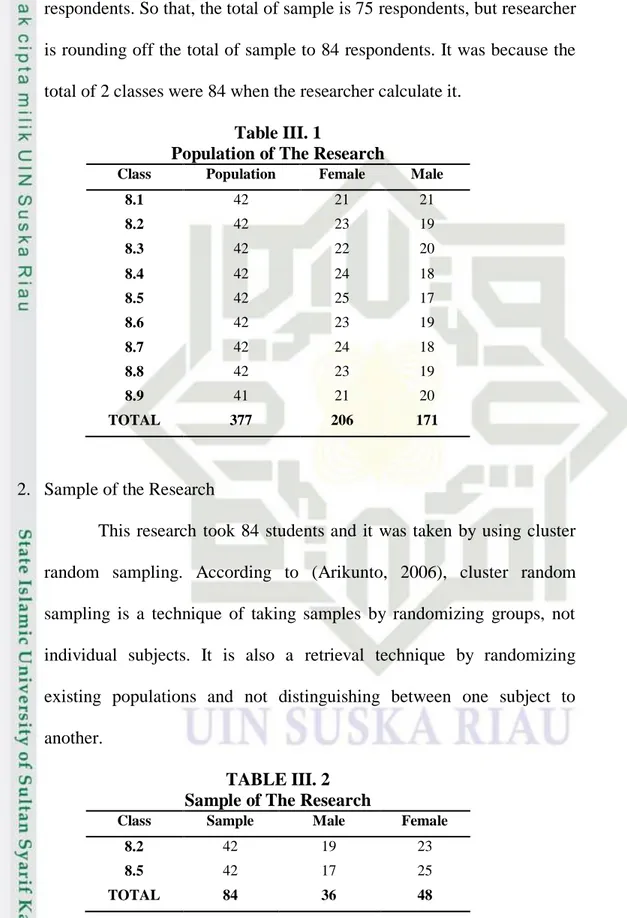
The population of this research included all of the eight grade students of Junior High School 20 Pekanbaru. There were 377 students and separate in nine classes. In this research, the researcher took 20% of population for the sample. It is relevant to Arikunto’s opinion (2002). He says that if the population is less than 100 respondents we can take all of it but if more than 100 respondents can take 10%-15% or 20%-25% or
more than it. In this research, the researcher took 20% of total respondents. So that, the total of sample is 75 respondents, but researcher is rounding off the total of sample to 84 respondents. It was because the total of 2 classes were 84 when the researcher calculate it.
Table III. 1
Population of The Research
Class Population Female Male 8.1 42 21 21 8.2 42 23 19 8.3 42 22 20 8.4 42 24 18 8.5 42 25 17 8.6 42 23 19 8.7 42 24 18 8.8 42 23 19 8.9 41 21 20 TOTAL 377 206 171
2. Sample of the Research
This research took 84 students and it was taken by using cluster random sampling. According to (Arikunto, 2006), cluster random sampling is a technique of taking samples by randomizing groups, not individual subjects. It is also a retrieval technique by randomizing existing populations and not distinguishing between one subject to another.
TABLE III. 2 Sample of The Research
Class Sample Male Female 8.2 42 19 23
8.5 42 17 25
In this research, the researcher took 84 students by randomizing the classes. Actually, in Junior High School 20 Pekanbaru, there were 2 teachers that teach in Eight Grade. In this research, the researcher just could do the research just to one teacher who teach 5 classes. So that, the researcher randomizing only five classes and there were 2 classes that would be choose, that were 8.2 class and 8.5 class.
E. Technique of Collecting the Data
Data collection is important to determine the result of the study. The data was collected through questionnaires and observation in the classroom. Finally, the questionnaires was distributed to the students and then the students fill out the questionnaires based on the instructions contain in the questionnaires. After the students finish filled the questionnaire, the questionnaire was collected and analyzed. For the next, the researcher made observation in the classroom, more precisely observed which students’ learning styles in studying vocabulary.
1. Questionnaire
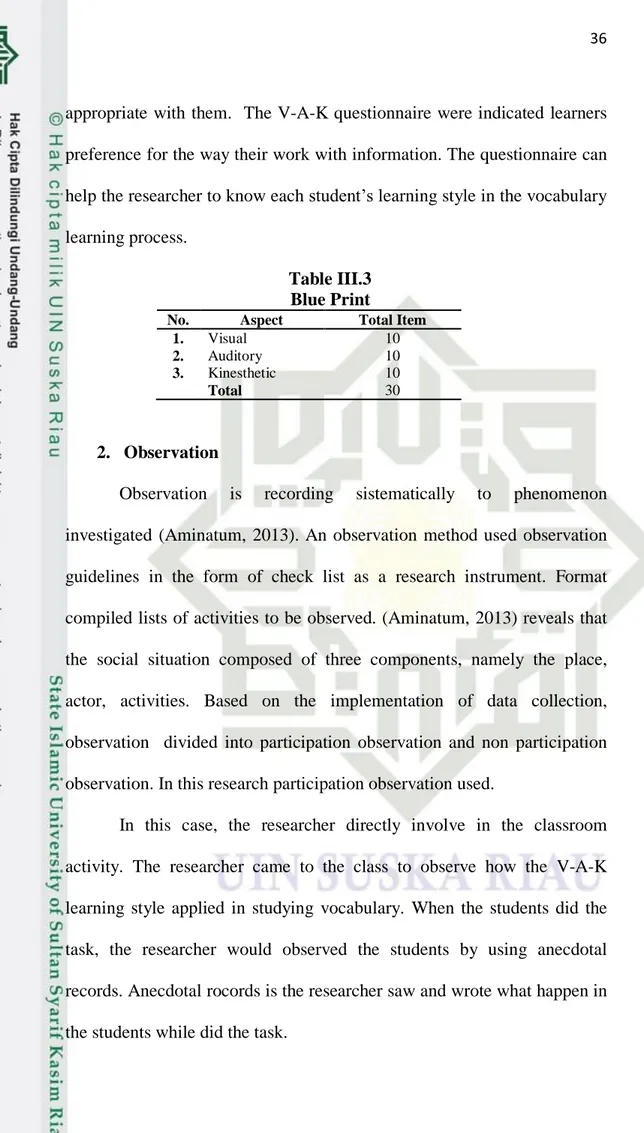
Questionnaire is a technique of data collection by giving a set of questions or a written statement to the respondent to answer. The questionnaires which answered by the students consists of 30 questions. The 30 questions are about perception or opinion of social phenomenon. The students were asked to check-list the statement that they feel
appropriate with them. The V-A-K questionnaire were indicated learners preference for the way their work with information. The questionnaire can help the researcher to know each student’s learning style in the vocabulary learning process.
Table III.3 Blue Print
No. Aspect Total Item
1. Visual 10
2. Auditory 10
3. Kinesthetic 10
Total 30
2. Observation
Observation is recording sistematically to phenomenon investigated (Aminatum, 2013). An observation method used observation guidelines in the form of check list as a research instrument. Format compiled lists of activities to be observed. (Aminatum, 2013) reveals that the social situation composed of three components, namely the place, actor, activities. Based on the implementation of data collection, observation divided into participation observation and non participation observation. In this research participation observation used.
In this case, the researcher directly involve in the classroom activity. The researcher came to the class to observe how the V-A-K learning style applied in studying vocabulary. When the students did the task, the researcher would observed the students by using anecdotal records. Anecdotal rocords is the researcher saw and wrote what happen in the students while did the task.
3. Validity of Instrument
According to Cohen (2005), validity of the test is the test measure according to its purpose. There are five kinds of validity, they are content validity, criterion validiy, construct validity, consequential validity, and face validity. In this research, the reasearcher use construct validity. Construct validity is use to measure learning style of students. The test must be create based on specific concept or conceptual definition that has been set. The test of the research is appropriate to know students’ vocabulary learning style.
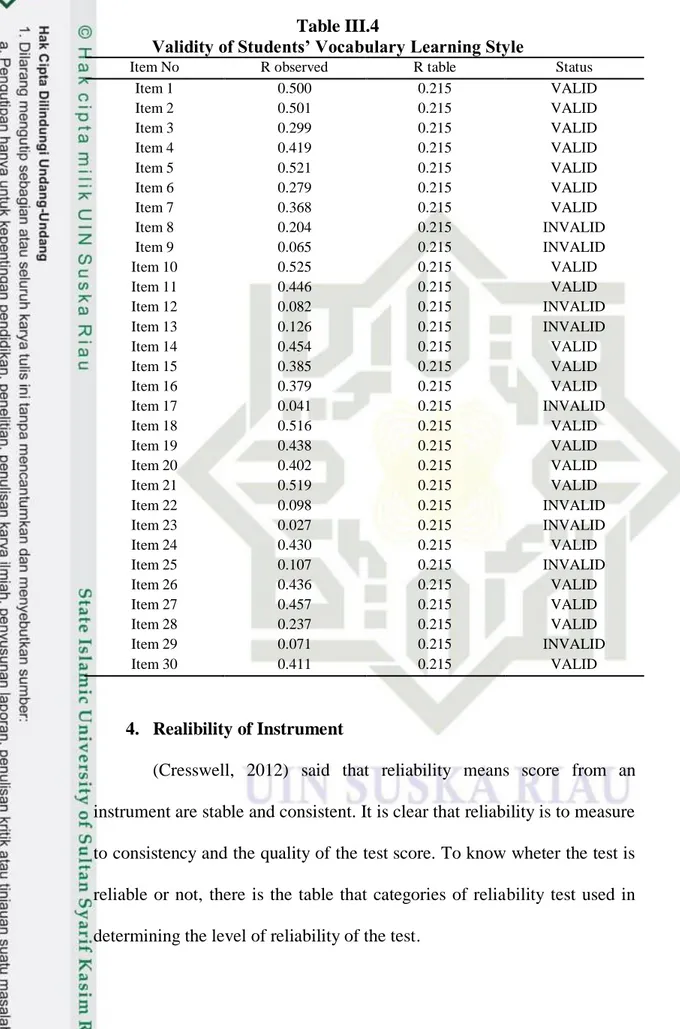
To analyze the validity of students’ vocabulary learning style, the researcher used SPSS 21.0 program version. The standard level pearson product moment is ≥ 0.215. Based on the tryout result of the instrument validity to the 30 items, it showed that 21 items were valid and 9 items invalid. It means that there were 21 items that were used in this research. In the following table is the result of the instrument validity.
Table III.4
Validity of Students’ Vocabulary Learning Style
Item No R observed R table Status
Item 1 0.500 0.215 VALID Item 2 0.501 0.215 VALID Item 3 0.299 0.215 VALID Item 4 0.419 0.215 VALID Item 5 0.521 0.215 VALID Item 6 0.279 0.215 VALID Item 7 0.368 0.215 VALID Item 8 0.204 0.215 INVALID Item 9 0.065 0.215 INVALID Item 10 0.525 0.215 VALID Item 11 0.446 0.215 VALID Item 12 0.082 0.215 INVALID Item 13 0.126 0.215 INVALID Item 14 0.454 0.215 VALID Item 15 0.385 0.215 VALID Item 16 0.379 0.215 VALID Item 17 0.041 0.215 INVALID Item 18 0.516 0.215 VALID Item 19 0.438 0.215 VALID Item 20 0.402 0.215 VALID Item 21 0.519 0.215 VALID Item 22 0.098 0.215 INVALID Item 23 0.027 0.215 INVALID Item 24 0.430 0.215 VALID Item 25 0.107 0.215 INVALID Item 26 0.436 0.215 VALID Item 27 0.457 0.215 VALID Item 28 0.237 0.215 VALID Item 29 0.071 0.215 INVALID Item 30 0.411 0.215 VALID 4. Realibility of Instrument
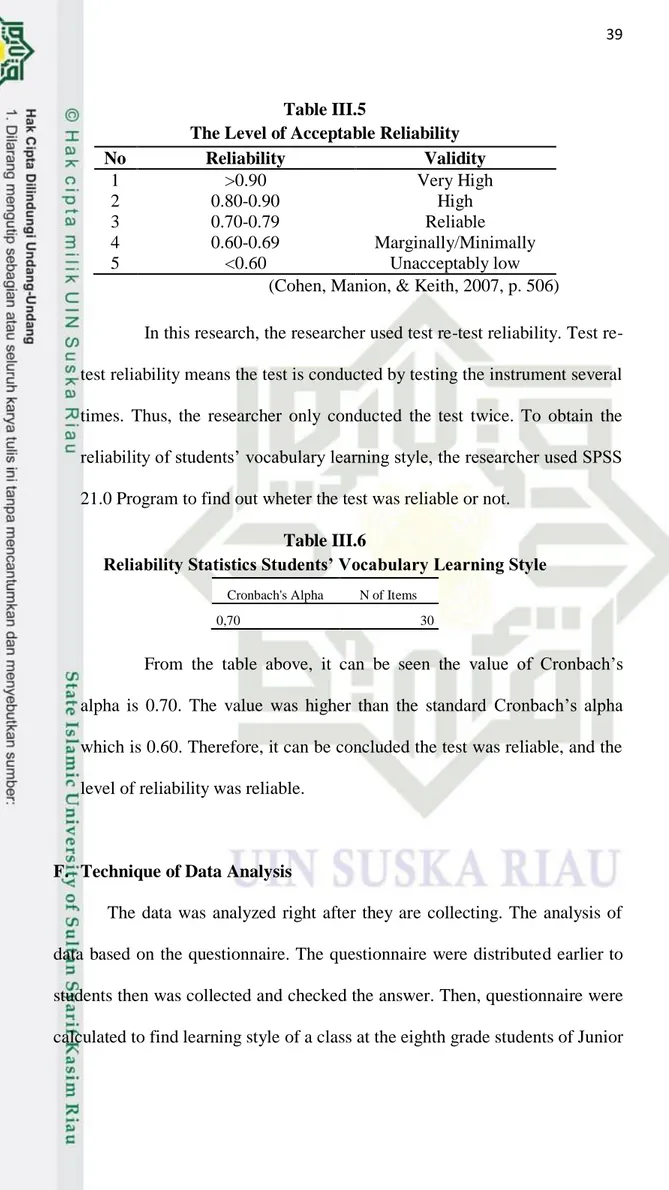
(Cresswell, 2012) said that reliability means score from an instrument are stable and consistent. It is clear that reliability is to measure to consistency and the quality of the test score. To know wheter the test is reliable or not, there is the table that categories of reliability test used in determining the level of reliability of the test.