AN ANALYSIS OF SENSE BASED SENTENCE ON LYRIC OF ADELE’S SONG IN THE 19 AND 21 ALBUMS
PUBLICATION ARTICLE
Submitted as a Partial Fulfillment of the Requirements for Getting Bachelor Degree of Education
in English Education Department
By:
RENANDA RIZKY AMALIA A320 100 134
SCHOOL OF TEACHER TRAINING AND EDUCATION MUHAMMADIYAH UNIVERSITY OF SURAKARTA
AN ANALYSIS OF SENSE BASED SENTENCE ON LYRIC OFADELE’S SONG IN THE 19 AND 21 ALBUMS
Renanda Rizky Amalia A 320100134
Abstract
This research belongs to qualitative research. The research purposes to identify the types of sense based sentence and illocutionary meaning or author’s intention in the lyric of Adele’s albums. This research is using scope of pragmatics to find out the author’s intention.
The objects of the research are lyrics in the Adele’s album entitled 21 and 19 which consist of 21 songs. In collecting data, researcher uses the document. The data in this research are simple declarative sentences containing types of sense based sentence, they are analytic sentence, syntactic sentence, contradiction sentence and the illocutionary meaning or author’s intentions, they are stating, informing, asserting, disclosing, offering, warning, threatening, affirming, promising, alleging, identifying, deploring, questioning, conjecturing, claiming and disputing. From the collected data, the researcher finds 50 data.
The result of the research shows that: (a) There are three kinds of sense based sentences from 50 data found in Adele’s album. They are analytic sentence (2 data/ 4,0%), syntactic sentence (29 data/ 58,0%) and contradiction sentence (19 data/ 38,0%). (b) There are 16 kinds of illocutionary meaning found in Adele’s album. They are stating (5 data/10,0%), informing (21 data/ 42,0%), asserting (2 data/ 4,0%), disclosing (2 data/ 4,0%), offering(2 data/ 4,0%), warning(2 data/ 4,0%), threatening (2 data/ 4,0%), affirming (2 data/ 4,0%), promising (2 data/ 4,0%), alleging (1 datum/ 2,0%), identifying (1 datum/ 2,0%), deploring (4 data/ 8,0%), questioning (1 datum/ 2,0%), conjecturing (1 datum/ 2,0%), claiming (1 datum/ 2,0%) and disputing (1 datum/ 2,0%).
A. Introduction
Sense is term used by a number of philosophers for what others would describe
simply as their meaning or perhaps more narrowly as their cognitive or descriptive
meaning. There are two kinds of sense, namely sense based sentence and sense relations.
Sense based sentence can be defined as sense or kinds of meaning in languages which
contain some agreement in meaning of language in used. There are three kinds sense
based of sentences, namely an analytic, synthetic and contradictory. Hurford and
Heasley (1983:94) state “the nation of analytic, synthetic, and contradictory are defines in terms of truth”.
In case is truth conditional of utterance. An Analytic Sentence as Hurford and Heaslay (1983:93) said that a sentences can be formed from contradiction, and vise versa,
by the insertion or removal, as appropriate of the negative particle word not. Analytic
sentence is not informative to anyone who already knew the meaning, it is not necessary
to prove the truth of the sentence in the real world.
Syntactic Sentence,Hurford (1983:92) states a synthetic sentence is one which is not analytic, but maybe either true or false, depending on the way the word is”. In this case, synthetic sentences can be sometimes true, sometimes false. It is depending on the
circumstances in the real world. So, the people who read the sentence should know the
fact before decide the sentence is true or false.
Contradiction Sentence, is in a way the opposite of an analytic sentence. Analytic sentence can be formed from a contradiction and vise versa, by the insertion or removal,
as appropriate of the negative particle word.
Speech act theory was developed by Austin (1962:78). Austin‟s work is in many respects a reaction to some traditional and influential attitude of language. These risks
simplifying as starting point. The attitudes can be said to involve three related
assumption, as follows: That the basic sentence type in language is declarative, that the
principal use of language is to describe states of affairs, that the meaning of utterances
Austin (in Saeed1997: 211) states that communicating speech act consist of three
elements: the speaker say something, the speaker signal associated speech act, the speech
act causes an effect on her listeners or the participants. The elements are:
Locutionary Act, by which Austin meant the act of saying something that makes
sense in a language, follows the rule of pronunciation and grammar. It closely related to
what Austin describe as „meaning‟. It is the act of uttering a sequence of words together
with their literal meaning including the appropriate sense and reference.
The second action intended by the speaker, Austin (in Chapman 2000:120) termed
Illocutionary Act. At the level of illocutionary act the intention of the speaker become relevant. To know what illocutionary act has been performed the hearer need to know
what is that the speaker intends to achieve or bring about by producing the utterance. The
example can be seen in the song entitled I’ll be waiting“Hold me closer one more time”, what the speaker wants when saying that is asking the hearer to hug tightly for the last
time.
After Austin speech act theory, there have been a number of works which attempt
to systematize the approach, Searle (1975:212) classifying illocutionary speech act:
a. Representatives, which commit the speaker to the truth of the expressed
proposition ( asserting, concluding, stating, claiming, hypothesizing,
describing, insisting, affirming, etc)
b. Directives, which are attempts by the speaker to get the addressee to do
something (requesting, questioning, ordering, commanding, daring, etc)
c. Commissives, which commit the speaker to some future course of action
(promising, threatening, offering, intending, vowing to do or to refrain from
doing something).
d. Expressives, which express a psychological state (thanking, apologizing,
welcoming, congratulating, deploring, condoling).
e. Declaratives, which effect immediate changes in the institutional state of
affairs and which tend to rely on elaborate extralinguistic institution
(excommunicating, declaring war, christening, marrying, firing, baptizing,
PerlocutionaryAct, depends not just on the speaker but on the hearer. It is concerned with the result or consequence of the utterance having been produced. In
Austin term it is about what will bring after saying something.
Lyrics according to Stainer (1876:276) are set of words that make up a song,
usually consisting of verses and choruses. The writer of lyric is a lyricist or lyrist. The meaning of lyric can either be explicit or implicit. Some lyrics are abstract almost
unintelligible, and in such cases their explication emphasizes form, articulation, meter,
and symmetry of expression.
Lyric derives from Greek word lyrikos, meaning singing to the lyre. Harper (2012) said the word lyric came to be used for the „words of song‟, this meaning was recorded in 1876. The common plural perhaps predominates the contemporary usage.
Use of the singular form lyric to refer to a song‟s complete set of word is grammatically
acceptable. However it is not considered acceptable refer to a singular word in a song as
lyric.
B. Research Method
In conducting this research the researcher uses qualitative research. Qualitative
research is research that gives the descriptive data in the form of written and oral words. As a result, it can be concluded that a qualitative research is a type of research which doesn‟t include any calculation. The data focus on words and sentence rather than number. The
objects of the research are simple declarative sentences which belong to sense based sentence
found in Adele Albums 19 and 21. The data of the research are simple declarative sentences.
The data sources are lyrics of Adele in albums19 and 21.
C. Finding and Discussion
1. Finding
This research presents two findings, the first is the types of sense based sentence, and the second is types of illocutionary meaning or author‟s intention.
a. Types of Sense Based Sentence.
The types of sense based sentence found in this research are which are analytic
1) Analytic Sentence
An analytic sentence is one sentence that is necessarily true as a result of
the words in it. It is not necessary to check on the outside world to prove the truth
of this sentence. In the other word, the sentence is obligatory true, it is not
bounded the condition that follows, based on the relationships between words
formed the sentence.
04/01/24/A/stating/21/TT Title: Turning Tables
Next time I'll be braver I'll be my own savior
When the thunder calls for me
The underlined sentence above is an analytic sentence. There is a relation
between the word I and my own. My own is adverbial adjunct of manner, my is determiner and own is pronoun, it is consider noun phrase that refers to I, the author. So the sentence I‟ll be my own savior belongs to analytic sentence, which is true because the word sense in it.
2) Syntactic Sentence
A synthetic sentence is a sentence which is not analytic, but maybe either
true or false, depending on the way the word is. In this case, syntactic sentences
can be sometimes true, sometimes false. It is depending on the circumstances in
the real world. So, the people who read the sentence should know the fact before
decide the sentence is true or false.
02/01/8/S/asserting/21/TT Title: Turning Table
So, I won't let you close enough to hurt me No, I won't rescue you to just desert me
The type syntactic sentence found in lyric above, the word won't rescue mean that there is no efforts to safe people who put someone in desert, desert here
people even though they have put him in misery. So, this is a syntactic sentence
because this sentence either true or false depending on the way the world is.
3) Contradiction Sentence
A contradiction sentence is the opposite of an analytic sentence. Analytic
sentence can be form from a contradiction and vise versa, by the insertion or
removal, as appropriate of the negative particle word. Another definition is that the
statement is necessarily false.
01/01/06/C/informing/21/TT Title: Turning Tables
I can't keep up with your turning tables Under your thumb I can't breathe So, I won't let you close enough to hurt me No, I won't rescue you to just desert me
The sentence under your thumb I can’t breathe is a contradiction sentence. The sentence can reformed in to I can’t breathe under your thumb. Thumb is the biggest part of human fingers and as the main control of the hand, while breathe
is an activity of inhaling oxygen and exhaling carbon dioxide. So, it is impossible
for someone become unable to breathe just because under one‟s thumb. Thus, the sentence is contradiction sentence, it is necessarily false because of the meaning
of the word in it.
b. Illocutionary Meaning or Author‟s Intention
Illocutionary act has been performed the hearer need to know what is that the
speaker intends to achieve or bring about by producing the utterance. In this research
there are six-teen type of illocutionary meaning or author‟s intention found, they are stating, informing, asserting, disclosing, offering, warning), threatening, affirming,
promising, alleging, identifying, deploring, questioning, conjecturing, claiming and
disputing.
23/02/09/C/deploring/19/CS Title: Cold Shoulders
Whenever you look at me I wish I was her
Context: This song is about a relationship with an unfaithful partner. In the song, the
author describes being in a relationship with a guy who addressed by the word you, the author knows that the guy unsatisfied with the relationship hand that is the reason he is
cheating.
Locutionary: You shower e with words made of knives.
Illocutionary: The sentence is using deploring type of speech act. The author deplores
the attitude of his/her partner who always picking up a fight. Even with the rugged
attitude the partner throws at the author and takes author‟s sweetness for granted, but the
author is still in-like with the partner but at times the author wishes he/she was the other
girl who is unaware of these happenings.
Perlocutionary: The partner stops being rude or keep continuing
2. Discussion
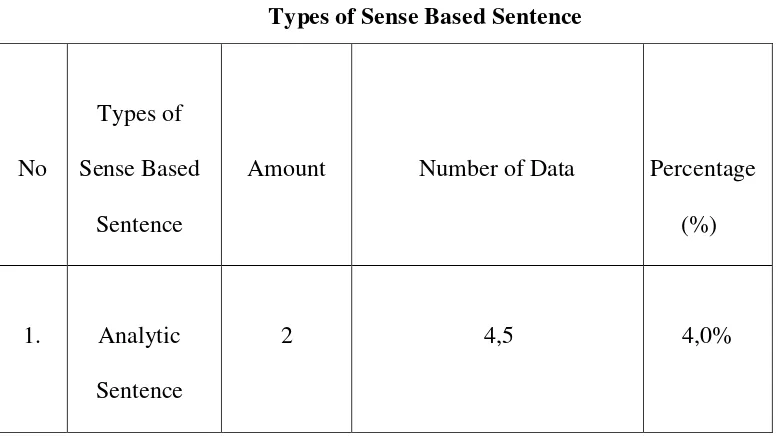
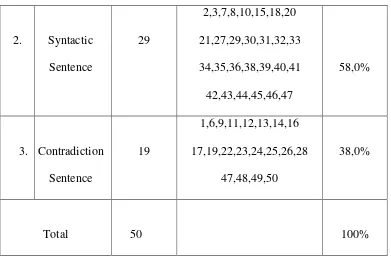
The discussion presents two tables to show the finding, the first is table of the types of
[image:11.612.100.489.499.717.2]sense based sentence and the second is table of the kinds of illocutionary meaning or author‟s intention.
Table 1.1
Types of Sense Based Sentence
No
Types of
Sense Based
Sentence
Amount Number of Data Percentage
(%)
1. Analytic
Sentence
2. Syntactic Sentence 29 2,3,7,8,10,15,18,20 21,27,29,30,31,32,33 34,35,36,38,39,40,41 42,43,44,45,46,47 58,0%
3. Contradiction
Sentence 19 1,6,9,11,12,13,14,16 17,19,22,23,24,25,26,28 47,48,49,50 38,0%
Total 50 100%
Based on the table above the results of the kinds of sense based sentence is that there are
two data belongs to the analytic sentence (4,0%), twenty-nine data belongs to syntactic sentence
[image:12.612.99.490.67.325.2](58,0%) and nine-teen data belongs to contradiction sentence (38,0%). So the total of the data found in Adele‟s Albums 21, and 19 are fifty data (100%).
Table 1.2
Types of illocutionary Meaning or Author’s Intention No
Types of
Illocutionary
Meaning
Amount Number of Data Percentage
(%)
1 Stating 5 4,25,30,31,32 10%
2 Informing 21 1,5,10,11,13,16,17,18
21,26,27,29,34,35,36
37,39,40,41,49,50
42%
4 Disclosing 2 3,28 4%
5 Offering 2 7,8 4%
6 Warning 2 14,15 4%
7 Threatening 2 9,20 4%
8 Affirming 3 33,44 4%
9 Promising 2 38,47 4%
10 Alleging 1 12 2%
11 Identifying 1 45 2%
12 Deploring 4 19,22,23,24 8%
13 Questioning 1 6 2%
14 Conjecturing 1 47 2%
15 Claiming 1 42 2%
16 Disputing 1 34 2%
Total 50 100%
Based on the table above the results of the types of illocutionary meaning or
writer‟s intention is that there are five data belongs to stating (10,0%), twenty-one data
belongs to informing (42,0%), two data belongs to asserting (4,0%), two data belongs to
disclosing (4,0%), two data belongs to offering(4,0%), two data belongs to
warning(4,0%), two data belongs to threatening (4,0%), three data belongs to affirming
(6,0%), two data belongs to promising (4,0%), one datum belongs to alleging (2,0%), one
datum belongs to identifying (2,0%), four data belongs to deploring (8,0%), one datum
belongs to questioning (2,0%), one datum belongs to conjecturing (2,0%), one datum
belongs to claiming (2,0%) and one datum belongs to disputing (2,0%). So the total of the
kinds of speech act found in Adele‟s albums 21 and 19 are six-teen types, and the amount
BIBLIOGRAPHY
Austin, J. L.1962. How to do things with words. Oxford: Oxford University Press.
Blackburn, Simon.1996. Implicature. Oxford London: The Oxford Dictionary of Philosophy. Chapman, Siobhan. 2000. Philosophy for Linguists An Introduction. New Fetter Lane, London:
British Library Cataloguing in Publication Data.
Ferdiana, Syandrian. 2013. The Analysis of Sense Relations Found in English Translation of Sura Yusuf. Skripsi. Kudus: English Education Department Teacher Training and Education Faculty Muria Kudus University.
H. P. Grice .1975. Logic and Conversation. Cambridge, MA: Harvard University Press. Harper, Douglas .2012. "Lyric". Online Etymology Dictionary, diakses 30 November 2013.
James R, Hurford, Brendan Heasley, & Michael B. Smith. 1983. Semantics: A Coursebook. Cambridge, New York: Cambridge University Press.
Jannah, Miftahul. 2012. An Analysis of Sense Based Sentence in Lenka Album. Unpublished Research Paper. Surakarta: Muhammadiyah University of Surakarta.
John Searle. 1975. Syntax and Semantics, 3: Speech Acts. New York: Academic Press.
Kristiani, Relis. 2012. An Analysis of Sense Based Sentence in One Half Love Comic. Unpublished Research Paper. Surakarta: Muhammadiyah University of Surakarta
Levinson,S.C. 1983. Pragmatics.Cambridge,MA: Cambridge University Press
Lyons, John. 1977. Semantic (volume 1). Trinity Hall Cambridge: Cambridge University Press.
Saeed, John I. 2000. Semantic. Trinity College Dublin: Blackwell Publishers.
Stainer, John & al. 1876. A Dictionary of Musical Terms, London.
VIRTUAL REFERENCE
Wikipedia. 2013. “Adele” (online), (http://en.wikipedia.org/wiki/Adele, accessed on 30
November 2013)
Wikipedia. 2013. “Lyrics” (online), (http://en.wikipedia.org/wiki/Lyrics, accessed on 30
November 2013)