P
P
R
R
O
O
C
C
E
E
E
E
D
D
I
I
N
N
G
G
Jakarta, 19th – 21st of October 2010
Organized by :
Agency for the Assessment and Application of Technology (BPPT) National Working Group on Indonesian Medicinal Plant (POKJANAS TOI)
Association of Indonesian Herbal Medical Doctors (PDHMI)
Supported by :
Deutscher Akademischer Austauch Dienst (DAAD)
INTERNATIONAL CONFERENCE AND TALK SHOW
ON MEDICINAL PLANT
First Edition, March 2011
ISBN :
PUBLISHER
Center for Pharmaceutical and Medical Technologies
Agency for the Assessment and Application of Technology
BPPT Building II, 15th Floor
Jl. MH Thamrin No. 8, Jakarta 10340
WELCOME MESSAGE
Praise and gratitude towards Allah who has given His Grace so that the International Conference and Talk Show on Medicinal Plant could be conducted in BPPT Jakarta on the 19th– 21st October 2010.
This International Conference and Talk Show on Medicinal Plant which is also the 39th Meeting of National Working Group on Indonesian Medicinal
Plant is organized by BPPT in colaboration with the National Working Group on Indonesian Medicinal Plants (POKJANAS TOI), Deutscher Akademischer Austauch Dienst (DAAD) and the Association of Indonesian Herbal Medical Doctors (PDHMI). This Conference is an effort to develop the national herbal medicine industry and as a venue for researchers, policy makers, clinicians, industrialists and observers of the herbal medicine to gather and discuss the issues regarding herbal medicine.
The theme of this Conference is “Effective, Safe and Qualified Herbal Medicine for Diabetes Mellitus Treatment”. This theme was chosen because diabetes mellitus is one of diseases that could become a serious threat to public health in the future and currently herbal medicine has not been optimally utilized for the treatment of various diseases, especially diabetes mellitus. This Conference is expected to provide an overview of recent advances in herbal medicine technology, herbal medicine role in the treatment of diabetes, the problems faced by the herbal medicine industry and alternative solutions.
This conference has brought together 88 research papers from researchers of various institutions with a variety of topics, ranging from the cultivation aspects to clinical trials which provide an overview of the research currently conducted by research institution in Indonesia. Through this Conference, it is expected that research institutions with similar interest could collaborate to accelerate research in Indonesian and also as a venue for facilitating collaboration between research institutes, universities and industries.
On this occasion the committee expressed the highest appreciation to the guest speakers, papers contributors, participants and sponsors for their cooperation in organizing the International Conference and Talk Show on Medicinal Plant
Jakarta, 19thof October 2010
Organizing Committee
The Agency for the Assessment and Application of Technology
BADAN PENGKAJIAN DAN PENERAPAN TEKNOLOGI (BPPT)
BPPT Chairman
His Excellency The Minister of Science and Technology, Mr. Suharna Surapranata
The Director of Deutscher Akademischer Austauch Dienst (DAAD), Indonesia
Chairman of The Association of Indonesian Herbal Medical Doctors (PDHMI)
Distinguished Speakers from China, Malaysia and Republic of Korea
Chairmen of Pharmaceutical Industries,
My colleagues and all participants,
Ladies and Gentlemen,
Assalamu Alaykum wa rahmatullahi wa barakatuh.
Good morning, Selamat Pagi, Salam Sejahtera untuk kita semua.
May God Almighty blesses us in conducting this event
Let us start by expressing our gratefulness to God almighty. His bless and mercy has given us opportunity to be here in the great and special event of International Conference and Talkshow on Medicinal Plants which focus on the theme of “Effective, Safe and Qualified Herbal Medicine for Diabetes Mellitus Treatment”.
In this very important moment, allow me to thanks to the committee who has been working verry hard to bring this event into reality. I also would like to express a special thank to the Assosiation of Indonesian Herbal Medical Doctors (PDHMI) who has been actively involved and support to this event. And to Deutscher Akademischer Austauch Dienst (DAAD) or German Agency for Academic Exchanges as a main sponshor, gratitute thanks and most appreciation shall be adressed.
Ladies and Gentlemen,
I would like to draw your attention that BPPT as a research agency under coordination of the Ministry of Research and Technology, highly supports the development of herbal medicines as one of the BPPT program on health and pharmaceutical sector especially in fulfilling the national self- sufficiency on medicines. Beside Health and medicine, BPPT is conducting other focused program, namely food, energy, ICT, transportation, defence, environment, and manufacturing.
I would like to highlight here that herbal medicine development is strategic choice for developing country like Indonesia where mega biodiversity is one of its comparative advantages. Currently, chemical and semi-chemical drug industries has been dominated by global pharmaceutical industries in developed countries. For this reason, competition in this area is not beneficial for Indonesian pharmaceutical industries where its industrial structure in general, is still very weak and need to be further developed. The choice to promote program on herbal medicine development is the fact that this program has strong national capacity building from upstream to downstream processes by using locally available resources and involving various stakeholders.
Ladies and gentlemen,
This is our main mission to relate the most suitable technology to significantly increase the added value of our bioresources in order to support our national herbal medicine industries. Knowledge and technology would be a foundamental tools in the development of herbal medicine industries which enable to support national economic growth (known as knowledge based economy).
in the utilization of knowledge and local resources in natural product development.
Ladies and gentlemen,
Since the enthusiasm of back to nature have been gaining popularity and acceptance in recent decade, national herbal medicine industries should become one of the pillars of national economic development. This is also supported by the fact that Indonesia has a second largest biodiversity in the word, with more than 30,000 species of plants. The number of herbal medicine industries keep increasing, numbering to 1,500 companies, big and small corporation. According to Herbal Medicine Entrepreneur Association (GP Jamu) data in 2007, not less than 3 million people works on herbal medicine sector from upstream to downstream industries. The market share of herbal medicine has growing significantly, up to 15-20% yearly.
We all hope that herbal medicine will not only fulfil local and national market, but more than that will expand to other countries, as export commodity.
Ladies and gentlemen,
As I have just mentioned before, BPPT, through the Centre of Pharmaceutical and Medical Technology - fully supports the herbal medicine development. I hope throughout this great forum, all stakeholders involved in the utilization of medicinal plants will stumble on the best and most suitable ways to develop our biological resources as health products. We would like to utilize our biodiversity as source of natural products to prevent and cure diseases, especially degenerative diseases such as diabetes mellitus, and also to promote our well being. To PDHMI, the Assosiation of Indonesian Herbal Medical Doctors we would certainly relay on your share in using herbal medicine as part of formal health services.
At last, we should work closely with all experts and institutions who concern in this area not only from our national side but also from abroad. Therefore, BPPT is continually welcome to all collaborators from national as well as international institutions based on our mutual benefit for each parties involved.
Ladies and gentlemen,
Finally, by saying “Bismillahirrohmanirrohim”, in the name of GOD Almighty, the Most Gracious and the Most Merciful, I have the great pleasure to declare the International Conference and Talkshow on Medicinal Plants
is officially opened.
Thank you very much for your passion and kind attention,
Wassalamu’alaykum warahmatullahi wabarakatuhu
BPPT Chairman,
CONTENT
Welcome Message i
Opening Speech by BPPT Chairman iii
Content vii
RECENT ADVANCES OF NATURAL PRODUCT RESEARCH
Wahono Sumaryono
1
DIURETIC EFFECT OF AQUEOUS EXTRACT OF LEAF OF Averrhoa bilimbi L. IN WISTAR RATS
Afifah B. Sutjiatmo, Elin Yulinah, Suswini K., Suci Narvikasari, Ita Nur Anisa
22
HYPOGLYCAEMIC ACTIVITY OF AQUEOUS EXTRACT OF LEAVES OF Strobilanthes crispa L. IN MALE WISTARRATS USING GLUCOSE TOLERANCE TEST METHOD
Afifah B. Sutjiatmo, Sri Wahyuningsih, Suci Nar Vikasari, Sri Wijayanti
27
COMPARATIVE STUDY OF PRIMOJEL® 2%, 5%, & 8% TO
PHYSICAL CHARACTERISTICS OF TABLET FROM DRIED EXTRACT Murraya paniculata (L.) Jack LEAVES
Agnes Nuniek Winantari, I. I. Panigoro, Ferrany
32
IN VITRO BIOASSAY OF N-BUTHANOL ISOLATE OF Acorus calamus L. ON INHIBITORY OF ACTIVITY α-GLUCOSIDASE
Ahmad Najib, Sri Hartati, Berna Elya
38
ISOLATION OF MAJOR COMPOUND HEXANE FRACTION FROM Piper betle L. LEAVE AND CHROMATOGRAM PROFILE
Ahwan, Haryoto, Haikal Sofyan Arif
44
CLINICAL STUDY OF ETHANOL EXTRACT OFJusticia gendarussaBurm. f. LEAVES IN MALE FERTILITY
Bambang Prajogo E.W., Hudi Winarso, Kasmijati, Aucky Hinting; Dyan Pramesti, Maria Anggraeni, Achmad Radjaram, Dwi Setiawan, Sri Musta’ina, Noor Cholies Zaini
49
THE MECHANISM OF ACTION INVESTIGATION OF
ROCAGLAMIDES AS ANTIPROLIVERATIVE AGENTS IN CHRONIC MYELOID LEUKEMIA USING PATHWAY-BASED PREDICTION BY COMPUTATIONAL DOCKING
B.S. Ari Sudarmanto, Fajar S. Wibowo, Chaidir
EFFECT OF Curcuma xanthorrizaEXTRACT ON LYMPHOCYTE CELL PROLIFERATION
Churiyah, Tarwadi, Fery Azis Wijaya, Elrade Rofaani
70
CYTOTOXIC ACTIVITY OF MARINE SPONGE Petrosia sp. FROM WEST SUMATERA, INDONESIA
Dian Handayani, Mega Yulia, Yohannes Allen
77
INHIBITION EFFECT OF SIDAGURI (Sida rhombifolia) AND CELERY (Apium graveolens) EXTRACT FORMULA ON THE ACTIVITY OF XANTHINE OXIDASE AND ITS
ANTI-INFLAMMATION EFFECT
Dyah Iswantini, Iskandar, Lukmanul Hakim.
81
METHANOL EXTRACT DERIVED FROM NIAS’S AND MENTAWAI’S SPONGES AND SOFT CORALS AS ANTI ANGIOGENESIS
Dyah Iswantini, Min Rahminiwati, Latifah K Darusman, Rudi Heryanto
91
SIMULTANEOUS ANALYSIS OF PARACETAMOL,
PROPYPHENAZONE AND CAFFEINE MIXTURE IN TABLETS
Effendy De Lux Putra, Muchlisyam, Mustika Furi, Nerdy
100
ANTIBACTERIAL POTENTIAL OF MARINE ALGAE COLLECTED FROM SOUTH SULAWESI COAST AGAINST HUMAN PATHOGENS
Elmi Nurhaidah Zainuddin
115
PROGRESS RESEARCH OF TEMOELAWAK (Curcuma xanthorrhiza Roxb.) TO PROVIDE HEALTHY PLANTING MATERIAL BY IN VITRO CULTURE
Endang Hadipoentyanti, Sitti Fatimah Syahid
128
EVALUATION OF GROWTH, PRODUCTIVITY AND OIL QUALITY FOUR PROMISING NUMBERS OF MENTHA (Mentha arvensis L.)
Endang Hadipoentyanti, Sri Suhesti, Amalia, Nursalam
144
EFFECT OF GROWTH ENVIRONMENT AND CULTIVATION METHODS SMAL WHITE GINGER (Zingiber officinale, L.
var.amarum) ON SEED PRODUCTION, FARMER INCOME AND FEASIBILITY OF FARMING SYSTEM
Ermiati, Sukarman
152
ECONOMIC ANALYSIS OF FARMING SYSTEM WHITE BIG GINGER (Zingiber Officinale L. Var. Officinale) SEED
PRODUCTION
Ermiati, Sukarman
TABLET FORMULATION OF Andrographis paniculata Ness DRY EXTRACT BY DIRECT COMPRESSION METHOD
Etik Mardliyati, Hafizah, Farida Sulistiawati
170
ANTIMICROBIAL OF SOME PARASITE PLANT IN THE FAMILY LORANTHACEAE
Fairus Zabadi, Haryoto, Peni Indrayudha
177
STRUCTURE MODIFICATION OF THYMOQUINONE AND CYTOTOXICITY OF THE PRODUCTS AGAINST
HEPATOCELLULAR CARCINOMA (HepG2) CELLS
Firdayani, Siswandono, Marcellino Rudyanto
181
STUDY ON THE DPPH AND -GLUCOSIDASE INHIBITORY
POTENTIAL OF VARIOUS GAMBIER AVAILABLE IN INDONESIAN MARKET
Galuh Widiyarti, Andini Sundowo
189
ANTIOXIDANT ACTIVITY OF TOTAL PHENOLIC COMPOUND IN HEXANE FRACTION FROM Piper betle L. LEAF WITH DPPH METHODE
Haryoto, Ahwan, Andika Punama Devi
199
ACUTE TOXICITY TEST OF Typhonium divaricatum (KELADI TIKUS) ETHANOL EXTRACT IN MICE
Indah.D.Dewijanti, Marissa Angelina, Sofna D. Banjarnahor, Rina Andriyani, M. Hanafi
206
ANTIPLASMODIAL EVALUATION OF ONE COMPOUND FROM Calophyllum. depressinervosum
Jamilah Abbas, Nina Artanti, Puspa Dewi, Puji Budi Setia Asih, Syafruddin
212
CYTOTOXIC COMPOUND FROM Calophllym spp (GUTTIFERAE) Jamilah Abbas
222
FUCOXANTHIN IDENTIFICATION IN Sargassum cinereum, Sargassum filipendula, AND Sargassum echinocarpum BROWN ALGAE IN KECAMATAN TALANGO, SUMENEP, MADURA AT GPS (113.94444°BT – 7.08795°LS, 113.94231°BT – 7.08913°LS,
113.94548°BT – 7.08911°LS AND 113.94347°BT – 7.08999)
Kartini Zailanie, Sri Dayuti
232
CORRELATION BETWEEN CYTOTOXIC ACTIVITY ON MCF-7 CELL AND TOTAL STEROID LEVEL ON Trigonella foenum-graecum.L
Kurnia Agustini, Wahono Sumaryono, Azri Fitria
ROLE OF NATURAL POLYSACCHARIDES XANTHAN GUM-LOCUST BEAN GUM IN PER-ORAL DRUG DELIVERY SYSTEMS
Lannie Hadisoewignyo, Achmad Fudholi
246
CYTOTOXIC EFFECT OF ETHANOL AND WATER EXTRACT OF Centella asiatica ON HUMAN BREAST CANCER T47D CELLS
Lucia Hendriati, Ferawati, Adrianta Surjadhana, Arijanto Jonosewojo, Elisabeth Catherina Widjajakusuma
253
ACUTE TOXICITY STUDIES OF Brucea javanica Merril LEAVES EXTRACT ON MICE
Marissa A., Indah D. Dewijanti, Banjarnahor S.D.S, Megawati, M. Hanafi
258
PHYTOCHEMISTRY, TOXICITY AND ANTIOXIDANT ACTIVITIES OF Kalanchoe pinnata (Lam.) Pers. LEAVES EXTRACTS
Megawati, A. Darmawan ,Sofa Fajriah, Lia Meilawati
272
IN VITRO ACTIVITY OF CERTAIN PLANT EXTRACTS IN COMBINATION WITH VANCOMYCIN AGAINST METHYCILIN RESISTANT Staphylococcus aureus
Murti, Y.B., Utami, D., Triutami, S., Cahayani, D.D., Mirayany, B.F., Ratnasari, D.
265
POTENSI EKSTRAK ETANOL TUMBUHAN BABANDOTAN (Ageratum conyzoides L) SEBAGAI BAHAN ANTIKANKER.
Pertamawati, Nuralih
277
INDUKSI PEMBENTUKAN BATU GINJAL PADA TIKUS PUTIH JANTAN GALUR Sprague DawleySECARA KIMIAWI UNTUK UJI EFIKASI HERBAL PELURUH BATU GINJAL (KALSIUM OKSALAT)
Pertamawati, Sriningsih, Kurnia Agustini,
281
MELEAGRINE, A ISOLATE COMPOUND FROM SKY III.2.1 AN ENDOPHYTIC FUNGI FROM Annona squamosa.
Prasetyawan Yunianto, Yudi Rusman, Agus Supriyono, Wahyudi Priyono Suwarso3)
296
CYTOTOXICITY COMPARATION OF ETHYL ACETATE EXTRACT AND THEIR ISOLATE FROM SKY III.2.1, AN ENDOPHYTIC FUNGI FROM SRIKAYA PLANTS (Annona squamosa)
Prasetyawan Yunianto, Fery Azis Wijaya, Nurhadi, Syofi Rosmalawati, Wahyudi Priyono Suwarso, Wahono Sumaryono
ISOLATION AND IDENTIFICATION OF A CHEMICAL COMPOUND IN n- HEXANE PHASE FROM THE METHANOL EXTRACT OF BINAHONG LEAF (Anredera cordifolia(Ten.) Steenis),
BASELLACEAE
Ratna Djamil, Wahyudi PS, Wahono S, Wiwi Winarti, Evi Nurlativah
310
ANTIDIABETIC PROPERTIES OF Andrographis paniculata Nees AND Eugenia polyantha Wight LEAVES IN WISTAR RATS BY ORAL GLUCOSE TOLERANCE TEST
Ratna Megawati Widharna, Ferawati, Lucia Hendriati1,
Adrianta Surjadhana, Arijanto Jonosewojo, Elisabeth Catherina Widjajakusuma
318
THE EFFECT OF SEED TREATMENT ON GINGER PLANT PARASITIC NEMATODE AND SCALE INSECT POPULATION DEVELOPMENT IN THE FIELD
S. Retno Djiwanti, Rodiah Balfas
325
THE STUDY OF BAP AND IBA CONCENTRATION ON THE
CALLUS FORMATION AND GROWTH OF Artemisia annua L. BY IN VITRO
Samanhudi
332
EFFECT OF BENZYL ADENIN AND THIDIAZURON ON SHOOT MULTIPLICATION OF ST. JOHN’S WORT (Hypericum perforatum) IN VITRO
Sitti Fatimah Syahid
341
DEVELOPMENT OF ACTIVE COMPOUNDS FROM ETHYL ACETATE EXTRACT OF RHIZOME Acorus calamus L AS ANTIDIABETIC
Sri Hartati, Rizna T. Dewi, A. Darmawan, Megawati
346
THE INFLUENCE OF LONG TERM BLOOD GLUCOSE-LOWERING JAMU ADMINISTRATION ON RAT KIDNEY
Sri Ningsih, Rilianawati, Agung Eru Wibowo
355
ANTIDIABETIC ACTIVITY OF MAHKOTA DEWA [Phaleria
macrocarpa (Scheff.) Boerl.] STEM EXTRACTS AS AN INHIBITOR OF ALPHA-GLUCOSIDASE
Sri Sugiwati, Siswati Setiasih
365
ANTIDIABETIC AND ANTIOXIDANT ACTIVITIES FROM SEED EXTRACTS OF ROSELLA (Hibiscus SabdariffaL.)
Sri Sugiwati, Hani Mulyani, Megawati, Minarti
UJI ANTIMIKROBA EKSTRAK ETANOL DAUN BINAHONG
(Anredera Cardifolia (Ten.) Steenis) DAN DALAM SEDIAAN SALEP DENGAN BASIS HIDROKARBON DIBANDINGKAN DENGAN BASIS ABSORPSI
Sudana Atmawidjaja, Ratna Djamil, Muhammad Yunus
381
A PHYTOCHEMICAL AND PHARMACOLOGICAL STUDY OF Averrhoa bilimbi L. LEAVES
Suswini Kusmaningati, Afifah B. Sutjiatmo, Maria Immaculata Iwo
404
INSECTS ASSOCIATED WITH HORSEWOOD PLANTS (Anis clausena)
Tri L. Mardiningsih, Dewi Sartiami
408
PLANT DAMAGING ORGANISMS OF JAVA TURMERIC (Curcuma xanthorrhiza)
Tri L. Mardiningsih, Miftahurrohmah, Ripah Karyatiningsih, D. Anser Sianturi, Desmawati, Shinta Ramadhani, Lilik Sri Utami
417
GROWTH AND YIELD OF Artemisia annua L. ON NITROGEN FERTILIZER AND CYTOKININ
Usman Siswanto, Ruri Kustia, Entang Inoriah, Yuli Widiyastuti
426
ISOLATION AND IDENTIFICATION OF A CHEMICAL
COMPOUNDS IN n-HEXANE PHASE FROM THE METHANOL EXTRACT OF KELADI TIKUS LEAF (Typhonium flagelliforme (Lodd.) Blume, Araceae.
Yunahara Farida, Resti Caroline. A, Wahyudi Priyono S., Wahono Sumaryono
433
DETERMINATION OF EUGENOL IN VOLATILE OIL FROM CLOVE LEAF AND FLOWER (Eugenia aromatica OK) BY
TLC-DENSITOMETRY
Zuhelmi Aziz, Ratna Djamil, Desi Rahmi Suciati
440
POTENCY OF SONGGA TREE (Strychnos lucida R Brown) AS
TRADITIONAL MEDICINAL PLANT : A CASE STUDY IN SUMBAWA ISLAND- INDONESIA
Zuraida
ANTIDIABETIC PROPERTIES OF
Andrographis
paniculata
Nees AND
Eugenia polyantha
Wight LEAVES IN
WISTAR RATS BY ORAL GLUCOSE TOLERANCE TEST
Ratna Megawati Widharna1, Ferawati1, Lucia Hendriati1,
Adrianta Surjadhana1, Arijanto Jonosewojo2,
Elisabeth Catherina Widjajakusuma1*
1Faculty of Pharmacy, Widya Mandala Catholic University Surabaya,
Jl. Dinoyo 42-44, Surabaya 60265
2 RSUD Soetomo, Surabaya
*) Corresponding author: [email protected]
ABSTRACT
Ethanol and water extract of Andrographis paniculata Nees, and ethanol extract of Eugenia polyantha Wight leaves were evaluated for their hypoglycemic effects in healthy albino Wistar rats by oral glucose tolerance test. Both ethanol extract of Euginia polyantha (200 mg/kg bw) and water extract of Andrographis paniculata (200 mg/kg bw) showed significant increase of blood glucose level at T30 and T60 (T30 = 30 minutes after glucose
loading or 60 minutes after drugs administration, T60 = 60 minutes after
glucose loading or 90 minutes after drugs administration). Meanwhile, ethanol extract of Andrographis paniculata (200 mg/kg bw) showed significant increased in blood glucose level up to T90. Therefore, water extract
of Andrographis paniculata (200 mg/kg bb) was considered faster to lower blood glucose level than the ethanol extract at the same dose of administration. Furthermore, water extract of Andrographis paniculata and Euginia polyantha leaves could be selected for further research as they reduce the blood glucose level steadily and does not cause hypoglycemia such as in glibenclamide.
Keyword : Andrographis paniculata Nees extract, Eugenia polyantha Wight leaves extract, oral glucose tolerance test
INTRODUCTION
Andrographolide without glucosidase inhibitory activity may also exert antidiabetic effect. They concluded that α-glucosidase inhibitory activity was the reason or at least one of the reasons that the constituents of A. paniculata had antidiabetic effects. The promotion of the glucose metabolism was found when treating diabetic rat with the plant extract or andrographolide. So, it can be deduced that extracts of A. paniculata and andrographolide lower plasma glucose by inhibiting the disaccharide metabolism and/or promoting the glucose metabolism (Dai, 2006).
Eugenia polyantha Wight leaves (known as daun salam in Indonesia) is also known as bay leaves. It is used in Indonesian culinary food additive, and as medicine in ulcer, diabetes, inflammation and diarrhea (Lelono, 2009). The antioxidant properties of the water extract Eugenia polyantha Wight infuse is bactericide against V. cholera and E. coli enteropathogen (Hendradjatin, 2009). E. polyantha Wight infusa is also can be used to reduce the uric acid in potassium oxonate-induced male white mice (Ariyanti, 2007). The dose of 1.25 g/kg bw; 2.5 g/kg bw and 5.0 g/kg bw were able to reduce the uric acid level by 79.98% (P= 0.000), 112,27% (P = 0.004) and 112.75% (P= 0.006) in the male white mice induced with 300mg/kg bw potassium oxonate. Moreover, extract of bay leaf (Eugenia polyantha) was proven to lower blood glucose levels of hyperglycemic white rats (Rattus norvegicus). Bay leaf extract (Eugenia polyantha) at doses of 252 mg / kg bw and 314.87 mg/kg bw, giving a decrease of blood glucose levels, which are similar when compared with glibenclamid as standard (Nugroho, 2010).
Although there are many studies on the hypoglycemic effect of Andrographis paniculata and Eugenia polyantha, they were not carried out together at the same time and interestingly, the Thin Layer Chromatography profiles of the ethanol and water extract of Andrographis paniculata were different. Therefore, the present study was conducted to differentiate the effect of the ethanol and water extract of Andrographis paniculata, the hypoglycemic effect of Eugenia polyantha extract.
MATERIALS AND METHOD
Materials
Ethanol and water extracts of Andrographis paniculata Nees and Eugenia polyantha Wight leaves extracts were obtained from PT. Natura Laboratoria Prima; metformin and glibenclamide from PT. Bernofarm; Accu Check Advantage glucosemeter and Accu Check Advantage sticks from Roche. Gavage, syringe, water, and glucose were used for the experiment.
Wistar rats were obtained from UD Wistar, Jogjakarta and were certified by drh. Slamet Raharjo, MP from Gadjah Mada university. The animals were maintained on rat pellet feed and treated water given ad-libitum in a normal uncontrolled condition (Exposed to natural day and night order). The rats were kept for one week for acclimatization before the experimental sessions. The experiment was conducted after the Animal Ethical clearance no 084-KE was obtained.
Method
Thin Layer Chromatography
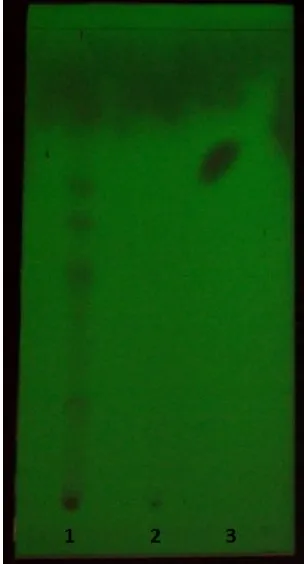
The TLC profile was made from Andrographis paniculata ethanol and water extract, where andrographolide was employed as standard. The stationary phase was silica gel GF254, and the eluents used in this experiment were chloroform-methanol (8:2).
Oral glucose tolerance test
Wistar rats, weighing 100-150 grams, were fasted for 10 hours prior the experiment, but water was provided ad libitum. The blood glucose concentrations of the fasted rats were taken from the tail veins and the blood glucose levels were measured by Accu Check Advantage glucosemeter and then rats which have blood glucose between 65-100 mg/dl were divided into 6 groups. The first two groups were the positive controls, and were given glibenclamid 0.45 mg/kg bw or metformin 63 mg/kg bw per oral. The third group was the negative control, which was given water, while the rest of the group were given 200 mg/kg bw of Andrographis paniculata Nees (water or ethanol extract) and Eugenia polyantha Wight leaves extracts from PT. Natura Laboratoria Prima. After 30 minutes, the rats were given 2 g/kg bw of glucose. Then every 30 minutes up to 150 minutes after glucose administration, the blood glucose was taken.
RESULT AND DISCUSSION
paniculata ethanol extract, the second profile was taken from Andrographis paniculata water extract and the third one was the andrographolide standard compound. It could be seen andrographolide was not detectable in the water extract.
Figure 1. The TLC profile : (1) Andrographis paniculata ethanol extract, (2) Andrographis paniculata water extract, (3) andrographolide as a reference compound
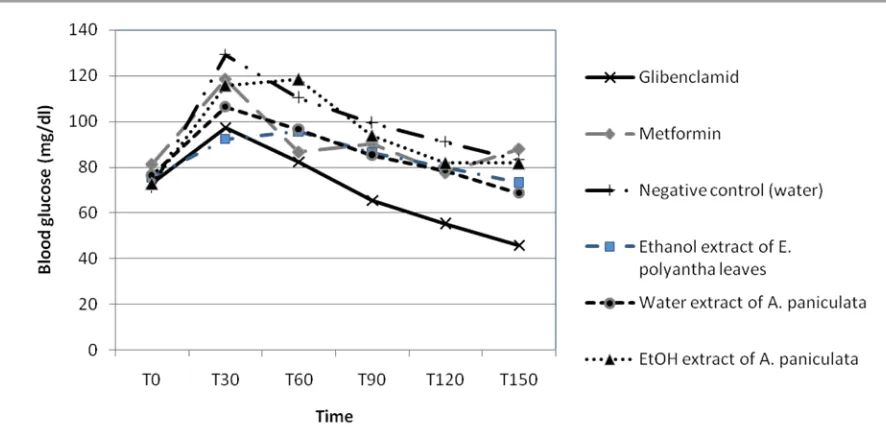
Moreover, the oral glucose tolerance test result can be seen in Table 1, Figure 1 and Figure 2.
Table 1. Blood glucose in treated Wistar rats (n=3, Average SEM)
Groups T0 T30 T60 T90 T120 T150
Glibenclamid 0.45mg/kg bw 73.00 4.04
Metformin 63 mg/kg bw 81.33 2.03
Negative control (Water) 71.00 3.06
Euginia polyantha leaves 200 mg/kg bw
Figure 2. Blood glucose levels at T0-T150 (mg/dl)
All the blood glucose at T30 (30 minutes after glucose loading or 60 minutes
after the control or drugs administration) illustrated in Figure 3 differed significantly (increasing blood glucose level) towards T0 (fasting blood
glucose), which showed that the method was valid. Glibenclamide 0.45 mg/kg bb started to lower the blood glucose at T60 although significant
difference was obtained at T120 and T150. On the other hand, the other
positive control, metformin 63 mg/kgbb showed blood glucose reduction at T120, although it rose again at T150. The raise at T150 was considered as
normal as the second raise of blood glucose after glucose loading happens normally in glucose metabolism.
Water or negative control gave the highest raise in blood glucose level at T30,
which is as expected. The blood glucose level differed significantly throughout the experiment, except at T150, when the blood glucose level
returned to normal.
Both Euginia polyantha leaves of 200 mg/kg bw and water extract of Andrographis paniculata (200 mg/kg bw) showed significant increase of blood glucose level at T30 and T60 (T30 = 30 minutes after glucose loading or
60 minutes after drugs administration, T60 = 60 minutes after glucose
loading or 90 minutes after drugs administration). Meanwhile, ethanol extract of Andrographis paniculata obtained from PT. Laboratoria Natura Prima (200 mg/kg bw) showed significant increased in blood glucose level up to T90. Therefore, water extract of Andrographis paniculata (200 mg/kg bb)
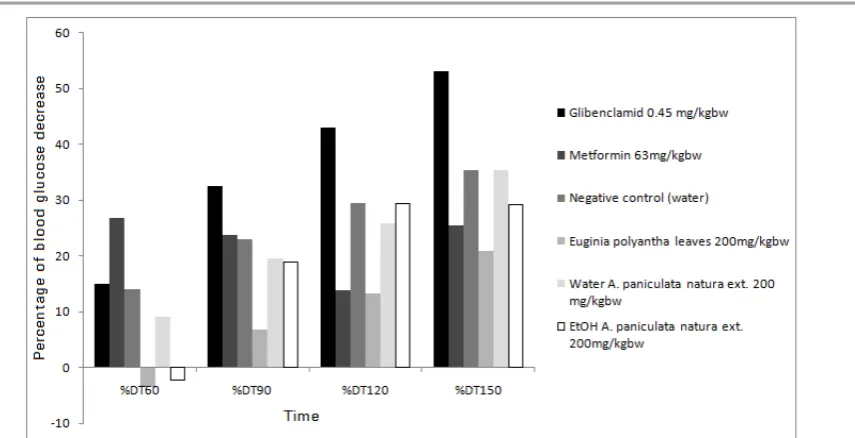
Figure 3 Percentage of blood glucose level reduction towards blood glucose level at T30
Although A. paniculata has antidiabetic properties, we should not neglect the toxicity. The toxic effects of its aqueous crude extracts were studied in 20 male white rats over a period of 28 days by Adedapo, and co-workers (2007). The rats were administered with 400mg/kg, 800mg/kg and 1,600mg/kg, doses of the extract respectively. They observed hepatic degeneration and necrosis with mononuclear cellular infiltration. The kidney showed glomerular degeneration with protein casts in the tubules. However, there were no pathological changes were observed in the testes. As a result of the histopathological changes in the kidney and the liver caution should be exercised in its use for medicinal purpose (Adedapo, 2007).
CONCLUSION
Water extract of Andrographis paniculata (200 mg/kg bb) had a promising antidiabetic properties compared to ethanol extract at the same dose of administration. Both Andrographis paniculata water extract and Euginia polyantha leaves extract did not demonstrated hypoglycemia effect such as in glibenclamide. This fact suggests a beneficial effect of the both extract in lowering glucose level.
ACKNOWLEDGEMENT
REFERENCES
Adedapo, A , Obadan, A. Y. and Ohore, O. G., 2007, Studies on the effects of the aqueous extract of the leaves of Andrographis paniculata in rats. International Symposium of Biology, Chemistry, Pharmacology and Clinical Studies of Asian Plants, Surabaya, Indonesia.
Amalia, AA, 2009, Efek anti bakteri infusa daun salam (Eugenia polyanthaWight) secara in vitro terhadap V. cholera and E. coli. Laporan penelitian Bagian Mikrobiologi Fakultas Kedokteran Universitas Padjadjaran.
Ariyanti, R, Wahyuningtyas, N, dan Wahyuni, AS, 2007, Salam (Eugenia polyantha Wight) leaf infusa effect in reducing male mice uric acid level induced by potassium oxonate.
Pharmacon, 8, 56–63.
Dai, GF., Xu, HW., Wang, JF., Liu, FW and Liu, HM, 2006, Studies on the novel α -glucosidase inhibitory activity and structure–activity relationships for andrographolide analogues. Bioorganic & Medicinal Chemistry Letters, 16, 2710–2713.
Hendradjatin, AA, 2009. Efek anti bakteri infusa daun salam (Eugenia polyantha Wight) secara in vitro terhadap V. choleare dan E. coli enteropatogen, Majalah Kedokteran Bandung, 36.
Nugroho, Y.S., Pengaruh pemberian ekstrak daun salam (Eugenia polyantha) terhadap kadar gula darah tikus putih (Rattus Norvegicus) penderita hiperglikemia, Skripsi, 2010, Univeristas Airlangga.